

Green Architecture Principles in 2025
What actually matters on real projects, why it matters, and how to make it stick when drawings hit the jobsite.
Forget marketing slogans. This is about the rules you can actually build with. How to cut carbon, water, and waste while keeping buildings livable and durable.
Green Architecture Principles Explained with Real Examples
Walk any jobsite and you see the gap. The render shows a glowing “sustainable” tower, but the dumpsters out back are full of off-cuts, plastic wrap, and busted drywall. The client asked for green. The contractor priced for fast. Somewhere between concept and concrete, the principles got watered down.
That is why we need to talk about green architecture in 2025. Not as buzzwords, not as certificates to frame, but as rules you can actually use. Rules that hold up when the HVAC sub says the spec is too tight, or when the client wants a bigger lobby “because it looks better on the brochure.”
This is not about chasing every point system. It is about five blunt truths that make or break sustainable buildings: sizing the program, using climate logic, locking the envelope, choosing the right assemblies, and planning for the day the building needs repair or teardown.
Stick to those, and the rest such as ratings, awards, and glossy photos will follow. Ignore them, and no amount of green branding will hide the waste.
Green Architecture Starts Before Form
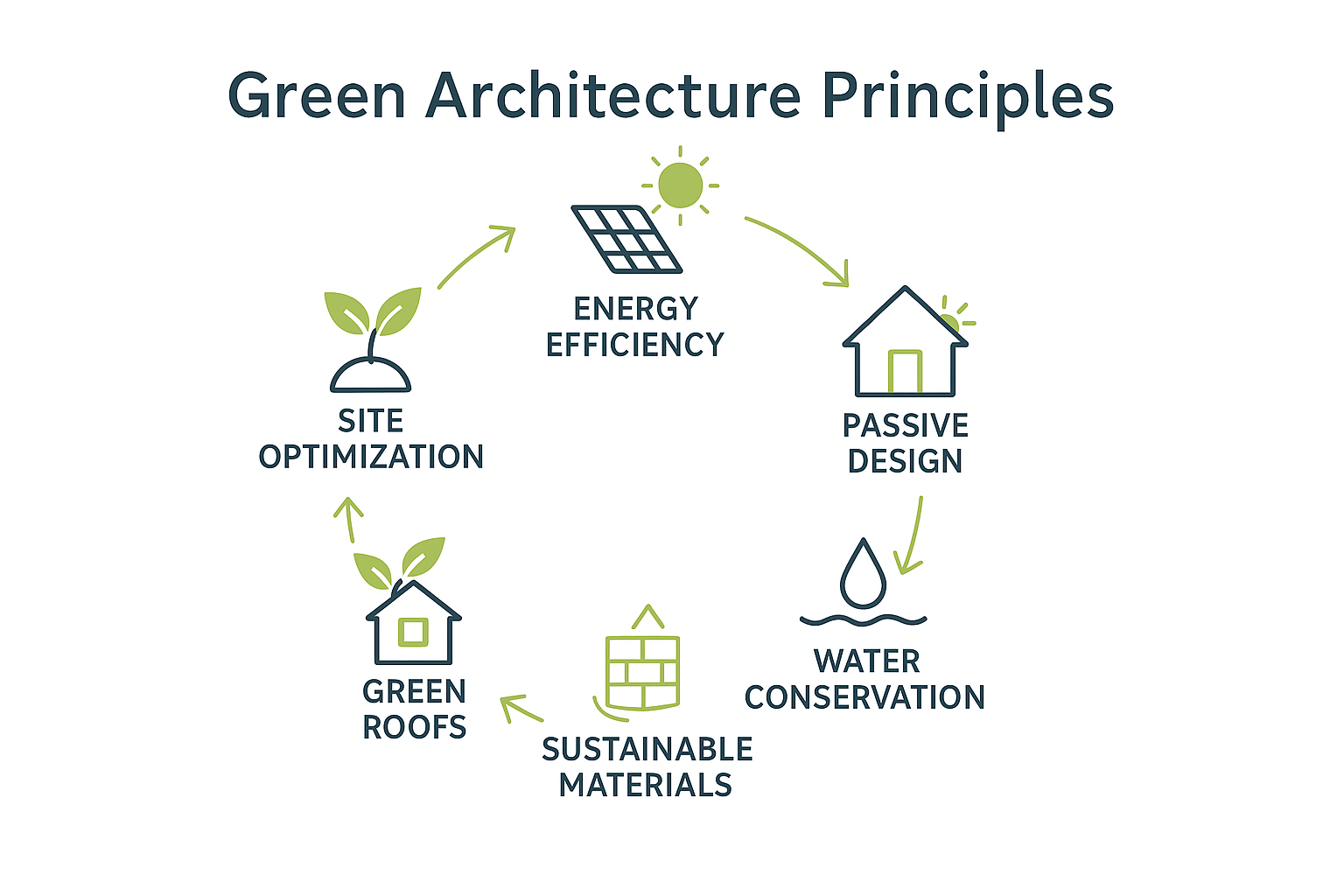
The greenest square foot is the one you do not build. Every project should open with a sequence that feels more like triage than design. These are the moves that cut carbon and cost long before mechanical systems enter the picture.
1. Challenge the brief
Most projects are oversized. Architects rarely earn points by telling clients to do less, but that is the first sustainability move. Right-size the program. Push for adaptive reuse before breaking ground on a new footprint. Renovating a tired warehouse or office can cut upfront carbon in half compared to a new build. Even partial reuse, keeping foundations, cores, or slabs, can shave 20 to 30 percent of embodied carbon off the table before finishes are even discussed. If you need a clear framework for where reuse fits into sustainable practice, see Sustainable Architecture 101: The Basics You Need.
2. Pick the climate strategy
Do not jump to tech. Start with climate logic. Is it mixed humid like New York, hot arid like Phoenix, or mild coastal like San Diego? Every zone has its own playbook. Deserts lean on shading and mass. Cold regions demand airtightness and insulation. Tropics rely on cross-ventilation. Passive first, active second. If you model loads down by 40 percent with passive moves, your systems shrink and so does cost. More examples of climate-led design are unpacked in Sustainable Design Strategies in Architecture: A Practical Guide.
3. Lock the envelope
Your walls, roof, and slab are the first line of defense. Airtightness beats thick insulation if you have to choose. A leaky R-40 wall is worse than a tight R-20. Kill thermal bridges at balconies and slab edges. Steel connections and concrete joints leak energy more than most clients realize. Once the envelope is locked, choose efficient HVAC systems sized to the reduced load. If you want to see how these details translate to real buildings, look at Sustainable Building Design.
4. Choose low-carbon assemblies
Structure drives embodied carbon. Steel versus concrete versus timber is not a coin toss — it’s a carbon multiplier. Hybrid systems often win: concrete cores for fire, CLT or engineered timber for spans, lightweight steel for roof framing. Then work the finishes. Bio-based insulation, EPD-backed gypsum, recycled metals. Supply chain distance matters almost as much as material choice. For deeper dives into what works and fails, see Sustainable Building Materials: What Works and What Fails.
5. Plan maintenance and end of life
The building does not end at handover. Detail for repair, not replacement. Screw-fixed panels instead of glue. Lime mortar instead of cement in restorations. Bolted timber that can be disassembled. Think of end-of-life like LEGO: every reversible joint is stored carbon you can harvest later. That mindset links directly with the ideas in Green Building Practices.
Do those five moves and most LEED, BREEAM, or WELL points fall into place. More important, they leave you with a building that stands up to climate stress without wrecking its owner’s budget.
Amazon must read: If you need one book that grounds this mindset, start with Cradle to Cradle: Remaking the Way We Make Things. It’s not a checklist, it’s a shift in how you think about reuse and end-of-life from day one.
The Essential Set: Ten Working Principles
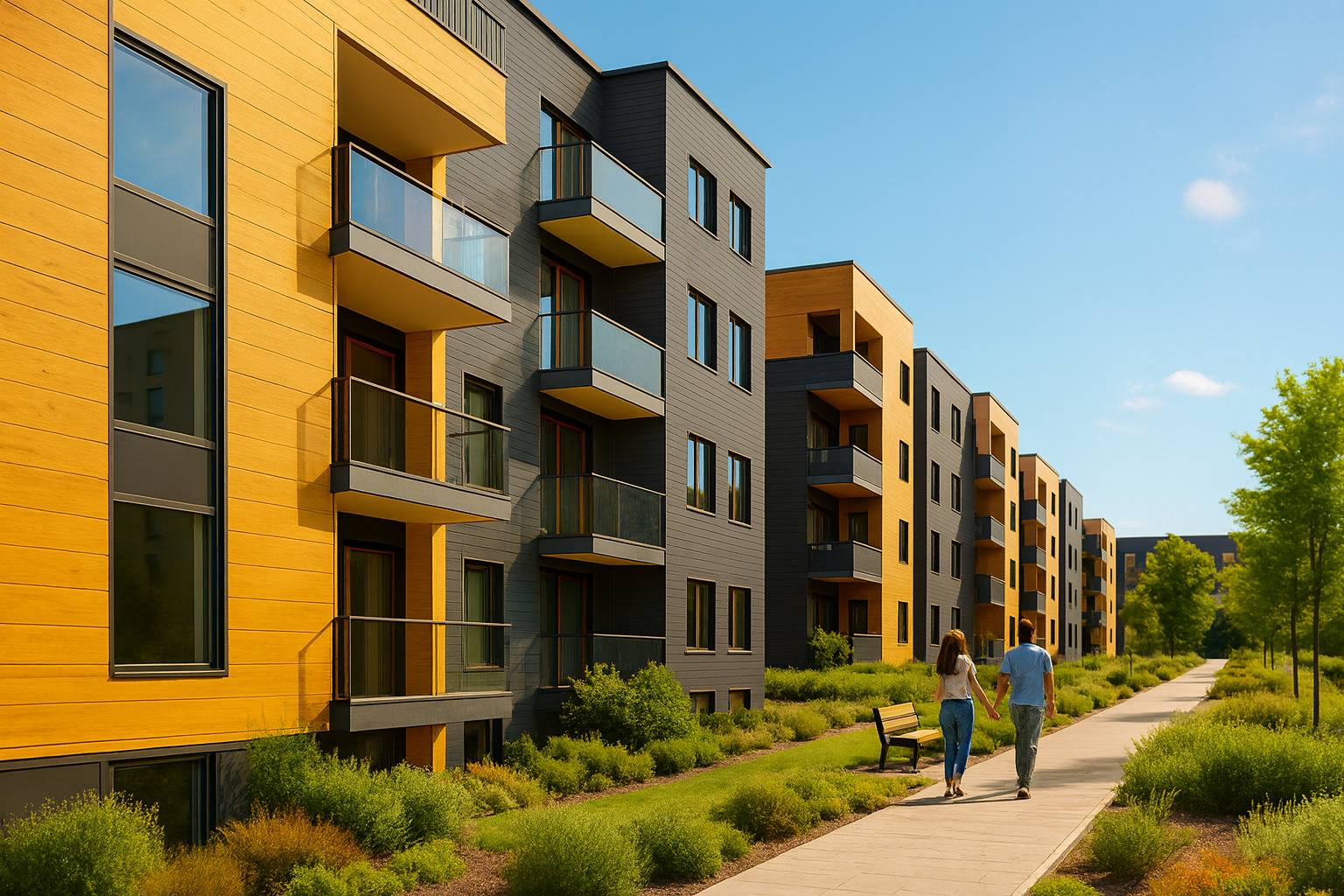
These are the habits architects and builders return to because they work. They connect rating systems like LEED, BREEAM, and Passive House with the messy reality of drawings, budgets, and job sites.
1. Build less and reuse more
Reusing structure and shell avoids the largest share of embodied carbon. Before sketching anything new, run a reuse check. Can the slab stay? Can the core stay? Even partial retention cuts emissions. Track it as embodied carbon per square meter and as the percent of structure you kept.
2. Let climate carry the load
Bioclimatic basics still matter most: winter sun, summer shade, prevailing wind, thermal mass. These reduce heating and cooling before you even size a unit. Model how many heating or cooling degree hours you avoid and test daylight autonomy. This connects directly with Sustainable Design Strategies in Architecture: A Practical Guide.
3. Start passive and add efficient systems later
Shrink demand before you buy equipment. A well-sealed, insulated, thermal-bridge-free envelope allows for smaller systems. Use the Passive House checklist: continuous insulation, airtight detailing, high-performance windows, balanced ventilation. Many of these details are also laid out in Sustainable Building Design.
4. Eliminate leaks and thermal bridges
One slab edge or balcony can erase the insulation value of a whole wall. On every section, draw a continuous air barrier line and a continuous thermal line. A blower door test will show if you succeeded. If you want the basics that tie into this, see Basic Elements for Sustainable Architecture.
5. Treat water as a cycle
Every liter used indoors is also wastewater to treat. Recover heat from drains, capture roof runoff for irrigation, and use bioswales for stormwater quality. Track potable water per person and how much rainfall is retained or infiltrated on site. This principle is built into Green Building Practices.
6. Focus on carbon in materials as well as operations
Choose cement-lean concrete, recycled steel, and mass timber where it fits. Always request environmental product declarations. Do not just track energy use after occupation—set maximum embodied carbon targets in the specification. For real-world wins and mistakes, see Sustainable Building Materials: What Works and What Fails.
7. Design with circularity in mind
A wall that cannot come apart will end up in landfill. Use reversible fixings, modular components, and finishes that can be maintained. Track the share of mass designed for reuse and the waste diverted during construction. Circular thinking links with Sustainable Design and Architecture.
8. Put health on equal footing with efficiency
Source non-toxic materials, provide steady ventilation, filter at MERV 13 or higher, control glare, and zone acoustics. Occupants notice indoor air and light long before they notice your energy model. Measure CO₂, total VOCs, and daylight quality. If you want a broader overview of what health means in sustainable spaces, check Environmental Sustainability in Interior Design.
9. Build resilience into the shell
A high-performing envelope can keep rooms safe through outages and heat waves. Design for passive survivability with thermal mass, night flushing, shaded courtyards, raised services, and circuits that can run independently. Track how many hours of safe comfort are possible without power. See also Net Zero Architecture: Everything You Need to Know for Sustainable Design.
10. Measure, adjust, and pass on the lesson
Sustainability that is not measured turns into marketing. Commission systems, meter sub-loads, run post-occupancy surveys, and adjust controls after move-in. The key metric is the gap between your modeled performance and the actual use. Close that gap and share what you learn. A strong way to frame this mindset is in Ecofriendly Roofing Guide: Costs, Mistakes, and Real Options That Work — it shows how on-site performance often diverges from drawings.
Amazon must read: A solid companion for these principles is Sustainability Principles and Practice (3rd Edition) by Margaret Robertson. It gives the big-picture frameworks and practical metrics you can plug directly into project briefs.
Translating Principles into the Big Rating Systems
Clients still expect the badges. Green architecture principles give you the physics, but certification frameworks give you credibility. Most projects in 2025 still orbit around LEED, BREEAM, or Passive House. The key is learning to speak their language while building to real performance.
LEED (USGBC)
LEED sorts sustainability into buckets: Location & Transportation, Water Efficiency, Energy & Atmosphere, Materials & Resources, Indoor Environmental Quality, and more. The principles we use every day—reuse first, airtight envelopes, low-carbon assemblies—map cleanly into those categories. The point of LEED isn’t invention. It’s documentation and third-party verification. If you want a quick overview of foundations, see Sustainable Architecture 101: The Basics You Need.
BREEAM (UK and global)
BREEAM puts heavy weight on process and lifecycle management. Categories like Health & Wellbeing, Waste, Materials, Land Use & Ecology remind you that it’s not just about the building but how you ran the job. European clients often prefer BREEAM because it captures not only results but discipline along the way. For material focus, compare with Sustainable Building Materials: What Works and What Fails.
Passive House (PHI/PHIUS)
Passive House is performance-driven. If you hit airtightness, heat demand, and ventilation recovery numbers, you know the building will sip energy in real life. That’s why many teams design to Passive House first, then wrap the paperwork in LEED or BREEAM for broader market recognition. For a deeper design strategy angle, see Basic Elements for Sustainable Architecture.
The working overlap
The frameworks package the same moves differently. Physics first, badges second. Design for airtightness, carbon cuts, and healthy interiors, then let LEED, BREEAM, or Passive House catch up in documentation. That’s how you avoid chasing points. For policy-minded readers, one strong reference is Sustainability (MIT Press Essential Knowledge) — concise, clear, and often the first book I hand to interns who need to understand how design aligns with policy and rating systems.
The Seven On-site Rules That Keep Projects From Falling Apart
Design drawings can be airtight on paper and still collapse in the mud of construction. What matters is how you stage, supervise, and record the work. These seven rules aren’t theory. They are what stop warranty calls, lawsuits, and client blowback months after ribbon cutting.
- Protect the envelope
Insulation and membranes only work if they go in dry and clean. Store rolls off the ground, cover stacks, and don’t let scaffolding or other trades puncture them. Penetrations should be pre-coordinated with sleeves already waiting. It’s the dull discipline that makes the difference. (For a refresher on what belongs in the envelope, see Basic Elements for Sustainable Architecture.) - Make airtightness visible
Most leaks come from gaps no one claimed responsibility for. Draw the red line on every section and make it a trade. A simple blower-door on the first units or bays can expose errors before the entire job repeats them. Good site managers assign an “air boss” with real authority. That small shift pays back for years. - Track utilities like you pay the bill
Temporary heat, lights left on all weekend, or a hose running in the basement can bleed money and mask leaks. Metering the site the way you meter the final building forces crews to stay alert. Post a chart weekly in the trailer — nothing sharpens focus like a spike in costs everyone can see. - Sort waste before it leaves
A pile is just a pile unless you mark it clearly. Pre-sort demo, metals, timber, drywall, and mixed. Photograph containers before they roll. Set a minimum diversion target of 75 percent and verify tickets. It keeps you aligned with frameworks like LEED and also saves tipping fees. (Some practical tips are in Green Building Practices.) - Log deliveries with proof
Batch every Environmental Product Declaration, VOC certificate, and recycled content claim into one live log as trucks unload. When substitutions appear — and they always do — you have a baseline to compare against. This is the paper trail auditors and owners expect. - Commission in real time
Don’t wait until turnover to find pumps running backwards or controls uncalibrated. Test and balance each floor or wing the moment it’s sealed and powered. Capture screen shots of trend logs to show it worked. It’s the difference between a smooth handover and months of finger-pointing. - Write down lessons as they happen
Five minutes every Friday with the site leads is enough. One thing that worked, one thing that failed, one action for next week. Roll those into post-occupancy evaluation later. These small notes become gold for your next job and keep the team honest. The habit matters more than the format. (For examples of how urban projects apply this rigor, see NYC Green Architecture: What Architects Are Building for 2030.)
Plenty of “seven principles of sustainable construction” lists float around online. The truth is they mean little unless adapted to your site conditions. Blend resource efficiency, waste control, worker safety, and carbon tracking into something crews can actually use on a muddy morning.
Amazon field pick: A rugged moisture meter earns its keep the first time it finds wet OSB behind brand-new siding. Crews trust the General Tools Moisture Meter because it’s cheap, fast, and avoids expensive callbacks.
Passive Design Playbook: The Everyday Bioclimatic Moves
Passive design isn’t fancy theory. It’s the set of small, early choices that make buildings comfortable with little or no equipment. Get these right and you cut loads before the engineer ever sizes a system. Here’s the field-tested playbook.
Orientation and massing
Stretch floorplates along the east–west axis so you tame low-angle sun. Stack service cores and stairs on the hot sides so they buffer occupied rooms. Carve narrow courtyards that allow cross-ventilation instead of relying on fans. Shading should be seasonal: brise-soleil or deep overhangs handle high summer sun, while deciduous trees or screens drop their leaves and let winter light pour in. If you want a primer on why orientation is step one, take a look at Sustainable Design and Architecture.
Envelope
A wall section is only as good as its weakest joint. Draw a continuous insulation layer and keep windows on the warm side of that layer. Break slab edges cleanly and thermally isolate every balcony. Do not leave airtightness to chance: specify it with numbers (ACH50 targets) and detail every joint with tapes and gaskets from day one. These moves look invisible in renderings but they decide energy bills for decades. Related basics are covered in Basic Elements for Sustainable Architecture.
Ventilation
Open windows are free, but only if the climate supports it and you’ve shaped the plan for cross-flow. Where outdoor air isn’t reliable, use balanced HRV/ERV units sized for low specific fan power (SFP). In shoulder seasons, design for night purges — let the cool air flush heat so mornings start fresh without mechanical load. If you’re working in a dense city context, see Building a Truly Green NYC Apartment: What It Takes in 2025 for how designers adapt passive air strategies to tight sites.
Daylight without glare
Good daylight is about balance, not flood. Model useful daylight area (sDA) but also check for annual sunlight exposure (ASE) as a glare warning. Light shelves can bounce sun deep without blinding anyone. High-transmittance glass works if it’s paired with shading devices. Avoid glossy finishes on floors — they bounce light in uncontrolled ways and create hotspots. For a practical guide to balancing light and comfort, see Sustainable Design Strategies in Architecture: A Practical Guide.
Thermal mass
Mass only helps where day–night swings are strong enough to matter. In arid zones, concrete or stone holds daytime heat and releases it cool at night. In stable climates, all you’re doing is adding embodied carbon with little gain. Choose carefully and use phase-change materials or lighter assemblies when heavy mass doesn’t perform. For context on material choices, you might also check Sustainable Building Materials: What Works and What Fails.
Amazon field pick: For daylight studies without hiring a consultant, architects often start with A Global History of Architecture by Ching, Jarzombek, and Prakash. It isn’t a software tool, but it shows how cultures solved light and heat before machines — a reminder that passive design is ancient, not new.
Water Systems as First-Class Design
-
Demand reduction: low-flow fixtures with verified user experience (bad fixtures get disabled); leak detection on mains and risers.
-
Source diversification: roof capture for irrigation, cooling tower makeup where allowed; graywater for flushing if code permits.
-
Quality: green roofs and bioswales to slow and clean runoff; protect waterways by default.
-
Metrics: potable use per occupant, stormwater retained on site, irrigation gallons saved.
(LEED Water Efficiency and BREEAM “Water” give you the accounting structure.)
Materials, Circularity, and Whole-Life Carbon
The material choices you lock into drawings today set the carbon bill for decades. Structure is the big hitter. A cubic yard of standard concrete carries nearly half a ton of CO₂. That is why carbon-smart projects start with structure first. Use cement-reduced mixes in post-tensioned slabs, high-recycled steel where certification is strong, or mass timber if the regional supply chain is verified and audited. For background on how these choices play out in practice, see Sustainable Building Materials: What Works and What Fails.
Set the rules in the spec
Do not leave embodied carbon as a “nice to have.” Put it into the contract. Demand Environmental Product Declarations (EPDs) from suppliers and set a maximum kgCO₂e per square meter of floor area. The RIBA 2030 Climate Challenge, for example, sets the bar at 625 kgCO₂e/m² for new construction. Substitutions should only clear if published data proves equal or better performance. For broader framing, see Sustainable Design Strategies in Architecture: A Practical Guide.
Design for disassembly
The demolition waste pile is the elephant in the room. Every glued joint or hidden fixing locks materials into landfill. Use mechanical fasteners, accessible service runs, and finishes that can be refinished instead of replaced. A door that can be re-sanded and re-oiled is worth more than one laminated in a color you cannot fix. Cities like Baltimore now run deconstruction programs that turn reclaimed brick and timber into new stock—proof that reversible detailing is no longer theory, it is labor policy.
Plan the second life
Circular design is not just about recycling. It is about making pieces fit back into reuse markets. Size wall panels and cladding modules so they can be handled, stored, and reused. Pick reversible adhesives or gaskets that allow separation. The test is simple: can you picture someone taking this apart in twenty years without a hammer drill?
WorldGBC’s whole-life carbon approach
When clients ask what matters most, this is the reference. The World Green Building Council puts numbers to both operational energy and embodied materials. Whole-life carbon accounting is now the yardstick that makes trade-offs clear. For a practical desk resource that translates policy into specs, Sustainability Principles and Practice (3rd Edition) remains a must-have.
Green Building Materials
Start with carbon, not catalogs
The spec section is where projects either stay green or fall apart. Cement, steel, and aluminum carry the biggest footprint. A cubic meter of aluminum can embody more than ten tons of CO₂. Switching to mixes with less clinker, recycled steel, or aluminum with renewable smelter inputs moves the needle far more than swapping light fixtures.
Timber with caveats
Mass timber shines in mid-rise frames and can outperform steel or concrete on embodied carbon if sourced responsibly. But ship it halfway across the world, or expose it unprotected in a wet climate, and the benefit disappears. Use timber where regional supply chains and detailing make sense.
Finishes that do not poison occupants
It is pointless to hit LEED credits if your client complains about chemical smells for months. Zero-VOC paints, formaldehyde-free boards, and adhesives that do not gas off are now standard. Healthy materials are not just for marketing—they cut warranty claims and boost occupant comfort. See Basic Elements for Sustainable Architecture for more on the overlap of materials and health.
Think assemblies, not products
A low-carbon insulation means little if it is paired with a high-carbon air barrier or gets soaked and replaced in five years. Think assemblies: durability, repairability, and moisture control. Ask: how long until this layer fails, and can someone swap it without tearing the wall apart?
Measure, do not assume
Environmental Product Declarations (EPDs) are the truth serum. If a supplier cannot provide one, move on. Whole-life carbon analysis should sit next to cost in every option set. For practical advice on testing and verification, see What Are Sustainable Materials?.
Local beats imported—most of the time
Stone quarried thirty miles away can beat bamboo flown five thousand miles, even if the bamboo regrows quickly. Transport carbon is real. Always check both production footprint and shipping impact.
Recycling is not enough
A “20% recycled content” sticker means little if the material heads to landfill at end-of-life. Circular design demands reusability. Can that carpet tile be lifted and reused? Can that cladding be unscrewed and sold again? If not, it is temporary green theater. For practical case work, see Green Building Practices.
Project reality
On a New York retrofit, the design team cut 32 percent of embodied carbon simply by reusing steel decking, specifying low-carbon concrete, and swapping aluminum curtain wall sections for recycled-content versions. It was not flashy. It was line-by-line substitution in the specs. That is how material choices matter. For more case insights, see Sustainable Building Case Study: The Bullitt Center, Seattle.
FIELD PICK: The Whole Building Handbook — still the most practical reference when you need assembly details, durability notes, and low-carbon material substitutions that actually hold up on site.
Health: Indoor Environmental Quality Without the Hand-Waving
Occupants notice comfort long before they notice your energy model. A drafty room or chemical smell is what triggers complaints, not the kilowatt-hour. Indoor environmental quality is the quiet backbone of sustainable design—when it fails, everything else unravels. These are not luxuries. They are baseline moves tied to LEED Indoor Environmental Quality credits and BREEAM “Health & Wellbeing.”
Air
Start with materials. Specify low-VOC paints, adhesives, and composites, and write it into the submittals. Require a bake-out or 14-day flush-out before occupancy to purge off-gassing. For filtration, MERV 13 is the new floor; MERV 16 or HEPA if you are in urban cores with heavy particulates. Variable-occupancy spaces—classrooms, gyms, event halls—demand demand-controlled ventilation. CO₂ sensors that modulate outdoor air save energy while keeping people sharp. For practical examples, see Sustainable Architecture for Children, where fresh air links directly to cognitive scores in schools.
Light
Daylight without glare is the goal. Model spatial Daylight Autonomy (sDA) to prove useful daylight hours, and Annual Sunlight Exposure (ASE) to avoid hotspots. External shading—overhangs, louvers, deciduous trees—beats the band-aid of blinds. For electric lighting, insist on high CRI (90+) and low-flicker drivers. Occupants feel the difference even if they cannot name it. It reduces headaches, improves sleep cycles, and wins buy-in on “sustainable design” from people who might not care about carbon.
Acoustics
Noise is a silent performance killer. Isolate mechanical equipment in design, not after complaints. Keep ducts oversized and lined, specify resilient hangers, and plan acoustic separation between zones. Use soft finishes—acoustic ceiling tiles, carpet, perforated wood or metal panels with absorptive backing—where reverberation matters. Clients will forget your insulation detail, but they will remember if their boardroom echoes.
Moisture
Moisture is the mold maker. A continuous vapor strategy is non-negotiable. Bulk water management—flashing, drainage planes, weeps—must be detailed at every penetration. Smart sensors embedded in risky assemblies (flat roofs, below-grade walls) now give real-time data. They cost little and can save millions in litigation. If you want a reference that translates building science into clear rules, see Principles of Sustainable Construction.
Project reality
On a recent office retrofit in New York, post-occupancy surveys showed comfort scores jump by 28 percent after three simple upgrades: MERV 16 filters, acoustic baffles in the open-plan ceiling, and automated exterior shades. Energy bills dropped slightly, but the real win was fewer sick days and better tenant retention. This is the side of sustainability that CFOs understand.
FIELD PICK: Designing Design by Kenya Hara — not a manual on air handlers, but a sharp reminder that perception and comfort matter as much as performance. It helps explain to clients why “invisible” elements like air, light, and acoustics deserve hard budget lines.
Policy Shortcuts: How to Talk LEED, BREEAM, and Passive House to Clients
Most clients do not want the alphabet soup. They want a clear story they can repeat to their board or investors. The trick is to translate rating systems into language that ties directly to value—cost, comfort, credibility. Then, quietly, you design to the shared physics.
LEED
Frame it as a credibility tool. “We will earn points across site, water, energy, materials, and air quality. The certification provides third-party credibility and strengthens your ESG reporting.” LEED is global, recognizable, and often required in RFPs. The downside is paperwork. The win is that brokers and investors know the label. For practical steps on structuring these points, see LEED Design Principles.
BREEAM
Pitch it as rigor and lifecycle management. “We will be scored on management, health, energy, transport, water, materials, waste, land use, pollution, and innovation. It is ideal for institutional portfolios and UK/EU projects.” BREEAM rewards process discipline—site audits, construction practices, end-of-life planning—often missed in North American frameworks. Clients who want lifecycle cost certainty respond to that framing.
Passive House
Here the message is comfort and performance. “We will meet airtightness and heat-demand targets. The result is a building that stays comfortable with small systems and low bills.” Passive House is physics-driven, not points-driven. It gives clients a tangible outcome they can feel on day one: steady temperatures, quiet interiors, fresh air without drafts. For broader application, connect it back to Principles of Bioclimatic Architecture.
Project reality
On a New York housing retrofit, the team sold the Passive House upgrade not as “a certification” but as “a building that keeps heat for three days during an outage.” That line landed harder with residents and financiers than any checklist. Pick one framework as the contract language, but design to the shared physics: airtightness, insulation, daylight, water, and materials.
MUST READ: The Whole Building Handbook — a field reference that shows how to line up design decisions with both certification and real performance.
The Quick-Hit Frameworks Everyone Asks About
Clients and consultants love numbered lists. The trick is knowing how to map them back to physics instead of memorizing slogans. These are the three sets you will hear most often, and how to use them without losing time.
“Ten green building principles”
Most versions cover reuse, passive design, energy, water, materials and embodied carbon, waste, health, mobility/site, resilience, and verification. Treat these as your working set. If your client already has a corporate sustainability policy, map your plan one-to-one. For carbon in particular, the World Green Building Council’s net-zero guidance is the reference many portfolios use. For basics, see Sustainable Architecture 101: The Basics You Need.
“Seven principles of sustainable construction”
You will see different wordings, but they typically emphasize resource efficiency, energy efficiency, waste minimization, lifecycle thinking, social responsibility, ethical procurement, and resilience. Use this as the construction-phase checklist and bake it into the contractor’s environmental plan. This is where site practices make or break design intent. For examples, see Green Building Practices.
“Six fundamental principles of sustainable building design”
These almost always reduce to the same six: site, energy, water, materials, indoor environment, and operations. If a course or consultant sells a radically different six, ask what physics they are using. The core does not change. For a clear explanation of these categories, MUST READ: Sustainability Principles and Practice (3rd Edition) — the most practical desk reference for design and policy alignment.
Cost, Schedule, and Risk (The Conversation That Decides Everything)
Cost: Passive envelopes and heat pumps typically add one to five percent in capital expense, but they cut operating costs for decades. Embodied carbon choices do not have to cost more if you address them at schematic design—structure and envelope—rather than scrambling during finishes. See Sustainable Building Materials: What Works and What Fails for examples of how substitutions save money and carbon.
Schedule: Green targets change the order of operations. Airtightness mockups and testing must happen early. Procurement timelines stretch if you require Environmental Product Declarations. Commissioning is not a punch-list item; it starts in mid-construction and runs through occupancy.
Risk: The only way to control risk is with numbers in the specification. Airtightness at ACH50, whole-life carbon caps, potable water use per occupant. When you measure, you deliver. When you stay vague, it gets “value engineered” into nothing. For a practical reference that shows how to set these metrics without hand-waving, MUST READ: Sustainability Principles and Practice (3rd Edition).
A One-Page Blueprint You Can Use Monday
Set three numeric targets at concept: whole-life carbon in kgCO₂e per square meter, energy use intensity (EUI) in kWh/m²-year, and potable water per occupant-day. If you only measure three things, start here.
Choose a climate strategy: shading, ventilation, and thermal mass. Commit to passive diagrams before massing gets pretty. This is the heart of Basic Elements for Sustainable Architecture—climate drives form.
Lock the envelope: draw continuous insulation, airtightness, and thermal-bridge breaks. Pick windows by U-value and SHGC for orientation, not catalog photos.
Right-size HVAC: shrink the load first, then choose systems. Heat pumps with heat-recovery ventilation are now baseline in most markets.
Specify by carbon: demand Environmental Product Declarations. Set maximums in the spec. Prefer bio-based materials where they are durable and local.
Write the construction plan: cover waste sorting, moisture control, airtightness ownership, mid-build commissioning, and site metering. These are the real “seven principles of sustainable construction” in action.
Close the loop: require post-occupancy evaluation, sub-metering, and a 12-month tune-up. Build it into scope, not as a value-add.
MUST READ: Sustainability Principles and Practice (3rd Edition) — Margaret Robertson. The most useful single volume for turning policy into measurable project targets.
What’s New in 2025 Practice
Whole-life carbon is no longer optional. More clients now demand cradle-to-grave carbon reporting alongside energy models. Use WLC to justify structure and envelope choices up front. One smart floor system swap often saves more than a year’s worth of fixture debates. For more on how these trade-offs stack up in the field, see Sustainable Building Materials: What Works and What Fails.
Passive survivability is now in the brief. Heatwaves and grid failures pushed it to the front. Many RFPs in 2025 require hours-of-safety modeling without power. That means airtight, insulated envelopes paired with shading and night-flush strategies. Passive House detailing isn’t just for efficiency anymore—it is for survival.
Verification beats claims. LEED and BREEAM build process discipline, but owners are asking for more. Post-occupancy evaluation, sub-metering, and public performance sharing are becoming the markers of credibility. Teams that publish real data are landing the next job.
MUST READ: Sustainability Principles and Practice (3rd Edition) — Margaret Robertson. Updated with net-zero and resilience case studies, it shows how WLC and POE are changing specs today.
What a New York “One-Page Brief” Feels Like on a Real Job
Starting with airtightness
We took a nearly identical brief into a mid-rise rental on Northern Boulevard in Queens. Eight stories over a transfer slab, 140,000 square feet. The developer wanted “low bills, good PR, no drama.” That’s what everyone says. What they meant: hit Local Law 97 targets, keep rents competitive, don’t slow the schedule. For context on how these laws reshape design choices, see Local Law 97 NYC: What Architects and Building Owners Need to Know.
The first meeting where it got real wasn’t with the client. It was in the trailer with the superintendent, concrete sub, envelope consultant, and the mechanical foreman. I put the airtightness number on the whiteboard: 0.8 ACH50. The super looked at me like I’d brought a yoga retreat to a job site. “We’ll never get that with twenty balconies,” he said. He wasn’t wrong—balconies are thermal and air leaks on legs.
We didn’t argue theory. We went to the mockup. The balcony edge wanted to carry straight through the slab. The thermal-break supplier had a 10–12 week lead time. The concrete sub wanted to pour in three. We solved it the oldest way: we cut two bays from the first pour, held the balcony zones, and poured other areas while thermal-break modules caught up. It wasn’t elegant. It saved the target. That’s the kind of trade you make when numbers meet schedule. For more examples of how these moves look in practice, see Building a Truly Green NYC Apartment: What It Takes in 2025.
Concrete and carbon
Low-carbon concrete was the next fight. The spec called for a cement-reduced mix with about 40% SCM. The plant could do it, but the foreman hated slow early strength. We brought test cylinders to the table from another job and committed to curing blankets and heat if a cold snap hit. The super got what he needed: a schedule he could defend. We got what we needed: tons of CO₂ we didn’t pour into the frame. No speeches. Just proof and a backup plan.
Windows and orientation
Windows were quiet until they weren’t. We set south façades to a lower SHGC, north to a higher one. That’s easy on paper and annoying in procurement—two glass recipes, two label sets, a hundred chances for a mix-up. The PM wanted to “simplify.” We kept the split but wrote it into the punch list: field verify SHGC and U-values by elevation before glazing more than one stack. That one line saved a very expensive mistake when a pallet with the wrong coating showed up and got flagged before it left the sidewalk.
Mechanical systems and value engineering
Ventilation didn’t stay simple either. We wanted balanced HRVs with decent heat recovery and low specific fan power, one per vertical stack. The MEP estimator swapped in cheaper units. We did a fan curve check in the meeting: at the pressure we actually needed, the “cheaper” fans would draw more power and miss the flow. Everyone in the room could read the graph. We went back to the original selection and shortened the duct runs instead. The cost landed where it started. The electrical load got better. That’s the trick with “value engineering” on a green brief—keep pulling the string until the math hits the room.
Water and site loops
Water was a curveball. We wanted roof capture into a small cistern for landscape and hose bibs. FDNY flagged the backflow layout; DOB wanted a different overflow route. The civil engineer sketched a bioswale that fit inside a strip we were planting anyway. The maintenance team asked, “Who cleans it?” Good question. We wrote an annual service line item into the O&M plan and tied it to the landscape contract. Rain stopped being an “amenity feature” and became a loop with a name and a budget owner.
Materials and paperwork
On the materials log, EPDs were the part that sounds like paperwork until you hit a wall. One flooring line couldn’t produce an EPD; their “green story” was a brochure. Procurement wanted to keep it for color reasons. We swapped the palette to a manufacturer who had the data. Did the client notice? Only when the operations team asked why the submittal for the first option kept bouncing. The new one sailed through and the field never slowed down. That’s the theme: sustainability moves that don’t cost time feel easy to approve; the ones that touch schedule need proof and Plan B.
Ownership of airtightness
We set the airtightness “air boss” on day one—a carpenter who took pride in tape and gaskets. He did a five-minute huddle every Friday: where the membrane got nicked, where the electrician drilled the wrong place, where a new detail needed a sketch. Two months in, the blower door number on the mid-build test landed at 1.1 ACH50. Not passing, but close. We found the usual suspects (shaft tops, a goofy door threshold) and fixed them while drywall crews were still moving. The final test hit 0.78. No heroics—just catching leaks when they were still cheap to fix.
Commissioning in real time
Commissioning started while walls were still open. The controls tech hated it until he loved it. We ran the HRVs and heat pumps with temporary power, logged flows, and tagged dampers. When turnover came, the systems didn’t “surprise” anyone. A month after move-in, we pulled the sub-meter data and found the domestic hot water recirc pump scheduled 24/7. Nobody had noticed; tenants had hot taps, and bills hadn’t arrived yet. We fixed it in five minutes. That one schedule change will save more energy than a building full of motion-sensor stickers.
Post-occupancy feedback
Post-occupancy made us eat some humble pie. CO₂ sensors in a co-working lounge were hitting 1,300 ppm on Mondays. The space was gorgeous, and it was stuffy by noon. The fix wasn’t a bigger fan; it was a better control point. We tied the HRV demand to the CO₂ sensor instead of the occupancy schedule and added a quiet boost button the community manager could hit before meetings. Complaints stopped. The EUI dropped a tick. Tenants felt the difference before the meters did.
Resilience under stress
Resilience got real the first heat wave. A transformer fault knocked out power on the block for six hours. The building stayed inside a tolerable band because the envelope worked and the shades were down. No one called to thank the airtightness number, but no one called to complain either. That’s the best review you can get from hundreds of apartments in August. For broader context on where the city is heading, see NYC Green Architecture: What Architects Are Building for 2030.
The lesson to copy
If you’re reading this for a template, here’s the part worth copying. Put two or three numbers on the wall early—airtightness, energy use, water per person—and trace every decision back to them in the room where the superintendent signs the two-week look-ahead. If a greener option threatens schedule, bring a test report and a fallback. If a cheaper swap threatens performance, put the fan curve or psi value on the table and let the trade foreman judge it. That’s how a tidy one-page brief survives contact with a real New York job.
MUST READ
📘 MUST READ
Sustainability Principles and Practice (3rd Edition) – Margaret Robertson. Clear, practical, and updated with net-zero and resilience case studies. It remains the desk reference many NYC firms use when sustainability debates hit the table.
Quick glossary
(so teams talk the same language)
-
Embodied Carbon: CO₂e from extraction through construction and replacements (A1–A5 + B modules). Target in kgCO₂e/m².
-
EUI: Energy Use Intensity—annual energy per area. Lower is better.
-
Airtightness: Air changes per hour at 50 Pa (ACH50). Passive House targets ~0.6 ACH50 for new builds.
-
Daylight Autonomy (sDA) / Annual Sunlight Exposure (ASE): balance of usable daylight vs. glare.
-
EPD: Environmental Product Declaration—product-level carbon data.
Final thought you can take to a kickoff meeting
Great green buildings aren’t accidents. They’re the product of a disciplined order: reuse if you can, tune the form to climate, seal and insulate the shell, right-size efficient systems, specify low-carbon assemblies, and verify performance in use. Everything else—points, plaques, and press—will follow.
FAQ
Is LEED still worth it?
If your client needs third-party validation or ESG reporting, yes. It structures the work and survives leadership changes. For pure performance, pair LEED with Passive House-style envelope goals.
What’s the single best “first move”?
Lock a passive strategy and airtight, thermal-bridge-free envelope before sketching interiors. It shrinks equipment and bills, and it’s hard to recover later.
Do bioclimatic rules still matter with heat pumps?
Yes—mechanical efficiency doesn’t replace free shading and ventilation. Passive loads avoided are forever avoided.
How do I compare materials fairly?
Ask for EPDs and set a max kgCO₂e/m² for the package. Focus on structure and envelope first; finishes come after.
What about BREEAM vs. LEED?
Both are credible; pick the one your region or client portfolio expects. BREEAM leans harder into management and lifecycle documentation; LEED is ubiquitous in North America.
Where do “seven principles of sustainable construction” fit?
Use them as the contractor’s plan: resource efficiency, energy, waste, lifecycle, social responsibility, ethical procurement, resilience. Turn each into site tasks and checklists.