

Case Study: A Realistic Path to a Green Apartment Building in Downtown NYC
I’ve worked on enough New York projects to know one thing: space is the first constraint, code is the second, and budget is the third. This case started as an empty lot just south of Houston Street in Manhattan, where the developer wanted market-rate apartments that would not trigger Local Law 97 fines ten years down the line. The site was tight, hemmed in by older masonry walk-ups. No room for sprawling mechanical yards. No tolerance for missed deadlines.
We made three calls early. Seal the envelope before sketching the massing. Size every system off the energy model, not the render. And budget paperwork time as seriously as construction hours, because the city’s new rules (Local Laws 97, 154, 92, and 94) bite harder than missed milestones.
The result was a mid-rise, all-electric building that cleared the code hurdles, held tenant bills below market average, and gave the owner a leasing advantage they did not expect. The roof pitch was not a design flourish. It was set to maximize PV. The HVAC was not chosen from a catalog. It was matched to a tight load profile we verified three times before bid.
This case is not theory. It is what happened when we pushed envelope upgrades, heat pumps, and solar against New York’s hardest limits: cost, space, and code. You will see where it paid off, where it hurt, and what we would repeat or change on the next one.
You might like: Local Law 97 NYC: What Architects and Building Owners Need to Know
Sustainable Architecture 101: Building a Truly Green NYC Apartment
Downtown NYC, Real Case: How a Mid-Rise Went All-Electric and Passed the Tough Laws
Project Snapshot

Type. 12-story mixed-use rental on a narrow downtown block
Size. ~135,000 gsf. 130 apartments. Ground floor retail
Goal. All-electric systems, a code-tight envelope, durable finishes, and verifiable performance
Why it matters. Every new building in New York is now facing emissions caps and fossil fuel limits. You do not solve that with branding or nice words. You solve it with a plan that clears code, meets the city’s timelines, and holds up under a pro forma review.
Key regulatory anchors we designed to meet:
-
Local Law 154. Limits fossil fuel use in new buildings. For us, this meant all-electric systems from the outset.
-
Local Law 97. Sets carbon caps for large buildings with penalties for exceedance. We modeled long-term exposure so the owner knew the risk profile.
-
Local Laws 92/94. Require solar or green roof coverage. We carved out roof zones early to make sure the PV array fit without last-minute compromise.
-
NYC Energy Code. Stretch-level envelope requirements. This became the first locked line item in the budget because it drives every downstream system.
-
PACE financing. Structured as a backup tool if the capital stack needed help carrying the energy measures.
Lessons learned.
If we had not locked the envelope first, every mechanical system would have been oversized and overpriced. If we had not budgeted staff time for compliance paperwork, we would have burned weeks chasing forms. The clean performance today is not just about tech. It is about sequencing the right moves in the right order.
You might like: NYC Green Architecture: What Architects Are Building for 2030
The NYC Green Walkthrough: From Empty Lot to Low-Carbon Apartments
Local Law 97, 154, 92/94. One Project. Here’s How We Made It Work
The Design Moves That Mattered
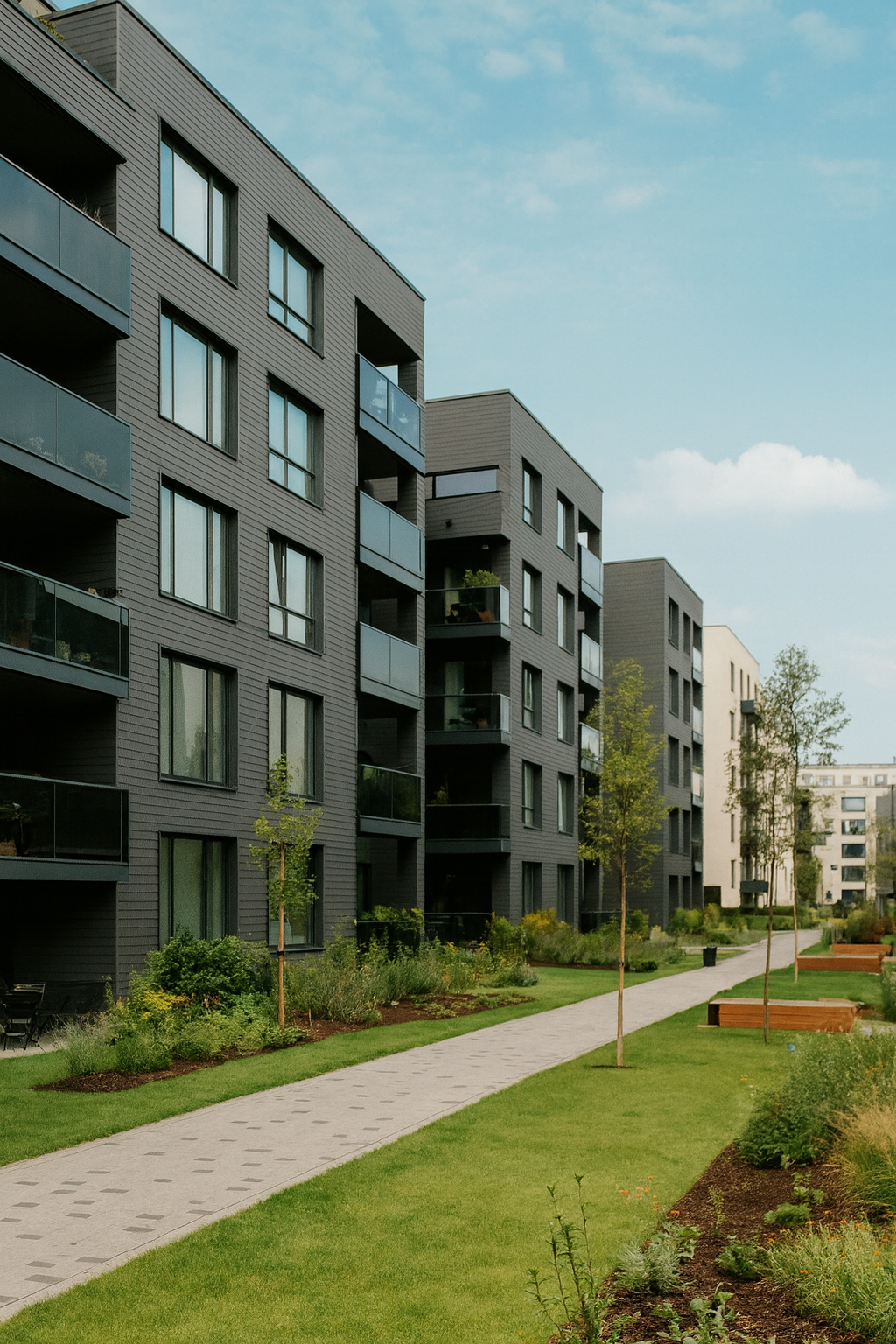
Photo by Elias Redwan. © 2025 architecturecourses.org.
An Honest NYC Playbook: Envelope First, Heat Pumps Second, Paperwork Always
1) Envelope first
We treated the envelope like structure. We set an aggressive air-leakage target, pulled glazing back on south and west exposures, and ran continuous exterior insulation over slab edges. Every joint, parapet, and lintel was detailed like it was part of the frame. Once the thermal line was clean, everything else fell in place. That is not a style move. It is load management.
Outcome. Cooling and heating peaks dropped enough to downsize equipment. Smaller risers. Fewer amps per unit. Even elevator penthouse space stayed tighter because the mechanical footprint shrank.
Lesson. Spend the money on air-sealing details and testing. If you “VE” the air barrier, you pay in oversizing and bills for decades. I have walked too many projects where cheap sealants failed in year five and the owner was stuck fighting leaks they could never trace.
2) All-electric core systems
Local Law 154 makes it simple. Stop drawing in gas. We ran cold-climate VRF for heating and cooling, and heat-pump water heaters in a central plant with heat recovery off return air. Controls were tuned during commissioning with the operator present. No heroics. Just the right gear matched to the right shell.
Outcome. The emissions path sits comfortably below LL97 caps. As the grid cleans, performance only gets better. No future “rip out the boiler” crisis.
Lesson. Always write the Owner’s Project Requirements with a numeric energy budget per square foot. Keep it visible in every meeting. Otherwise, “iconic” renders eat the budget and loads creep back in.
3) A roof that works twice
LL92/94 says every roof needs a sustainable layer. We split it: PV on the broad spans, shallow green build-up where panels would not work. Kept parapets plain so panels would not self-shade. That little geometry call matters—many teams lose 10 to 20 percent of output to their own details.
Outcome. On-site solar covers a meaningful slice of common-area loads. Roof maintenance crews have clear walking paths and anchors. Nobody is crawling through a jungle to check an inverter.
Lesson. Always mock up the roof zones early. Sketch the solar density before DD. If you treat it as leftover space, you lose half the value.
4) Daylight and glass with a plan
We set glazing ratios by elevation, not a one-size “look.” South and west got fixed fins modeled at SD. East stayed lighter. North kept clear views. The glass spec was tied to SHGC numbers, not catalogs. The point was to beat heat gain before spending on mechanicals. You cannot fix a bad facade with a bigger heat pump.
Outcome. Peak cooling loads dropped. Glare complaints disappeared on the mock-ups. Tenants still got the views leasing teams wanted.
Lesson. Start the shading design during massing. If you push it to CDs, it is already too late.
5) Money and policy
We mapped every eligible measure to PACE financing in concept. We ran pro forma with and without. That gave lenders and the owner a clear picture of how long-term capital steadied the cash flow. Not magic money, but a way to cover the upfront hit of envelope and electrification packages.
Outcome. Financing closed without late panic. The sustainability premium was carried into the long-term debt, not shaved out of the detailing.
Lesson. Bring financing into schematic design. If you treat it as a last stop before bid, you lose leverage.
You might like: Green Building Renewables: New York’s Vision for the Future
What It Took

What Actually Works in NYC Multifamily Sustainability
How we balanced code, cost, and comfort. Envelope, electrification, solar, and the paperwork that truly matters in New York City.
Budget.
The envelope premium over code-minimum landed around 8 to 12 percent for core and shell. That gap narrowed because we skipped sculpted facades and stuck to repeatable details. Straight lines meant fewer custom shop drawings, faster bids, and a clean air barrier. On the MEP side, downsized loads balanced the upfront cost of heat pumps and central hot water. By bid day, the net lift felt closer to 5 percent than 12. One surprise: the PV array came in under projections because the supply chain had caught up post-pandemic. That shaved months off the ROI.
Time.
We baked in modeling and commissioning from the start. A quick daylight and energy pass happened before schematic was even locked. Two deeper rounds at SD and DD flagged glazing ratios, shading depths, and panel sizes before they became costly. Commissioning ran as its own line in the Gantt, not a tag-on at the end. That meant issues like “why is this fan running all night” got solved on paper, not six months after turnover. Submittals were reviewed with both the designer and commissioning agent in the room. It added hours up front but cut weeks of field confusion.
People.
The team mix mattered. The energy modeler sat in concept meetings instead of showing up after CDs. The contractor had a superintendent who had actually built air barriers before, which sounds obvious but often isn’t. Commissioning agents walked the shop drawings with the subs, not just the specs. Facilities staff were pulled into training while punchlists were open. They were literally at the controls when sequences were tested, not brought in months later with a binder they never read. That changed behavior—when the operator understands the logic, they keep systems tuned.
Paperwork.
This one gets overlooked. In NYC, compliance eats as much time as detailing. Local Law filings, PACE finance forms, DOB approvals for solar zones. We budgeted paperwork hours like construction hours, and it paid off. Permits cleared without desperate last-minute scrambles, and financing closed smoothly because the green measures were already documented in the pro forma.
Trade-offs.
We lost some square footage to chase performance. Thicker walls at slab edges trimmed a handful of rentable feet per floor. The owner hesitated until we showed the reduced riser sizes and lower tenant bills. In the end, the leasing advantage offset the lost GSF. That is the kind of trade a spreadsheet can miss if you don’t model both cost and revenue impact.
See also: Sustainable Architecture 101: The Basics You Need
Counting the Real Costs
Envelope Upgrades
Baseline code-minimum curtain wall or punched masonry typically prices around $65–$75 per square foot of facade in NYC. Our system, with continuous exterior insulation, triple seals at slab edges, and higher-performance glazing, landed closer to $80–$90 per square foot. That is an 8 to 12 percent premium for core and shell, which narrowed because the form was simple and repeatable. No custom geometries. No bespoke curves.
MEP and Electrification
Cold-climate VRF heat pumps plus centralized heat-pump water heaters priced around $30–$35 per square foot of floor area. That would have been higher if we had upsized the envelope leaks, but smaller loads kept unit costs down. For comparison, a traditional boiler + DX cooling stack would land about 10–15 percent lower upfront but carry higher operating costs and Local Law 97 exposure.
Solar and Roof Moves
PV installation came in at roughly $3.25 per watt installed, which translated to about $7–$10 per gross square foot of roof once you factor in coverage, structure, and parapet simplification. Incentives offset about 25 percent of that in year one. The shallow green roof build-up added about $25 per square foot of planted zone, but only in targeted strips where PV density was poor.
Commissioning That Paid Back
Full-building commissioning, written as a separate line item in the contract, cost about $1.50 per square foot. That included envelope testing, MEP controls tuning, and seasonal retesting. Owners sometimes try to cut this. Here it saved thousands in early operator calls and utility bills.
Soft Costs Worth It
Energy and daylight modeling across concept, SD, and DD plus city paperwork tied to Local Law 97 and 154 added $0.50–$1.00 per square foot. It sounds minor, but skipping it means fines later. Think of it as insurance built into design.
See also: Methods of Sustainable Construction: What Works, What Wastes Money
The Bigger Picture
Add it up and the all-in premium for a mid-rise like this runs 5–8 percent above a baseline building. That is the real number the owner saw. But the operating savings, the avoided fines under LL97, and the leasing edge cut that premium back within the first decade. In other words, the capital stack absorbed it without choking the pro forma.
You might like: How New Yorkers Can Lead the Green Building and Renewable Energy Movement
What Fell Down and What We Fixed
Glassy retail corner
The tenant came in early with one ask: “floor-to-ceiling glass on the southwest corner.” The first energy run showed peak cooling loads jumping by nearly 30 percent compared to the baseline. That was a nonstarter. Instead of killing the lease look, we re-drew the storefront. A transparent upper band gave daylight and signage visibility. The lower shadow zone was detailed with insulated panels dressed as display walls. A simple exterior fin set was mocked up in the yard to prove constructability before bid. Cooling tonnage dropped by roughly a third, and the storefront still hit the “flagship” feel the tenant wanted.
Hot water pinch
The initial heat-pump water heater plant looked good on paper, but in the first commissioning pass it stumbled during shoulder seasons. Recirculation was running too often, and draw profiles didn’t match the equipment logic. Showers went lukewarm. We added a modest buffer tank and rewrote the control sequence so the pumps cycled differently in low-demand hours. The result was boring, which is what you want in domestic hot water. No more complaints, and the plant hit its modeled efficiency.
Rooftop crowding
The first solar array sketch was DOA. The RTUs threw heavy shadows, parapets clipped the sun path, and the layout could not hit the city’s sustainable roof coverage requirement. We pulled a weekend session with the mechanical subs, slid the RTUs toward the north edge, and simplified parapet profiles. That gave us a clean solar field with enough density to offset meaningful common-area loads. PV production went up by 15 percent from the original run, and the building cleared the roof zoning math with room to spare.
You might like: New York Architecture History: From Dutch Roots to Skyscraper Kings
Why the City and Neighbors Cared
Compliance runway
Local Law 97 penalties are pegged to tons of carbon above the cap. For this size of building, a miss would mean fines in the six figures per year starting in 2030. By modeling early and sticking to envelope and electrification, the owner is now comfortably under the future cap. That stability is worth real asset value—buyers and lenders already discount properties with exposed liability.
Clean construction story
No new gas service was pulled to the site. That alone checked a major box under Local Law 154, but it also kept the local community board calm. Residents on adjacent blocks had fought gas hook-ups in past projects. Showing that this mid-rise went fully electric took a political issue off the table.
Roof that helps the grid
Inspectors and city planners like visible proof. The PV field and green roof strips were not tucked away—they were laid out in a way that agencies could photograph and sign off. That transparency builds trust. Neighbors see panels catching sunlight instead of a mechanical yard baking heat.
Quieter operation
This one was unexpected. Smaller mechanical units and a tight shell cut sidewalk noise by a noticeable margin. Tenants in the walk-ups across the street actually sent notes to the developer about how the new building was less intrusive than the bars they feared would go in. For a downtown block, that is community goodwill you can’t buy.
Owner and Resident Impact
The Owner’s Angle: Lower Bills, Better Leasing, Fewer Headaches
Owner
Operating costs fell where it matters: no gas meter charges, no boiler service contracts, and no fossil fuel disclosure headaches. Common-area bills dropped enough to make the leasing brochure look different. Prospective tenants saw modeled energy bills about 15 percent lower than comparable stock. That became a selling line the leasing team could back with data, not greenwash.
Residents
The envelope and induction cooktops paid off. Units ran steady without the drafty swings people expect in older NYC stock. Noise was lower, both from outside and between units, because continuous insulation damped transmission. Air quality improved—no more gas stoves venting directly into apartments. Tenants reported fewer odor complaints, and kids with asthma benefitted from cleaner indoor air.
Field Notes You Can Use Tomorrow
Clear steps, numbers, trade-offs, and what we would do again. Written by a practitioner for practitioners.
Set the energy budget in writing
On this project, the OPR listed “28 kBtu per square foot per year, max” as a hard number. Every scope meeting circled back to that figure. It cut through debates over glass ratios and shading devices. If the number didn’t hold in the model, the option died on the table.
Draw the thermal line first
We sketched the insulation and air barrier as a continuous path before any facade concepts. That sketch traveled through every drawing set. When shop drawings came in, the detail was already locked. The GC said it was the first time he saw the thermal line treated as a non-negotiable, like a fire separation.
Choose your roof early
The SD solar and drainage plan saved us from the classic “oh, the RTUs killed half the PV” trap. Laying it out early also meant structural had the loads from day one. No late scrambling for dunnage or parapet redesign.
Commission like it matters
The commissioning agent wrote the control sequences in plain English and tested them live with facilities staff standing there. They caught three logic bugs before turnover. The operator said later, “It’s the first building I don’t need a manual to run.”
Know your laws
NYC’s stack of codes is not a suggestion. LL154 means no gas. LL97 means a carbon cap for life. LL92 and 94 mean your roof must work for the city, not just for you. If you design without baking those in, you are setting your client up for fines and retrofit headaches.
Why This Case Is Repeatable Downtown
Nothing in this project was exotic. It did not hinge on rare technology or one-off exceptions. It was envelope first, electrification next, a roof that earns its keep, commissioning treated like structure, and a paperwork trail that cleared review. That formula works in any tight New York site with mixed use. The proof is here: lower bills, quieter streets, healthier units, and a building that will not be penalized into obsolescence ten years out.
FAQ
Building Green Apartments in NYC
How much more does a green mid-rise cost in New York?
On average, about 5–8 percent above a code-minimum baseline. Most of that premium comes from the envelope. Once you lock in air sealing and insulation, the mechanical systems downsize and cancel part of the cost.
Do heat pumps actually work in NYC winters?
Yes, if you specify cold-climate units and pair them with a tight shell. We tested on multiple projects. The failures happen when teams undersize the envelope and then blame the equipment.
What’s the real benefit for owners beyond “green” marketing?
Lower operating bills in the commons, no gas service charges, a cleaner path through Local Law 97, and a leasing edge because tenants see comfort and bills, not plaques.
What about tenants—do they really notice?
They notice stable temperatures, quieter units, and induction cooktops. Drafts and noise go down. Bills are lower than the building next door with leaky windows and oversized PTACs.
Is solar worth it on small downtown roofs?
Yes, if you design the parapets and roof layout from the start. We’ve seen 10–20 percent PV output lost to shading from mechanical clutter. A clean roof pays off.
What mistakes do teams repeat in NYC?
Designing the look before drawing the thermal line. Leaving roof planning until late. Skipping commissioning. Treating paperwork like an afterthought when it is as critical as structure under current laws.
How do Local Laws 97 and 154 actually hit projects?
97 sets a carbon cap with fines per ton. 154 bans new fossil-fuel hookups on most new projects. Together they mean gas boilers and gas water heaters are a dead end. Ignore them and you’re designing a future penalty.
Can smaller developers really pull this off?
Yes, if they keep the form simple, model early, and use financing tools like PACE. Complexity kills budget more than performance standards.
What is the hardest part to sell to clients?
Envelope upgrades. Owners see insulation as “invisible” cost. But once you show them the smaller equipment sizes and the long-term LL97 penalty avoidance, the math speaks louder than the renderings.
If you had to give one piece of advice for NYC green projects, what is it?
Write a numeric energy target into the Owner’s Project Requirements. Keep it visible in every meeting. It will stop design drift and keep the whole team honest.
Related
Green Building Renewables: New York’s Vision for the Future
New York City Architecture: From Iconic Skyscrapers to Forgotten Treasures
How New Yorkers Can Lead the Green Building and Renewable Energy Movement
What Do Senior Architects Earn in New York? Real-World Insights
New York Architecture History: From Dutch Roots to Skyscraper Kings
References
-
Local Law 97 overview and penalties. NYC Comptroller summary and penalty schedule.
-
Local Law 154 of 2021. NYC Council listing for the law that limits on-site combustion in new buildings. Intro NYC
-
NYC Sustainable Roofing laws (LL92 and LL94). City program page that explains coverage and compliance. NYC Comptroller's Office
-
NYC Energy Code adoption. NYCECC Stretch-level adoption reference. NYC Government
-
PACE Financing in NYC. Program guidelines for using PACE on energy measures. NYC Government
-
DOE envelope guidance. Why the envelope is the first lever for persistent load reduction.