
NYC’s Architectural Secrets: Hidden Stories in Stone and Steel
New York’s buildings don’t just stand—they speak.
They tell you who had power, what the city feared, and where style went to die or be reborn.
People stare up at the Empire State Building and miss the jagged black lines of the American Radiator Building.
They walk past Brooklyn brownstones and never look up at the Gothic arches or terracotta faces above the second floor.
This city is layered—colonial brick, cast iron, Deco steel, post-war glass—stacked like sediment. You just have to know where to look.
MUST READ: Architecture of New York City: Histories and Views of Important Structures, Settings, and Symbols
What You’ll Learn
▪ Buildings that shaped whole neighborhoods but never made the postcards
▪ Architects who didn’t follow rules—and changed the skyline because of it
▪ Why certain patterns show up again and again, decades apart
▪ How real-world events—fires, strikes, booms—left scars in design
This isn’t a tour. It’s a breakdown of the city’s design logic, from the ground up.
- Rich history and design principles of New York City’s architecture
- Manhattan Architecture: A Guide to NYC's Iconic Skyscrapers and Historic Landmarks
Why Study This Guide?
Because NYC’s buildings are more than landmarks—they’re design lessons.
You’ll learn how the city grew, who shaped it, and what styles got buried or revived.
It’s sharp, useful, and full of architecture most people miss.
ARCHITECTURAL HISTORY
How Old New York Was Really Built
The city didn’t start with skyscrapers. It started with brick, steep roofs, and borrowed styles.
Before Manhattan was steel and glass, it was timber and Dutch practicality. Early New York was built for survival—tight spaces, harsh winters, basic tools. But even back then, design still mattered.
What the Dutch Brought
The first permanent buildings came from the Dutch in the 1600s. Simple brick houses with:
▪ Steeply pitched roofs
▪ Narrow gabled façades
▪ Thick walls for insulation
They weren’t pretty—but they worked. These houses gave shape to early street layouts and influenced how the city would grow, block by block.
What Changed After Independence
Once the British left and the U.S. was born, New York started copying Europe again—this time Rome. The Federal Style took over, with symmetry, columns, and calm proportions. These buildings didn’t shout. They whispered respectability.
Famous example:
▪ Hamilton Grange – Built for Alexander Hamilton, it’s a quiet but dignified home, all clean lines and balanced windows.
Two Buildings That Still Show You How It Was
▪ Morris-Jumel Mansion
Built in 1765. Used as Washington’s headquarters. Still standing in Manhattan. You can walk through it and see what life looked like when New York had more goats than bankers.
▪ Fraunces Tavern
Everyone calls it a bar, but it’s a museum in disguise. The brickwork, fireplaces, and wooden beams tell a deeper story—of war, peace, and early Manhattan’s tight streets and tight rooms.
What to Notice When You Look
▪ Brick wasn’t just a material—it was a sign of permanence
▪ Rooflines and window shapes often echoed survival needs, not style trends
▪ Most of what survived was rebuilt or restored—but the shapes remain
These buildings didn’t aim to impress. They aimed to hold up. And that mindset shaped how the rest of the city was built.
Related Reading
▪ New York Architecture History: From Dutch Roots to Skyscraper Kings
→ Breaks down how each architectural phase stacked on top of the last, right up to glass towers.
▪ What Dutch Design Still Teaches Us Today
→ Modern Dutch architecture is still influencing cities. This piece connects old-world New Amsterdam to today’s sustainable, minimal trends.
And: Historical Overview of New York City Architecture
Early Architectural Influences (1600s-1800s)

How New York’s Architecture Got Its Backbone
1600s–Today: From timber huts to glass towers—this is the real timeline.
The First Layer: Dutch Roots and Colonial Bones (1600s–1800s)

Forget skyscrapers—early New York was mud, brick, and steep roofs. Dutch settlers built functional homes in what they called New Amsterdam. These weren’t about beauty. They were about surviving winters and storing goods.
What to look for:
-
Steep gables, thick walls, simple forms
-
Brick facades built to last
-
Tight footprints, aligned with crooked old street patterns (still visible in Lower Manhattan)
Still standing:
-
Fraunces Tavern (1719) – Colonial tavern turned Revolutionary War site. Still shows how mixed-use buildings looked before “mixed-use” was a term.
-
Morris-Jumel Mansion (1765) – Georgian and Federal crossover. Oldest house in Manhattan. Once hosted Washington. Worth seeing for its scale and symmetry.
Architectural focus:
The Federal Style arrived post-Revolution. You’ll see neoclassical inspiration—clean lines, minimal ornament, Roman arches.
Architects: Mostly builder-architects and craftspeople—no star system yet.
When Steel Hit the Sky (1880s–1920s)
New York didn’t invent the skyscraper—but it perfected it.
The elevator + steel frame = vertical explosion.
Focus on these monuments:
-
The Flatiron Building (1902, Daniel Burnham) – Only 22 stories, but broke the grid and set new visual expectations.
-
Woolworth Building (1913, Cass Gilbert) – The “Cathedral of Commerce.” Gothic detailing meets corporate ambition.
-
The Apthorp (1908) – Luxury residential done right. Huge, symmetrical, with a European courtyard. Set the tone for Uptown elegance.
-
The Dakota (1884, Henry J. Hardenbergh) – Landmark of pre-skyscraper luxury. Think heavy, fortress-like massing. Still defines Central Park West.
What to learn:
-
Skyscrapers weren’t just technical—they were branding tools.
-
Ornament was still in. Architects borrowed from Gothic, Renaissance, Beaux-Arts, and Classical playbooks to make modern buildings feel established.
The Bold Geometry Era (1920s–1950s)
This is where Art Deco kicked in.
Key Examples:
-
Chrysler Building (1930, William Van Alen) – Aluminum, steel, and ego. Built during the race for tallest building in NYC. Every inch is styled.
-
Empire State Building (1931, Shreve, Lamb & Harmon) – Clean, symmetrical, monumental. The most iconic office tower of its time.
-
Rockefeller Center – Not just a building, a district. The model of private-public design partnership.
What to focus on:
-
Vertical lines and setbacks (zoning laws shaped these)
-
Geometric decoration, metal spires, crown features
-
Aesthetic + performance merged—buildings looked good and worked well
When Glass Took Over (1950s–1990s)
Now we enter International Style and modernism. Clean. Flat. Minimal.
Landmarks:
-
Seagram Building (1958, Mies van der Rohe + Philip Johnson) – Less is more. Bronze. Perfection. It’s what corporate minimalism looks like.
-
Lever House (1952, Skidmore, Owings & Merrill) – First full-glass curtain wall in NYC. Started the glass box trend.
Architectural focus:
-
Efficiency over flair
-
Open-plan interiors
-
Grid systems and logic
Mistakes:
Some of these buildings aged poorly. Maintenance was underestimated. Critics began pushing back by the late ‘70s.
The Present: Sustainability Meets Statement (2000s–Today)
New York’s buildings are now smart, sustainable, and sculptural. They’re designed to perform, not just impress.
Projects that show where we are:
-
One World Trade Center (David Childs, SOM) – Symbolic height, wind-resistance tech, LEED Gold certified
-
The Vessel (Thomas Heatherwick) – Love it or hate it, it’s interactive architecture
-
Central Park Tower – Tallest residential tower in the world. Form, view, engineering.
Trends to watch:
-
Green roofs, triple glazing, energy modeling
-
Parametric design in facades (see Hudson Yards)
-
Urban integration—buildings now interact more with the city
Who Shaped NYC’s Architecture?
Here are the names that truly influenced how the city looks—and still functions:
-
Cass Gilbert – Gothic + steel, made corporate buildings feel like cathedrals
-
Daniel Burnham – Flatiron and urban planning principles
-
McKim, Mead & White – Beaux-Arts beasts (see original Penn Station)
-
Mies van der Rohe – Brought European modernism to NYC
-
Zaha Hadid – One of few starchitects to leave a sculptural footprint (520 West 28th)
What to Take Away from This Timeline
● Every style built on the bones of the last.
New York didn’t erase history. It layered over it.
● Buildings reflect ambition.
From survival huts to billion-dollar glass towers, each phase shows what the city valued at the time.
● Form follows rules—but breaks them, too.
Each major shift—steel framing, zoning setbacks, post-war glass—was both a constraint and a chance to create something wild.
Related
When New York Shot Upward: Art Deco and the Skyscraper Race
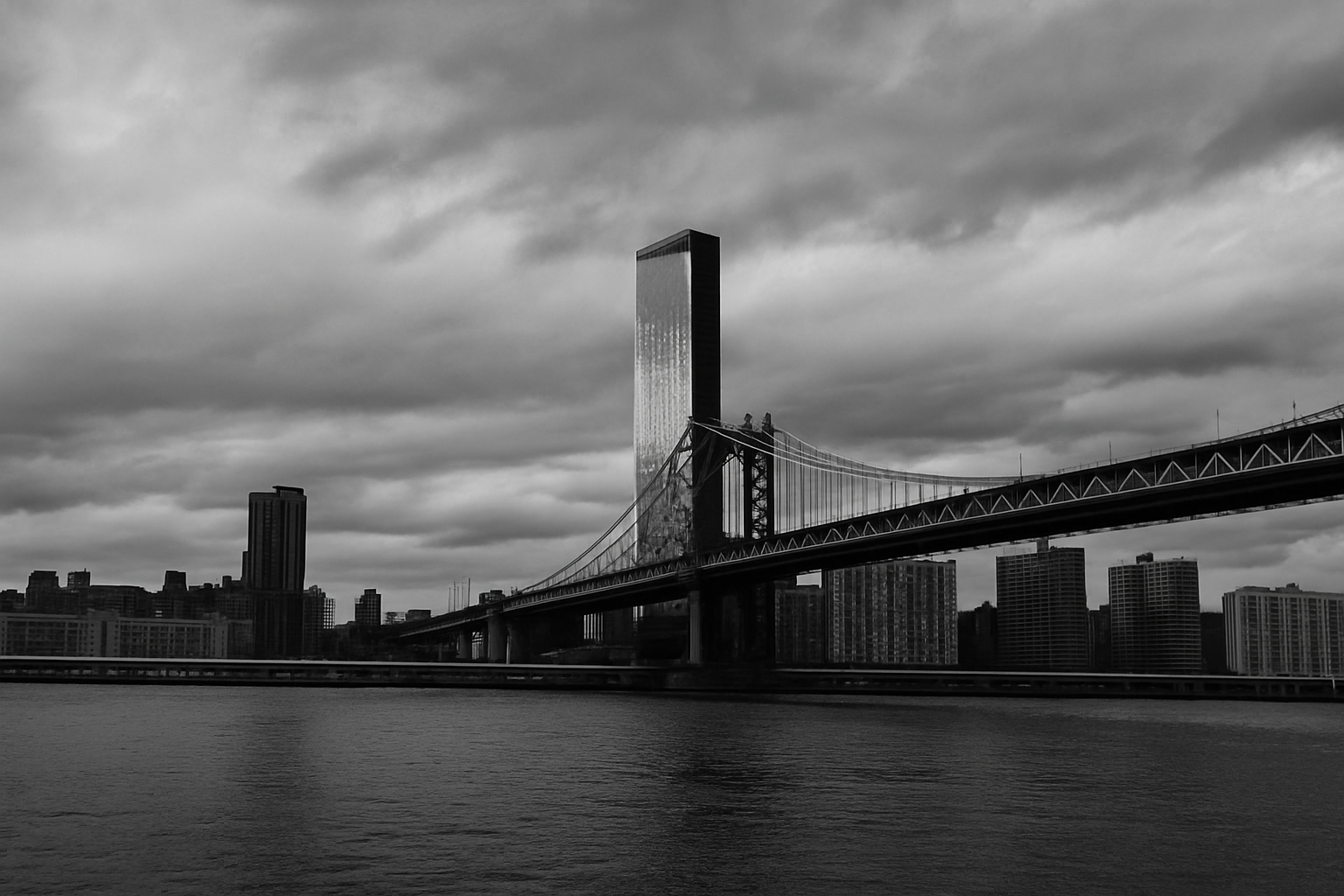
In the early 1900s, New York stopped building out and started building up. Steel frames and elevators unlocked vertical ambition—and Art Deco gave it style.
This era wasn’t just about height. It was about turning towers into statements. Every surface mattered. Every detail sent a message.
Everyone knows the Chrysler and Empire State Buildings. But if you’re serious about architecture, go deeper.
Look at These Instead:
● American Radiator Building (1924, Raymond Hood)
Forget chrome and glass—this one’s black brick with gold trim. A building made to look like a furnace. It's compact but commanding. The start of modernism in disguise.
● Chanin Building (1929, Sloan & Robertson)
Easily missed from the street. But inside? It’s industrial design poetry. Terra cotta patterns. Machine-inspired bronze. A bold mix of Art Deco and raw energy.
What to Focus On:
-
Base, shaft, crown—the tripartite skyscraper structure
-
Ornament used for identity, not just beauty
-
How zoning laws (like the 1916 setback rule) shaped the silhouette of every tower
Why It Mattered:
This wasn’t architecture for the elite. These were commercial towers meant to impress millions. Every inch had to work—from lobby floor mosaics to rooftop spires.
Who Made It Happen:
-
Raymond Hood – Blended Gothic and Deco before modernism took over
-
William Van Alen – Chrysler Building, built as brand promotion for a car company
-
Sloan & Robertson – Quiet masters of texture and proportion
This was the decade when New York looked up—and never looked back.
Must-Read Book
"Delirious New York: A Retroactive Manifesto for Manhattan" by Rem Koolhaas
What’s in it? Koolhaas examines New York City’s urban evolution, blending architectural theory with cultural commentary to reveal the city’s unique design.
Why You Should Buy It:
Perfect for understanding the dynamic and chaotic nature of NYC's skyline, this book is a must for anyone fascinated by urban architecture. Get it on Amazon.
After the Glamour: Modernism Hits the Ground (Mid-20th Century)
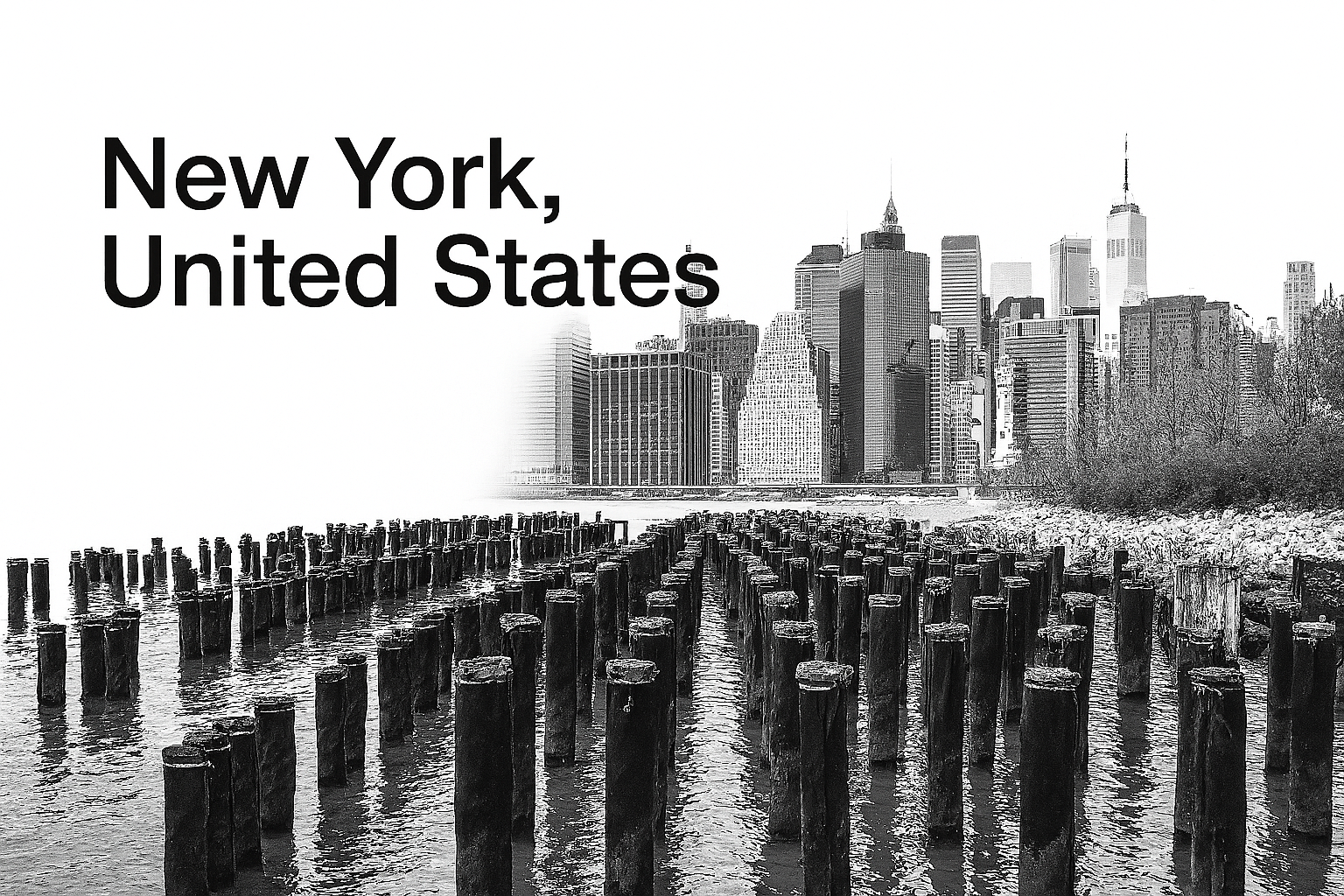
IMAGE: Black and white photo showing the Manhattan skyline as seen from Brooklyn, capturing the iconic urban landscape of New York City.
Once Art Deco burned out, the mood changed. Ornament vanished. Steel and glass took over. By the 1950s, New York was building less like a city of ambition and more like a machine for living.
Modernism wasn’t about making statements—it was about function, repetition, and efficiency.
Forget gold trim. Think black glass and bronze frames.
Two Buildings That Changed the Game:
● Seagram Building (1958, Ludwig Mies van der Rohe + Philip Johnson)
This tower didn’t shout. It whispered. Set back from the street, it created its own plaza—something unheard of in Manhattan. Bronze-toned I-beams, clean lines, and no decoration. Just proportion, rhythm, and precision.
● Lever House (1952, Skidmore, Owings & Merrill)
Glass curtain walls. A sleek rectangle on stilts. It broke with the heavy, grounded buildings of the past. Suddenly, lightness mattered. Air and space mattered.
What to Focus On:
-
Curtain wall systems: glass replacing stone
-
Open public plazas instead of dense sidewalk walls
-
Uniform floorplates, designed for corporate use—not individualism
Why It Mattered:
This wasn’t about legacy—it was about systems. Office buildings became tools. Skyscrapers became products. The city was turning into an efficient grid, inside and out.
Who Led the Shift:
-
Mies van der Rohe – His “less is more” mantra became the blueprint for corporate modernism
-
Philip Johnson – Played both sides: minimalist now, postmodernist later
-
SOM (Skidmore, Owings & Merrill) – The ultimate corporate architecture firm
This era made NYC cleaner, colder, faster.
Some call it boring. Some call it brilliant. Either way, it changed how cities were built forever.
NYC ARCHITECTURE STYLES
The Styles That Built New York: What to Know and Where to Look
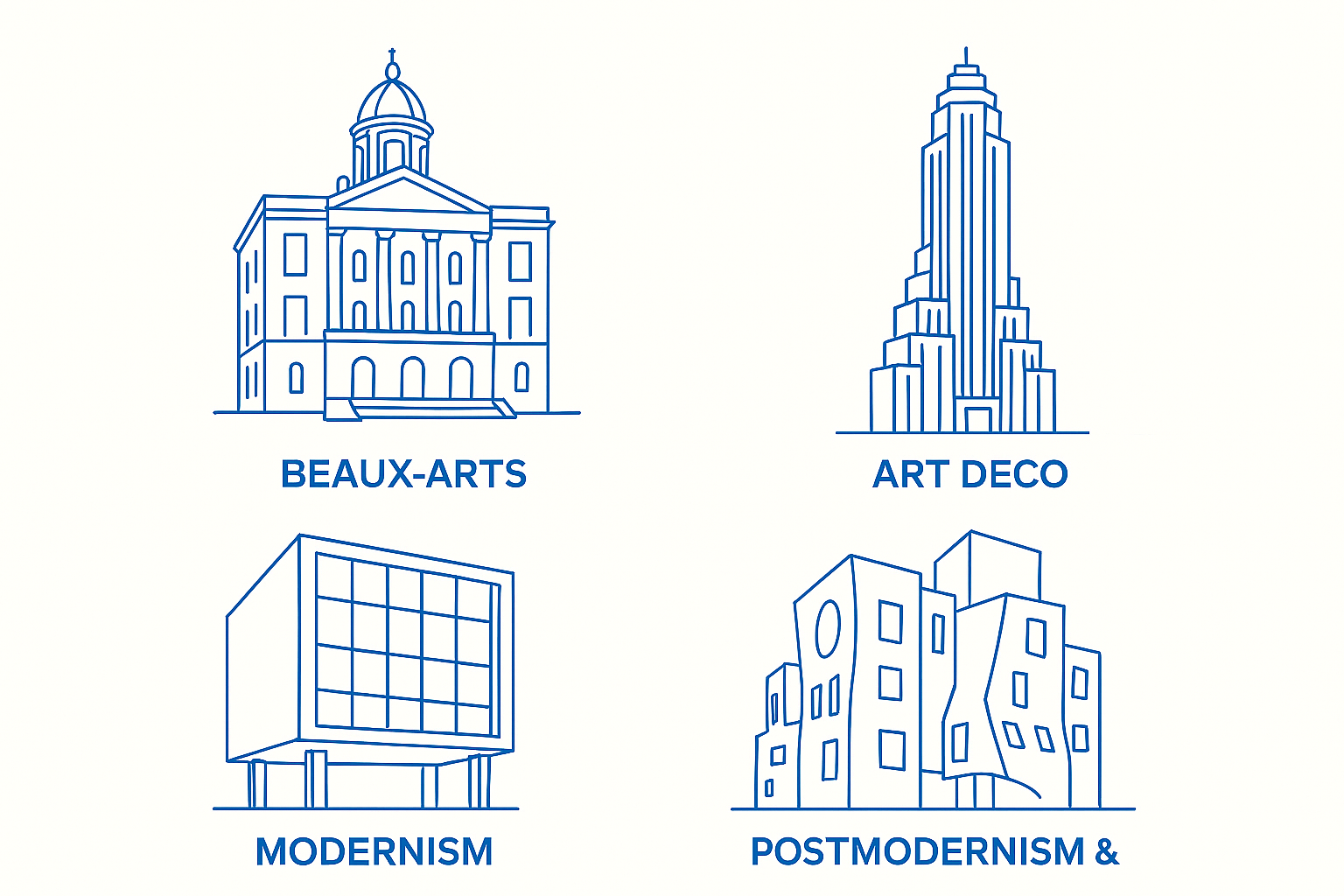
New York’s skyline didn’t happen all at once. It’s a collage of styles—each one tied to a moment in history, a shift in culture, or a new way of building. Here's what to focus on:
Beaux-Arts & Neoclassicism
Grandeur. Symmetry. Stone and spectacle.
● What defines it: Formal columns, arched windows, carved stone facades, and symmetry that screams power and prestige.
● Why it mattered: This was New York’s “look how serious we are” phase—when it wanted to be taken as a world-class city.
Where to see it:
▪ The New York Public Library (5th Ave lions and all)
▪ The Metropolitan Museum of Art
▪ Grand Central Terminal’s main hall
Look for: Wide staircases, domes, classical statues, and interiors that feel like palaces.
Art Deco
The city got taller—and flashier.
● What defines it: Bold lines, tiered setbacks, gold trim, and a love of geometry. Think zigzags, sunbursts, and skyscraper spires.
● Why it mattered: It was the style of the roaring '20s and survivalist '30s—optimism carved into stone and steel.
Where to see it:
▪ Chrysler Building (those eagles!)
▪ Rockefeller Center
▪ American Radiator Building (black + gold, can’t miss it)
Look for: Elevator doors with etched metal, vertical stripes, and stylized patterns straight out of the Machine Age.
Modernism
No frills. Just structure.
● What defines it: Glass, steel, function-first design. No ornaments, no nostalgia—just clean lines and honest materials.
● Why it mattered: After WWII, efficiency was the goal. It was about rebuilding fast, cheap, and new.
Where to see it:
▪ Seagram Building (Mies van der Rohe’s minimalist masterpiece)
▪ Lever House (sleek, curtain-wall glass before it was trendy)
Look for: Open plazas, exposed structural elements, and a total rejection of fluff.
Postmodernism & Deconstructivism
Playful, weird, and not afraid of color.
● What defines it: Clashing shapes, irony, historical callbacks, or just plain chaos. These styles broke rules on purpose.
● Why it mattered: It pushed back against the coldness of modernism and brought personality back to architecture.
Where to see it:
▪ Sony Tower (once AT&T Building) with its “Chippendale” top
▪ Cooper Union’s newer building (wild, warped metal forms)
▪ 41 Cooper Square (twisting mesh and asymmetric windows)
Look for: Broken symmetry, bold materials, and buildings that feel more like sculptures than structures.
Contemporary + What’s Next
Glass giants. Green tech. Global ambition.
● What defines it: Ultra-thin towers, eco-engineering, and digital parametric design. Architecture that thinks about climate, efficiency, and impact.
● Why it matters: It’s not just about looking good anymore—it’s about performing better and lasting longer.
Where to see it:
▪ One World Trade Center (LEED Gold certified)
▪ Steinway Tower (super-skinny, super-luxe)
▪ The Edge at Hudson Yards
Look for: Curved glass, sky gardens, energy-efficient cladding, and tech-driven facades.
Takeaway:
Each of these styles tells you what New York wanted at that time—power, optimism, order, rebellion, or sustainability.
To walk the city is to walk through its shifting values, etched in concrete, metal, and glass.
Post-War Modernism and Brutalism
International Style
After World War II, the International Style became a dominant architectural movement, characterized by clean lines, functional design, and a lack of ornamentation. Modernist structures in New York, like the United Nations Headquarters and Lever House, are prime examples of this style. These buildings emphasize glass facades, steel frames, and open floor plans, reflecting the ideal of form following function.
- United Nations Headquarters: Designed by an international team, this complex epitomizes the post-war desire for global cooperation and architectural progress. Its sleek, minimalist design focuses on transparency and simplicity, using large glass facades to symbolize openness and diplomacy.
- Lever House: This skyscraper, located in Midtown Manhattan, is one of the first to use a glass curtain wall, setting a precedent for modern office buildings. Its rectangular form, clean lines, and use of open space represent the ideals of the International Style.
Brutalism
Brutalism, a stark contrast to the International Style, emerged in the 1950s and '60s. Known for its use of raw concrete and imposing forms, Brutalism focuses on functionality and structural honesty. While often criticized for its austere, monolithic appearance, it left a strong imprint on New York’s public architecture.
- Bronx Civic Center: A notable example of Brutalism in New York, the Bronx Civic Center showcases the movement's hallmark use of raw, unadorned concrete. Its heavy, block-like forms reflect the style’s emphasis on functionality and a rejection of ornamentation. Despite its lack of popularity, it stands as an important part of the city's architectural narrative.
Both Post-War Modernism and Brutalism played critical roles in shaping the post-war architectural landscape of New York, moving away from the decorative styles of the past and towards more utilitarian and minimalist structures.
HIDDEN GEMS
Overlooked but Built to Last

Not every building in New York screams for attention. Some whisper. And those whispers often say more.
Mid-Century Office Buildings That Deserve a Second Look
While tourists stare up at the Empire State Building, most locals walk past buildings like the McGraw-Hill Building without a second glance.
Designed by Raymond Hood in 1931, it sits somewhere between Art Deco and modernism—cool turquoise terracotta, strong horizontal lines, and clean massing. It’s bold, but not loud. It’s the kind of building that rewards people who actually pay attention.
Civic Buildings With Real Weight
The Surrogate’s Courthouse is the kind of municipal structure cities don’t build anymore.
It’s pure Beaux-Arts—from its carved marble facade to its monumental interior stairs.
Built in the early 1900s, it shows how New York once used public buildings to signal ambition, permanence, and power.
Architect’s Pick: Buildings That Don’t Beg You to Notice
Some buildings don’t care if you like them.
The AT&T Long Lines Building is a brutal, windowless monolith in Lower Manhattan. It wasn’t built to impress—it was built to protect sensitive telecom equipment. And that makes it one of the most honest pieces of architecture in the city.
You also have Mies van der Rohe’s Seagram Building. People call it minimal, but get closer—it’s pure detail. Bronze skin, perfect proportions, clean repetition. Quiet buildings, sharp lessons.
New York’s Forgotten Architecture: Beneath the Streets
When people picture New York architecture, they look up—at towers, spires, and glass walls. But some of the city’s most fascinating architecture is hidden below street level.
Underneath the surface lies a network of forgotten tunnels, abandoned stations, and historic infrastructure that once powered the city’s growth.
Key Examples:
● City Hall Subway Station – Opened in 1904, closed in 1945. This underground station is covered in Guastavino tile, arched ceilings, chandeliers, and skylights. It’s still there—sealed off and largely unseen.
● The Old Croton Aqueduct – Built in the 1840s, this water system once ran from Westchester to Manhattan. Miles of hand-built underground tunnels still exist, showing how early engineers carved infrastructure through bedrock.
● Atlantic Avenue Tunnel – Built in 1844 and sealed for decades, it’s considered the world’s oldest subway tunnel. Brick-lined, massive, and haunting—this forgotten corridor once carried trains under Brooklyn streets.
These spaces weren’t built as spectacles. They were built to solve urgent problems—moving water, people, and power across a growing city. And they did it with skill, permanence, and unexpected beauty.
Today, most New Yorkers walk above these structures without ever knowing they’re there.
And that’s what makes them important. They’re not just relics—they’re reminders of how architecture isn’t always about what you see. Sometimes, the most impressive work is invisible.
Urban Design and Public Spaces in NYC
🟦 How New York Was Planned
The Grid That Changed Everything
In 1811, NYC locked itself into one of the boldest moves in urban history: the street grid. The Commissioner’s Plan didn’t just organize space—it turned chaos into predictable, fast-growing blocks. That grid made development cheap, streets legible, and the city scalable.
Then came the Zoning Resolution of 1916. It forced buildings to “step back” from the street as they got taller—introducing setbacks that let light and air in. You can thank this for the wedding-cake style of early skyscrapers like the Empire State Building.
🟦 What Urban Planning Does Now
From Concrete to Community
Today, urban design isn’t about expansion—it’s about fixing what’s already there. That means:
-
Affordable housing rules
-
Mixed-use development
-
Green roofs and parks
-
Climate resilience in every new plan
Zoning now shapes neighborhoods to be more livable, not just more profitable.
🟦 Parks That Built a City
Central Park wasn’t just about trees. Olmsted and Vaux built it as a “social equalizer”—a place where rich and poor could breathe the same air. That idea stuck.
Today, public space means more than just lawn:
-
The High Line turned abandoned rail into a vertical garden.
-
Washington Square Park still mixes protests, jazz, chess, and chill in a few tight acres.
-
Little Island, built over the river, proves a park doesn’t even need land anymore.
🟦 The Future: Resilient and Dense
Hudson Yards shows what’s next—dense, vertical neighborhoods packed with commercial, residential, and retail, stitched together with plazas and parks.
NYC is also testing:
-
Eco-districts that track energy, waste, and water use
-
Storm-ready shorelines in places like Red Hook and Lower Manhattan
-
Car-free zones to lower emissions and boost walkability
Bottom Line:
New York’s best public spaces are intentional. Urban design here is about making it smarter, healthier, and ready for what’s next.
New York City Architecture
Preservation and Green Building: The Real Work Behind NYC Architecture
Keeping What Matters
Some buildings stay because they still work. Others because they still matter.
● Grand Central nearly got wiped out. It didn’t—because people stopped it.
● The Dakota, The Ansonia, The Flatiron—they’re not just old. They’re built better than most new stuff.
Preservation isn’t romance. It’s respect for solid craft.
Building Better Now
The new stuff? It has to hold up—without killing the planet.
● One Bryant Park runs on clean air and recycled water.
● Green roofs keep streets cooler.
● Better insulation, passive design, less waste.
This is where architecture’s headed. Not fancier. Smarter.
Architects Who Changed New York
The Originals
William Van Alen
▪ Designed the Chrysler Building
▪ Made Art Deco a skyline signature with steel, speed, and style
Cass Gilbert
▪ Created the Woolworth Building
▪ Mixed Gothic detail with early skyscraper tech—world’s tallest in 1913
These two didn’t just build—they defined an era.
The Innovators Now
Diller Scofidio + Renfro
▪ Designed The Shed at Hudson Yards
▪ Buildings that move, shift, and respond—part structure, part machine
Bjarke Ingels (BIG)
▪ Created VIA 57 West
▪ A new shape for city living—mixing courtyard calm with vertical ambition
These names are shaping what architecture looks like now—and where it’s going.
Iconic Buildings of NYC: What to Focus On and Why They Matter
New York’s skyline is more than just tall buildings—it’s a layered story of ambition, style, and structural evolution. Here’s what to look for, building by building, and what they represent.
🔹 Early Skyscrapers – The First Bold Steps
What to focus on: Structure + Ornament + Symbolism
-
Woolworth Building (1913): Neo-Gothic detail on a steel frame—set the bar for height and style.
-
Flatiron Building (1902): Triangular lot, steel skeleton—early proof NYC could shape space, not just fill it.
🔹 Art Deco Power – The Golden Age
What to focus on: Vertical rhythm, metallic detailing, form-as-brand
-
Chrysler Building (1930): Car-age speed meets spire glamour—iconic stainless steel crown.
-
Empire State Building (1931): Mass, symmetry, and endurance—built in 410 days during the Depression.
🔹 Modernism Arrives – Clean and Corporate
What to focus on: Simplicity, grid logic, material honesty
-
Seagram Building (1958): Mies van der Rohe’s bronze minimalist—made setbacks sexy.
-
Lever House (1952): Glass curtain wall—first of its kind in NYC, shifted the whole corporate design game.
🔹 Postmodern + Super Tall – Vertical Statements
What to focus on: Function meets spectacle, tech-driven forms
-
One World Trade Center (2014): Symbolic height, layered safety, LEED Gold.
-
Bank of America Tower (2009): Green tech core—one of NYC’s most sustainable skyscrapers.
🔹 Ultra-Luxury Residentials – Thin, Rich, Controversial
What to focus on: Floorplate innovation, skyline tension, money as form
-
432 Park Avenue: Pencil-thin, square windows—pure real estate logic in concrete.
-
One57: Blue glass, sky-high pricing—ushered in Billionaire’s Row.
🔹 Cultural Icons – Shape Over Scale
What to focus on: Expression, civic meaning, public flow
-
The Guggenheim: Frank Lloyd Wright’s spiral—rebel architecture on the Upper East Side.
-
The Met Museum: Eclectic façade, ever-expanding—tells NYC’s story in layers.
🔹 Civic Landmarks – Beauty in Utility
What to focus on: Scale, legacy, transit as monument
-
Grand Central Terminal: Beaux-Arts grandeur meets industrial function—still breathtaking.
-
NY Public Library (Main Branch): Lions, marble, and memory—built to last, and impress.
Contemporary Masterpieces in NYC Architecture
The 21st century isn’t just more glass—it’s more function, more flexibility, and smarter design. Here’s what’s actually changing the city.
🔹 One World Trade Center
Architect: Skidmore, Owings & Merrill
What to focus on: Symbolism, structural safety, energy performance
-
Still the tallest in the Western Hemisphere.
-
Built for strength, visibility, and resilience post-9/11.
-
LEED Gold–rated skyscraper that proves sustainability doesn’t mean small.
🔹 VIA 57 West
Architect: Bjarke Ingels Group (BIG)
What to focus on: Form, green space, urban innovation
-
A warped pyramid–meets–courtyard hybrid.
-
Solves the “tower vs. park” dilemma in one bold move.
-
A real answer to dense city living—smart, green, and weird in a good way.
🔹 The Shed
Architects: Diller Scofidio + Renfro with Rockwell Group
What to focus on: Adaptability, public use, mechanical genius
-
A building that moves—literally.
-
Retractable shell lets it shape-shift for concerts, exhibits, anything.
-
Redefines how culture fits into real estate.
🔹 The Vessel
Architect: Heatherwick Studio
What to focus on: Public interaction, form-as-function, spectacle
-
Not quite a building, not just a sculpture.
-
Designed for climbing, viewing, gathering—not just watching.
-
Controversial, but undeniably new.
🔹 The High Line
Designers: James Corner Field Operations + Diller Scofidio + Renfro
What to focus on: Urban reuse, landscape meets architecture
-
Old elevated rail turned into a park.
-
Sparked a wave of adaptive reuse projects around the world.
-
Blurs the line between city, nature, and design.
Bottom Line:
Contemporary NYC architecture isn’t just about height anymore. It’s about reusability, interaction, and how people actually move through the city. These projects show how architecture can flex, evolve, and still be beautiful.
Wrap-Up: Why It All Matters
New York didn’t just grow.
It was built, torn down, rebuilt.
Then reshaped, block by block!
You’ve seen the real stuff: underground stations no one talks about, towers that changed how cities are made, and the architects who took risks.
This is understanding how power, design, and survival shaped one of the toughest cities on earth.
Know what to look for. That’s how you stop walking past history.
EXTRAS
NYC Architecture & Interior Design Firms That Shape the World
New York isn’t just home to iconic buildings—it’s where the world’s most influential architecture and interior design firms operate. These studios don’t just shape the city—they shape cities across the globe.
Top Global Architecture Firms Based in NYC
Skidmore, Owings & Merrill (SOM)
Designers behind One World Trade Center, SOM combines engineering and sustainability with powerful design. Their work influences urban skylines from New York to Dubai.
Kohn Pedersen Fox (KPF)
Known for mega-projects like Hudson Yards, KPF blends high-rise luxury with master planning. Their work is driven by environmental strategy and elegant form.
Innovators Who Redefine the Rules
Diller Scofidio + Renfro
Masters of civic and cultural space, this firm transformed the High Line and revamped Lincoln Center. Their designs fuse storytelling, public interaction, and bold visual identity.
SHoP Architects
From the Barclays Center to skyscrapers using modular construction, SHoP embraces technology and fresh material use. Their digital workflows make complex ideas buildable.
Leaders in Green and Sustainable Design
COOKFOX Architects
Famous for biophilic design, they created the ultra-sustainable Bank of America Tower. Their work prioritizes health, light, air, and a deeper connection to nature.
FXCollaborative
Their projects like 4 Times Square and The Greenwich Lane show how sustainability, performance, and beauty can co-exist in dense cities.
Interior Design Powerhouses
Rockwell Group
Known for immersive spaces—from Nobu restaurants to luxury hotels—Rockwell blends mood, material, and storytelling.
Gensler
With offices worldwide, Gensler’s NYC studio leads interior design for workplaces like Spotify and Morgan Stanley, balancing brand and user experience.
Rising Firms to Watch
WORKac
This studio mixes ecology and architecture, known for projects like the Edible Schoolyard at PS216. Their playful, sustainable design speaks to the next generation of cities.
nARCHITECTS
Leaders in small-scale innovation. Their My Micro NY project launched NYC’s first micro-housing development, a bold step toward housing reform.
How to Learn More
● AIA New York / Center for Architecture: Check lectures, exhibitions, and firm tours.
● Columbia GSAPP / Pratt Institute: Leading programs shaping the next wave of talent.
● Architizer / Architectural Digest: Explore features, rankings, and firm deep-dives.
Must-Read Books
Essential Books on New York City Architecture for Enthusiasts and Professionals
1. "New York 1900: Metropolitan Architecture and Urbanism 1890-1915" by Robert A.M. Stern, Gregory Gilmartin, and John Massengale
What’s in it?
- This book delves into the late 19th and early 20th centuries, covering Beaux-Arts and the architectural boom that shaped modern New York.
- Why You Should Buy It: Perfect for anyone interested in the historical transformation of New York’s urban landscape during a period of immense growth and architectural experimentation. Get it on Amazon
2. "Delirious New York: A Retroactive Manifesto for Manhattan" by Rem Koolhaas
What’s in it?
- Rem Koolhaas explores the chaotic beauty of New York City’s urban design and its history. The book is a unique blend of architectural theory and cultural history.
- Why You Should Buy It: An essential read for those who want to understand how New York’s skyline reflects its complexity and ambition. Get it on Amazon
3. "The Architecture of New York City" by Donald M. Reynolds
What’s in it?
- This is a comprehensive overview of the architectural evolution of New York, from its early settlements to its modern-day skyscrapers.
- Why You Should Buy It: It’s a highly informative guide that captures the chronological development of the city’s unique skyline, making it ideal for architectural students and professionals. Get it on Amazon
4. "The Historic Shops and Restaurants of New York" by Ellen Williams and Steve Radlauer
What’s in it?
- This book highlights New York’s historic commercial architecture, focusing on the shops and restaurants that have stood the test of time.
- Why You Should Buy It: For those fascinated by the hidden architectural gems that define the city’s cultural and historical identity. Get it on Amazon
5. "Manhattan Skyscrapers" by Eric P. Nash and Norman McGrath
What’s in it?
- This book offers a photographic journey through the skyscrapers that dominate Manhattan’s skyline, providing historical background and architectural details.
- Why You Should Buy It: If you’re captivated by New York’s tall buildings, this book is a visual treat that also educates. Get it on Amazon
6. "Why Buildings Fall Down: How Structures Fail" by Matthys Levy and Mario Salvadori
What It’s About:
This book explores structural failures in famous buildings and what can be learned from them. It’s a captivating read for architects and engineers alike, diving into the science of why some structures don't stand the test of time.
Why You Should Buy It:
Understanding past architectural failures is crucial to building better, safer structures in the future. This book offers practical lessons and insights into structural engineering that every architect should know.
Affiliate Notice: While there's no additional cost to you, we do earn a commission through affiliate links if you choose to purchase something after following our recommendation.
FAQ
Architecture in New York City
Is New York a good place for architects?
Yes. It’s one of the best places on Earth to work in architecture. The skyline is always evolving. Big firms, constant projects, old buildings to restore, new towers to design—it’s a real lab for creativity. If you’re serious about architecture, NYC pushes you to level up.
What are the most famous architecture firms in NYC?
Some names come up over and over:
- SOM (Skidmore, Owings & Merrill) – Think One World Trade Center.
- BIG (Bjarke Ingels Group) – Behind VIA 57 West.
- KPF (Kohn Pedersen Fox) – They helped shape Hudson Yards.
These firms don’t just dominate NYC—they influence design globally.
What architectural styles are in New York?
New York is a buffet of architectural styles. Examples:
- Beaux-Arts – Grand Central Terminal
- Art Deco – Chrysler Building, Empire State Building
- Modernism – Seagram Building
- Postmodernism – AT&T Building
- Contemporary – The Shed, One World Trade Center
It’s like walking through a timeline of design history.
How do I find an architect in NYC?
Simple:
- Start with the AIA New York Chapter directory
- Check firm portfolios online
- Go to design events, exhibitions
- Ask people who’ve built or renovated in NYC
Always look at past work and make sure their style fits what you want.
What are the 4 main types of architecture?
Here’s how the profession splits:
- Residential – Homes, condos, apartments
- Commercial – Offices, malls, restaurants
- Industrial – Factories, warehouses
- Institutional/Public – Schools, museums, hospitals
Each requires different skills and rules.
Where can I study architecture in NYC?
Best schools in town:
- Columbia GSAPP – Top-tier theory and global design
- Pratt Institute – Hands-on design training
- The Cooper Union – Rigorous and free for some
- CCNY (Spitzer School) – Great education at a public price
- NYIT – Accredited and tech-forward
NYC is a hard place to live. These schools make it worth it.
Explore More About NYC Architecture
1. Landmarks You Should Know
- Empire State Building
- Chrysler Building
- Flatiron Building
- Grand Central Terminal
2. Styles That Built the City
- Art Deco, Beaux-Arts, Modernism, Postmodernism
3. How the City Was Planned
- The 1811 Grid Plan
- Zoning laws and setbacks
- Modern resilience planning
4. Sustainable NYC Projects
- One Bryant Park (LEED Platinum)
- Javits Center green roof
5. Interior Design in NYC
- Open-concept apartments
- Mixed-use towers
- Historic-meets-modern in high-end interiors
6. Preservation and Renovation
- Woolworth Building (residential conversion)
- Grand Central (preserved icon)
7. Architecture Schools in NYC
- Columbia, Pratt, Cooper Union, CCNY, NYIT
8. Must-See Museums and Design Stops
- MoMA Design Store
- Cooper Hewitt Design Museum
- Skyscraper Museum
- Storefront for Art and Architecture
9. Underrated Historic Buildings
- The Ansonia
- The Beresford
- The Apthorp
10. Streets That Matter
- Park Avenue (corporate power)
- Fifth Avenue (landmarks + luxury)
NYC isn’t just one city.
It’s hundreds of cities stacked on top of each other.
Learning architecture here means learning history, risk-taking, reinvention, and how to build when space runs out.