
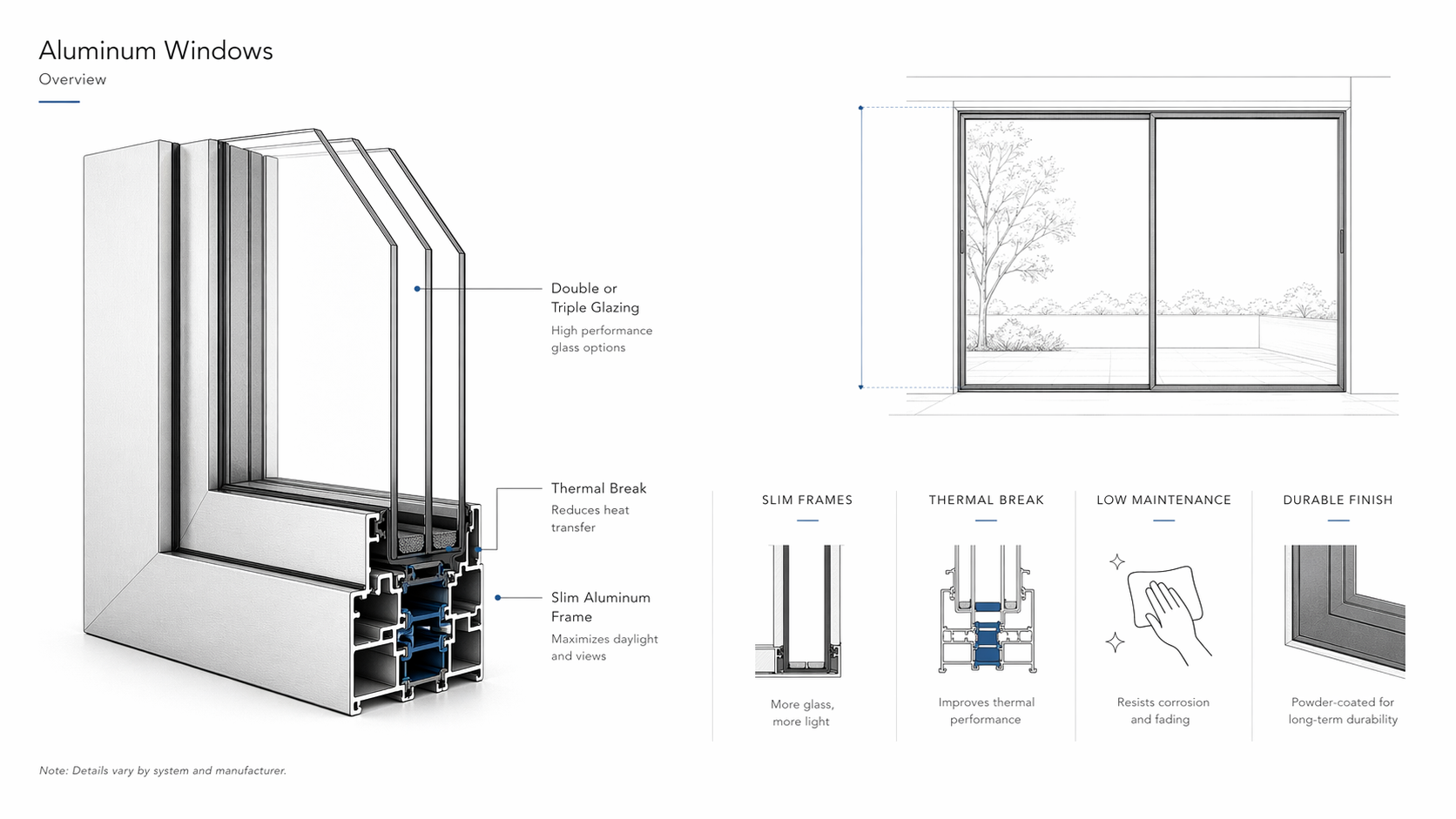
Aluminum window frames solve a specific problem. They hold large glass in a slim profile without rotting, swelling, or needing repainting every few years the way wood does. That is why you see them in storefronts, schools, offices, and modern homes with floor-to-ceiling glazing.
The problem is not aluminum. The problem is cheap aluminum. A frame without a thermal break, or one with weak seals and budget hardware, will collect condensation, leak air, and feel cold in winter — and people blame the material when the issue was the system or the install. Those are not the same thing.
If you are still in the design stage, Design Your Own Windows is the better page to start with. If you are specifying or buying aluminum frames, read on.
How the Frame Works
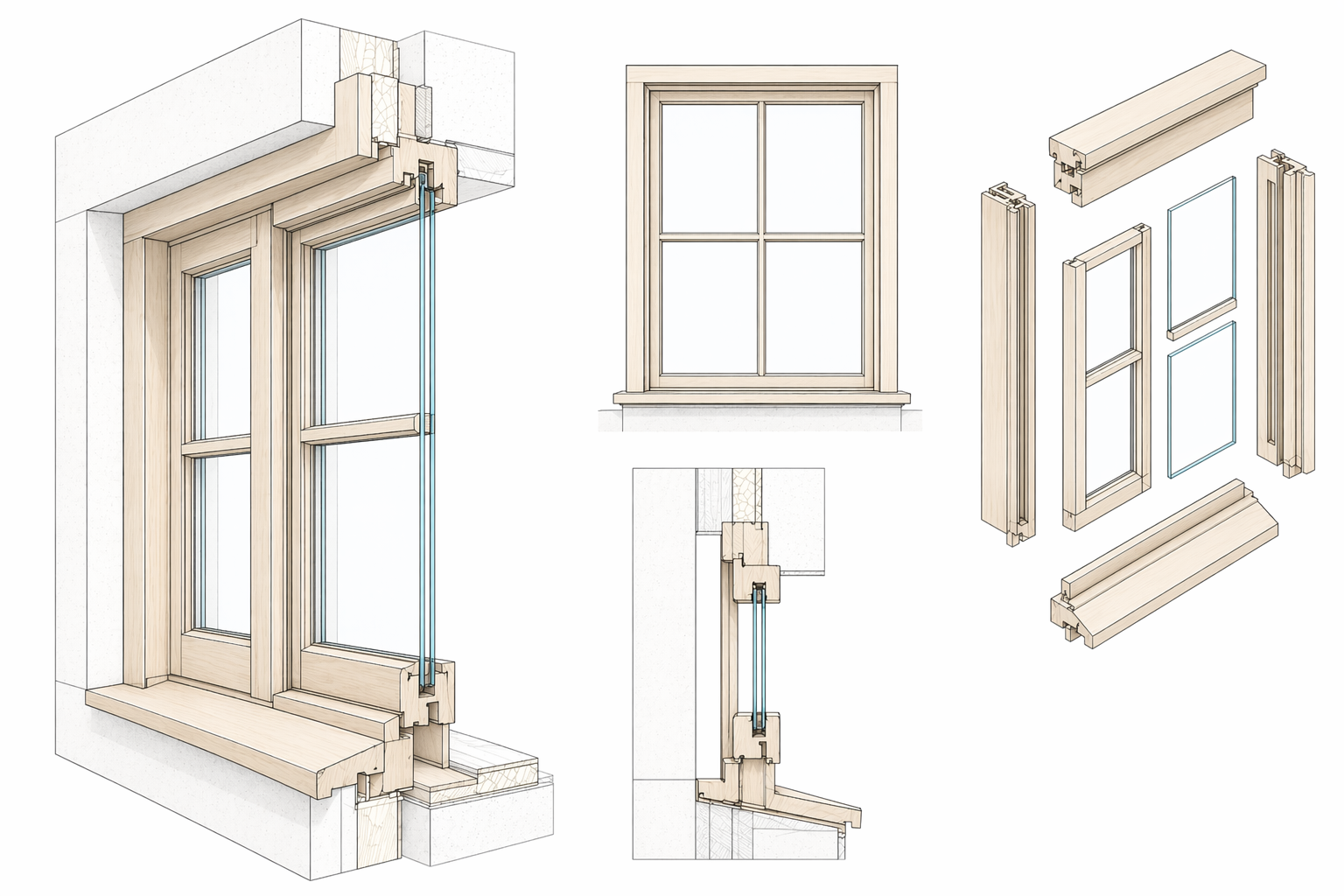
Illustration by ArchitectureCourses.org. Basic aluminum window frame parts and profile shape.
An aluminum window frame is built from extruded profiles — long metal sections shaped with grooves, tracks, channels, and pockets that hold glass, seals, hardware, and fasteners in position. Extrusion is what makes aluminum practical at scale: consistent, complex shapes produced without machining each piece.
The frame has four jobs: hold the glass, keep the unit square and rigid, block air and water, and tie the window into the wall opening. When any of those four fail, the window fails. Most failure points trace back to the thermal break, the seals, the hardware, or the install — not the aluminum itself.
Aluminum vs. the Alternatives
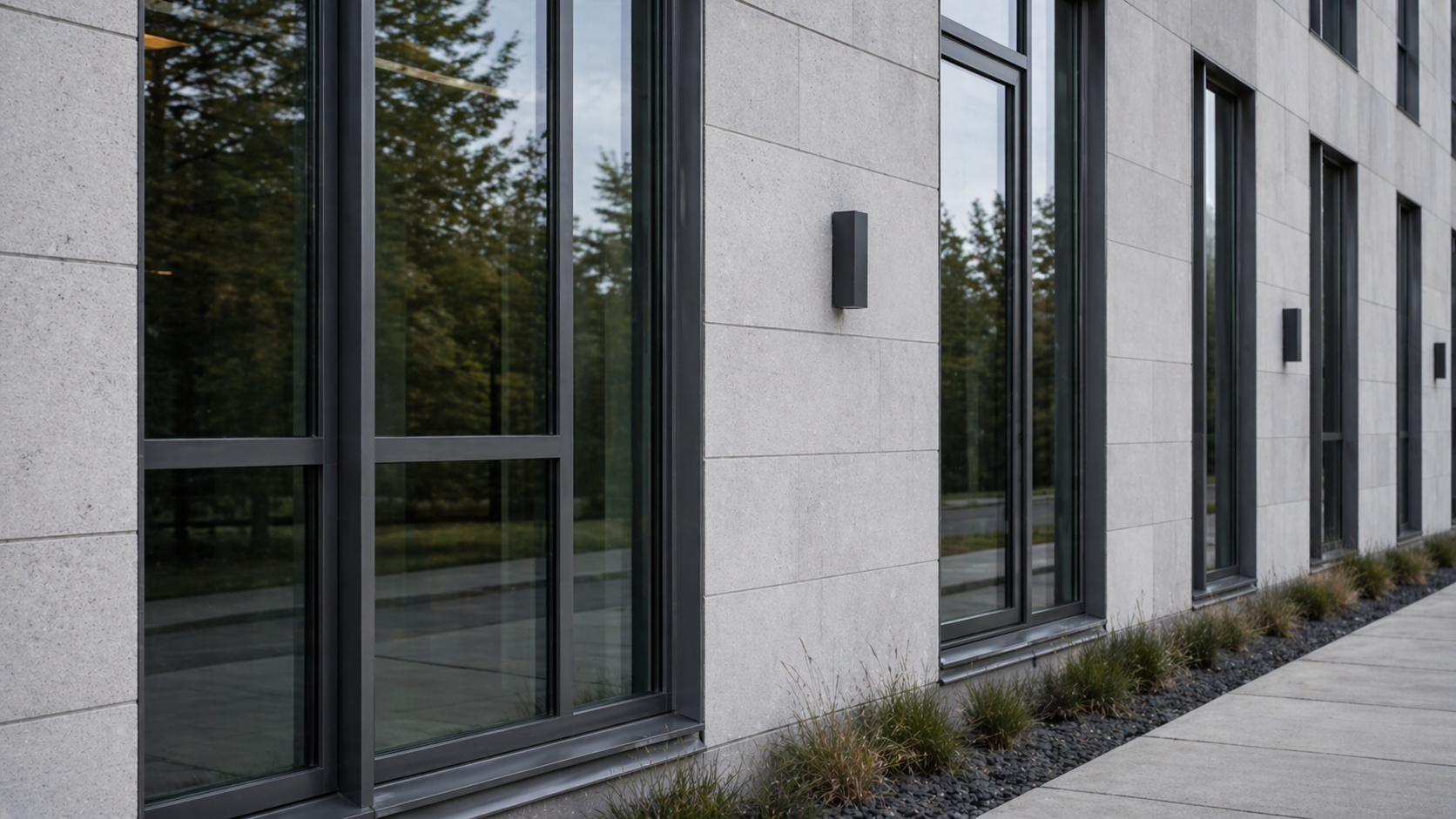
Image by ArchitectureCourses.org. Slim aluminum window frames suit contemporary facades where clean profiles, durability, and low maintenance matter.
Most projects are deciding between aluminum, vinyl, wood, fiberglass, and occasionally steel. Each has a different strength, a different weakness, and a different market it fits best.
| Material | Strength | Thermal Performance | Maintenance | Cost (Installed, Per Window) | Best For |
|---|---|---|---|---|---|
| Aluminum | Excellent — strongest frame material per unit of profile depth | Poor without thermal break; adequate to good with one | Very low — no rot, no repainting | $400–$1,200 residential; $800–$1,500+ commercial | Large glass, commercial, modern homes, low-maintenance projects |
| Vinyl (uPVC) | Moderate — can flex and warp in large spans | Good — naturally insulating, no thermal break needed | Very low — no painting, but fades and becomes brittle over decades | $200–$600 | Budget residential replacement where energy performance matters more than frame slimness |
| Wood | Good — heavier but traditional construction | Good — naturally insulating | High — needs repainting every 5–10 years; rots without maintenance | $500–$1,500+ | Period homes, traditional architecture, interiors where the wood look is the point |
| Fiberglass | Very good — stiffer than vinyl, expands less than aluminum | Excellent — low conductivity, holds shape through temperature swings | Low — can be painted, holds paint well | $600–$1,800+ | High-performance builds where energy is the priority; cold climates |
| Steel | Excellent — strongest of all frame materials, thinnest possible profiles | Poor — higher conductivity than aluminum; thermal break is critical | Moderate — can rust if finish fails; more demanding than aluminum | $1,500–$5,000+ | Industrial and heritage aesthetics, ultra-slim profiles, specialist projects |
Aluminum sits in the middle on price and at the top on strength. Its weakness is thermal performance, which is why the thermal break is the most important specification on any aluminum window in a climate with cold winters. Fiberglass beats it on energy performance. Steel beats it on profile slimness. Vinyl and wood beat it on thermal performance without needing a break. Aluminum beats all of them on strength-to-section ratio and maintenance-free durability.
Why Builders Use Aluminum
| What Aluminum Does Well | Why It Matters |
|---|---|
| Slim profiles | More glass, less frame in the opening |
| Low maintenance | No rot, no repainting cycle |
| Structural strength | Handles larger openings without heavy sections |
| Dimensional stability | Does not warp or swell the way weak wood units can |
| Finish durability | Powder coat and anodized finishes outlast painted wood in most conditions |
| Recyclability | Aluminum is almost infinitely recyclable; many systems include 15–30% recycled content |
Where It Works and Where It Doesn't
| Good Use for Aluminum | Where to Be Careful |
|---|---|
| Modern homes with large glass panels | Cold climates without a thermal break — the frame conducts heat through and pulls condensation to the interior surface |
| Commercial buildings and storefronts | Cheap replacement windows where energy performance is the main concern — the low end of the aluminum market does not compete on U-value |
| Coastal and wet locations with the right finish | Historic homes where the frame needs to read as traditional — aluminum profiles do not replicate wood convincingly |
| Projects where low maintenance is the priority | Budget jobs where the cheapest available system gets specified — cheap aluminum fails fast |
| Custom shapes and large or irregular openings | Passive House builds — fiberglass or high-end thermally broken systems usually get you there more easily |
Frame Types
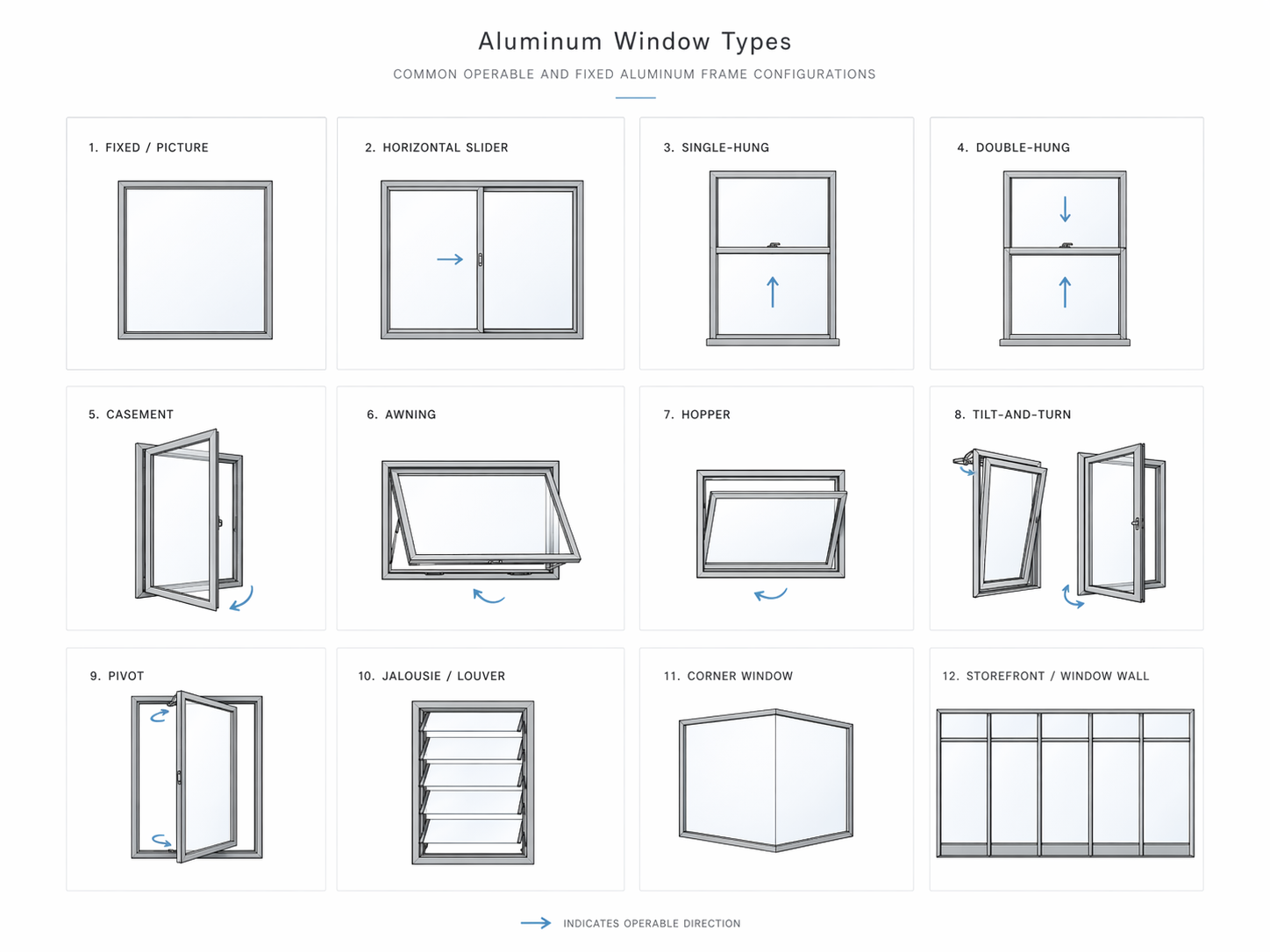
Illustration by ArchitectureCourses.org. Common aluminum window types and frame configurations.
Standard Residential Frames
These cover a wide quality range. At the low end: thin sections, no thermal break, basic hardware, seals that do not last. At the better end: thermally broken frames, real hardware, finishes that hold up. Both get called "standard residential aluminum." The price difference is real. So is the performance difference.
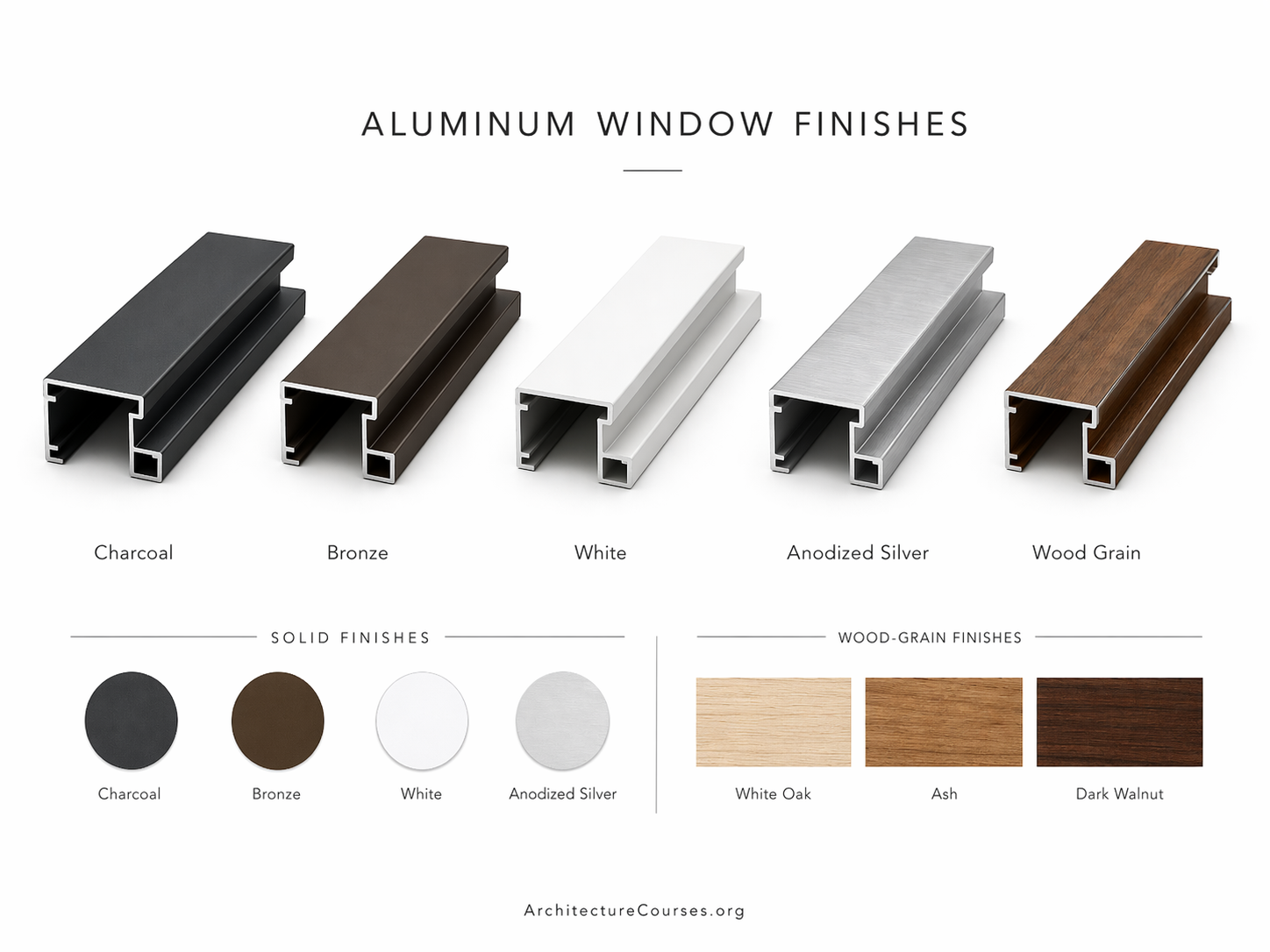
Illustration by ArchitectureCourses.org. Aluminum frame profiles, sections, and common system types.
Commercial Frames
Heavier sections, stronger profiles, built for larger glass and harder use. They cost more, but the hardware is better, the tolerances are tighter, and the systems stay straighter over time. A residential project with fixed picture windows over two meters wide should be looking at commercial-grade profiles, not residential-grade ones.
Custom Frames
Odd shapes, large spans, narrow profiles, or design-specific requirements that stock systems cannot meet — aluminum extrusions can be produced in custom profiles for projects that justify the tooling and minimum order quantities. Not inexpensive, but the right answer when nothing off the shelf works.
Sliding Systems
Sliding aluminum windows run on tracks and rollers. Common where swing clearance is limited. The track quality determines most of the experience — smooth when new, rough and dirty when the tracks are cheap or unmaintained. Drainage design matters here too. Water has to exit the sill track cleanly, and many sliding systems fail at exactly this point.
Fixed Frames
Fixed units have no moving sash, no hardware, and fewer parts that can fail. Often the most economical aluminum window option and frequently the cleanest-looking. For applications where ventilation comes from other sources, fixed aluminum is worth considering before defaulting to an operable unit.
The Thermal Break
Aluminum conducts heat roughly 1,000 times faster than wood, and up to 2,000 times faster than some wood species. Without a thermal break, the outside face of the frame is connected directly to the inside face. Heat moves out in winter, in during summer, and condensation forms on the interior surface whenever the temperature difference is large enough. On a cold day, an unbroken aluminum frame can feel as cold as the exterior glass.
A thermal break adds an insulating barrier — typically a polyamide strip 24 to 34mm wide — inside the frame profile, separating the outer and inner aluminum sections. Wider breaks perform better. A 34mm polyamide strip outperforms a 24mm one in cold conditions, and the difference shows up in U-values.
If you are buying aluminum windows for any climate with cold winters, ask specifically: does this system have a thermal break, where is it in the profile, and how wide is it? Vague answers about "improved thermal performance" without specifics are a reason to look harder or look elsewhere.
U-Values and NFRC Ratings
The U-factor measures how much heat a window assembly loses. Lower is better. It is expressed in BTU/hr·ft²·°F in the U.S. The NFRC label on a window gives you the certified whole-unit U-factor — not just the center of glass, which is always better than the whole unit because the frame and edges conduct more heat than the glass does. Always compare NFRC whole-unit ratings, not center-of-glass numbers.
ENERGY STAR Version 7.0 (effective October 23, 2023) sets the following requirements by climate zone:
| Climate Zone | Max U-Factor | SHGC Requirement | Typical States |
|---|---|---|---|
| Northern | ≤ 0.22 | ≥ 0.17 minimum (solar gain helps in winter) | MN, WI, MI, NY, ME, WA, OR, MT, WY, ID |
| North-Central | ≤ 0.25 | ≤ 0.40 | PA, OH, IN, IL, NE, CO, UT, NV (north) |
| South-Central | ≤ 0.28 | ≤ 0.23 | VA, NC, TN, AR, OK, NM, AZ |
| Southern | ≤ 0.32 | ≤ 0.23 | FL, TX (south), LA, MS, AL, GA (south), HI |
Where aluminum frames land in practice:
- Non-thermally broken aluminum: whole-unit U-values typically 0.50–0.80 or higher. Does not meet ENERGY STAR in any climate zone. Not appropriate for climate-controlled residential spaces.
- Thermally broken, double pane, standard low-e: whole-unit U-values typically 0.28–0.38. Meets Southern and South-Central requirements. Falls short of Northern and North-Central.
- Thermally broken, double pane, high-performance low-e with argon: whole-unit U-values typically 0.24–0.30. Can meet North-Central requirements; borderline for Northern.
- Thermally broken, triple pane: whole-unit U-values typically 0.17–0.22. Meets Northern zone requirements. The path to ENERGY STAR compliance for aluminum in cold climates.
The SHGC (Solar Heat Gain Coefficient) measures how much solar energy the window lets through. Higher SHGC on south-facing windows is useful in cold climates — free solar heating. Lower SHGC keeps cooling loads down in hot climates. The glazing controls this more than the frame does.
Check certified ratings on specific products at nfrc.org before specifying.
Glazing
The frame holds the glass. The glass does most of the thermal work. Specifying one without understanding the other is how projects end up disappointing.
Single Pane
One layer of glass. U-values around 0.85–1.0. Appropriate for unheated spaces — garages, agricultural buildings, covered walkways. Not appropriate for any occupied, climate-controlled space. Not ENERGY STAR eligible anywhere.
Double Pane
Two layers of glass with an air or gas-filled cavity between them. The standard for most residential and commercial work. Air-filled units produce glass U-values of roughly 0.45–0.55. Gas fill and low-e coatings push it lower from there.
Low-E Coatings
Low-emissivity coatings are microscopically thin metallic layers on the glass surface that reflect radiant heat while letting visible light through. The single most cost-effective upgrade to a standard double-pane unit. Two main types:
- High-solar-gain low-e: reflects heat back in, lets solar energy through. Right for cold climates on south-facing windows.
- Low-solar-gain low-e: reflects solar energy out, keeps interiors cooler. Right for hot climates or any orientation where summer overheating is a concern.
Specifying the wrong low-e type for the climate and orientation is a common error. A low-solar-gain coating on a north-facing window in Minnesota is counterproductive and happens more than it should.
Argon and Krypton Fill
Dense inert gases slow convection of heat through the IGU cavity. Argon is standard and widely available — it reduces the glass U-value by roughly 10–15% compared to air fill. Krypton is denser, more effective, and more expensive; used mainly in triple-pane units where the cavity is narrower. Both gases slowly leak over time, but at roughly 1% per year — not a concern over the design life of a window.
Triple Pane
Three glass layers with two cavities. U-values for the glass alone can reach 0.10–0.15 with quality coatings and gas fill. This is the direction to go when Northern zone ENERGY STAR requirements need to be met with an aluminum frame. The trade-offs are weight — significantly heavier than double pane — cost, and slightly reduced visible light transmission. For aluminum frames in the Northern zone, triple pane is often the most practical path to compliance.
Acoustic Glazing
Standard IGUs do not provide much acoustic attenuation. Acoustic glazing uses laminated glass — two glass layers bonded with an interlayer that absorbs sound — on one or both panes of an IGU. The interlayer disrupts the resonance frequency that allows standard glass to transmit noise efficiently. A standard double-pane window produces STC 28–32. Acoustic laminated IGUs can reach STC 38–42 depending on configuration. Worth specifying near roads, rail, airports, or in multi-unit residential work where sound transfer between units is a concern.
Frame Components
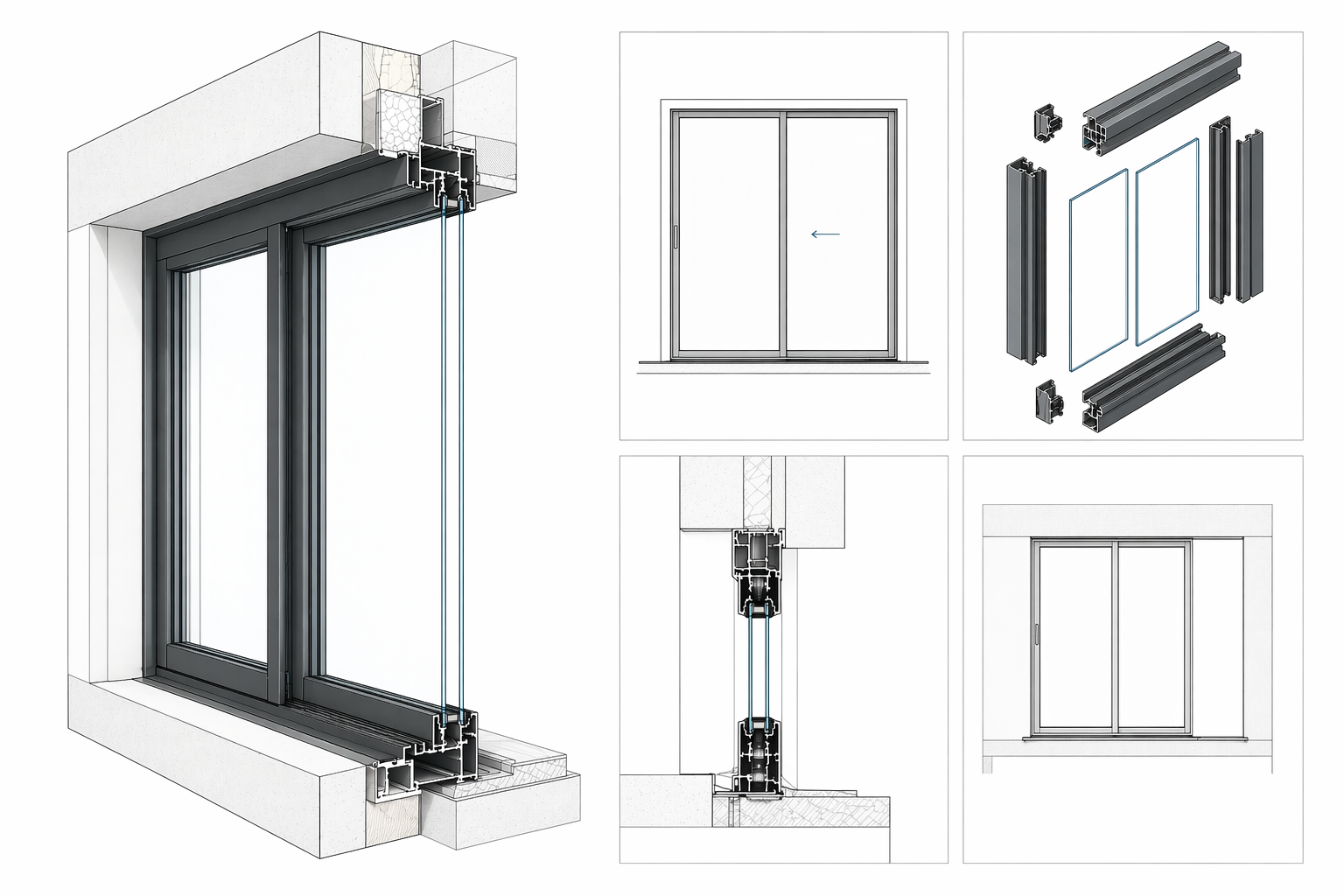
Illustration by ArchitectureCourses.org — Aluminum window system detail showing frame anatomy, glazing, sill section, and assembly components.
Profiles and Sections
The profile is the cross-sectional shape of the frame member. Light-duty residential profiles are thinner-walled and rely on geometry for stiffness. Heavier commercial profiles have more material and more complex internal geometries. The profile determines how much glass the frame can hold, how load transfers to the wall, and how much deflection you get under wind load. For large openings, this matters more than most buyers realize before they see a frame visibly bowing under wind pressure.
Channels and Tracks
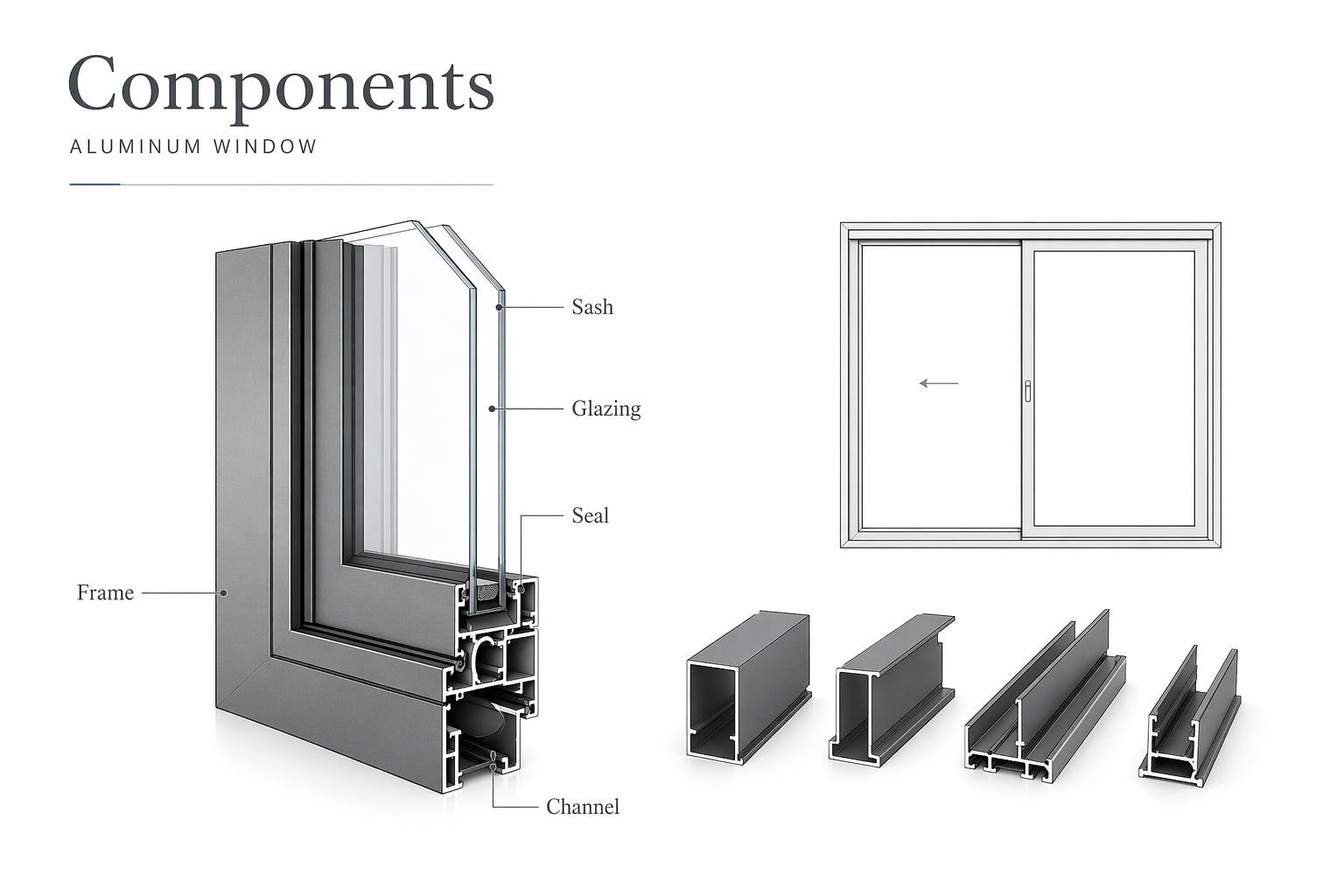
Illustration by ArchitectureCourses.org. Aluminum window systems are made from frame sections, sash members, glazing, seals, and channel-like extrusions that work together as one assembly.
Channels guide the glass or sash and manage drainage. In sliding systems, the sill track is where most maintenance problems begin — dirt accumulates, rollers wear, drainage holes block. Good track design keeps these manageable. Poor track design makes them inevitable. Check how the track drains and how accessible the weep holes are before selecting a sliding system.
Gaskets and Seals
This is where air and water control happens. The frame material is largely irrelevant to weathertightness compared to seal quality and continuity. Compressed EPDM gaskets at the glass-to-frame junction and perimeter seals at the frame-to-wall junction are both critical. Seals that are undersized, poorly compressed, or interrupted at corners are where leaks begin.
Glazing Stops and Beads
These hold the glass in place in the frame. Sloppy glazing beads mean the glass is not held consistently, the seals do not compress evenly, and the unit looks cheap at close range even if the frame itself is decent.
Weep Holes and Drainage
Water gets into window frames — through rain, condensation, and glazing seal degradation over time. The frame has to get it out. Weep holes at the sill, sized correctly and positioned to drain, are what keep water from sitting in the frame and finding its way into the wall or the interior. Blocked weep holes are one of the more common causes of water damage in otherwise acceptable aluminum window systems.
Cost
Figures below are for 2024–2025, installed in standard openings. Custom openings, difficult access, or high-rise conditions add to labor significantly.
| Type | Installed Cost Range | Notes |
|---|---|---|
| Budget residential aluminum, no thermal break | $200–$450 per window | Not ENERGY STAR eligible; not appropriate for heated spaces in most climates |
| Standard thermally broken residential, double pane | $450–$900 per window | The most common residential aluminum window category |
| High-performance thermally broken, double pane, low-e and argon | $800–$1,200 per window | Meets ENERGY STAR in most climate zones |
| Thermally broken, triple pane | $1,000–$1,800+ per window | For cold climates or Northern zone ENERGY STAR compliance |
| Commercial aluminum, fixed panel (approx. 4×6 ft) | $800–$1,500 per unit | Standard commercial storefront with tempered safety glass |
| Commercial aluminum, large or custom | $1,500–$5,000+ per opening | Custom shapes, oversized spans, high-performance glazing packages |
A good system with quality glazing and hardware runs forty to fifty years with basic maintenance. A budget system in a hard environment can start generating problems inside ten years. That arithmetic generally favors the better product — but only if you think past the initial quote. Thermally broken aluminum windows with NFRC-certified U-factors meeting ENERGY STAR criteria may also qualify for the federal 25C energy-efficient home improvement tax credit, currently up to $600 per year for windows as of 2024.
Before you commit to a window package, the full system picture — how frame, glazing, hardware, and install interact — is worth understanding first. Master Windows in Construction for Free covers that in detail.
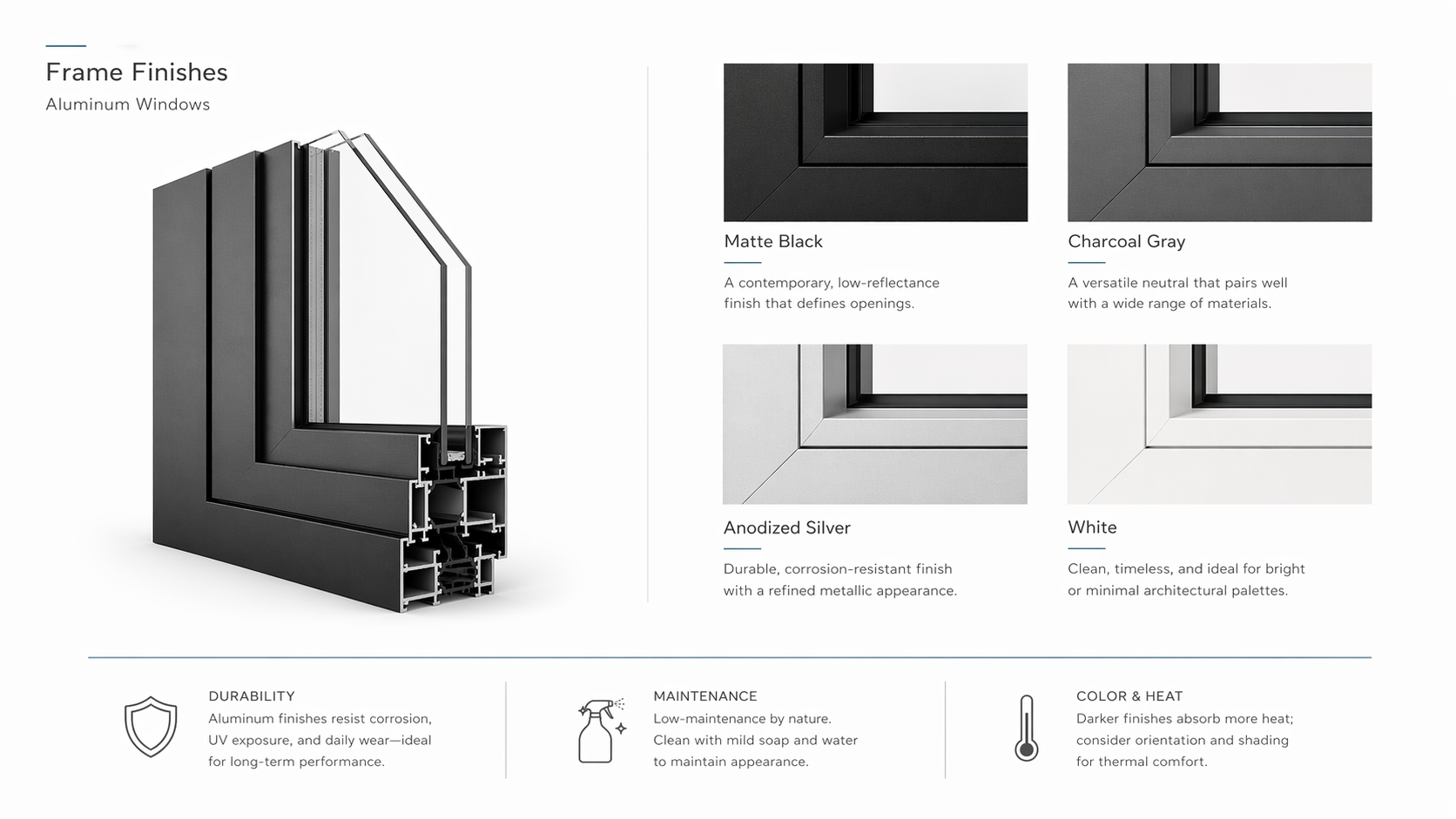
Illustration by ArchitectureCourses.org. Common aluminum window frame finishes include matte black, charcoal gray, anodized silver, and white, each with different visual and maintenance characteristics.
Finishes
Anodized Finishes
Anodizing converts the surface of the aluminum into aluminum oxide — a finish that is part of the metal itself, not a coating over it. It does not peel, chip, or flake. Clear and bronze anodized are the most common. Both are available in Class 1 (architectural grade, thicker oxide layer, longer service life) and Class 2 (standard grade). In coastal environments and commercial applications, Class 1 is the right choice — more resistant to salt air and UV over time than powder coat on the same frame.
Powder Coat
Powder coat gives you the full RAL color range — black, white, and custom colors that anodizing cannot match. It is a dry coating applied electrostatically and cured in an oven. Quality powder coat on properly pretreated aluminum holds up well — fifteen to twenty-five years before noticeable fading in most conditions. Poorly applied powder coat on insufficiently prepared aluminum fails much sooner, and refinishing aluminum frames in the field is difficult and expensive.
Black Frames
Black aluminum has been one of the most requested residential finishes for several years. It reads well against light walls, frames views clearly, and hides weathering better than white. The caution: black powder coat on south-facing or west-facing exposures absorbs heat. That accelerates finish degradation, increases thermal movement in the frame, and can affect seal performance over time. Check the finish warranty on black frames for sun-exposed installations and ask specifically whether it covers south-facing applications without qualification.
White Frames
White works well in brighter interiors and homes where the window should read as light rather than as a graphic element. It shows dirt faster than darker finishes. In coastal or rainy climates, the exterior face needs regular cleaning to stay presentable.
Pick the finish for the climate, the orientation, and what the building looks like — not what it looked like in a product photograph shot on a cloudy day with a studio-grade unit.
Where Jobs Go Wrong
No thermal break. The frame conducts heat straight through. The interior surface drops below the dew point in cold weather, condensation forms, and moisture accumulates on the frame and adjacent surfaces. People blame aluminum. The problem is the missing break and often an inadequate specification for the climate.
Wrong U-value for the climate zone. A thermally broken aluminum frame with a standard double-pane unit produces a whole-unit U-value around 0.30–0.38. That does not meet ENERGY STAR Northern zone requirements (≤ 0.22). Specifying this system in Minnesota or Wisconsin and expecting ENERGY STAR performance is a paperwork problem that becomes a field problem when the client notices condensation or a failed audit.
Bad install. The best frame available still leaks if it goes into an out-of-square opening without adequate shimming, if the perimeter seal is applied in the wrong sequence, or if the flashing detail is wrong. Install accounts for a significant share of aluminum window callbacks.
Weak seals. Seals age. Cheap EPDM or poorly compressed gaskets can start failing in five to eight years. Good-quality, properly installed seals last twenty or more. The seal is the part nobody discusses when specifying the frame, and it is often where the failure begins.
Cheap hardware. Sliders with budget rollers and tracks start feeling rough fast. Handles and locking mechanisms on the low end of the market corrode or loosen within a few years. Hardware is worth specifying explicitly on any project where people operate the windows daily.
Wrong frame type for the opening. A light-duty residential frame in an opening that needs a commercial-grade system will deflect, rack, and underperform. This happens when the glass size exceeds what the profile was designed to handle, or when wind loading pushes past what the frame can take without visible flex.
Most aluminum window failures are cheap-system problems or install problems. The frame material is rarely the root cause.
Installation
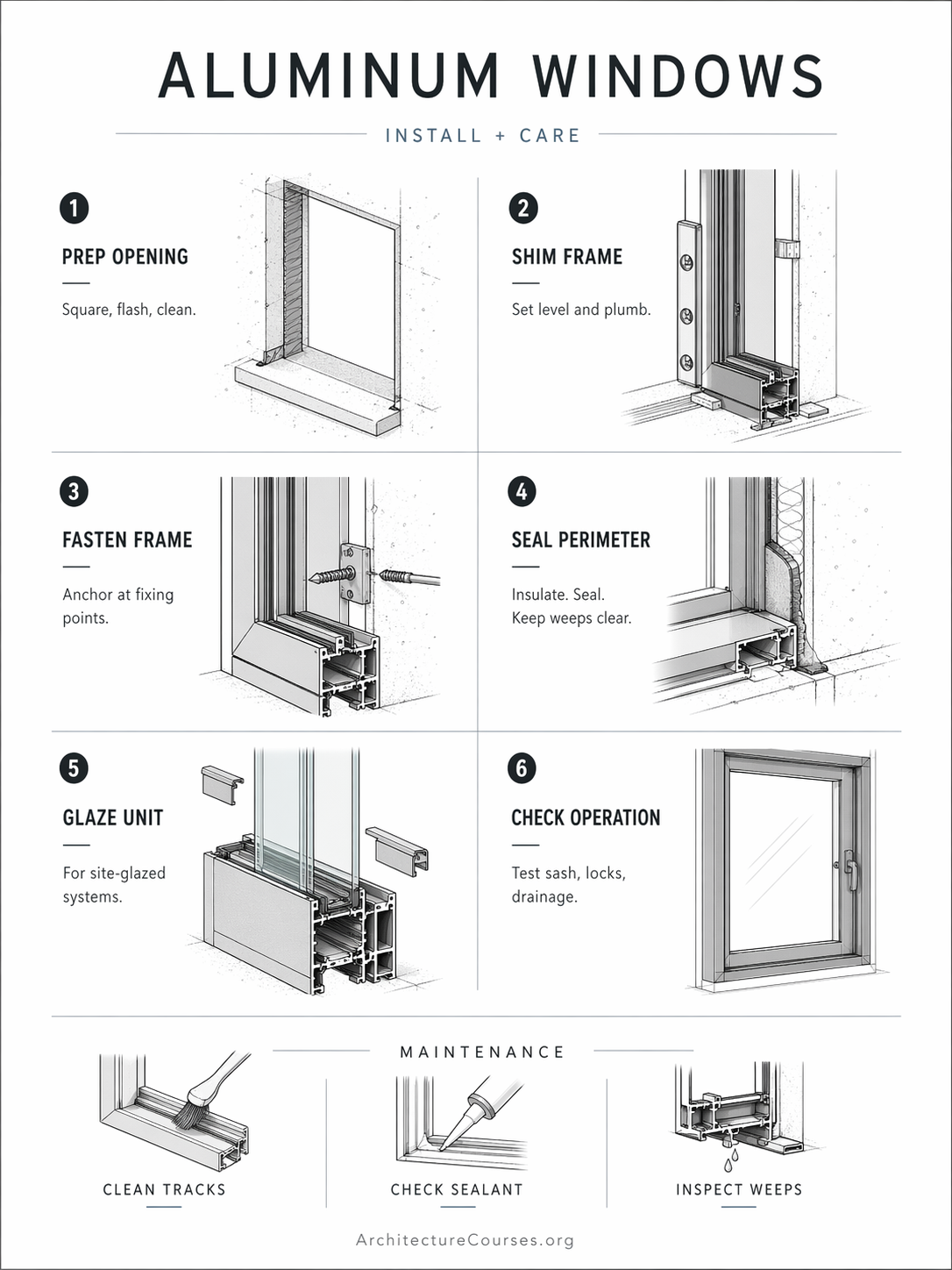
Illustration by ArchitectureCourses.org. Aluminum window installation with shims, fasteners, and perimeter sealing.
Step 1: Prepare the Opening
Check the rough opening dimensions against the frame size with the manufacturer's recommended clearances — typically 10–15mm on each side for shimming. Check level, plumb, and square in all directions. A 5mm error in square at the opening translates directly into a gap at the frame corner or a sash that does not seal. Fix the opening before the frame goes in.
Step 2: Set the Frame
Place the frame in the opening, check it again, and shim to level and plumb. Shims go at the load-bearing points specified by the manufacturer — typically at the corners and at regular intervals along the sill. Use composite or plastic shims in wet conditions rather than wood, which compresses and rots. The goal is a frame that sits flat without twist or rack.
Step 3: Fasten Without Distorting
Anchor the frame with the right fastener type and spacing for the wall construction — masonry anchors into block, wood screws into timber, appropriate fixings for steel stud. Do not overdrive fasteners. Pulling the frame out of square trying to close a gap in the rough opening is one of the more common install errors. A distorted frame means a sash that will not seal and hardware that will not operate correctly.
Step 4: Seal the Perimeter
Install backer rod at the correct depth — roughly twice the joint width — and apply sealant in a continuous run without bridging gaps or skipping corners. Use a sealant compatible with both the aluminum frame finish and the wall substrate: silicone for most applications, hybrid MS polymer where paintability matters. This is the step that gets rushed most often and generates the most callbacks.
Step 5: Check Operation, Drainage, and Fit
Open and close every operable unit. Confirm locks engage fully. Check that the sash seals evenly around the perimeter. Pour water at the sill and confirm it exits through the weep holes. Do not close up the wall or apply interior trim until you have confirmed the window works as it should.
What You Need on Site
- drill/driver with the right bit for the fastener type
- torpedo level and a longer spirit level (minimum 600mm)
- framing square
- caulking gun
- composite or plastic shims — not wood in wet conditions
- correct fasteners for the wall construction type
- backer rod in the right diameter for the joint width
- glass handling equipment if the units are large or heavy
Maintenance
Aluminum frames do not need much. The maintenance that matters is mostly about keeping drainage and seals working — considerably cheaper than dealing with what happens when they stop.
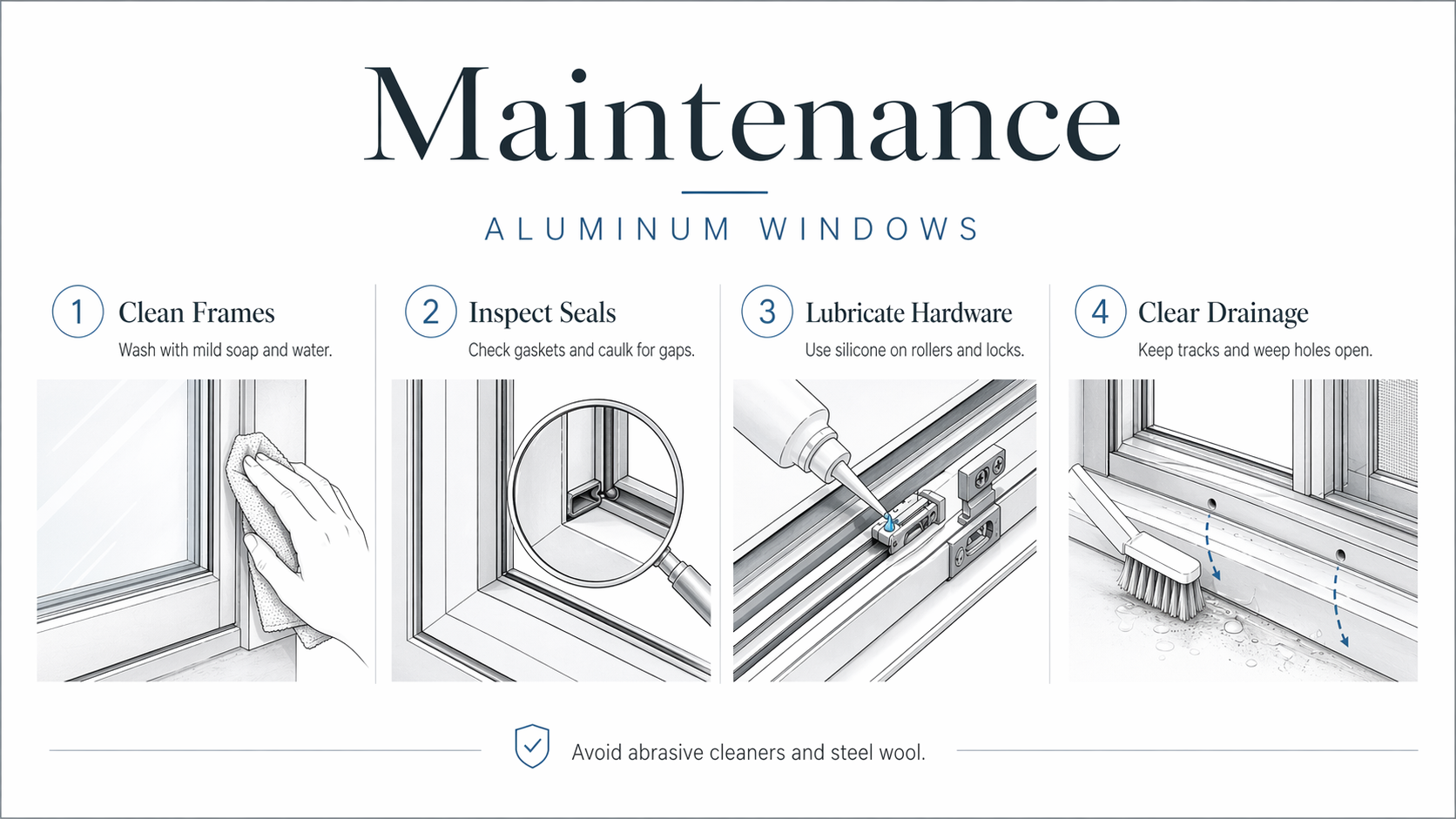
Illustration by ArchitectureCourses.org. Basic aluminum window maintenance includes cleaning frames, checking seals, lubricating moving hardware, and keeping tracks and weep holes clear.
- wash the frame with mild soap and water once or twice a year — avoid abrasive cleaners on powder-coated or anodized surfaces, and avoid alkaline cleaners on anodized finishes
- inspect seals at the glazing and perimeter annually; replace anything cracked, shrunken, or pulling away
- clear weep holes at the sill — a thin tool or compressed air does it; blocked weep holes mean water sits in the frame
- keep tracks clean on sliding systems; dirt and debris are the primary cause of rough operation and worn rollers
- check corners and the back of coastal-facing frames for early pitting or discoloration — addressing it early costs far less than waiting
What the Better Systems Fixed
The reputation aluminum frames have for feeling cold and underperforming on energy comes from cheap systems that were specified where they should not have been. The better systems addressed the specific failure points:
- wider thermal breaks — 34mm polyamide strips rather than the 20–24mm strips found in earlier and cheaper systems
- slimmer profiles with engineered internal geometries that maintain stiffness without added weight
- integrated acoustic glazing options designed to fit the frame profile without modification
- larger glass spans without visible deflection under design wind loads
- finish systems with longer warranty periods and better UV resistance, especially for darker colors on south exposures
- higher recycled content — some current product lines incorporate 30–50% recycled aluminum without compromising structural performance
That does not mean every aluminum window is good now. The low end of the market is still the low end. Asking hard questions about thermal break width, glazing packages, seal quality, hardware, and NFRC-certified ratings gets you something meaningfully different from what gave aluminum a bad name in residential work twenty years ago.
FAQ
Why use aluminum instead of wood or vinyl?
Slimmer frames, better strength for larger glass spans, and lower long-term maintenance. If energy performance in a cold climate is the primary concern, fiberglass or thermally broken aluminum with triple pane may serve you better than standard thermally broken aluminum with double pane.
Do aluminum windows work in cold climates?
Yes, with the right system. A thermally broken frame with triple pane and quality low-e glazing can meet ENERGY STAR Northern zone requirements (U ≤ 0.22). Non-thermally broken aluminum should not be specified for occupied, heated spaces in northern states.
What U-value should I ask for?
Check the ENERGY STAR requirements for your climate zone — Northern ≤ 0.22, North-Central ≤ 0.25, South-Central ≤ 0.28, Southern ≤ 0.32 as of Version 7.0. Ask for the NFRC whole-unit certified U-factor, not center-of-glass. The two numbers are different, and the whole-unit figure is the one that matters.
Are aluminum windows suitable near the ocean?
They can be. Coastal exposure is hard on every material. Class 1 anodized finishes hold up better than powder coat in salt air. Rinse the frames more frequently near the coast — salt deposits accelerate finish degradation regardless of material. Keep the weep holes clear.
Do they save energy?
The frame alone saves nothing. The combination of a thermally broken frame, appropriately specified glazing, continuous seals, and a correct install can perform well. Any one of those missing significantly reduces the result.
How much do aluminum windows cost?
Standard thermally broken residential units installed run $450–$900 per window. High-performance packages with quality low-e glazing run $800–$1,200. Triple pane for cold climates runs $1,000–$1,800 or more. Commercial systems run $800–$1,500 per standard fixed opening, and considerably more for large or custom work. Budget aluminum without a thermal break runs $200–$450 installed and is not appropriate for most occupied buildings.
How long do aluminum frames last?
A well-made thermally broken frame with quality finishes and basic maintenance runs forty to fifty years. The glazing seal on the IGU typically needs replacement at fifteen to twenty-five years regardless of frame condition. Cheap frames in hard environments without maintenance can become problematic inside ten years.
Can aluminum windows qualify for the federal tax credit?
Thermally broken aluminum windows with NFRC-certified U-factors meeting ENERGY STAR criteria for their climate zone may qualify for the 25C energy-efficient home improvement tax credit — currently up to $600 per year for windows as of 2024. Confirm current eligibility with the manufacturer's documentation and a tax professional; this credit has changed several times and may change again.
What should I ask before buying?
Does the frame have a thermal break and how wide is it? What is the NFRC-certified whole-unit U-factor? What glazing package is standard and what are the upgrade options? What low-e coating type is specified and is it right for my climate and orientation? What finish is specified and what is the warranty on it, including for south-facing exposures? How does the sill drain? What hardware comes with the unit? What is the maximum glass size the frame profile is rated to support?
Read This Next
For the full window system picture — how glazing, frame, hardware, and install interact — go to Master Windows in Construction for Free: A Detailed Course for Every Aspect. Still in the design phase, Design Your Own Windows covers the decisions that come before frame selection. For DIY options, Build Your Own Windows.