
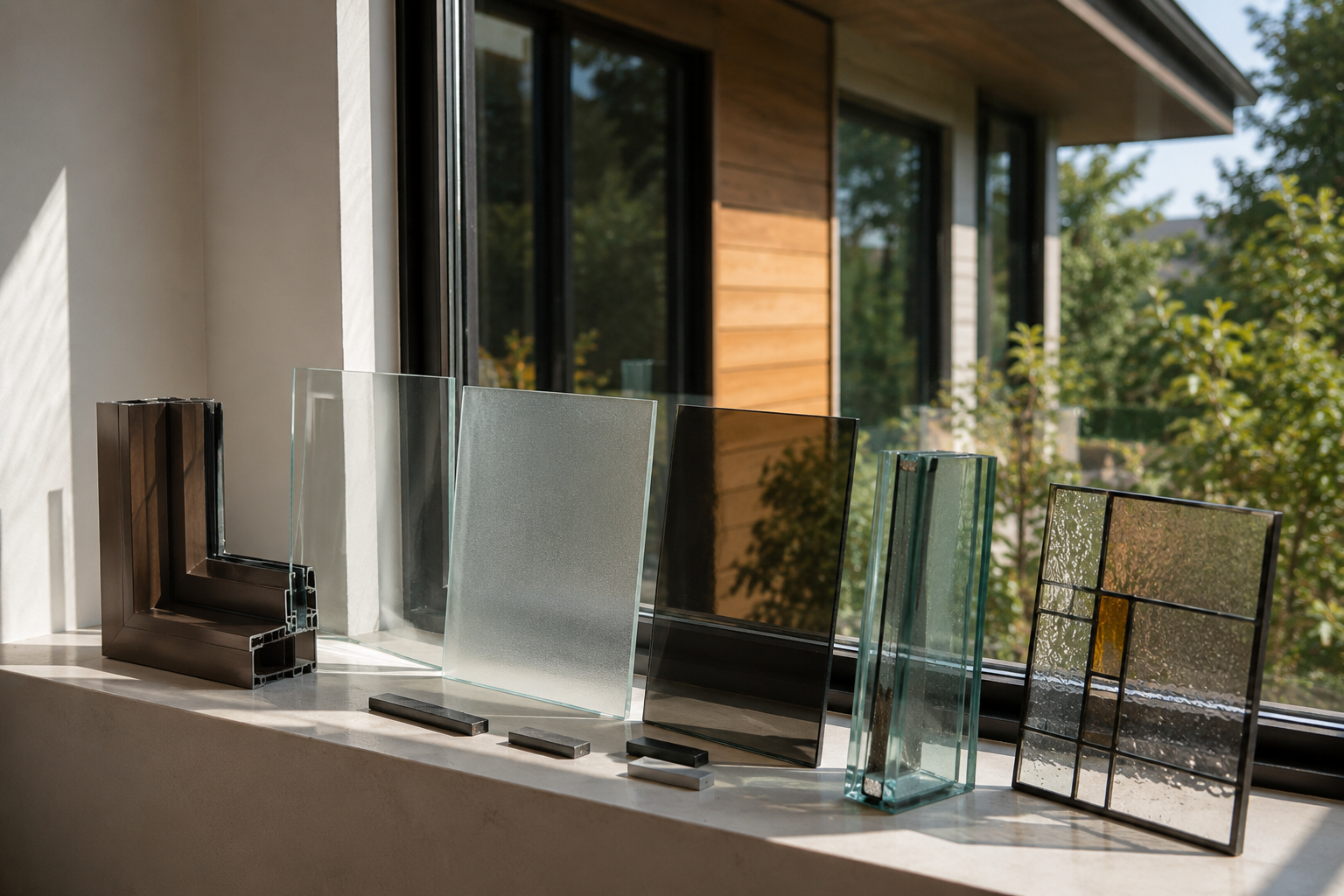
Glass window design goes wrong when glass is treated as decoration only.
The glass controls light, heat, privacy, noise, safety, and how exposed a room feels. Frame style matters. Pattern matters. But glass is the part that changes daily comfort first.
A clear pane in the wrong place can make a bathroom useless. A tinted pane on the wrong side of the house can make a room gloomy. A large fixed window can look beautiful and still overheat the space by midafternoon.
I would decide the job of the glass before choosing the look.
Start With the Problem the Glass Has to Solve
Do not start with frosted, stained, tinted, etched, or clear.
Start with the room.
Does the room need daylight without privacy loss? Does it face hot afternoon sun? Is the street too close? Is there a view worth framing? Is the window near a door, stair, tub, floor, or walking path where safety glass may be required by code?
Those questions change the glass.

A full-height living room window and a frosted bathroom window are not two versions of the same decision. One is about view and openness. The other is about light without exposure.
That is where the design starts.
Clear Glass Is Not Neutral
Clear glass feels like the default, but it is still a choice.
It gives the sharpest view and the cleanest daylight. It also gives the least privacy. On a side yard, front bathroom, bedroom facing a neighbor, or street-facing stair, clear glass can turn into a daily annoyance.
Clear glass works best when the view is worth seeing, the exposure is controlled, and the room can handle the light. If the window faces west or southwest, I would check heat gain before approving large clear panes.
Glass is not just transparent wall. It is a climate decision.
Frosted, Obscure, and Etched Glass
Frosted glass is usually the simplest privacy move.
It lets light through and blocks direct view. That makes it useful in bathrooms, stairwells, door sidelights, closets, laundry rooms, and ground-floor rooms facing a tight side yard.
The risk is overusing it. Frosted glass can make a room feel flat if every pane diffuses light the same way. I would use it where privacy matters, not everywhere a window feels awkward.
| Glass Type | Best Use | Watch For |
|---|---|---|
| Frosted glass | Bathrooms, sidelights, privacy windows | Can flatten daylight and remove view completely |
| Obscure glass | Bathrooms, basements, older houses | Pattern can look dated if it fights the house style |
| Etched glass | Feature panels, doors, interior partitions | Too much pattern becomes decoration noise |
| Frosted film | Retrofits and rental-friendly privacy fixes | Can trap heat on some insulated glass units if wrong product is used |
Film is useful, but I would not treat it as the same thing as factory frosted glass. Film is a surface layer. It can peel, scratch, bubble, or age differently in sun.
Tinted and Low-E Glass Are Not the Same Thing
Tint changes visible light.
Low-E glass changes heat transfer.
People mix those up. A dark tint may reduce glare, but it can also make the room feel dull. Low-E glass can help control heat without making the window look obviously dark, depending on the coating and glass package.
The right choice depends on orientation. A north-facing window may not need strong solar control. A west-facing window often does. In hot climates, the glass and shading should be designed together. Glass alone should not be asked to fix a bad exposure.
If the window needs shade before it needs a different glass type, see window canopy design.
Tempered and Laminated Glass
Safety glass is not a style upgrade.
Tempered glass is heat-treated so it breaks into small pieces instead of long sharp shards. Laminated glass holds together because a plastic interlayer bonds the panes. Both matter in different places.
Tempered glass is common near doors, in large low windows, showers, patio doors, and other hazardous locations. Laminated glass is useful for safety, security, storm exposure, and noise control.
Check local code before ordering. The location, height, size, and use of the opening can change the requirement.
Double Glazing, Triple Glazing, and Comfort

An insulated glass unit is not just two panes of glass.
It is a sealed unit with a spacer, air or gas space, and edge seals. That sealed edge is the part people forget. When the seal fails, the glass can fog between panes. You do not wipe that off from the room side.
Double glazing is the normal upgrade in many homes. Triple glazing can make sense in cold climates, noisy areas, or high-performance houses. But thicker glass packages affect weight, frame depth, hardware, and cost.
A better glass package installed badly is still a bad window.
Stained, Leaded, and Decorative Glass
Stained glass is not just “color.”
It changes privacy, daylight, style, and the whole tone of an opening. It can be beautiful in an entry, stair landing, transom, bathroom, or old-house repair. It can also look forced when dropped into a clean modern wall without any relationship to the rest of the house.
Leaded glass and stained panels need restraint. The pattern should belong to the architecture, not fight it.
For many houses, the safest move is one feature panel, not decorative glass everywhere.
Smart Glass and Switchable Privacy
Smart glass sounds better than it often is.
It can switch from clear to opaque, which is useful in bathrooms, conference rooms, bedrooms, and interior partitions. But the cost, wiring, controls, replacement difficulty, and long-term service matter.
I would not use smart glass just because it feels high-end. Use it where fixed privacy would be too limiting and blinds would make the detail worse.
A frosted pane is boring. Sometimes boring is correct.
Floor-to-Ceiling Glass

Floor-to-ceiling glass is seductive in renderings.
In a real house, it raises harder questions. How does the glass meet the floor? Where does the structure go? Is the glass tempered or laminated where needed? What happens to privacy at night? How much heat gain does the room take in summer?
The detail is where the honesty lives.
Large glass works best when the view, shading, structure, and mechanical comfort all support it. If the wall only works as a clean image, it does not work yet.
Match Glass to the Window Type
Not every glass belongs in every window.
Heavy decorative glass in a moving sash can create hardware problems. Smart glass needs wiring and service access. Thick triple glazing can overload cheap frames. Glass block belongs in fixed openings, not where ventilation or egress is needed.
| Window Type | Glass That Usually Makes Sense | Decision Point |
|---|---|---|
| Fixed or picture window | Low-E, laminated, tempered where required, clear or low-iron glass | View, heat gain, safety, and glare |
| Sliding window | Tempered, double-glazed, tinted or Low-E glass | Panel weight and track quality |
| Casement window | Low-E double glazing, laminated glass where noise matters | Hinge load and seal quality |
| Awning or hopper window | Obscure, frosted, tempered, Low-E double glazing | Privacy, rain, and hardware access |
| Skylight or roof window | Laminated interior pane, tempered exterior pane, Low-E glass | Impact, leaks, heat gain, and glare |
| Bay or bow window | Low-E insulated glass, safety glass where required | Comfort and structure across the projection |
For operating styles, see types of windows.
Frame Material Changes the Glass Decision
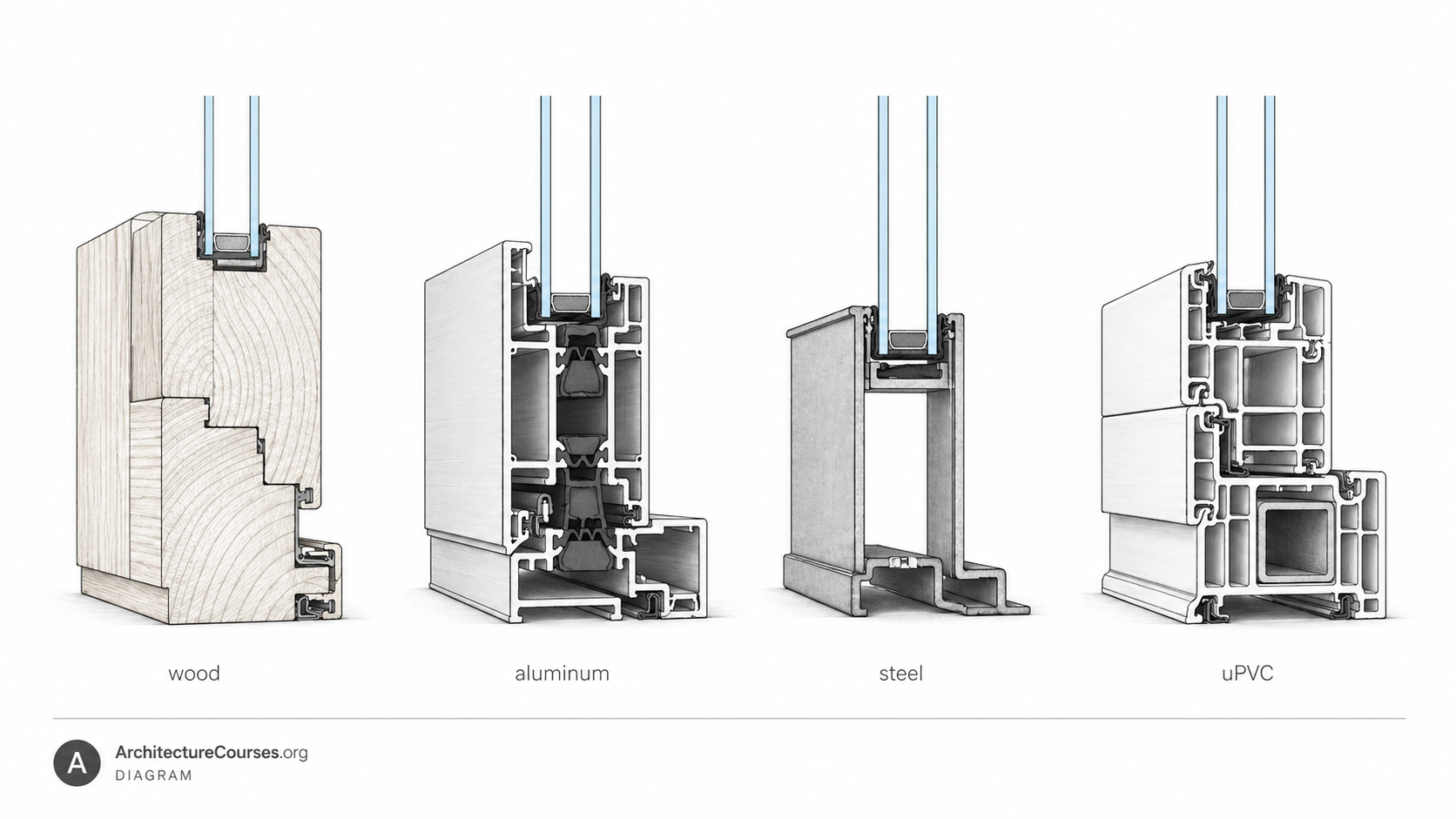
Glass and frame should be chosen together.
Aluminum can carry a slim modern look, but it needs a proper thermal break in cold or mixed climates. Wood has warmth and repairability, but it needs maintenance. Vinyl is common and affordable, but thicker profiles can reduce glass area. Fiberglass is stable and practical where temperature swings are hard on frames. Steel gives beautiful thin lines, but it can be expensive and unforgiving without thermal detailing.
The mistake is choosing the frame for looks and the glass for performance as if they never meet. They meet at every edge.
For deeper frame decisions, read aluminum window frames and wooden window frames.
Room-by-Room Glass Decisions
The same glass can be right in one room and wrong in another.
| Room or Location | Glass Direction | What Can Go Wrong |
|---|---|---|
| Bathroom | Frosted, obscure, higher sill, or narrow glass | Privacy solved too late with blinds that hold moisture |
| Kitchen | Clear glass where view matters, Low-E where sun is strong | Glare over work surfaces |
| Living room | Clear or low-iron glass if the view is worth it | Overheating and nighttime exposure |
| Bedroom | Clear, tinted, or obscure depending on exposure | Too much morning glare or street visibility |
| Stairwell | Fixed, narrow, frosted, or high glass | Random placement with no relation to the facade |
| Entry door or sidelight | Laminated, frosted, leaded, or patterned glass | Privacy and safety treated as afterthoughts |
Decorative Film Is a Retrofit, Not a Design Strategy
Window film can be useful.
It can add privacy, reduce glare, soften a bad view, or test a frosted-glass idea before replacing the pane. That does not make it equal to a well-designed glass choice.
Film has limits. It can scratch. It can bubble. Some films are not suitable for certain insulated glass units because heat buildup can stress the glass or seal. Read the manufacturer’s limits before applying film to double-pane windows.
For a permanent bathroom or entry solution, I would price real obscure or frosted glass before assuming film is the answer.
Glass Blocks and Partitions
Glass block is not dead. It is just easy to use badly.
It works in bathrooms, basements, stair walls, and places where light and privacy matter more than view. It is thick, heavy, and visually strong. That means it should be treated as part of the wall, not as a normal window substitute.
If the opening needs ventilation, use a vented unit or another window nearby. If the room needs egress, do not assume glass block solves it.
What to Check Before Ordering Glass
I would check these before pricing finishes or decorative patterns:
- Which direction does the window face?
- Does the room need privacy during the day, at night, or both?
- Is safety glass required because of height, size, location, or use?
- Does the frame support the glass weight and thickness?
Then check the boring part: drainage, sealant compatibility, frame depth, sill slope, and whether the glass can be replaced later without tearing apart the wall.
Design gets better when the drawing stops hiding the maintenance problem.
Common Mistakes
| Mistake | Why It Fails | Better Move |
|---|---|---|
| Choosing glass by appearance only | Privacy, heat, glare, or safety shows up later | Start with the room problem first |
| Using clear glass everywhere | Bathrooms, bedrooms, and entries can feel exposed | Use obscure, frosted, higher, or narrower glass where needed |
| Adding film without checking compatibility | Some films can overheat insulated glass units | Use film approved for the glass type |
| Putting heavy decorative glass in operable sash | Hardware may not carry the weight cleanly | Check hinge, sash, and manufacturer limits |
| Ignoring orientation | West and south glass can overheat rooms | Design glass and shading together |
FAQ
What is the best glass for privacy windows?
Frosted, obscure, etched, or patterned glass usually works best. For a temporary fix, film can help, but I would use real privacy glass for bathrooms, sidelights, and long-term exterior openings.
What is the difference between frosted and etched glass?
Frosted glass is usually about privacy and light diffusion. Etched glass can also add pattern or detail. The line gets blurry because both can be made in different ways, but the design question is simple: do you need privacy, decoration, or both?
Can I apply film to double-pane windows?
Sometimes. Use film approved for insulated glass units and check the film manufacturer’s limits. The wrong film can create heat buildup.
Is stained glass still useful in modern homes?
Yes, but it needs restraint. One entry panel, transom, bathroom window, or stair window can work. A whole house full of decorative glass can feel forced.
Should I choose the frame or glass first?
Choose the glass performance first, then the frame that can support it. Frame color should not lead the decision.
Is smart glass worth it?
Only when changing privacy is genuinely useful. If the room always needs privacy, frosted or obscure glass is simpler and usually more sensible.
What glass works best for noisy streets?
Laminated glass and airtight frames help more than normal decorative glass choices. The frame seal matters as much as the pane.