
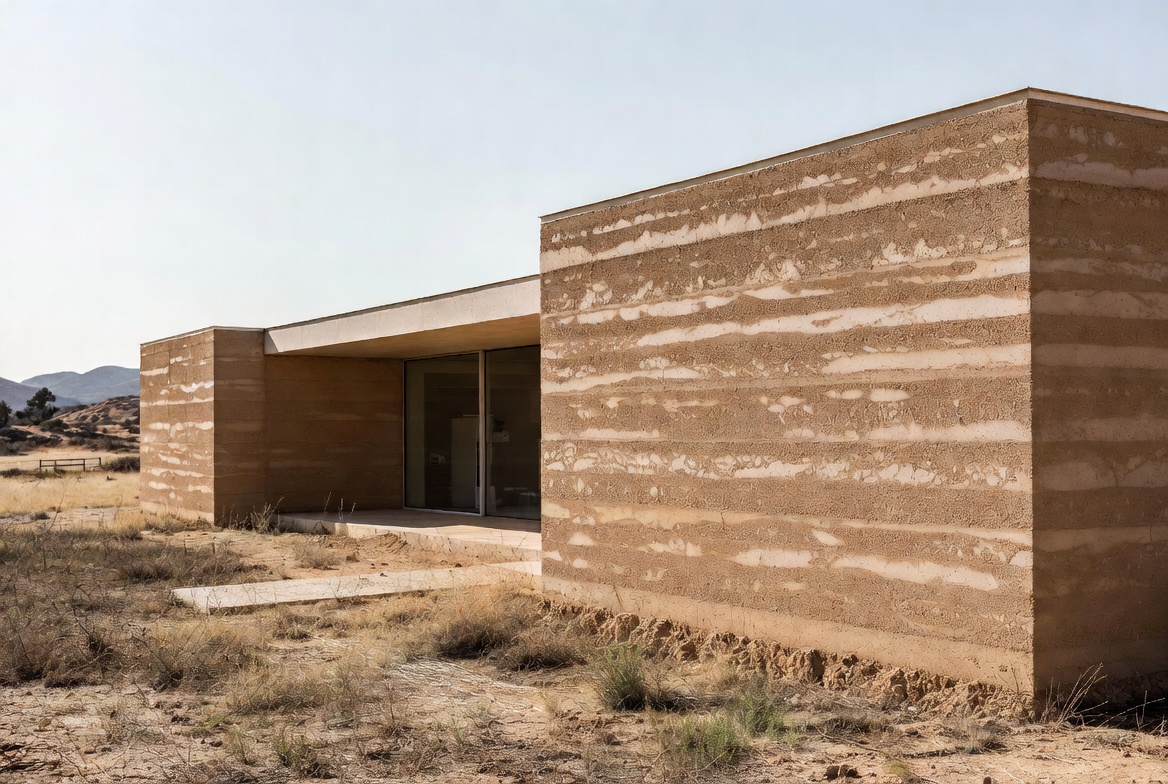
Rammed earth houses look simple in photos. Thick walls. Deep windows. Quiet rooms. Clean lines. The hard part starts when that wall has to become a whole house.
A rammed earth house changes the plan, the section, and the budget. Thick walls take floor area. Openings get deeper. Insulation gets harder in cold climates. The permit path can get slower. This is not just a house with a different wall finish.
This page stays on the house side of the subject: what kind of house rammed earth suits, one-story vs two-story layouts, wall thickness and layout, cost ranges, insulated vs non-insulated systems, house plans, engineering, and what people get wrong when they budget one.
Also useful: Rammed Earth: An Ancient Technique for Modern Sustainable Construction covers the broad method. Rammed Earth Walls: What They Are and Why They’re Back goes deeper into wall systems, panels, and moisture details.
Good Reading
Modern Rammed Earth Construction
A good starting book if you want the house side of the method without drifting into vague natural-building talk.
When Rammed Earth Makes Sense
Rammed earth suits houses that are simple enough to build carefully and strong enough in concept to make thick walls feel intentional.
It tends to work best when the house has:
- a clear plan, not a fussy one
- good solar orientation
- enough footprint to absorb thick exterior walls
- a budget that can carry slower wall construction
- an owner who wants durability, mass, and finish in one wall
It tends to work less well when the house is:
- very small and space-tight
- being value-engineered hard
- full of tight curves and awkward geometry
- on a fast speculative schedule
- in a cold climate with no clear insulation strategy
The method works best when the house is simple and deliberate, not when the design is already fighting the wall.
One Story or Two Stories
Most people should start by assuming one story is the easier move.
| House Type | Why It Works | What Gets Hard |
|---|---|---|
| One-story rammed earth house | Simpler roof loads, simpler wall bracing, easier detailing, easier passive design | Large footprint can raise slab and roof cost |
| Two-story rammed earth house | Smaller footprint, stronger vertical massing, deeper design payoff | More engineering, more reinforcement, more cost at openings and floor bearing |
| Hybrid house | Lets you use rammed earth where it matters most and lighter framing where it makes more sense | Junctions, movement, and moisture transitions need careful detailing |
One-story houses are not the only answer. They are just the cleaner starting point. Once floors stack, the wall stops being just enclosure and starts carrying more demanding structural work at a higher price.
That is why a lot of rammed earth houses you see published are either one story, partly bermed, or hybridized with steel, timber, or concrete frames.
Wall Thickness Changes the Plan
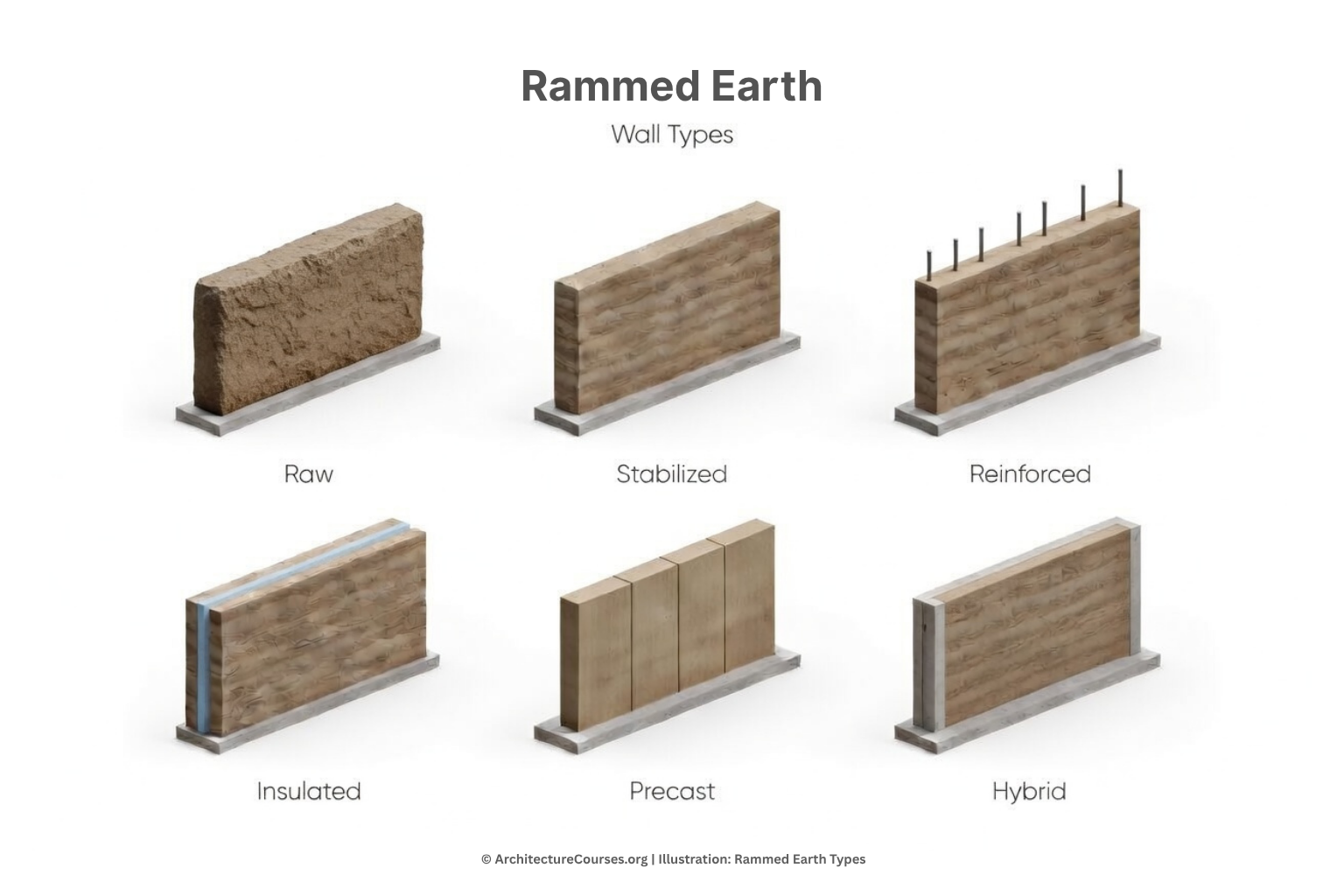
Illustration by ArchitectureCourses.org. Rammed earth wall types comparing raw, stabilized, reinforced, insulated, precast, and hybrid wall systems.
This is the part buyers miss first.
Rammed earth houses often use walls in the rough range of 18 to 24 inches, sometimes more.
That changes the house plan in a way standard framed-house thinking does not prepare people for.
Thick walls affect:
- interior floor area
- window and door depth
- how corners feel
- how cabinets and stairs land
- how plumbing and wiring get handled
- how roof and floor framing bear on the wall
On a compact house, that matters a lot. A small rammed earth house can feel tighter than the same outside dimensions in wood framing simply because the wall takes more of the footprint.
That is also why plans made for stick framing do not just convert cleanly. The wall thickness changes the plan logic.
House Plans Need Rework
Stock plans exist. Inspiration plans exist. Pretty floor plans exist. That does not mean you can buy one and build next month.
Rammed earth house plans need to deal with:
- soil mix and wall thickness
- lintels and openings
- roof bearing details
- reinforcement, where needed
- insulation strategy
- base details and water protection
- local permit path
That is why most house plans in this space are either custom, heavily adapted, or tied to a specific builder or system. Even the simpler published examples still assume thick walls and method-specific detailing, not a generic builder handoff.
Worth knowing: if you are still deciding between a monolithic earth wall and a modular earth system, Compressed Earth Blocks and Sustainability is the cleaner comparison page.
Do This Instead of This
| Do This | Instead of This | Why |
|---|---|---|
| Start with a house designed for thick walls | Trying to convert a standard framed-house plan late | The layout, openings, and sections change too much |
| Use one story or a simple hybrid first | Jumping straight to a complex two-story custom shape | The engineering and cost rise fast |
| Decide the insulation strategy early | Assuming thermal mass solves winter performance | Mass and insulation are not the same job |
| Budget it like a custom house | Treating it like a low-cost natural-building shortcut | Formwork, labor, and detailing will punish that assumption |
| Use a team that has done it before | Letting a standard custom-home crew figure it out live | Walls, openings, curing, and moisture details are not forgiving |
What Rammed Earth Houses Cost
There is no clean universal price. The published numbers are all over the place because they come from different systems, climates, scopes, and finish levels.
The safer way to say it is this: rammed earth houses price like custom houses, not like bargain houses.
| Published Example | What It Says | What To Take From It |
|---|---|---|
| Innovative Earth, Canada | About CAD $250 to $350 per sq ft for certified passive rammed earth homes | Even optimized systems still sit in custom-home territory |
| Aerecura, Ontario | Uses CAD $600 per sq ft as a turnkey example for a 1,200 sq ft rammed earth home | High-performance custom work can climb fast |
| Rammed Earth Enterprises, Australia | About AUD $4,000 to $4,500 per m2 for full custom builds | Full-house pricing still lands in premium territory internationally |
Those are not direct apples-to-apples numbers. They are still useful because they point in the same direction: this is not cheap-house pricing.
The cost drivers are usually:
- formwork
- labor and compaction time
- engineering and testing
- wall thickness
- insulation strategy
- openings, corners, and curved work
- builder experience
The payoff is different. You may save finish layers. You may save repainting. You may get lower swings in indoor temperature. You may get a house with a long life and a wall finish that does not age out every ten years. But the first-cost story is still hard.
Insulated vs Non-Insulated House Systems
This is the biggest house-level decision after budget.
Plain rammed earth can work well in dry and mixed climates where thermal mass helps and code targets are manageable. Once winters get harder or energy code gets tighter, plain mass walls stop being enough for many houses.
| System | Best Fit | Main Trade-Off |
|---|---|---|
| Non-insulated rammed earth | Dry or mixed climates, simpler houses, projects prioritizing mass and finish | Low R-value on its own |
| Insulated rammed earth | Cold climates, high-performance houses, stricter energy-code targets | Higher cost and more complex detailing |
| Hybrid house | Projects using rammed earth only where it pays off most | More transition details and less pure monolithic look |
SIREWALL is the best-known insulated proprietary version in North America and markets standard exterior walls at about R-33, with higher-performance assemblies possible.
That tells you where the method is heading in cold-climate house work: not away from earth, but away from pretending mass alone solves envelope performance.
Related reading: Rammed Earth Walls goes deeper into insulated wall systems, moisture details, and panels.
Do House Plans Need Special Engineering?
Usually, yes.
Even where a jurisdiction is open to earthen methods, a rammed earth house is not a routine framing package. Outside the few places with a clearer earthen-code path, expect more engineering and more explanation during permitting.
That does not mean the house cannot be approved. It means the plans need to be developed like a method-specific house, not like a standard house with different paint.
What People Get Wrong
- They budget the wall, not the house. The wall affects structure, floor area, openings, insulation, and planning.
- They assume thermal mass means good winter performance. It does not, on its own.
- They start with a normal house plan. Thick walls change too much.
- They think it is cheap because the main ingredient is soil. The expensive parts are labor, formwork, and detailing.
- They treat moisture as a minor detail. The base, cap, flashing, and drainage are not side notes here.
- They think every builder can do it. This is a specialist house type, even when the shape looks simple.
What To Read Next
This part matters: Rammed Earth Walls: What They Are and Why They’re Back if you need the harder technical side of wall types, moisture control, and insulated systems.
Also useful: Rammed Earth: An Ancient Technique for Modern Sustainable Construction if you want the broader method page behind the house-specific advice.
One more thing: Sustainable Building Materials: What Works and What Fails if you are still comparing wall systems as part of a bigger house-material decision.
FAQ
Are rammed earth houses good in cold climates?
They can be, but plain rammed earth is often not enough by itself. Cold-climate houses usually need insulated or hybrid wall systems.
How thick are the walls in a rammed earth house?
Many houses use thick exterior walls, often in the rough range of 18 to 24 inches, sometimes more depending on the system and insulation strategy.
Can a rammed earth house be two stories?
Yes. It is possible. It just raises the engineering, detailing, and cost compared with a one-story house.
Are rammed earth house plans easy to buy off the shelf?
Not really. Some stock plans exist, but most still need local engineering and method-specific changes before they are ready to build.
Is a rammed earth house cheap?
Not usually. It is more often a custom-house choice than a low-budget choice.
What is the main benefit of a rammed earth house?
The wall can provide structure, finish, mass, durability, and material character in one assembly. That is the main draw.
What is the main downside?
Cost, thickness, slower wall construction, and the need for a team that understands the method.
Can you use rammed earth for only part of the house?
Yes. A hybrid house is often the smarter move when you want the effect of rammed earth without forcing the whole house to depend on it.