
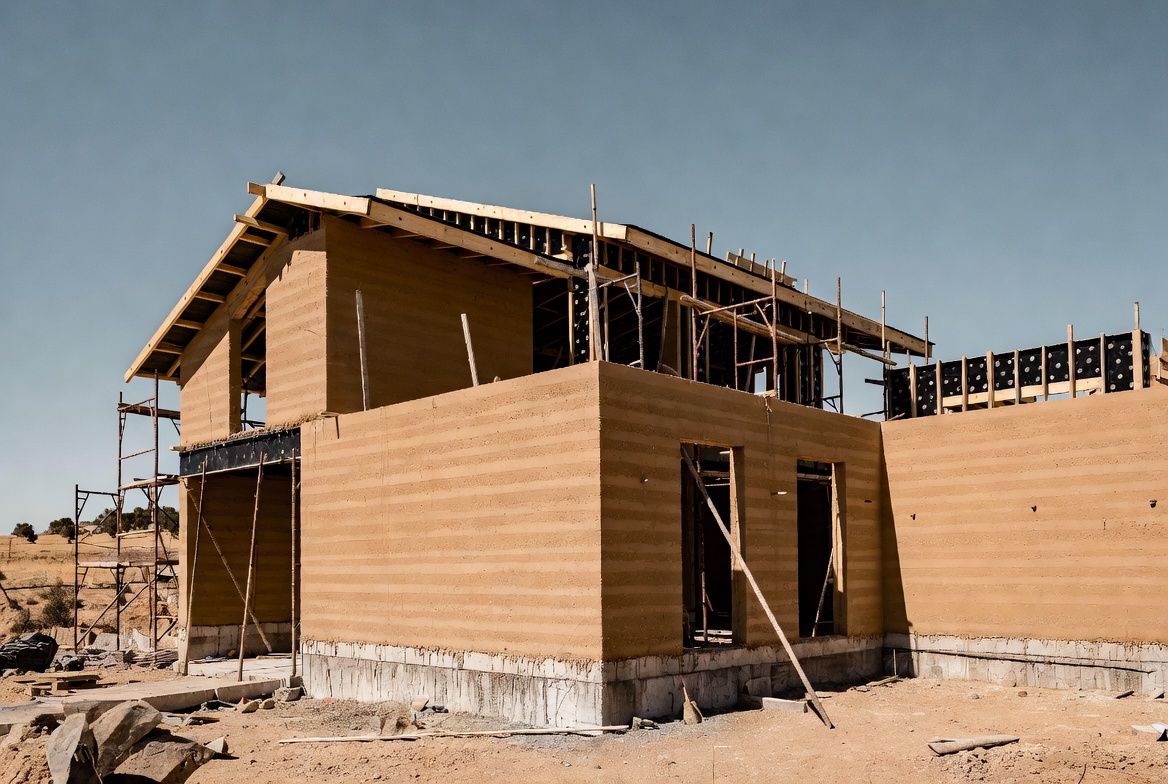
Rammed earth house pricing gets messy when wall cost, shell cost, and full-house cost all get talked about like they mean the same thing.
That is where budgets go off track.
A rammed earth house is rarely a cheap house. It is usually a custom house with a labor-heavy wall system, thicker walls, slower construction, and more engineering than a standard build. Sometimes that cost pays for something substantial. Sometimes it pays for a wall idea the budget was never ready to carry.
Start with the split first: what part of the house you are pricing, what published numbers tend to include, what drives quotes up, and where rammed earth budgets usually go wrong.
Also useful: Rammed Earth: An Ancient Technique for Modern Sustainable Construction covers the broad method. Rammed Earth Walls: What They Are and Why They’re Back goes deeper into wall systems, panels, and moisture details.
Start With the Right Cost Question
The first problem is scope.
| What You Are Pricing | What It Usually Includes | What It Usually Leaves Out |
|---|---|---|
| Wall-only price | Rammed earth wall work itself | Roof, windows, slab, finishes, services, permits, general house construction |
| Shell price | Walls plus part of the structure or enclosure | Full fit-out, interior finish, major services, landscaping, site extras |
| Turnkey house price | Complete finished home | Sometimes land, some site works, sometimes special design fees and contingencies |
A cheap-looking wall number does not mean you are close to a cheap house. A lot of people miss that.
What Published Prices Look Like by Region
These are not universal market averages. They are public builder and specialist examples, plus regional build baselines where rammed-earth-specific pricing is thin.
| Region | Published Price Signal | What It Means |
|---|---|---|
| United States | Builder examples around USD $250-$300/sq ft, with Arizona examples around USD $350+/sq ft | Rammed earth sits in custom-home territory, not budget-build territory |
| Canada | Western Canada published at CAD $250-$350/sq ft; one Ontario high-performance example uses CAD $600/sq ft turnkey | Big spread. System choice and finish level matter a lot |
| United Kingdom | No strong public rammed-earth rate cards; self-build baselines sit around £1,775-$3,000/m² | Budget rammed earth above ordinary baseline self-build assumptions, not at them |
| Australia | Published full-build example around AUD $4,000-$4,500/m² | Clear premium custom-home pricing |
| New Zealand | Specialist builders mostly avoid flat public rates and say cost depends heavily on design and current conditions | Get direct project pricing early. Do not rely on old case-study numbers |
The pattern is the same across regions: this is not the wall system people choose to save first cost.
U.S. Cost Reality by Region
The U.S. is not one market.
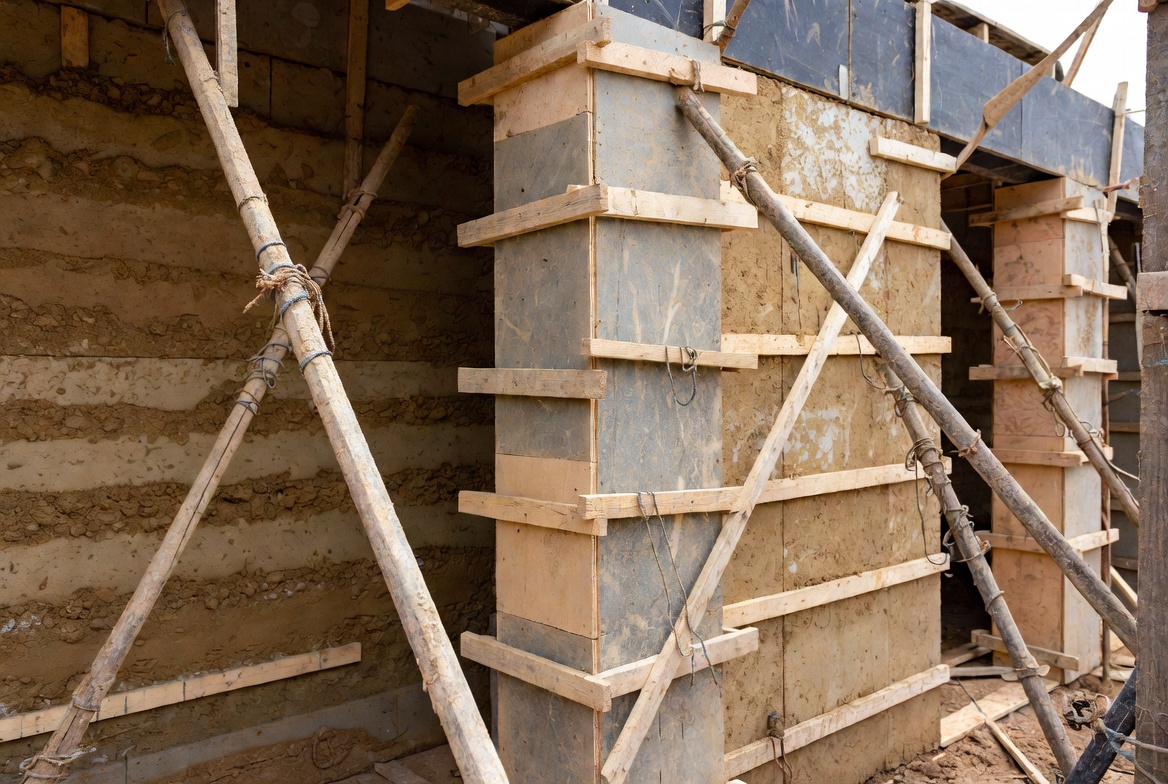
Image by ArchitectureCourses.org. Rammed earth wall construction showing the formwork and labor behind the cost of a rammed earth house.
Even before rammed earth enters the conversation, current published new-home baselines vary a lot by region. The South and Midwest still tend to sit lower. The Northeast is higher. The West is usually the hardest place to keep costs down. That matters because rammed earth does not replace those regional differences. It stacks on top of them.
| U.S. Region | General New-Build Baseline | Rammed Earth Read |
|---|---|---|
| South | Lower baseline in many markets | Can still go premium fast if specialist labor is thin |
| Midwest | Often one of the cheaper baseline regions | Rammed earth still tends to price above ordinary local builds |
| Northeast | Higher baseline labor and custom-home cost | Rammed earth gets expensive quickly, especially with winter detailing |
| West / Southwest | Often high baseline build cost already | Best climate fit in parts of the Southwest, but that does not make it cheap |
The Southwest often suits rammed earth better climatically. That helps performance. It does not erase custom-home pricing.
Why the Numbers Swing So Much
Two rammed earth house quotes can be far apart even when the floor area looks similar.
| Cost Driver | Lower-Cost Version | Higher-Cost Version |
|---|---|---|
| House shape | Simple rectangle, fewer corners | Curves, offsets, complex geometry |
| Wall system | Plain or lightly stabilized system in the right climate | Insulated or heavily engineered system |
| Stories | One story | Two stories or mixed structural loads |
| Openings | Simple, well-spaced windows and doors | Many large openings, deep lintels, more steel or concrete support |
| Site | Flat, easy access, easy soil handling | Remote site, steep land, retaining, bad access, imported material |
| Finish level | Simple custom-home finish | High-end joinery, premium glazing, luxury fit-out |
A lot of the public cost confusion comes from people comparing a cleaner, simpler desert house to a high-performance custom house in a cold climate and calling both “rammed earth homes.”
What a Wall Quote Leaves Out
This is where people get hurt.
A wall quote can look manageable. Then the real house starts showing up.
- Roof structure
- Slab and foundations
- Windows and deep opening details
- Electrical and plumbing strategy
- Insulation or hybrid wall work
- Engineering and testing
- Permit work
- Interior fit-out
A rammed earth wall is not the house. It is one expensive part of the house.
Canada, the U.K., Australia, and New Zealand
Canada
Canada has some of the clearest public pricing. Western Canada builders publishing CAD $250-$350/sq ft for passive rammed earth homes gives a credible lower-to-mid custom benchmark. Ontario examples reaching CAD $600/sq ft show how quickly the number climbs once the house moves into high-performance custom territory.
Cold climate plus custom detailing is where the jump happens.
United Kingdom
Public rammed-earth house pricing is thinner. That does not mean the houses are cheap. It means fewer builders publish neat rate cards. The safer move is to use current U.K. self-build baselines as a floor, then assume rammed earth will sit toward the premium end once specialist labor, engineering, and thicker wall construction enter the job.
Australia
Australia has some of the clearest specialist pricing and some of the strongest climate fit in the right regions. That does not make it low-cost. Published full-build pricing around AUD $4,000-$4,500/m² is still premium custom-house territory.
Dry climates help the building science. They do not erase labor and formwork cost.
New Zealand
New Zealand has real earth-building knowledge and live standards, but current public house pricing is thinner. Builders there openly say flat m² pricing is not straightforward right now because transport and material conditions move too much.
That is useful in its own way. It tells you not to lean on old blog-case-study numbers and pretend they still price today’s job.
Do This Instead of This
| Do This | Instead of This | Why |
|---|---|---|
| Budget it like a custom house | Treating it like a cheap natural-building shortcut | The wall system is too labor-heavy for that fantasy |
| Separate wall cost from full-house cost | Using one public number as the whole budget | That is how people under-budget by a lot |
| Keep the design simple | Using curves and complex geometry everywhere | Formwork and labor costs climb fast |
| Decide insulation strategy early | Assuming thermal mass solves winter performance | Mass and insulation are not the same thing |
| Get local project-specific pricing | Using old online case studies as hard current numbers | Region, crew, and site conditions change everything |
What People Get Wrong
- They price the wall, not the house.
- They think local soil means low cost. The expensive parts are labor, formwork, testing, and detailing.
- They assume one good climate makes the whole job easy. Site access, geometry, and crew still matter.
- They assume all rammed earth is uninsulated. Many cold-climate houses now need insulated or hybrid systems.
- They compare a simple one-story house to a high-spec two-story custom home. That is not a fair cost comparison.
- They think public rates are firm bids. They are not.
What To Read Next
This part matters: Rammed Earth Walls: What They Are and Why They’re Back if you want the wall-system side behind the money.
Also useful: Rammed Earth Formwork: How It Works, What It Costs, and What Fails if you want to see where a lot of the labor and wall cost comes from.
One more thing: Rammed Earth: An Ancient Technique for Modern Sustainable Construction if you want the broader method page first.
FAQ
Is a rammed earth house expensive?
Usually, yes. It is more often a custom-house choice than a budget-house choice.
What is a realistic cost range in Canada?
Public builder pricing currently puts some Western Canada rammed earth homes around CAD $250-$350 per sq ft, while higher-spec Ontario examples can climb much higher.
What is a realistic cost range in the United States?
Published builder examples sit around USD $250-$300 per sq ft in some markets, with Arizona luxury-custom examples around USD $350+ per sq ft. The real number depends heavily on region and finish level.
What about Australia?
Published specialist examples put full custom rammed earth homes around AUD $4,000-$4,500 per m², which is firmly in premium custom-home territory.
Why is U.K. pricing harder to pin down?
Because fewer builders publish simple public rate cards for rammed earth houses. Use current self-build baselines as a floor, then budget above them for specialist work.
Why is New Zealand harder to price cleanly?
Because builders there openly say flat m² pricing is not straightforward right now. Current project conditions matter too much to fake a neat public number.
What makes a quote jump the fastest?
Complex geometry, two stories, lots of openings, hard sites, insulated systems, and high-end finishes.
Is the wall cost the same as the house cost?
No. A wall price is only one part of the total house budget.