
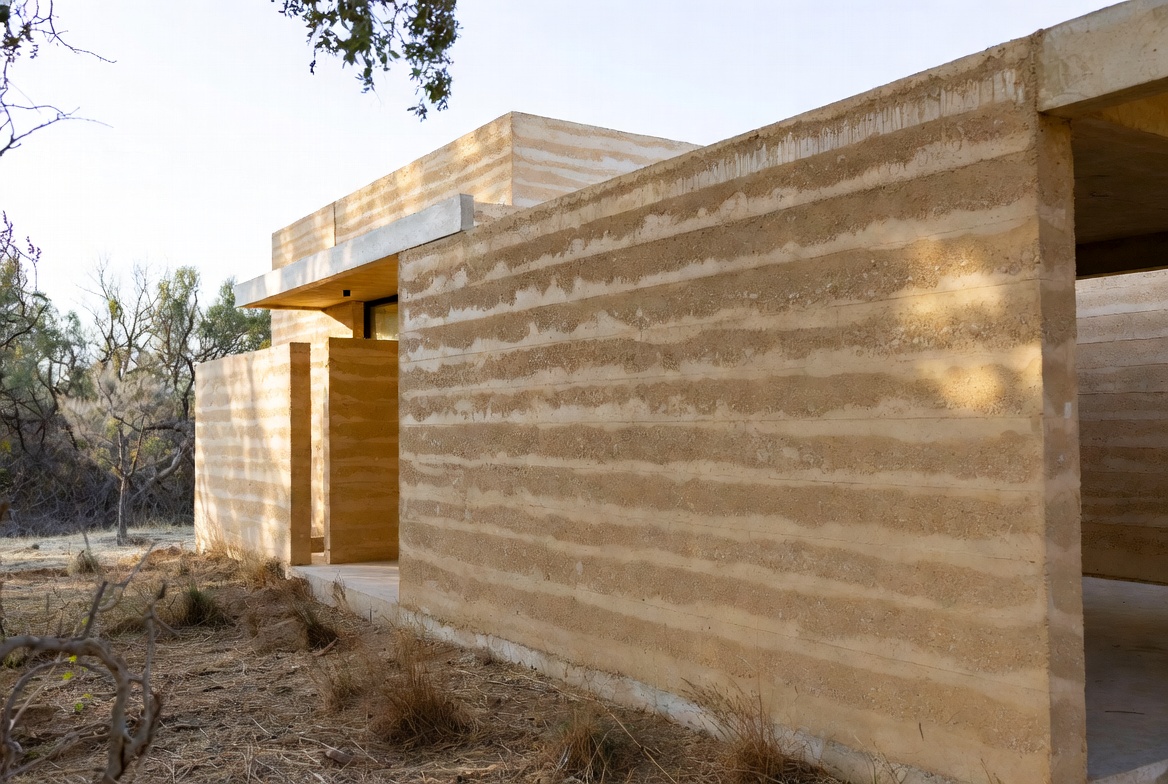
What Is Rammed Earth?
Rammed earth is a wall system made by compacting damp soil inside forms, one layer at a time, until the wall becomes solid and dense.
The method is old, but modern rammed earth is more controlled. Soil gets tested, formwork gets engineered, and builders often add a small amount of cement or lime to improve strength and water resistance.
The useful questions are where rammed earth works well, where it struggles, what it costs, and how it compares with other low-carbon wall systems.
Also useful: Sustainable Building Materials: What Works and What Fails if you want the bigger material picture before getting deep into earth walls.
Good Reading
Modern Rammed Earth Construction
A good first book if you want the basics of soil mixes, formwork, and wall building without drifting into marketing talk.
What Rammed Earth Is Made Of
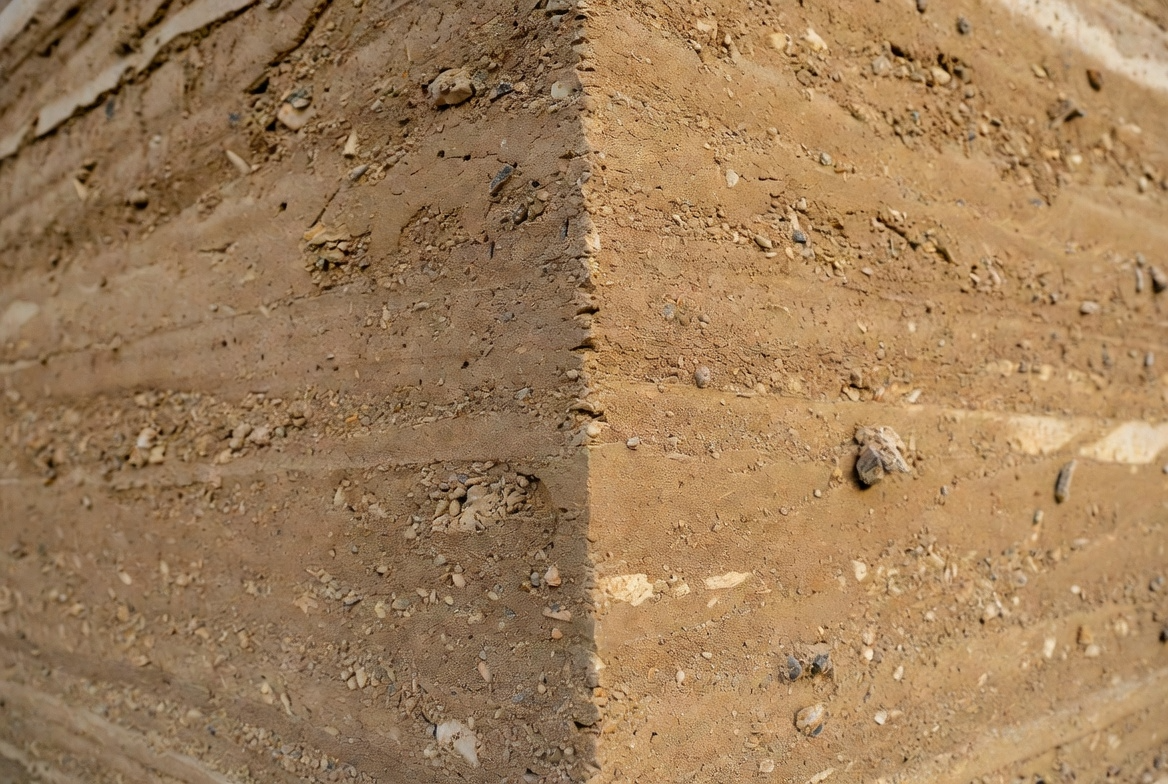
Image by ArchitectureCourses.org. Close-up of a rammed earth wall corner showing compacted layers and exposed aggregate.
Most rammed earth mixes use sand, gravel, fines, and clay. Many modern projects also use a stabilizer such as cement or lime.
The exact mix matters. Too much clay and the wall can shrink and crack. Too much silt and the wall loses strength. Organic material is bad news. That is why serious jobs use test batches and lab checks instead of guessing from color or feel alone.
That is also why two rammed earth walls can behave very differently. One may be a simple dry-climate garden wall. Another may be a reinforced insulated wall engineered for a cold-climate house.
How Rammed Earth Is Made
The process is simple to describe and hard to do well.
- The soil is mixed. The blend has to compact well without falling apart or shrinking too much.
- Formwork is built. This holds the damp mix in place and controls the final wall face.
- The soil goes in in lifts. Builders place shallow layers, then compact each layer before the next one goes in.
- The wall is stripped and cured. Once the forms come off, the wall still needs protection while it dries and gains strength.
That is the method in plain terms. The hard part is consistency. Bad moisture content, weak formwork, poor compaction, or rushed curing can ruin the wall.
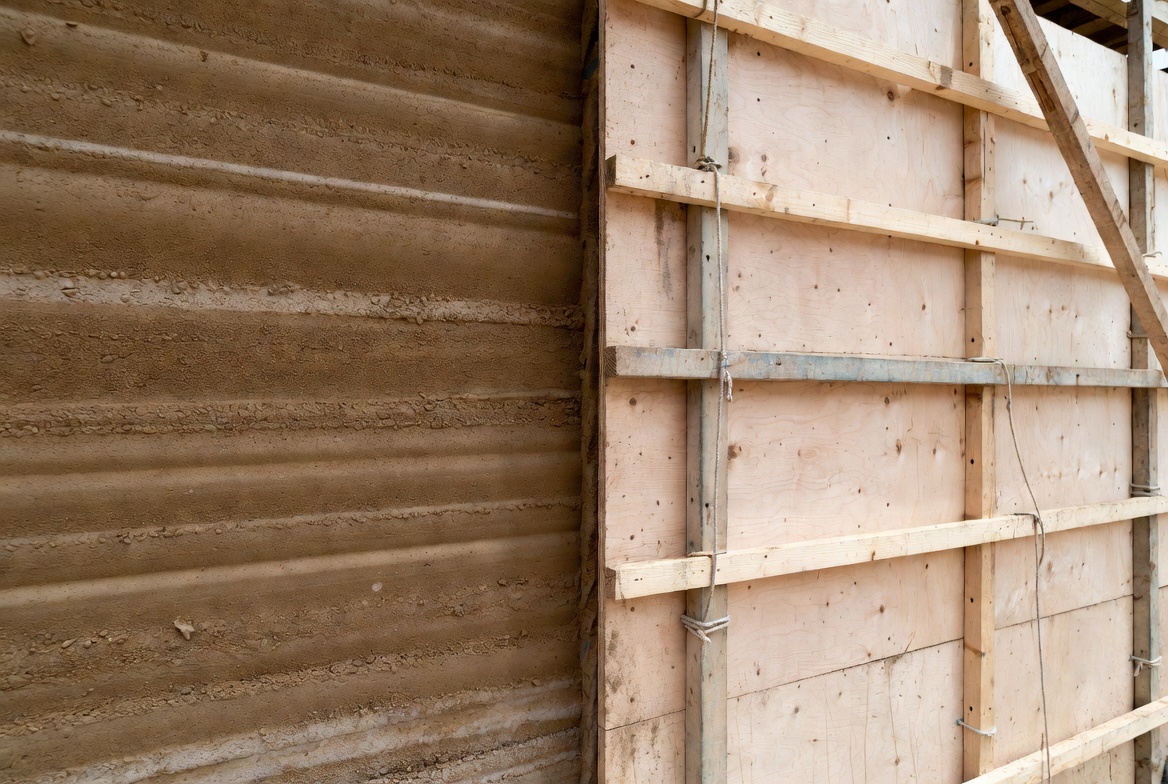
Image by ArchitectureCourses.org. Rammed earth wall surface beside plywood formwork and bracing during construction.
Why People Use Rammed Earth
People use rammed earth because it can do several jobs at once.
- It gives thermal mass. The wall can absorb and release heat slowly.
- It can be structural. Stabilized and reinforced versions can carry loads.
- It can be the finish. In many projects, the finished wall is the final surface.
- It can use local material. That can cut transport and give the wall a site-specific look.
- It is durable when detailed well. Good base details and good water protection matter more than romantic ideas about “natural” building.
It also has a look that a lot of builders and architects want: layered, heavy, quiet, and hard to fake with paint or thin veneer.
Thermal Mass Is Not Insulation
This is the mistake that keeps showing up.
Rammed earth is good at storing heat. It is not good at stopping heat flow on its own. That makes it useful in places with strong day-night temperature swings, passive solar design, and buildings that want indoor temperatures to change more slowly.
It does not mean a plain rammed earth wall is enough for every cold climate. In many places, it is not.
If you are building where energy code is strict or winters are hard, treat insulation as part of the wall strategy from the start.
Where Rammed Earth Works Best
- Dry and mixed climates
- Custom homes that want the wall to be part of the architecture
- Feature walls and interior walls
- Public buildings where the wall is doing visual work as well as structural work
- Projects that value thermal mass and long life more than low first cost
Where Rammed Earth Gets Hard
- Cold climates with strict insulation targets
- Projects with tight budgets
- Fast builds that cannot tolerate formwork and curing time
- Below-grade or constant-wet conditions
- DIY jobs that are bigger than the builder’s skill level
This part matters: if the project is drifting toward plinths, bases, or wet soil conditions, Alternative Foundation Materials: Building Strong, Sustainable Foundations is a better next read than forcing rammed earth into the wrong role.
Types Used Today
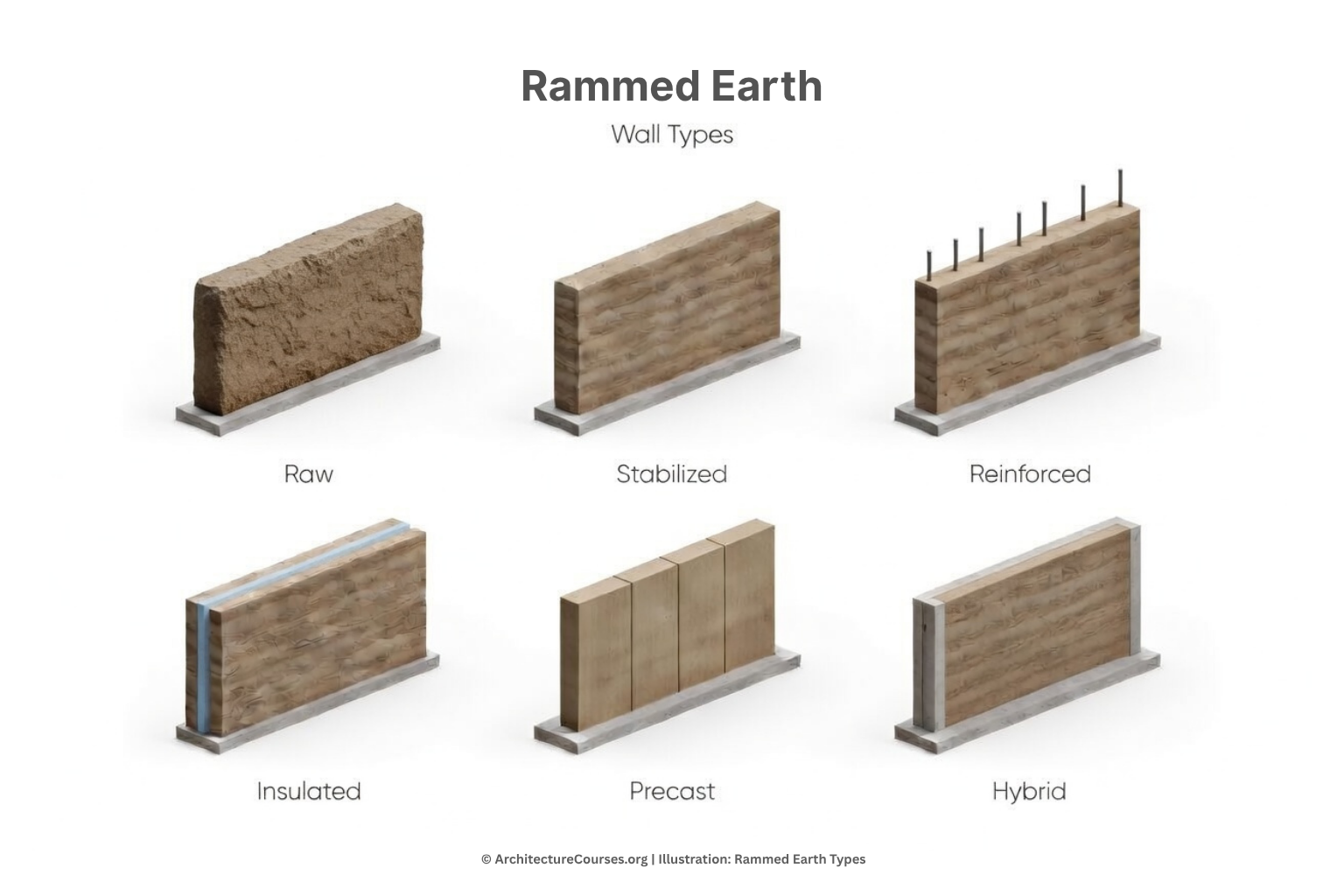
Illustration by ArchitectureCourses.org. Rammed earth wall types comparing raw, stabilized, reinforced, insulated, precast, and hybrid wall systems.
| Type | Best For | Main Trade-Off |
|---|---|---|
| Raw rammed earth | Interior work, dry climates, simple walls | Least forgiving with water |
| Stabilized rammed earth | Most structural exterior work | Higher embodied carbon than raw earth |
| Reinforced rammed earth | Seismic zones, taller walls, harder structural jobs | Needs engineering and tighter site control |
| Insulated rammed earth | Cold climates and high-performance houses | More complexity and more cost |
| Panelized or precast systems | Repeat work, commercial jobs, faster installation | Transport, crane work, and visible joints |
If you are comparing monolithic rammed earth with unit-based earth systems, Compressed Earth Blocks and Sustainability is the cleaner side-by-side page.
Rammed Earth Panels
Panels solve one problem. They shorten site time. They do not remove complexity.
Instead of compacting the wall on site, the wall is made off site, cured, then shipped to the project and installed by crane or lift. This can help on tight sites, repeat projects, and schedules that cannot absorb long wall-building time.
It can also add cost fast. Transport, lifting, and joint detailing are not minor issues.
| Panels Make Sense When | Panels Make Less Sense When |
|---|---|
| Wall layouts repeat | The project is small and custom |
| Site space is tight | The design depends on curves |
| The schedule is tight | The budget is already strained |
| Factory quality control matters | Visible panel joints would hurt the design |
Insulated Rammed Earth
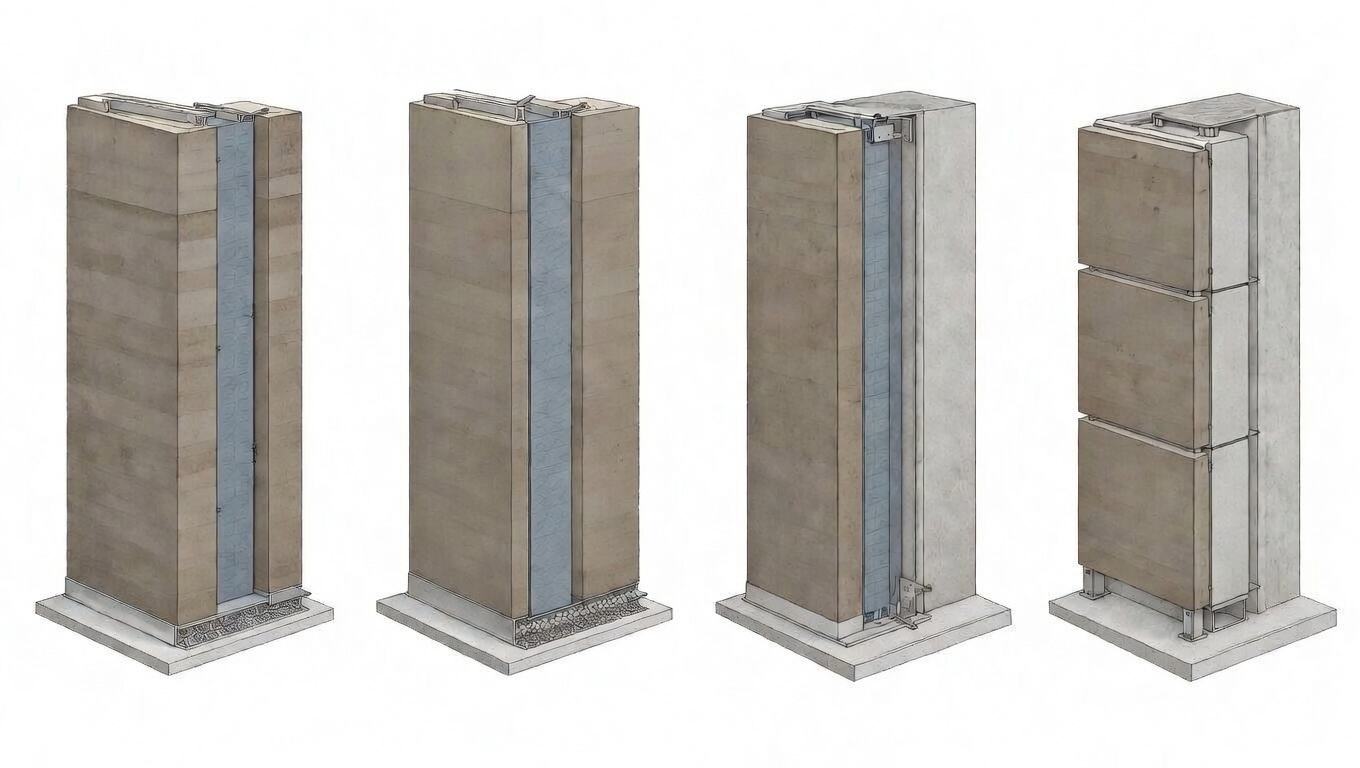
Illustration by ArchitectureCourses.org. Insulated rammed earth wall assemblies comparing double-wythe, hybrid backup-wall, and panelized earth systems.
Insulated rammed earth is one answer to the low-R-value problem. The wall keeps the look and much of the mass of rammed earth, but adds insulation in the assembly.
SIREWALL is the best-known version in North America. The basic idea is simple: earth on both sides, insulation in the middle, and a wall that performs more like a modern envelope in cold weather.
This is where the method moves away from simple earth wall building and into a more engineered system. That can be worth it. It also raises the price and the level of detailing.
Rammed Earth vs Other Wall Materials
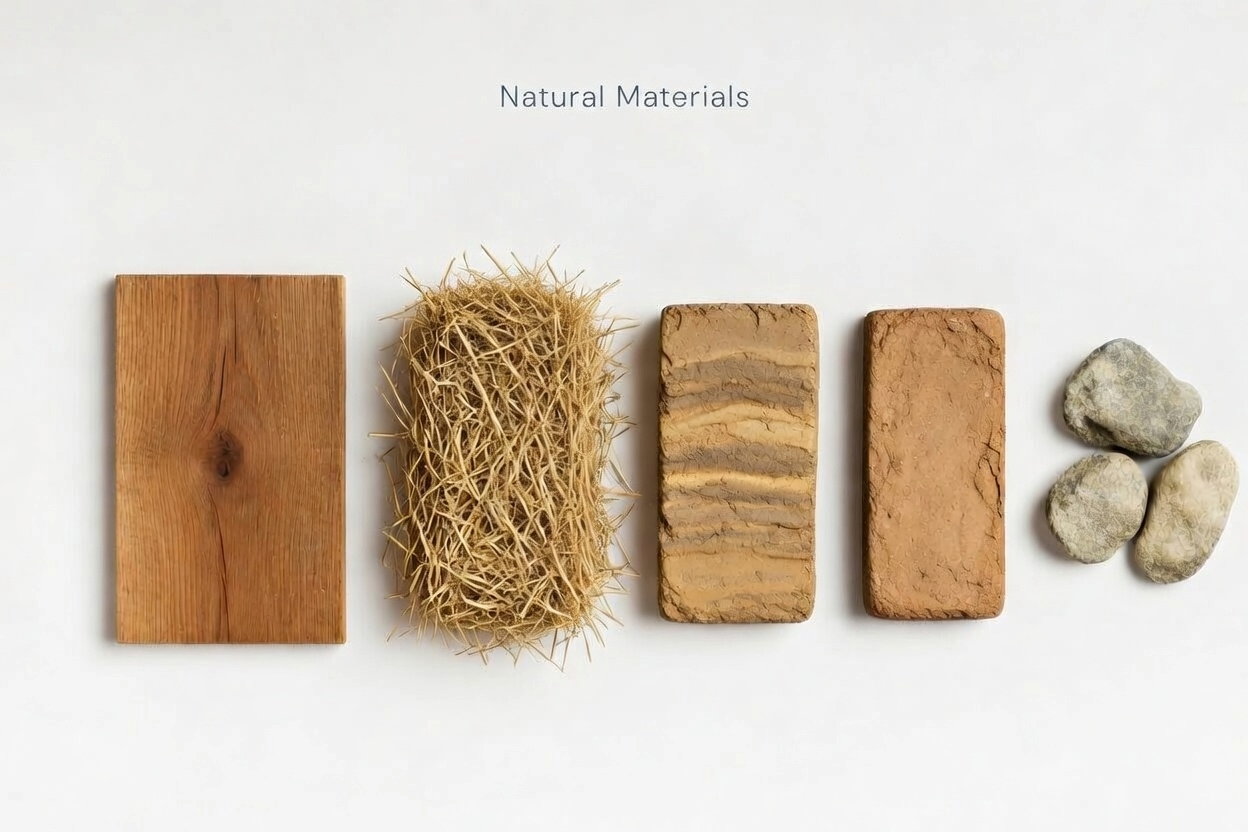
| Material | Good At | Weak At | Best Fit |
|---|---|---|---|
| Rammed earth | Thermal mass, durability, finish, load-bearing potential | Insulation, labor speed, budget work | Custom walls where the wall itself matters |
| Hempcrete | Insulation, vapor-open wall assemblies, low-weight infill | Not a structural wall on its own | Breathable infill systems |
| Compressed earth block | Modular earth construction, smaller units, easier handling | More joints, different look, more masonry labor | Projects that want earth construction in block form |
| Concrete | Foundations, below-grade work, standardized structure | Higher carbon, colder finish, less material character | Heavy structural and wet-site work |
Before you move on: Sustainable Concrete Alternatives is the better page if the project is not fixed on earth walls and you are still comparing broad low-carbon options.
Cost and Trade-Offs
Rammed earth is rarely the cheap option. It tends to compete with premium masonry, architectural concrete, and other custom wall systems more than with basic wood framing.
The wall can save you finish layers. It can save you repainting. It can help with thermal mass. It can last a long time. But the first-cost story is usually tough because of formwork, labor, testing, wall thickness, and project-specific detailing.
| Cost Driver | What Pushes It Up |
|---|---|
| Formwork | Custom shapes, curves, exposed finish quality |
| Labor | On-site compaction, slower wall building, specialist crews |
| Engineering | Structural review, testing, seismic demands, insulation strategy |
| Wall thickness | More material, more time, bigger openings and deeper details |
| Moisture detailing | Base protection, caps, flashings, drainage, transitions |
The short version: rammed earth is usually a durability and design choice, not a bargain wall choice.
Where You See It Now
Rammed earth keeps showing up in a few clear places:
- Custom houses in dry or mixed climates
- Interior feature walls in higher-end projects
- Public buildings, wineries, schools, and visitor centers
- Projects where the wall is expected to carry both performance and visual weight
That tells you something useful. This method works best when the wall is not just background construction.
Use This / Avoid This
| Condition | Use This | Avoid This |
|---|---|---|
| Dry climate, small feature wall | Raw or lightly stabilized rammed earth | Overbuilt hybrid systems you do not need |
| Exterior structural wall in mixed weather | Stabilized rammed earth with strong moisture detailing | Raw exposed wall with weak caps and weak base details |
| Cold climate with strict energy targets | Insulated rammed earth or a hybrid insulated wall | Pretending thermal mass solves insulation on its own |
| Seismic or high-load work | Reinforced, engineered rammed earth | DIY assumptions carried into structural work |
| Fast commercial schedule | Panelized or precast systems where logistics support them | Custom site-built curved work on a tight deadline |
What To Read Next
Worth Knowing: Natural Building Materials if rammed earth is one option inside a bigger material decision.
Also Useful: Compressed Earth Blocks and Sustainability if you want to compare monolithic earth walls with modular earth construction.
One More Thing: Sustainable Building Materials: What Works and What Fails if you are still sorting out durability, carbon, and cost across several material families.
FAQ
Is rammed earth structural?
Yes. Stabilized and reinforced rammed earth can be load-bearing. The level of structure depends on the mix, wall design, engineering, and local code path.
What soil works best?
A sand-heavy mix with enough fines and clay to bind under compaction. Exact proportions vary by project, which is why testing matters.
Is rammed earth good in cold climates?
It can work, but plain rammed earth is not enough for many cold-climate energy targets. That is where insulated or hybrid systems come in.
Is rammed earth waterproof?
No. It needs good caps, good base details, drainage, splash protection, and honest moisture control.
How thick are rammed earth walls?
Structural walls are often thick compared with standard framed walls. Many projects land around the 12-inch to 18-inch range, sometimes more when insulation or higher structural demands are added.
Can you build it yourself?
You can build small non-critical work yourself. A structural house wall is a different level of job.
Is rammed earth cheap?
Not usually. It tends to be a premium wall choice because labor, formwork, testing, and detailing add up.
Can rammed earth be used for retaining walls?
Yes, but that is a more serious structural and drainage problem than a garden wall or feature wall. It needs engineering.
Can it be prefab?
Yes. Panel systems are one route. They help with speed and repeat work, but they do not remove transport, crane, and joint-detail issues.
Why do architects still use it?
Because it gives mass, finish, and material character in one wall. When it fits the climate and the budget, it is hard to replace with something thinner or more generic.