
Not every “concrete alternative” is really replacing concrete.
Some systems can replace a standard footing or slab in the right job. Others still depend on concrete but use less of it, disturb the site less, or lower the cement content. That difference matters. If you blur it, the page turns into green-building fog fast.
This page is for the real distinction: what can replace a standard concrete foundation in some projects, what only reduces the concrete load, and where each option starts making sense.
If you need the wider foundation picture first, start with House Foundations Before Construction. If the site still looks uncertain, Foundations, Soil Analysis, and Site Investigation should come first.
What Replaces Concrete, What Only Reduces It
| Option | Can It Replace a Standard Concrete Foundation? | Best Fit | Main Limit |
|---|---|---|---|
| Screw piles or helical piles | Often yes | Light to moderate structures, low site disturbance, tight-access sites | Still needs soil review, load review, and corrosion planning |
| Pier and beam | Sometimes partly, not always fully | Uneven sites, flood-prone sites, projects that need crawlspace access | Often still uses concrete at piers or footings |
| Permanent wood foundation systems | Sometimes yes | Some residential work, cold climates, well-drained sites | Moisture control has to stay disciplined |
| Rammed or stabilized earth systems | Sometimes, in niche cases | Dry climates, site-specific low-carbon work, specialty builds | Climate, code path, and contractor skill can stop the idea fast |
| Recycled-content or lower-cement concrete mixes | No | Projects keeping concrete but trying to cut impact | Still concrete |
| Raft or floating foundations | No, not usually | Poor soils, broad load spreading, specific engineering cases | Usually still concrete-heavy |
The Systems That Can Be Real Alternatives
Screw Piles or Helical Piles
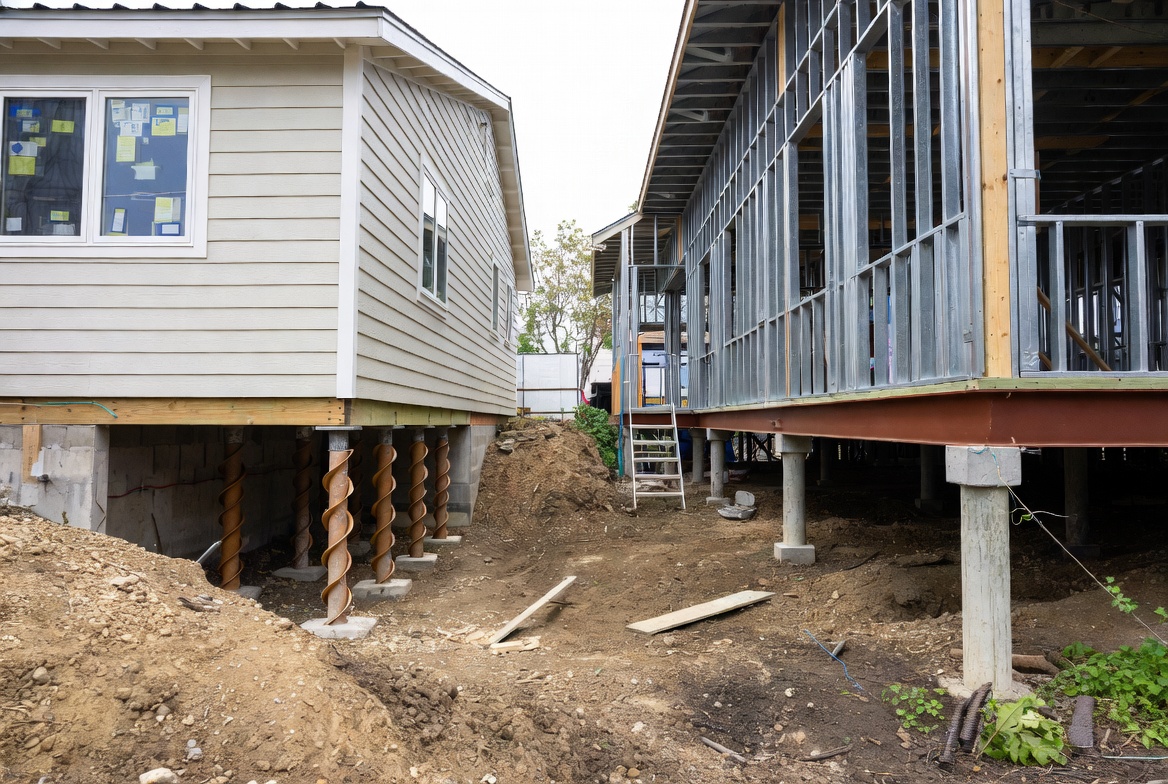
This is one of the clearest alternatives when the job fits. Instead of excavating and pouring a conventional footing or slab, steel piles are screwed into the ground and used to support the structure above.
They make sense when access is tight, excavation is messy, the site needs to stay cleaner, or the structure does not justify a full conventional foundation system. They can be a strong fit for additions, cabins, decks, light-frame buildings, and some awkward sites.
What gets missed is simple: they are not magic screws. Soil conditions, load calculations, corrosion protection, and proper installation still decide whether the system works.
Pier and Beam Foundations
Pier and beam is not anti-concrete by default, but it is a real alternative to a full slab or full basement on the right site. The building bears on points instead of one continuous slab, and the crawlspace below gives utility access that slabs do not.
This can work well on uneven sites, some flood-prone sites, and projects where access below the floor matters later. It can also cut the total amount of concrete compared with a full slab or full basement foundation, even though many pier systems still use concrete at the bearing points.
This part matters: Pier and Beam Foundation is the better next read if this is the option you are seriously weighing.
Permanent Wood Foundation Systems
This is one of the most misunderstood options because people either ignore it or talk about it like it works anywhere. It does not.
A permanent wood foundation system can be a valid alternative in some residential work, especially where lighter handling, insulation value, and cold-climate detailing matter. It can cut the need for a fully conventional poured wall system, but only when drainage, moisture control, treated wood selection, and detailing are handled properly.
On a wet site with sloppy water management, this is not where you improvise.
Rammed or Stabilized Earth Systems
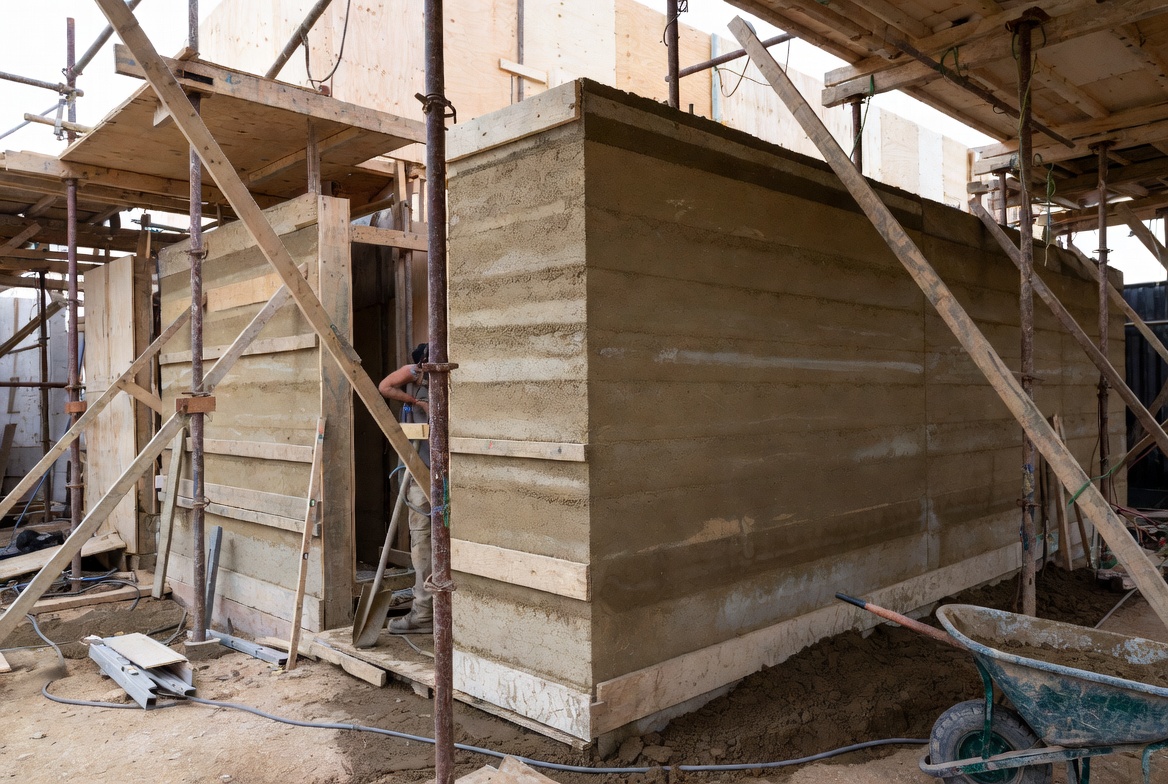
Image by ArchitectureCourses.org. Rammed earth wall under construction showing plywood formwork, bracing, scaffold, and visible compacted lifts.
This is the niche one. It can be durable and low-impact in the right project, but it is not a plug-and-play replacement for a standard residential concrete foundation everywhere.
It works better in dry climates, site-specific low-carbon projects, and jobs where local soil, detailing, and contractor skill all line up. It works badly on a wet site, a rushed site, or a site where nobody on the team builds that way.
Also useful: Rammed Earth and Natural Building Materials if you are comparing earth systems as part of a wider material choice.
The Things That Do Not Really Replace Concrete
Recycled Materials
This is where a lot of articles get sloppy. Recycled materials can matter in foundation work, but they often do not replace the foundation system itself. They usually reduce the environmental cost of the materials inside it.
Crushed recycled aggregate, recycled steel, fly ash, slag, and other supplementary cementitious materials can all lower the impact of a concrete-heavy job. That matters. It is not the same thing as saying the project no longer depends on concrete.
Worth knowing: Sustainable Building Materials and Sustainable Construction Materials if the wider question is lower-impact material choices across the whole build.
Raft or Floating Foundations
These are system alternatives in an engineering sense, but not usually material alternatives. A raft foundation can be the right answer on poor or uneven soils because it spreads load differently. That does not make it a non-concrete foundation in most residential work.
So yes, it belongs in the conversation. No, it should not be sold as “we replaced concrete” when the system is still heavily concrete-based.
Use This Instead
| Do This | Instead Of This | Why |
|---|---|---|
| Say the system reduces or replaces standard concrete in this use case. | Call it a green replacement for concrete foundations. | The first is clear. The second is too loose to trust. |
| Say the option works on this soil, with this building size, and this drainage plan. | Say it works for sustainable construction. | Foundation choices are site decisions, not slogans. |
| Say it cuts site disturbance and excavation. | Say it is better for the environment. | The first tells the reader what benefit they are really getting. |
| Say it still uses some concrete, just much less of it. | Say it avoids concrete. | Those are different claims. |
When Standard Concrete Is Still the Better Move
There is a point where trying too hard to avoid concrete turns into bad judgment.
- When the site has strong water pressure, retaining demands, or a basement that needs a conventional below-grade system.
- When the local code path and contractor market strongly favor standard concrete work.
- When the building loads, span logic, and long-term expectations do not fit lighter or more specialized systems.
- When the project team does not know how to build the alternative they are proposing.
This is the part that gets skipped. Sometimes the smarter low-impact move is not eliminating concrete. It is using less of it, placing it more carefully, or changing the rest of the assembly so the foundation is not oversized and overbuilt.
Where Problems Usually Start
Foundation alternatives are rarely just about the foundation.
The better question is usually this: what does this system force me to solve somewhere else? Floor buildup. Utilities. Insulation. Moisture control. Lateral bracing. Site drainage. Future access. If the alternative solves one problem and creates four more, it is not automatically the smarter option.
One more thing: Foundation Building Materials if you need the wider material logic first, and Concrete Pad Alternatives if the real question is smaller foundations and lighter support options.
FAQ
What is the best alternative to a concrete foundation?
There is no single best one. Screw piles, pier and beam, permanent wood foundations, and some earth-based systems can all work, but only in the right soil, climate, building type, and code path.
Are screw piles better than concrete?
Sometimes. They can cut excavation, speed up installation, and reduce site disturbance. They are not automatically better on every project, and they still need proper engineering and installation.
Is pier and beam a true alternative to a slab foundation?
Yes in system terms, often yes in practical terms, but not always as a full concrete-elimination strategy. Many pier and beam systems still use concrete at the piers or footings.
Are recycled materials a real foundation alternative?
Usually not in the full sense. They are more often lower-impact ingredients inside a still-concrete strategy, not a total replacement for concrete.
When should I stop chasing alternatives and just use concrete?
When the site is wet, the loads are serious, the code path is clearer, and the team knows how to build the conventional solution well but does not really know the alternative being proposed.
What To Do Next
Alternative foundation materials can be useful. Some are smart. Some are niche. Some only look smart until the site gets wet, the loads go up, or the code official asks the next question.
The better move is not “avoid concrete at all costs.” It is choosing the foundation system that fits the soil, climate, building, and budget without pretending every lower-carbon idea is interchangeable.
- House Foundations Before Construction if you still need the big-picture foundation map first.
- Pier and Beam Foundation if you are comparing one of the clearest alternatives to a standard slab.
- Concrete Pad Alternatives if the project is smaller and the real question is how to avoid a full pad or slab.
Resources
- ICC-ES Acceptance Criteria for Helical Pile Systems and Devices (AC358)
- APA: Raised Wood Floor Foundations Guide (PDF)
- HUD: Guide to Foundation and Support Systems for Manufactured Homes (PDF)
- EPA: Construction Products and Recovered Materials Guidance
- New Mexico Earthen Building Materials Code (PDF)