
New York Architecture: The Icons You Miss When You Walk Too Fast
New York isn’t short on famous buildings, but the real story hides in the details most people never notice. A cornice tucked above a deli. A Dutch gable that survived a century of rebuilds. A 1930s lobby mosaic that commuters rush past every morning. These pieces tell you more about the city than the skyline posters ever will.
I’ve walked students through these streets for years. Every block holds a layer. Colonial row houses in Lower Manhattan pressed against cast-iron facades in SoHo. Post-war towers reshaping Midtown. Glass at Hudson Yards fighting for attention while the Chrysler still pulls the better silhouette. The city doesn’t erase its past, it stacks it.
That’s what makes New York different. You get the Golden Age towers, the immigrant-built brownstones, the experimental glass boxes, all crammed together. The mix is the style. And if you slow down and look up, you’ll see the story of a city still arguing with itself about what architecture should be.
New York Architecture: From Dutch Streets to Glass Towers
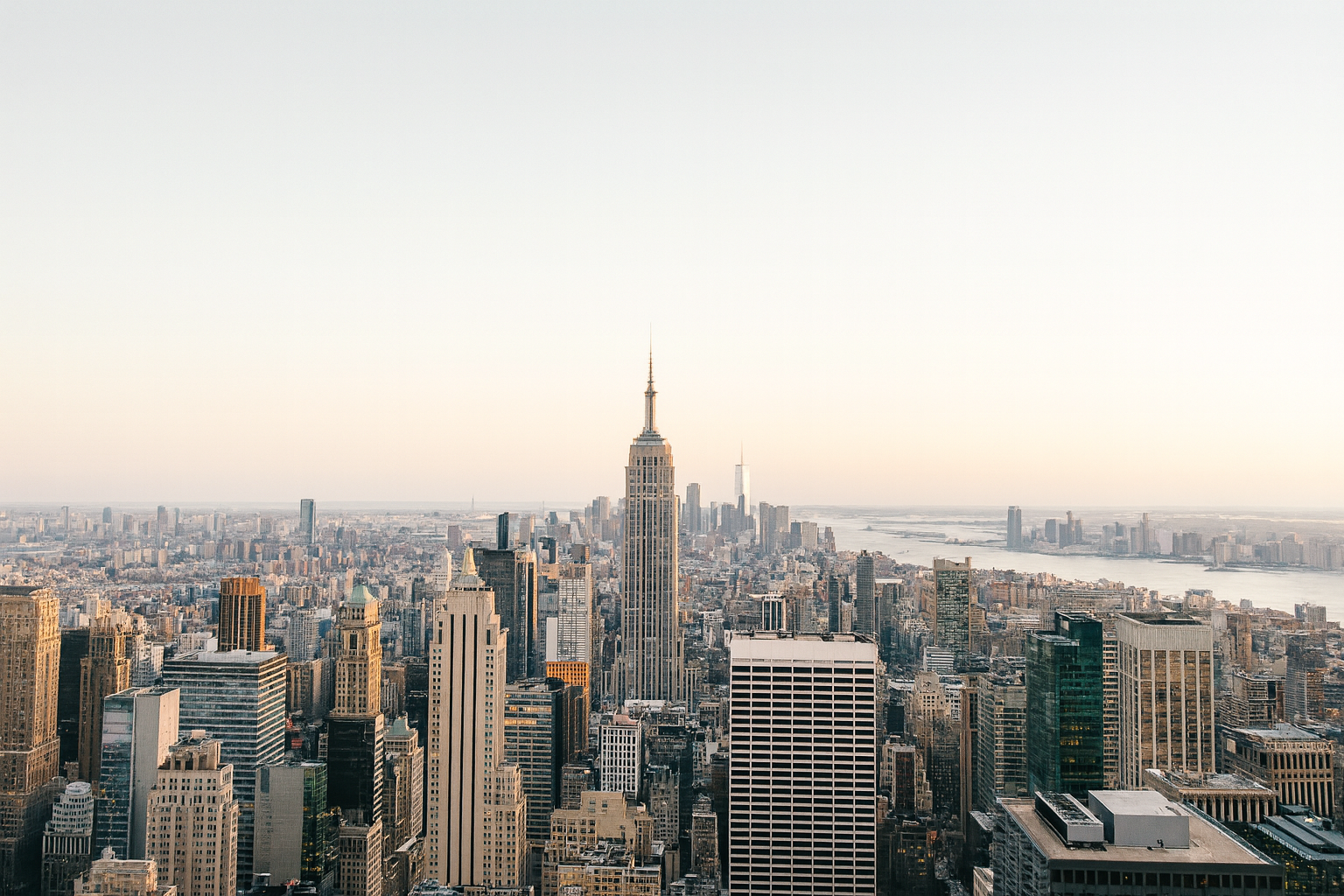
Midtown Manhattan. Photo by Elias Redwan. © 2025 architecturecourses.org.
Early Footprints: A City Shaped by Water and Trade
Walk Lower Manhattan and you’ll notice the grid stutters and twists. That’s not poor planning—it’s New Amsterdam. The Dutch settlers laid out streets in the 1600s to follow the shoreline and topography, not a master plan. Those narrow lanes are the bones of the first city.
The Wyckoff House in Brooklyn, built in 1652, still stands. A plain wooden farmhouse. No marble, no ornament. Just survival. It reminds you that New York started as a pragmatic outpost, not a metropolis. Steep gables, brick or timber walls, roofs angled to shed snow—Dutch logic transplanted to the New World.
The Grid That Changed Everything
In 1811, the Commissioner’s Plan carved the island into 12 avenues and 155 cross streets. At the time, most of Manhattan above Houston was farmland and swamp. Laying a rigid grid over it was an audacious move. Efficiency won over romance. Paris has boulevards. New York got numbered blocks.
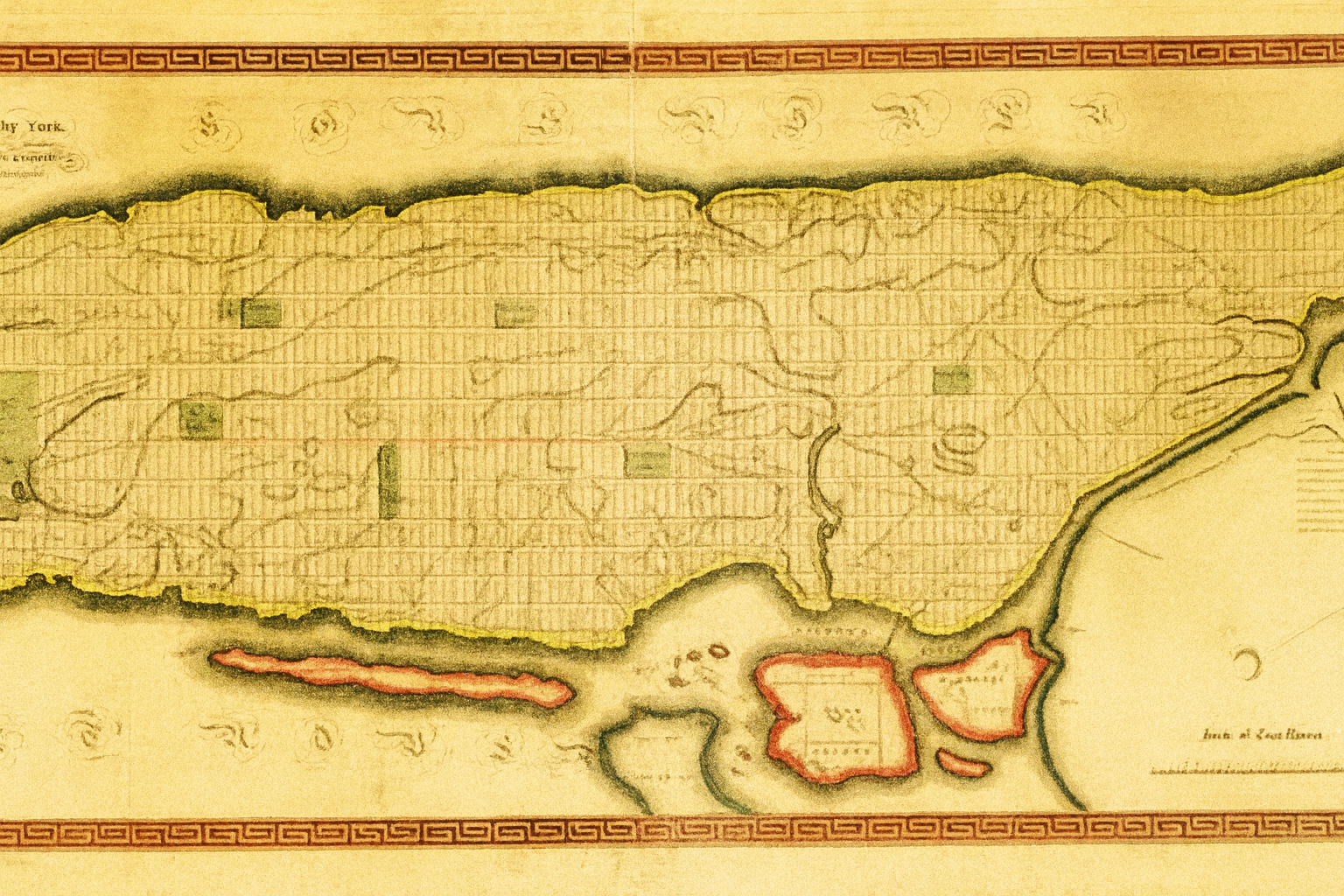
That grid gave developers certainty. Parcels could be bought, sold, and built fast. It also set the stage for vertical growth. Once steel and elevators arrived, the grid wasn’t just flat—it was the launchpad for towers.
The Vertical Leap: Skyscrapers Take Over
Chicago may have built the first steel-framed skyscraper, but New York made them cultural icons. The Woolworth Building in 1913 was called the “Cathedral of Commerce.” Cass Gilbert mixed Gothic ornament with a modern frame, and at 792 feet it dominated the skyline.
Frank Woolworth paid cash—$13.5 million. That kind of boldness defined the city. Not long after, the Chrysler Building rose with its chrome crown and eagle gargoyles, a skyscraper that still steals every sunset. These were not just offices. They were advertisements in steel.
The Empire State: Built in a Depression
Completed in 1931, the Empire State Building rose in just 410 days. That speed is almost unthinkable now. It became the tallest building on earth at 1,454 feet. Built during the worst years of the Great Depression, it put thousands to work and gave the city a symbol of hope.
Architecturally, it was stripped-down Art Deco, less ornament than Chrysler, more muscle than flair. Structurally, it was overbuilt for its time. That durability is why it still anchors Midtown.
Modernism Lands in Midtown
By the 1950s, the skyline had shifted again. The Seagram Building by Mies van der Rohe brought glass and steel minimalism to Park Avenue. No gargoyles, no crown. Just precision. The bronze-toned facade and its open plaza set a new standard for corporate America.
Developers followed suit. The glass box became the office archetype. For better or worse, it was the end of ornament in commercial towers.
The High Line and Reinvention
Jump to the 2000s, and New York proved it could reinvent its leftovers. The High Line turned an abandoned freight line into a mile-and-a-half elevated park. What could have been demolished became one of the city’s most loved spaces. It also changed how developers thought about public amenities.
The lesson: New York doesn’t just build. It repurposes. The city keeps stitching new layers over the old.
See also: A Look at Dutch Architecture: From Classic to Contemporary
21st Century: Sustainability and Performance
Today, the conversation is carbon. One Bryant Park set the tone with LEED Platinum certification—efficient HVAC, recycled materials, water reuse. Hudson Yards added spectacle, with The Shed rolling on rails to reshape itself for events.
Also: Building a Truly Green NYC Apartment: What It Takes in 2025
This is not just about style anymore. Local Law 97 fines buildings that exceed carbon caps. Design in New York today means resilience, energy budgets, and systems that work as hard as the facade.
You might like: New York City Architecture: From Iconic Skyscrapers to Forgotten Treasures
Hidden Facts About New York Architecture You Probably Missed

Most people look up at New York’s skyline and stop there. The real story runs deeper. The city’s architecture is full of quirks, forgotten experiments, and hidden systems that most New Yorkers walk past every day without knowing.
Why Towers Cluster in Midtown and Downtown
Skyscrapers didn’t rise just anywhere. Manhattan’s bedrock is closest to the surface in Midtown and Downtown, which made it possible to anchor massive foundations. That geology is why the skyline has two main clusters of towers with a dip in between.
The Flatiron That Nearly Flopped
When the Flatiron Building went up in 1902, critics hated it. People even thought its narrow wedge shape would collapse in strong winds. Instead, it became one of the most photographed buildings in the city. What was once mocked now defines New York postcards.
Central Park Could Have Been a Pyramid
In the mid-1800s, before Central Park was approved, there was a serious proposal to drop a giant glass pyramid in the middle of Manhattan. Imagine that instead of Olmsted’s meadows and lakes. The plan was scrapped, and New York got the park that still anchors the city today.
The Skyscraper Without Windows
33 Thomas Street, better known as the AT&T Long Lines Building, is a 550-foot windowless tower in Tribeca. Built in 1974 to protect telephone equipment, it looks more like a fortress than an office. Urban legends claim it doubles as one of the most secure sites in America.
What Lies Beneath Central Park
Central Park isn’t just lawns and ponds. Underneath, there’s a network of service tunnels, storage rooms, and even a Cold War–era fallout shelter. That hidden infrastructure keeps the park functioning smoothly while millions use it above ground.
Off the Beaten Path: Hidden Architectural Landmarks
New York’s architectural story isn’t only about towers. Some of its most revealing structures sit quietly away from the main skyline.
The Eldridge Street Synagogue
Built in 1887, this Moorish Revival synagogue is tucked into Chinatown. For decades it fell into disrepair, but a 20-year restoration brought back its stained glass, domes, and intricate detailing. It’s one of the best examples of immigrant-built architecture in the city.
The Little Red Lighthouse
Beneath the George Washington Bridge sits a tiny brick lighthouse from 1921. It once guided ships along the Hudson before the bridge lights made it obsolete. Today it’s more symbol than tool, but it still draws curious visitors who know to look for it.
The Cloisters
Perched in Fort Tryon Park, The Cloisters looks like it belongs in medieval Europe. Built in the 1930s from actual stonework imported from French monasteries, it houses the Met’s medieval art collection. Step inside, and the city outside disappears.
The Underground City Few Talk About
New York isn’t only about what’s above ground. Its hidden strength is the infrastructure buried below.
The Croton Aqueduct Tunnels
Completed in 1842, this 40-mile aqueduct brought clean water from Westchester into the city. Before it, cholera and fire were constant threats because the water supply was so poor. Parts of the old aqueduct still exist under the city, with fragments visible in the Bronx.
The Abandoned City Hall Subway Station
The first subway line in 1904 ended at City Hall Station, a vaulted space with skylights and Guastavino tile arches. It was closed in 1945 because it couldn’t handle longer trains, but the station remains intact, a hidden jewel beneath City Hall.
Grand Central’s Secret Levels
Below the famous concourse sits M42, a basement that once powered the entire rail system. During World War II, it was guarded heavily—sabotaging it could have shut down troop movements. Even today, it isn’t marked on public maps.
Manhattan’s Buried Rivers
Streams like Minetta Brook in Greenwich Village still run underground. They were paved over in the 19th century, but heavy rains sometimes reveal their presence, flooding basements or reappearing as surface springs. The natural landscape never fully went away.
The World Trade Center’s “Bathtub”
The Twin Towers stood on top of a massive underground retaining wall that held back the Hudson River. Known as the “Bathtub,” it was one of the most difficult engineering feats of the 20th century. When the towers fell on 9/11, the Bathtub held, preventing Lower Manhattan from flooding.
Why These Hidden Stories Matter
The skyline gets the attention, but the real lessons are in these overlooked structures. Bedrock set the stage for towers. Restorations saved immigrant landmarks. Forgotten tunnels and aqueducts still shape daily life.
If you study New York architecture, don’t stop at the Chrysler or Empire State. Look underfoot. Walk side streets. The most surprising buildings are the ones hiding in plain sight.
See also: Manhattan Architecture: A Guide to NYC's Iconic Skyscrapers and Historic Landmarks
Best-Selling Architecture Titles
- The Architecture of Happiness by Alain de Botton
Meta Description: Explores how architecture affects emotions and well-being, highlighting the deep connection between design and human experience.
Why It’s Important: A philosophical take on the impact of architecture, often overlooked in technical education. - Towards a New Architecture by Le Corbusier
Meta Description: Le Corbusier's manifesto for modern architecture, advocating for functional and innovative design.
Why It’s Important: A critical work that influenced the modernist movement, still relevant for today’s architects. - The Future of Architecture in 100 Buildings by Marc Kushner
Meta Description: A showcase of groundbreaking structures redefining architectural possibilities through innovation and sustainability.
Why It’s Important: Offers a futuristic look at where architecture is heading, making it an inspiring read for professionals and students. - Yes is More: An Archicomic on Architectural Evolution by Bjarke Ingels
Meta Description: This graphic novel-format book explains complex architectural ideas through a visually compelling, accessible approach.
Why It’s Important: Makes understanding architecture fun and approachable for a wide audience, blending theory with practice.
New York Architecture Ahead: Where the Skyline is Going
New York has never been shy about changing its face. The next phase is less about height for the sake of height and more about resilience, light, and sustainability.
Hudson Yards shows the shift. It is the largest private real estate project in U.S. history and it works like a mini city. Office towers, apartments, cultural venues, and plazas all stitched together with energy and water systems that meet stricter sustainability targets. Even The Vessel, love it or hate it, signals that public spectacle is now part of how developments sell themselves.
Then there is One Vanderbilt. At 1,401 feet it ranks as the city’s fourth tallest. What makes it matter is not the number, but the approach: transparency in its facade, daylight strategies inside, and a LEED Gold rating baked into the design. It sets the tone for towers that compete as much on performance as on skyline presence.
The lesson is clear. Future New York buildings will still aim high, but the real measure will be how they balance spectacle with systems like light, air, water, and carbon.
Why New York Keeps Pulling Architects Back
This city never stands still. You can spend a lifetime walking it and still find buildings you missed—a brick row house tucked into SoHo, a forgotten Deco lobby, a new timber addition hiding in plain sight.
That’s why architects love it. New York forces you to design for density, weather, cost, and culture, all on the same block. It’s a laboratory that never shuts down.
FAQ
1. What’s the most iconic building in New York?
Most people point to the Empire State Building. But the Chrysler Building, with its stainless-steel crown and gargoyles, is the one architects keep in the conversation.
2. Why are there so many water towers on rooftops?
Gravity. The city’s mains can’t push water higher than about six stories, so rooftop tanks make sure upper floors have pressure. They’re old tech, but they work, so they stay.
3. What’s the oldest skyscraper in New York?
The Park Row Building, finished in 1899. At 391 feet it was the tallest in the world and set the stage for every tower that followed.
4. Why does New York mix so many styles?
Each wave of immigrants and each boom period left a layer. Beaux-Arts banks, Gothic spires, Art Deco towers, glass curtain walls. The city never had a single style—it built whatever the moment demanded.
5. What’s the biggest trend now?
Sustainability and adaptive reuse. New towers like One Bryant Park go heavy on green systems, while projects like The Shed at Hudson Yards show how flexibility is becoming part of the design brief.
Must-Read Books
1. New York 1900: Metropolitan Architecture and Urbanism 1890-1915 by Robert A.M. Stern, Gregory Gilmartin, and John Massengale
What’s in it?
- This book explores the Beaux-Arts movement and the architectural boom of the late 19th and early 20th centuries, which helped shape modern New York.
Why You Should Buy It:
A must-read for history buffs and architecture students curious about New York's transformation into a modern metropolis.
Get it on Amazon
2. Delirious New York: A Retroactive Manifesto for Manhattan by Rem Koolhaas
What’s in it?
- A unique blend of architectural theory and cultural history, exploring Manhattan's chaotic and ambitious urban design.
Why You Should Buy It:
A foundational text for understanding how New York’s skyline represents its complex, ever-evolving identity.
Get it on Amazon
3. The Architecture of New York City by Donald M. Reynolds
What’s in it?
- An in-depth look at the architectural evolution of New York City, from its colonial past to modern-day skyscrapers.
Why You Should Buy It:
Perfect for students and professionals wanting a comprehensive guide to New York’s architectural milestones.
Get it on Amazon
4. The Historic Shops and Restaurants of New York by Ellen Williams and Steve Radlauer
What’s in it?
- A celebration of New York’s enduring commercial architecture, focusing on the businesses that have become part of the city’s cultural fabric.
Why You Should Buy It:
Ideal for those who love exploring the lesser-known architectural gems hidden in the city’s iconic shops and restaurants.
Get it on Amazon
5. Manhattan Skyscrapers by Eric P. Nash and Norman McGrath
What’s in it?
- A photographic tour of Manhattan’s most iconic skyscrapers, complete with historical context and architectural details.
Why You Should Buy It:
For anyone fascinated by the towering buildings that define New York’s skyline, this is a visual and educational delight.
Get it on Amazon
These books offer a deep dive into New York City’s architectural legacy and are perfect for anyone looking to expand their knowledge of its history and design. From historic shops to soaring skyscrapers, these reads provide invaluable insights.
More Books:
"Why Buildings Fall Down: How Structures Fail" by Matthys Levy and Mario Salvadori
What It’s About:
A fascinating exploration of structural failures and the engineering lessons learned from them, offering insight into the complexities of building design.
Why You Should Buy It:
Understanding how and why structures fail is essential for any architect or engineer committed to improving the built environment.
Sources:
- The Municipal Art Society of New York (MAS)
- Website: mas.org
- Purpose: Promotes the preservation and celebration of New York’s architectural and cultural heritage through events, exhibitions, and research.
- New-York Historical Society
- Website: nyhistory.org
- Purpose: Dedicated to New York's history, this society offers an extensive collection of art, documents, and exhibitions showcasing the city's evolution.
- The Skyscraper Museum
- Website: skyscraper.org
- Purpose: Focuses on the architectural, historical, and cultural significance of skyscrapers in New York, providing educational resources and archives.
- The Architectural League of New York
- Website: archleague.org
- Purpose: Advocates for architecture, urbanism, and design in NYC by organizing lectures, exhibitions, and educational events.
- The Historic Districts Council (HDC)
- Website: hdc.org
- Purpose: Provides advocacy and resources to protect New York’s historic districts and buildings, including research and preservation efforts.