
How Skyscrapers Changed the City
Landmarks Every Architect Should Know
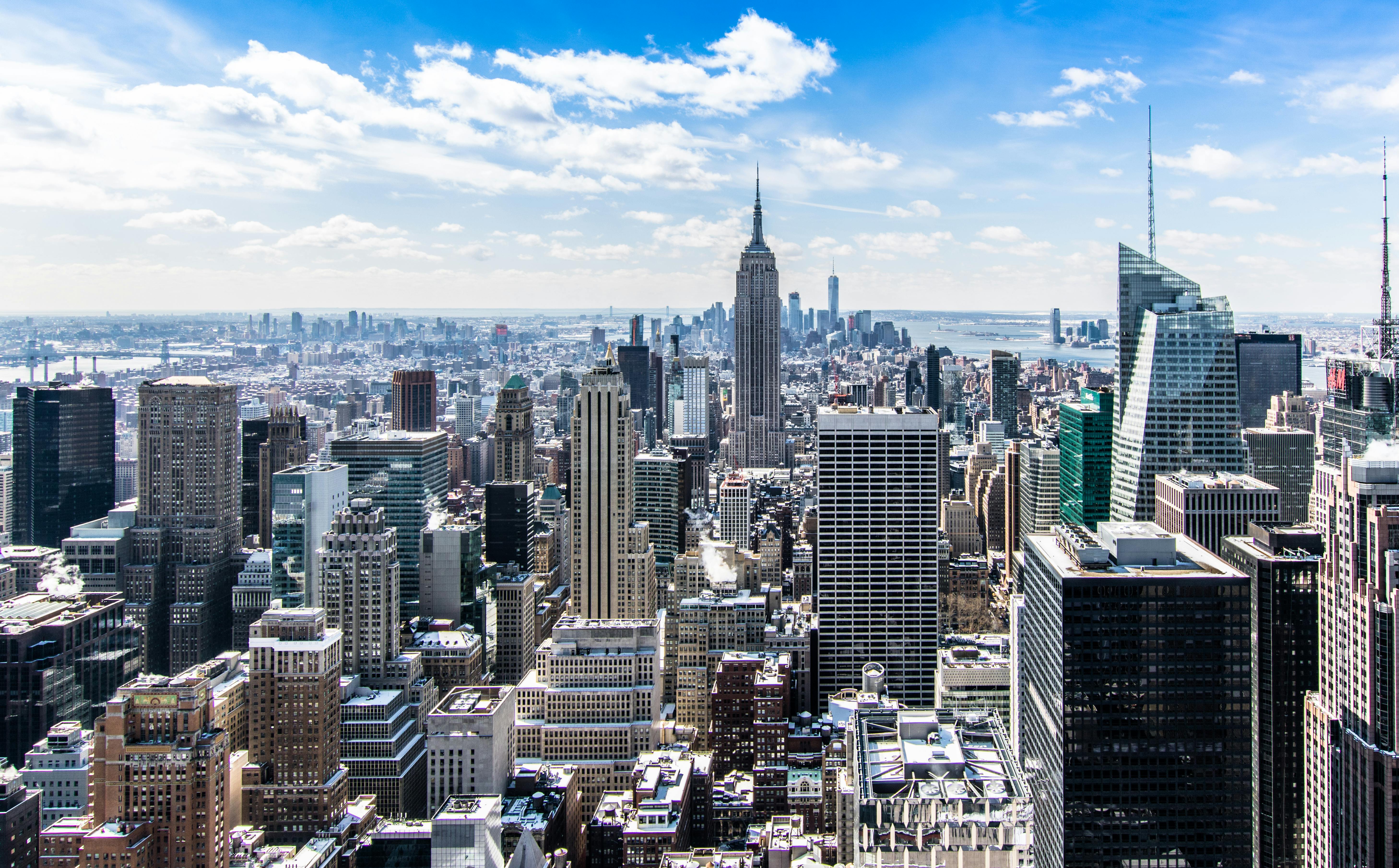
You know the skyline from pictures, but the real story is at street level. Brownstones still sit heavy from the 1800s. A block later the Deco towers cut shadows across the pavement. Glass walls now press in from every angle, bright in the day, lit up at night. Walk long enough and you see the city’s habit: never stop building higher
HISTORY
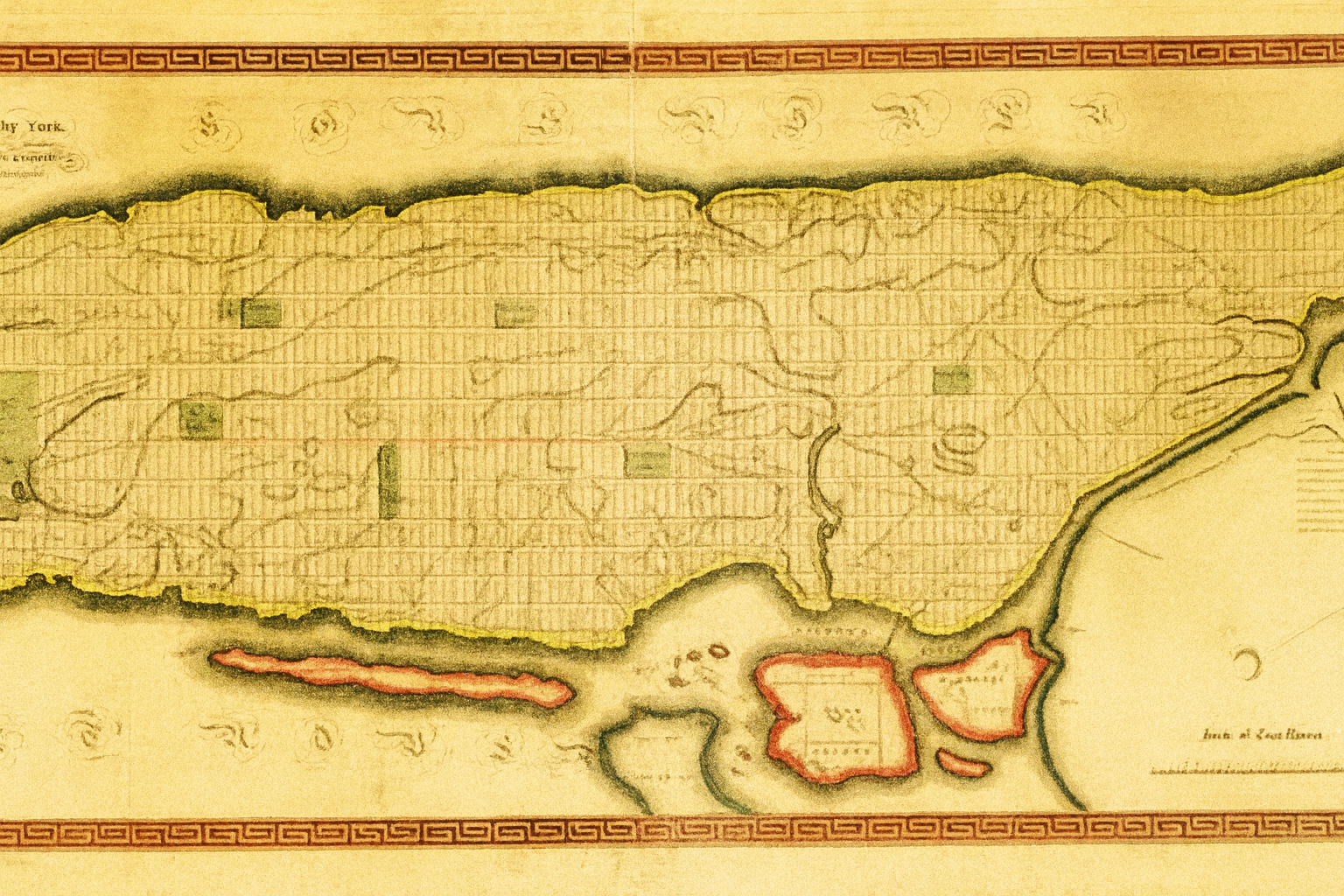
Manhattan Architecture: From Brownstones to the Empire State Building
Mid-Century Modernism: Clean Lines and New Rules
By the middle of the 20th century, Manhattan’s architecture pivoted hard. The ornament of Art Deco gave way to Modernism. Architects stripped towers down to glass, steel, and proportion. Decoration was out. Clarity, repetition, and efficiency became the new values.
The Seagram Building, finished in 1958 by Ludwig Mies van der Rohe with Philip Johnson, set the tone. Bronze-tinted glass, deep vertical mullions, and a plaza that stepped the tower back from Park Avenue. The design proved restraint could still command power. That plaza wasn’t just a design flourish—it established the template for privately owned public spaces, a zoning deal that would change New York for decades.
A few years earlier, Lever House (1952) had cracked the door open. Its slim green-tinted curtain wall floated above a low base on pilotis. Against the granite and limestone giants of Midtown, Lever House looked impossibly light. It introduced a new building type—the corporate glass box—that multiplied across Manhattan and then the world.
Together these buildings shifted the skyline. Towers stopped chasing decorative crowns and started broadcasting corporate identity. Modernism, efficient and global, became the new architectural language of New York.
Postmodernism: A Rebellion With a Wink
By the 1980s and 90s, the steel-and-glass discipline of Modernism began to feel sterile. Postmodernism hit back, bringing humor, history, and even irony. The AT&T Building (now the Sony Building), designed by Philip Johnson in 1984, said it best. Its “Chippendale” top—a broken pediment straight out of antique furniture—was a provocation aimed at the glass box status quo.
Postmodern towers across Manhattan mixed granite with glass, added arches and color, and quoted history in ways that ranged from witty to clumsy. Critics still argue whether this era enriched or cheapened the skyline. But it marked a cultural shift: architecture was no longer only about efficiency, it was also about personality.
The New Century: Resilience and Scale
The 21st century brought different pressures—terrorism, climate change, and global capital. Architecture had to respond.
One World Trade Center, designed by David Childs and completed in 2013, anchors Lower Manhattan. At 1,776 feet it is the tallest building in the Western Hemisphere. The design is sleek, faceted, and deliberate in its symbolism. For New Yorkers, it remains less about height and more about resilience—proof the city could rebuild after 9/11.
On the West Side, Hudson Yards emerged as something else entirely: a brand-new district, the largest private development in U.S. history. It dropped an instant skyline of glass towers onto a platform built above rail yards. At its center, the Vessel, a honeycomb of staircases, drew crowds for photos as much as for its design. Love it or hate it, Hudson Yards is New York’s statement that it still builds at the biggest scale.
Where Manhattan Stands Now
Walk the island today and you see every layer at once. Brownstones still line Greenwich Village. Art Deco crowns still glow at sunset. Modernist slabs march up Park Avenue. Postmodern experiments sit cheek by jowl with glass supertalls. And now, Hudson Yards and One Vanderbilt stretch into the sky with sustainable systems and LEED plaques.
Manhattan’s architecture has never been one story. It is a palimpsest of ambitions—residential, corporate, civic, and symbolic—stacked on a small island of bedrock. That’s what makes it worth studying, and why architects everywhere still measure their work against this skyline.
Manhattan Architecture Walk: An Architect’s Field Notes
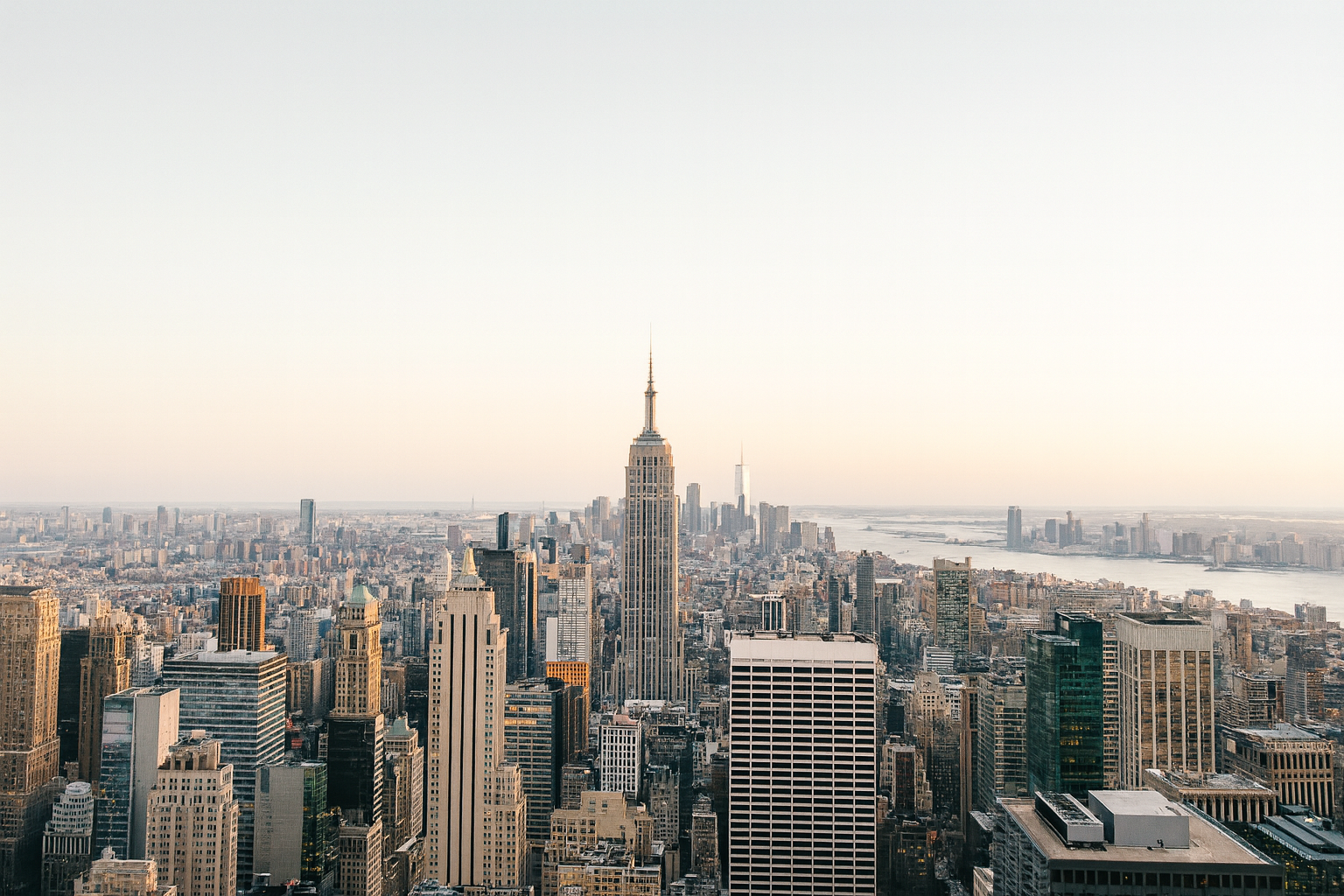
Midtown Manhattan. Photo by Elias Redwan. © 2025 architecturecourses.org.
Flatiron Building: The Wedge That Proved Steel
I always start at 23rd and Broadway. From afar it looks like a novelty, but stand under the prow and you’ll feel the wind whip through the canyon. The corner is barely six feet wide, yet the load carries because steel frames had finally matured. Burnham wasn’t drawing a postcard — he was solving a knife-edge site with new tech.
Chrysler Building: Branding in Stainless Steel
Take students up close to the eagle gargoyles. They’re not just ornament. They’re car hood ornaments, blown up to 60 feet. This tower was corporate branding in architecture, decades before logos plastered glass walls. The spire was secretly assembled inside, then hoisted up in 90 minutes to beat out the Empire State. It’s optimism and one-upmanship in chrome.
Empire State Building: Speed, Scale, and Survival
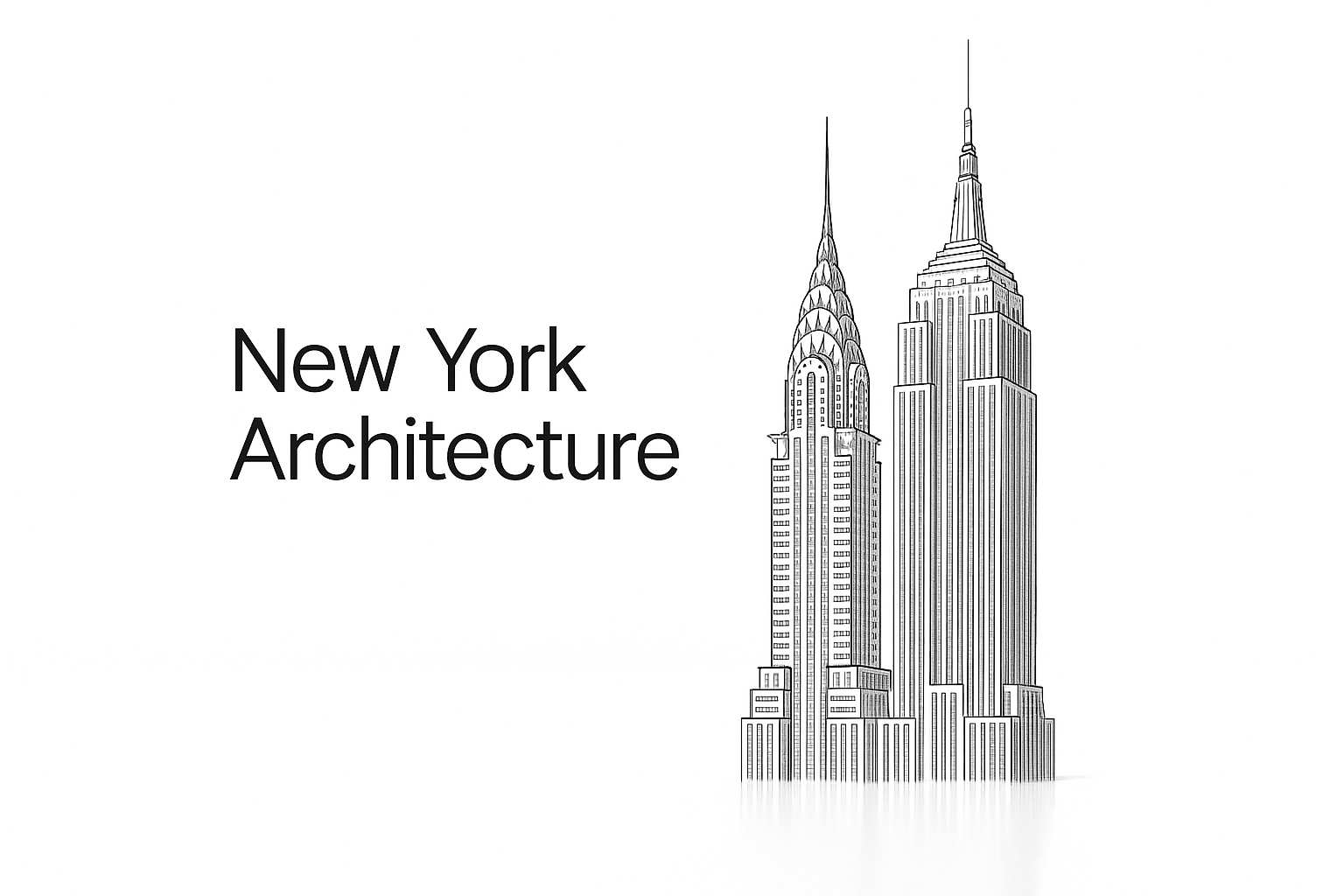
At 1,454 feet, it’s the king of Manhattan stories. But the real lesson is speed: topped out in 13 months during the Depression. Walk through the lobby at rush hour. Notice how wide the corridors are, how quickly elevators take people up. This wasn’t just a tower. It was efficiency cast in limestone and steel, built to prove New York wouldn’t stop building.
Seagram Building: The Plaza That Changed Midtown
Students glance and call it a black box. But sit at the plaza ledge on Park Avenue. Mies and Johnson pulled the tower back 100 feet from the street, trading space for openness. That zoning deal — extra height for public plaza — shaped Midtown for the next half-century. The bronze glass cost a fortune, but the precedent it set was priceless.
Grand Central Terminal: Circulation as Design
Most people look up at the starry ceiling. I tell students to watch the ramps. Vanderbilt wanted seamless circulation. Even at rush hour, thousands flow without a jam. That’s design at infrastructure scale, a lesson in how circulation is as architectural as stone and vaults.
Rockefeller Center: Corporate Urbanism Done Right
Stand in the plaza at night and it feels obvious. But in 1931, building a complex of offices, retail, and public space in the depths of the Depression was radical. Notice the setbacks and sightlines. This was corporate America curating urban space — and it worked. The public embraced it because it gave back as much as it took.
Woolworth Building: A Cathedral for Commerce
Before Chrysler, before Empire State, this was the tallest. Cass Gilbert dressed a steel frame in Gothic stone to sell grandeur. Step inside the lobby and it feels like a church nave, except it was built with retail cash. Lesson: style is marketing. The steel frame was modern, the Gothic skin made it familiar.
Lever House: Glass Arrives on Park Avenue
Finished in 1952, Lever House looks tame today. Back then, against stone-clad towers, it was shocking. A curtain wall of green glass, lifted above the street on pilotis, set the template for every corporate block to come. Students usually dismiss it as “just another box,” until you remind them this was the first of its kind in Manhattan.
The High Line: Turning Ruin Into Asset
This one isn’t about a tower. It’s a lesson in reuse. An abandoned freight line could have been demolished. Instead, designers turned it into a linear park. The concrete tracks are still there under the plants. It shows students that architecture is also editing — choosing what to keep, what to cut, and how to reframe a city’s leftovers.
One World Trade Center: Symbol and System
At 1,776 feet, it is as much symbol as building. But look at the base. Blast resistance, secure entry, heavy podium walls. This is architecture responding to trauma and regulation. Inside, daylight and open spans return a sense of normalcy. The lesson for students: context matters. A tower is never just a tower.
Keeping the Old While Building the New
Manhattan keeps growing, but it doesn’t erase everything. Since the 1960s, the Landmarks Preservation Commission has locked in whole districts and thousands of individual buildings. That’s why SoHo’s cast-iron facades and the East Village’s pre-wars still stand. Without those protections, they’d have been condos decades ago.
Preservation here isn’t nostalgia. It forces new towers to negotiate with what came before, and that’s what gives Manhattan its layered streets.
How to Actually See the Architecture
Skip the bus tours. Walk. Book a Municipal Art Society tour if you want someone who knows the zoning quirks and the cornices. Stop at the Skyscraper Museum in Battery Park. Small but sharp.
And don’t just crane your neck. Look at the ground level—iron grates, terra-cotta trim, mosaics half hidden in subway entries. That’s where the city’s history hides.
The Skyscrapers Most People Forget
Not every tower made the postcards.
The MetLife North Building was designed to be the tallest in the world. The Depression froze it at 29 floors. Now it looks squat, a reminder of ambition cut short.
The New York Life Insurance Building, with its gold-topped roof, opened with fanfare in 1928. Within a decade it was already outshone. The gargoyles are still there if you bother to look up.
These “failures” tell as much of the story as the Empire State or the Chrysler. Manhattan’s skyline is built as much on experiments and half-finished ideas as on icons.
Best-Seller Books
-
New York 1900: Metropolitan Architecture and Urbanism 1890-1915 by Robert A.M. Stern, Gregory Gilmartin, and John Massengale
- What to Expect: A detailed look at New York's transformation in the late 19th and early 20th centuries, focusing on the Beaux-Arts movement and architectural growth.
- Why It’s a Must-Have: An essential read for anyone interested in exploring the roots of New York City's architectural development.
-
Delirious New York: A Retroactive Manifesto for Manhattan by Rem Koolhaas
- Key Themes: A blend of architectural theory and cultural history, this book explores Manhattan's chaotic and ambitious urban design.
- Why It’s Important: A must-read for understanding the ambitious urban fabric of Manhattan and its representation of New York's identity.
-
The Architecture of New York City by Donald M. Reynolds
- Overview: A thorough examination of New York's architectural journey, from colonial buildings to modern skyscrapers.
- Why You’ll Love It: Ideal for anyone seeking a comprehensive understanding of New York's architectural landmarks.
-
The Historic Shops and Restaurants of New York by Ellen Williams and Steve Radlauer
- What Makes It Special: A charming exploration of New York’s commercial architecture, focusing on the historic shops and restaurants that have shaped the city’s cultural fabric.
- Why You Need This: Perfect for those interested in discovering hidden architectural gems scattered across NYC’s historic shops and eateries.
-
Manhattan Skyscrapers by Eric P. Nash and Norman McGrath
- What's Inside: A stunning photographic tour of Manhattan’s most iconic skyscrapers, complete with historical context and architectural details.
- Why It’s Worth Buying: Perfect for architecture lovers fascinated by the towering buildings that define New York’s skyline.
- Why Buildings Fall Down: How Structures Fail by Matthys Levy and Mario Salvadori
- Summary: A captivating look at structural failures and the lessons learned from them, providing valuable insights for architects and engineers.
- Why You Should Read It: Essential for understanding how and why structures fail, making it a must-read for any architect or engineer.
Buy on Amazon More Best-Selling Architecture Books
-
The Architecture of Happiness by Alain de Botton
- What to Expect: Explores how architecture influences emotions and well-being.
- Why It’s a Must-Have: A philosophical look at the deep connection between design and human experience.
-
Towards a New Architecture by Le Corbusier
- What to Expect: A manifesto for modern architecture, advocating for functional and innovative design.
- Why It’s a Must-Have: A critical work that shaped the modernist movement, still relevant for today's architects.
-
The Future of Architecture in 100 Buildings by Marc Kushner
- What to Expect: Showcases groundbreaking structures that redefine architectural possibilities.
- Why It’s a Must-Have: A futuristic look at where architecture is headed, inspiring professionals and students alike.
-
Yes is More: An Archicomic on Architectural Evolution by Bjarke Ingels
- What to Expect: A graphic novel that explains complex architectural ideas in a fun, accessible way.
- Why It’s a Must-Have: This book makes architecture fun and approachable for a wide audience, blending theory with creativity.
FAQ
Q: What is the tallest building in Manhattan?
A: As of now, the tallest building in Manhattan is One World Trade Center, standing at 1,776 feet tall.
Q: What are some must-see architectural landmarks in Manhattan?
A: Be sure to visit the Empire State Building, Chrysler Building, One World Trade Center, Flatiron Building, and Seagram Building for a mix of historical and modern marvels.
Q: How is New York preserving its historic architecture?
A: The Landmarks Preservation Commission protects many of Manhattan’s historic districts, ensuring that the city's architectural heritage is maintained even as new buildings are constructed.
Resources
- NYC Landmarks Preservation Commission
Website: NYC Landmarks
Description: The Landmarks Preservation Commission works to safeguard Manhattan’s architectural heritage and ensure that historical sites are protected and preserved for future generations. - The Skyscraper Museum
Website: Skyscraper Museum
Description: The museum focuses on the architectural evolution of New York City and its history of high-rise buildings. It’s a non-profit institution dedicated to the study of skyscrapers. - The Historic Districts Council
Website: HDC Website
Description: HDC advocates for the preservation of New York’s historic neighborhoods and buildings. It’s a non-profit working with communities to maintain the character of the city. - The Municipal Art Society of New York (MAS)
Website: MAS Website
Description: A non-profit organization promoting thoughtful planning and urban preservation in New York City, MAS supports efforts to keep the city's architecture unique and vibrant. - Columbia University Graduate School of Architecture, Planning, and Preservation
Website: Columbia GSAPP
Description: One of the premier schools for studying architecture and preservation, Columbia’s GSAPP offers a range of resources for understanding architectural history and preservation.