

The Netherlands is a country that should not exist. Most of it sits below sea level, much of it was reclaimed from water by hand over centuries, and all of it is too small and too dense to accommodate the number of people trying to live there. That is the actual starting point for understanding Dutch architecture. Not the canal gables. Not the modernist towers. The problem came first. The buildings came after.
Every Dutch building tradition—old or new—traces back to a specific constraint. The narrow lot. The soft ground. The low sky and limited light. The need to show your neighbors, through the size and placement of your windows, that you had nothing to hide. These were not aesthetic choices. They were answers to pressure. The aesthetic followed from the answer.
That is why Dutch architecture keeps producing work that matters. The pressure never went away. It just changed shape.
What the window is actually about
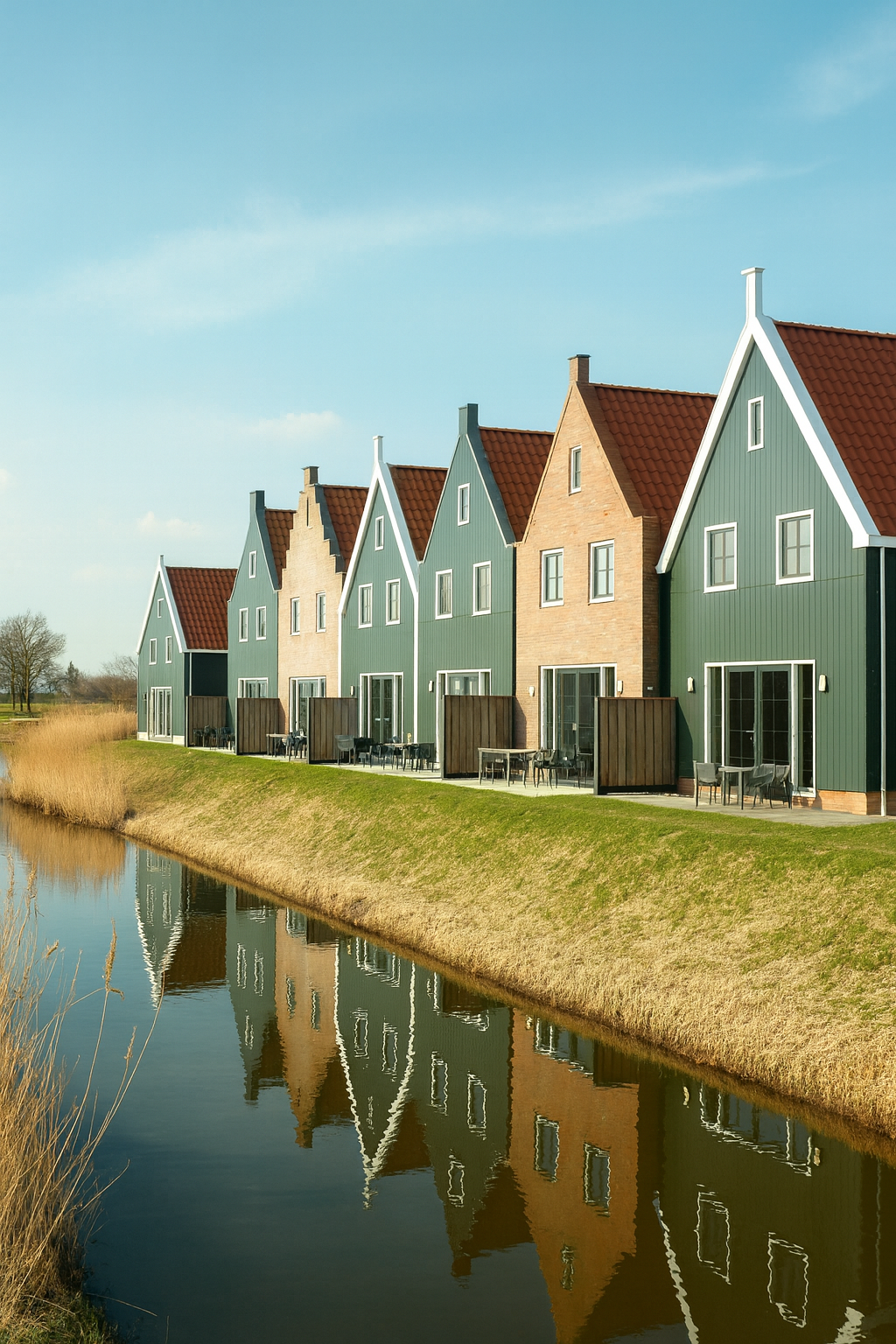
Walk through any Dutch neighborhood and the windows are the first thing you notice. They are large. They face the street without curtains. The furniture inside is arranged so the room reads clearly from outside: a lamp here, a plant there, a sofa angled toward the light. This is not carelessness. It is a several-hundred-year-old cultural decision encoded into the architecture.
The Calvinist tradition held that an honest citizen had nothing to hide. Closing your curtains in 17th-century Amsterdam implied you were doing something behind them. Open windows were a form of civic participation—a way of showing the street that your household was orderly, decent, and above suspicion. That social pressure shaped window sizes long before architects started talking about daylighting.
Dutch Baroque builders made windows tall and wide because the gray North Sea sky demanded it, and because the culture demanded it. Those two pressures compounded each other. Over time, the oversized window stopped being a statement and became default. It got built into the housing stock, repeated for generations, and eventually absorbed into contemporary Dutch architecture as something that looks like a style choice but started as a moral one.
The detail that most architecture writing misses: the curtainless window also shaped interiors. If the room faces the street and will be seen, then the room has to be considered as a composition. Dutch domestic interiors—historically and now—tend to be more deliberately arranged than interiors in countries where curtains are standard. The window is a frame, and the Dutch have always known it.
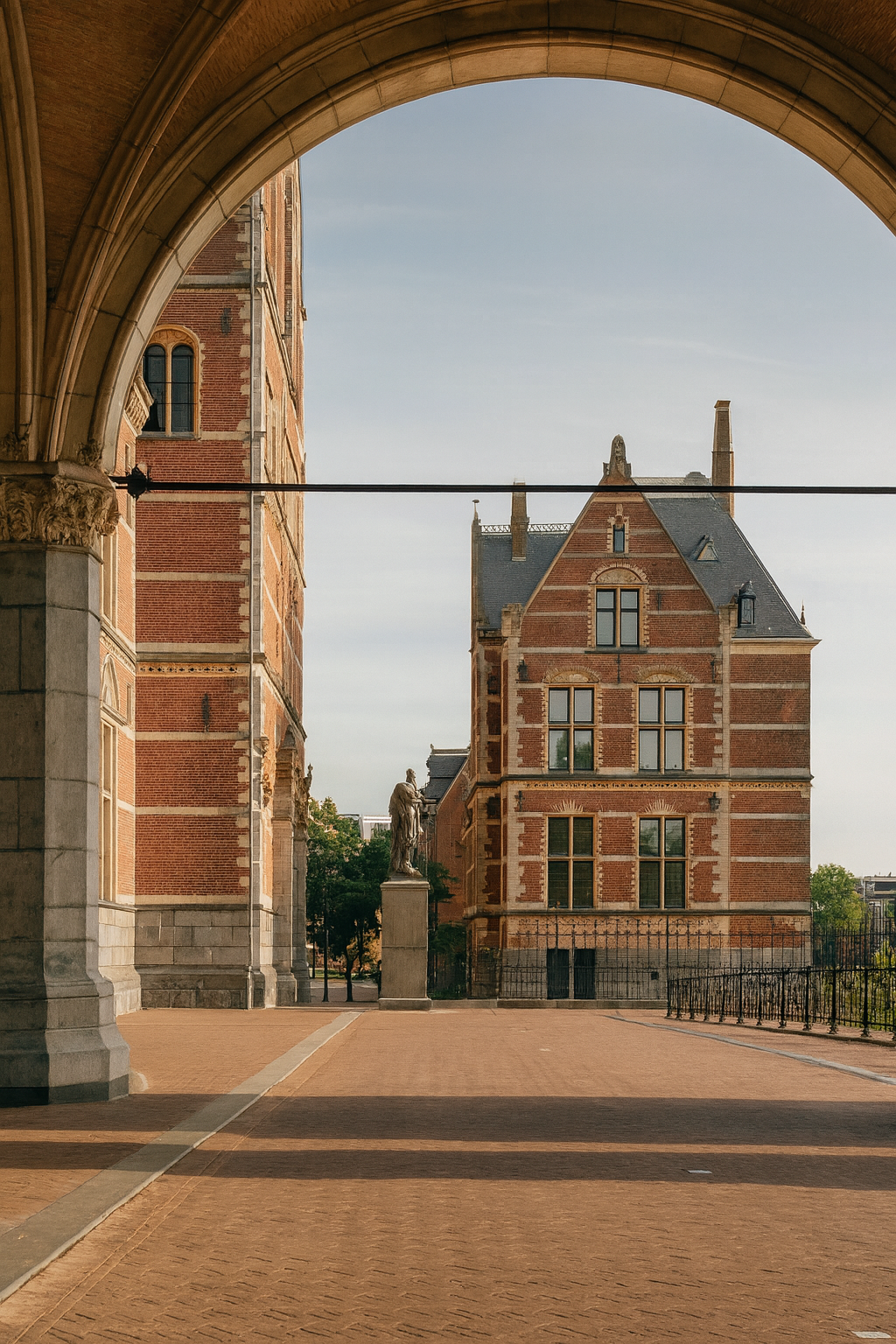
The narrow lot and the hoisting beam
Canal house lots in Amsterdam run roughly six to nine meters wide and can extend thirty meters deep. That shape was not accidental. Lots were taxed on their canal frontage in the 17th century, so building narrow and deep was the rational response. Stairs were made steep—sometimes sixty degrees—to save floor space. Rooms were stacked rather than spread. And because furniture could not physically navigate those stairs, hoisting beams were built into the gable above every front window.
Those beams are still in use today. Walk past any Amsterdam canal house when someone is moving in or out and you will see a mattress or a wardrobe being lifted by rope from the street to a third-floor window. This is not a charming historical curiosity. It is active infrastructure, built in the 1600s and still solving the same problem four centuries later. No retrofit has replaced it because nothing works better given the constraints.
That is the particular quality of Dutch architectural thinking at its best. The solution fits the constraint so precisely that it does not need to be replaced. It just gets used.
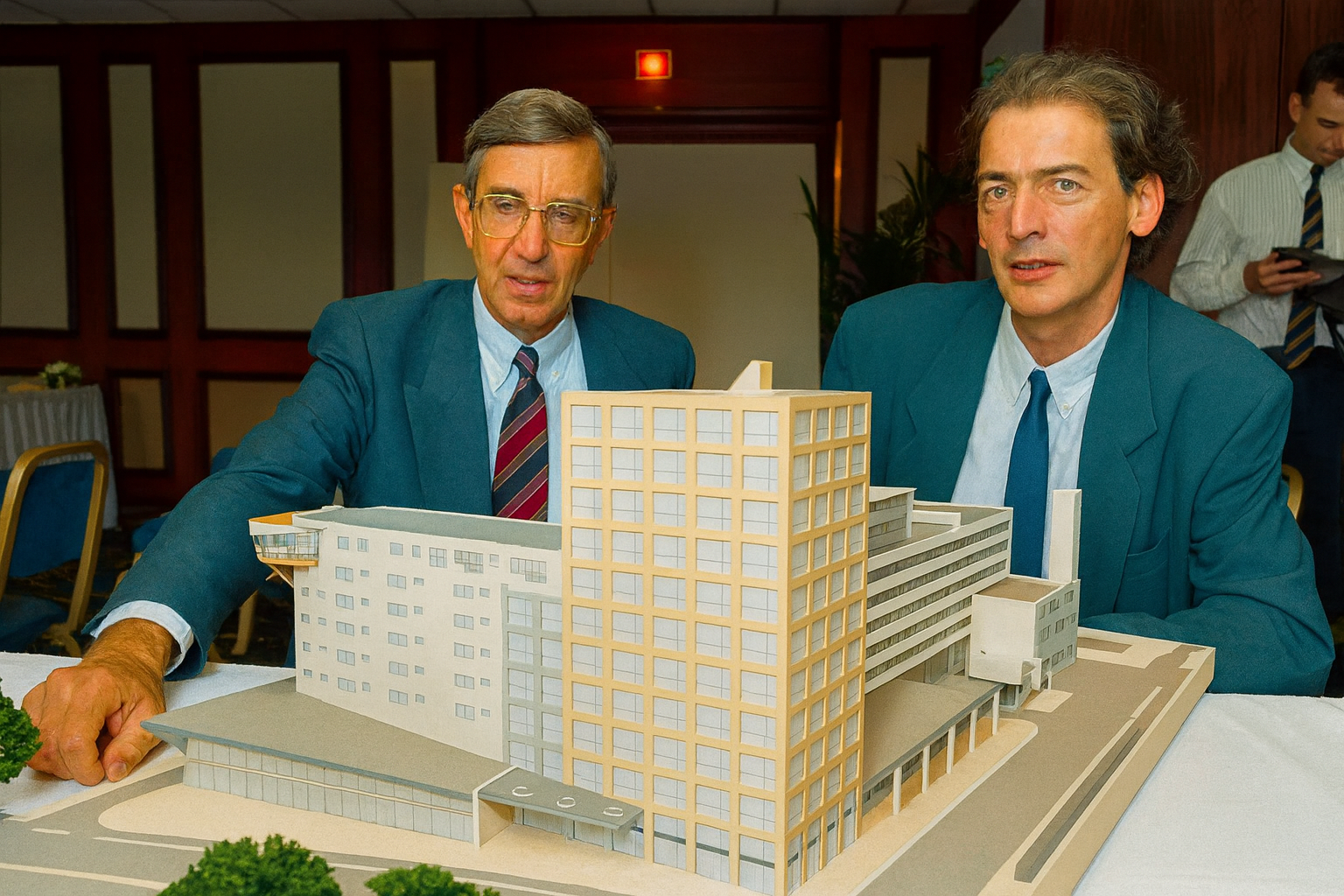
Amsterdam and Rotterdam: two answers to the same country
The Netherlands effectively contains two competing ideas about what architecture should do, and they are on display in its two largest cities.
Amsterdam preserved. The canal ring survived, and the city made protecting it a priority. New construction happens at the edges or above existing structures. The center holds a 400-year inventory of buildings that are still in residential use, still heating up poorly, still relying on hoisting beams, still producing the same narrow silhouette on the water. It is a living museum that people actually live in, which is rarer than it sounds.
Rotterdam started over. The city center was bombed flat in 1940, and what followed was not just reconstruction—it was an argument. The city planner Witteveen proposed rebuilding the old street pattern, traditional gables and all. The modernists won instead. Van Traa's plan cleared the center for wide streets, open spaces, and buildings that answered to function rather than history. Rotterdam got light and air. It also lost housing from its center for decades, pushing residents outward and leaving the core to offices and commerce.
One Rotterdam historian described this as a double bombardment: the German bombs first, then modernist planning. That framing is sharp and largely accurate. The reconstruction that followed was technically impressive and visually striking. It was also, in several ways, a planning failure that took forty years to acknowledge. The residential areas built on the edges in the 1950s and 1960s—carefully programmed, precisely zoned, designed to a high modernist standard—became some of the poorest neighborhoods in the country once the original selected residents moved on and the selection mechanisms were abolished as patronizing. The architecture was good. The social logic was not.
Rotterdam learned from this, eventually. The city has been reinventing itself as an architecture laboratory since the 1990s, tolerating provocation, importing talent, and producing buildings that no other Dutch city would allow. Amsterdam and Rotterdam are not in competition. They are a two-city argument that Dutch architecture has been having with itself for eighty years, and the argument has been productive.
| City | Architectural stance | What it produced | The cost |
|---|---|---|---|
| Amsterdam | Preservation, controlled density, canal ring as anchor | One of the world's most intact historic urban centers, still in residential use | Housing shortage, high prices, limited room to experiment in the center |
| Rotterdam | Reconstruction as opportunity, modernist planning, experimental tolerance | Constant architectural production, global reputation as a design city | Peripheral housing estates that failed socially; center cleared of residential life for decades |
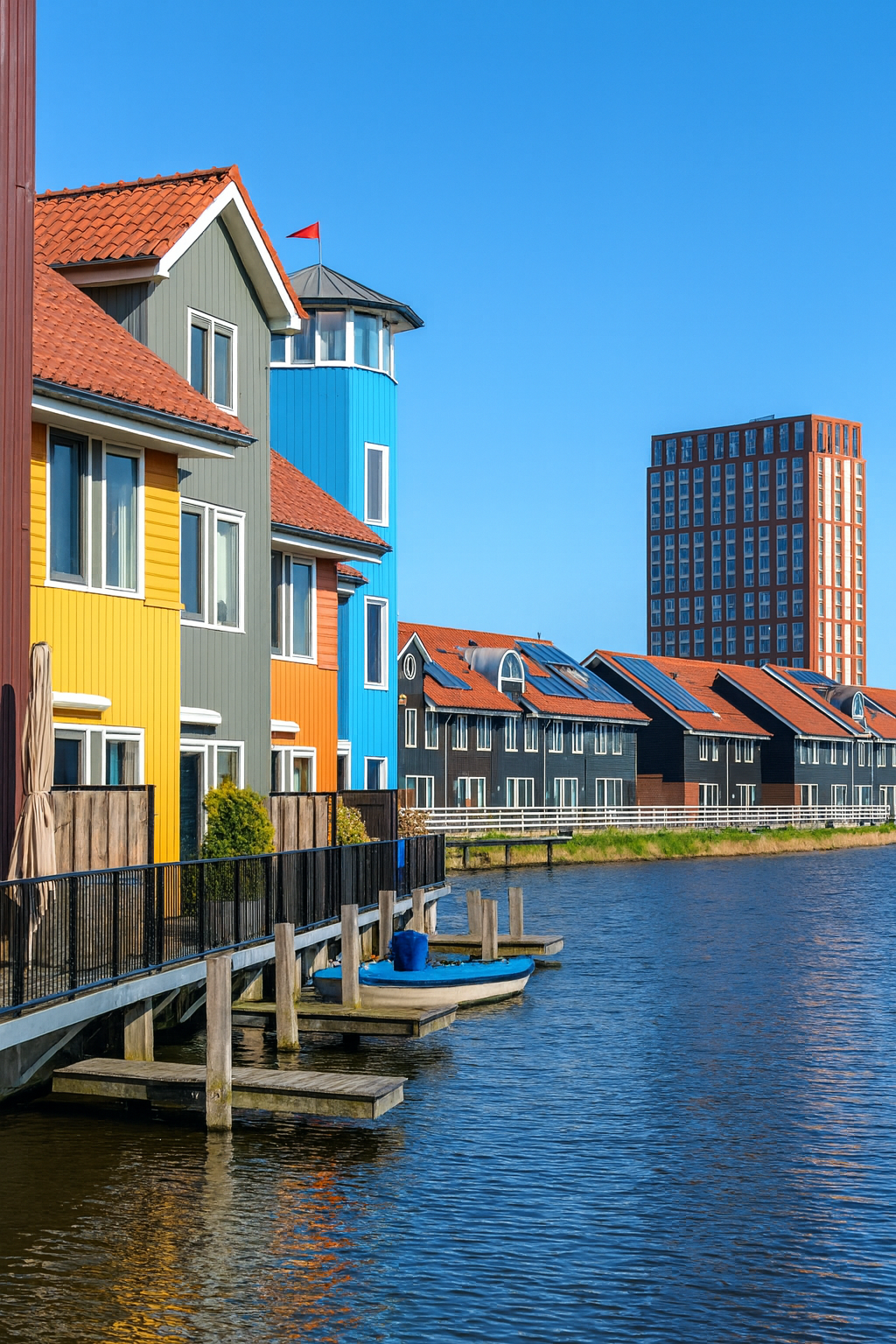
The brick
Dutch brick is not background material. It carries information.
The way brick is laid in the Netherlands—the bond pattern, the joint color, the size of the unit—has historically signaled building type, neighborhood status, and era. Canal houses used large, expensive bricks with thin joints. Social housing used cheaper units with wider joints. The difference is visible at twenty meters. You can read the economic history of a Dutch street through its brickwork without knowing anything about its residents.
Willem Dudok understood this. His Hilversum Town Hall, completed in 1931, is a study in what disciplined brickwork can carry. No marble. No gilded surfaces. A common material stacked with enough precision that it reads as permanent and civic without being expensive. Smaller Dutch cities used that building as proof that dignity in architecture comes from proportion and restraint, not from budget. Several of them hired Dudok afterward.
The reclaimed brick tradition connects to the same logic. Old Dutch brick, pulled from demolished buildings, holds memory and performs like masonry and often costs less than new. It is the Dutch building tradition's version of adaptive reuse applied to individual units rather than whole structures.
The architects
Dutch architects tend to come out of constraint rather than theory. The ones who lasted are the ones who solved something specific first and built a philosophy around the solution afterward.
Gerrit Rietveld designed the Schröder House in Utrecht in 1924 for a widow who needed a home that could change with her life. Sliding partitions divide or open the upper floor. Furniture folds and stacks. The house functions like three configurations in the same footprint. Rietveld was not pursuing abstraction—he was answering a brief from someone who could not afford wasted space. The De Stijl theory came after the fact. The house came first.
Aldo van Eyck did something harder. He rejected the postwar modernist consensus when it was still dominant. His Amsterdam Orphanage, completed in 1960, organized itself like a village rather than a block—small courtyards, low passages, human-scaled sequences. Children moved freely and formed their own social clusters. Van Eyck argued that scale shapes behavior, and that the large modernist slab produced loneliness by design. Schools and care facilities still use his logic. The evidence backs him.
Rem Koolhaas turned the problem inside out. In Delirious New York he described urban density not as a problem to manage but as the condition that makes city life possible. His firm OMA built that argument into real projects. De Rotterdam stacks offices, apartments, and hotel into a single mass. The CCTV Headquarters in Beijing folds into a loop so departments that would normally be sealed off from each other share sight lines. Koolhaas treats crowding as energy, which is a distinctly Dutch response to a distinctly Dutch condition.
MVRDV pushed public life into private buildings. The Markthal in Rotterdam puts apartments around the arc of a food market, creating a civic hall that is also housing and housing that wraps a public room. The firm's stronger argument is not the building but the overlap. When private and public share the same structure, the city stays active after hours. That is not an architectural statement. It is a planning position.
Koen Olthuis treated water as a platform rather than a threat. In IJburg, whole neighborhoods float. The homes rise with water levels. They are engineered like boats and lived in like houses, which is either an obvious response to a country below sea level or a remarkable one depending on how long it takes you to ask why more places have not done this.
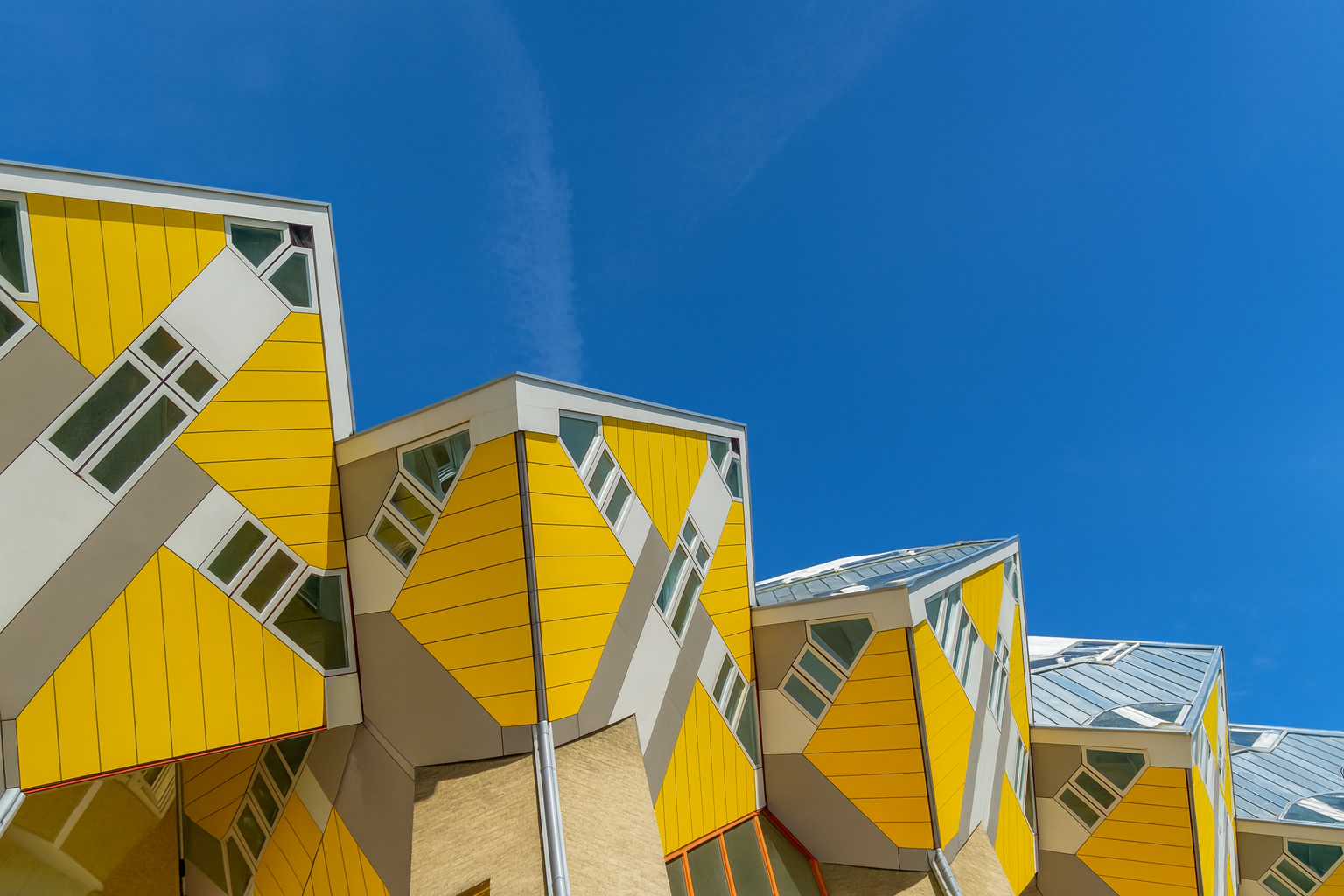
Piet Blom's Cube Houses in Rotterdam tilt forty-five degrees. The walls are slanted and furniture placement is genuinely difficult. Some residents find them unworkable. The point was never perfect comfort—it was provocation, and provocation has a role. The Cube Houses gave Rotterdam a landmark that has been generating architectural conversation for fifty years. That is a long return on one uncomfortable idea.
What water actually did to the plan
The Netherlands manages water at a national scale. Dikes, pumping stations, and polders are not infrastructure—they are the precondition for the country's existence. That dependency on engineered systems created something unusual: a culture genuinely comfortable with top-down planning. When your city requires coordinated water management to remain above water, you develop institutional trust in large-scale coordination. That trust transferred to architecture and urban planning.
Dutch cities got zoned, planned, and replanned at a scale and pace that most countries found uncomfortable. Amsterdam's canal ring was a coordinated city-building project in the 17th century, not an organic growth. Rotterdam's reconstruction was a top-down imposition. The Bijlmermeer housing project was another. All of them failed in some ways. All of them produced buildings that are still being studied. The willingness to plan at scale, make mistakes at scale, and correct at scale is one of the most distinctive things about how the Netherlands builds.
The current moment—housing shortage, climate pressure, rising water—looks like the same set of pressures that produced the canal houses and the gambrel roofs and the floating neighborhoods. The country is, as one curator put it, once again on the drawing board. That is not a crisis. For the Netherlands, it is the normal condition.
Where to look
Five buildings that carry the full argument:
Rietveld Schröder House, Utrecht (1924) — Walls that disappear, balconies that slide open, a floor plan that changes during the day. Every line is answering a specific problem. Worth two visits: once to see it and once to understand why it still works.
Van Nelle Factory, Rotterdam (1930) — A tobacco and coffee factory flooded with daylight through glass and steel. Le Corbusier came to see it. Function drove every decision, and the result is better-looking than most buildings designed primarily for appearance.
Hilversum Town Hall, Hilversum (1931) — What brickwork can carry when the person laying it out understands proportion. No borrowed grandeur. The material does everything.
De Rotterdam, Rotterdam (2013) — Three towers in one mass, stacked and shifted. Koolhaas made density the subject of the building rather than a problem to be hidden inside it.
Schoonschip, Amsterdam (2020) — Forty-six floating homes on a shared energy grid with solar panels and heat pumps. The systems are more interesting than the architecture. A neighborhood built around shared infrastructure rather than shared walls.
What it adds up to
The Dutch approach is not a style. It is a method. Every project starts with a constraint—water, density, budget, site—and turns that constraint into the generator of the design. The buildings that result look different from each other because the constraints are different. But the working method underneath is consistent.
What other design traditions can take from this is less about specific forms and more about sequence: problem first, solution second, aesthetic last. The aesthetic that comes from that sequence tends to be more durable than the aesthetic that comes from the other direction. Dutch buildings hold up because they were solving real problems to begin with. When the problem is real and the solution is good, the look takes care of itself.
FAQ
What is Dutch architecture known for?
Practical form, engineering intelligence, and a consistent willingness to experiment. From canal houses to floating neighborhoods, Dutch design answers real constraints rather than decorating borrowed ones.
Why does the Netherlands produce so much influential architecture?
Limited land, constant water pressure, and a planning culture comfortable with large-scale coordination. The constraints are severe enough that weak solutions fail fast. The ones that survive tend to be genuinely good.
What defines Amsterdam's architecture?
The canal house: tall, narrow, brick, with large windows and hoisting beams still in active use. Built for merchants on taxed canal frontage in the 17th century. The proportions still shape the city.
Why is Rotterdam architecturally so different from Amsterdam?
Rotterdam was bombed flat in 1940 and rebuilt by modernists who saw the damage as an opportunity. Amsterdam was not bombed and chose to protect its historic center. The two cities represent two different answers to the same country.
Did Dutch postwar housing succeed?
Architecturally, often yes. Socially, often no. The planned estates of the 1950s and 1960s became some of the poorest neighborhoods in the Netherlands once the original selected residents left and the patronizing selection criteria were dropped. The failure is instructive and rarely discussed in architecture coverage.
Why do Dutch houses have such large windows?
Two reasons that reinforced each other for centuries: the gray northern light required large apertures to get enough daylight inside, and the Calvinist tradition equated open windows with moral transparency. A household with nothing to hide kept its curtains open. That cultural pressure shaped window sizes before electricity made daylighting a design problem rather than a survival one.
What can architects elsewhere learn from the Dutch approach?
That constraint is generative. The best Dutch buildings are not copies of a style—they are answers to specific problems. Starting from the problem and working toward the form tends to produce buildings that hold up. Starting from the form and working backward tends to produce buildings that date.