
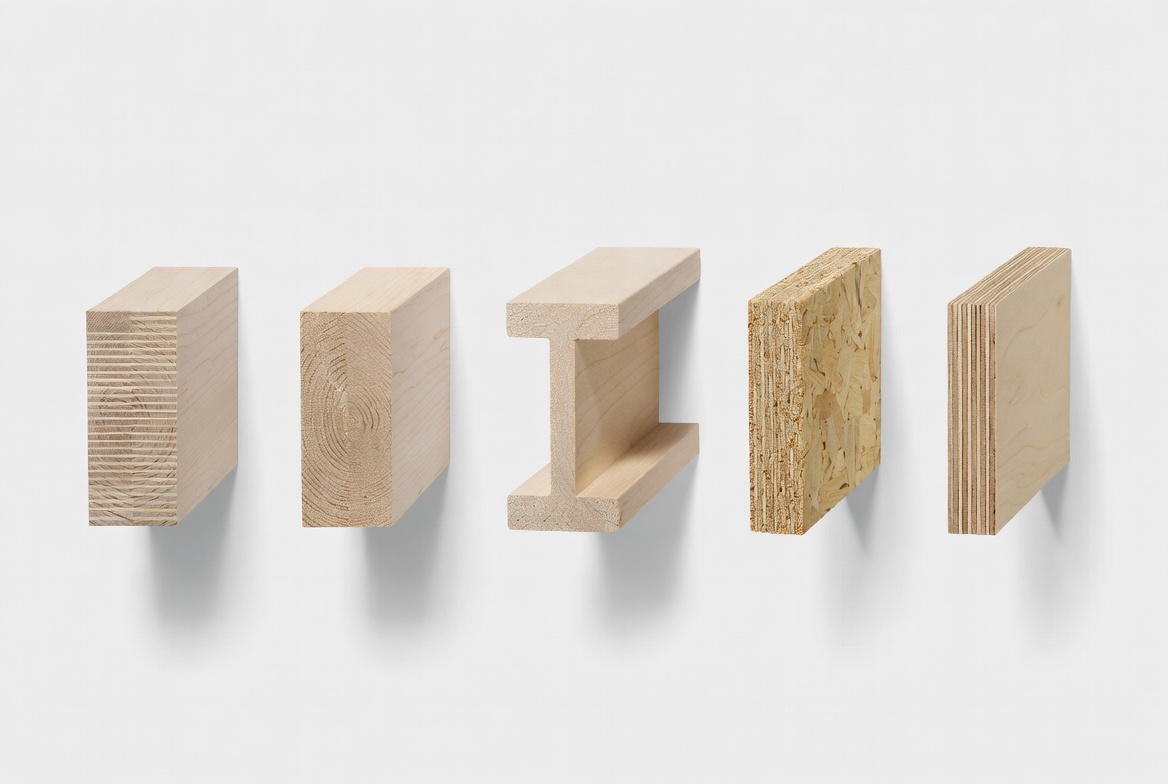
Engineered wood usually shows up when solid wood stops being the easy answer.
The panel needs to stay flatter. The span gets longer. The floor is going over concrete. The cabinet parts need a cleaner paint finish than low-grade plywood will give you. The beam has to be stronger and more predictable than ordinary framing lumber. That is where engineered wood starts making sense.
The problem is that the term gets used too loosely. Plywood, OSB, MDF, HDF, LVL, glulam, CLT, and engineered hardwood flooring all belong to the engineered wood family, but they do not do the same job. Some are structural. Some are finish materials. Some are excellent in dry interiors and weak anywhere moisture keeps showing up.
This page sorts the category the way it needs to be sorted on a real project: what each product is, where it fits, where it does better than solid wood, and where people buy the wrong thing and pay for it later.
What This Covers
- What engineered wood means
- The main product families and how they split
- Where plywood, OSB, MDF, HDF, LVL, glulam, CLT, and engineered flooring fit
- What engineered wood does well
- Where it fails when it is specified lazily
- How installation changes by product type
- What to check before you buy
Engineered Wood Is a Category, Not One Material
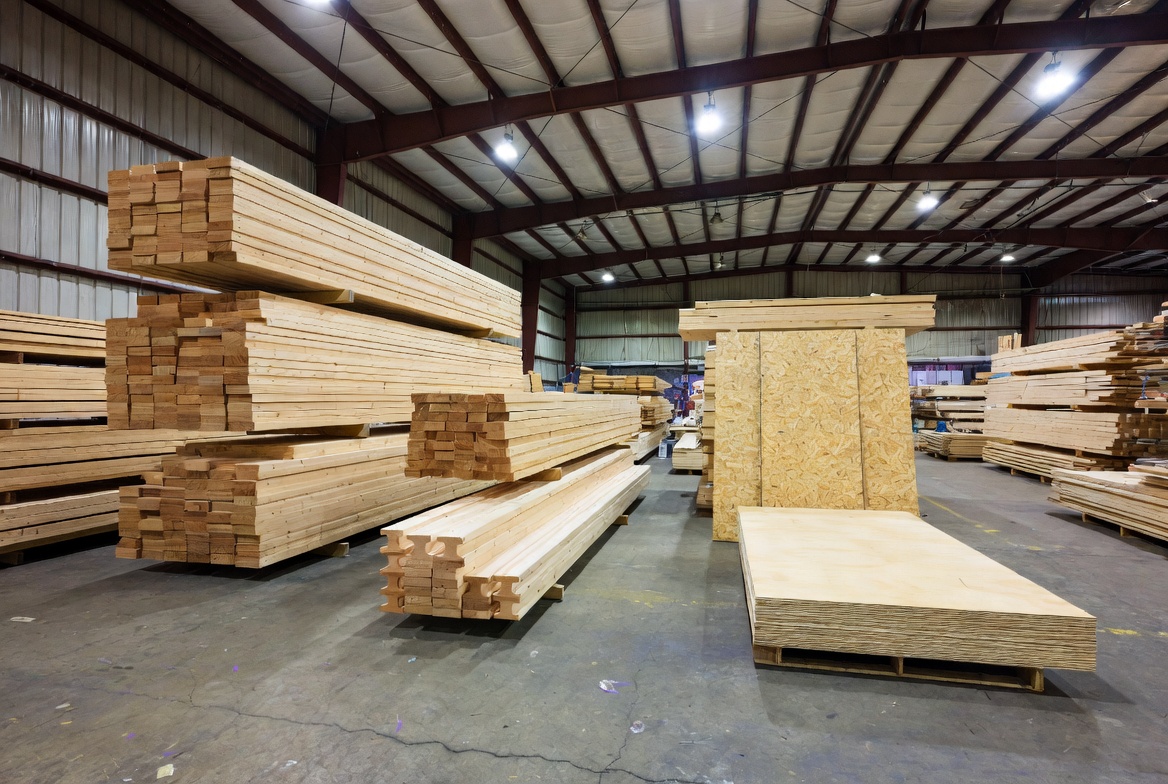
Engineered wood products stored in a supplier warehouse, including I-joists, sheet goods, and structural beam stock. Image by ArchitectureCourses.org.
Engineered wood is wood that has been broken down and put back together in a more controlled form. That may mean veneers laminated into plywood, strands pressed into OSB, fibers bonded into MDF or HDF, or structural laminations turned into beams and large panels.
The point is not to make fake wood. The point is to fix a problem. Maybe the job needs a flatter sheet. Maybe it needs a longer span. Maybe it needs a smoother paint surface. Maybe it needs more consistency than ordinary sawn lumber can give without a lot of sorting, waste, and cost.
That is why the category gets confusing. People use the term as if it only means flooring, or only means cheap furniture board, or only means structural beams. It can mean any of those depending on the product. The term is broad. The specification still has to be precise.
If you want the wider parent page before getting into the engineered side, Wood Essentials: Free Masterclass Course is the better first stop.
The Main Engineered Wood Families
The cleanest way to understand engineered wood is to sort it by the job it is trying to do.
| Product family | Made from | Best for | Common mistake |
|---|---|---|---|
| Plywood | Cross-laminated wood veneers | Subfloors, wall and roof sheathing, cabinets, utility panels | Assuming all plywood grades behave the same |
| OSB | Compressed wood strands and resin | Wall, roof, and floor sheathing | Leaving it exposed too long in wet conditions |
| MDF | Wood fibers and resin | Paint-grade panels, furniture parts, trim profiles, interior millwork | Using it where edges get wet or spans get lazy |
| HDF / hardboard | Denser wood fiber panel | Backing panels, harder-wearing thin panels, some flooring cores | Treating it like the same product as MDF |
| Particleboard | Wood particles and resin | Low-cost furniture cores, laminate substrates, low-stress shelving | Expecting strong moisture resistance or durable edges |
| LVL and similar structural members | Laminated veneers or strands | Headers, beams, rim boards, long spans, framing members | Thinking it is just finish lumber in a different shape |
| Glulam and CLT | Laminated lumber or cross-laminated timber layers | Mass timber, long spans, exposed structure, large panels | Using the terms loosely for any thick laminated wood piece |
| Engineered hardwood flooring | Real wood wear layer over a stable core | Interior flooring where movement control matters | Calling it waterproof or assuming every product can be refinished many times |
Why Engineered Wood Exists
Solid wood still matters. It is repairable, durable in the right use, and hard to beat visually. But it also moves with moisture, varies from board to board, and gets expensive fast when you need large, clear, straight pieces.
Engineered wood exists because building and interiors keep asking for things solid wood does not always give easily: flatter panels, longer spans, smoother paint surfaces, more stable floors, wider sheet formats, and more predictable structural members.
| What engineered wood usually improves | Why it matters |
|---|---|
| Dimensional consistency | Panels stay flatter and structural members behave more predictably |
| Material efficiency | Smaller wood pieces, veneers, and fibers become useful finished products |
| Large-format production | Sheet goods and structural laminations solve jobs wide boards and long clear lumber do not solve cheaply |
| Paint-grade finishing | MDF and similar panels give smoother faces than many low-grade natural boards |
| Structural performance in some products | LVL, glulam, and CLT can handle spans and loads ordinary sawn members struggle with |
None of that makes engineered wood automatically better. It makes it useful when the product matches the job. Wrong product, wrong setting, wrong expectations, and the whole “engineered” advantage disappears fast.
How the Category Splits
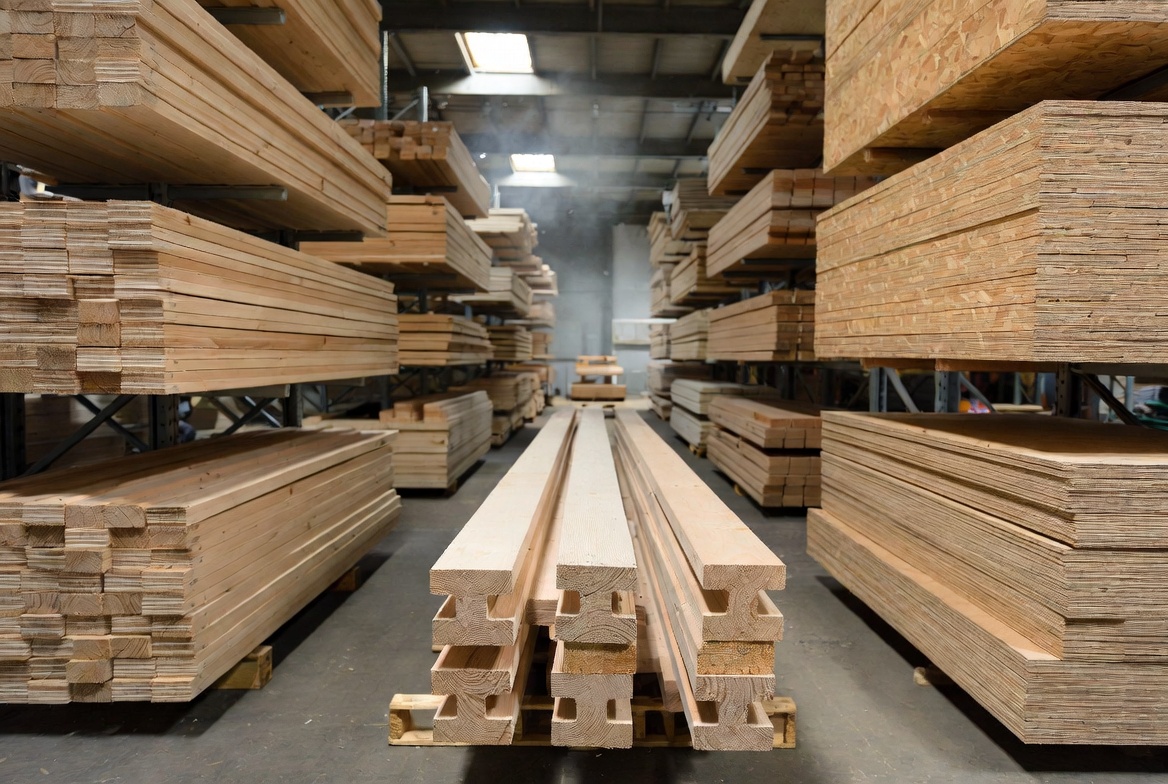
Wood I-joists and sheet goods shown with other structural engineered wood products in storage. Image by ArchitectureCourses.org.
A lot of weak articles lose the plot because they keep bouncing between flooring, furniture board, and structural beams as if those were minor variations of one product. They are not.
Panel Products
Plywood, OSB, MDF, HDF, and particleboard mostly live here. These solve sheet-size, surface, substrate, and layout problems. Some are structural. Some are not. Some want dry interior use. Some are made for sheathing and construction.
Structural Products
LVL, LSL, PSL, glulam, and CLT live here. These are about spans, loads, uniformity, and controlled structural performance. They are not interchangeable with cabinet panels just because the word engineered shows up in both.
Finish Products
Engineered hardwood flooring is the branch most homeowners know. It is still part of engineered wood, but it should not define the whole category. It solves a finish-floor problem, not a beam, cabinet, or paneling problem.
Where the Main Products Fit
Plywood
Plywood is one of the most useful products in the whole category because it crosses between construction and finish work. It can be subfloor, roof decking, wall bracing, cabinet stock, furniture material, or simple shop panel. The usual mistake is buying the wrong face grade, glue type, or thickness and then blaming plywood in general.
OSB
OSB is primarily a structural sheet. It is common in wall, roof, and floor systems because it does the sheathing job well at a competitive cost. It is not the board people choose because they want a refined finished surface. It is a jobsite sheet first.
MDF
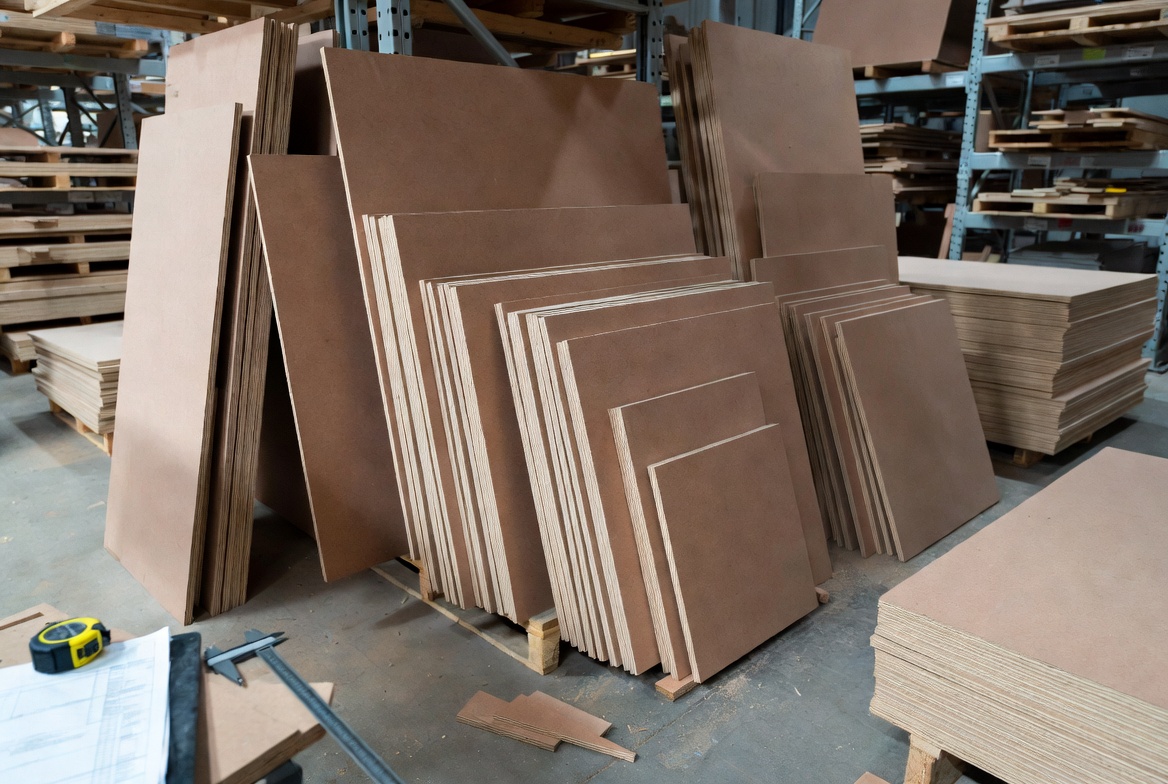
MDF is the smooth, paint-friendly, interior panel people keep trying to use everywhere. It works well in built-ins, cabinet parts, paneling, trim profiles, speaker boxes, templates, and furniture where the environment is controlled and the spans make sense. It is a poor choice when repeated moisture, weak support, or rough-service use is part of the job.
If the question is really about the fiberboard branch, High Density Fiberboard (HDF) is the right next comparison, and Low Density Fiberboard (LDF) helps complete that picture.
Particleboard
Particleboard is a cost-driven core material. It shows up in flat-pack furniture, laminate substrates, closet systems, and lower-cost shelving. It has its place, but it is weak around water and not especially forgiving at the edges. A lot of cheap furniture frustration starts here.
LVL, Glulam, and CLT
Once you move into LVL, glulam, and CLT, you are in structural territory. LVL is common in headers, beams, and rim boards. Glulam works when you need long spans or exposed wood members that still have serious structural work to do. CLT belongs in larger panelized structural systems and mass timber construction, not in casual “wood board” conversations.
Engineered Hardwood Flooring Is Only One Branch
Engineered hardwood flooring gets too much control over this topic because it is what most homeowners recognize first. It matters, but it is still one branch.
Engineered flooring usually means a real wood wear layer over a more stable core. That core may be plywood, high-density fiberboard, or another layered construction depending on the product. The goal is simple: keep the wood look, reduce some of the movement headaches.
| Engineered flooring does well | It does not fix |
|---|---|
| Handles humidity swings better than many solid plank floors | Standing water, repeated soaking, or ignored subfloor moisture |
| Works over more subfloor conditions | Poor prep, bad leveling, or sloppy vapor control |
| Gives a real wood face with a more stable base | Thin wear layers that do not tolerate much future sanding |
| Can simplify installation with click systems in some products | Overpromising that every engineered floor is easy or equally durable |
That is the line to keep clear. Engineered flooring is not fake hardwood. It is also not the same thing as a thick solid wood floor. The wear layer, core construction, finish system, and subfloor conditions still decide how good the floor will be.
What People Get Wrong
The same mistakes keep showing up.
- They assume all engineered wood is cheaper than solid wood.
- They assume all engineered wood is weak because they have seen cheap particleboard furniture fail.
- They assume moisture-resistant means waterproof.
- They assume plywood, MDF, HDF, OSB, LVL, and engineered flooring are close substitutes.
- They shop by face appearance and ignore the core.
- They call every fiber panel MDF.
- They use interior panels in damp, rough, or structural conditions and blame the category when the board breaks down.
That is why the category has to be sorted by performance and use, not by vague impressions.
Use This When / Avoid This When
| Product type | Use this when | Avoid this when |
|---|---|---|
| Plywood | You need versatile sheet stock for structural work, cabinets, subfloors, or general utility | You need the smoothest paint-grade face without extra prep |
| OSB | You need cost-effective structural sheathing | You want a refined visible surface or a finish-grade panel |
| MDF | You need smooth interior paint-grade parts and stable panel shapes | The job has repeated moisture, weak support, or rough-service conditions |
| HDF | You need a denser thin panel or a tougher fiberboard product | You are looking for a cheap all-purpose substitute for every sheet good |
| Particleboard | The job is cost-sensitive and low-stress | Water, durable edges, or heavy-duty performance matter |
| LVL / glulam / CLT | You need structural reliability, long spans, or large-format timber assemblies | You are shopping for decorative panels or low-cost furniture board |
| Engineered flooring | You want a wood floor with better movement control than many solid floors | You need a floor that can take chronic wetting or careless maintenance |
Installation Is Not One Conversation
This is another place broad engineered wood pages get sloppy. Installation is not one thing here.
Panel Products
Plywood, OSB, MDF, HDF, and particleboard each want the right support spacing, fastening, edge treatment, and exposure control. Get that wrong and the failure usually looks familiar: swollen edges, sagging spans, blowouts at fasteners, soft corners, or joints that never felt solid in the first place.
Engineered Flooring
Floating, glue-down, and nail-down systems all exist. The correct method depends on the product, the subfloor, the room conditions, and the manufacturer’s instructions. The common mistake is thinking the click joint is the whole job. It is not. Flatness, movement allowance, moisture, and underlayment still decide whether the floor feels good six months later.
Structural Engineered Wood
LVL, glulam, and CLT are not improvise-it-on-site materials. Bearings, connections, hardware, lifting, weather protection, and sequencing matter. On that side of the family, installation is a structural coordination problem, not a carpentry shortcut.
What Costs More and Why
Engineered wood can be cheaper than solid wood, but that is not the rule. It depends entirely on the product and the job.
Particleboard and some commodity panel products are often low-cost. Good plywood, quality engineered flooring, LVL, glulam, and mass timber products may not be cheap at all. Sometimes they cost more up front because they solve a performance problem ordinary lumber or cheap boards do not solve cleanly.
That is the part people flatten too much. A glulam beam and a flat-pack shelf panel do not belong in the same price conversation just because both are engineered wood. One is solving span and structure. The other is solving cost and surface. Same family. Different job. Different money.
Sustainability and Health
Engineered wood often uses wood more efficiently than wide solid boards because veneers, strands, fibers, and smaller pieces can become useful finished products. That part is real.
But sustainability is not automatic. Resin systems matter. Sourcing matters. Service life matters. A long-lasting product used in the right place is a better environmental story than a cheap panel that swells, chips, and gets replaced early.
The same goes for indoor air concerns. Adhesives and emissions are not identical across the category. If indoor air quality matters on the project, the product data matters too.
If that side of the topic is part of the decision, Sustainable Wood and Where Wood Belongs in Architecture Today are the next pages worth reading.
The Detail People Miss
The category name is not the specification.
Saying engineered wood is not enough. You still need to know whether you are talking about veneers, strands, fibers, particles, or structural laminations. You still need to know whether the product is structural, decorative, interior-only, moisture-tolerant, finish-grade, or paint-grade. You still need to know what kind of fastening, support, and exposure the job is about to ask for.
That is the detail people miss. The broad term sounds simple, so they stop too early.
What To Do Next
If you want the broader wood parent page first, go back to Wood Essentials: Free Masterclass Course.
If your question is really about fiberboard products and where they separate, the next useful reads are High Density Fiberboard (HDF) and Low Density Fiberboard (LDF).
If the job is more about choosing the right wood family than choosing one specific engineered product, use How to Choose the Right Wood for Your Project.
If you are building or making rather than just comparing materials, Woodworking Basics: A Friendly Beginner’s Guide is the better practical next step.
FAQ
What is engineered wood?
It is a broad category of wood products made by bonding veneers, strands, fibers, particles, or laminations into a more controlled material. Plywood, OSB, MDF, HDF, LVL, glulam, CLT, and engineered hardwood flooring all belong to that family.
Is plywood engineered wood?
Yes. Plywood is one of the oldest and most common engineered wood products. Thin veneers are laminated together with alternating grain direction to improve stability.
What is the difference between engineered wood and MDF?
MDF is one type of engineered wood, not a separate category. Engineered wood is the whole family. MDF is the smooth, fiber-based interior panel branch inside it.
Is engineered wood stronger than solid wood?
Sometimes. Structural products like LVL and glulam can outperform ordinary sawn lumber in consistency and span. That does not make every engineered wood product stronger than solid wood. MDF and particleboard solve different problems.
Is engineered wood waterproof?
No. Some products handle moisture better than others, but engineered wood as a category is not automatically waterproof. That claim gets stretched too far, especially in flooring and furniture marketing.
Can engineered wood be used for structural work?
Yes, but only the products made for structural duty. LVL, glulam, CLT, plywood, and OSB can all be part of structural systems when properly specified. MDF and particleboard are not structural substitutes.
Is engineered hardwood flooring real wood?
Yes. It has a real wood wear layer on top. The difference is that the visible wood sits over an engineered core instead of being one solid plank through the full thickness.
What is better, engineered wood or solid wood?
Depends on the job. Engineered products usually win where dimensional stability, panel size, or controlled structural performance matter. Solid wood usually wins where repairability, edge durability, deep refinishing potential, or natural grain character matter most.