
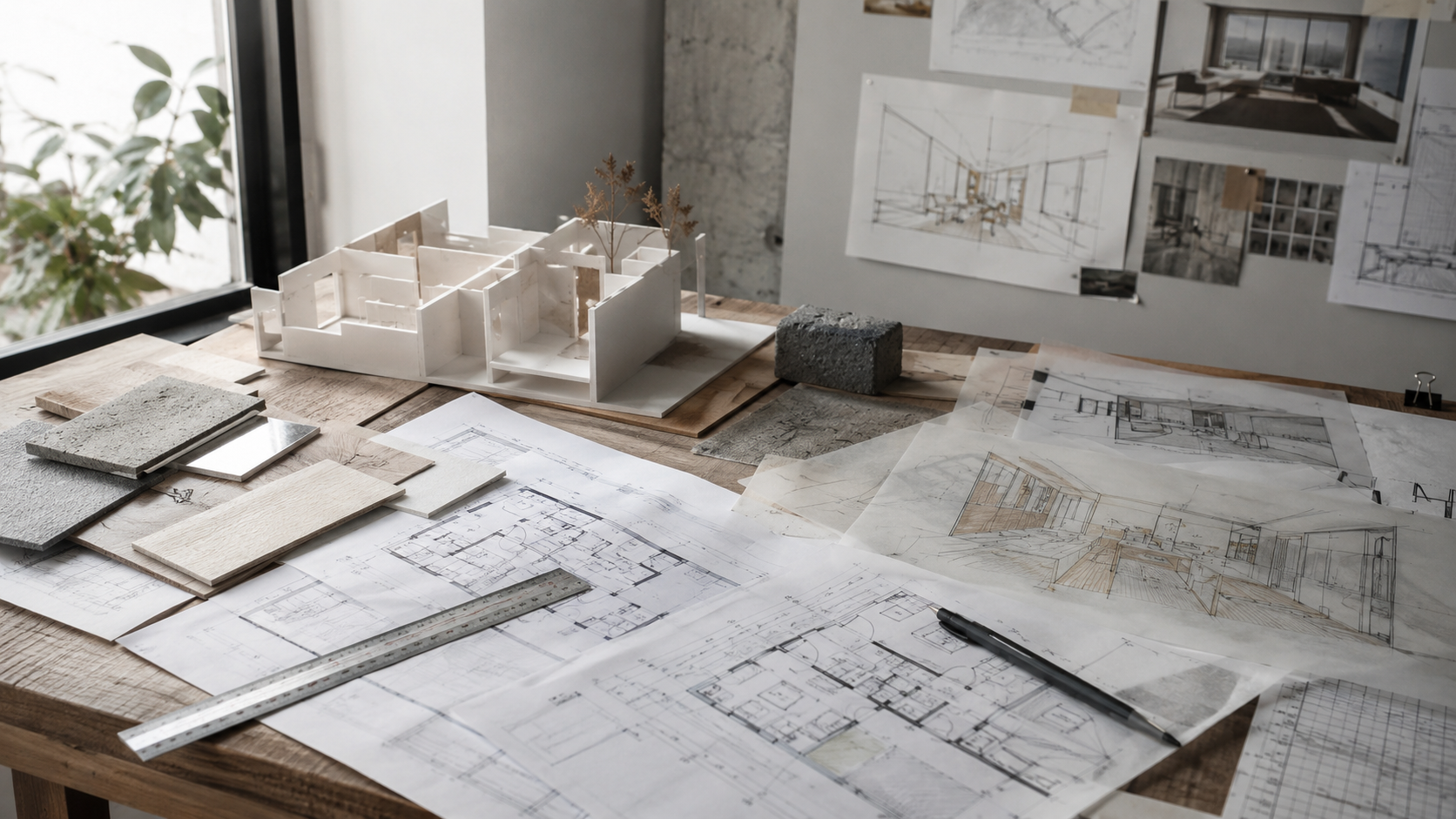
Image by ArchitectureCourses.org. Interior and spatial design begins with plans, models, materials, circulation, and light. The work is not only about styling a room. It is about testing how a space will be used before it is built.
What You Study, What Jobs It Leads To, and What To Check First
A room can look expensive and still work badly.
The furniture blocks the path. The desk sits in glare. The kitchen feels crowded even when the room is not small. The gallery looks dramatic until visitors bunch at the entry. The office feels open until every phone call carries across the floor.
Interior and spatial design starts there.
It deals with how interior space works before it gets styled: movement, light, privacy, sound, storage, furniture, thresholds, and the parts of a room that start bothering people after a few weeks of real use.
For degrees and careers, the wording matters. This is not pure decoration, and it is not full architecture. It sits in the middle: interiors, exhibitions, retail spaces, hospitality, workplaces, and public-facing rooms where layout and use matter as much as finish.
What Interior and Spatial Design Means
Interior and spatial design is the design of interior environments with strong attention to layout, circulation, atmosphere, use, and the relationship between people and space.
The interior side deals with rooms, materials, furniture, lighting, surfaces, and how spaces feel from the inside.
The spatial side pushes deeper. It deals with sequence, thresholds, movement, zoning, scale, proportion, privacy, storage, and the logic of how one space connects to another.
That is why schools use this name. They are usually trying to signal that the course goes beyond finish-led interior work. The work still includes interiors, but it asks harder questions:
- How does the room work before it is styled?
- What is the path through the space?
- Where does light help, and where does glare hurt?
- What belongs near what?
- How do people arrive, wait, work, gather, sit, display, and leave?
On this site, it connects naturally with spatial design, spatial planning and design, and space planning and layout in interior design.
Why Some Schools Use This Name Instead of Interior Design
The phrase “interior and spatial design” usually appears when a program wants to sound broader than traditional interior decorating or finish-led interior design.
That does not automatically make it better. It usually means the course wants to cover more of these areas:
- space planning
- human movement and use
- retail and exhibition environments
- workplace and hospitality interiors
- temporary installations and spatial experience
- material and lighting decisions connected to use, not taste alone
In other words, the room is not treated as a box waiting for decoration. It is treated as an environment with behavior.
Do Not Choose This Degree Because the Name Sounds Broader
Interior and spatial design can be a strong route, but the name alone does not prove the course is right for you.
Some programs use the phrase to describe a serious mix of interior design, spatial planning, studio projects, drawing, materials, lighting, exhibition work, and user experience. Others use it as a broad design label without enough technical depth, portfolio support, or professional direction.
Before paying tuition, check the actual studio projects. Look for plans, sections, spatial diagrams, material studies, lighting work, model-making, portfolio development, and live or realistic briefs.
If the course page only shows polished renderings and vague creative language, be careful. A good program should help you build work that can be shown to employers. It should not only describe design in attractive language.
The expensive mistake is choosing the title instead of the training. The course name may sound current, but the value comes from the work you produce, the feedback you get, and the portfolio you leave with.
Interior and Spatial Design vs Interior Design vs Architecture
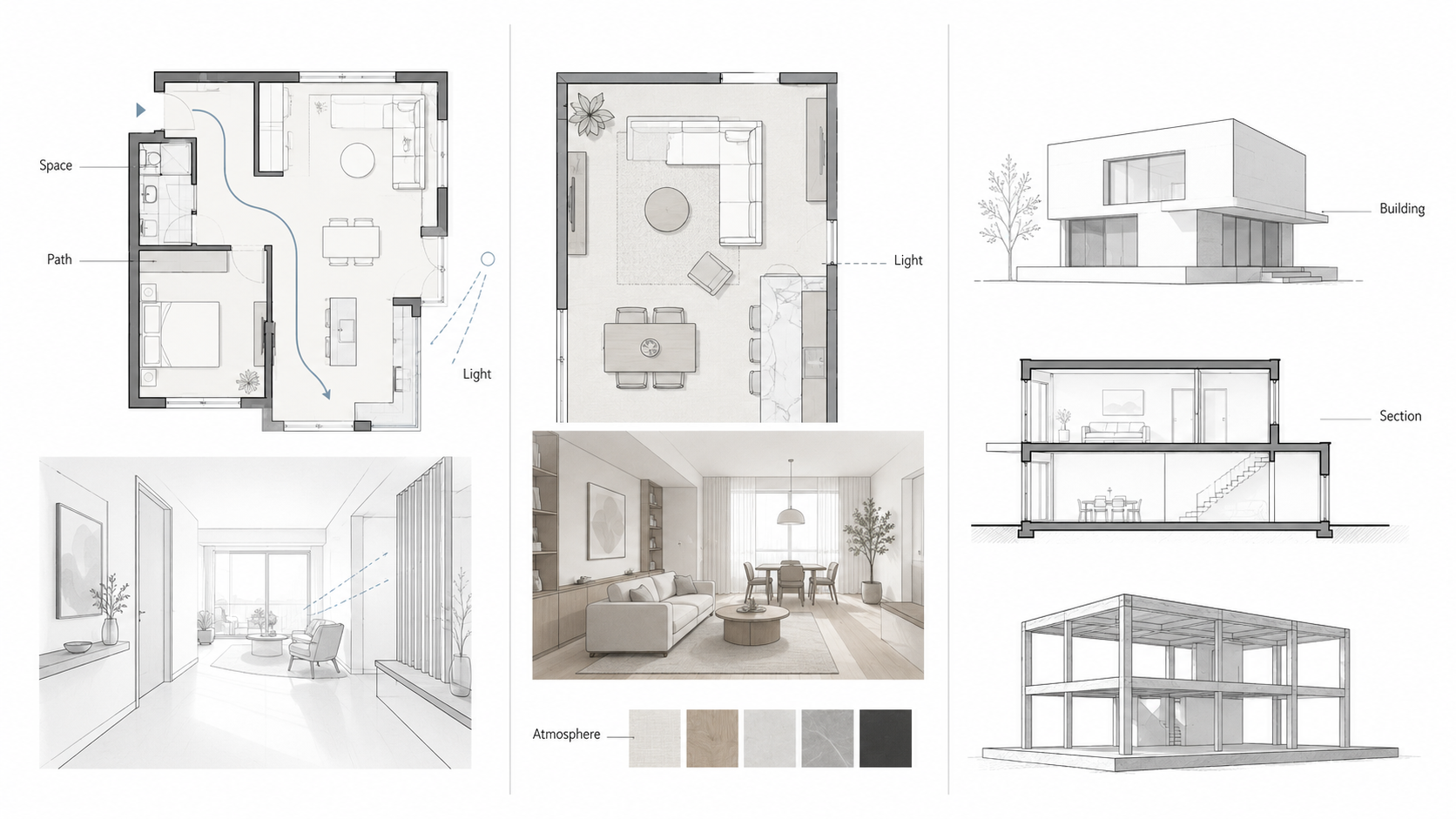
Illustration by ArchitectureCourses.org. Interior and spatial design overlaps with interior design and architecture, but its center is interior space, movement, atmosphere, and use.
This is where applicants often get confused. The titles overlap, but the emphasis is different.
| Field | Main focus | Typical work | Common misunderstanding |
|---|---|---|---|
| Interior and spatial design | How interior spaces work, feel, and connect. | Layouts, circulation, atmosphere, exhibition, retail, hospitality, workplace, and residential interiors. | People assume it is only decoration. |
| Interior design | Interior function, finish, furnishing, lighting, and user comfort. | Residential, workplace, hospitality, healthcare, and commercial interiors. | People reduce it to color palettes and furniture. |
| Architecture | Buildings as a whole, including structure, envelope, systems, and space. | Building design, coordination, planning, construction documents, code, and larger-scale form. | People assume all spatially focused design is architecture. |
The practical difference is simple. If you care most about the experience and behavior of interior environments, interior and spatial design may fit. If you want to design buildings as complete technical and structural systems, architecture may be the better route.
That matters because the degree title does not describe taste alone. It often shapes the portfolio you build, the software you learn, the briefs you work on, and the jobs you are prepared for.
Which Path Fits the Goal?
| If your goal is... | This path may fit | Check before committing |
|---|---|---|
| Design rooms, retail spaces, hospitality interiors, exhibitions, and workplace environments. | Interior and spatial design. | Studio depth, portfolio support, software training, and real project types. |
| Become a licensed architect. | A professional architecture degree. | Accreditation and licensure route before enrolling. |
| Work mainly with finishes, furniture, styling, and residential clients. | Interior design or decorating route. | Whether the program teaches technical drawings, codes, business practice, and client work. |
| Build a portfolio for retail, exhibition, or spatial experience work. | Interior and spatial design can fit well. | Whether student work includes sequence, circulation, user journey, and installation thinking. |
What You Usually Study
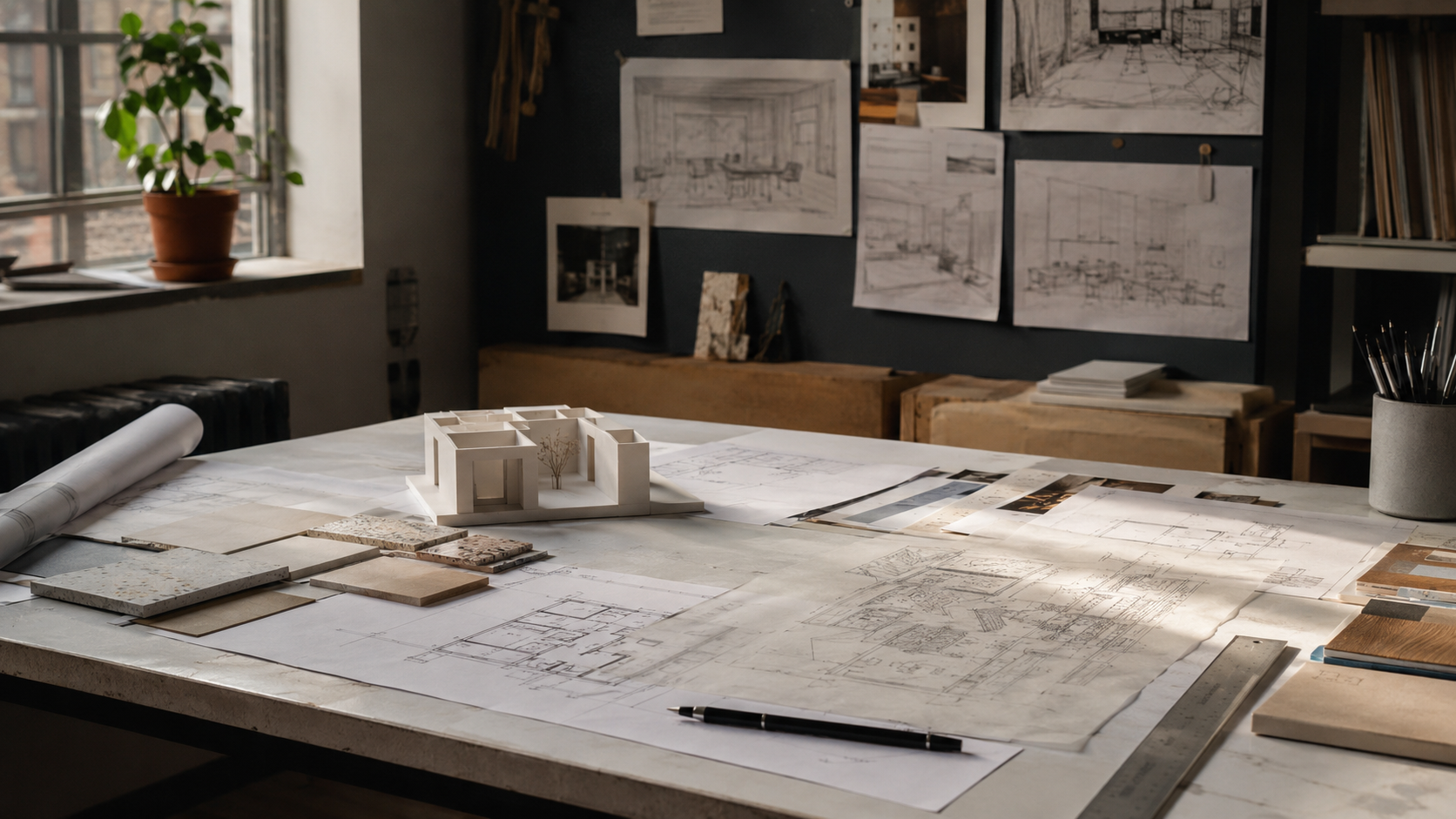
Image by ArchitectureCourses.org. Interior and spatial design sits between atmosphere and planning. The work is not only about styling a room.
A good interior and spatial design course usually mixes design thinking, drawing, layout work, material knowledge, lighting, visual communication, and project development.
The exact modules change by school, but most serious programs touch the same core areas.
Space planning
This is the backbone. Students learn how to organize space, test circulation, place functions, study adjacencies, and fix rooms that look fine until people try to use them.
Drawing and representation
That includes plans, sections, elevations, diagrams, axonometric views, collage, and presentation boards. A lot of students arrive expecting styling and discover that drawing is where the work gets honest.
This is one reason pages like architectural drawings and scale and proportion in architectural design fit naturally beside this topic.
Interior atmosphere
Material choice, color, texture, light, and detailing still matter. The difference is that they are usually taught as part of space-making, not as a beauty layer pasted over a weak layout.
Human use
Good programs push students to think about bodies in space: movement, seating, waiting, reach, noise, privacy, comfort, accessibility, and what happens when real use begins.
That overlaps closely with human-centered design and architecture.
Project types
Students may work on homes, apartments, retail spaces, hospitality interiors, exhibitions, installations, cultural spaces, studios, cafés, workspaces, or adaptive-reuse interiors. The point is usually not the building shell alone. It is what happens inside it.
Software and visualization
Most students also learn some combination of CAD, 3D modeling, rendering, layout software, and digital presentation. Those tools help, but they are not the design. A weak layout does not become good because it was rendered well.
What Students Discover After Enrolling
This is the part school marketing rarely says clearly.
Interior and spatial design looks polished from the outside because the final images look polished. The actual student experience is usually slower, rougher, and more technical than expected.
It is less about styling than some students expect
Students who arrive only wanting to make beautiful rooms can get frustrated fast. The course may ask for plans, sections, user analysis, circulation studies, material tests, precedent research, technical details, and repeated revisions before the project starts to look finished.
Critique is part of the education
You present incomplete work. People question it. Tutors ask why the path turns there, why the threshold is narrow, why storage is missing, why the light is uncontrolled, or why the concept and plan are not agreeing.
Some students love that process. Some hate it. Either way, it is part of the training.
The strongest students can think and revise
A polished render can impress for five minutes. A clear plan, good section, strong sequence, and sensible material logic last much longer.
You may spend a lot of time making things that never reach a final decorated stage
That is normal. Early design education often lives in the rough work: layout tests, diagrams, physical models, iterations, and critiques.
Portfolio matters almost as much as the degree title
A weak portfolio from a good school is still weak. A strong portfolio from a less famous school can still open doors.
The course name matters. The work matters more.
Where People Waste Money in This Field
Money gets wasted when students or beginners buy the wrong thing too early.
A better laptop does not fix weak plans. Expensive rendering software does not make a poor layout stronger. Paid courses do not help much if they avoid drawing, critique, portfolio development, and real spatial problems.
Spend first on the basics that improve judgment: drawing practice, space planning, model-making, clear feedback, software you will actually use, and portfolio work that shows process.
The same logic applies outside school. A homeowner or small business owner can waste money on furniture, built-ins, finishes, or an AI-generated room image before checking the path, storage, light, and clearances. Interior and spatial design is valuable because it slows those decisions down.
What the Work Looks Like After School
Interior and spatial design can lead into several kinds of work, depending on the program and the portfolio.
Residential interiors
This is the most familiar route, but even here the good work goes beyond finishes. The better designers solve layout, storage, circulation, and light before they start chasing a style.
Retail design
Retail interiors are spatial problems. The route, display logic, threshold, product focus, pause points, and checkout flow all matter. A store can be attractive and still fail if people do not understand where to go.
Hospitality design
Restaurants, cafés, hotels, and bars all depend on interior atmosphere, but they also depend on path, waiting, service flow, acoustics, and comfort. This is a strong fit for students who like both mood and planning.
Workplace design
Office work is not just desks. It includes focus, collaboration, noise control, meeting zones, arrival, shared amenities, and what happens when open space stops working.
Exhibition and installation design
This is where the spatial part often becomes very clear. The designer shapes sequence, pause, display, orientation, and visitor experience. If you like narrative and movement, this can be one of the most interesting branches.
Cultural and public-facing interiors
Museums, galleries, libraries, learning spaces, and visitor environments also fit well inside this field.
What Employers Care About More Than the Degree Title
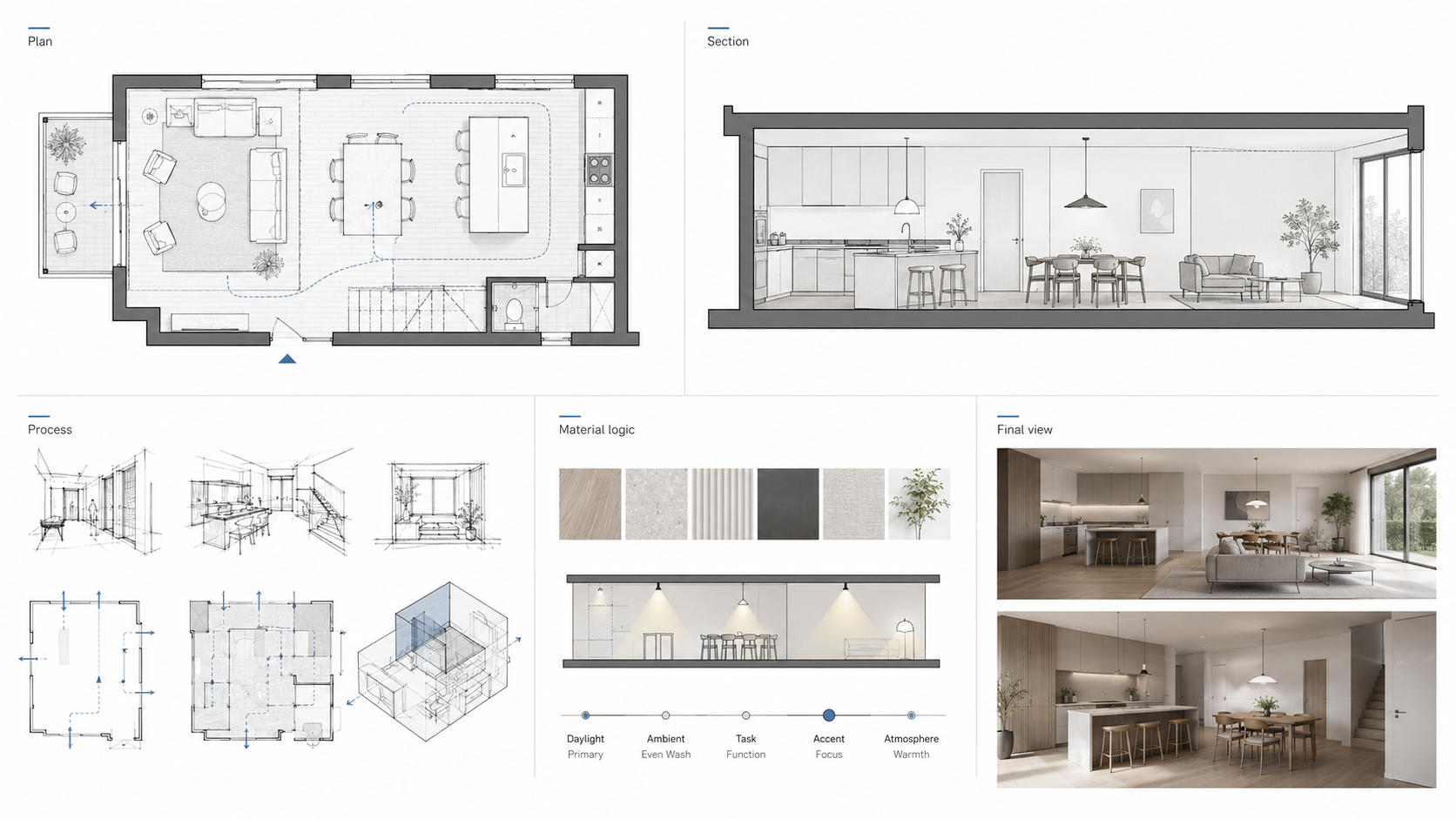
Illustration by ArchitectureCourses.org. Employers usually trust a portfolio that shows process and workable space, not just polished images.
A lot of students overestimate the course name and underestimate the portfolio.
Employers usually want evidence that you can do the work. That means they look for signs like these:
- Can you plan a space clearly?
- Can you draw plans and sections that make sense?
- Can you explain a concept without hiding behind vague words?
- Can you choose materials and lighting for a reason?
- Can you develop a project beyond the mood-board stage?
- Can you show process, not only final images?
A portfolio full of glossy renders but weak plans usually reads as shallow. A portfolio with clear diagrams, workable layouts, sensible sections, and a few strong finished views usually reads much better.
A strong portfolio should not rely only on finished views. It should show plans, sections, circulation diagrams, material logic, lighting decisions, and evidence that the designer can revise a weak layout. The related page on interior designer portfolio development fits here if the reader needs help shaping the work into a presentable body of projects.
| What employers like seeing | Why it matters |
|---|---|
| Clear plans and sections | They show that you understand space, not just surface. |
| Process work | It proves you can think, test, and revise. |
| Material and lighting logic | It shows that the atmosphere supports the use. |
| A few strong finished views | They help communicate quality and design intent. |
| Project variety with some depth | It shows range without making the portfolio feel random. |
If You Want Architecture or Licensure, Check the Route Carefully
This part matters more than many applicants realize.
An interior and spatial design degree is not automatically the same as an architecture degree, and it is not automatically the same as a professionally accredited interior design route either. The exact outcome depends on the school, the country, and the accreditation path.
If your long-term goal is to become a licensed architect, you usually need a professional architecture route, not simply a spatially oriented design course.
If your goal is licensed interior design in a place where regulation matters, you need to check whether the degree supports that route.
If your goal is creative interior, spatial, exhibition, retail, hospitality, or workplace design, the course may fit very well even if it is not an architecture-licensure degree.
This is where applicants get burned. They choose the course name they like instead of the professional route they need.
How AI Fits Into Interior and Spatial Design
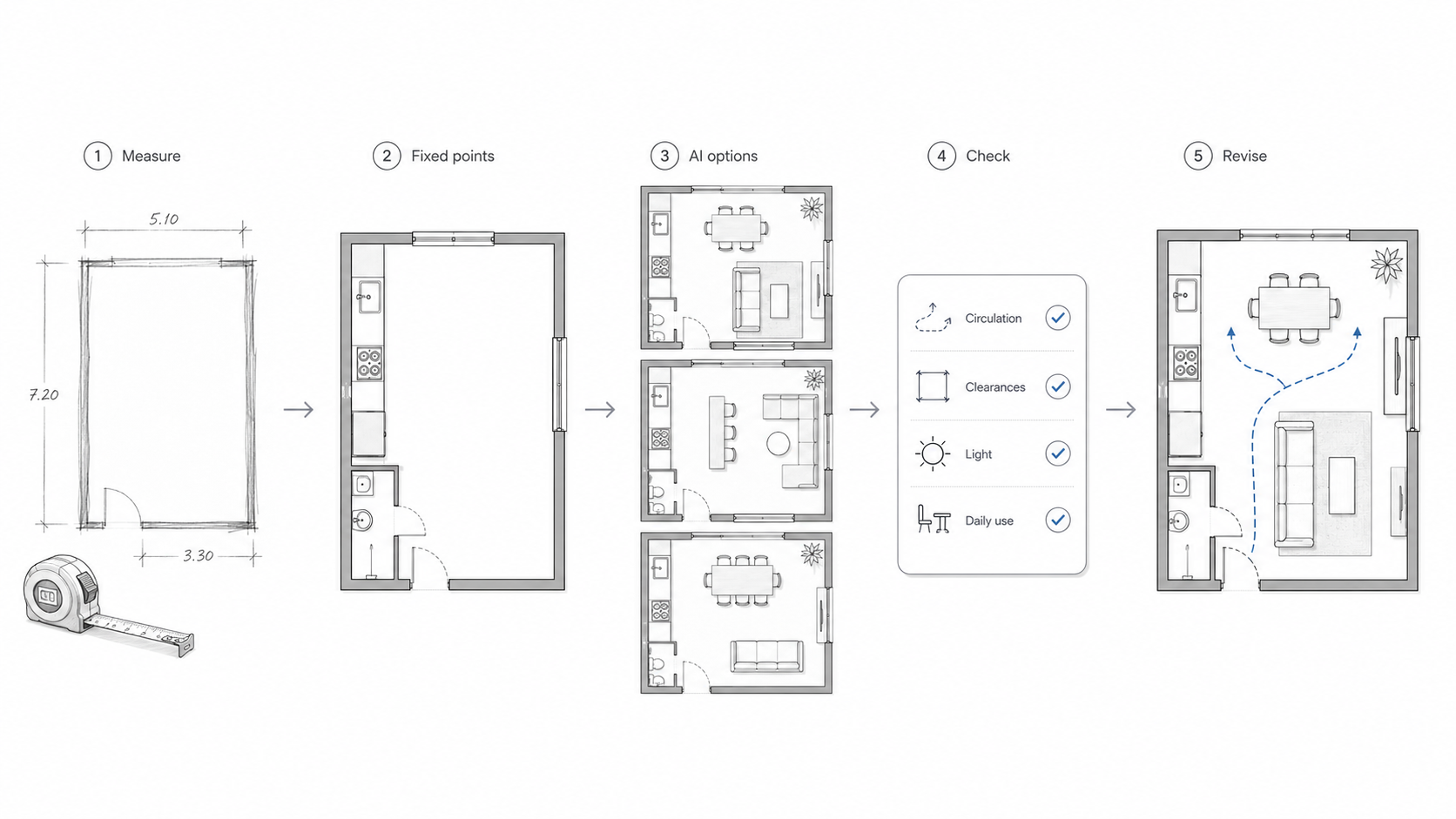
Illustration by ArchitectureCourses.org. AI helps most when it tests the layout before it decorates the room.
AI is already part of the field, but it changes some tasks more than others.
It can help with mood imagery, early layout options, precedent research, quick visual testing, and generating alternative concepts. It can also help students ask better questions if they use it well.
But AI has one big weakness: it can make weak spatial thinking look polished.
A generated image may show a beautiful interior with impossible clearances, fake daylight, bad circulation, or furniture that would never fit in the real room. That makes AI useful, but dangerous.
The better use is to treat AI as a fast testing tool:
- ask for layout options, not only pretty views;
- check path, storage, door swings, and furniture size;
- test whether a smaller change solves the problem before a bigger one;
- use it to compare alternatives, then judge them with real design basics.
Ordinary people can benefit from AI here too. A homeowner planning a room, a student testing layout options, or a small business owner working on a shop interior can all use AI to think through the space earlier. It helps most when the user understands the basics first.
For a broader look at AI in interior work, see AI interior design and furniture design. The useful point is not whether AI can make a polished room image. The useful point is whether it helps test layout, scale, furniture, light, and daily use before the design gets expensive.
Without those basics, AI just makes the wrong idea look expensive.
Books, Tools, and Software: Where Spending Helps
Books and tools can help, but they should not replace studio work, drawing practice, or portfolio development.
For this topic, the best resources are the ones that improve layout judgment, scale, materials, lighting, and how rooms work before they are styled. A general decorating book may be enjoyable, but it will not teach enough spatial thinking by itself.
If you are buying books, courses, software, or AI tools, ask one question first: will this help me make better plans, sections, spatial diagrams, lighting decisions, material choices, or portfolio pages? If the answer is no, it may be inspiration rather than training.
That does not make it useless. It just means it should not be treated as the main investment.
Is Interior and Spatial Design a Good Fit for You?
It may be a good fit if you care about both atmosphere and planning.
You will probably do well if you like questions like:
- Why does this room feel awkward?
- How can the path improve without moving everything?
- What kind of light should this space have?
- How do people enter, wait, gather, display, work, or leave?
- How can a room feel calmer without becoming empty?
It may be a weaker fit if you only want styling, or if your main goal is the architecture licensure path and you are not willing to verify the degree route carefully.
What Makes a Strong Interior and Spatial Design Student
The best students are not always the most artistic in the narrow sense.
They are usually the ones who can notice friction, explain it, test alternatives, and improve the work without getting precious about the first idea.
They can think in plan. They can see how a section changes a room. They care about materials, but they do not let materials hide a weak layout. They can use references and software without letting either one do all the thinking for them.
That mix matters because interior and spatial design sits between beauty and use. If either side gets ignored, the work gets weak fast.
FAQ
What is interior and spatial design?
Interior and spatial design is the design of interior environments with strong attention to layout, circulation, atmosphere, use, and how spaces connect and behave.
Is interior and spatial design the same as interior design?
Not exactly. There is overlap, but interior and spatial design usually puts more emphasis on space planning, sequence, movement, and the behavior of the interior environment.
Is interior and spatial design the same as architecture?
No. It overlaps with architecture, but it usually focuses more on interior environments and spatial experience than on whole-building structural and technical design.
What do you study in interior and spatial design?
Most students study space planning, drawing, layout, material use, lighting, human use, project development, and some digital tools for representation and visualization.
What jobs can it lead to?
It can lead to work in residential interiors, retail, hospitality, workplace design, exhibition design, installation design, and other interior-focused spatial fields.
Is interior and spatial design worth studying?
It can be worth studying if the program teaches strong studio work, clear drawing, spatial planning, material logic, lighting, and portfolio development. The name alone is not enough. Check the student work before committing.
Do employers care more about the degree name or the portfolio?
The degree name matters, but the portfolio usually matters more. Employers want clear plans, process work, strong thinking, and evidence that you can develop a real project.
Can AI help with interior and spatial design?
Yes, but it works best as a testing tool. It can help with options and quick comparisons, but it cannot replace basic judgment about circulation, light, clearance, material logic, and real use.
Is this a good degree if I want to become a licensed architect?
Not automatically. If your main goal is architecture licensure, check the degree route carefully before enrolling.
Read This Next
If you want the broader field context, the next page is spatial design.
If you want the process side, go next to spatial planning and design.
If the practical problem is room layout, space planning and layout in interior design is the better follow-up.
For beginner-level layout checks, keep space planning essentials nearby.
If the next concern is portfolio quality, read interior designer portfolio development.