
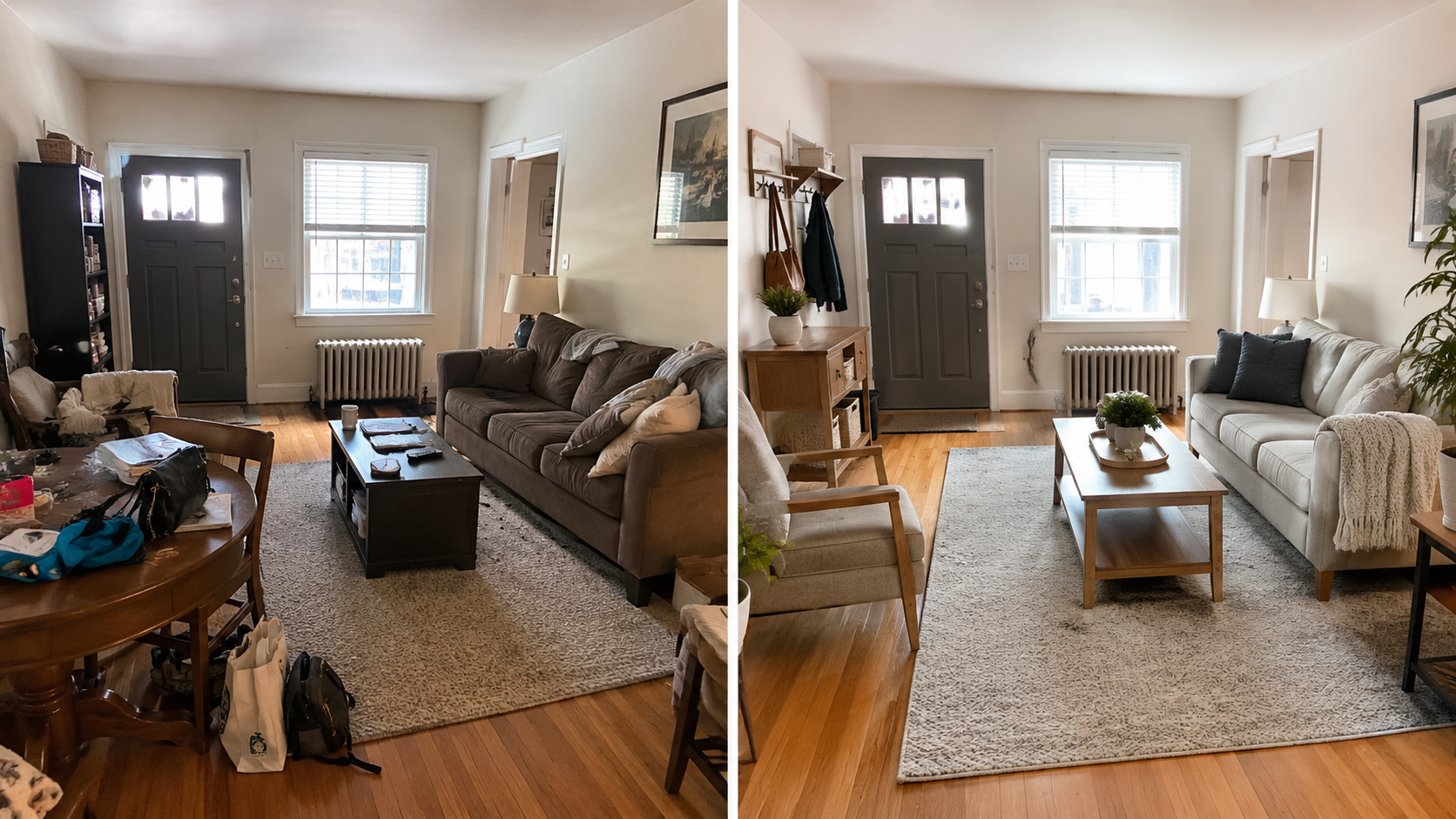
A plan can look clean and still be wrong.
The rooms are labeled. The furniture fits. The drawing looks balanced. Then the refrigerator door opens into the main path, the desk lands in glare, the dining chairs block circulation, and the quiet room sits beside the loudest space in the house.
The problem starts before finishes.
Spatial planning decides what belongs near what, where people move, where they stop, which zones need privacy, which fixed points are expensive to move, and whether the plan still works after real life begins.
What Spatial Planning and Design Means
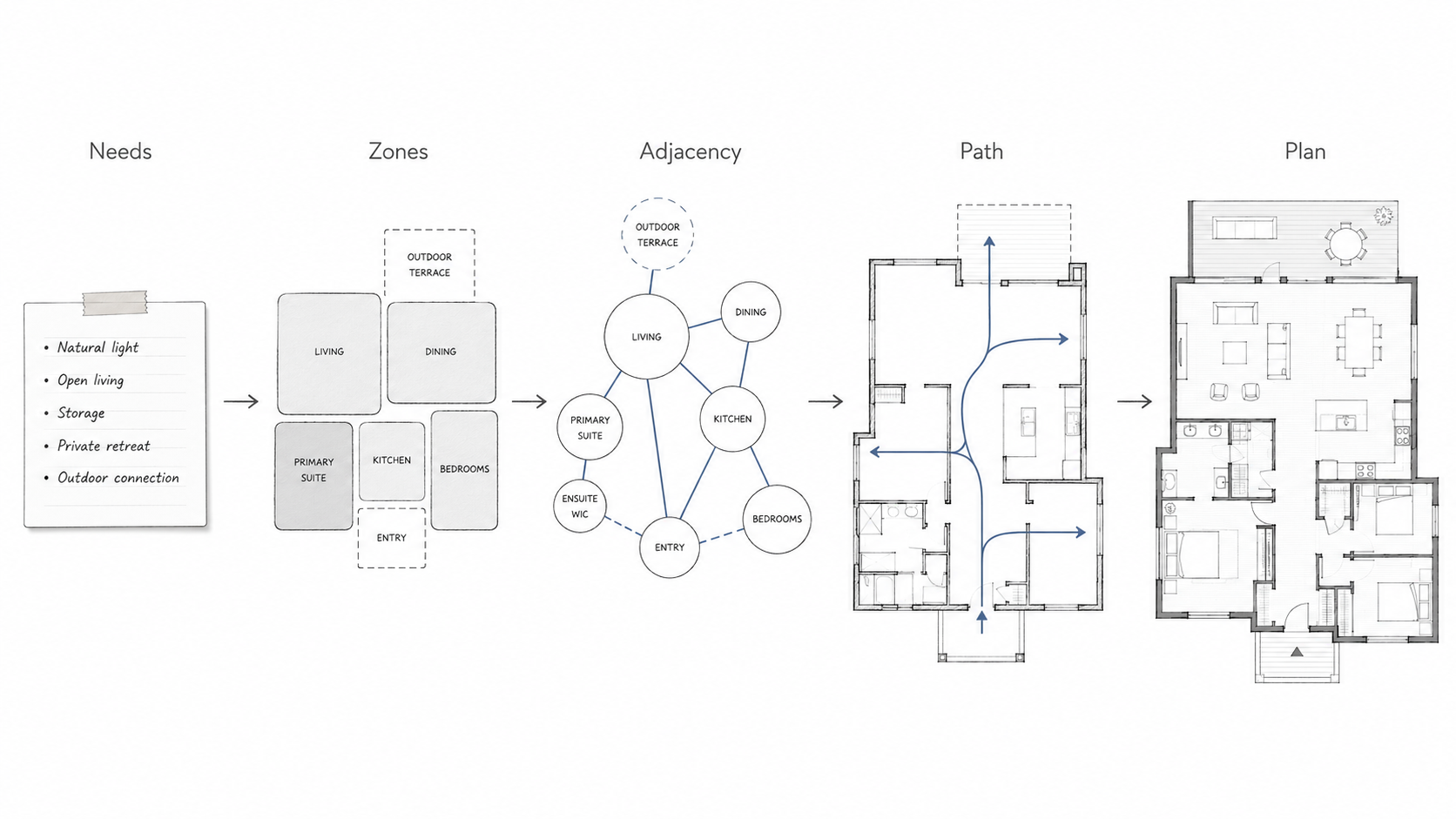
Illustration by ArchitectureCourses.org. Spatial planning turns loose needs into zones, paths, adjacencies, and a plan that can be tested.
Spatial planning is the process of arranging uses, zones, rooms, paths, openings, furniture, service areas, and relationships so a space works before it is decorated.
The planning part matters because it happens before the finished look. It is where rough decisions get tested: entry, circulation, public and private zones, storage, light, noise, access, and service routes.
The design part comes from how those decisions shape experience. A planned space should not feel mechanical. It should guide movement, support daily use, and make the main activities feel natural.
For the broader concept, start with spatial design. This page is the process layer: how loose needs become a workable plan.
Spatial Planning vs Spatial Design
Spatial design and spatial planning overlap, but they do not do the same job.
| Question | Spatial design asks | Spatial planning asks |
|---|---|---|
| Purpose | How should the space feel, behave, and support experience? | Where should each use, zone, path, and fixed element go? |
| Movement | How does the person experience the route? | Does the route fit, cross, tighten, or fail? |
| Relationship | What should feel connected, separate, open, or protected? | What belongs beside what, and what should stay apart? |
| Risk | The space looks good but feels wrong. | The plan looks organized but works badly in use. |
A strong project needs both. Spatial design gives the larger intention. Spatial planning tests whether that intention can survive doors, furniture, storage, plumbing, structure, circulation, and people using the space at the same time.
Start With Use, Not Shape
The first mistake is starting with the shape of the plan instead of the way the space will be used.
A rectangle, open plan, corridor, island, courtyard, or central stair may look clear on paper. That does not prove it works. The plan has to answer ordinary questions first.
- Who enters first, and what do they carry?
- Where do people stop without blocking others?
- Which activities need quiet?
- Which activities create noise, mess, heat, or traffic?
- What needs to be near storage?
- What needs daylight?
- What should visitors see first?
Those questions are not decoration. They are the plan.
Zones Come Before Rooms
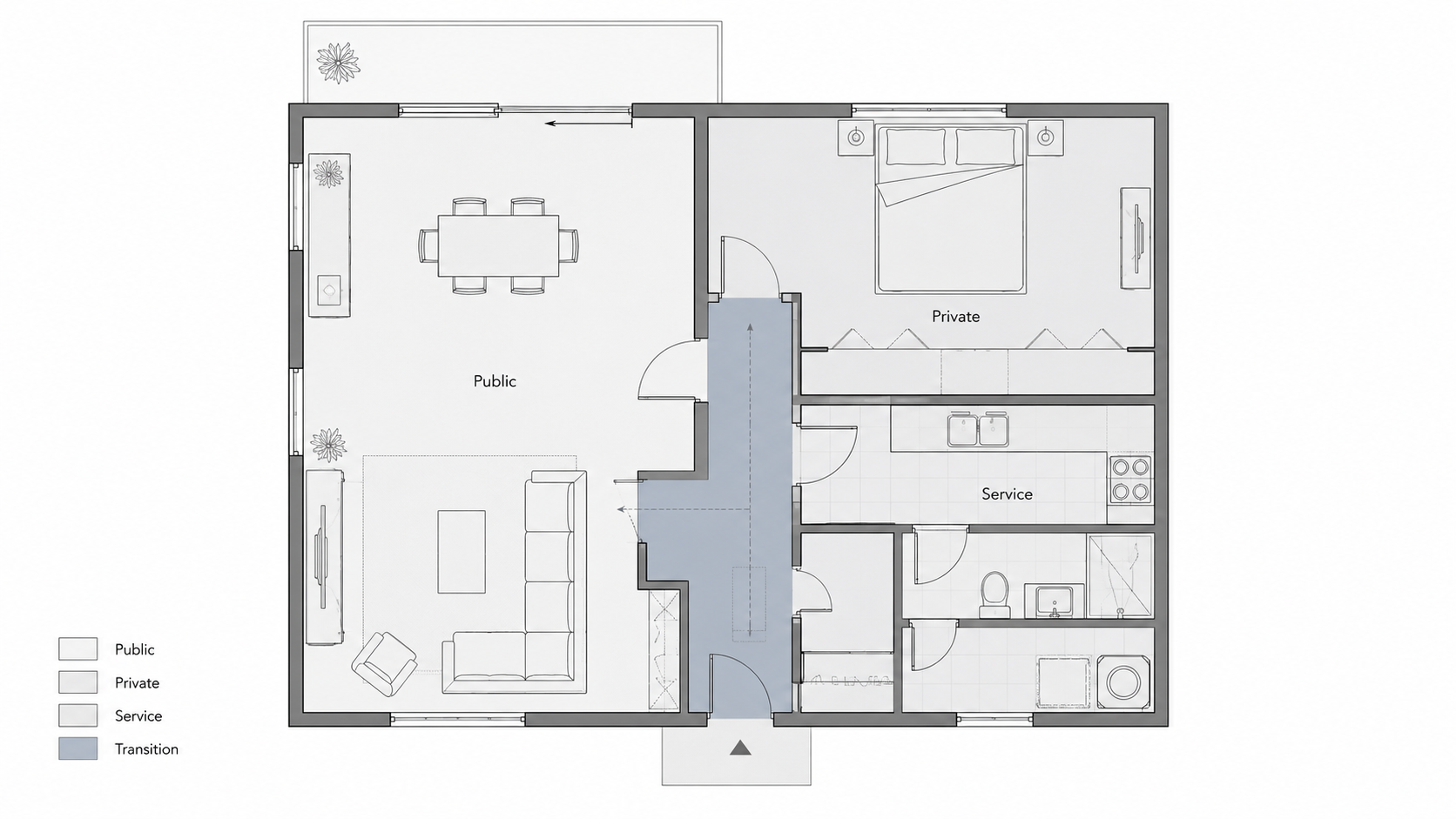
Illustration by ArchitectureCourses.org. A plan usually starts to make sense when public, private, service, and transition zones are separated clearly.
A weak plan jumps too quickly into room labels. Kitchen. Living. Bedroom. Office. Storage.
A better plan starts with zones.
| Zone | What it handles | Common mistake |
|---|---|---|
| Public | Entry, gathering, reception, living, dining, display, shared use. | Public movement cuts through private or work areas. |
| Private | Sleeping, focused work, retreat, personal storage, quiet rooms. | The private zone sits on a main path or beside noise. |
| Service | Kitchen, bathroom, laundry, mechanical, storage, utility, cleaning access. | Service areas are placed far from the point of use. |
| Transition | Entry, hallway, threshold, landing, stair, pause point, circulation edge. | The transition space becomes leftover area instead of a working part of the plan. |
Zoning does not have to be rigid. A small apartment may overlap public, work, and dining zones in one room. A school studio may mix messy work, quiet work, storage, and display. The point is not to separate everything. The point is to know what is overlapping before the conflict becomes permanent.
Adjacency Decides What Belongs Near What
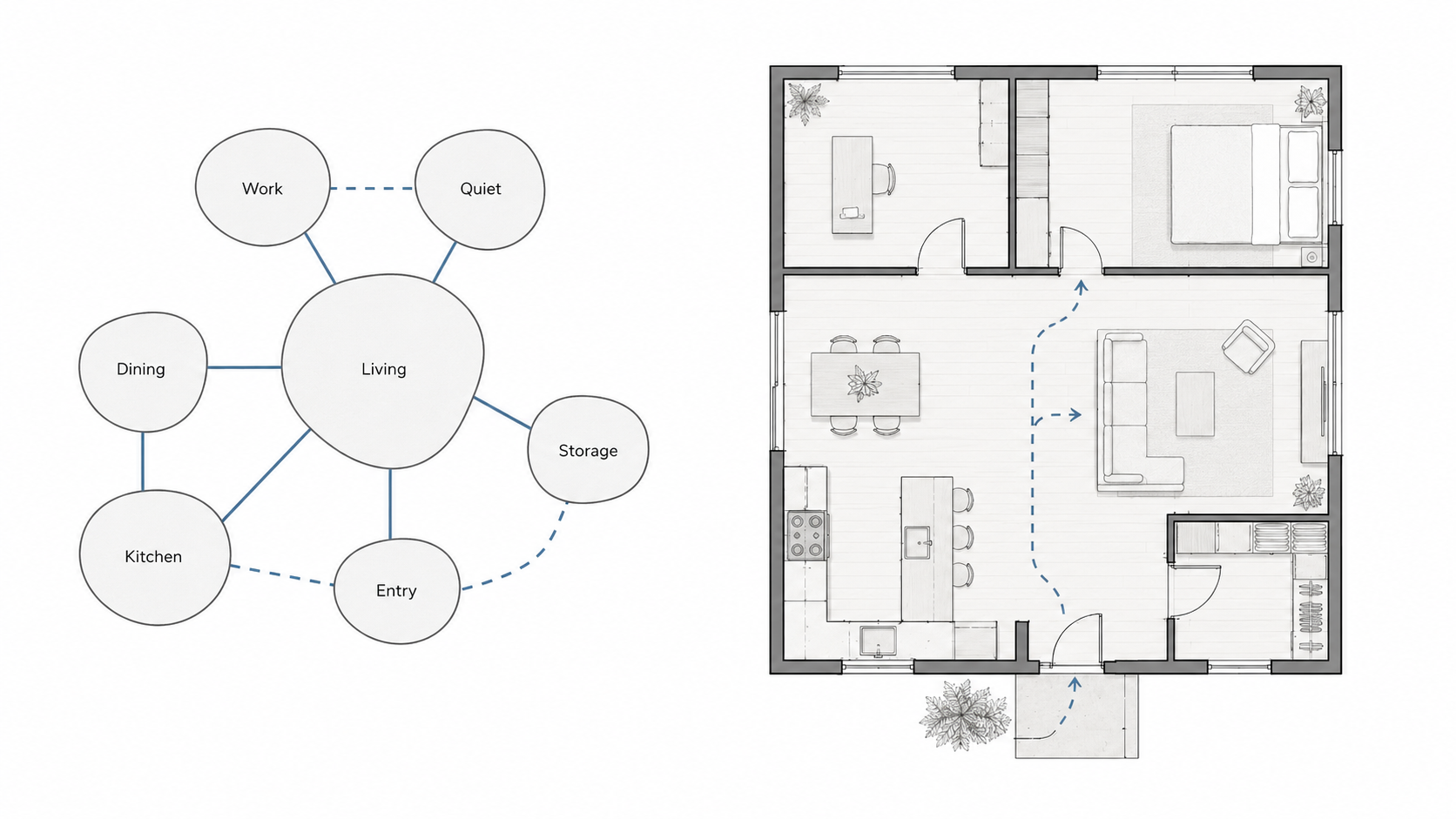
Illustration by ArchitectureCourses.org. Adjacency planning helps decide what belongs near what before the floor plan gets polished.
Adjacency is the relationship between spaces.
A kitchen near dining usually makes sense. A noisy meeting room beside focused work does not. A laundry area near bedrooms may help. A guest bathroom opening directly into a dining area usually feels wrong. Storage placed near the point of use saves more frustration than a larger storage room in the wrong place.
This is why bubble diagrams still matter. They look simple, but they catch relationships before wall lines make the plan look more certain than it is.
A good adjacency study asks:
- Which spaces need to touch?
- Which spaces need separation?
- Which spaces share noise, water, storage, staff access, or equipment?
- Which route should be short?
- Which view should be protected?
The wrong adjacency can make a project expensive without looking wrong at first. The rooms exist, but the daily relationship between them is broken.
Circulation Exposes the Plan
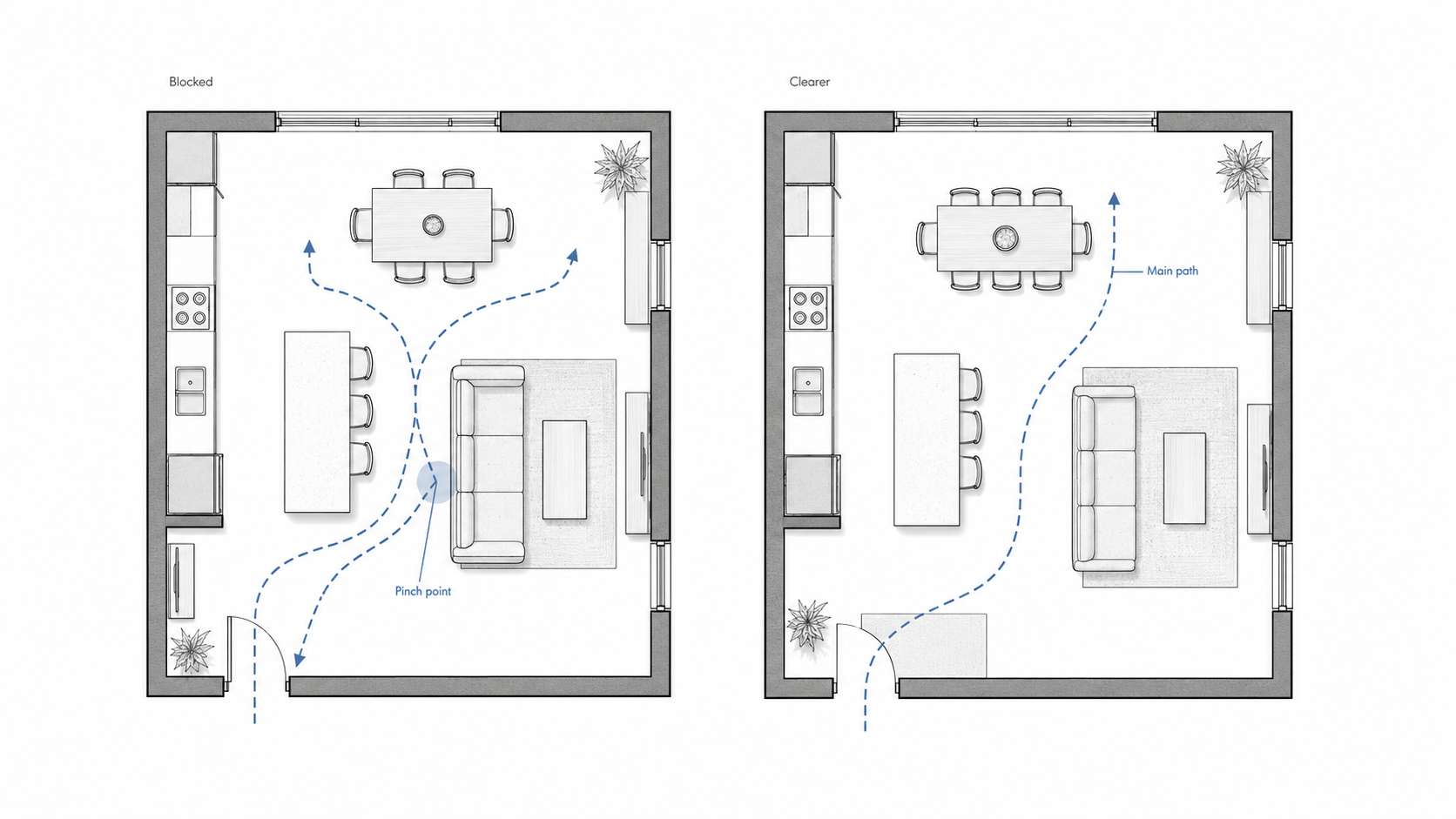
Illustration by ArchitectureCourses.org. Circulation problems are easier to see when the blocked route is drawn directly over the plan.
Circulation is not just hallway width. It is the way people move through the whole layout.
In a house, circulation shows up between entry, kitchen, living room, bedrooms, bathrooms, laundry, and storage. In a store, it shows up between entry, display, pause points, checkout, and exit. In a school, it shows up where students enter, wait, store things, gather, and move between rooms.
The simplest test is to draw the main paths over the plan. Do not explain them. Draw them.
Then look for the damage:
- paths crossing work zones;
- chairs blocking movement when pulled out;
- doors swinging into furniture;
- people stopping at the entry because there is no landing space;
- storage placed across the main route;
- quiet rooms placed beside the busiest path.
A plan that survives the circulation overlay is usually much stronger than a plan that only looks clean without people in it.
Fixed Points That Cost Money To Move
Spatial planning gets expensive when the plan ignores what is fixed.
On paper, moving a sink looks like dragging a symbol. In the building, it can mean plumbing, floor framing, venting, cabinets, countertops, wall repair, permits, and inspection. Moving a stair can change structure. Moving a window can affect the exterior wall, siding, flashing, insulation, trim, and sometimes the whole elevation. Removing a wall can reveal electrical, ducts, posts, beams, or bad old work.
This is where many planning decisions go wrong. The early sketch treats every zone as movable. The real project does not.
| Fixed point | Why it matters | Planning move |
|---|---|---|
| Plumbing walls | Sinks, toilets, tubs, vents, drains, and supply lines may be expensive to relocate. | Plan wet areas around existing plumbing first, then decide whether moving them is worth it. |
| Structural walls and posts | Wall removal can trigger beams, posts, footings, engineering, and inspection. | Test smaller openings or layout changes before assuming full removal. |
| Stairs | Stair location affects circulation, headroom, structure, floor openings, and code. | Treat stairs as a major organizing element, not leftover circulation. |
| Windows and exterior doors | Openings affect light, views, envelope work, exterior appearance, and wall space. | Use openings to guide layout, but do not move them casually. |
| HVAC and mechanical routes | Ducts, radiators, returns, and equipment access can limit room layout. | Check service access before placing furniture, storage, or built-ins. |
A good spatial plan does not avoid every expensive move. Sometimes moving plumbing, structure, or openings is the right decision. The mistake is discovering the cost after the design already depends on it.
The Plan After Furniture Arrives
An empty plan is too easy to trust.
It may show enough square footage. It may show a sofa, table, bed, or desk fitting inside the room. But real use adds chair pullback, open drawers, cabinet doors, bags, chargers, shoes, cleaning supplies, laundry baskets, pets, guests, and someone trying to pass while another person is standing still.
That is when the weak plan shows itself.
A dining area may work until all chairs are pulled out. A bedroom may work until the closet door opens. A living room may work until the coffee table steals the only comfortable path. A home office may work until afternoon glare makes the desk useless.
Spatial planning should test the furnished version, not just the empty room. For room-level decisions, the practical follow-up is space planning and layout in interior design.
From Bubble Diagram to Floor Plan
A bubble diagram is not childish. It is where the plan stays loose enough to be tested.
At that stage, the goal is not to draw final rooms. The goal is to test relationships. Entry near storage. Kitchen near dining. Quiet work away from noise. Public movement away from private retreat. Service zones grouped where possible.
The mistake is turning bubbles into walls too quickly. Once the plan has crisp lines, people start trusting it. The drawing looks finished before the relationships have been tested.
A better sequence is:
- List the uses. Write what actually has to happen in the space.
- Group the zones. Separate public, private, service, and transition needs.
- Test adjacency. Decide what should touch, separate, or share access.
- Draw circulation. Mark the main paths before locking rooms.
- Check fixed points. Confirm structure, plumbing, stairs, windows, and service routes.
- Only then draw the cleaner plan. Let the final lines follow tested relationships.
Light, View, and Noise Belong in the Planning Stage
Light is not a finish. View is not a bonus. Noise is not a problem to solve after furniture arrives.
These conditions should shape the plan from the start.
A desk in glare is not a good desk. A living area with no useful daylight may feel dead even if the furniture is expensive. A bedroom beside a loud common area may look efficient but feel restless. A long hallway with no view or light may feel mean even when it technically works.
Good spatial planning does not only ask where the rooms go. It asks what each room receives: daylight, privacy, quiet, view, storage, access, and a comfortable edge.
For deeper reading on light, see natural lighting in architectural design.
How AI Can Help With Spatial Planning
AI can help with spatial planning if it is used to test options, not decorate mistakes.
A weak prompt asks for a beautiful room. A stronger prompt gives the tool the constraints: room size, doors, windows, fixed plumbing, structural walls, storage needs, furniture sizes, daylight problems, and what currently feels wrong.
Use AI to ask for alternatives:
- three layout options with the same fixed doors and windows;
- a circulation check for each option;
- where furniture clearance fails;
- which fixed items should not move unless the benefit is strong;
- what smaller change might solve the problem before demolition.
Then check the result yourself. AI can make a bad plan look confident. It may ignore structure, plumbing, code, real furniture sizes, outlets, HVAC, stair rules, and the cost of moving fixed elements.
The useful role of AI is early testing. It should help you ask better questions before drawings, purchases, or renovation work become expensive.
Common Spatial Planning Mistakes
Starting with the final look
A polished plan can hide weak relationships. Start with use, zones, paths, and fixed points before finishes or presentation style take over.
Letting one feature dominate the plan
An island, stair, fireplace, view wall, or dramatic entry can organize a space. It can also damage everything around it if the path, storage, and daily use are forced to serve the feature.
Forgetting the service side
Cleaning, maintenance, delivery, waste, laundry, equipment, storage, and mechanical access are easy to ignore on a clean plan. They become obvious after people start using the space.
Using open space as a shortcut
Open space does not automatically mean flexible space. If movement, noise, furniture, storage, and privacy are not planned, openness can create more problems than walls did.
Trusting square footage too much
A larger room can still fail if the doors, furniture, windows, and storage edges are wrong. A smaller room can work if the plan protects one clear route and gives each activity a place.
Spatial Planning Checklist Before You Commit
Before the plan gets drawn cleanly, check the rough version against the decisions that will be hard to reverse.
- Trace the main paths. Entry to seating, kitchen to table, bed to closet, desk to storage, public entry to waiting area.
- Mark the fixed points. Plumbing, structure, stairs, windows, exterior doors, ducts, radiators, and equipment access.
- Test chair and door movement. A chair, cabinet, drawer, closet, or appliance can destroy a path after the plan looks finished.
- Separate noisy and quiet uses. Do not place quiet work or sleep beside the busiest route unless there is a good reason.
- Find the landing zones. Entry, kitchen, laundry, work, and storage all need places where activity begins and ends.
- Check the plan after three weeks of use. Imagine bags, chargers, dishes, coats, guests, pets, deliveries, cleaning, and maintenance access.
If the plan only works when empty, it is not ready.
FAQ
What is spatial planning and design?
Spatial planning and design is the process of organizing zones, paths, adjacencies, rooms, openings, furniture, and fixed points so a space works before it is decorated or built.
How is spatial planning different from spatial design?
Spatial design is the broader idea of shaping how space behaves and feels. Spatial planning is the practical process of arranging uses, circulation, relationships, and constraints into a workable plan.
What are the main parts of spatial planning?
The main parts are zoning, adjacency, circulation, fixed-point checks, light, privacy, noise, storage, and furniture or equipment clearance.
Why does adjacency matter?
Adjacency decides what belongs near what. A kitchen near dining may help. A noisy room beside quiet work may fail. Good adjacency reduces daily friction before the plan is finalized.
What is a bubble diagram in spatial planning?
A bubble diagram is a rough relationship drawing. It helps test which spaces should connect, separate, or share access before the floor plan becomes too fixed.
Can AI help with spatial planning?
Yes, if it is used to test options. Give AI the room size, doors, windows, fixed points, furniture needs, and daily problems. Do not treat a polished AI image as proof that the plan works.
Why do spatial plans fail after furniture arrives?
Furniture adds real clearance problems. Chairs pull out, drawers open, doors swing, bags land near entries, and people need to pass each other. An empty plan may not show those conflicts.
What should I check before changing a layout?
Check circulation, fixed plumbing, structure, stairs, windows, service access, furniture clearance, light, noise, storage, and whether a smaller change solves the same problem.
Read This Next
For the broader idea behind this process, read spatial design.
For room-by-room layout decisions, use space planning and layout in interior design.
If you are studying the field or building a portfolio, read interior and spatial design.
For simpler beginner checks, keep space planning essentials nearby.
If the issue is drawing and plan communication, the next useful page is architectural drawings.