
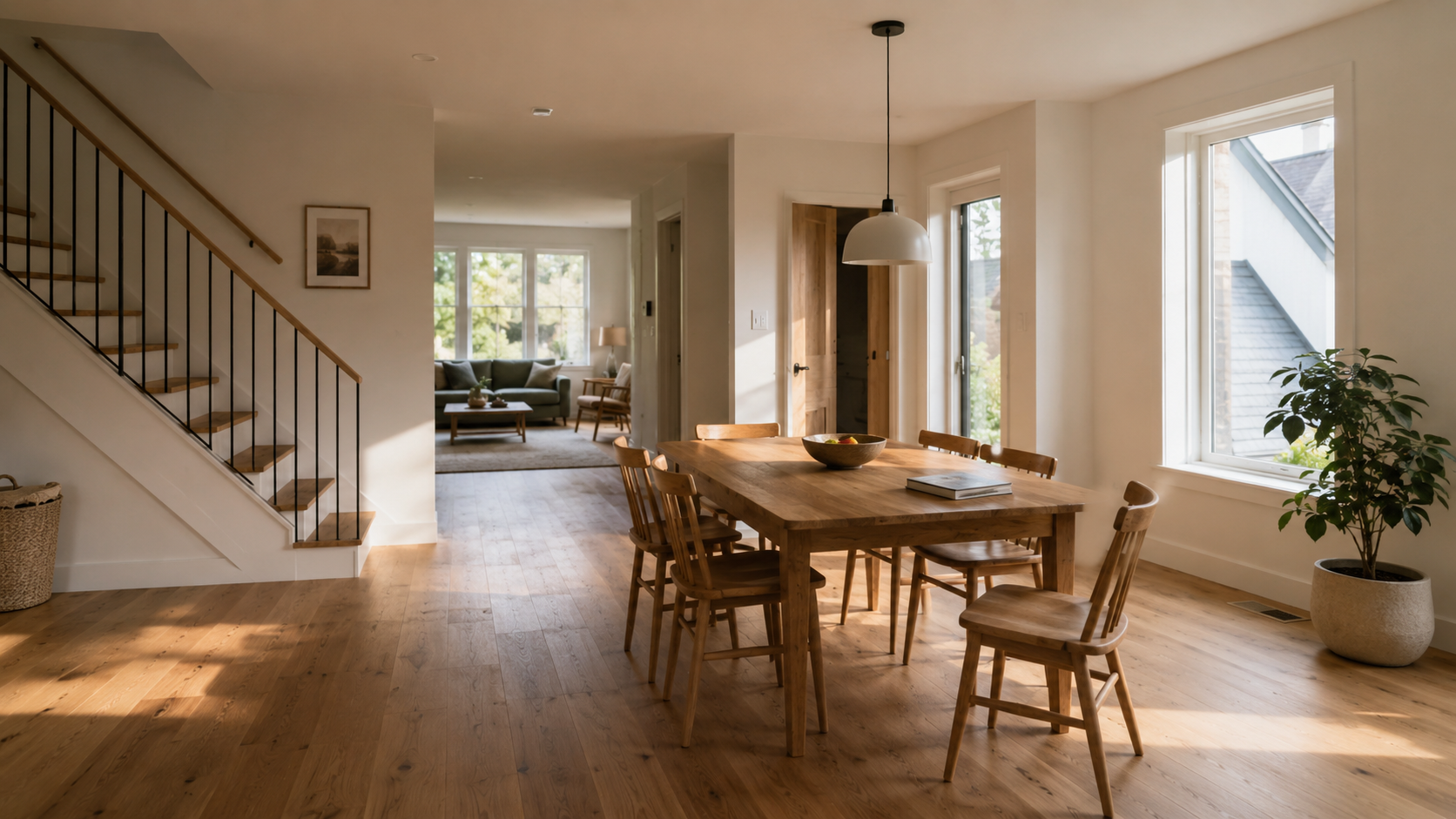
Image by ArchitectureCourses.org. Good natural lighting makes a room easier to use, not just brighter. Here, soft side light supports the dining area, stair zone, and deeper living space without glare taking over.
Bright Rooms Are Not Always Good Rooms
Natural light gets praised too easily.
A room can be full of daylight and still feel wrong. Glare on the table. Heat by late afternoon. A bright window in the wrong place. A stair that is washed out at the top and dark at the bottom.
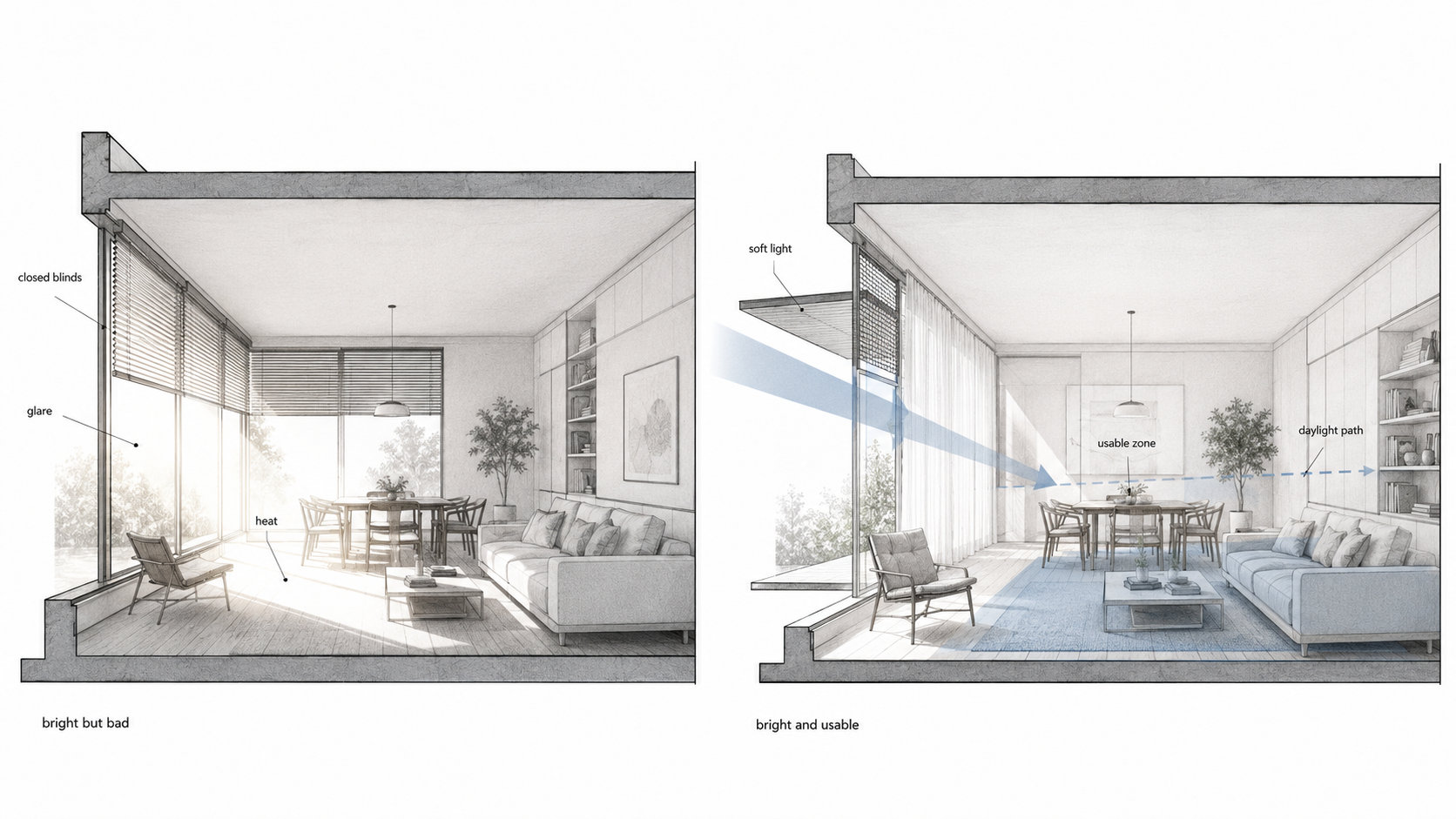
Illustration by ArchitectureCourses.org. A bright room is not always a good room. The real question is whether daylight creates glare and heat, or reaches deeper into the room in a way that stays comfortable and usable.
Good daylight is controlled daylight. More sun is not the goal. The right light, in the right place, at the right time of day, is the goal.
If you want the shorter foundational page, go to Design Elements in Architecture. If you are comparing daylight with larger sustainability choices, Sustainable Architecture is the better companion piece.
Bright is not the same as usable
This is where a lot of daylight advice goes soft.
It says natural light improves mood, saves energy, and makes rooms feel larger. All true. Also incomplete.
Daylight changes room behavior. It decides where people sit, which surfaces look clean, when a room overheats, and whether a space still works once the sun moves.

Image: Good daylight does more than brighten a room. It shapes movement, softens surfaces, and changes how the space feels hour by hour.
A breakfast corner with east light can be perfect at 8 a.m. and irrelevant by noon. A west-facing living room can feel flat all morning, then turn blinding and hot exactly when the room is most used. A skylit hallway can become the best space in the house, while a giant picture window in the wrong room becomes a daily problem.
That is why daylight should be planned like circulation, not treated like decoration.
If you want one book that is still useful here, The Interior Design Handbook is worth a look because it focuses on room proportion, spacing, and placement instead of style fluff. That matters when daylight is changing how the room actually works.

Daylight works best when it reaches the parts of a house that people actually use, not just the places that look dramatic in photos.
Give the best light to the rooms that earn it
Not every room deserves the best side of the house.
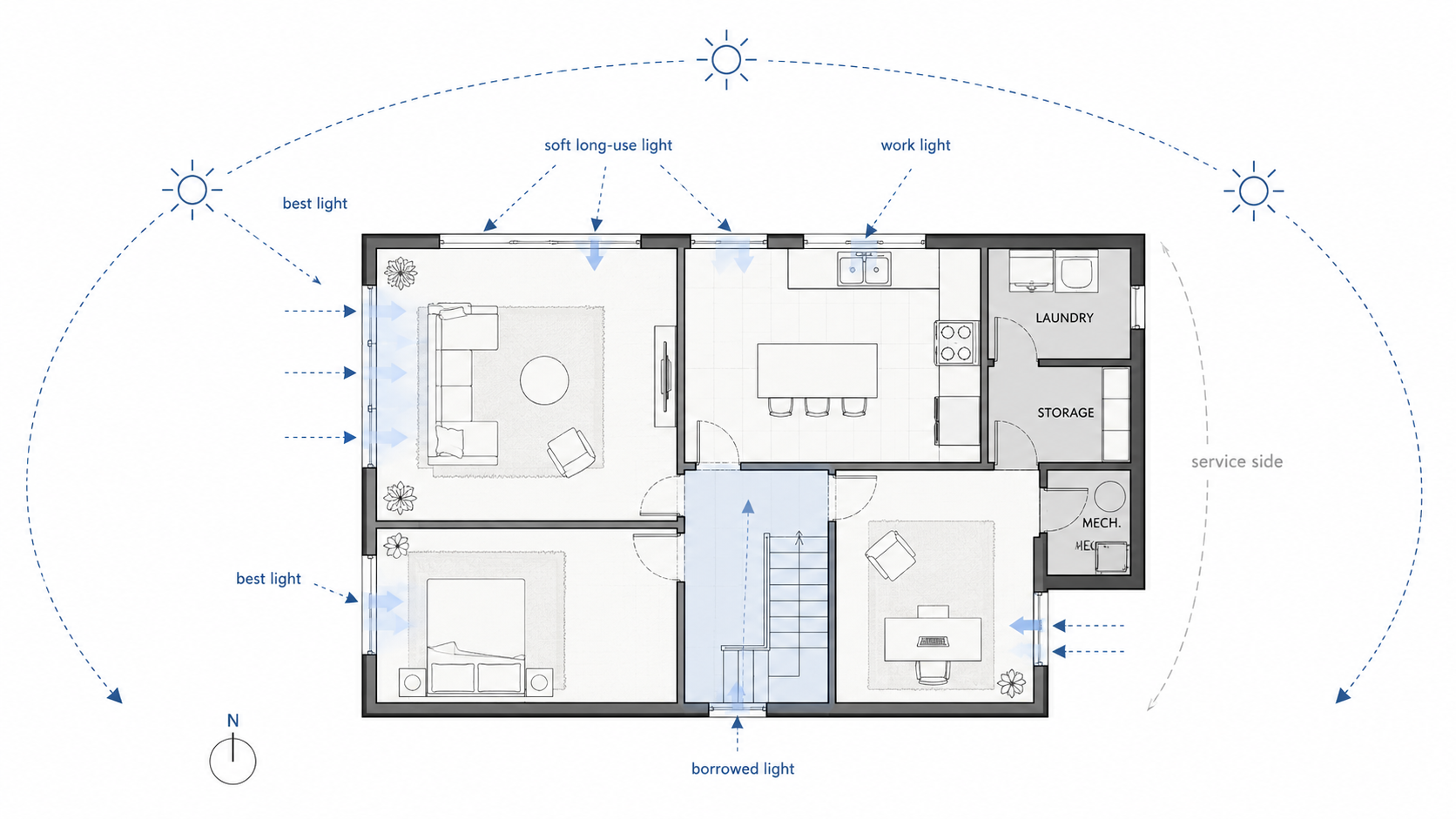
Illustration by ArchitectureCourses.org. Good daylight planning is not about giving every room the same window exposure. Kitchens, living rooms, offices, halls, and service rooms should receive different kinds of light based on how they are used.
A lot of bad plans happen because daylight gets assigned by habit. Big windows in the living room because that feels normal. Smaller windows in work spaces because they are “secondary.” Then the people in the house end up spending most of the day in the dimmest room.
The better move is to decide which rooms need the most useful light, not the most impressive light.
| Room | What the light should do | Common mistake | Better move |
|---|---|---|---|
| Kitchen | Support work, reading, prep, and cleaning | Backlit counters or dark work zones | Bring soft side light to the main work surfaces and sink |
| Living room | Stay comfortable through changing hours | One oversized west-facing glass wall | Use balanced openings and glare control, not just bigger glass |
| Bedroom | Support waking and wind-down | Harsh late sun or no morning light | Use gentler morning light and control strong evening exposure |
| Home office | Reduce fatigue and screen glare | Desk placed directly against a bright window | Bring daylight from the side and keep the screen out of glare lines |
| Stairs and hallways | Improve orientation and safety | Leaving circulation zones dark | Use roof light, clerestories, or borrowed light to guide movement |
Readers miss this because most articles treat light as a room bonus. It is closer to room structure than that.
Ancient buildings already knew the hard part

Older building traditions treated daylight as part of climate control, comfort, and ritual, not just as a visual effect.
The history section matters here, but only if it stays useful.
Greek and Roman buildings used courtyards, atriums, and roof openings because deeper plans needed interior light and moving air. Islamic architecture shaped daylight more deliberately, using screens, filtered openings, and layered geometry to soften glare and cool interiors. Japanese interiors often diffused light rather than chasing brightness, which is one reason they still feel calm. Across vernacular building traditions, daylight was rarely treated as “more is better.” It was shaped, filtered, and placed with purpose.
That is the real lesson. Older buildings were not simply brighter or darker. They were better at knowing where hard sun should stop and where soft light should continue.
If you want the broader context behind that thinking, Vernacular Architecture and Islamic Architecture are the strongest internal follow-ups here.
Where daylight goes wrong
This is the section many articles skip.
Not because it is complicated. Because it ruins the easy “sunlight is always good” story.
Glare
A room can be bright and still be tiring. Dining tables, screens, white counters, polished floors, and glossy cabinet fronts can throw light back into the eye and make the room harder to use.
Heat gain
Large glass without shading is not a daylight strategy. It is often a cooling problem in disguise. South and west exposures can become expensive if the room is not shaped to control them.
Bad timing
Some light arrives when nobody needs it and disappears when the room is actually occupied. That is why room use matters as much as orientation.
Uneven circulation
Dark stairs, dim halls, and blind center zones make buildings feel smaller and older than they are. Good daylight can improve movement through a building even more than it improves the rooms themselves.
Privacy problems
More window does not always mean better living. Bathrooms, bedrooms, dense urban lots, and street-facing rooms need control, not exposure.
The best daylight design handles all five without losing the benefits of openness.
The parts people retrofit later
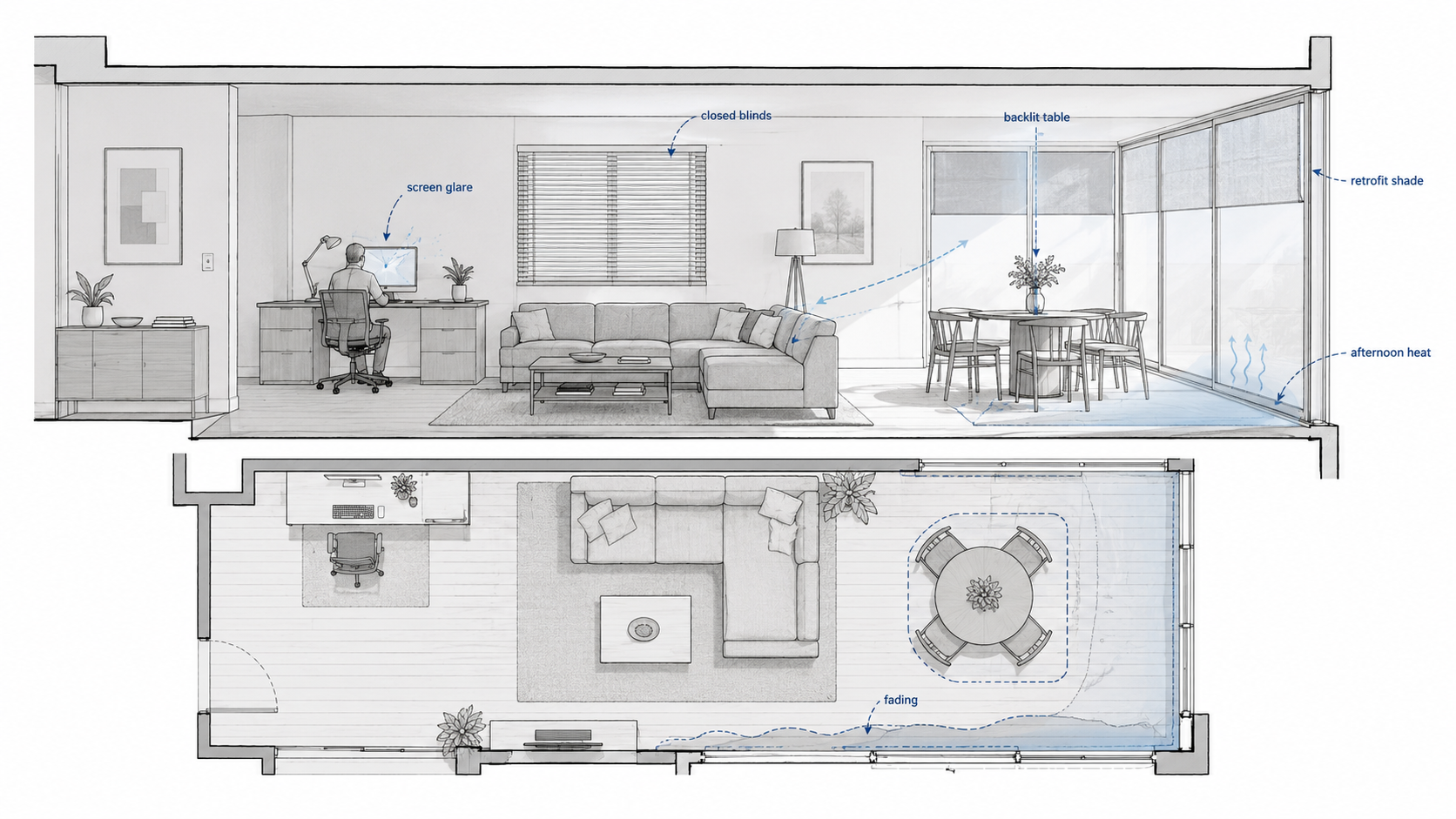
Illustration by ArchitectureCourses.org. Poor daylight planning often looks fine on move-in day. A few weeks later, the problems show up: glare on screens, uncomfortable dining light, closed blinds in a supposedly bright room, overheated glass zones, fading finishes, and retrofit shades added after the fact.
A lot of daylight problems do not show up on the first walkthrough.
They show up after people move in and start using the room the way real life uses it. The breakfast table is always backlit, so nobody wants to sit there in the morning. The home office looks bright in photos, but the screen glare makes the desk unusable by noon. The living room gets hammered by late sun, so the blinds stay closed for half the afternoon and the “light-filled” room ends up darker than expected.
Then the second round of spending starts. Shades. Window film. Exterior screening. New furniture placement. Sometimes a larger cooling bill. Sometimes fading on floors, fabrics, artwork, or wood finishes near the glass. Skylights can do the same thing from above: they look clean on day one, then later bring overheating, early waking, hard-to-reach cleaning, or leak anxiety if the detailing was weak.
This is the part worth checking early. Not whether the room looks bright, but whether the light still works once people are eating, reading, working, watching, waking, and trying to stay comfortable in it. Good daylight design saves you from retrofitting the room to protect yourself from the very light you thought you wanted.
For simple retrofit control, products like blackout cellular shades or heat-control window film can help, but they are still second-best solutions compared with getting the opening, shading, and room use right from the start.
Use plan, section, and surface together
Natural light does not get solved by windows alone.
It gets solved in three layers.
Plan
Where are the rooms? Which spaces get the long-use daylight? Which spaces can accept weaker light? Where should borrowed light help a deeper plan?
Section
Can light come from above? Can a stairwell become a light shaft? Can a clerestory bring daylight deeper without giving away privacy or wall space?
Surface
What happens after light lands? Pale walls, matte finishes, wood, tile, ceilings, and floor color all decide whether that light gets softened, bounced, absorbed, or turned into glare.
A lot of failed daylight design comes from solving only one of those three.

Stairwells show the difference fast. A little daylight in section can make circulation clearer, safer, and much more pleasant to move through.
Skylights are useful, but they are not a miracle fix
Skylights get sold as the answer to dark interiors. Sometimes they are. Sometimes they are just expensive patches over a bad plan.
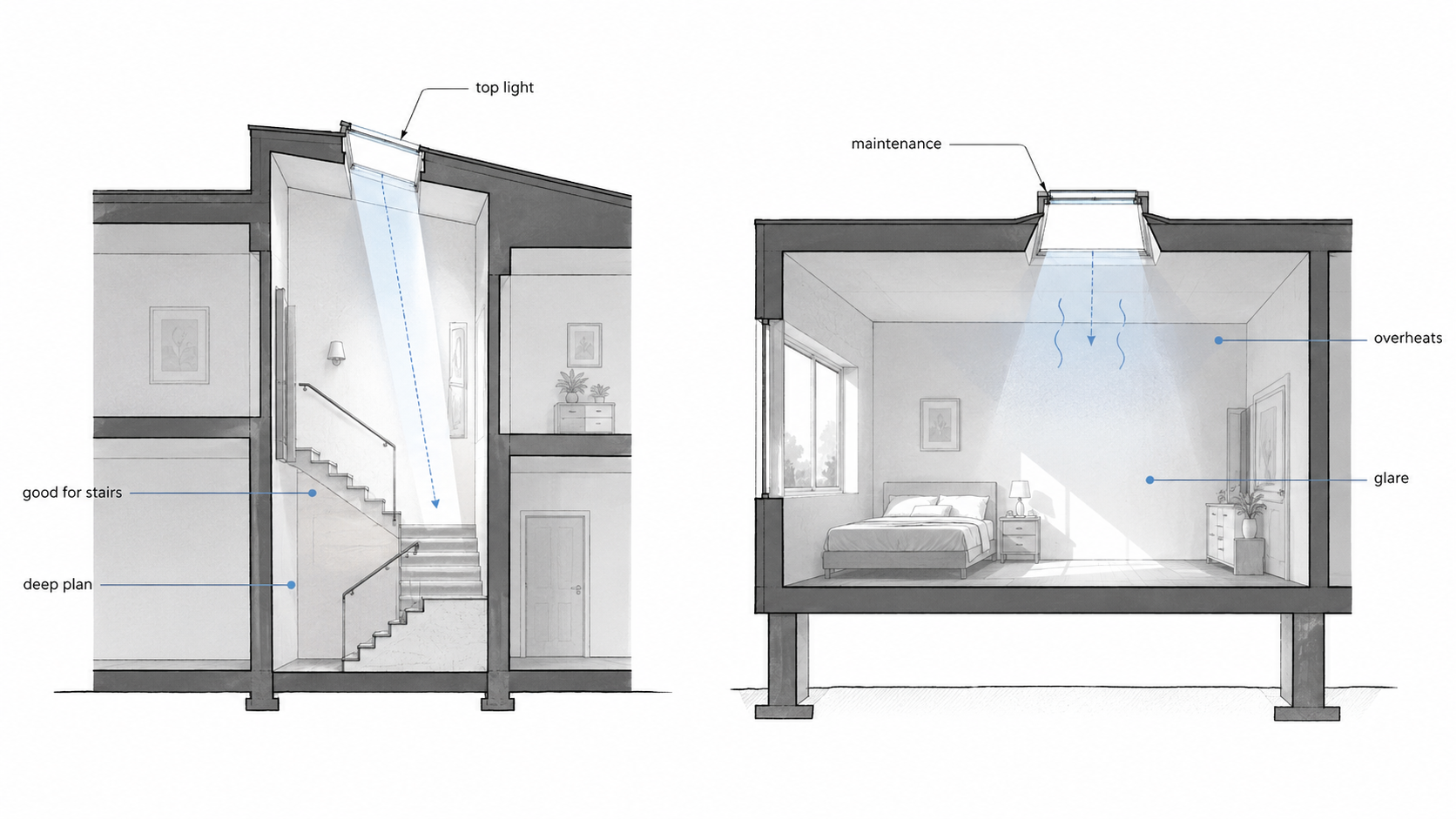
Illustration by ArchitectureCourses.org. A skylight works best when it brings useful top light into a dark interior zone like stairs or a deep hallway. In the wrong room, it can add glare, heat, and maintenance without improving how the space works.
They work best when the room has no good wall for a normal window, when circulation needs help, or when top light can make a narrow space feel taller and clearer.
They work badly when they dump heat into a room already struggling with summer sun, or when they land in a spot where glare matters more than brightness.
| Use skylights here | Be careful here |
|---|---|
| Stairwells | Low rooms already prone to overheating |
| Interior bathrooms | TV rooms with high glare sensitivity |
| Deep hallways | Bedrooms without good blackout control |
| Top-floor landings | Roofs where maintenance access is already difficult |
A skylight should solve something the plan could not solve cheaply any other way.

Top light can transform a narrow circulation space, but only when heat, glare, and maintenance are part of the decision.
Courtyards and light wells earn their space when the plan is deep
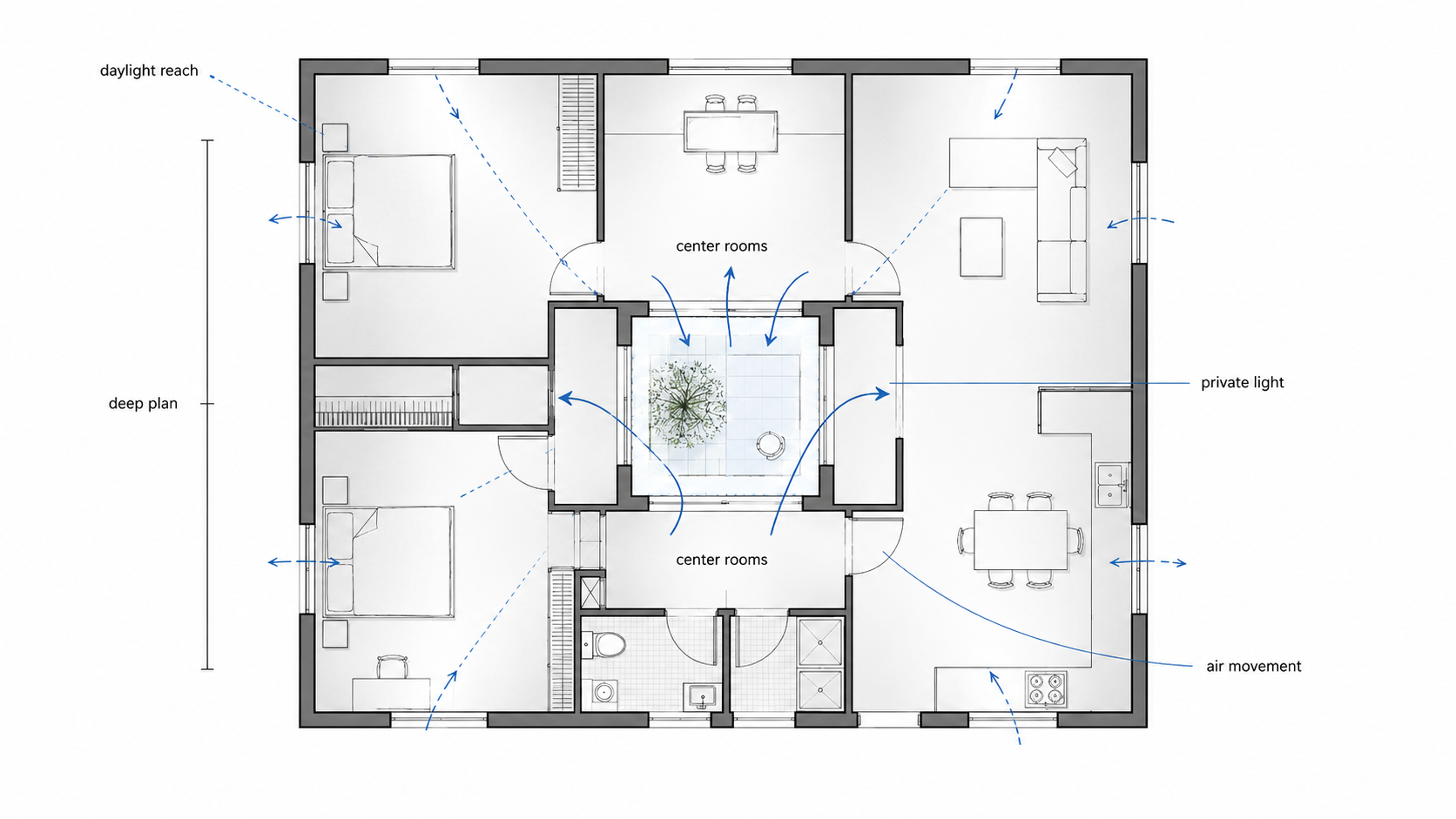
Illustration by ArchitectureCourses.org. In a deep house plan, exterior windows only do so much. A small courtyard or light well can bring calmer daylight, better air movement, and more usable light into the middle rooms without relying on giant exposed glazing.
Interior courtyards and light wells sound luxurious. Their real value is more practical.
They bring light and air into the parts of the building that exterior walls cannot reach well. In tight urban sites, attached houses, or deeper plans, that can make the center of the house feel like part of the building instead of leftover interior space.
But a courtyard only works if the building is organized around it. If it becomes a decorative leftover void, it will be expensive, hard to maintain, and not especially useful.
Good courtyards do at least two jobs: they bring light in, and they improve either ventilation, privacy, or circulation.
If they only “look nice,” they are usually too costly for what they return.
This is also where Design Elements in Architecture becomes relevant again. Light, void, plant life, and view all start acting together instead of as separate decorative moves.
Use daylight to reduce artificial lighting, not replace good lighting design
This matters more than people admit.
Natural light changes constantly. Artificial light fills the gaps. A house that depends on daylight but ignores evening lighting will still feel badly designed half the day.
The strongest buildings do both well. Daylight handles orientation, comfort, and daytime life. Artificial lighting handles the hours when the sun leaves and the work still continues.
That is why window planning and fixture planning should not live in separate conversations. If you need the artificial side of that equation, How to Choose Light Fixtures for Your Home is the practical next page.
What to ask before adding more glass
These are the better questions:
- What time of day is this room really used?
- Will this opening improve light quality or just increase brightness?
- What happens to glare on screens, counters, and tables?
- What controls the summer heat here?
- Does this opening help the center of the plan or only the perimeter?
- Is privacy going to get worse?
A lot of expensive daylight mistakes survive because nobody asks those questions early enough.
FAQ
What is natural lighting in architectural design?
It is the planned use of daylight to improve comfort, function, energy use, movement, and the feel of a building. Good daylight design is about control, not just brightness.
What is the biggest mistake people make with natural light?
Assuming more glass automatically means better living. It can also mean more glare, more heat, and less privacy if the room, orientation, and shading are wrong.
Are skylights always worth it?
No. They are strongest in interior bathrooms, stairs, hallways, and deep plans where wall windows cannot do the job well. In already hot or glare-prone rooms, they need more caution.
Why do some bright rooms still feel uncomfortable?
Because brightness is only one part of light quality. Glare, heat, timing, reflection, and room use matter just as much.
Which rooms should get the best daylight?
Usually the rooms used longest and hardest: kitchens, living rooms, work spaces, and key circulation areas. Not every room needs the most dramatic exposure.
Read this next
For a broader look at how buildings work with climate instead of against it, go next to Vernacular Architecture.
If you want the sustainability side without the fake green brochure tone, Sustainable Architecture is the right follow-up.
And if the next decision is not the windows but the fixtures that take over after sunset, use How to Choose Light Fixtures for Your Home.