

Islamic architecture gets flattened fast.
The usual shortcut is domes, arches, tile, courtyards, minarets, and calligraphy. Fine. But a building still has to solve the harder things first: where people face, where they gather, how shade works, how water moves, what stays private, and how the wall meets the street.
That is why Cairo, Granada, India, and Mali do not give you the same building with different decoration. They give you different answers.
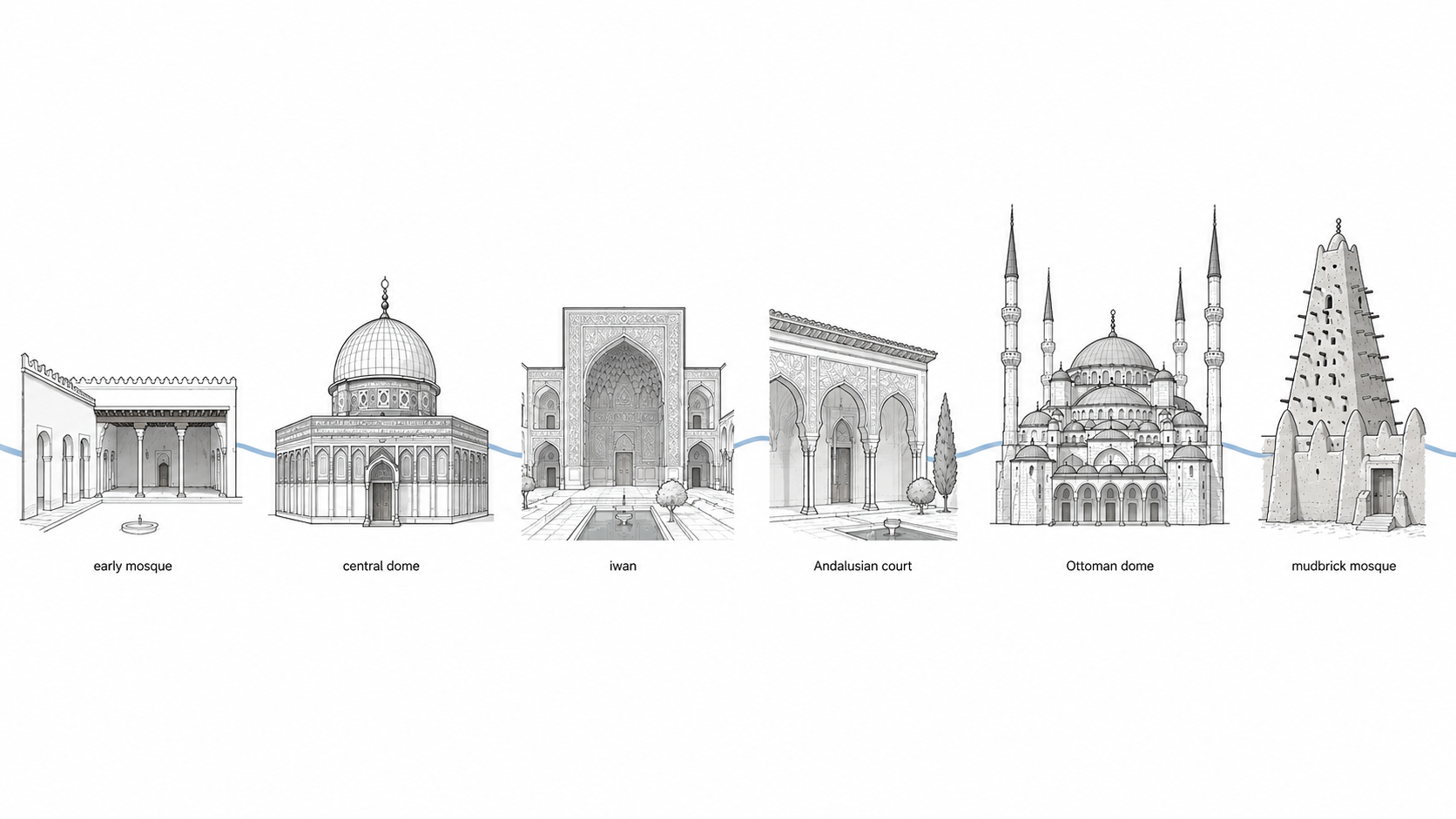
Illustration by ArchitectureCourses.org. Islamic mosque architecture did not develop as one single style. It moved through different structural ideas, court layouts, dome systems, iwans, regional materials, and local building traditions.

The Alhambra in Granada shows how Islamic architecture can join fortress walls, courtyards, carved surfaces, water, gardens, and controlled views into one spatial system.
Start With Systems, Not Style
Islamic architecture is easier to read when you stop treating it as a look.
The strongest buildings usually work through systems. A courtyard cools and organizes movement. A qibla wall sets religious direction. A minaret marks the building in the city. A mashrabiya filters light, air, privacy, and street views. Geometry gives large surfaces order. Calligraphy turns walls, arches, and domes into text-bearing architecture.
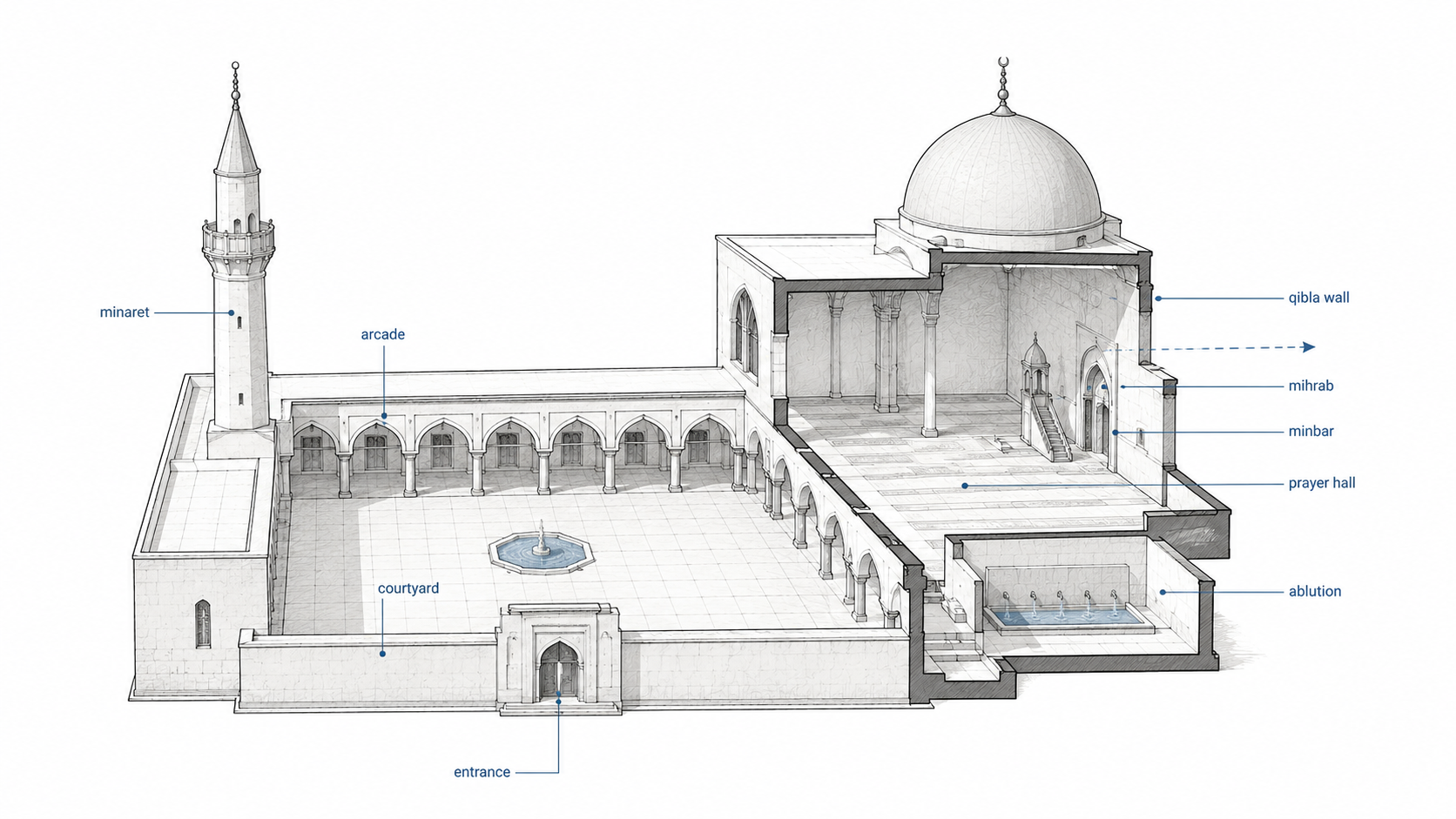
Illustration by ArchitectureCourses.org. A mosque is easier to understand when the parts are read as a working system: courtyard, prayer hall, qibla wall, mihrab, minbar, arcade, entrance, minaret, and ablution area.
The ornament is not separate from the building. In the best examples, it gives scale, rhythm, direction, hierarchy, and meaning. It helps the eye understand where to slow down, where to enter, and where the important surfaces are.
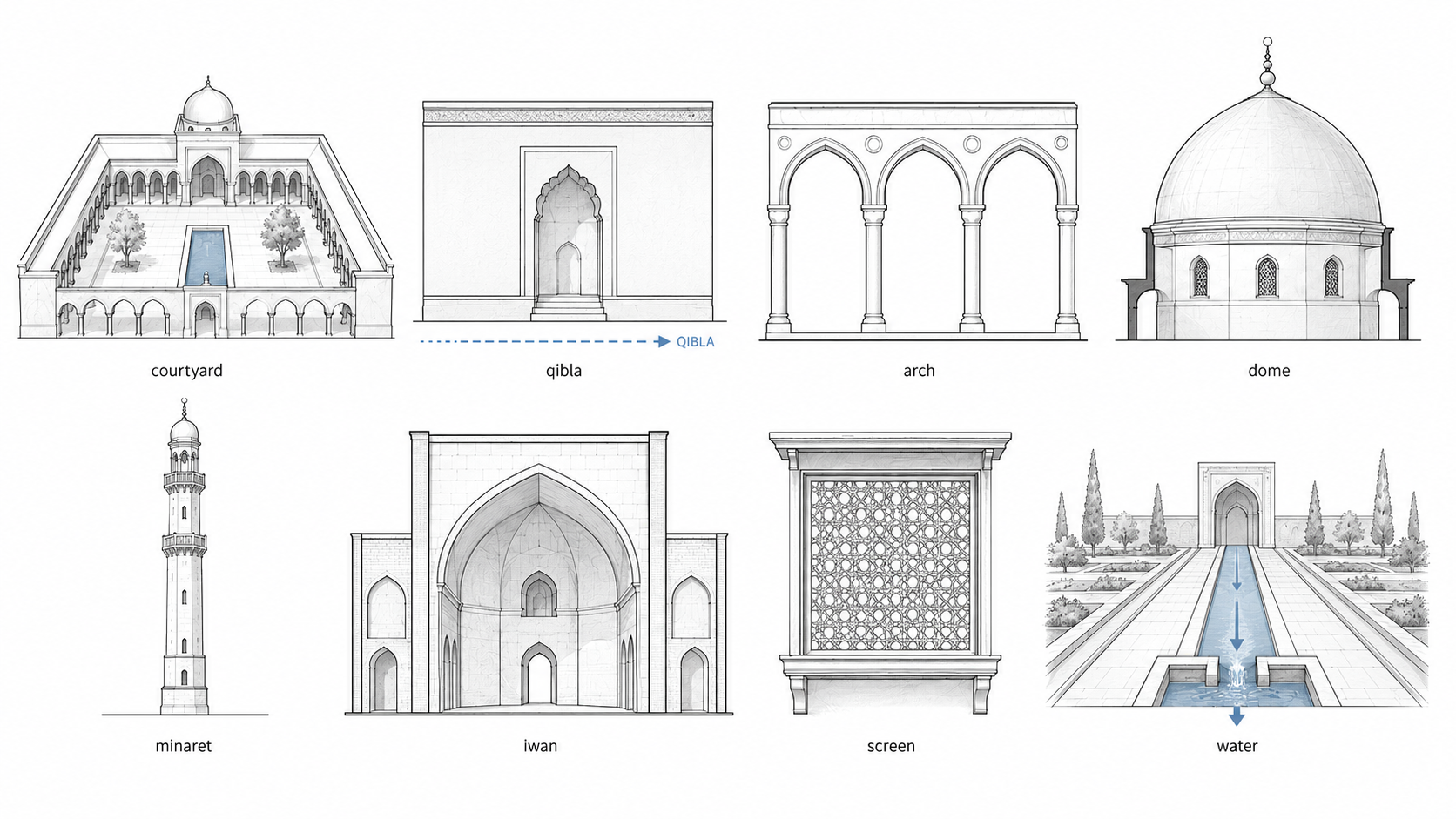
Illustration by ArchitectureCourses.org. The strongest Islamic architectural systems travelled across regions, but each one changed with climate, material, and building type.
| System | What It Does | Where to Go Deeper |
|---|---|---|
| Courtyard | Handles light, air, gathering, movement, and preparation before prayer. | Courtyards in Islamic architecture |
| Arch | Carries load, frames thresholds, creates rhythm, and shapes interior edges. | Arches in Islamic architecture |
| Minaret | Marks the mosque vertically and gives the building a public presence. | Minarets |
| Geometry | Orders surfaces, repeats modules, and gives scale to walls, screens, and domes. | Islamic geometric patterns |
| Mashrabiya | Filters sun, air, privacy, and street views in hot urban settings. | Mashrabiya designs |
| Dome | Creates focus, volume, sound reflection, and symbolic presence. | Dome of the Rock, Ottoman mosques, Mughal tombs |
Core reference:
Robert Hillenbrand’s Islamic Architecture: Form, Function and Meaning is still one of the strongest books for readers who want plans, building types, regional differences, and the design logic behind the architecture.
Form, Function, and Meaning
The best Islamic architecture does not separate form from use.
A courtyard is beautiful, but it also cools, gathers, and organizes. A water channel can symbolize paradise, but it also changes sound, reflection, and comfort. A dome can suggest the heavens, but it also changes light and acoustics. A screen can be ornamental, but it also solves glare and privacy.
Copying a dome or a pattern is easy. Understanding what the form is doing takes more work.
For the deeper theory, read form, function, and meaning in Islamic architecture. This page stays with the main systems and how they fit together.
Islamic Cairo Changed the Scale of the Subject
Cairo is a good place to stop thinking of Islamic architecture as a museum category.
In Islamic Cairo, the buildings are dense, layered, repaired, altered, and pressed into real streets. A mosque is rarely only a mosque. It may sit beside a madrasa, tomb, sabil, hospital, market edge, gateway, or residential fabric. The architecture has to handle prayer, teaching, movement, water, burial, charity, rule, and street life.
Cairo shows Islamic architecture as urban work, not detached monument-making.
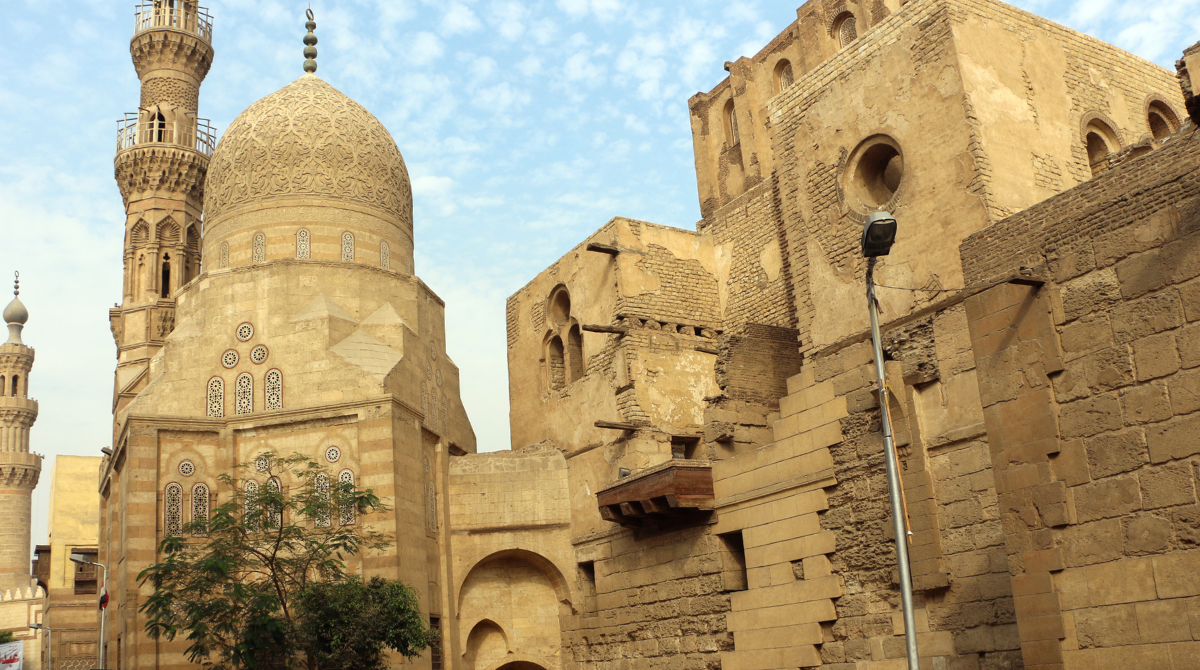
The Amir Khayrbak Funerary Complex in Cairo shows the Mamluk command of façade, dome, minaret, street edge, and carved stone detail in one dense urban composition.
The Khayrbak Complex Is a Better First Lesson Than a Postcard Mosque
The Amir Khayrbak Funerary Complex is not the easiest building to explain to a beginner. That is part of its value.
The façade is cut hard into the street. The dome sits as a marker of burial and power. The minaret holds the block vertically. The stone surface is not decoration pasted on a wall; it gives the façade weight, rhythm, shadow, and hierarchy.
Look at a building like this before jumping straight to famous global monuments. It teaches the smaller, harder skills: how an entrance is framed, how a dome is positioned, how a minaret anchors a street, and how a building announces itself when there is no open plaza around it.
For more Cairo context, read Islamic Cairo. Al-Azhar Mosque and Ibn Tulun Mosque give two very different Cairo readings: one layered and institutional, one spacious and early.
How Islamic Architecture Developed
Islamic architecture did not develop in one clean line.
It spread through Arabia, Syria, Iraq, Egypt, Iran, North Africa, Spain, Turkey, Central Asia, South Asia, West Africa, China, Southeast Asia, and modern global cities. Each region brought its own materials, climate, builders, patrons, and older building traditions.
The short version below gives the basic sequence. The full history has more overlap, repair, borrowing, and regional drift.
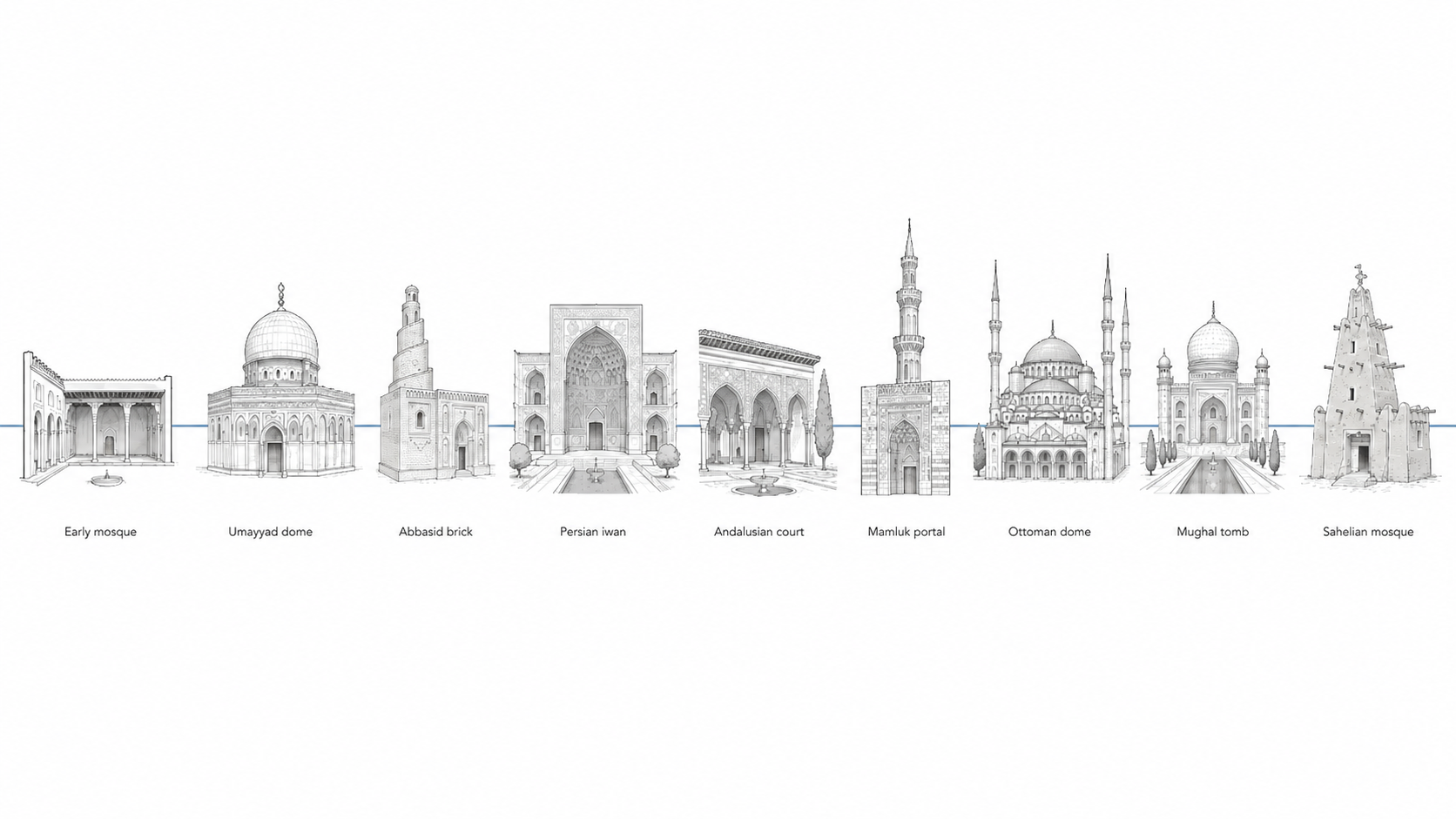
Illustration by ArchitectureCourses.org. Islamic architecture developed through overlapping regions and building traditions, not one clean straight line. Courts, domes, iwans, portals, minarets, gardens, and local materials all changed the form over time.
| Period or Region | What Changed | Useful Example |
|---|---|---|
| Early Islamic | Simple mosque spaces, qibla orientation, courtyards, shade, communal gathering. | Prophet’s Mosque as the early reference model |
| Umayyad | Monumental sacred buildings, mosaics, imperial mosque planning, strong public identity. | Dome of the Rock; Great Mosque of Damascus |
| Abbasid | Brick, stucco, large new cities, experimental minarets, and powerful urban scale. | Great Mosque of Samarra |
| Persian and Seljuk | Four-iwan plans, domes, muqarnas, tilework, and courtyard refinement. | Great Mosque of Isfahan |
| Moorish / al-Andalus | Horseshoe arches, double arches, carved plaster, water, courtyards, and controlled light. | Great Mosque of Córdoba; Alhambra |
| Fatimid and Mamluk Cairo | Stone portals, minarets, madrasas, tombs, mosque complexes, and dense urban edges. | Al-Azhar Mosque; Sultan Hasan Mosque |
| Ottoman | Central domes, semi-domes, slender minarets, and unified prayer halls. | Süleymaniye Mosque; Blue Mosque |
| Mughal | Garden planning, axial symmetry, marble, red sandstone, gateways, tombs, and large mosque courts. | Taj Mahal; Badshahi Mosque |
| Regional and modern | Timber roofs, mudbrick, local craft, climate-specific planning, and contemporary reinterpretation. | Great Mosque of Djenné, Chinese mosques, Southeast Asian mosques, Cambridge Central Mosque |
For the full sequence, use Islamic architecture history. The overview here is only enough to orient the reader before the design systems become more specific.

The Dome of the Rock shows early Islamic architecture using centralized form, inscription, mosaic surface, and sacred presence at a monumental scale.
Early Mosques Were Practical Before They Were Monumental
The early mosque had a plain job: orient the community, provide shade, and make space for prayer and gathering.
That sounds modest, but it set up many later systems. The courtyard helped with crowd movement and climate. The qibla wall gave direction. The prayer hall organized rows. Arcades provided shade. Simple materials made construction possible with local resources.
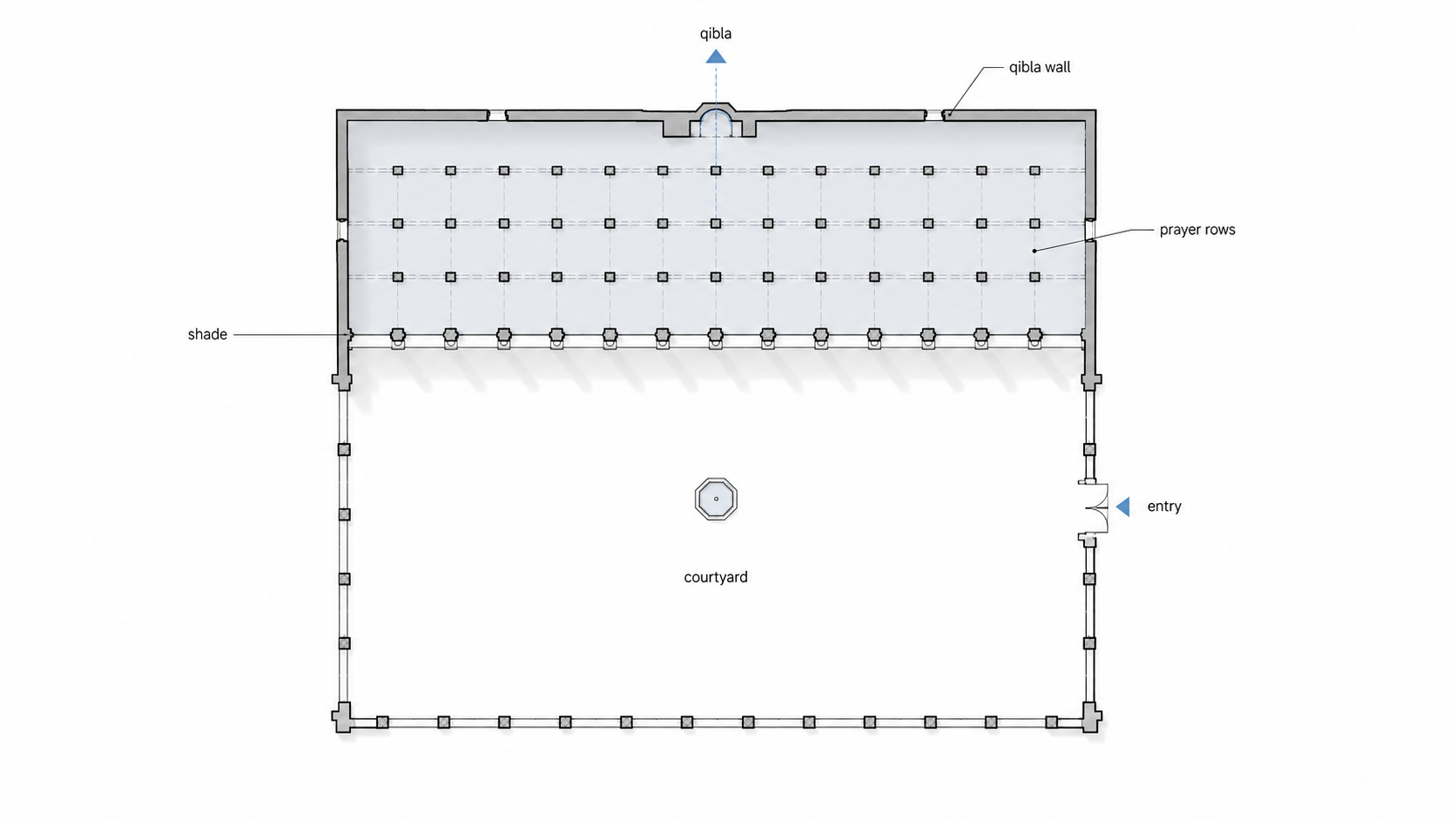
Illustration by ArchitectureCourses.org. Early mosque planning started with direction, shade, gathering, and a clear prayer edge before later ornament and monumentality became dominant.
Later mosques became larger, richer, and more complex. The basic questions did not disappear. Where do people enter? Where do they gather? How does the building make shade? How does it mark the qibla? How does it handle sound, heat, light, and the street?
Arches, Domes, and Minarets
These are the forms readers recognize first. They should still be explained through use.
Arches
An arch is not only a shape. It is structure, threshold, rhythm, and image at the same time. Horseshoe arches, pointed arches, ogee arches, multifoil arches, and keel arches belong to different regions and periods. A good arch page should explain where each form appears and what it does in the building.
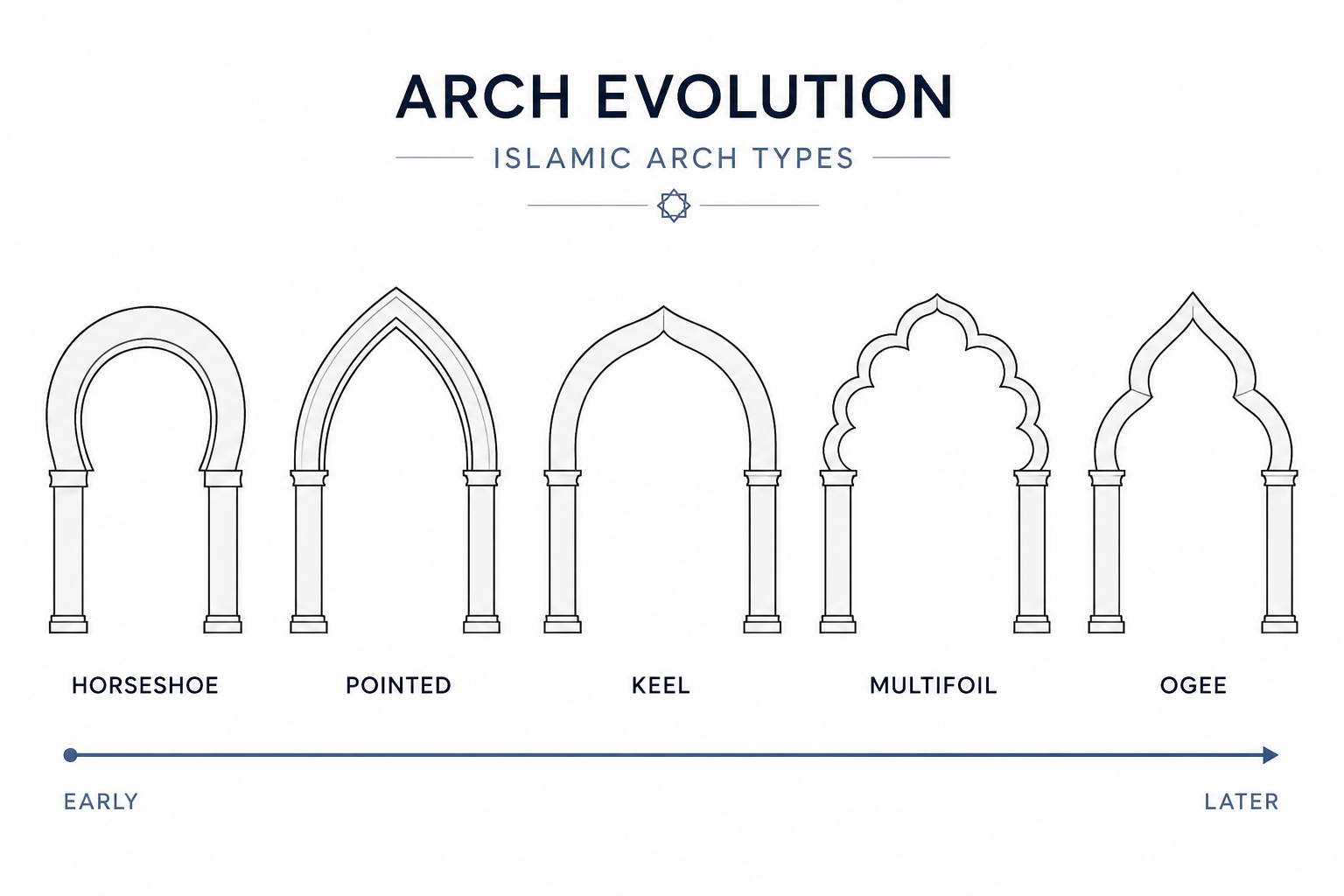
Illustration by ArchitectureCourses.org. Islamic arch forms developed through regional use, structural needs, and decorative refinement, from horseshoe and pointed arches to keel, multifoil, and ogee profiles.
For the deeper visual guide, use arches in Islamic architecture.
Domes
Domes create volume and focus. They can mark a sacred center, cover a tomb, open a large prayer hall, or give a building skyline presence. A dome in Jerusalem, Istanbul, Cairo, or Agra does not carry the same architectural job.
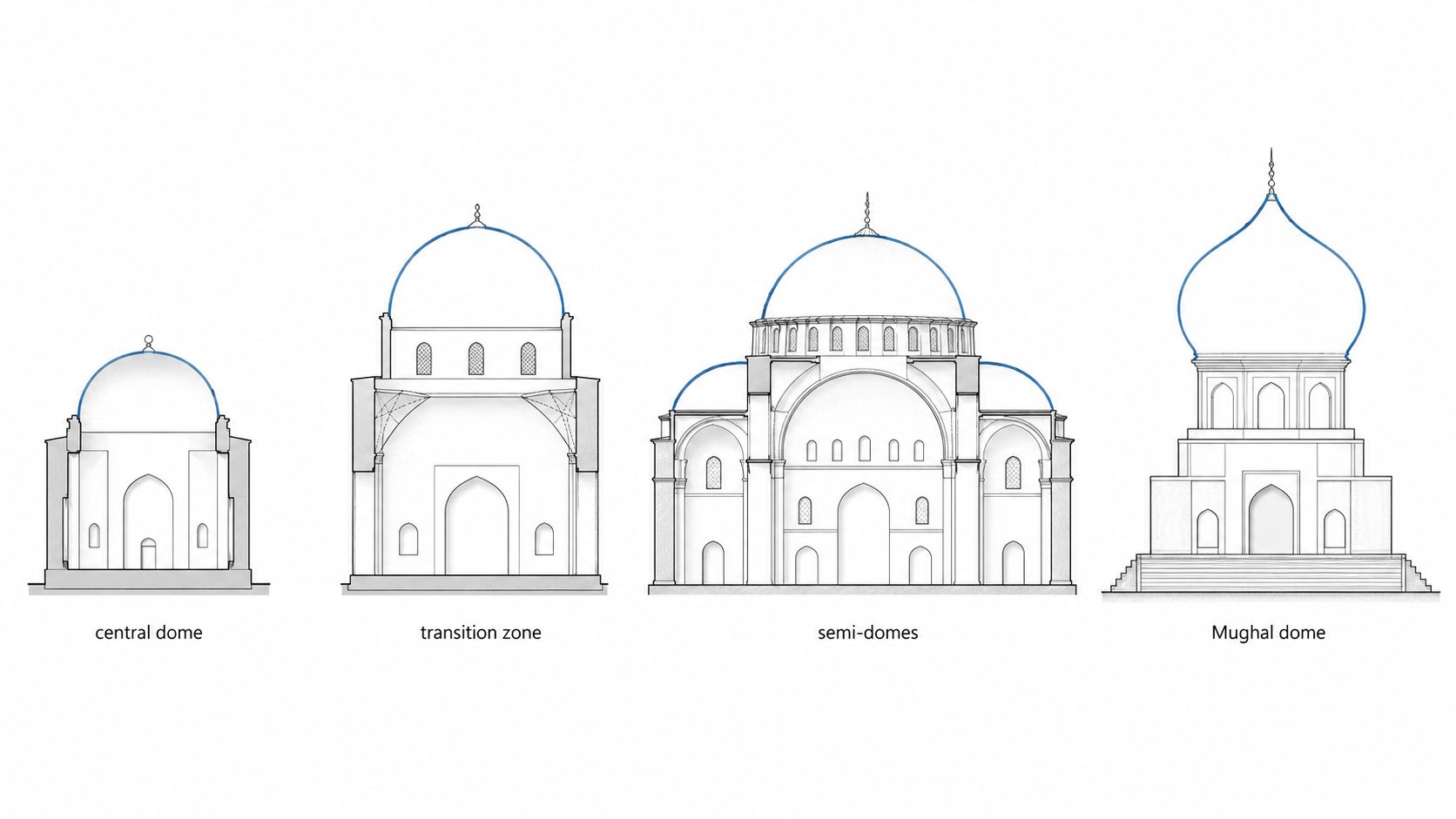
Illustration by ArchitectureCourses.org. Domes in Islamic architecture changed by region, structure, and building type, from early centralized monuments to Ottoman mosque volumes and Mughal tombs.
Minarets
Minarets are towers, but that is too thin as a definition. They mark the mosque in the city. They carry religious association. They show patronage and period. Their shape changes sharply by region: square, spiral, pencil-thin, cylindrical, faceted, or heavily carved.
The full support page is minarets.
Geometry and Calligraphy Give the Surface Discipline
Geometry is often treated as decoration because it is beautiful.
That misses the harder part. Geometry gives a surface rules. It lets a wall, dome, screen, or tile field repeat without becoming dull. It can scale a huge surface down to the hand. It can lead the eye across an entrance or around a dome. It can turn a façade into a measured field instead of a blank wall.
Calligraphy works differently. It adds text, meaning, hierarchy, and movement. Inscriptions can frame a portal, circle a dome, run across a wall, or mark the qibla zone. In strong buildings, the writing is part of the architecture, not a label placed after the fact.

The dome interior of Sheikh Lotfollah Mosque shows how geometry, color, calligraphy, and curvature can work as one controlled surface.
For detailed pattern study, continue with Islamic geometric patterns. This section is only concerned with how geometry helps the building read.
Courtyards, Water, and Shade
A courtyard is one of the most useful systems in Islamic architecture.
It can bring light into a dense building, create a cooler center, give worshippers a place to gather, organize entrances, and separate public street life from interior calm. In mosque design, the sahn often becomes the pause before prayer. In palace and garden architecture, the courtyard can become a place of water, sound, reflection, privacy, and framed views.
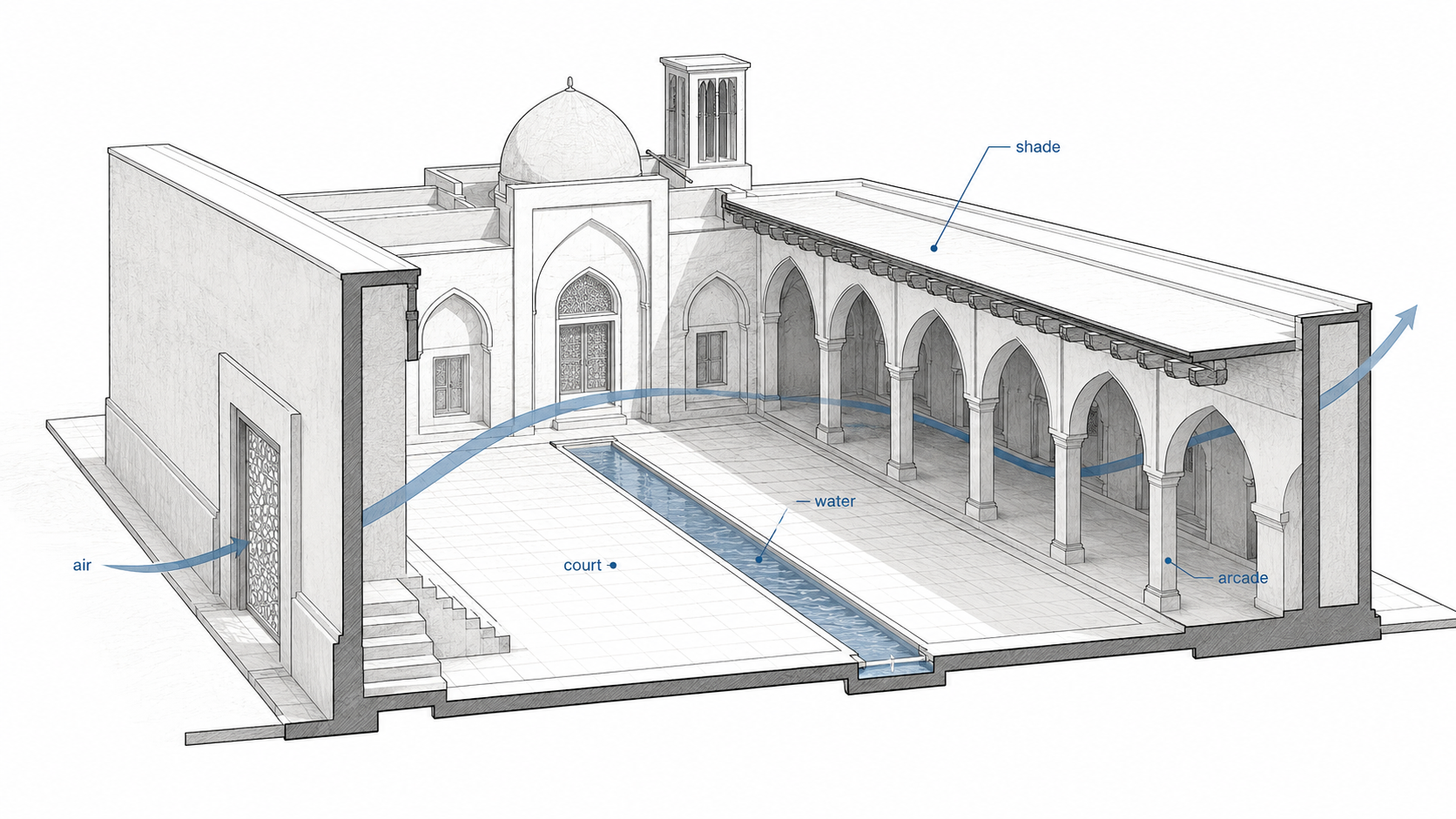
Illustration by ArchitectureCourses.org. Courtyards in Islamic architecture often handled shade, air, water, reflection, privacy, and movement at the same time.
Water often carries symbolic meaning, but it also changes the space physically. It reflects light. It cools air through evaporation in the right climate. It makes sound. It slows movement. It marks an axis.
This is one reason Islamic architecture still interests designers working on hot-climate buildings. The lessons are practical: shade first, air movement second, water carefully, walls and screens as climate tools.
Mashrabiya and the Architecture of Privacy
The mashrabiya is one of the clearest examples of form and function working together.
A wooden screen can filter sun, allow air, protect privacy, soften the edge between street and room, and create a patterned façade. It gives the occupant a view out without making the interior fully exposed.
Modern buildings often borrow the look without understanding the job. A screen that only decorates a glass box is not doing the same work. The useful lesson is environmental control: glare, heat, privacy, airflow, and street relationship.

Mashrabiya screens use pattern as a working architectural layer, filtering light, air, privacy, and views instead of acting as surface decoration only.
For the focused article, continue with mashrabiya designs.
Regional Styles Do Not All Say the Same Thing
The word “Islamic” can hide major differences.
A Mamluk portal in Cairo, an Ottoman mosque in Istanbul, a Persian iwan in Isfahan, a Moorish courtyard in Granada, and a Mughal tomb in Agra are not interchangeable. They belong to different materials, climates, dynasties, and urban situations.
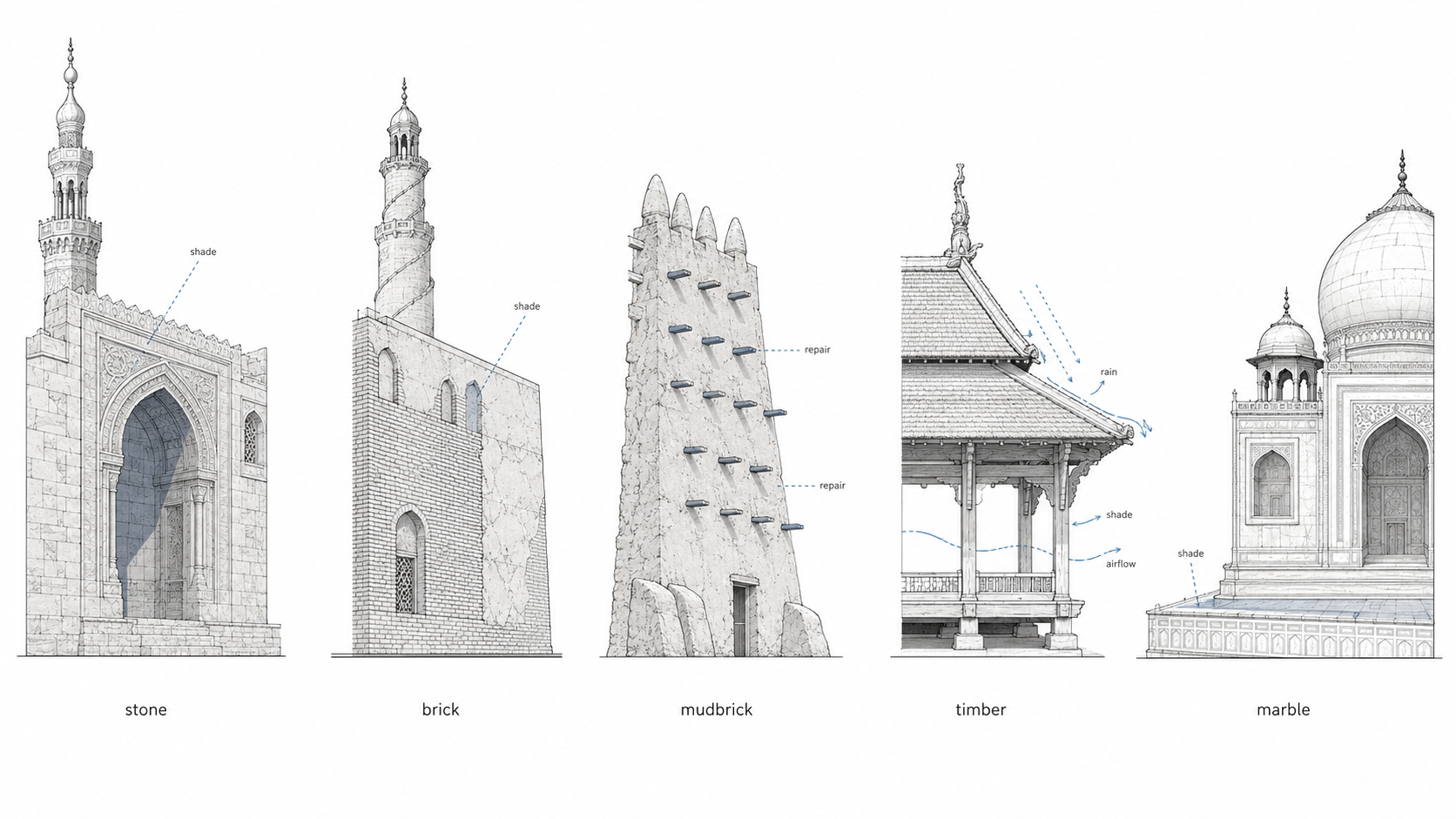
Illustration by ArchitectureCourses.org. Islamic architecture changed because local materials and climate changed. Stone, brick, mudbrick, timber, marble, heat, shade, rain, and repair all shaped the buildings.
| Style or Region | What to Notice First | Common Mistake |
|---|---|---|
| Umayyad | Early monumentality, mosaics, courtyards, and public identity. | Treating it as a fully formed later mosque style. |
| Abbasid | Scale, brick, stucco, new cities, and experimental minarets. | Ignoring material and urban planning. |
| Persian / Safavid | Iwans, tilework, domes, geometry, and courtyard order. | Seeing only color and tile. |
| Moorish / Andalusian | Horseshoe arches, water, plasterwork, light, and interior rhythm. | Reducing it to exotic ornament. |
| Fatimid / Mamluk Cairo | Urban edges, stone carving, portals, minarets, tombs, and madrasas. | Looking only for freestanding monuments. |
| Ottoman | Central domes, semi-domes, slender minarets, and unified interiors. | Calling every dome-based mosque Ottoman. |
| Mughal | Gardens, axial planning, red sandstone, marble, inlay, and monumental gates. | Studying the Taj Mahal only as a love story. |
For a more focused regional breakdown, read Islamic architecture styles.

The Mosque of Córdoba shows how repeated arches, deep interior rhythm, and layered expansion can shape one of the most recognizable spaces in Islamic architecture.
Islamic Architecture Outside the Usual Map
A narrow reading jumps from Jerusalem to Cairo, Granada, Istanbul, Isfahan, and Agra. That leaves too much out.
West African mosques, Chinese mosques, Southeast Asian timber mosques, Balkan Ottoman buildings, and modern diasporic mosques all belong to the wider story. The shared tradition is real, but the local answer matters. A mudbrick mosque in Mali does not need to look like an Ottoman mosque in Istanbul to belong.
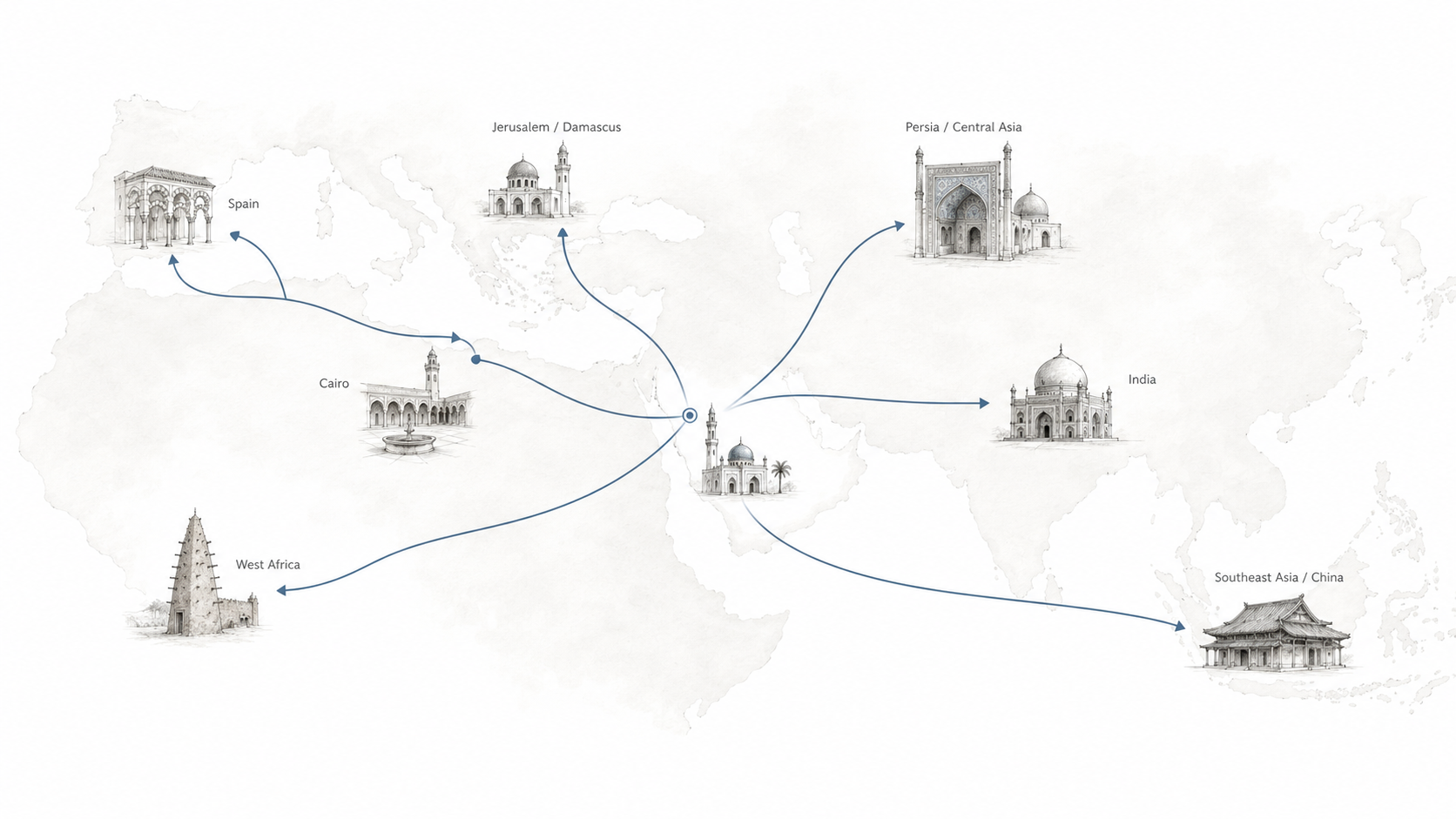
Illustration by ArchitectureCourses.org. Islamic architecture moved through cities, trade routes, empires, and local building cultures, which is why the tradition looks different from region to region.
Modern Islamic Architecture Has a Harder Job
A modern Islamic building can fail in two ways.
It can copy historic forms without understanding them. Or it can reject the tradition so completely that the building loses the spatial intelligence that made the older work valuable.
The better modern projects study the systems: shade, courtyard, screen, prayer direction, water, community space, daylight, and material. They do not need to look medieval. They need to understand what the older forms were solving.

Sheikh Zayed Grand Mosque in Abu Dhabi shows a contemporary monumental reading of domes, minarets, marble surfaces, calligraphy, and reflective water.

The gallery of Sheikh Zayed Grand Mosque uses repeated arches, columns, material contrast, and surface detail to create a controlled processional edge.
Where the Style Reading Breaks Down
The weak reading of Islamic architecture starts with the surface and stays there.
It says dome, arch, tile, pattern, minaret, courtyard, and stops. That leaves out the reason those parts were used. It also makes the tradition look fixed, when the buildings were constantly adapting to region, patronage, climate, material, city form, and religious use.
A courtyard in Damascus, a water court in Granada, a four-iwan mosque in Isfahan, a domed Ottoman prayer hall in Istanbul, and a mudbrick mosque in Mali belong to the same broad tradition. They do not belong to the same architectural problem.
The better reading starts with use. Then climate. Then structure. Then material. Then surface.
What Students and Designers Should Study First
Do not begin with the prettiest detail.
Start with the plan. Mark the courtyard, entrances, qibla wall, prayer hall, shaded edges, domes, towers, water, and public approach. Then look at how the building handles heat, light, privacy, sound, crowd movement, and street presence.
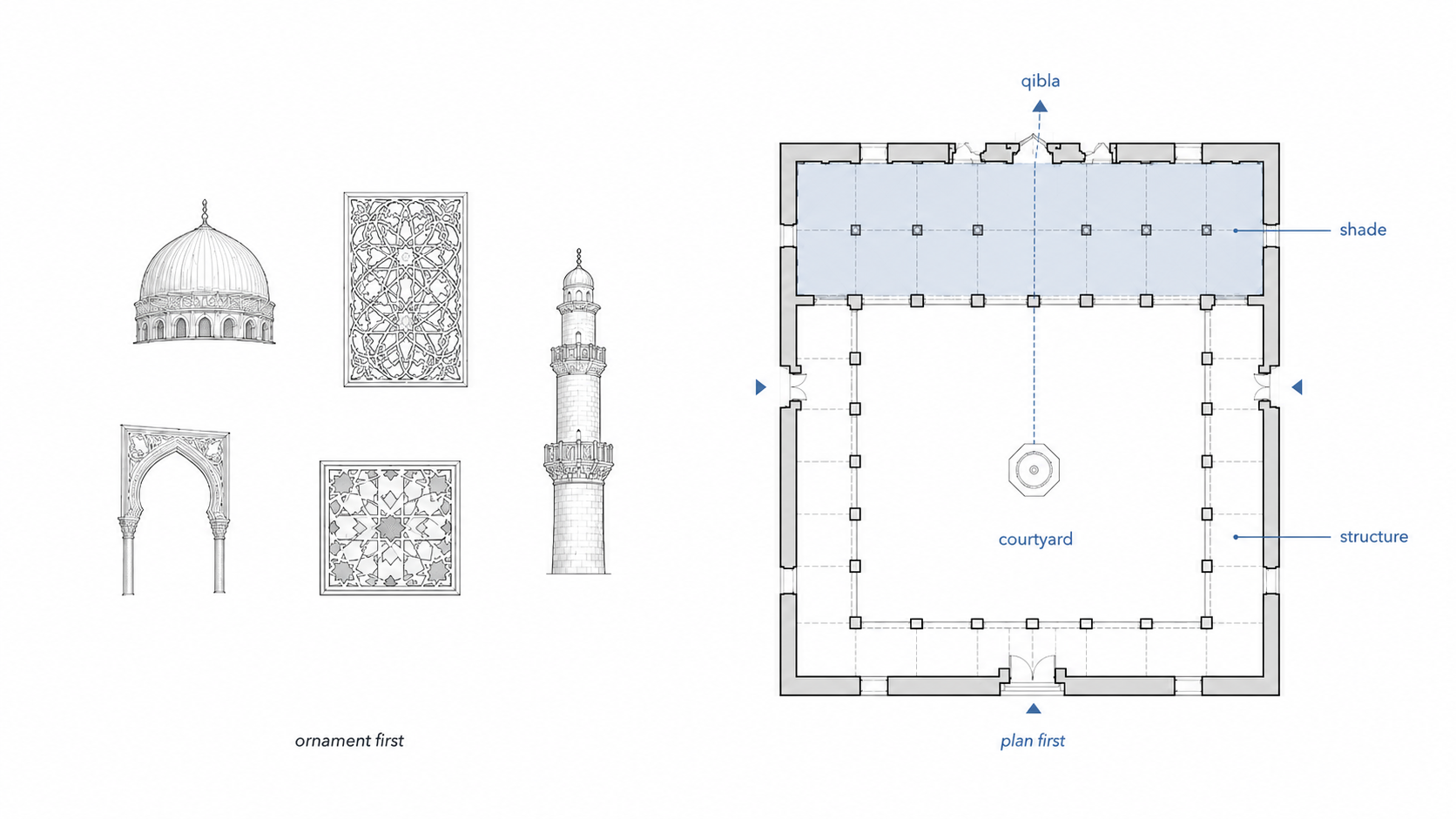
Illustration by ArchitectureCourses.org. Islamic architecture is easier to study when the plan, climate, structure, and building type come before ornament.
After that, study the ornament. The geometry, calligraphy, tile, carving, and muqarnas will make more sense once the building’s order is clear.
- Draw the plan before describing the style.
- Mark the qibla direction and main movement paths.
- Identify the climate strategy: shade, water, air, wall mass, screen, or courtyard.
- Look at the structure: column, arch, dome, vault, iwan, timber, stone, brick, or mudbrick.
- Study the surface last: pattern, calligraphy, tile, plaster, marble, inlay, or carving.
Common Mistakes
| Mistake | Why It Fails | Better Move |
|---|---|---|
| Starting with decoration | The building becomes a pattern collection. | Start with plan, use, climate, and structure. |
| Calling it one style | It flattens major regional differences. | Name the region, period, material, and building type. |
| Using “Islamic” and “Arab” as the same word | It erases Persian, Ottoman, Mughal, African, Andalusian, Central Asian, Chinese, and Southeast Asian work. | Use Islamic architecture for the broad tradition and regional labels when needed. |
| Copying motifs into modern design | The result becomes surface styling. | Study what the older system solved before borrowing its form. |
| Overclaiming influence | Architecture rarely moves in one clean line. | Discuss exchange through Spain, Sicily, trade, travel, empire, and craft knowledge. |
Major Buildings to Know
A short building list works better than a giant directory. These are the anchor examples worth knowing first.
| Building | Location | Best Architectural Lesson |
|---|---|---|
| Dome of the Rock | Jerusalem | Early Islamic monumentality, centralized form, inscription, and dome presence. |
| Al-Azhar Mosque | Cairo | A mosque-university that grew through layers instead of staying one clean period. |
| Blue Mosque | Istanbul | Ottoman skyline, domes, minarets, and imperial mosque composition. |
| Süleymaniye Mosque | Istanbul | Sinan’s control of dome, light, massing, and site. |
| Taj Mahal | Agra | Mughal garden order, symmetry, platform, marble, and tomb design. |
| Qutub Minar | Delhi | Indo-Islamic tower form, inscription, material, and early conquest architecture. |
FAQ
What is Islamic architecture?
Islamic architecture is a broad building tradition shaped by Muslim religious practice, regional cultures, climate, materials, geometry, urban life, and patronage. It includes mosques, palaces, tombs, madrasas, houses, gardens, markets, forts, and civic buildings.
What are the main features of Islamic architecture?
Common features include courtyards, qibla walls, mihrabs, arches, domes, minarets, geometric patterns, calligraphy, gardens, water features, mashrabiya screens, iwans, and muqarnas. Not every building uses all of them.
When did Islamic architecture begin?
It began in the 7th century with early mosque spaces built for prayer, gathering, shade, and community life. It became more complex as Muslim rule expanded into older Byzantine, Persian, Roman, African, Indian, and Asian building cultures.
Is Islamic architecture one style?
No. Ottoman, Persian, Mughal, Moorish, Mamluk, Fatimid, West African, Chinese, and Southeast Asian Islamic buildings can look very different. The shared tradition is real, but the local answers matter.
Why are geometric patterns so common?
Geometry gives surfaces order, rhythm, scale, and visual continuity. In sacred settings, it also offers a strong abstract language without relying on figural imagery.
How did Islamic architecture influence Europe?
Ideas moved through Spain, Sicily, the eastern Mediterranean, trade, travel, translation, conquest, and craft exchange. Pointed arches, tilework, gardens, courtyards, and surface pattern all entered wider architectural conversations, though influence rarely moves in one simple direction.
What should beginners study first?
Start with the plan and building type. Learn how a mosque, palace, tomb, madrasa, house, garden, or urban complex works. Then study the details.
Read This Next
For the historical sequence, read Islamic architecture history. For the main feature list, use characteristics of Islamic architecture. For regional differences, continue with Islamic architecture styles.
For design systems, start with Islamic arches, minarets, courtyards, Islamic geometric patterns, and mashrabiya designs.
For building case studies, use Dome of the Rock, Al-Azhar Mosque, Islamic Cairo, Blue Mosque, Süleymaniye Mosque, and Taj Mahal.
What Stays Useful
Islamic architecture is strongest when you read it as a working tradition.
The buildings handle prayer, heat, shade, water, privacy, movement, power, teaching, burial, trade, and public life. Some are quiet. Some are imperial. Some are made from marble, some from brick, some from timber, some from mud.
The surface is often beautiful. The plan usually explains more.
References
- Islamic Architectural Heritage Database
- The Aga Khan Program for Islamic Architecture at MIT
- The Aga Khan Program for Islamic Architecture at Harvard University
- Center for the Study of the Built Environment: Resources on Islamic Architecture
- Archnet: Resources for the Study of Islamic Architecture
- The Barakat Trust