
Dome of the Rock Architecture Analysis
Design and Structure
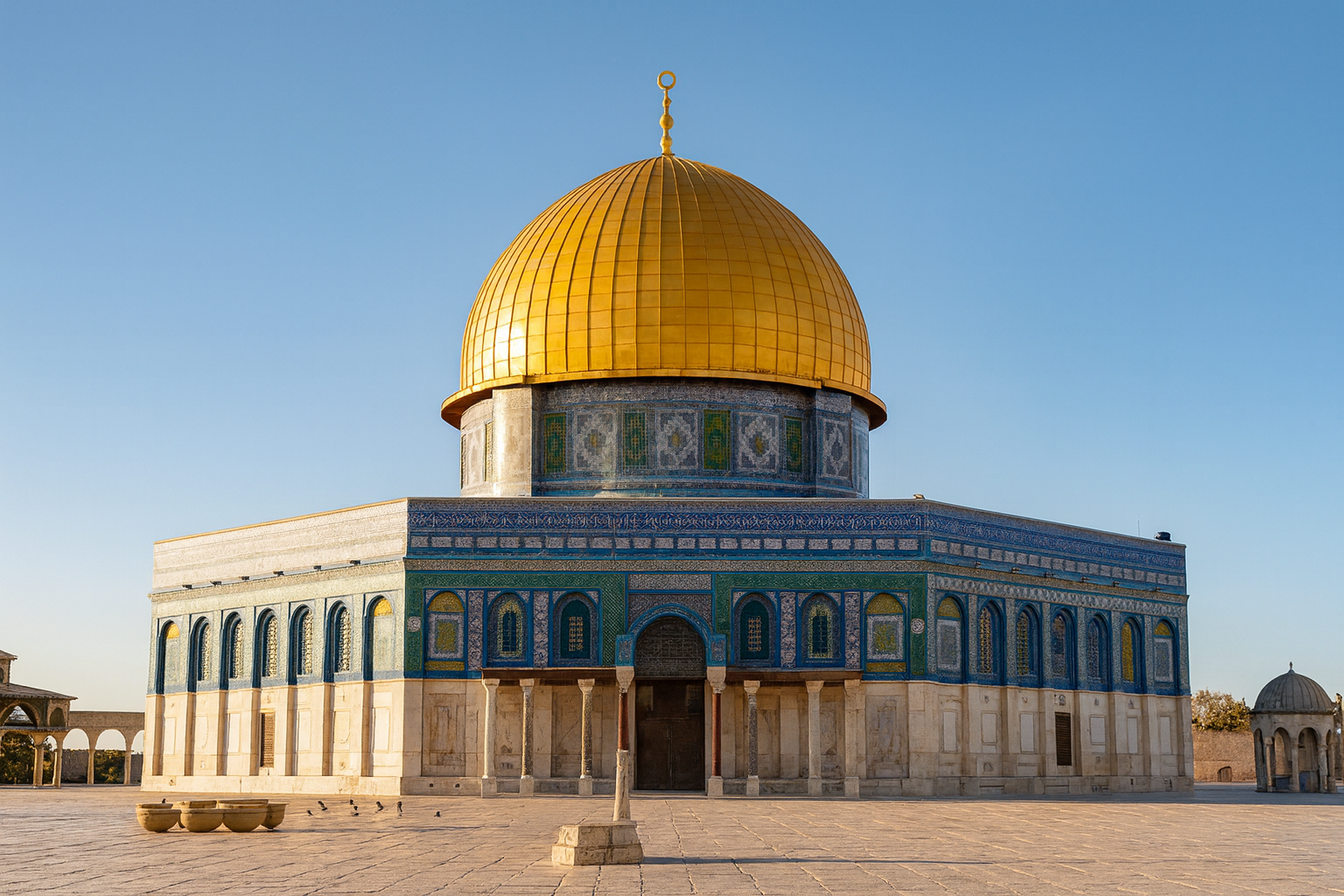
The Dome of the Rock in Jerusalem is one of those buildings that makes you stop, even before you know what you’re looking at. Built in 691 CE under the Umayyad caliph Abd al-Malik.
It was a declaration. Islam had arrived, and it could build in its own language, not as a copy of Rome or Byzantium.
The structure is blunt in its logic. A raised platform. An octagon. A circle. A dome. That’s it. The simplicity is its strength. No gimmick in the plan, no frantic search for originality. The geometry alone carries the meaning. For early Islamic architects, this was enough: proportion, clarity, and an unmistakable presence on the skyline.
Inside, the layering of arcades draws you inward and upward at the same time. Columns set the rhythm. Marble panels climb the walls. Light enters through the drum windows and changes the surfaces hour by hour. There is no attempt to hide the structure or overwhelm with excess decoration. The building is open about what it is doing.
Why the Dome Still Stops You
Stand in front of it today and the gold dome is obvious, but the real hit comes from the order of the whole composition. Eight sides wrapping a circle. A dome lifted high above. It is not visual noise. It is one clear thought executed in stone, timber, and metal.
The shock is how little it takes. No sprawling ground plan, no hybrid forms. Every part supports the center. Even the ornament stays in its lane—geometry, pattern, and calligraphy instead of human figures. Walk around it and you see restraint, not poverty. The architects understood the power of leaving things out.
Compare that to many public buildings now. Architects twist glass until it leaks, pile steel in random angles, or throw scale at the problem. The Dome shows the opposite: one proportion done right can hold a city’s skyline for over a thousand years.
Who Built It
The patron was Abd al-Malik, an Umayyad caliph who wanted to make a point. The Temple Mount was already sacred to Jews and Christians. By raising the Dome of the Rock there, he made Islam visible in both theology and politics.
The builders were Muslim craftsmen of the early Islamic period, pulling knowledge from Syrian, Byzantine, and Persian sources but recombining it into something new. Over time the building needed repairs. Earthquakes cracked it, mosaics fell, tiles were replaced, and the dome itself was re-covered in gold. Yet the form never changed. The octagon, the drum, the dome—set once, kept forever.
You might like: Islamic Architecture: Connecting History, Styles, and Global Impact
The Plan and Geometry
At its core, the Dome of the Rock is a circle inside an octagon. The rock sits at the middle, surrounded by a circular arcade. The octagon wraps the whole with outer walls. It’s a diagram as much as a building.
This choice wasn’t casual. The octagon mediates between a square (earth, stability) and a circle (heaven, perfection). The geometry symbolized balance, order, and divine alignment. Islamic architects made the point through math and proportion instead of narrative art.
Step inside and you feel the effect immediately. Rings of space collapse toward the center, but the upward pull of the dome lifts it again. You are grounded and elevated in the same move. That’s not accident—it’s calculation.
You might like: How Form, Function, and Meaning Shape Islamic Architecture
Dome of the Rock in Islamic Architecture: The Dome as Structure
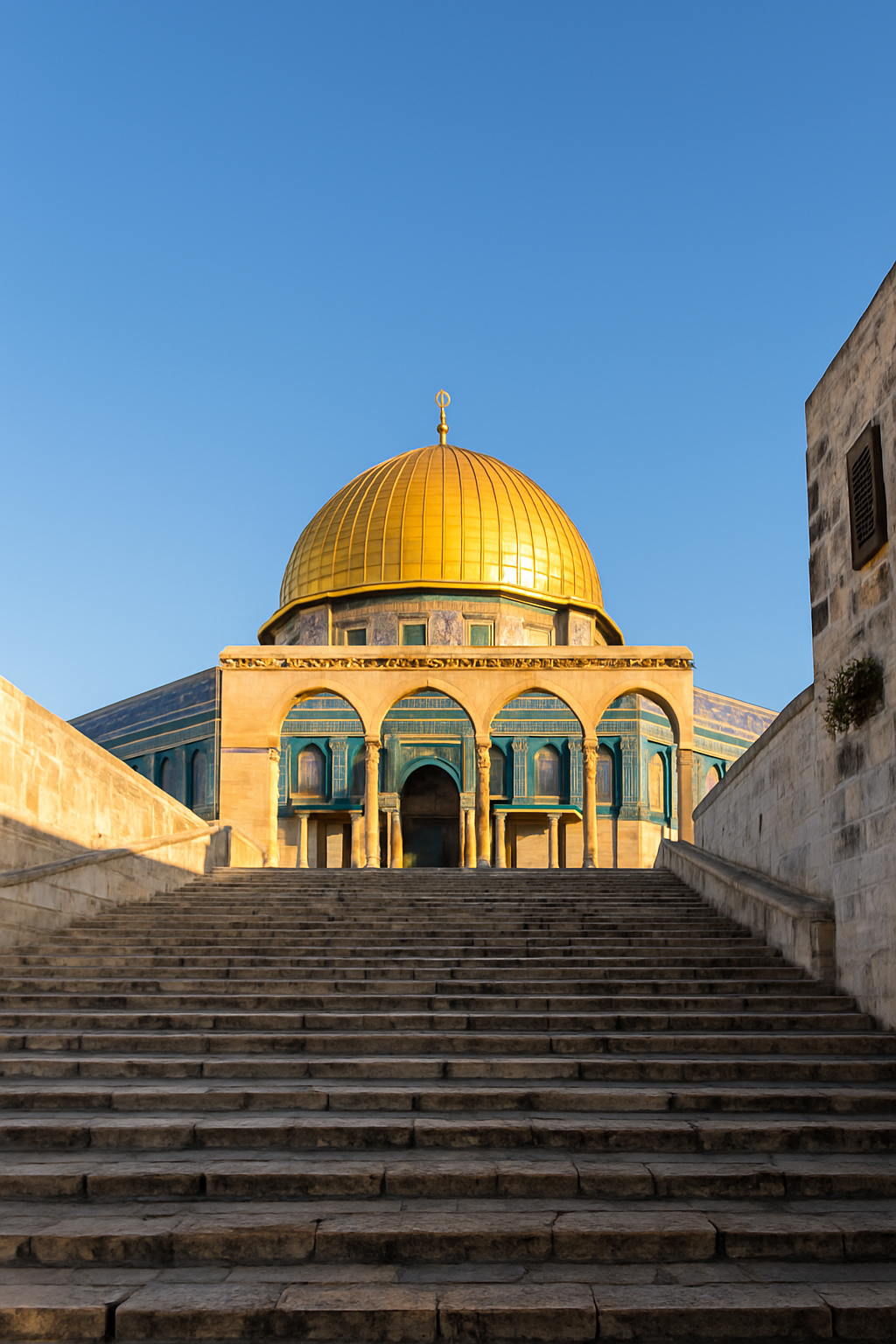
Technically, the dome is a wooden double shell. It sits on a tall drum that distributes its weight to the walls below. In its time, that was a serious achievement. It solved the challenge of covering a sacred center without columns cluttering the space.
Visually, the dome dominates Jerusalem. Even before it was gilded, it was designed to shine. Covering it in gold later only amplified what was already built into the design: a crown for the city and for the faith.
See also: Dome of Soltaniyeh, Iran
Ornament and Surface
Step inside and the mosaics do the talking. No saints, no portraits, no biblical scenes. Instead you get vines, jewels, and infinite geometric patterns. The absence of figures is not a lack—it’s the identity of Islamic design taking shape. The message is in rhythm, repetition, and abstraction.
That move became foundational. From North Africa to India, Islamic builders worked with calligraphy, pattern, and geometry as their surface language. The Dome was one of the first to prove that ornament could carry spiritual force without human images.
You might like: Islamic Geometric Patterns: Clean, Sharp, and Still Useful
Materials and Craft
The Dome wasn’t thrown together. The walls are layered marble, cut and fitted with precision. The mosaics mix glass, gold, and stone. Ceilings and doors carried carved and painted woodwork. Nothing is casual. Every material was chosen for both durability and meaning.
Later rulers left their marks. The Ottomans clad parts of the exterior in blue tile. In the 20th century, the dome was re-gilded with modern techniques. Each addition changed the surface but left the geometry untouched. That adaptability is part of why it survived. The building absorbed history without losing itself.
For restoration today, the lesson is clear: you don’t freeze a monument in time. You maintain it, update materials, but protect the core logic. The Dome of the Rock shows how a building can stay alive through centuries of repair.
You might like: The Complete List of Building Materials: Key Types and Their Applications
The Interior of the Dome of the Rock
Central Plan
At the core sits the exposed bedrock, surrounded by a circular arcade of marble columns. Above that, the drum and dome rise in layers, pulling the eye upward. Everything directs to the center and then lifts toward the sky.
Materials and Surfaces
Walls are faced with marble panels cut into geometric patterns. Above them, mosaics in glass, stone, and gold shimmer as the daylight shifts. Instead of saints or portraits, you see vines, jewels, and rhythmic patterns. Calligraphy winds across surfaces, turning scripture into ornament.
Light and Atmosphere
Windows in the drum send daylight across the mosaics. The glow changes from morning brightness to evening shadow. Sometimes the dome feels weightless, other times heavy, pressing down toward the rock below.
Scale and Rhythm
The building is not vast like Hagia Sophia. The rhythm of the columns and the layering of arcades create a space that feels precise and intentional. Visitors are directed, not overwhelmed.
Craft and Detail
The interior is a record of skill. Marble cladding, carved wood ceilings, gilded finishes, and careful joinery all show the precision of Umayyad builders. Later repairs by the Ottomans and modern restorers added new tilework, but the core geometry stayed intact.
Architectural Lesson
The Dome of the Rock proves grandeur does not need massive scale. Rhythm, proportion, and surface detail can achieve the same power.
Influence on Later Architecture
The Dome of the Rock set the tone for Islamic domes everywhere. Ottomans in Istanbul stretched it taller and wider. Sinan turned it into the heart of mosques like the Süleymaniye and Selimiye. In Persia, domes became turquoise landmarks of Isfahan. In India, the Taj Mahal put the dome at the center of an entire complex.
Even outside Islam, the lessons spread. Byzantine and Renaissance architects studied the proportions. Hagia Sophia, St. Mark’s in Venice, and St. Peter’s in Rome all show traces of the dialogue. The Dome wasn’t copied. It was referenced, debated, reinterpreted.
You might like: Classical Architecture: History, Key Features, Famous Buildings, and Influence
Lessons for Architects Today
The building proves geometry is never neutral. An octagon around a circle is not just a math exercise. It centers power, faith, and order in a physical form. Louis Kahn saw this when he used circles and octagons in Dhaka’s National Assembly. Norman Foster understood it in Berlin, where a dome signals political transparency as much as it lets in light.
The other lesson is restraint. You don’t need to decorate every surface or twist every angle to hold attention. Strong proportion, handled with care, is harder to dismiss. Ornament can then echo the structure instead of drowning it.
For practice, the takeaway is blunt: every line, every material, every proportion either strengthens the idea or weakens it. The Dome of the Rock shows what happens when everything points the same way.
Design and Politics
The Dome has never been just a building. The gold dome is a marker of presence, heritage, and political control. That makes it as fragile as it is iconic.
Extremist groups have threatened it. Governments have tried to claim it. Earthquakes shook it harder than wars. Yet it still stands. That survival is part of its meaning now. To protect it is to protect a piece of cultural memory that belongs to world history.
FAQs
History and Origins
When was the Dome of the Rock built?
It was completed in 691 CE under the Umayyad caliph Abd al-Malik, making it the oldest surviving Islamic monument.
Who commissioned the Dome of the Rock?
Caliph Abd al-Malik ordered its construction to assert Islamic presence in Jerusalem and to express Islam’s independent architectural voice.
Who designed the Dome of the Rock?
Early Muslim architects and craftsmen led the work, drawing techniques from Byzantine builders but creating a new form with Islamic meaning.
Why was the Dome of the Rock built?
It was a shrine to mark the sacred rock, but also a political statement that Islam had arrived with its own identity.
How does the Dome of the Rock fit into early Islamic architecture?
It is the first Islamic monument with a bold, symbolic plan. Earlier mosques were simpler. The Dome set the standard for geometry, ornament, and presence.
Form and Geometry
Why is the Dome of the Rock an octagon around a circle?
The circle represents heaven, the octagon connects it to earth. The geometry symbolized harmony and divine order.
What is the layout of the Dome of the Rock?
At the center is the rock, enclosed by a circular arcade. Around it sits the octagon, capped by the dome.
How big is the Dome of the Rock?
The dome is about 20 meters in diameter and rises nearly 35 meters above the platform, making it dominant on the skyline.
How does the geometry compare to Byzantine domes?
Byzantine domes sat on squares. The Dome of the Rock uses an octagon, making it more abstract and symbolic, less church-like.
What can modern architects learn from its plan?
That clarity beats clutter. One clean move—circle inside octagon—creates more power than layers of complexity.
Materials and Craft
What materials were used to build the Dome of the Rock?
Stone walls, marble panels, timber for the dome, and glass-and-gold mosaics for decoration.
Why is the dome covered in gold?
The gold makes it shine across Jerusalem, visible from afar. It is both decorative and symbolic of presence and authority.
What mosaics are inside the Dome of the Rock?
Glass, stone, and gold mosaics showing vines, jewels, and patterns, instead of human or animal figures.
How has the Dome of the Rock been restored over time?
The Ottomans added tiles, modern restorers re-gilded the dome, and earthquakes forced repairs. The geometry stayed unchanged.
Who maintains the Dome of the Rock today?
It is managed by the Islamic Waqf (religious trust) in Jerusalem, with support from Jordan and other Muslim authorities.
Design Analysis
What makes the Dome of the Rock feel so balanced?
Every part—the octagon, circle, drum, and dome—reinforces the center. The design pulls the eye inward and upward at once.
How does light work inside the Dome of the Rock?
Windows in the drum cast daylight across mosaics, shifting colors and atmosphere as the sun moves.
Why are there no figures in the decoration?
Islamic builders avoided images, using calligraphy, color, and pattern to carry meaning instead.
What is the structure of the dome itself?
It is a wooden double-shell sitting on a high drum, allowing a wide span without crushing the walls.
Why is the Dome of the Rock considered both religious and political?
It marks a sacred site while also serving as a visible statement of Islamic presence on contested ground.
Comparisons
How does the Dome of the Rock compare with Hagia Sophia?
Hagia Sophia is massive, with a dome floating over a rectangular plan. The Dome of the Rock is smaller but sharper, centered, and symbolic.
How does the Dome of the Rock differ from the Blue Mosque?
The Blue Mosque is a congregational mosque. The Dome of the Rock is a shrine, which makes its geometry more symbolic and focused.
Why is the Dome of the Rock seen as a prototype for later domes?
Because it proved domes could define Islamic identity. Later builders in Persia, Turkey, and India expanded on its idea.
What buildings were influenced by the Dome of the Rock?
Ottoman mosques in Istanbul, the turquoise domes of Isfahan, and the Taj Mahal in India all show its impact.
Did Christian architecture borrow from the Dome of the Rock?
Yes. Byzantine and Renaissance architects studied its proportions, influencing works like St. Mark’s Basilica and St. Peter’s.
Political and Cultural Role
Why is the Dome of the Rock important in Jerusalem?
It stands on land sacred to Jews, Christians, and Muslims, making it central to religious and political disputes.
Why is the Dome of the Rock politically sensitive?
Its visibility makes it a symbol of control. Whoever maintains it signals dominance over Jerusalem’s sacred landscape.
Has the Dome of the Rock ever been threatened?
Yes. Extremist groups have plotted against it, not for architectural reasons but because of what it represents.
How has politics shaped the Dome’s preservation?
Rulers across centuries repaired it to show legitimacy. Access has been restricted depending on who was in power.
Why must the Dome of the Rock be protected as world heritage?
Because it is more than religious—it’s one of the most important architectural records of early Islamic civilization.
Lessons for Architects
What design lessons does the Dome of the Rock teach?
That restraint is stronger than excess. Geometry and proportion can carry meaning without clutter.
How do proportions create power in the Dome of the Rock?
The circle, octagon, and dome rise in perfect ratios, creating calm, balance, and authority.
Can modern materials recreate the Dome’s effect?
Yes. Steel, glass, or concrete can achieve the same clarity if handled with strong geometry.
What does the Dome of the Rock teach about preservation?
That buildings can evolve through repairs and still hold their identity. Protecting the plan is more important than freezing the surface.
How does the Dome of the Rock connect architecture and politics?
It shows that no building is neutral. Form, material, and site choices all carry cultural and political weight.
Practical Curiosity
Can non-Muslims visit the Dome of the Rock?
Yes, but access is limited. Non-Muslims usually have restricted hours and cannot enter freely at all times.
Has the Dome of the Rock been damaged by war?
It has been threatened but not destroyed. Most damage came from earthquakes and natural aging.
How has the Dome of the Rock survived for 1,300 years?
Because rulers valued it and kept repairing it. Its geometry was strong enough to endure.
What does the Dome of the Rock symbolize?
It symbolizes divine order through geometry, Islamic presence in Jerusalem, and the link between heaven and earth.
Why is the Dome of the Rock so famous?
Because it is both the first great Islamic monument and one of the most visually striking domes in world architecture.