
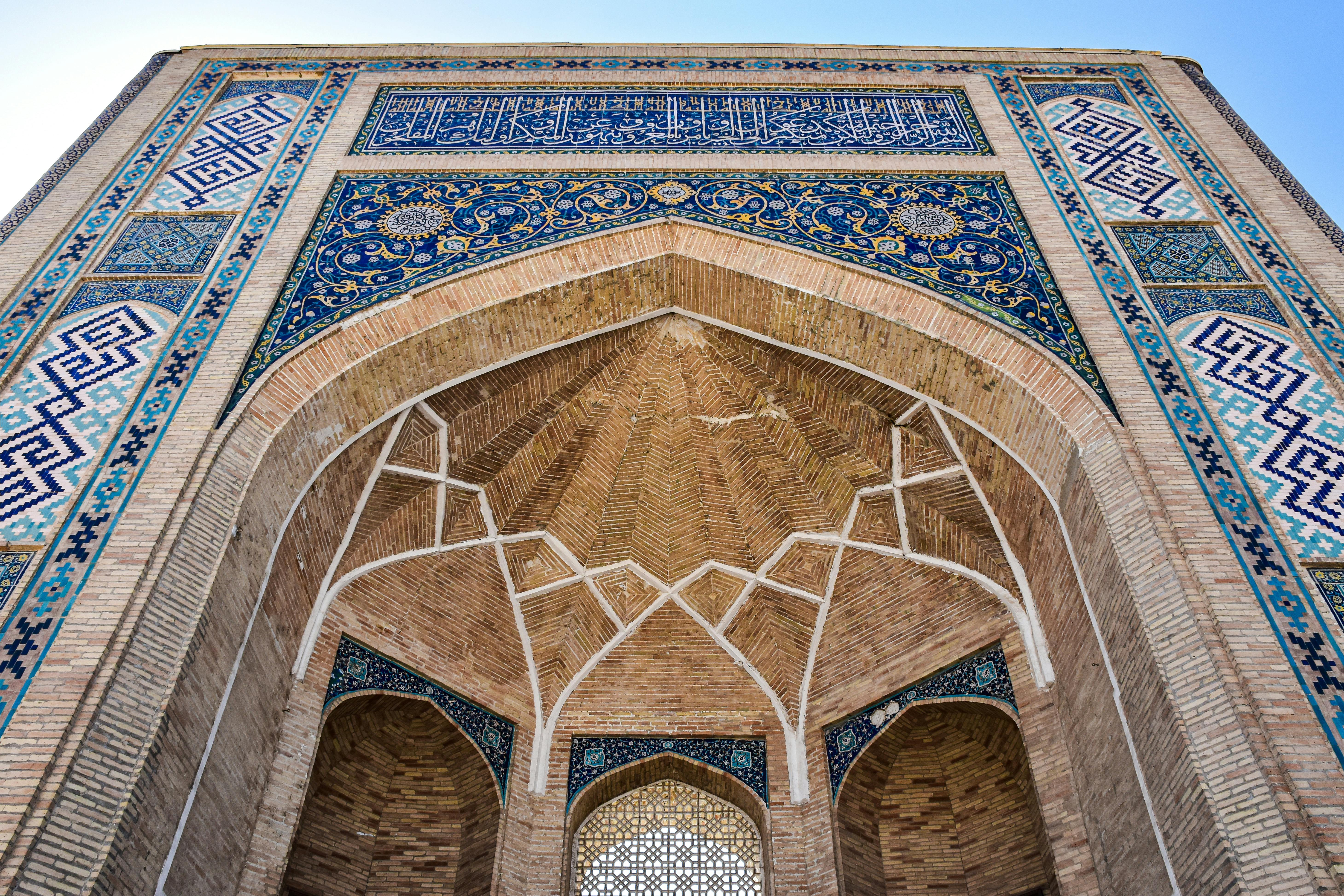
There is no single Islamic architecture style. Islamic architecture changes from place to place.
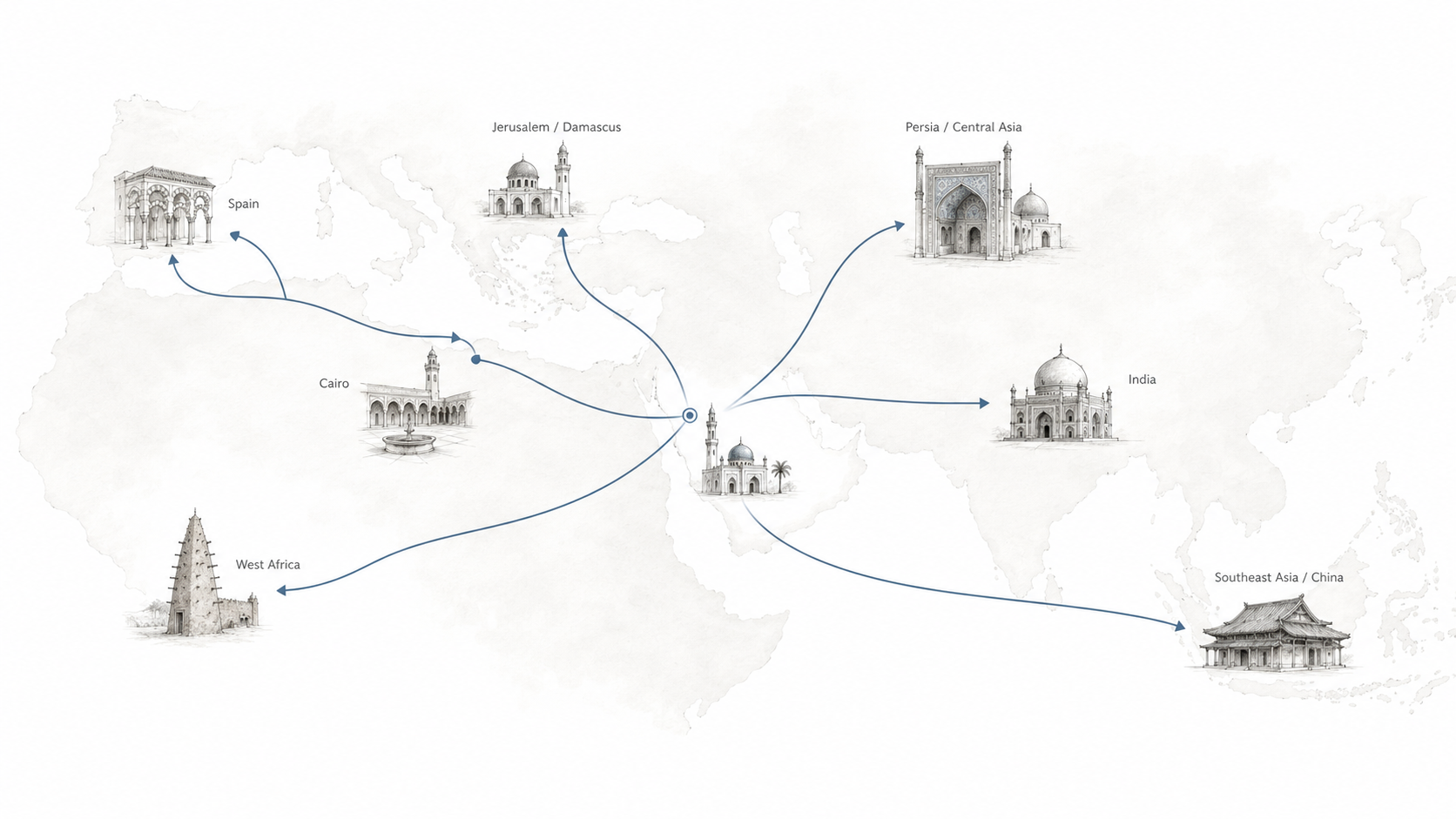
A mosque in Cairo, a madrasa in Samarkand, a palace in Granada, a timber mosque in China, a mudbrick mosque in Mali, and a Mughal tomb in India can all belong to the same tradition. They do not look alike because they were built with different climates, materials, crafts, and public needs.
The shared parts are deeper than style: prayer direction, gathering space, shade, water, thresholds, geometry, surface, and how the building meets the city. The local answer changes. The building logic stays connected.
For the broad parent page, start with Islamic architecture. For the chronological version, use Islamic architecture history. This page focuses on regional styles: what changed, where it changed, and why.
What Stayed the Same When the Style Changed
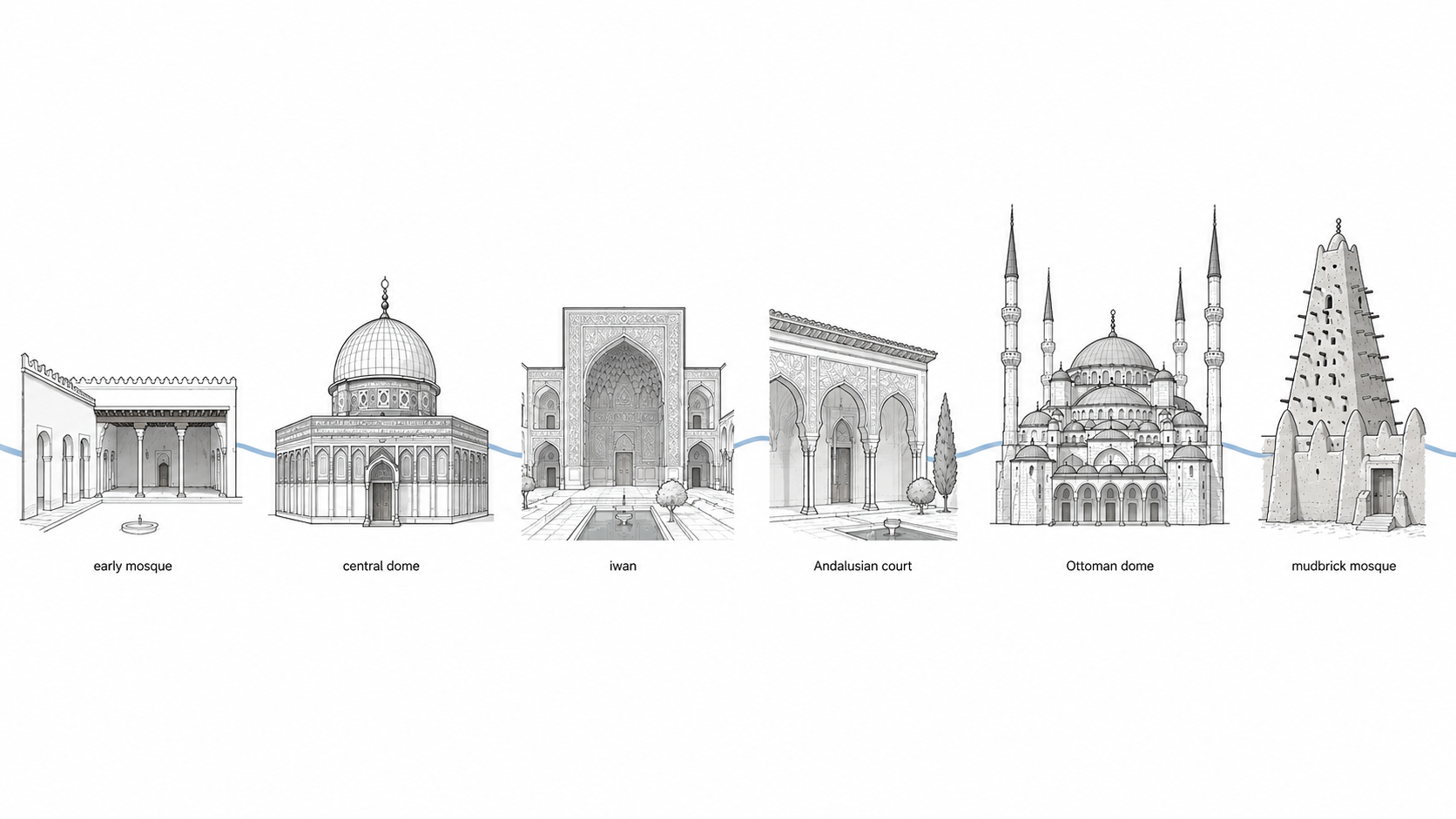
The visible style changed by region, but several architectural problems kept returning.
A mosque still needed orientation. A courtyard still had to handle light, shade, gathering, and movement. A prayer hall still needed a relationship to the qibla wall. Entrances, arcades, water, screens, domes, minarets, and ornament all changed by region, but they usually served a building problem before they became a visual identity.
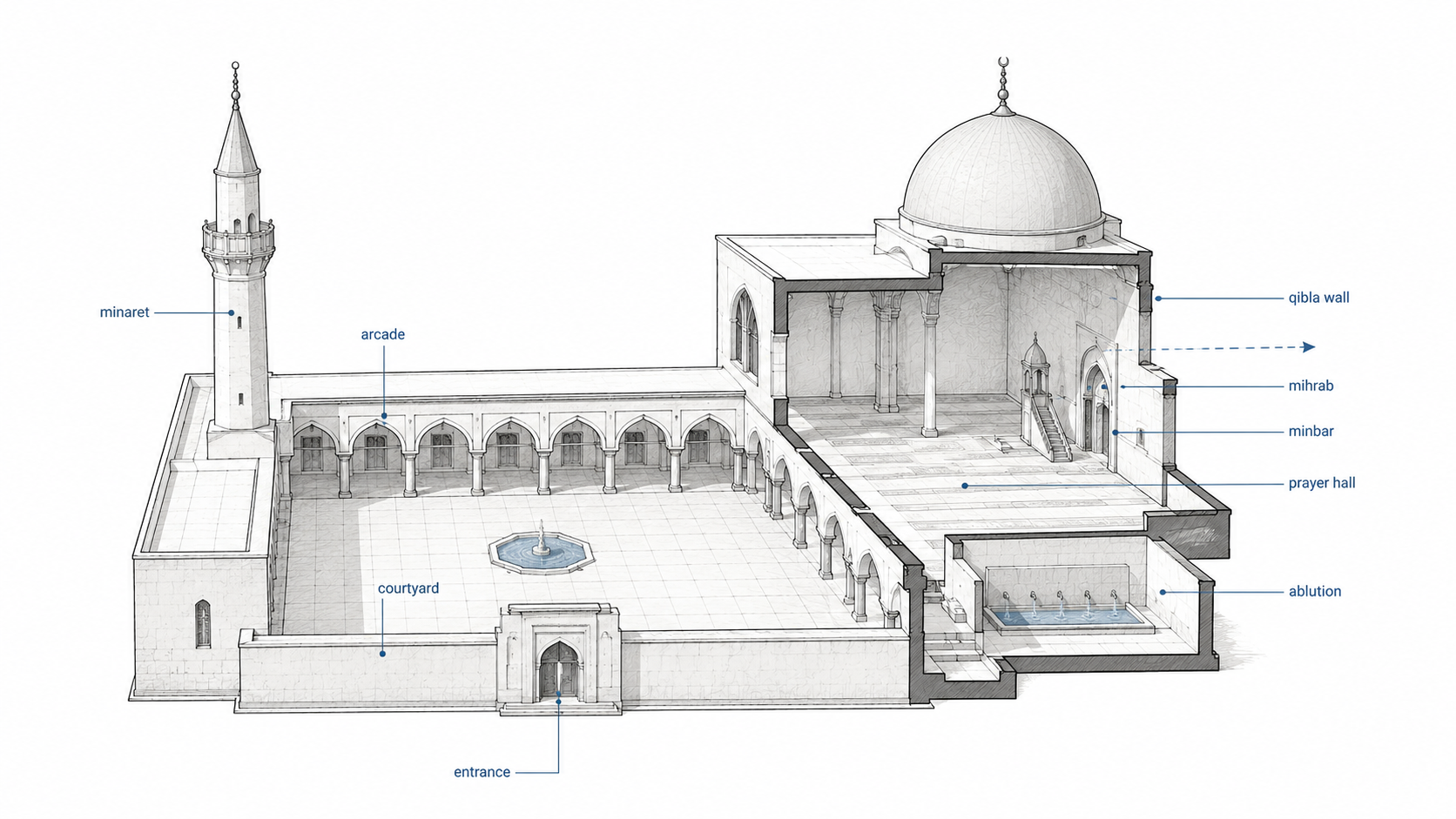
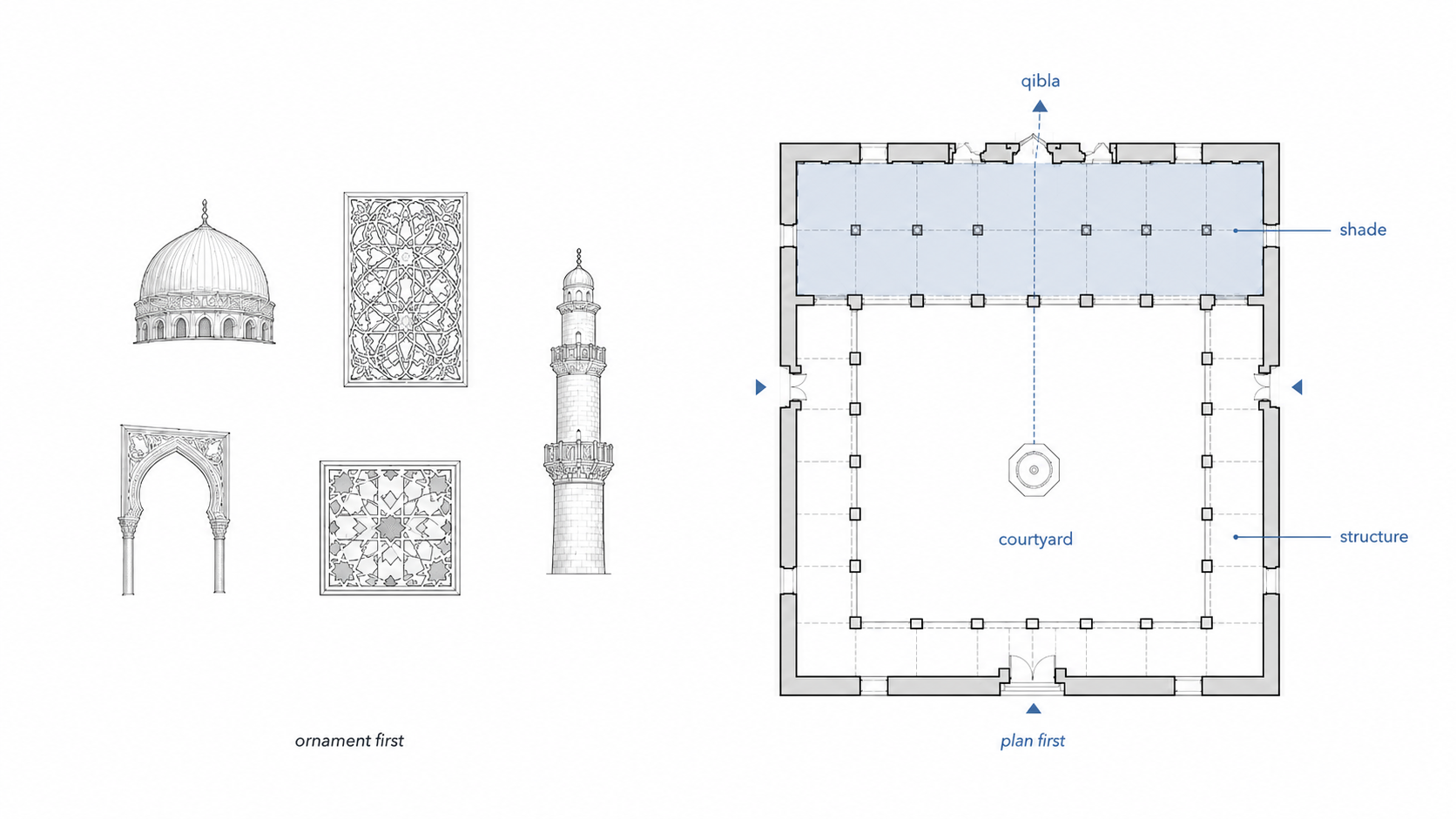
That is the best way to read Islamic styles. Do not start with the surface. Start with the building type, the climate, the material, the patron, and the city around it. The ornament makes more sense after that.
Islamic Architecture Styles at a Glance
The labels below are useful, but they are not perfect. Empires overlapped. Buildings were repaired and expanded. Crafts moved across trade routes. A single mosque can carry more than one period.
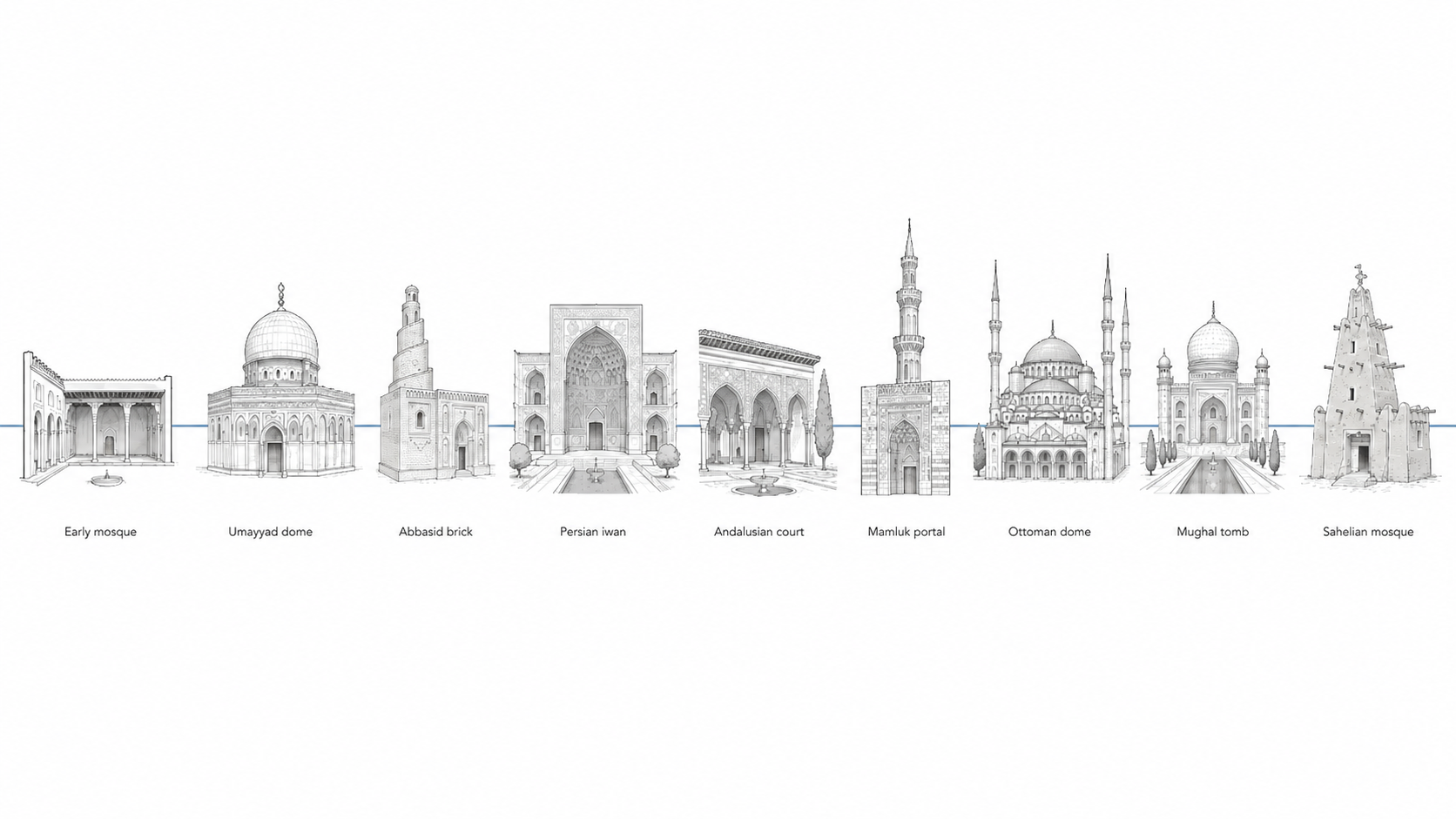
| Style or region | Main period | What changed architecturally | Good examples to study |
|---|---|---|---|
| Early Arab / Early Islamic | 7th–10th centuries | Simple mosque plans, hypostyle halls, courtyards, qibla orientation, shaded gathering space | Prophet’s Mosque as the early reference; Great Mosque of Damascus; Great Mosque of Kufa |
| Persian / Iranian | 8th century onward, especially Seljuk and Safavid periods | Iwans, four-iwan courts, large brick domes, tilework, garden order, refined geometry | Jameh Mosque of Isfahan; Shah Mosque, Isfahan; Persian garden complexes |
| Central Asian / Timurid | 14th–16th centuries | Huge portals, blue tile, monumental madrasas, tall drums, domes, and axial urban settings | Registan, Samarkand; Gur-e-Amir; Bibi-Khanym Mosque |
| Mamluk | 13th–16th centuries | Dense urban mosque complexes, carved stone portals, tiered minarets, madrasas, tombs, street presence | Sultan Hasan Mosque; Qalawun Complex; Islamic Cairo monuments |
| Moorish / Maghrebi / Andalusian | 8th–15th centuries | Horseshoe arches, courtyard sequence, carved plaster, zellij tile, water, slender columns, controlled views | Great Mosque of Córdoba; Alhambra; Kairaouine Mosque, Fez |
| Ottoman | 14th–20th centuries | Central domes, semi-domes, unified prayer halls, pencil minarets, mosque complexes with social services | Süleymaniye Mosque; Blue Mosque; Selimiye Mosque |
| Mughal | 16th–18th centuries | Charbagh gardens, axial symmetry, red sandstone, white marble, bulbous domes, large gateways, inlay | Taj Mahal; Badshahi Mosque; Humayun’s Tomb |
| Gulf and Yemeni | 9th century onward | Wind towers, coral stone, mudbrick towers, vertical houses, mashrabiya screens, desert climate response | Shibam; Al Fahidi Historic District; Gulf courtyard houses |
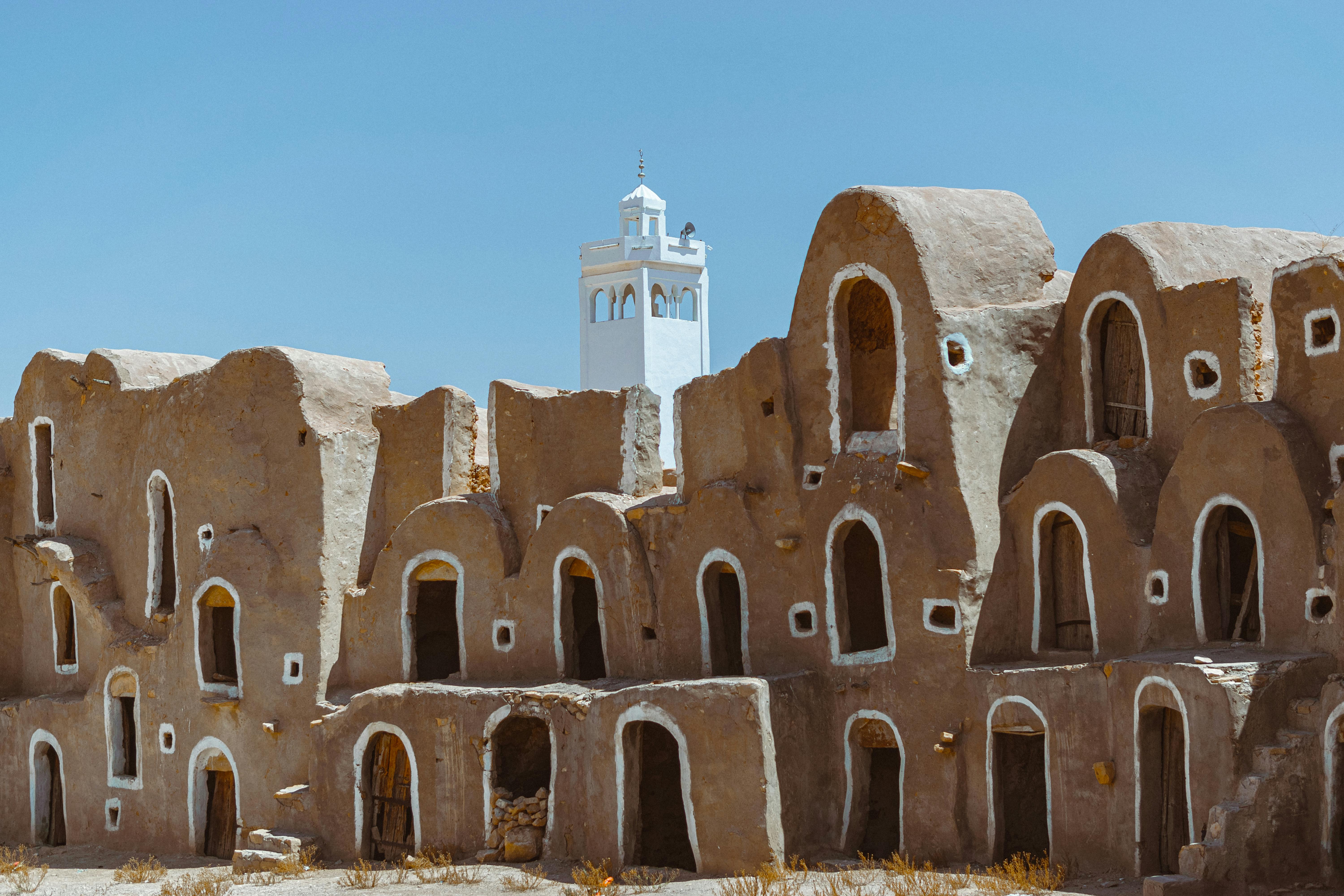
| West African / Sahelian | varies by region | Mudbrick mosques, timber repair scaffolds, thick walls, community maintenance, heat response | Great Mosque of Djenné; Sahelian mosque traditions |
| Chinese and Southeast Asian Islamic | varies by region | Timber construction, local roof forms, inward courtyards, regional craft, climate-specific adaptation | Historic Chinese mosques; Indonesian and Malay mosque traditions |
Early Arab and Early Islamic Architecture
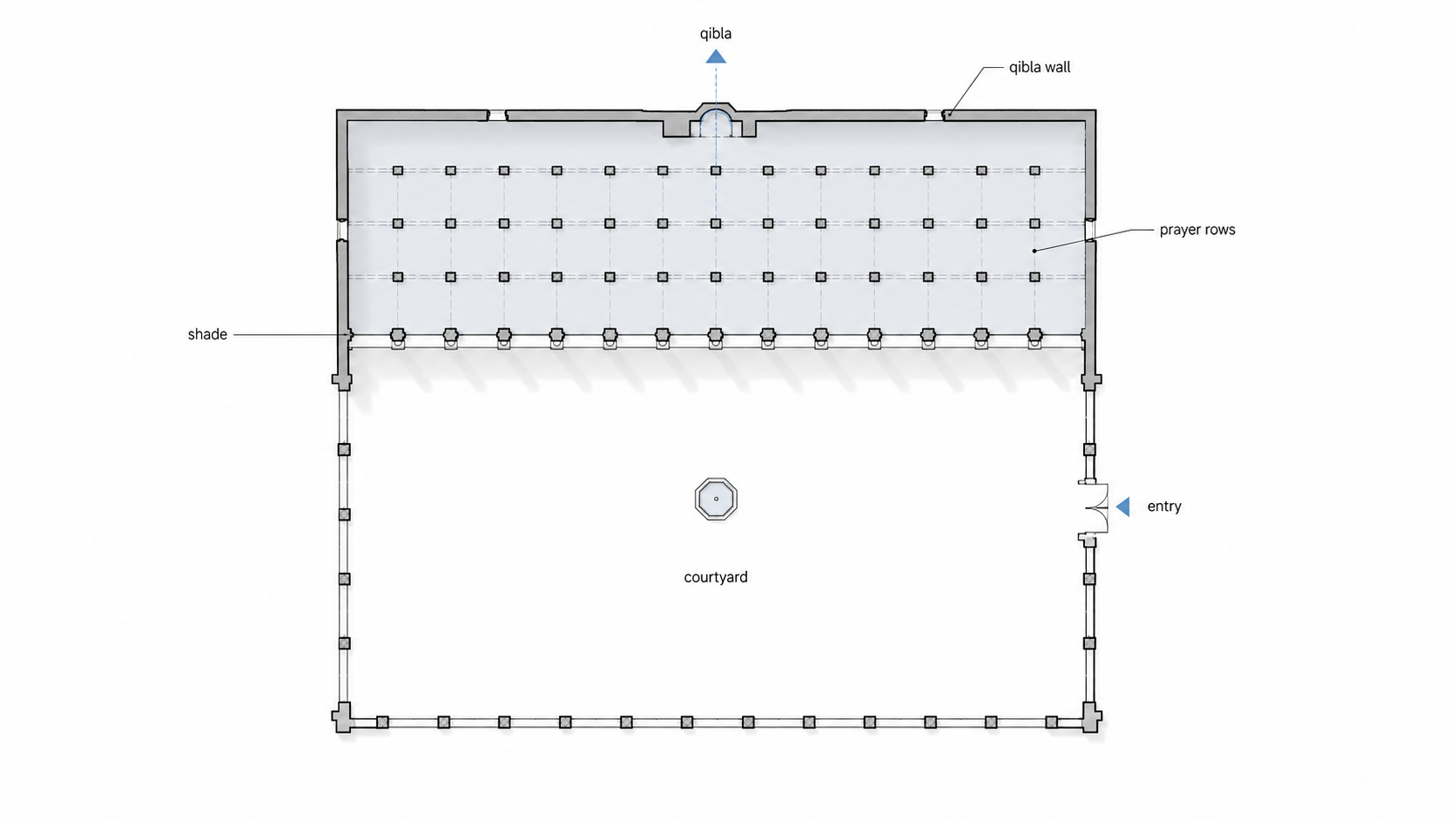
Early Islamic architecture was direct because it had to be.
The first mosques were not trying to look like later imperial monuments. They needed a place for prayer, teaching, leadership, and gathering. Courtyards, shaded edges, qibla orientation, rows of columns, and simple roof structures mattered more than display.
The hypostyle mosque became important because it was flexible. Rows of columns could support a roof, make a shaded prayer hall, and allow expansion. The plan could grow as the community grew.
The Great Mosque of Damascus shows the next step. Early Islamic architecture moved into inherited cities and older sacred landscapes, then used mosaics, courtyards, prayer halls, and urban scale to make a public religious and political statement.
Persian and Iranian Architecture
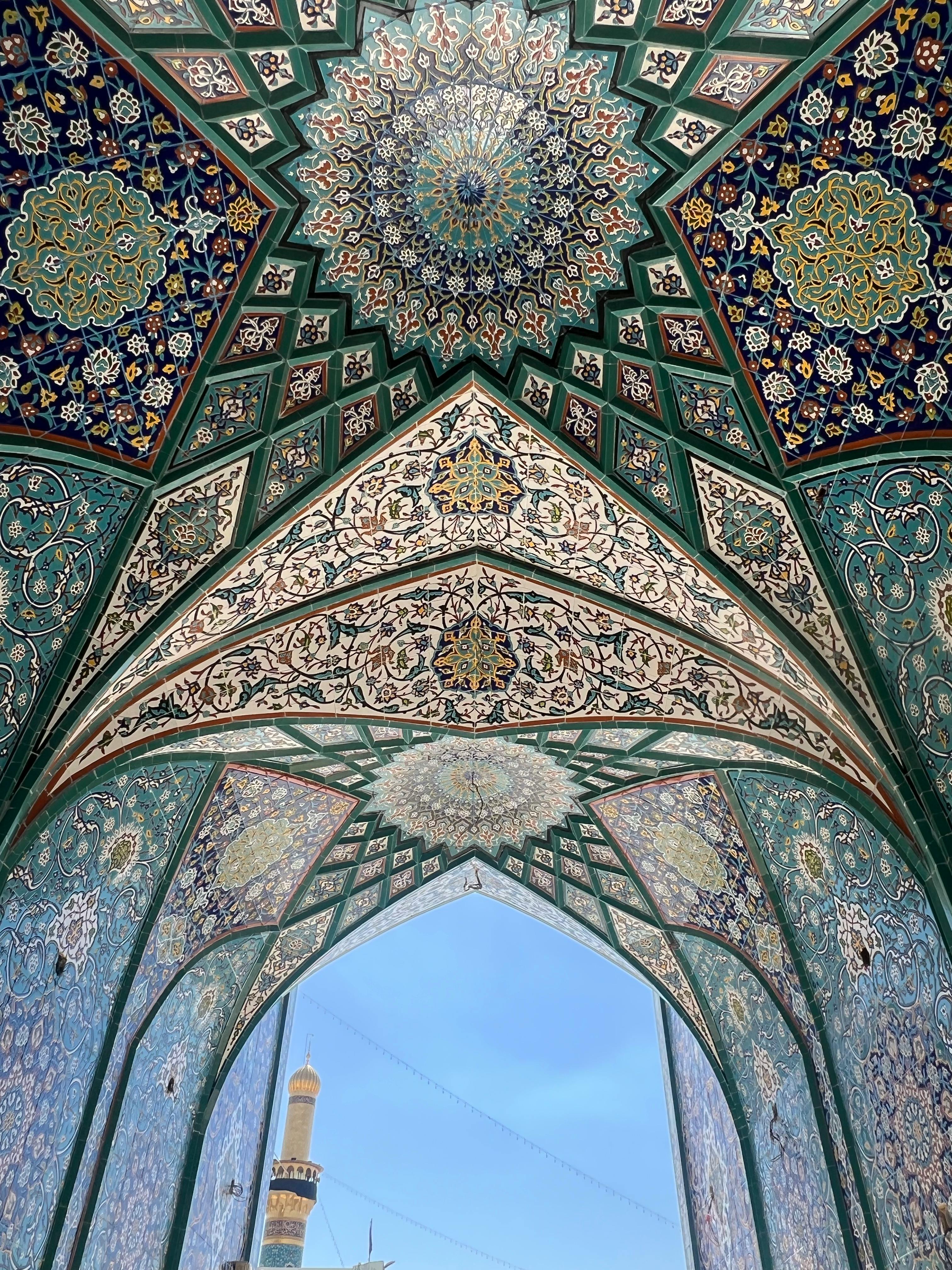
Persian architecture changed the mosque plan.
The key move was the iwan: a large vaulted space open on one side. In Persian mosque design, iwans could organize the sides of a courtyard. The four-iwan mosque plan gave the courtyard a stronger hierarchy than a simple open court with uniform edges.
Persian and Seljuk builders also pushed brick construction, dome transitions, tilework, inscriptions, and geometric planning. Later Safavid architecture made tile color, axial composition, and city-scale religious space even more visible.
The Jameh Mosque of Isfahan is useful because it is not one frozen design. It grew over time. You can study its courtyards, iwans, domes, brickwork, tile, and repair history as a long architectural process.
Central Asian and Timurid Architecture
Central Asian Islamic architecture often works at a different scale.
The Timurid world developed monumental portals, huge tiled facades, tall dome drums, madrasas, mausoleums, and strong axial urban compositions. Samarkand is the obvious place to study this style because the architecture uses surface and scale together.
The blue tile and grand portals are not only decoration. They make large buildings readable from open squares and long approaches. The portal becomes a public face. The dome becomes a skyline object. The madrasa becomes part of an urban room.
This is one reason Timurid and Central Asian architecture feels different from early Arab hypostyle mosques or Ottoman central-domed mosques. It often makes the threshold, facade, and tile field carry the main visual weight.
Mamluk Architecture in Cairo
Mamluk architecture is best read from the street.
In Cairo, buildings often had to fit dense urban fabric. Mosques, madrasas, mausoleums, hospitals, and charitable complexes were inserted into tight streets instead of standing alone in open space. That changed the architecture.
Portals became important because the street edge mattered. Minarets became skyline markers. Carved stone, muqarnas, marble panels, inscriptions, and layered facades gave heavy urban buildings depth and authority.
The Sultan Hasan Mosque and Qalawun Complex show the Mamluk ability to combine worship, education, burial, charity, medicine, power, and urban presence. The style is not only ornate. It is urban, public, and highly controlled.
For Cairo context, use Islamic Cairo and Al-Azhar Mosque.
Moorish, Maghrebi, and Andalusian Architecture
Moorish architecture developed in al-Andalus and across North African traditions. It is one of the most visually familiar Islamic styles, but it is also one of the easiest to misunderstand.
The visible signs are clear: horseshoe arches, multifoil arches, carved plaster, zellij tile, courtyards, slender columns, water channels, muqarnas ceilings, and controlled views. The deeper logic is climate, privacy, movement, and light.
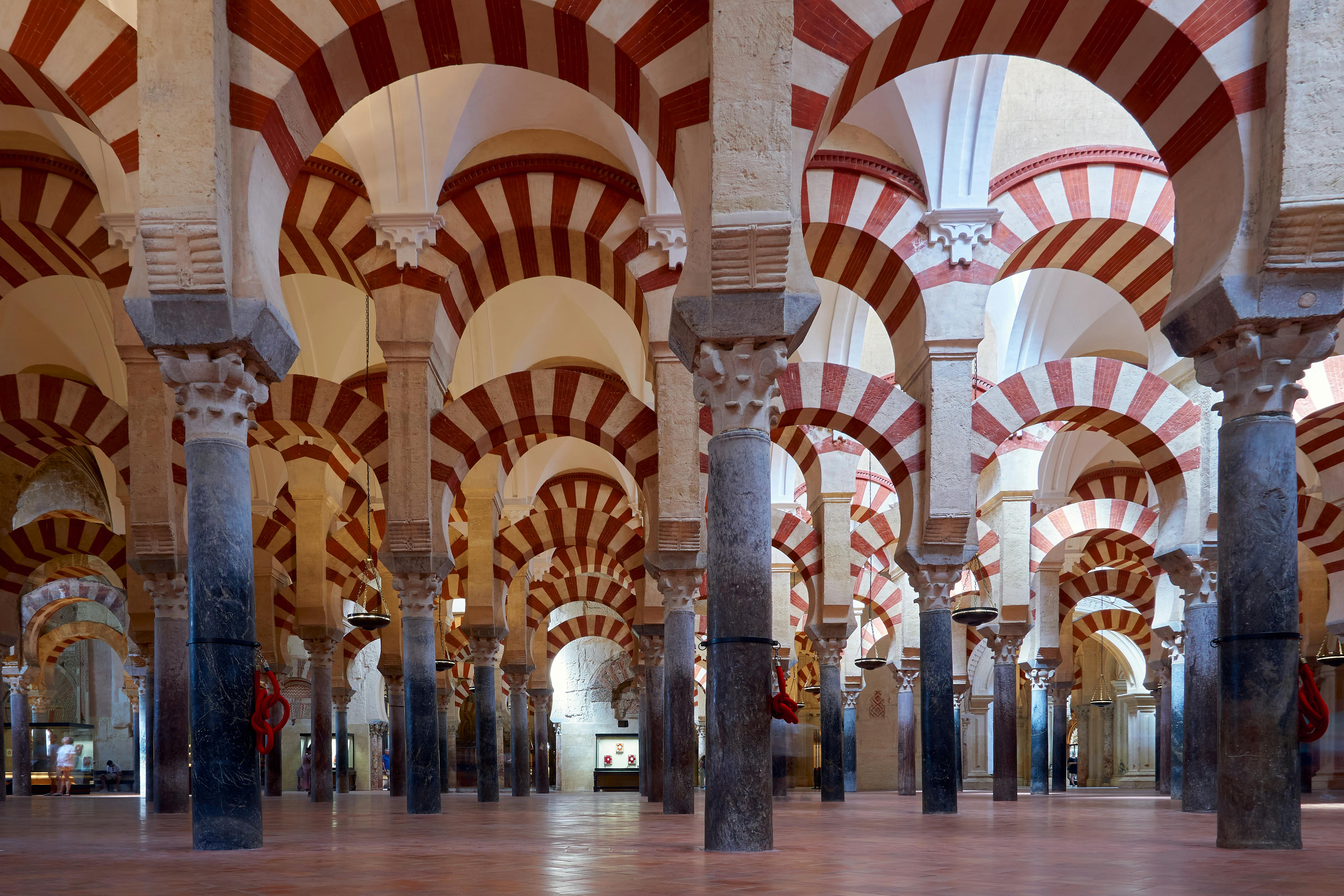
The Great Mosque of Córdoba shows the power of repeated arches and a deep hypostyle field. The Alhambra shows a different side: palace courtyards, water, plaster, tile, framed views, and delicate thresholds.
For the regional branch, continue with Islamic and Moorish architecture in Spain and Alhambra Palace architecture.
Ottoman Architecture
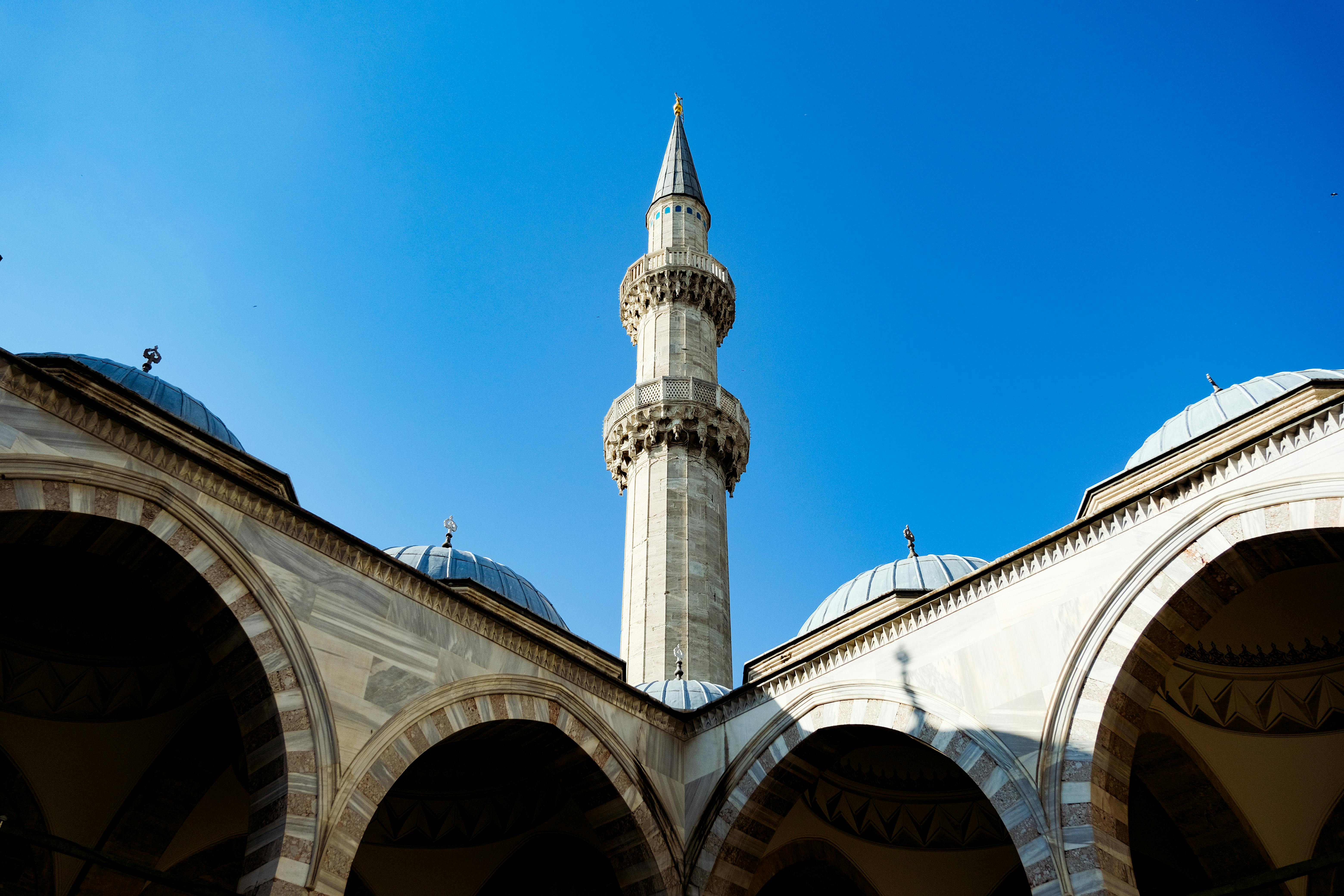
Ottoman architecture took the central dome seriously.
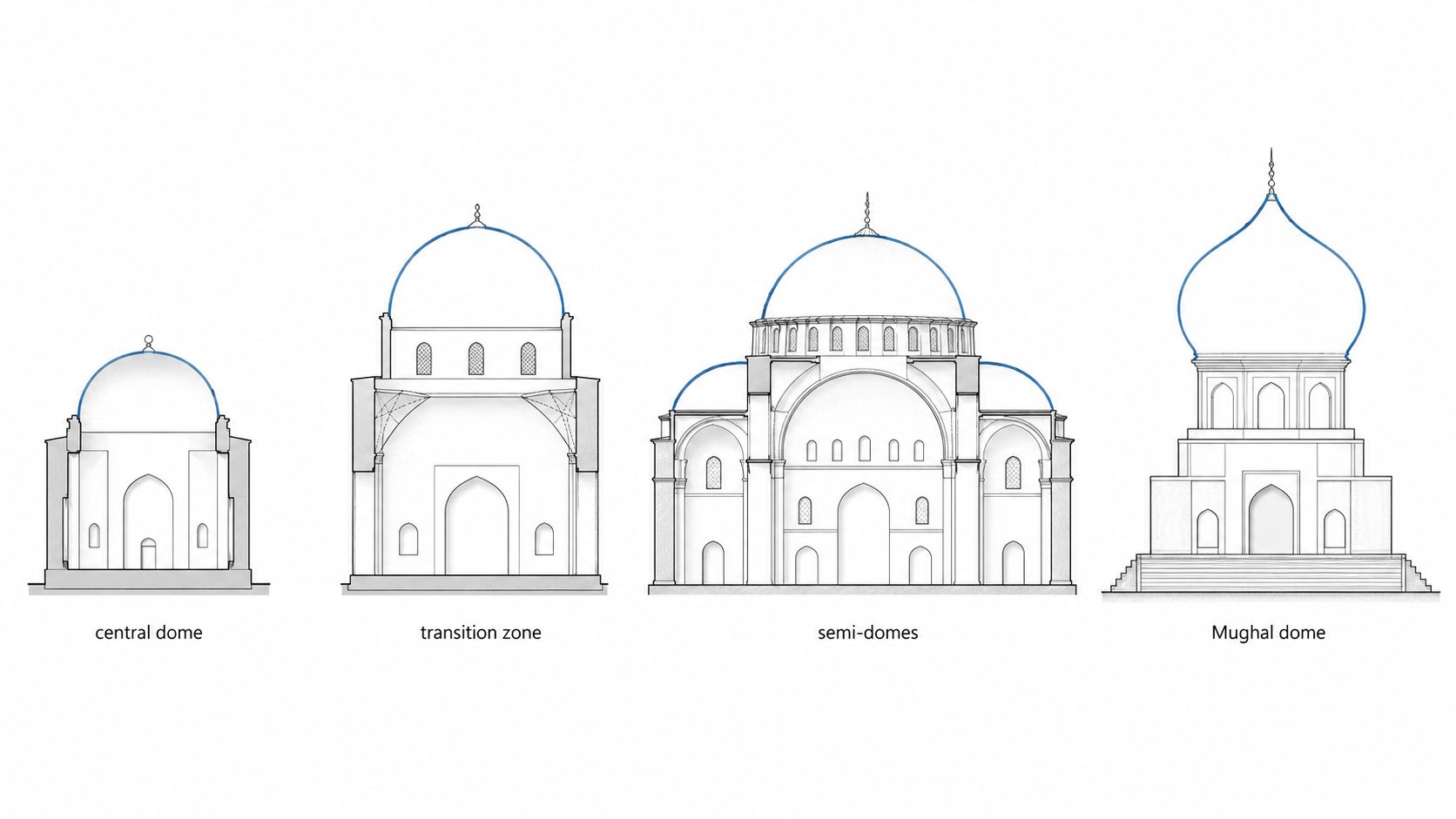
In Istanbul, Hagia Sophia gave Ottoman architects a huge problem to study: how to make one vast interior volume feel unified, lit, and structurally controlled. Ottoman mosque design did not simply copy Hagia Sophia. Over time, it developed its own language of central domes, semi-domes, courtyards, pencil minarets, and large prayer halls.
Mimar Sinan is the key figure. His mosques tested mass, light, structure, and proportion. Süleymaniye Mosque and Selimiye Mosque show how Ottoman architecture made dome systems feel clear, ordered, and powerful.
Ottoman mosque complexes also became social infrastructure. They could include schools, hospitals, kitchens, baths, libraries, and markets. The mosque was not just a prayer room. It was often part of a civic system.
Mughal Architecture
Mughal architecture blended Persian, Timurid, and Indian traditions into a powerful courtly style.
The recognizable features are large gateways, axial symmetry, charbagh gardens, red sandstone, white marble, inlay, bulbous domes, and carefully framed tombs and mosques. But the real strength is planning. Mughal buildings often use platforms, gardens, gates, water channels, and symmetry to control the whole site.
The Taj Mahal is the best-known example, but it should not be reduced to romance or marble. It works through river edge, garden, gateway, platform, tomb mass, dome, inlay, and proportion.
Mughal style also shaped mosques at enormous scale. Badshahi Mosque in Lahore shows how a large court, monumental gate, prayer hall, domes, and minarets can create civic presence.
For South Asian case studies, use Taj Mahal architecture and Badshahi Mosque.
Gulf and Yemeni Architecture
Gulf and Yemeni architecture belongs in the styles map because it shows how much climate and material can change Islamic building.
In Gulf settlements, coral stone, gypsum, timber, wind towers, courtyards, and mashrabiya screens helped buildings handle heat, airflow, privacy, and dense urban life. In Yemen, mudbrick towers created vertical city forms with thick walls, small openings, and strong environmental logic.
Shibam is often called the “Manhattan of the desert,” but the nickname can distract from the architecture. The important point is not that the buildings are tall. It is that they use mudbrick, mass, height, shade, and density to make urban life possible in a harsh climate.
For the screen and airflow side of the tradition, read mashrabiya designs.
West African and Sahelian Islamic Architecture
West African Islamic architecture should not be treated as a footnote.
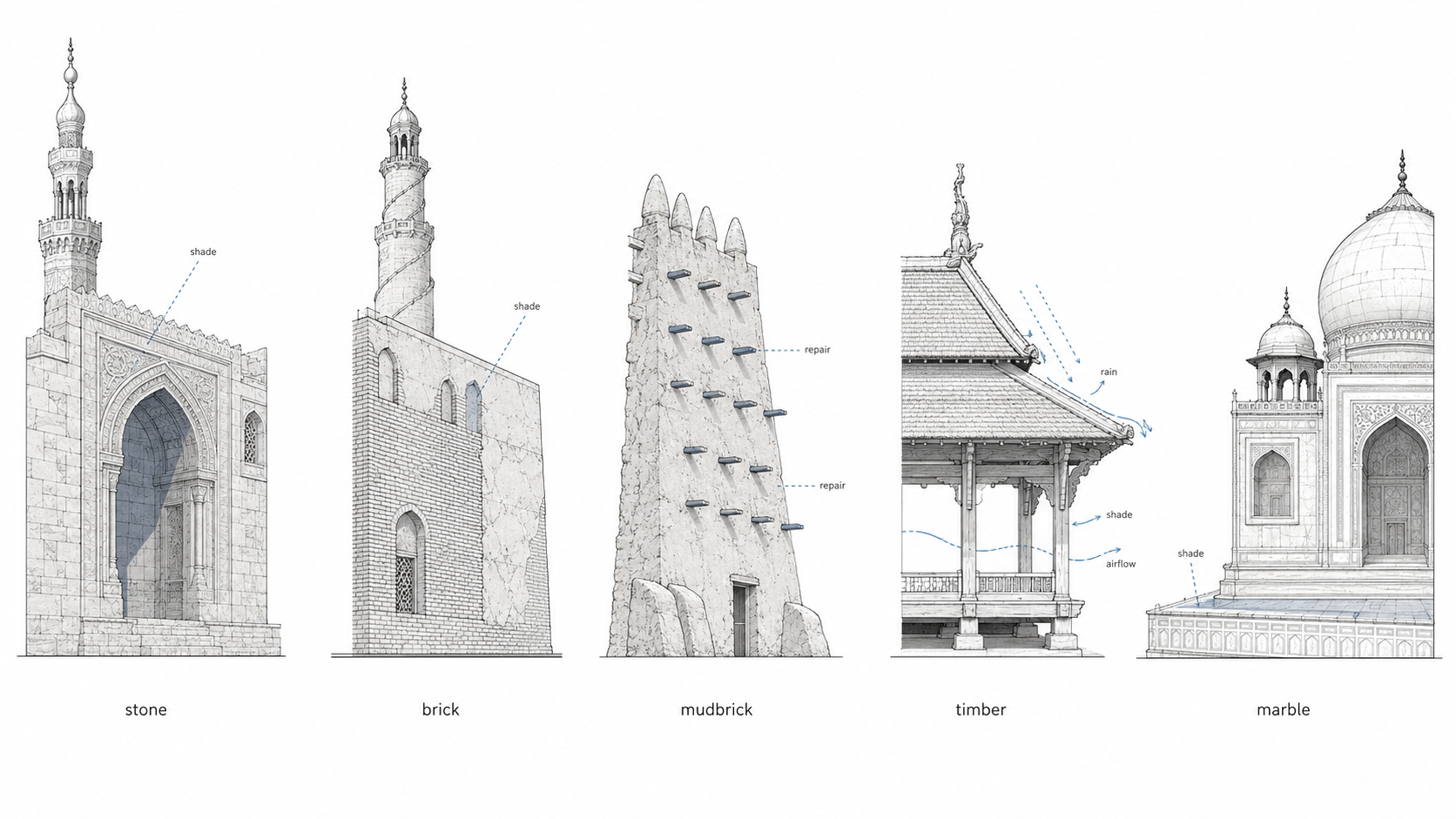
Mudbrick mosques in the Sahel show a different architectural intelligence from marble tombs or tiled iwans. Thick earthen walls handle heat. Timber projections help with repair and replastering. Community maintenance becomes part of the building’s life.
The Great Mosque of Djenné is the best-known example, but the lesson is broader. In this region, material and maintenance are not secondary details. They shape the style.
Chinese and Southeast Asian Islamic Architecture
Islamic architecture in China and Southeast Asia often looks different because local building traditions were different.
Chinese mosques could use timber construction, courtyard planning, local roof forms, and Chinese spatial traditions while still serving Islamic religious use through orientation, inscription, and prayer space. In Southeast Asia, timber, pitched roofs, deep overhangs, rain, humidity, and local craft shaped mosque design before globalized dome-and-minaret imagery became common.
These buildings are useful because they break the lazy idea that Islamic architecture must always mean a dome, minaret, and pointed arch. The religious use may be shared. The architectural language can still be local.
How Styles Moved Across Regions
Islamic architecture spread through empire, trade, migration, pilgrimage, conquest, scholarship, craft, and patronage. Ideas moved, but they did not stay unchanged.
The arch is a good example. Horseshoe arches became strongly associated with Andalusian and North African architecture. Persian and Central Asian traditions developed large iwans and pointed forms. Ottoman architecture used arches inside larger dome systems. Mughal architecture used ogee and four-centered openings within symmetrical garden and tomb compositions.
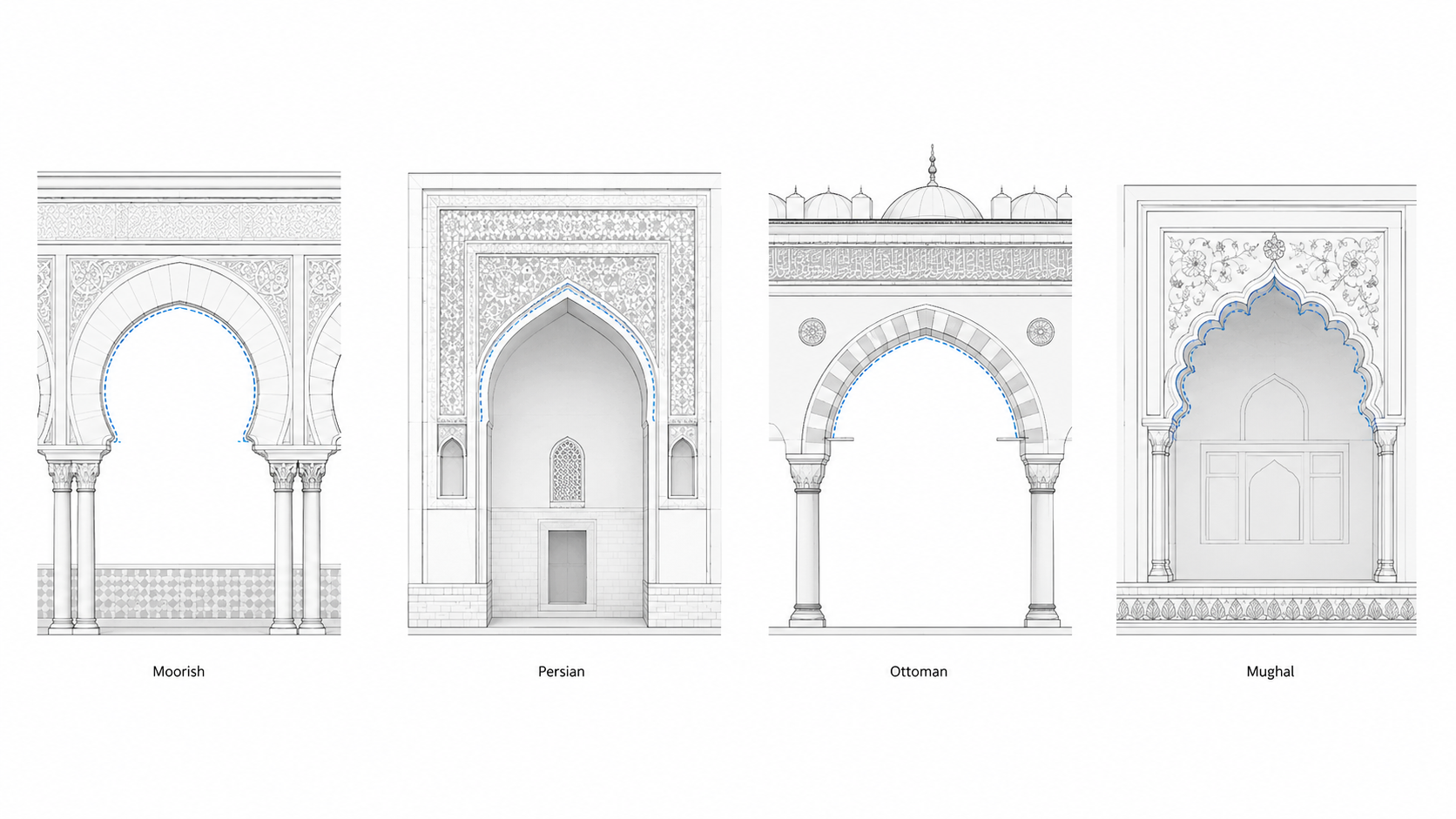
For the full arch guide, use Islamic arches.
Shared Design Systems Across Styles
Regional styles changed, but some design systems kept reappearing.
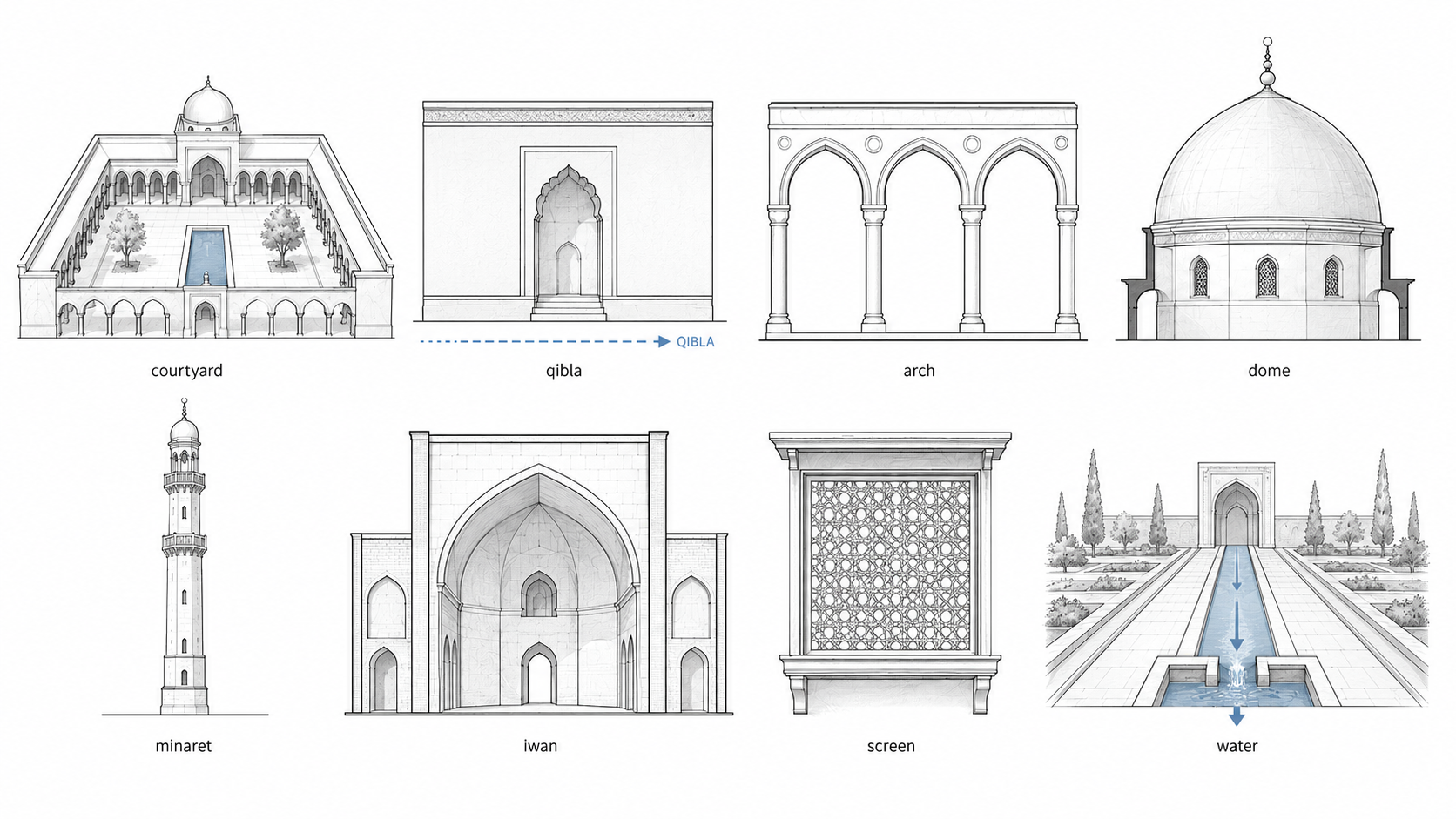
Courtyards, qibla walls, mihrabs, minarets, domes, arches, iwans, screens, water, gardens, tile, geometry, calligraphy, and muqarnas all moved across the Islamic world. They did not always mean the same thing or look the same, but they gave builders a shared set of architectural tools.
| Design system | What stayed recognizable | How styles changed it |
|---|---|---|
| Courtyard | Open center for light, air, gathering, water, and movement | Mosque sahn, palace court, madrasa court, house courtyard, garden court |
| Arch | Opening, threshold, rhythm, load, view, shade | Horseshoe, pointed, multifoil, ogee, keel, four-centered forms |
| Dome | Volume, focus, skyline, sacred or ceremonial presence | Centralized early monuments, Ottoman mosque domes, Mughal tomb domes |
| Minaret | Vertical marker and mosque identity | Square Maghrebi forms, spiral examples, Mamluk tiers, Ottoman pencil minarets |
| Screen | Light, privacy, airflow, street control | Mashrabiya, jali, carved plaster, timber lattice, stone screens |
| Surface pattern | Geometry, calligraphy, vegetal rhythm, scale control | Tile, stucco, stone carving, brick pattern, marble inlay, painted wood |
Courtyards, Heat, and Water Changed the Style
Climate is one of the fastest ways to understand why Islamic styles look different.
A courtyard in a hot, dry city does more than create beauty. It brings light into dense buildings, gives air a place to move, creates a protected social center, and lets water and shade cool the space. In a mosque, the courtyard also manages gathering and the approach to prayer.
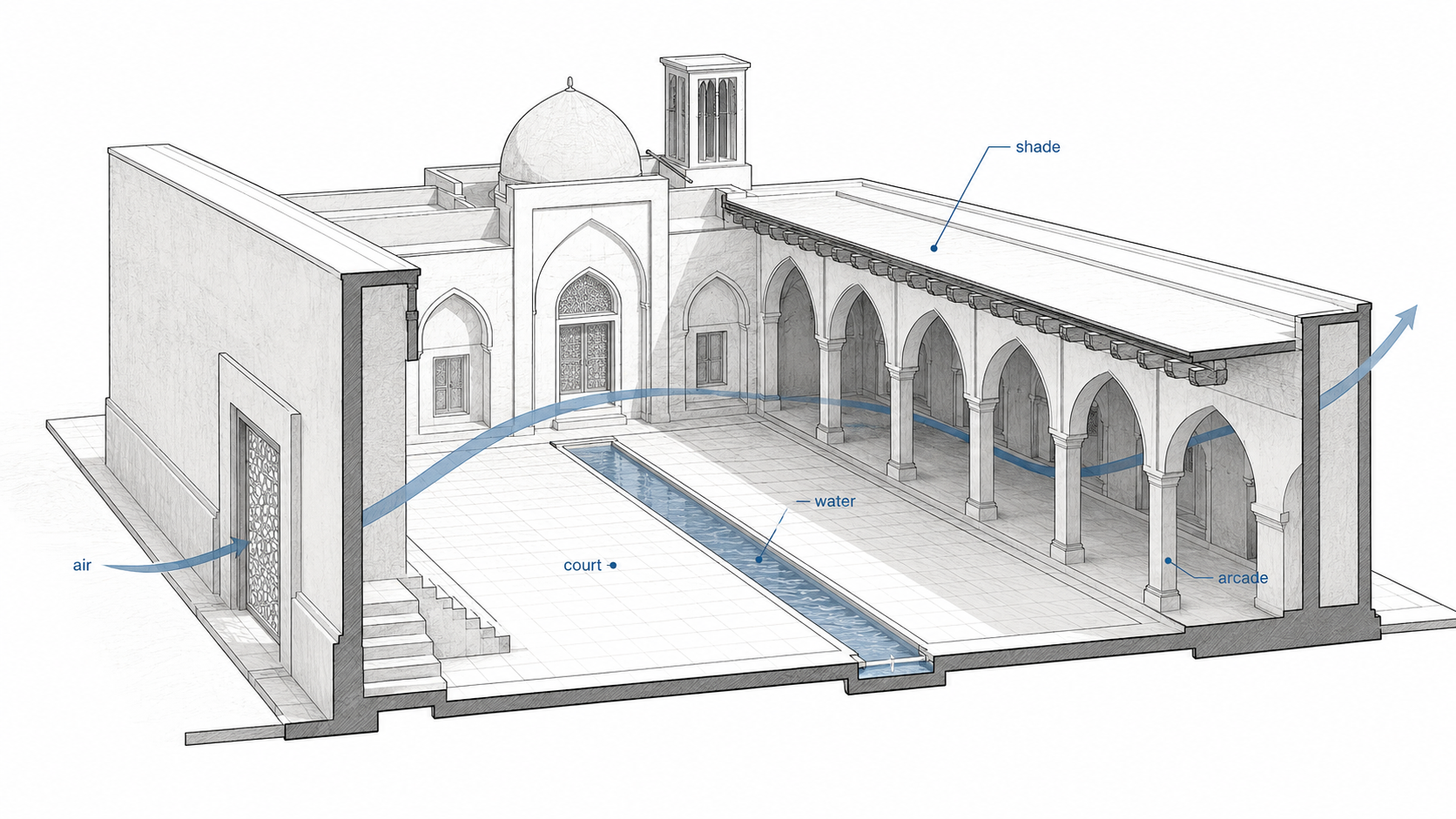
That is why courtyard styles in Cairo, Fez, Granada, Isfahan, Damascus, and Delhi cannot be read only as decoration. The open space is often doing environmental, social, and ritual work at the same time.
For more, read courtyards in Islamic architecture.
Where Style Labels Mislead
Style labels are useful until they make the architecture too neat.
“Arab,” “Persian,” “Moorish,” “Ottoman,” and “Mughal” are not sealed boxes. Builders moved. Crafts moved. Rulers borrowed. Cities were conquered, repaired, rebuilt, and expanded. A building could start in one period and gain its most visible features in another.
Al-Azhar Mosque is a good example. It began as a Fatimid mosque, but later additions changed its skyline and urban presence. The building is not a pure style sample. It is a layered architectural record.
The same problem appears in Spain, India, Iran, Turkey, North Africa, and Central Asia. A style label should help you start reading the building. It should not stop the reading.
What Modern Designers Still Use
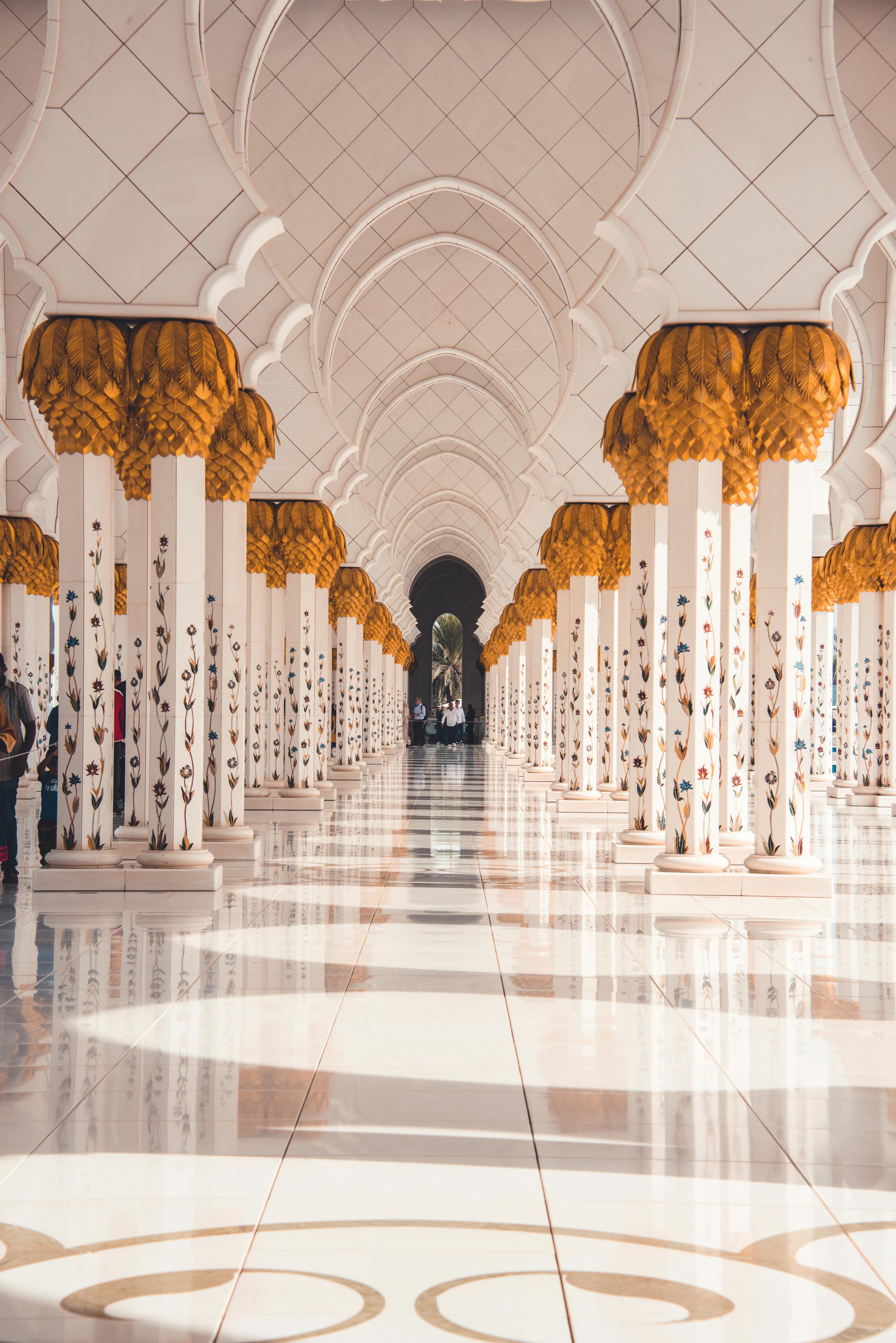
Modern architects still borrow from Islamic styles, sometimes well and sometimes badly.
The weak version copies a dome, arch, tile pattern, or minaret without understanding the building logic behind it. That can make a mosque, museum, hotel, or cultural center look “Islamic” on the surface while the plan, light, movement, shade, and material logic remain generic.
The stronger version learns from the systems:
- Use courtyards to bring light, air, privacy, and gathering into dense sites.
- Use arcades and screens to control glare and heat.
- Use geometry to organize structure and surface, not just decorate panels.
- Use water carefully where it supports cooling, sound, reflection, or ceremony.
- Let local material shape the building instead of forcing one global “Islamic” image.
The old styles still matter because they show how architecture can connect climate, ritual, structure, surface, and city life without treating any one part as separate.
How to Study Islamic Architecture Styles
Do not start by memorizing every dynasty.
Start with the building’s job. Is it a mosque, palace, tomb, madrasa, market, house, caravanserai, fort, or garden? Then ask where it stands, what it is built from, how it handles climate, and who paid for it.
- Identify the building type.
- Find the region and approximate period.
- Look at the material: stone, brick, mudbrick, plaster, timber, tile, marble, or concrete.
- Read the plan before the ornament.
- Check the climate response: shade, air, water, wall thickness, screens, courtyards, or roof form.
- Then study the surface: calligraphy, geometry, tile, plaster, carving, inlay, or muqarnas.
A style is not only a look. It is a pattern of decisions.
Recommended reference: The Architecture of the Islamic World is a useful book to compare regional traditions, plans, materials, and building types without treating Islamic architecture as one fixed style.
FAQ
What are the main styles of Islamic architecture?
The main styles usually include early Arab or early Islamic, Persian, Central Asian or Timurid, Mamluk, Moorish or Maghrebi, Ottoman, Mughal, Gulf, Yemeni, West African, and regional Asian traditions.
Why do Islamic buildings look different in different countries?
They changed because local materials, climate, craft traditions, rulers, cities, and building types changed. A mosque in Istanbul did not face the same design problem as a mudbrick mosque in Mali or a courtyard palace in Granada.
What is the difference between Arab and Persian Islamic architecture?
Early Arab mosque architecture often used simple courtyard and hypostyle layouts. Persian architecture developed stronger iwan planning, large domes, tilework, axial courtyards, and garden-related order.
What makes Ottoman architecture different?
Ottoman mosque architecture is known for large central domes, semi-domes, slender minarets, unified prayer halls, strong daylight control, and mosque complexes that could include schools, kitchens, hospitals, libraries, and baths.
What makes Moorish architecture different?
Moorish architecture is strongly associated with horseshoe arches, multifoil arches, zellij tile, carved plaster, water courts, shaded rooms, and controlled views, especially in Spain and North Africa.
Is Mughal architecture Islamic architecture?
Yes. Mughal architecture is a major Islamic architectural tradition in South Asia. It blends Persian, Timurid, and Indian elements through gardens, gateways, tombs, marble, red sandstone, symmetry, and large domes.
Are domes required in Islamic architecture?
No. Domes are important in many Islamic buildings, especially Ottoman and Mughal architecture, but Islamic architecture also includes flat roofs, timber roofs, mudbrick mosques, courtyard houses, markets, forts, and buildings without domes.
What should students study first?
Start with plan, use, region, climate, material, and building type. After that, study the style label and surface details.
Read This Next
For the main overview, start with Islamic architecture. For the historical order, use Islamic architecture history. For the shared features, read characteristics of Islamic architecture.
For specific design systems, continue with Islamic arches, courtyards in Islamic architecture, Islamic geometric patterns, muqarnas architecture, and mashrabiya designs.
For major case studies, use Dome of the Rock, Al-Azhar Mosque, Süleymaniye Mosque, Blue Mosque, Taj Mahal, and Badshahi Mosque.