

How the Alhambra Was Designed: Real Techniques Behind the Beauty
Why the Alhambra Is the Most Studied Piece of Islamic Architecture
We aren’t here to fool around or write romance about this place. It looks poetic, yes, but under the tile it’s pure problem solving — air, light, water, structure. Nothing mystical. The rooms just work. Let’s figure out how. That’s how you actually get better at design. Air moves because someone cut the vents right. You feel it in the back of your neck.
Alhambra Architecture Guide
Courtyards, Arches, Patterns, and Logic
What Hits You First
The slope. Always the slope. You drag yourself up and realize the site placement was the first design move. Wind, not view. Defense, not vanity. Water runs down, air slides up. They picked the hill because it worked like a natural HVAC system. That’s climate logic 800 years ahead of us.
Stand near the base and touch the wall. South face burns, north stays cold. That’s not luck. That’s thermal mass tuned by orientation. You can read the physics in your fingertips. The same terrain reading shows up in Islamic Moorish Architecture in Spain — every hill used for heat control.
The Skeleton Under It

The Alcazaba came first — raw defense. Thick, uneven, ugly in the best way. No plaster, no decoration. Just walls that hold. The later Nasrid layers float over it like skin on muscle. That mix of heavy and thin keeps the building alive. Most architects forget that contrast: mass below, light above.
Walk those towers and you’ll see rough brick patched with lime that outlived five empires. Nothing fancy. It just works. That’s structure before ego.
Palaces That Kept Adapting
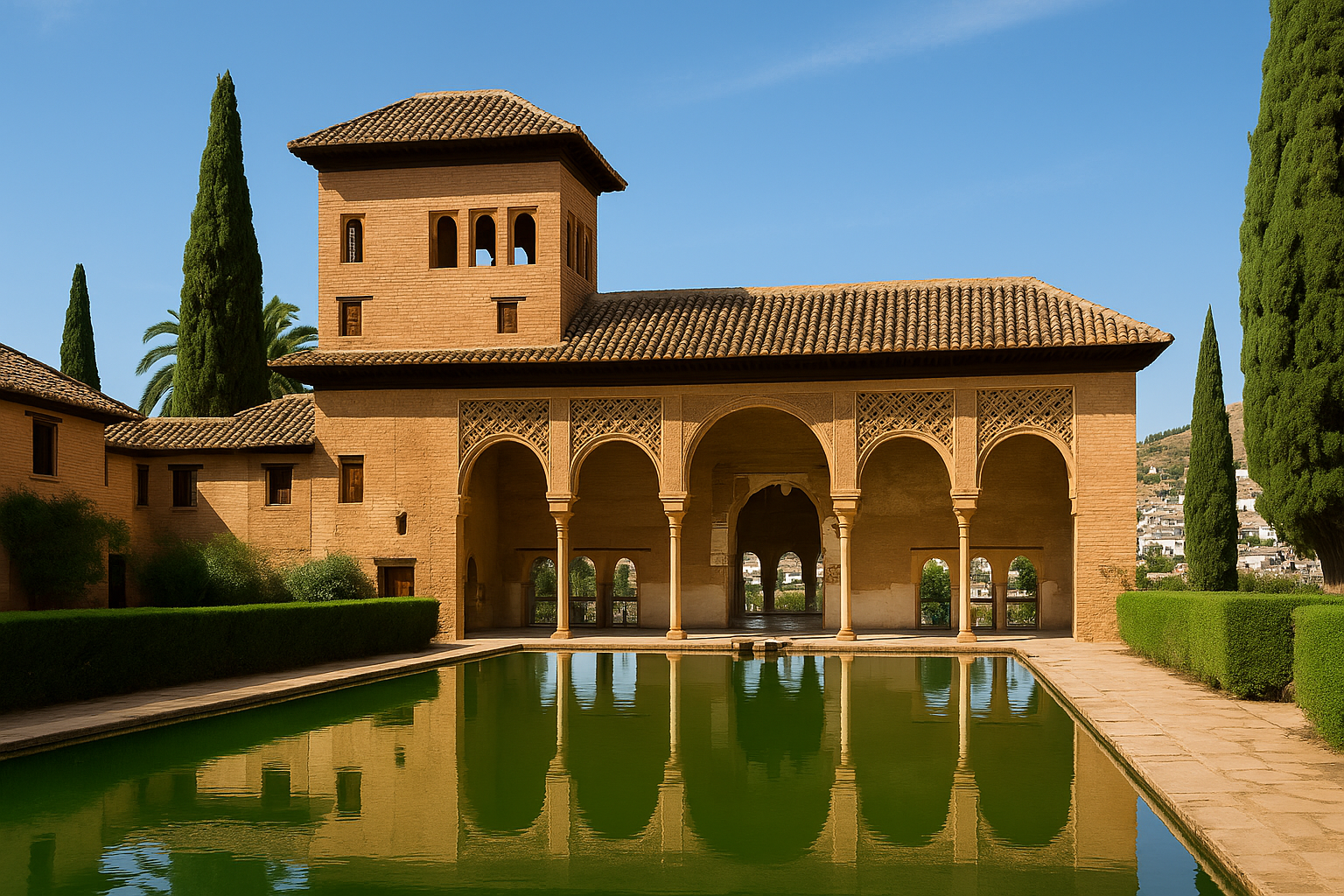
The palaces aren’t one idea. They’re add-ons. Each ruler fixed or tweaked the climate plan. Mexuar = meetings. Comares = light experiments. Lions = water cooling. It’s evolution by necessity. You can see the trial-and-error — uneven plaster, shifted columns, drainage scars. That’s how you know humans built it, not algorithms.
They built for comfort first. Every shadow has purpose. Every reflection controls glare. That’s why it still feels balanced even when packed with tourists. You can see the same rule in The Architecture of Minarets: What They Are and How They Work — height and airflow, not show.
The Alhambra: Architecture, Water, and Light
Water Doing Real Work
The fountains aren’t decoration. They’re cooling engines. The sound masks conversation, the mist drops temperature, and the slope drives circulation. No motor, no wires. Just slope and math. Gravity never fails inspection.
You can hear the old hydraulic brains when you walk through Lions Court. The pitch is constant — never stops, never floods. That’s what precision sounds like when stone becomes plumbing. Half our “sustainable” systems can’t compete with this.
FIELD PICK: The Mosque: History, Architectural Development & Regional Diversity — read it for old water logic that still beats new software.
Light That Thinks
Every opening is a test. Stucco eats glare. Lattices slice daylight into strips thin enough to read by but never blind you. These people didn’t “chase atmosphere.” They solved heat and vision before the concept even had words.
Stand in Comares Hall at noon. You’ll see gold, then ash gray ten minutes later. That’s solar geometry, not mood lighting. We simulate that now in Revit with bad accuracy. They built it by memory and habit. You can find the same obsession with daylight in Islamic Architecture in Egypt: Mosques, Minarets, and Madrasas.
The Labor You Can Still Read
No signatures, no famous name. Just trades stacked. The lower panels are rushed, top carvings clean — hierarchy visible in dust lines. That’s project management, 14th-century style. The pattern of work is the real ornament.
Each craft talks to the next. Wood joins plaster joins tile joins calligraphy. You can tell when they fought, too — mismatched joints, unfinished corners. It’s honest. We hide that now and lose character.
Same rhythm shows in Süleymaniye Mosque Architecture: The Project Sinan Got Perfect — large systems held together by trade trust.
FIELD PICK: The Architecture of the Islamic World — skip the theory, go straight to the diagrams.
Geometry That Cools
The patterns aren’t just math games. Deep carving adds shadow. That shadow cuts radiant heat. Every inscription breaks wind pressure along surfaces. That’s physics, not faith alone. You realize belief and engineering weren’t separate. They carved the same principle both ways.
There’s a lesson in that: meaning can do work. Islamic Geometric Patterns: Clean, Sharp, and Still Useful digs into how this system logic spread and never died.
After the Fall
Then came conquest. Different religion, same walls. They tried to “civilize” it, slapped Renaissance stone in the middle, killed the airflow. Charles’s palace still sits there like a dead lung. Proof that misunderstanding is the fastest path to decay.
Restorations kept making that mistake. Seal a wall here, lose breath there. Machines hate the Alhambra. It was built to self-regulate. We keep forcing tech into it and breaking the loop.
Field Rules You Can Steal
● Work with the slope.
● Let air and water handle the hard part.
● Light should move, not stay static.
● Craft beats concept.
● Test with touch, not render.
Follow that, you’re already ahead of half the firms. Read The Core Styles of Islamic Architecture: From Baghdad to Istanbul for how that logic scaled across regions.
FIELD PICK: Islamic Architecture: Form, Function and Meaning — Hillenbrand gets the engineering side right.
Where People Keep Failing
● Turning it into pattern wallpaper.
● Fixing “imperfections” that are functional.
● Copying without site, wind, or slope.
● Calling it “timeless” instead of “tested.”
You’ll see the same mistake on Qutub Minar History: From Empire to Icon — when design becomes souvenir, it dies.
How to Apply It Now
1. Walk your site at different hours before you draw.
2. Sketch airflow, not just footprint.
3. Design light like plumbing.
4. Use real materials with memory.
5. Leave breathing space. Buildings need lungs too.
That’s the real sustainability. No slogans. Just working physics, same as 14th-century Granada.
Last Line
Nothing mystical here. The Alhambra still runs on gravity, slope, and logic. That’s why it lasts. You stand there and feel stupid for how much tech we waste trying to imitate it. Learn it, apply it, stop worshiping it. It’s not art. It’s a working system that happens to look perfect by accident.
FAQ
Why is the Alhambra important to architecture?
Because it solves heat, air, and light without machines. It’s a living textbook on passive systems that still beat modern ones.
What materials were used?
Brick, lime plaster, tile, carved wood, and patience. Every material was local and climate-tested. Nothing imported for show.
What was the main purpose?
Control — of people, water, and temperature. Defense came first. Comfort grew later.
How can architects use its lessons today?
Start with terrain, not renders. Let water and geometry do the cooling. Build for maintenance, not magazines.