
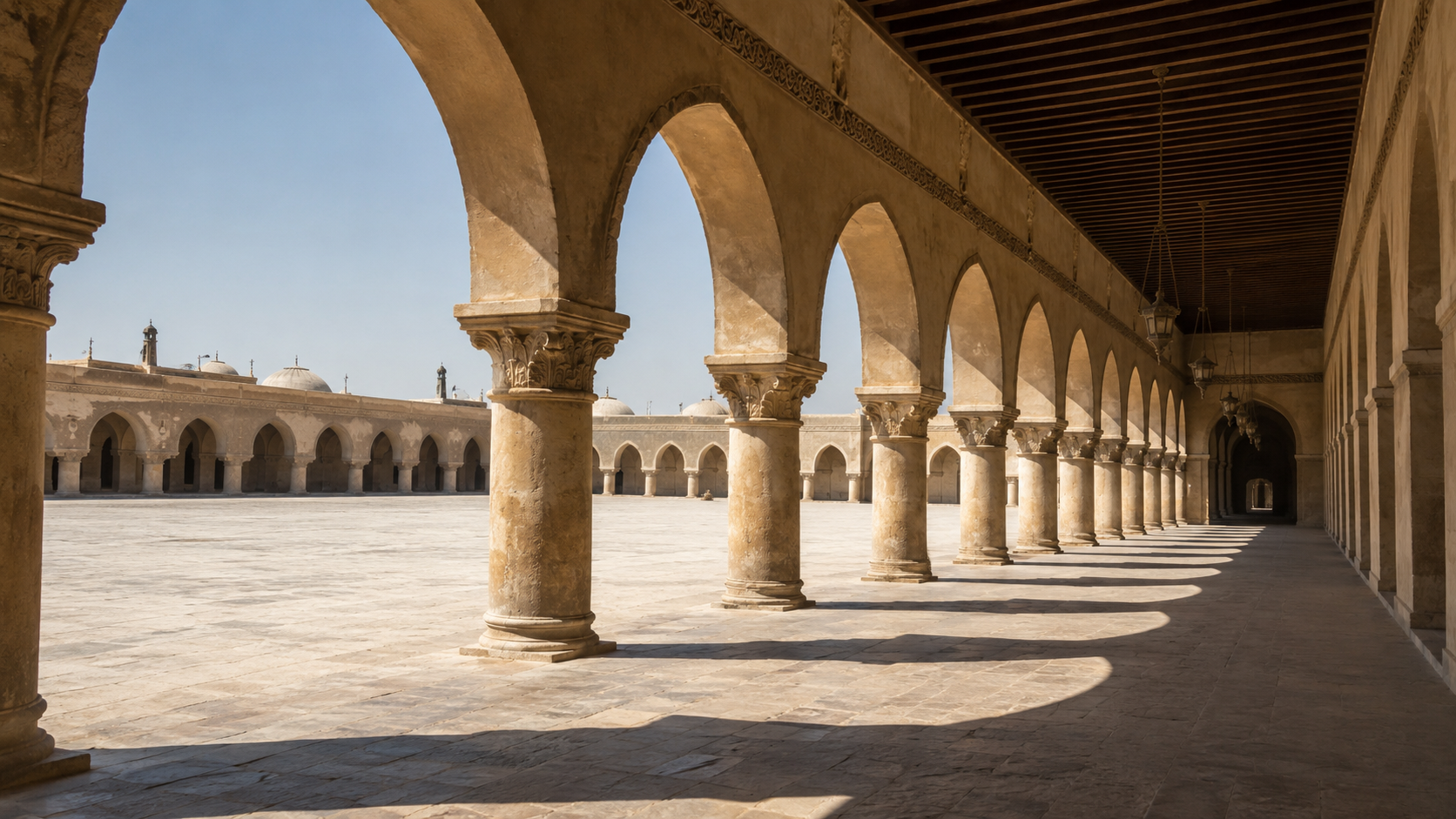
An Islamic arch has a job.
It holds weight, makes shade, marks a path, and gives a wall or courtyard a clear rhythm. In a mosque, it can lead the eye toward the prayer hall. In a courtyard, it can make movement feel ordered instead of random.
The shape depends on where it was built. Córdoba, Persia, Ottoman mosques, and Mughal India did not use the same arch for the same reason. Climate, material, structure, and use changed the form.
For the broader parent topic, start with Islamic architecture. This page focuses on the arch itself: how it works, how the main types differ, and why Islamic builders used arches for more than decoration.
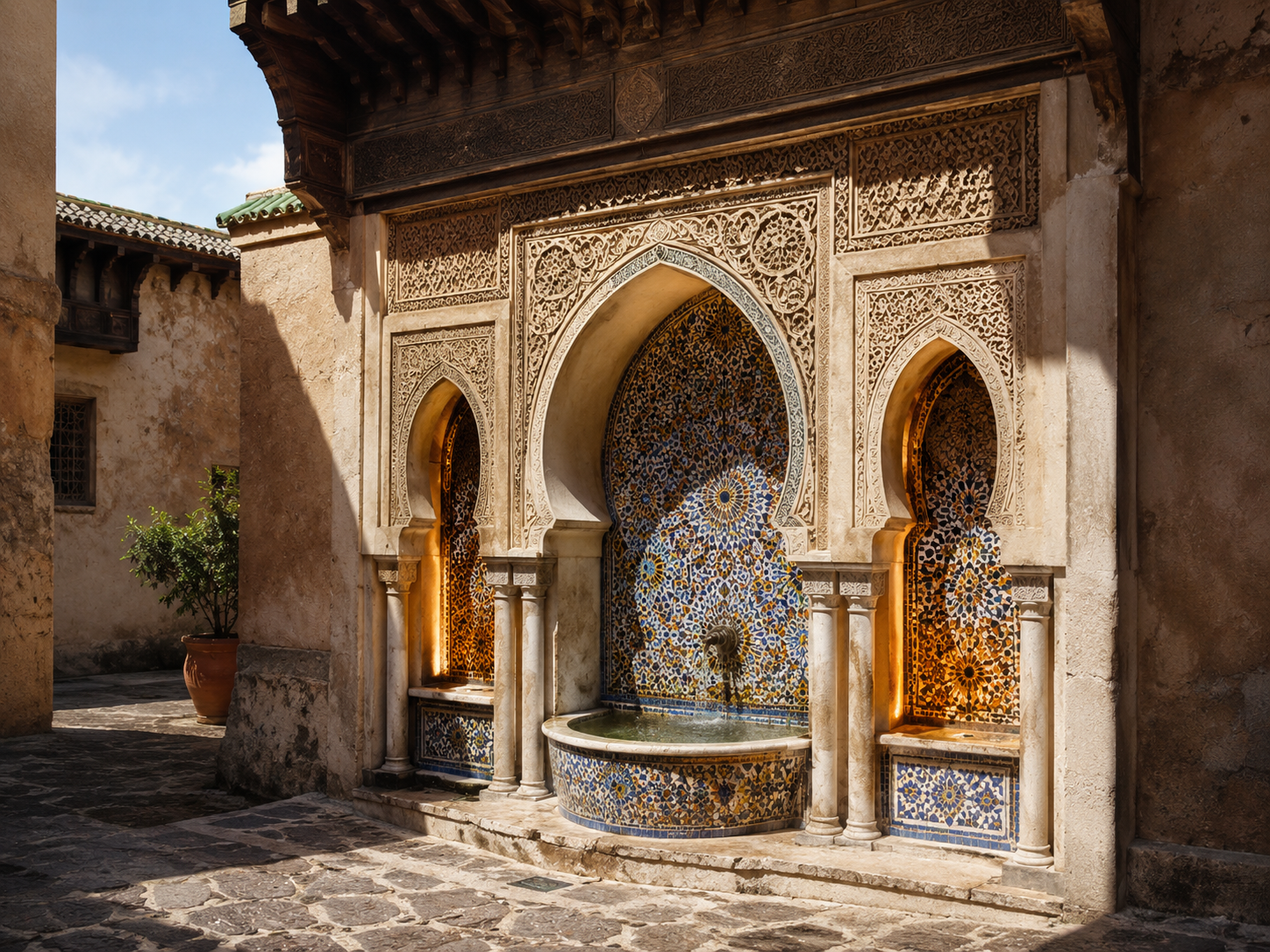
Start With What the Arch Does
A good arch is never only a shape.
It can span an opening, carry load into columns or walls, shade a walkway, frame a courtyard view, mark an entrance, or point attention toward a mihrab. In the best Islamic buildings, the arch is structure, movement, light, and meaning at the same time.
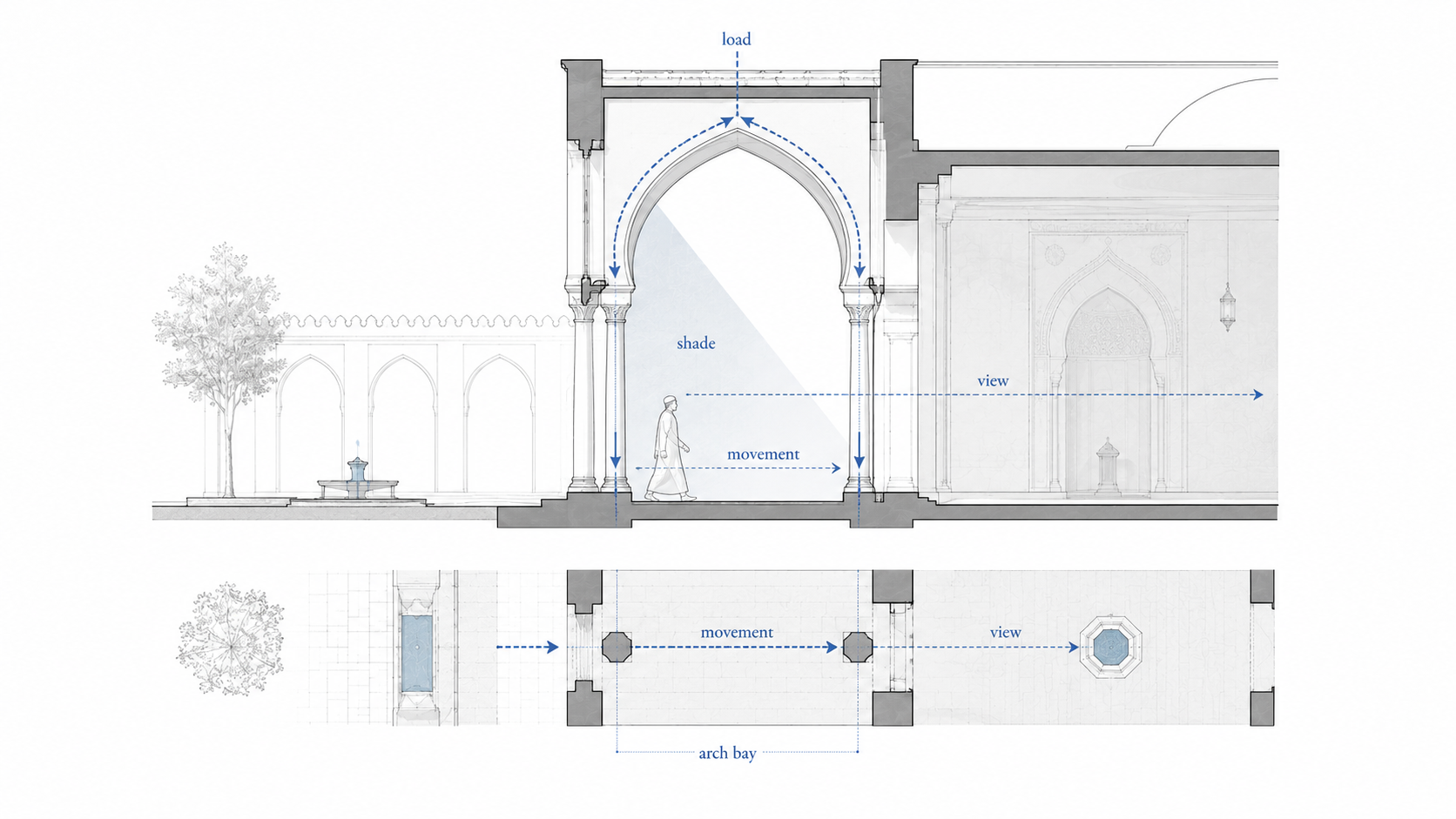
This is where many weak explanations go wrong. They list arch names before explaining the building problem. The useful question is simpler: what is the arch being asked to do here?
The Main Types of Islamic Arches
Islamic architecture is not defined by one arch type. Different regions developed different profiles because they had different materials, structural needs, craft habits, and visual traditions.
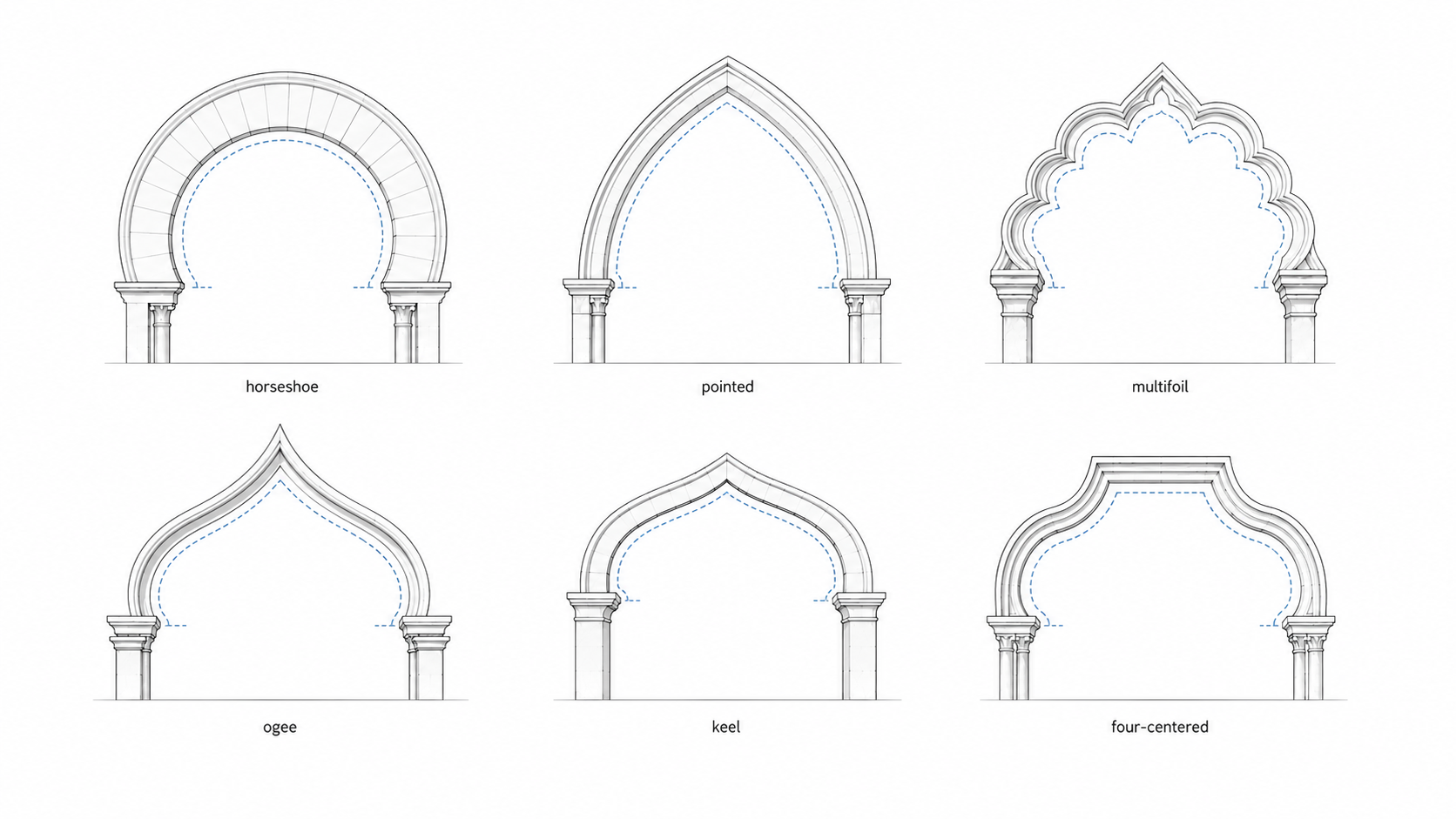
| Arch type | Where it often appears | What to notice |
|---|---|---|
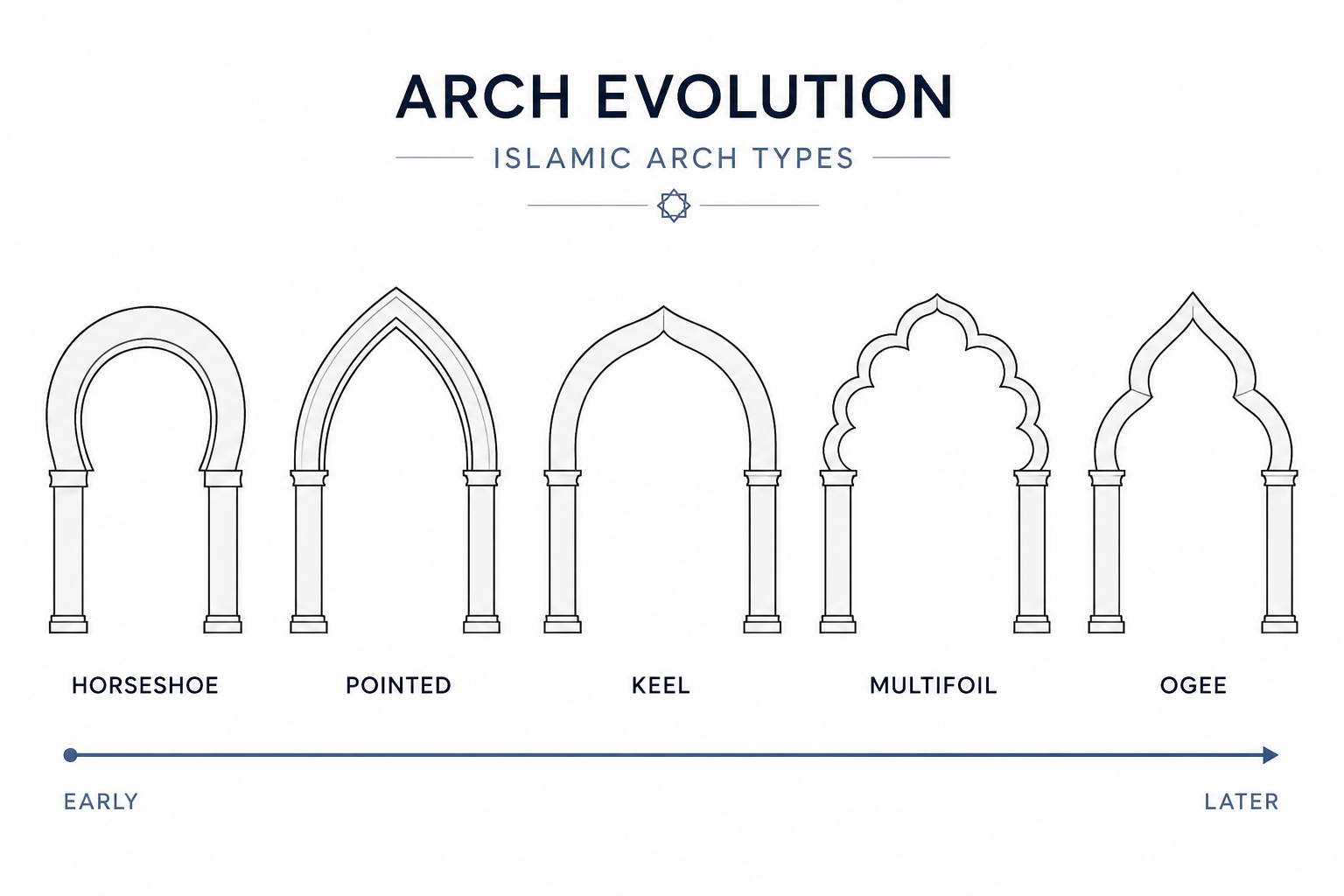
| Horseshoe arch | Andalusian, Moorish, North African, and earlier western Islamic buildings | The curve continues past a semicircle, giving the opening a strong inward grip. |
| Pointed arch | Persian, Seljuk, Abbasid, Mamluk, and later Islamic architecture | The peak helps direct load downward and gives the opening more vertical force. |
| Multifoil arch | Alhambra, Moorish interiors, North African and Andalusian ornamental settings | Repeated lobes create a lace-like edge while keeping the opening symmetrical. |
| Ogee arch | Mughal and Indo-Islamic architecture | The S-curve creates a softer, more elegant silhouette, often used for hierarchy. |
| Keel arch | Persian, Central Asian, and later regional Islamic forms | The profile rises to a sharper, boat-keel-like point. |
| Four-centered arch | Persian, Timurid, Mughal, and Indo-Islamic architecture | Several arcs create a broad opening with a controlled, flattened rise. |

Horseshoe Arches
The horseshoe arch curves beyond the semicircle before it turns down into the supports. That small change gives the opening more force and identity than a simple round arch.
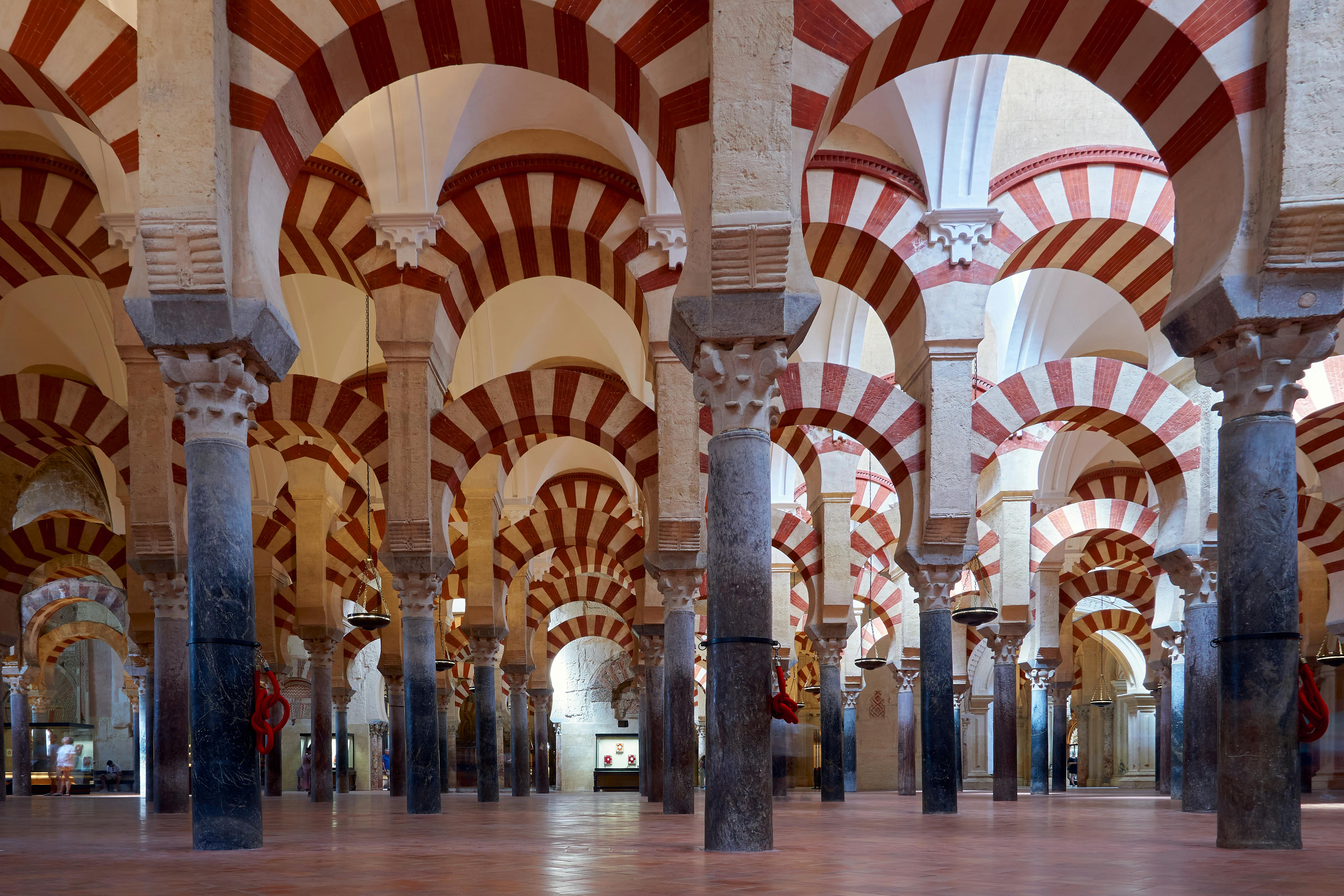
In Islamic Spain and North Africa, the horseshoe arch became one of the most recognizable forms. The Great Mosque of Córdoba is the obvious example, where repeated horseshoe arches create depth, rhythm, and a strong interior field.

The form is not only decorative. In an arcade, repeated horseshoe arches can make the eye move through the space bay by bay. They turn structure into rhythm.
Pointed Arches
The pointed arch rises from two curves that meet at a peak.
That peak gives the arch a different structural and visual character. It can help send loads down more efficiently than a simple round arch, and it gives interiors more vertical lift. Pointed arches appear across many Islamic regions, including Persian, Abbasid, Seljuk, Mamluk, and later mosque traditions.

The pointed arch also matters because it entered wider architectural exchange. Its movement through the Islamic world, the Mediterranean, Spain, Sicily, and Europe is one reason the arch becomes part of later Gothic conversations. That history is not a simple one-way handoff, but the connection is real enough to study carefully.
Multifoil Arches
A multifoil arch is made from repeated lobes. The edge can look scalloped, layered, or almost lace-like.
This type appears most strongly in Moorish and Andalusian settings, especially where the arch is doing visual and ceremonial work rather than carrying the heaviest load. It can frame a courtyard, soften a wall, or create a delicate threshold between rooms.

The danger is overreading it as decoration only. In palace architecture, a multifoil arch can also control view, depth, privacy, and approach.
Ogee Arches
An ogee arch has an S-shaped curve that bends inward and then rises to a point.
It is especially familiar in Mughal and Indo-Islamic architecture, where it appears in gateways, pavilions, tombs, and mosque openings. The shape softens the transition between vertical wall and pointed opening.

At the Taj Mahal, tall arched openings help create hierarchy, symmetry, and softness at the same time. The arch is part of the building’s order, not just a decorative outline.
Four-Centered and Multicentric Arches
Four-centered arches use several arcs to create a broad opening with a controlled rise. Related multicentric forms can be more complex, especially in Persian, Timurid, Safavid, and Indo-Islamic architecture.
These arches are useful when a building needs width without a very tall peak. They can frame iwans, gateways, halls, and transitional spaces.

Arch Forms Changed by Region
Islamic arches changed because Islamic architecture spread across different building cultures.
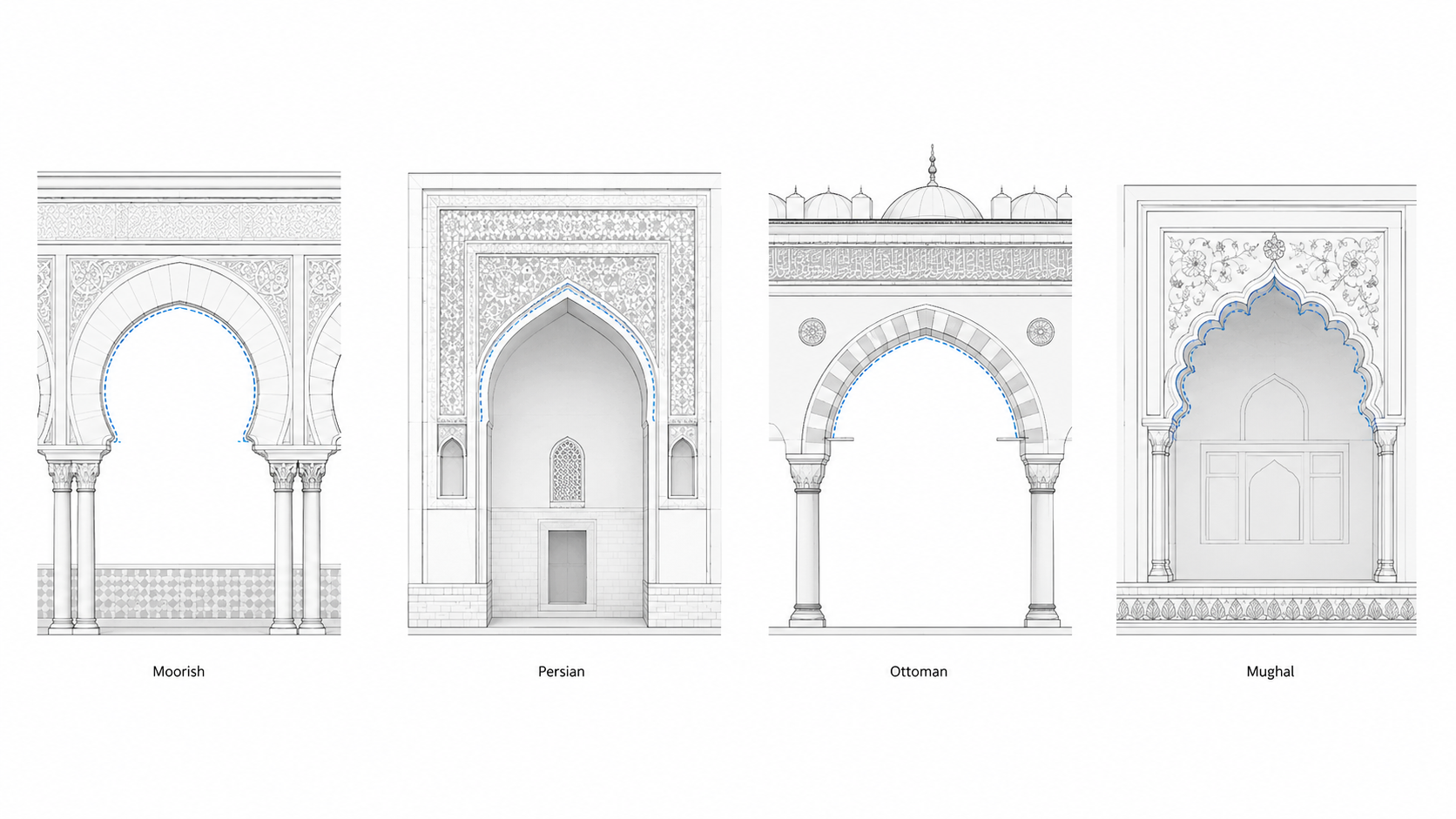
A Moorish arch in Granada, a Persian iwan in Isfahan, an Ottoman mosque arcade in Istanbul, and a Mughal ogee arch in Agra do not solve the same architectural problem. The names help, but the setting matters more.

| Region or tradition | Common arch reading | What changes |
|---|---|---|
| Andalusian / Moorish | Horseshoe, multifoil, scalloped, layered arches | Interior rhythm, court views, plaster detail, and controlled light |
| Persian / Seljuk / Safavid | Pointed arches, iwans, four-centered forms | Large courtyard edges, tiled surfaces, domes, and vaulted thresholds |
| Mamluk Cairo | Pointed arches, stone portals, layered openings | Urban entrances, heavy masonry, carving, and street presence |
| Ottoman | Broad mosque arches tied to dome systems | Centralized prayer halls, light, dome support, and interior unity |
| Mughal | Ogee and four-centered arches | Symmetry, garden order, marble, red sandstone, and monumental gateways |
Arches and the Mosque Plan
In mosque architecture, arches rarely work alone.
They frame arcades around courtyards, support prayer hall roofs, mark entrances, and help organize the qibla wall. In some mosques, rows of arches create a hypostyle hall. In others, arches help carry the dome system. In courtyard mosques, arches often form the shaded edge that makes the open court usable.

For the courtyard side of this system, read courtyards in Islamic architecture. For the larger list of mosque features, use characteristics of Islamic architecture.

Arches, Light, and Shade
Arches control more than structure. They control light.
A deep arch creates shade. A repeated arcade breaks hard sunlight into rhythm. A narrow opening can make the space beyond feel brighter. A courtyard arch can turn glare into shadow and movement.

This is one reason archways are so important in places such as the Alhambra. The arch is not just a view frame. It is part of how the building manages sun, shadow, approach, and privacy.

For the palace context, continue with Alhambra Palace architecture.
Arches and the Mihrab
One of the most important arch relationships is the mihrab.
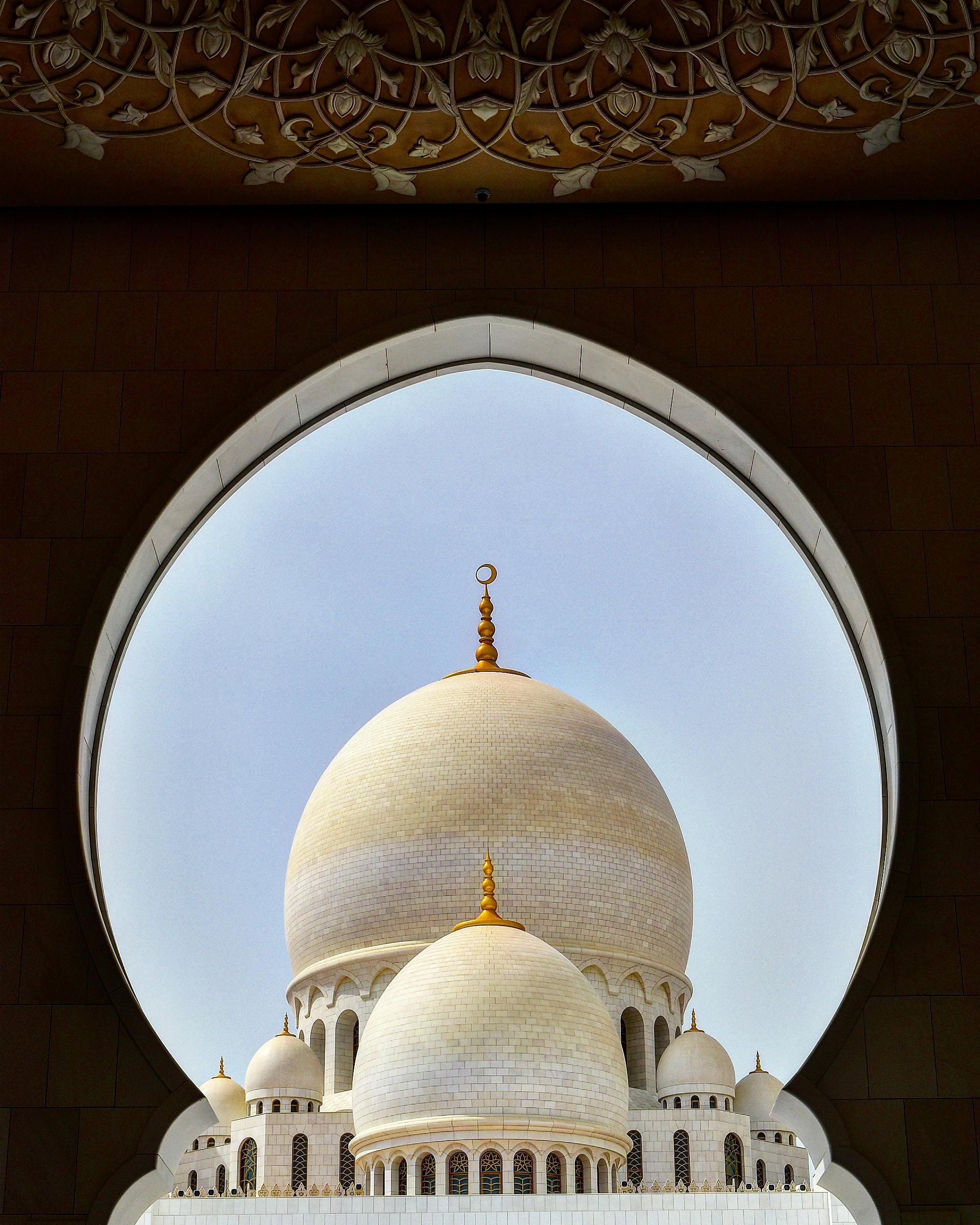
The mihrab is the niche in the qibla wall that marks the direction of prayer. It is often framed by an arch, and that arch does more than decorate the niche. It gives the prayer wall hierarchy. It pulls attention toward the direction of prayer. It makes one part of the wall feel different from the rest.
This is where arch, surface, and sacred direction come together. Calligraphy, tile, stone carving, geometry, and muqarnas can all strengthen the mihrab zone, but the arch often gives the first visual frame.
For related surface systems, see Islamic geometric patterns, arabesque patterns, and muqarnas architecture.
Arches and Acoustics
Arches can affect sound, but this needs to be handled carefully.
The curve of an arch, the height of a dome, the depth of a niche, and the hardness of stone, plaster, or tile can all change how sound moves. In a mosque, that matters. Speech, recitation, and prayer depend on clarity, not only volume.

It is easy to overstate this and claim every historic arch was acoustically engineered in a modern sense. The safer reading is stronger: Islamic builders understood space through use. They worked with curve, height, material, enclosure, and repetition long before microphones changed how religious buildings could function.
Arches in Famous Islamic Buildings
A short list works better than a monument dump. These examples show different arch problems.
| Building | Arch lesson | Why it matters |
|---|---|---|
| Great Mosque of Córdoba | Repeated horseshoe arches and striped voussoirs | The arcade turns the prayer hall into a deep rhythmic field. |
| Alhambra | Multifoil, scalloped, and delicate palace arches | The arch controls view, light, intimacy, and interior sequence. |
| Süleymaniye Mosque | Arches tied to a larger Ottoman dome system | The arch helps organize mass, light, and structural transition. |
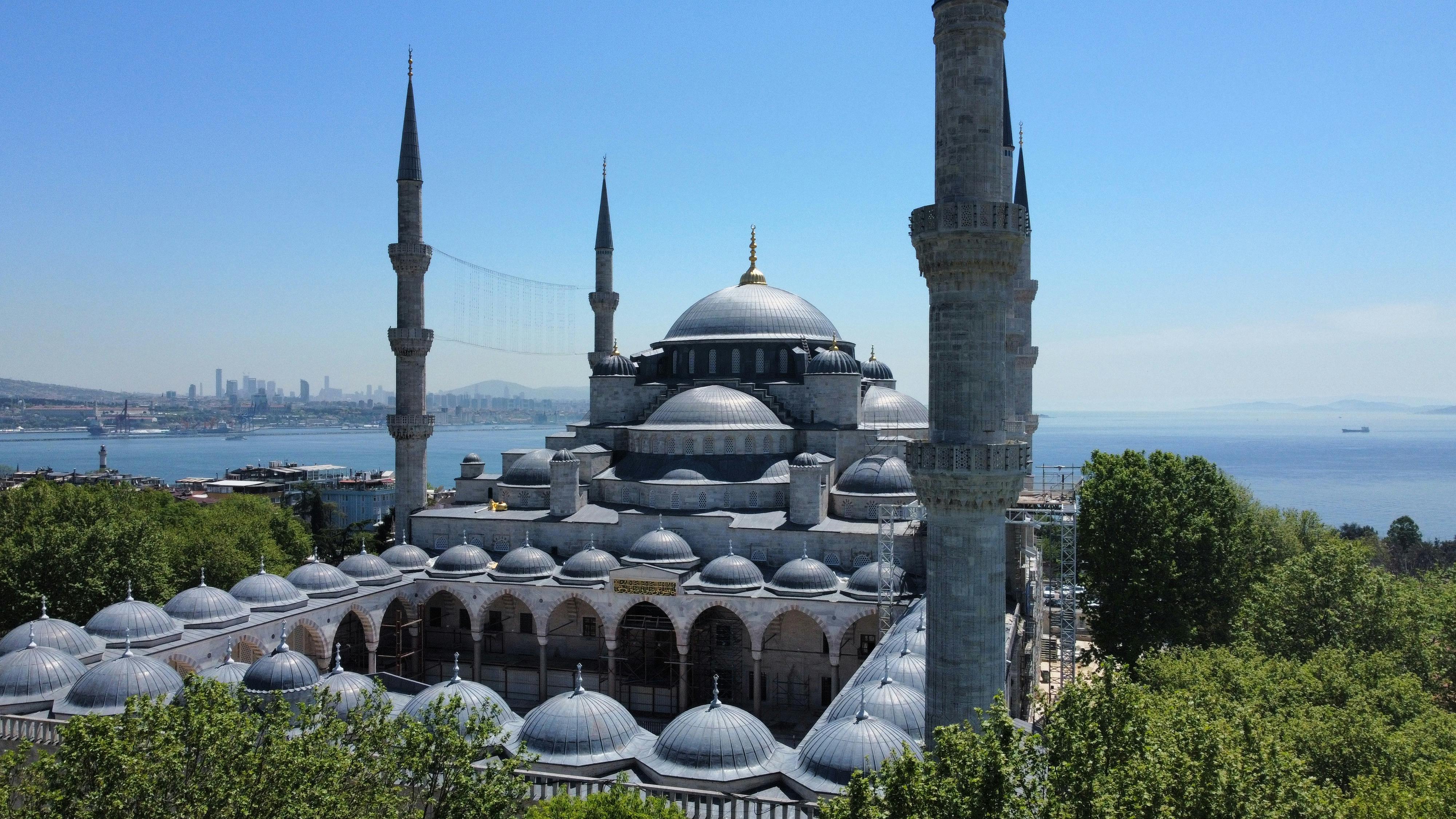
| Blue Mosque | Arcades and dome-supporting arches | The arch helps the eye move from ground level to the dome system. |
| Taj Mahal | Large ogee and recessed arched openings | The arch gives the marble mass hierarchy, softness, and symmetry. |
Modern Islamic Arches
Modern architects still use Islamic arch forms, but the best examples do not simply copy the outline.
A modern arch can shade an entry, frame a courtyard, hold a large span, soften a civic façade, or connect a new building to an older visual tradition. Concrete, steel, glass, and engineered stone allow larger spans and thinner profiles, but the old questions remain: what does the arch do, and where does it lead the eye?

The weak version uses the arch as branding. It pastes a pointed or horseshoe outline onto a glass wall and calls the building Islamic. The stronger version studies the older logic: shade, threshold, structure, rhythm, view, gathering, and light.

What Gets Copied Badly
The arch is one of the easiest Islamic forms to copy badly.
A pasted arch outline does not make a building thoughtful. If the arch does not carry structure, shade a threshold, frame a meaningful view, or organize movement, it can become surface decoration with no architectural weight.
The same problem appears in digital renderings. A designer adds a horseshoe or pointed opening, covers it with pattern, and stops there. But the strong historical examples rarely stop at shape. They connect the arch to the wall thickness, the column rhythm, the courtyard edge, the prayer direction, the dome, or the view beyond.
A better test is simple: remove the arch from the design. Does the space stop working, or does only the image change? If only the image changes, the arch was probably decoration.
How to Study Islamic Arches
Do not start by memorizing names.
Start with the building. Find the courtyard, prayer hall, wall, gateway, iwan, or mihrab. Then ask what the arch is doing there.
- Identify the arch profile: horseshoe, pointed, multifoil, ogee, keel, or four-centered.
- Look at the setting: mosque, palace, tomb, courtyard, gate, madrasa, or house.
- Check whether it carries load or mainly frames space.
- Notice how light and shadow fall inside the opening.
- Look at the surface: plain stone, tile, plaster, calligraphy, geometry, or carving.
- Ask what the arch frames: movement, prayer direction, garden, dome, street, or threshold.
That method is more useful than a style list. The arch only makes sense when it is read with the building around it.
Recommended reference: Robert Hillenbrand’s Islamic Architecture: Form, Function and Meaning is a serious architecture-focused book for readers who want building types, plans, regional differences, and design meaning in one place.
The Arch Only Works When the Building Needs It
Islamic arches are strongest when they are read as working architecture.
The profile matters, but the job matters more. A good arch carries weight, makes shade, marks a threshold, frames a view, leads movement, or gives a wall rhythm. The surface may be beautiful. The building explains why the arch is there.
FAQ
What are the main types of Islamic arches?
The main types include horseshoe, pointed, multifoil, ogee, keel, four-centered, and iwan-related arch forms. The exact profile depends on region, period, material, and building type.
What is a horseshoe arch?
A horseshoe arch curves beyond a semicircle before turning down toward the supports. It became especially important in Moorish and North African Islamic architecture.
What is a pointed arch in Islamic architecture?
A pointed arch is formed by two curves meeting at a peak. It can give a space more vertical lift and helps direct loads more efficiently than a simple rounded arch.
What is a multifoil arch?
A multifoil arch has several rounded lobes along the arch profile. It is common in ornate Andalusian and Moorish interiors, especially where the arch frames a view or ceremonial threshold.
What is an ogee arch?
An ogee arch has an S-shaped curve that rises to a point. It is especially common in Mughal and Indo-Islamic architecture.
How did Islamic arches influence Gothic architecture?
Pointed arches and other building ideas moved through contact zones such as Spain, Sicily, trade routes, and the eastern Mediterranean. Gothic architecture did not simply copy Islamic architecture, but the exchange of forms and techniques matters.
Are Islamic arches only decorative?
No. Many Islamic arches carry load, shade arcades, frame movement, mark sacred direction, control views, and organize large spaces. Ornament can be part of the arch, but it is not the whole story.
References and Resources
- The Metropolitan Museum of Art: The Mosque
- Archnet: Islamic architecture resources
- Aga Khan Development Network: Islamic architecture resources
Read This Next
For the parent topic, read Islamic architecture. For the main feature list, continue with characteristics of Islamic architecture. For the historical sequence, use Islamic architecture history.
For related design systems, read courtyards in Islamic architecture, Islamic geometric patterns, arabesque patterns, mashrabiya designs, and muqarnas architecture.