

Look at a wall in the Alhambra. It doesn’t sit still. Curves run into each other. Leaves twist into knots. You follow one line and lose it in another. That is arabesque.
It came from builders trying to fill space with life when figures weren’t allowed. They turned to vines, branches, flowers. Pulled them into endless rhythm. No start, no finish. Just motion.
You see it in Cairo woodwork, Ottoman tiles, Persian stucco. Always moving, always layered. Geometry set the frame. Arabesque gave it breath.
Origins and historical significance

Where it begins
Early Islamic roots
Arabesque began around the 8th century, as Islamic builders searched for ornament that carried meaning but avoided figural images. Stucco walls in Abbasid Samarra are among the earliest examples. Instead of flat surfaces, vines and leaves roll across panels like frozen movement.
The spread through empires
By the 11th century Seljuk Anatolia was experimenting with it. Carved stone portals mixed geometry with arabesque bands. Persia carried it further in manuscripts and tile. By the 14th century the Alhambra in Granada set a high point, every surface alive with looping tendrils.
Why it mattered
The symbolism was clear. Infinite lines stood for infinite creation. Interwoven leaves suggested the interconnectedness of nature and spirit. In mosques, arabesque let builders keep space sacred without figures. In palaces it projected refinement and power.
You might like: Islamic Architecture: Connecting History, Styles, and Global Impact
Characteristics of arabesque design
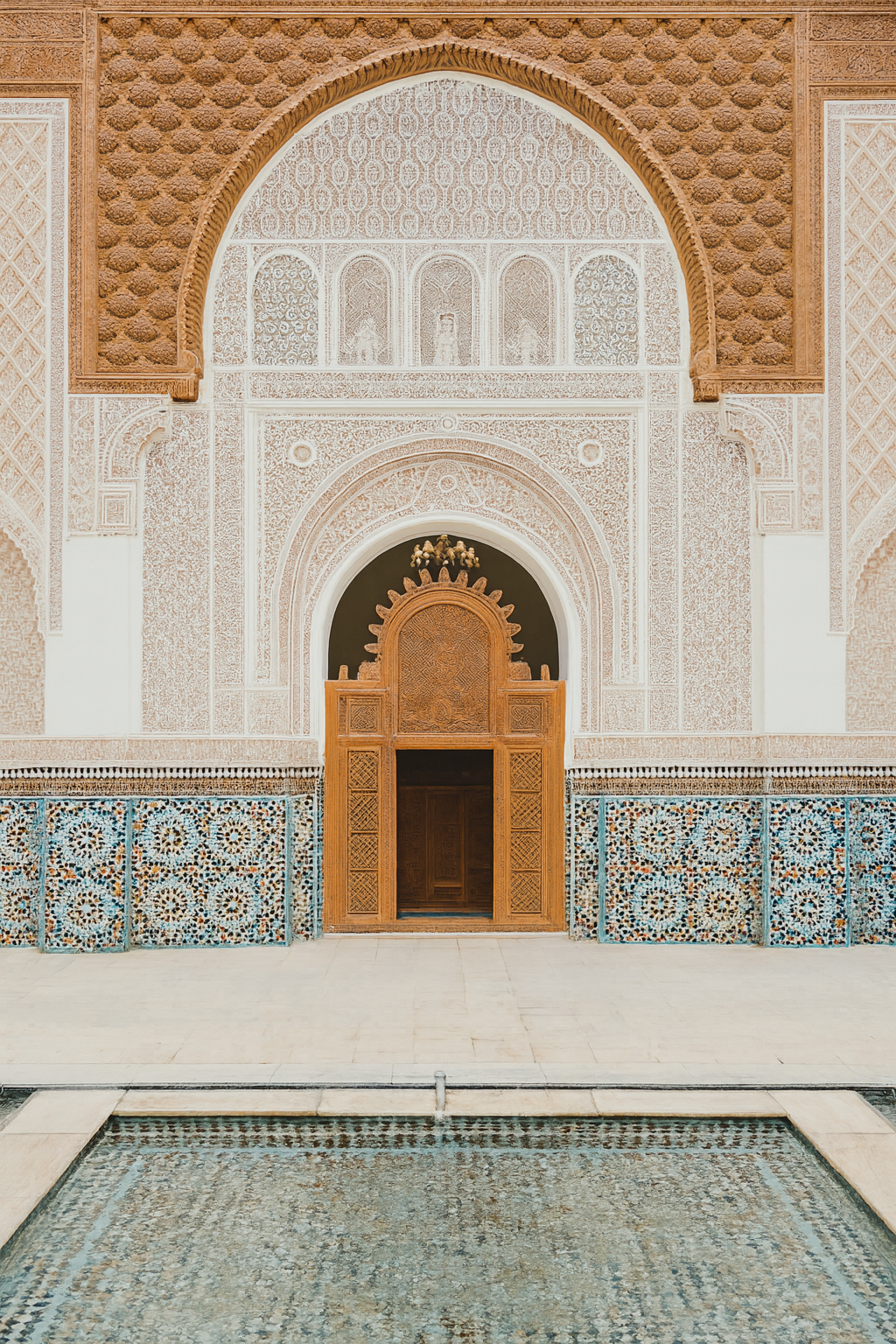
Flow over rigidity
Arabesque favors curves. Where geometry locks into grids, arabesque softens. A carved vine might turn sharply, then fade into another tendril. Surfaces feel animated.
Nature abstracted
Leaves and flowers appear, but rarely as literal plants. They’re simplified into forms that can repeat without losing rhythm. A tulip might become a single stroke. A vine becomes a looping S.
Controlled repetition
Patterns repeat, but never in a mechanical way. Variation keeps the eye moving. This balance—repeat but never bore—is why arabesque feels alive centuries later.
Integration
Arabesque rarely runs alone. It frames geometry, surrounds calligraphy, fills empty bands. Each system reinforces the other.
See also: Geometric Patterns
Design principles
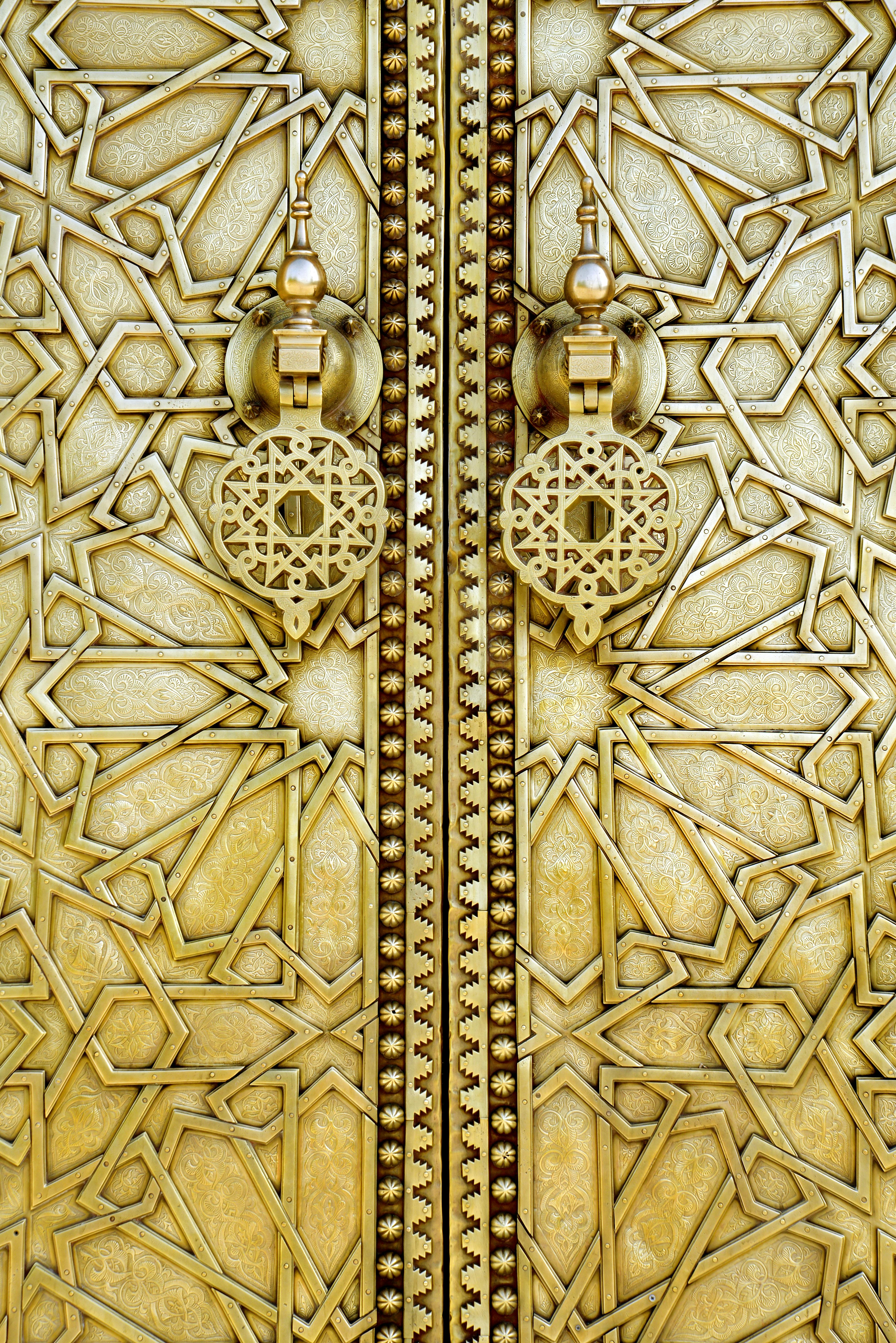
Endless extension
Lines don’t stop at the panel edge. They imply continuation beyond the surface. That sense of infinity was deliberate.
Balance, not mirror symmetry
Arabesque balances heavy and light zones rather than exact mirroring. A dense vine cluster on one side may be offset by open scrolls on the other.
Layering
Carvers cut in different depths so shadows gave dimension. Tile painters layered color so vines slipped over blossoms. Manuscripts used ink and gold to build layers even on flat parchment.
Scale shift
The same vine motif might stretch across a 20-meter dome or shrink into a two-centimeter Quran margin. Craftsmen trained small, then scaled up.
See also: Islamic Geometric Patterns
Tile domes, carved plaster, wood screens. The math is strict, but the result feels alive. Walk into a mosque in Isfahan and you’re standing inside geometry itself.
Case studies from history
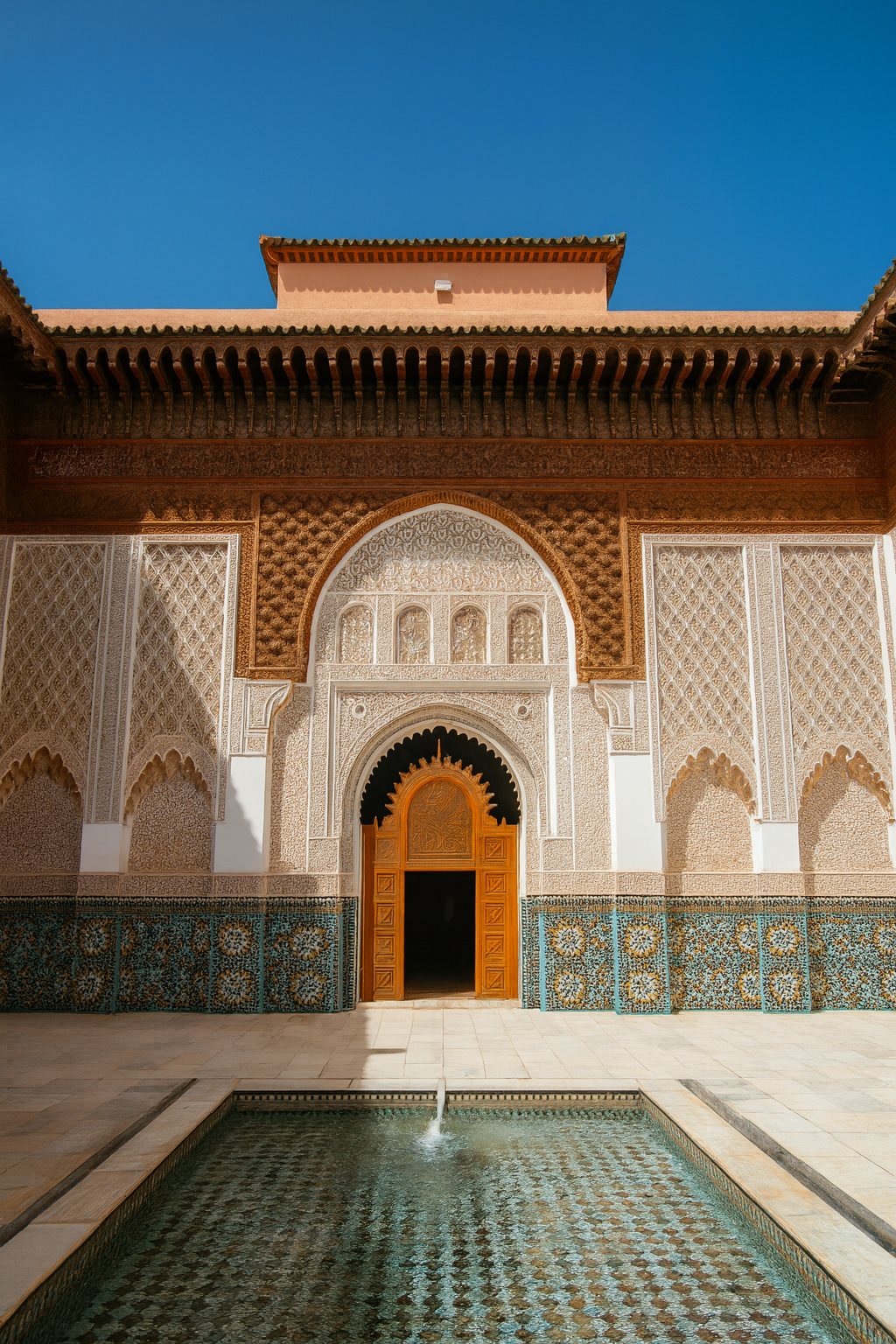
The Alhambra, Granada
Stucco arabesques flow across walls, often paired with Quranic calligraphy and polygon grids. Walk the Court of the Lions: every panel feels like vines woven into the wall. Light makes them shift throughout the day.
Cairo mosques
Fatimid minbars carved from wood, such as in Al-Hakim Mosque, show arabesque vines interlacing with stars. Mamluk Cairo carried the same logic into marble floors, mixing floral scrolls with rosettes.
Ottoman Iznik tiles
Sixteenth-century tiles from Iznik—still seen in Istanbul’s Topkapi Palace—merge floral arabesque with deep blue geometry. Tulips and carnations twist between stars, proving the two systems can live together.
Persian manuscripts
Safavid Qurans framed text with arabesque vines painted in gold and lapis. Borders weren’t decoration only. They were exercises in discipline. One slip in the brush ruined hours of work.
You might like: Arabic Geometric Patterns
Same logic, but broader than sacred use. Found in textiles, ceramics, manuscripts. A craft language shaped by centuries of trade.
Workshop realities
Tools
Carvers used compasses and grids as guides, but arabesque required chisels, brushes, steady hands. Stucco was scored wet, before it hardened. Wood required razor-sharp blades. Tiles needed fine brushes and control of glaze shrinkage.
Time
A single wooden panel for a minbar might take weeks. Stucco carving for a mosque wall took seasons. Manuscripts were no faster—border pages sometimes consumed days for a single vine band.
Mistakes
Arabesque punishes sloppy rhythm. Carve one leaf too fat, and the whole vine looks heavy. Brush too much glaze, and the line runs under firing. Cairo restorers often find old panels with patched leaves—proof mistakes were common, even for masters.
Shop culture
Apprentices copied patterns endlessly. In some Ottoman tile workshops, students painted vines on practice shards until their hand found rhythm. Only then could they move on to full panels.
Common missteps today
-
Over-symmetry. Designers mirror motifs too literally. Real arabesque balances instead of cloning sides.
-
Overuse. Filling every surface flattens the effect. The Alhambra teaches restraint: dense panels balanced by quiet plaster zones.
-
Bad scaling. Modern reproductions often blow motifs too large. Arabesque loses its pulse when stretched beyond proportion.
-
Cheap lighting. Flat LED washes kill depth. Arabesque comes alive under raking light where shadows make it move.
Lessons for modern design
Facades
Laser-cut metal screens with arabesque vines double as shading devices. Seen in Doha, Riyadh, Abu Dhabi. Done well, they echo tradition and reduce solar gain.
Interiors
Panels, rugs, textiles. A single arabesque wall can soften a rigid concrete frame. One Dubai apartment lobby I reviewed used carved plaster vines sparingly on a single wall—it lifted the whole space.
Graphics and branding
Brands in the Middle East often borrow arabesque curves for logos. When balanced, it signals heritage without kitsch.
Products
Furniture, lamps, ceramics. The same rule applies: restraint. A carved vine on a chair back reads strong. Cover the whole thing, and it turns cartoonish.
What arabesque really teaches a designer
Arabesque isn’t just a style. It’s a method for handling space. Builders used it to solve practical design problems that still matter today.
Controlling empty surfaces
A flat plaster wall can feel dead. Arabesque turned it into movement. Modern parallel: glass lobbies and blank drywall. Instead of hanging generic panels, architects can borrow the principle—let ornament create depth and motion without clutter.
Softening geometry
Islamic architecture leans heavily on squares, circles, and stars. Arabesque blurred those hard lines with curves, giving transitions a natural ease. You see the same need today in digital design: rigid grids balanced by soft edges or organic layering.
Scaling across media
Arabesque worked on everything from 2 cm manuscript borders to 20 m domes. That range is a lesson in scalability. If your design only works at one size, it fails. Arabesque proves a motif must survive at both detail and building scale.
Variation inside repetition
Repetition without variation looks mechanical. Arabesque hid subtle shifts—a leaf curling differently, a vine splitting. Modern designers can steal this trick. Pattern isn’t about copy-paste, it’s about rhythm that breathes.
Light as part of the pattern
Carved vines came alive only when shadows cut across them. Builders understood that pattern and light are partners. Translate that to today: don’t just design the pattern, test how daylight or artificial light will animate it.
What it teaches now
Arabesque proves design doesn’t need to be stiff to be ordered. Geometry gave Islamic builders structure. Arabesque gave them flow. Together, they turned stone and wood into living surfaces.
Builders today can learn the same lesson. Let proportions hold the frame. Let motion run inside it. One keeps you disciplined. The other keeps the work alive.
FAQ on Arabesque Patterns in Art and Architecture
1. What are arabesque patterns?
Flowing designs built from vines, leaves, and curves that repeat without end.
2. Where did arabesque originate?
Early Islamic art around the 8th century, with Abbasid stucco in Samarra as a first clear example.
3. Why did Islamic builders use arabesque?
To fill sacred spaces with life without showing figures. Infinite vines carried meaning without images.
4. What does arabesque symbolize?
Infinity, creation, interconnectedness. A line without beginning or end.
5. What materials carried arabesque best?
Stucco for carving, wood for panels, tile for color, parchment for manuscripts.
6. How is arabesque different from geometric patterns?
Geometry locks into grids and ratios. Arabesque bends, flows, and softens the edges.
7. What role did nature play?
Leaves, vines, and blossoms were the base forms, abstracted until they worked as repeatable rhythm.
8. Where can I see strong examples today?
Alhambra in Spain, Sultan Hassan Mosque in Cairo, Topkapi Palace in Istanbul, Safavid manuscripts in Iran.
9. Was arabesque only used in mosques?
No. It shows up in palaces, manuscripts, textiles, carpets, ceramics.
10. How did craftsmen design arabesque?
Compasses and grids set anchors. Curves were then drawn freehand within those guides.
11. Did arabesque require training?
Yes. Apprentices copied patterns for years before touching major panels.
12. What mistakes killed a pattern?
Overly fat leaves, sloppy rhythm, brush lines that bled under glaze. Any one mistake disrupted flow.
13. How long did panels take to make?
Wooden minbar panels could take weeks. Dome surfaces covered in vines took full seasons.
14. What’s the link between arabesque and calligraphy?
Often side by side. Calligraphy anchors text, arabesque fills borders and bands.
15. What’s the difference between arabesque and girih?
Girih is interlaced geometry made of polygons. Arabesque is flowing foliage. Often used together.
16. How did light affect arabesque?
Raking light made carved vines pop. Flat light killed depth. Builders tested panels under sun.
17. Why do Alhambra walls feel alive?
Stucco arabesques were cut in layers, catching shadows so the surface looked like it moved.
18. How did Ottomans adapt arabesque?
They blended it with floral motifs like tulips and carnations, especially in Iznik tiles.
19. How did Persians use arabesque?
In manuscripts and tiles, often with intense color and gold highlights.
20. Can arabesque be purely geometric?
No. Geometry frames it, but arabesque relies on organic curves. Without flow, it dies.
21. Was every pattern symbolic?
Not always. Some were pure craft, made to cover surfaces elegantly. Symbolism layered on after.
22. Why does arabesque feel infinite?
Lines loop without end. Craftsmen avoided closed, isolated forms. Everything connects.
23. Is arabesque still used in modern architecture?
Yes. Laser-cut facades, interior panels, rugs, branding elements.
24. What’s the risk in modern use?
Overuse. Too much arabesque feels kitsch. One strong panel works better than covering everything.
25. Did European art borrow arabesque?
Yes. Renaissance ornament books lifted Islamic arabesque motifs and spread them across Europe.
26. Why do some arabesques feel flat?
Because they’re repeated mechanically. Real arabesque thrives on subtle variation and layered depth.
27. Can arabesque exist without geometry?
Yes, but most strong examples use geometry as a frame. The two systems reinforce each other.
28. Did all cultures in the Islamic world use the same motifs?
No. Spain leaned on bold vines, Ottomans added florals, Persians layered color. Regional flavors shaped the style.
29. How should architects use arabesque today?
Tie it to function. Screens for shade, panels for acoustics, textiles for softness. Don’t just paste it as surface filler.
30. What does arabesque teach a designer?
That order doesn’t have to be rigid. Geometry sets the structure, arabesque gives it breath. Balance the two.
Related
Geometric Patterns
Basic grids. Circles, squares, triangles. Simple math turning into rhythm and balance. Used everywhere.
Islamic Geometric Patterns
Tile domes, carved plaster, wood screens. The math is strict, but the result feels alive. Walk into a mosque in Isfahan and you’re standing inside geometry itself.
Arabic Geometric Patterns
Same logic, but broader than sacred use. Found in textiles, ceramics, manuscripts. A craft language shaped by centuries of trade.