
Taj Mahal History, Story, and Architecture
The Taj Mahal is one of those buildings everyone thinks they already understand. White marble. Love story. Perfect symmetry. Done.
Then you walk it like a builder or an architect. Different story. The Taj is controlled. It is staged. It is structural risk management dressed up as paradise. The real power is not one detail. It is the whole system working together: site, approach, proportion, light, water, and a level of finishing discipline that most modern projects cannot afford anymore.
This guide covers the Taj Mahal story, the Taj Mahal built date, construction timeline, materials, design logic, interior, garden planning, and the myths people keep repeating. Plain English. Working professional lens. No brochure tone.
Taj Mahal Built Date, Built When, Built in Which Year
People ask this in ten different ways, so here is the clean answer.
- 1631 Mumtaz Mahal dies during childbirth.
- 1632 Taj Mahal construction starts.
- 1648 The main mausoleum is completed, and the project shifts hard into finishing, site works, and the rest of the complex.
- 1653 The full complex is generally dated as complete.
Quick build timeline that actually makes sense: a lot of pages throw around “completion dates” like they’re one clean moment. They’re not. The main tomb can be done while the gateway, courtyard, paving alignment, water systems, and surface detailing keep going for years. That’s why you’ll see 1648 and 1653 both used and both can be right depending on what the author means.
If you want a quick comparison for North India, the Delhi region has its own axis-and-monument logic in earlier work like Qutub Minar history, which helps you see how empires use height, gateways, and procession for control, not just beauty.
The Real Story of Taj Mahal (Love, Yes, But Also Empire)
The Taj Mahal was commissioned by Shah Jahan, a Mughal emperor with money, labor, and political ambition stacked in his favor. It was built for Mumtaz Mahal, his wife, after her death in 1631.
Now the part people oversell. They make it sound like he woke up sad and decided to build the world’s prettiest tomb. That is not how imperial projects happen.
This is what makes more sense if you have ever worked around power, big donors, governments, institutions, or anyone who can move large budgets without blinking.
Grief is real, but grief also becomes branding. A monument lets the ruler lock a narrative into stone. It says, “This is what my reign is.” And it forces everyone else to participate in that message just by walking through the gate.
The Taj is mourning, but it is also a public claim. It is also a flex. It is also a warning to rivals. It is also a statement to foreign envoys. It is also an internal message to nobles: the throne has resources and taste and absolute control.
That mix is why the Taj still hits people. It is not one pure emotion. It is complicated, like real humans.
RECOMMENDED TOOL (Book)
Islamic Architecture: Form, Function and Meaning
Why I recommend this: it helps you read monuments like systems (water, hierarchy, geometry), not as “pretty objects.”
About Taj Mahal Information That Matters (Site Choice and River Logic)
The Taj Mahal sits in Agra on the bank of the Yamuna River. That choice is not romantic. It is practical and symbolic at the same time.
Practical because riverbank soil is tricky and you need a foundation approach that spreads load and handles settlement. The Taj is heavy. Marble veneer is not light. The dome is not light. The platform is a serious slab of mass. You cannot fake that on weak ground without planning.
Symbolic because water is paradise-coded in Islamic architecture. Water means continuity, cleansing, reflection, and direction. Put a reflective pool on axis with the dome and you doubled the building without adding one stone.
Here is the professional point. A lot of buildings are average, but if the approach sequence and the site staging are perfect, people swear the building is magic. The Taj does not rely on magic. It relies on control.
If you want to zoom out and see how Islamic urban and regional context shapes form, read Islamic Cairo architecture. Different place, different climate, same obsession with procession, enclosure, and threshold.
Taj Mahal Garden Design (Charbagh, Axis, and Why the Tomb Sits at the End)
The garden is a charbagh, a four-part garden layout with water channels dividing the site. People say “Persian garden” and stop there. The real thing is what the garden does to your body and your camera.
Most classic charbagh tomb gardens place the tomb near the center. The Taj places the tomb at the far end by the river. That decision changes everything.
It creates a long approach that makes the building grow as you walk. You do not get a quick peak and then a long flat walk. It keeps expanding in your frame.
The reflecting pool on the main axis is not decoration. It is an optical amplifier. Your brain reads symmetry as stability and stability as authority. That pool locks you into the center line.
If you are a designer, steal this lesson. The sequence is half the building. Sometimes more than half.
For a parallel case where water and light are used like weapons, not ornaments, the Alhambra Palace light, water, and geometry breakdown is worth reading. Different era, same mindset.
Taj Mahal Architecture (The Plan Is Symmetry, Then One Human Break)
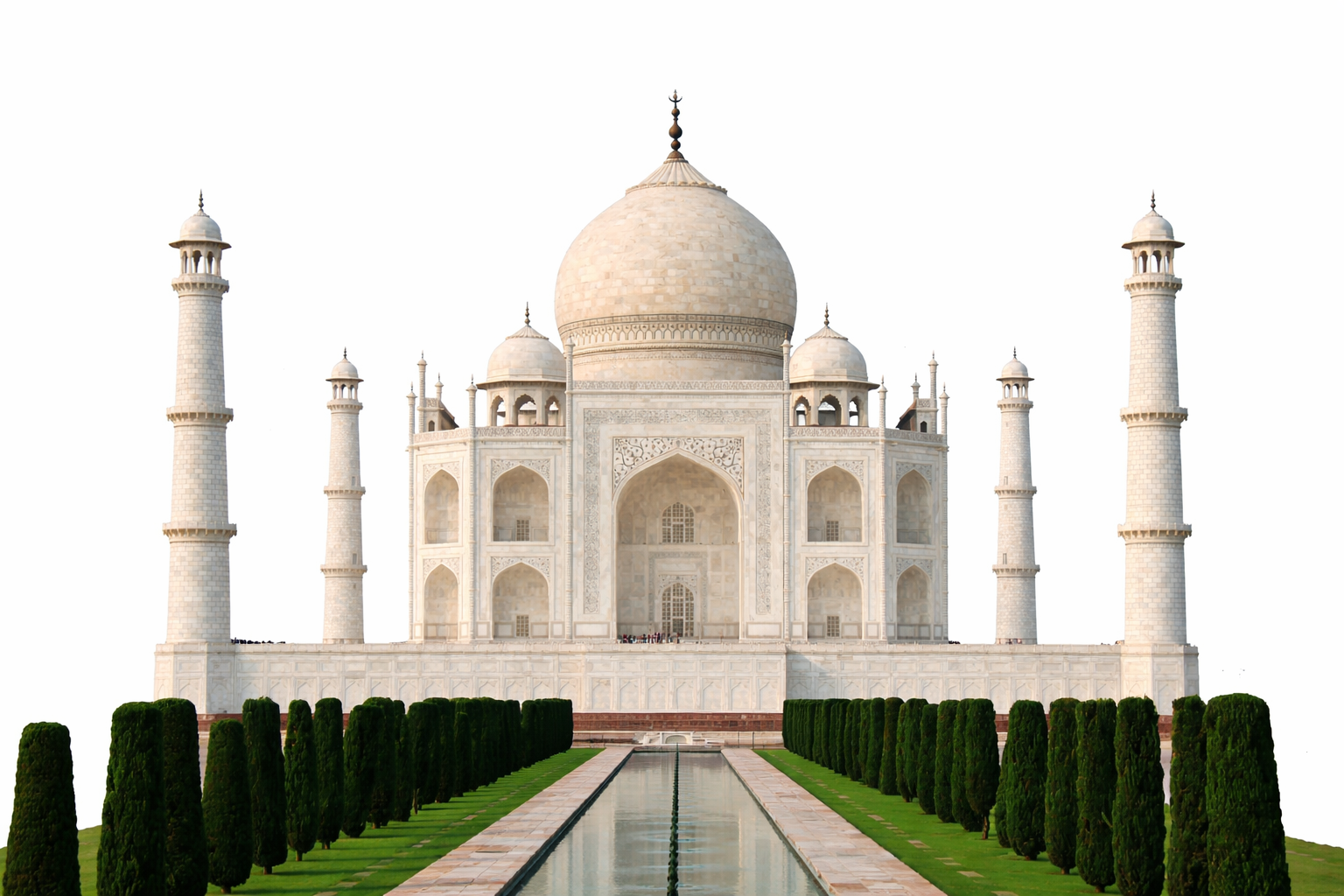
The Taj is famous for symmetry because it is genuinely extreme about it. The main tomb is centered, the flanking buildings mirror, the garden is a strict grid, the gateways align, the platform locks the geometry.
But the famous secret is that it is not perfectly symmetrical in the end.
Mumtaz Mahal’s cenotaph is centered. Shah Jahan’s cenotaph was placed later and it sits off-axis. It breaks the “perfect machine” feeling.
That one break is not a flaw. It is the human moment inside the empire machine. It tells you the project was not an abstract geometry exercise. It was a living political and personal site where reality entered the plan.
Architects know this pain. You design a clean grid, then plumbing arrives, then budget arrives, then ego arrives, and the grid gets punched. The Taj is the sacred version of that story.
If you want to compare how other monumental mosque complexes handle symmetry and court politics, read the Blue Mosque history.
The Architects of the Taj Mahal (Not One Hero Name)
The Taj wasn’t “one genius architect.” It was a board-of-architects setup under imperial control. You’ll see Ustad Ahmad Lahauri regularly named as the principal designer, but the more accurate professional read is that the project was directed like a court machine: lead designer, multiple major architects, and a huge specialist labor stack under tight supervision.
That matters because it explains why the building feels coherent across disciplines. Calligraphy does not fight the geometry. Landscape does not feel like an afterthought. The whole thing shares one set of priorities.
If you want a clean way to understand how features like minarets became both symbolic and structural devices, read The Architecture of Minarets: What They Are and How They Work.
Architectural Design of Taj Mahal (Square, Octagon, Dome, Done Right)
Most cheap “Taj-inspired” buildings fail because they copy the dome and ignore the geometry ladder under it.
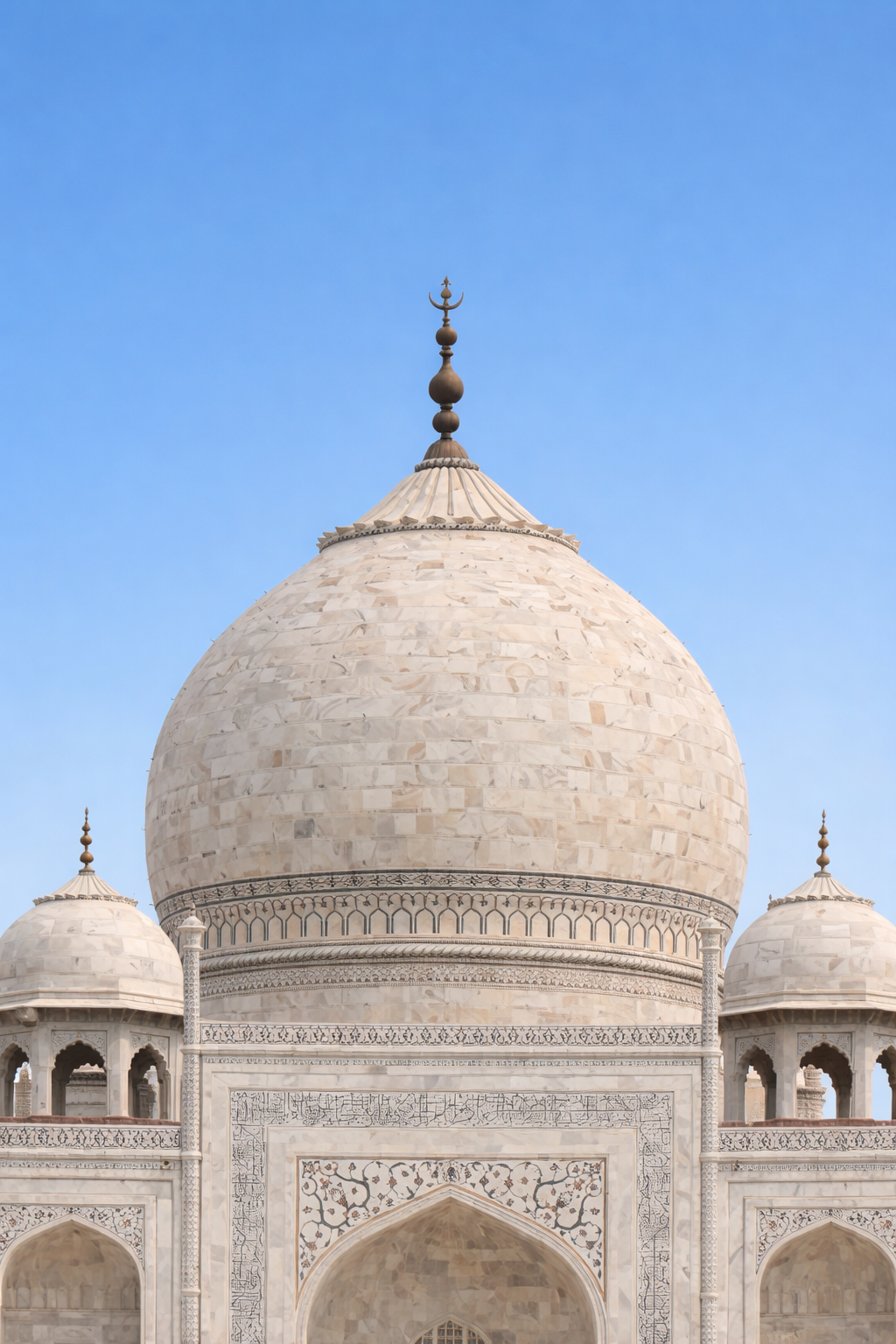
The core mass transitions cleanly from a square base into an octagonal logic using chamfered corners. This matters because it prevents the dome from feeling like a hat dropped on a box. The transition is the design.
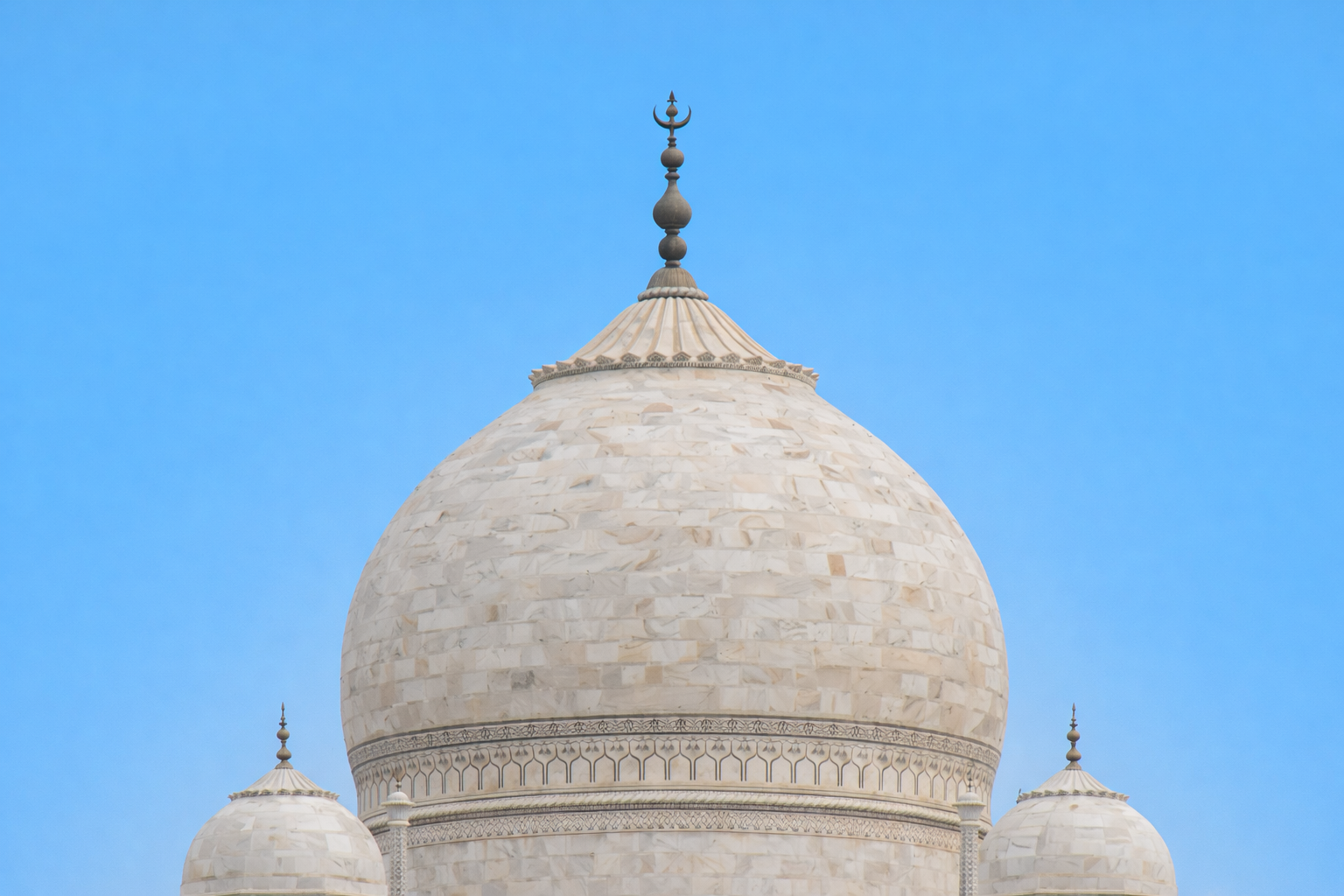
Then the drum and the dome sit above. The proportions are tuned so the building reads stable from far away and still feels detailed when you are standing on the platform.
One correction that cleans up a lot of bad internet writing: the Taj’s central dome height is often misquoted. A useful, simple way to say it is that the main dome rises to roughly 73 meters (about 240 feet) when measured up to the finial tip. That number tracks with how the building actually reads in the skyline: tall, dominant, and not “cute.”
If you want a clean vocabulary for Islamic geometry so you can describe what you are seeing without sounding like you are guessing, read Islamic geometric patterns.
Taj Mahal Minarets
Why They Lean, and Why That’s a Big Deal
Those four minarets are not there just to look “Islamic.” They frame the tomb and lock the composition. But the real professional detail is structural behavior.
The minarets tilt slightly outward. The intent is simple. If a minaret ever collapses, it should fall away from the central mausoleum, not onto it.
That is failure-mode design. Modern engineers talk about it all day. Historic builders were doing it with stone and experience.
Also, the minarets are functionally independent from the tomb mass. That separation reduces the chance that one failure drags the whole system down.
Want a second reference that stays practical and not poetic? Inside the design logic of Ottoman pencil minarets gives you a different regional lens that still helps you read the Taj’s “corner framing” move.
Taj Mahal Built With What (Materials, Marble, and the Expensive Parts)
The Taj Mahal is known for white marble. Specifically, the main mausoleum uses Makrana marble, the stuff that became a brand because it behaves well when polished and it holds detail.
But the complex is not only white marble. A lot of supporting structures use red sandstone, which is common in Mughal monumental work. The color hierarchy is not accidental.
White is the sacred center. Red is the frame and the support. The whole site reads like a diagram.
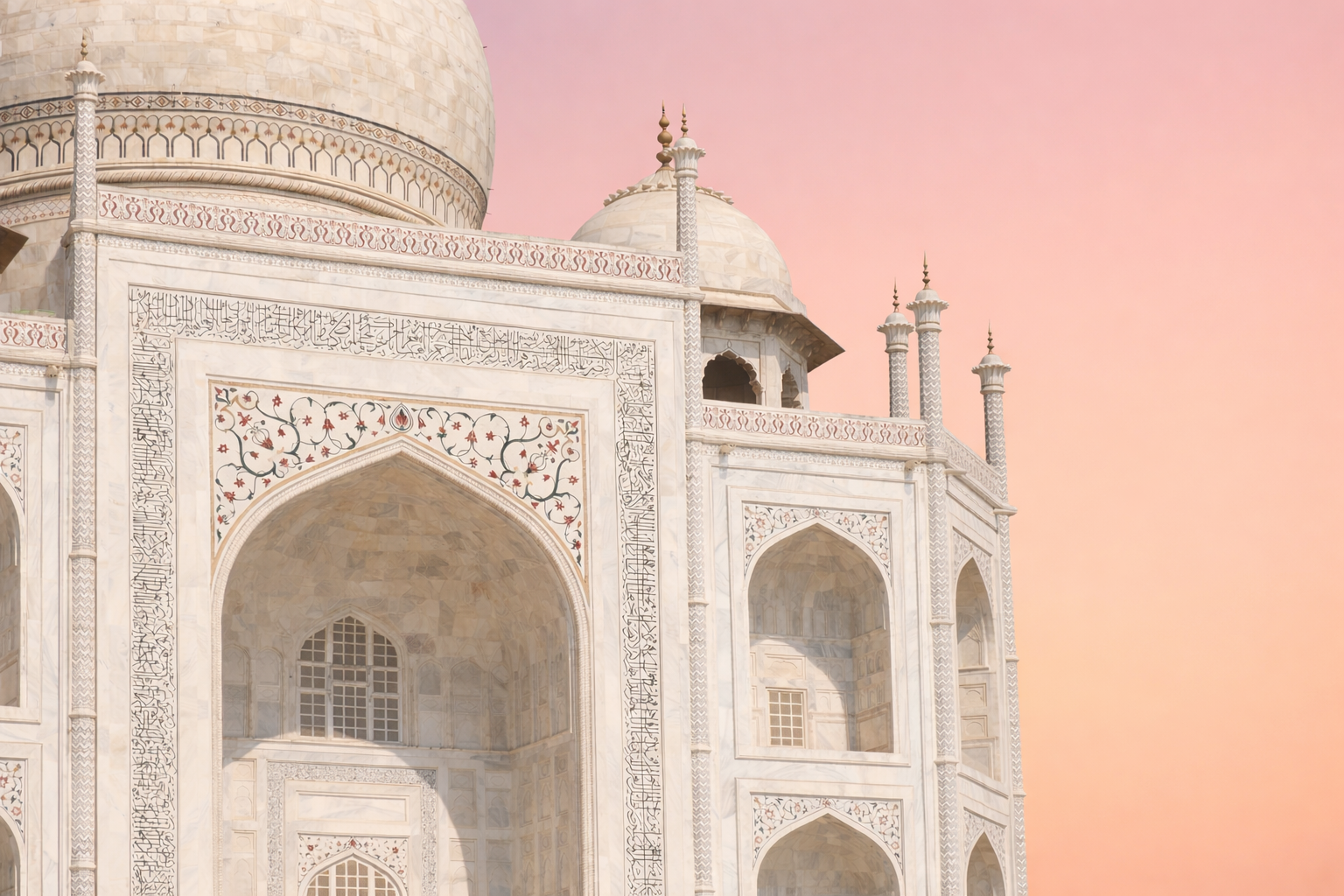
Then comes the inlay. Semi-precious stone inlay work is where the project stops being “a big marble building” and becomes the Taj.
This is not cheap craft. It is slow and unforgiving. Each stone is cut, shaped, and set flush into marble. If you slip, you ruin the fit. If you force it, you crack something. If your joints are sloppy, the whole panel reads cheap.
FIELD PICK (Book)
Islamic Art and Architecture: The System of Meaning
Why I recommend this: it explains ornament as a system of meaning, not “decoration for decoration’s sake.”
Taj Mahal Decorative Patterns, Calligraphy, and Optical Tricks
The Taj looks “perfect” because it cheats in smart ways.
Calligraphy is scaled so it reads consistent from ground level. Letters near the top are larger because your eye reads them from farther away. If they were all the same size, the top would look thin and weak.
Floral panels and surface framing also work like optical correction. Humans do not see evenly. We see with bias. The Taj compensates for that bias.
This is the same mindset behind entasis in classical columns and behind good signage kerning. It is not lying. It is building for human perception.
If you want a tight reference on arches and pattern logic that shows up across Islamic work, this fits naturally with what you are seeing at the Taj: Arches in Islamic architecture.
Taj Mahal Interior Design
Light, Echo, and Why People Automatically Whisper
Inside the Taj, the vibe changes fast. Outside is glare and crowds. Inside is filtered light and controlled sound.
The interior chamber is not “decorated” in the way people expect. The center is the cenotaphs. The real graves are below in a lower chamber. What you experience above is volume, symmetry, and restraint.
Light comes in indirectly through openings and bounces off pale stone surfaces. It softens everything.
Sound is a big part of it. Hard surfaces create a lingering echo. That echo makes people lower their voice. Nobody needs a sign that says “be quiet.” The room makes you do it.
This is sacred-space design done properly: the space controls behavior without begging for it.
If you want a broader explanation of how Islamic design uses form, function, and meaning together, this is a clean read: How form, function, and meaning shape Islamic architecture.
RECOMMENDED TOOL (Book)
The Mosque: History, Architectural Development & Regional Diversity
Why I recommend this: it makes mosque-adjacent planning and sacred-space logic easier to spot in any region.
Space, Form, and Balance: How the Taj Mahal Keeps You Oriented Without You Noticing
The Taj Mahal never lets you feel lost.
That sounds obvious until you realize how rare it is.
Most large historic sites overwhelm people. Too many paths. Too many objects. Too many decisions. You drift, you zigzag, you miss half of it.
The Taj does the opposite.
From the first step inside the complex, your body always knows where it is in relation to the whole. Not because of signs. Not because of guides. Because the space itself is doing quiet correction.
The trick is balance, but not the decorative kind people usually talk about.
This is spatial balance.
The main axis is obvious, but what matters more is what sits on either side of it. Every major element has a counterweight. The mosque on one side. The jawab, its mirror twin, on the other. Same mass. Same proportion. Different function.
Your brain reads this as stability.
Even when you step off the main path, the balance pulls you back. You never wander too far before the axis reappears in your peripheral vision. That is not accidental placement. That is spatial discipline.
The form of the mausoleum does the same thing vertically.
The square base feels grounded. Heavy. Settled.
The octagonal transition loosens the grip just enough to prepare you for the dome.
The dome finishes the move without ever feeling top-heavy.
This is why the building feels calm instead of monumental in an aggressive way. Nothing is fighting for dominance. Every form knows its role and stops at the right moment.
Balance also shows up in what is not there.
No unnecessary projections. No random ornament breaking the silhouette. No secondary domes competing for attention. The Taj refuses visual noise.
That restraint is doing work.
It keeps your eye moving slowly instead of bouncing. It keeps your body aligned with the space. It keeps the experience readable even when the site is crowded.
This is why people instinctively stand in the same places, take similar photos, and pause at similar points without being instructed.
The space is tuning behavior.
Most modern buildings fail here because they try to impress from every angle at once. The Taj picks one clear idea and protects it across every scale.
Balance is not decoration here.
It is control.
And it is one of the quiet reasons the Taj Mahal still feels composed, legible, and emotionally steady centuries after it was built.
Taj Mahal Building Structure and Construction
Tourist talk focuses on romance and marble. Builders care about boring problems. Heavy loads. Settlement. Water. Transport. Labor control. Finishing tolerances.
The Taj is heavy. The platform is heavy. The dome is heavy. If your foundation logic is wrong, you do not get a second chance. You get cracks, movement, and slow failure that never stops.
Then transport. Marble and stone came from far away. Moving that material required a serious logistics machine. It is not just “elephants did it.” It is scheduling, storage, theft prevention, tool maintenance, and quality control on every block.
And then the finishing. This is where projects die. Not because the structure collapses, but because finishing takes forever and costs a fortune.
The Taj had the budget and the authority to keep finishing going until it met a standard. Most modern projects do not. That is why modern “luxury” often feels thin. The finish program gets value-engineered into something safe and bland.
If you want a clean way to show readers how Islamic architecture evolves across regions and why Mughal work looks the way it does, point them to Islamic architecture history.
One Last Practical Take
(What the Taj Teaches Modern Builders)
If you take nothing else from the Taj Mahal, take this.
The approach is design. The Taj would still be impressive as an object, but it becomes unforgettable because the walk, the gate, the axis, the reflection, and the platform are all built to control perception.
Finishing is where quality lives. Most projects die in the finishing phase. The Taj survived because the empire could keep paying for precision until the surfaces met a standard.
Failure planning is not modern. Those minarets leaning outward are a quiet admission that things can fall. They designed the fall away from the core.
Fun Facts About the Taj Mahal
- It is a whole complex, not one building: tomb, mosque, mirror building, gateways, courtyards, gardens, water infrastructure.
- It is staged for the approach. The main gate frames the first reveal like a camera.
- It uses hierarchy in color. White marble dominates the sacred center, red sandstone supports the frame.
- It is full of optical correction. Calligraphy and motifs scale so they read balanced from human eye level.
- It has a controlled failure idea. Minarets lean outward to protect the tomb if they ever fall.
Myths and Fake “True Story” Claims
Myth: Workers’ hands were cut off so nobody could copy the Taj.
This survives because it sounds dramatic. It is not a reliable historical claim. It is the kind of rumor people repeat when they cannot accept that skilled craft plus serious organization can produce something this refined.
Myth: It was originally a different religious building and got rebranded.
Also a recurring internet claim. If someone wants to argue it, they need primary evidence, not vibes. The Taj’s complex layout fits Mughal funerary planning cleanly.
Truth: It is political, not only romantic.
The romance is real. But a monument at this scale is always a public project. It shapes legacy.
A Visit to a Historical Place: Taj Mahal
(Seen Through an Architect’s Eyes)
You do not arrive at the Taj Mahal the way you arrive at a normal building.
You are slowed down before you even realize it.
The first real moment is the gate. Not the ticket area. Not the crowd. The gate itself. It is not a passage. It is a lens. The opening is tall, dark, and controlled. Your field of view narrows. Your peripheral vision shuts down. Then the white marble appears inside that frame like a controlled reveal. Bright. Flat. Almost unreal.
This is not drama. It is spatial compression and release. Old trick. Perfectly executed.
You step through and the axis takes over. A straight line. No debate about where to walk. The reflecting pool grabs your eye and refuses to let go. You think you are choosing your path. You are not. The site is choosing it for you.
The building grows as you walk. Not fast. Not slow. Just enough that your brain keeps recalibrating scale. The dome never jumps at you. It stays calm. That calm is deliberate. It keeps the building from feeling theatrical. It feels inevitable.
By the time you reach the platform, something shifts.
The Taj stops being a skyline object and turns into a surface object.
This is where architects wake up.
You start noticing joints. Shadow lines. How the marble panels align. How nothing drifts. How the inlay work does not scream for attention but holds up when you lean in close. This is where most monuments fail. They look good from far away and fall apart at arm’s length.
The Taj does the opposite. It gets stricter.
Inside, the space tightens emotionally. The light softens. It does not pour in. It arrives indirectly, bounces, settles. Sound stretches. A single footstep lingers longer than expected. People lower their voices without being told. No signs. No guards. The room handles it.
This is architecture doing behavioral work.
You feel the geometry even if you cannot name it. Square to octagon to dome. Stable. Quiet. No wasted movement.
Most visitors stand under the dome and look up. That is expected.
The move most people miss comes after.
Turn around.
Look back through the space you just walked.
From here, the entire complex reads at once. The garden. The axis. The gateways. The mosque and its mirror twin. You realize the tomb is not the object. It is the anchor.
The project is the system around it.
That is when the Taj finally makes sense.
Not as a symbol. Not as a love story. Not as a postcard.
As a perfectly controlled sequence of spaces that never lets you rush, never lets you dominate it, and never gives you everything at once.
You leave without a single dramatic gesture from the building.
And that restraint is exactly why it stays with you.
The One Thing the Taj Mahal Does That Almost No One Talks About
(And Why It Still Works)
Here’s the part that almost every Taj Mahal article misses.
The Taj Mahal does not rely on detail to impress you.
It relies on distance management.
Most famous buildings are designed to look good from one main viewpoint. Either far away or up close. Rarely both.
The Taj is different. It is engineered to behave differently at every distance you encounter it.
From far away, it reads as a clean, almost abstract mass. White dome. Four minarets. Calm skyline. Nothing fussy.
At mid-distance, the geometry takes over. The square, the octagon, the dome, the axis. You start reading order, not decoration.
Up close, suddenly the building breaks into insane levels of precision. Stone inlay you did not see before. Calligraphy joints that are perfectly tight. Panel edges that do not drift. No sloppy transitions.
This is not accidental. It is a design strategy.
Most buildings dump all their effort into one scale. The Taj deliberately spreads its effort across scales. It gives just enough information at each distance to keep you moving forward.
That is why people walk slower without realizing it.
That is why photos never feel like enough.
That is why the building doesn’t “get old” the longer you stand there.
Here’s the brutal architectural truth hidden inside this move:
If a building reveals everything at once, people get bored.
The Taj withholds.
It makes you earn the next layer.
This is also why cheap replicas fail so badly. They copy the dome and the symmetry, but they compress all the information into one scale. You see everything immediately, and there’s nowhere for the eye to go after that.
The Taj never makes that mistake.
It behaves more like a well-written argument than a sculpture. Each step gives you just enough clarity to keep listening.
That is not romance.
That is architectural discipline.
And it is something modern buildings almost never get right anymore, because it takes restraint, time, and the willingness to leave things unresolved until the visitor physically arrives.
That single decision — to design for distance, not just form — is why the Taj Mahal still feels alive instead of frozen in history.
Once you see that, you can’t unsee it.
And once you start designing with distance in mind, everything else you build starts getting quieter, stronger, and harder to forget.
Short Story of Taj Mahal (Fast Version for Students)
The Taj Mahal is a Mughal-era mausoleum in Agra, India, commissioned by Emperor Shah Jahan in memory of his wife Mumtaz Mahal. Construction began in 1632 and the full complex is generally dated as completed by 1653, with the main mausoleum completed earlier. It is famous for its white marble tomb, symmetrical planning, charbagh garden, detailed calligraphy, and stone inlay work, and it remains one of the most recognized historical buildings in the world.
Taj Mahal Information in Hindi (Simple)
ताज महल आगरा में यमुना नदी के किनारे स्थित एक मुगल मकबरा है। इसे बादशाह शाहजहाँ ने अपनी पत्नी मुमताज़ महल की याद में बनवाया था। इसका निर्माण 1632 ई. में शुरू हुआ और पूरा परिसर 1653 ई. के आसपास पूरा माना जाता है। मुख्य मकबरा सफेद मकराना संगमरमर, सुंदर जड़ाई, और कुरआनी लेखन के लिए प्रसिद्ध है।
Taj Mahal Story in Urdu (Short)
تاج محل آگرہ میں دریائے جمنا کے کنارے واقع ایک مغلیہ مقبرہ ہے۔ اسے شاہجہان نے اپنی اہلیہ ممتاز محل کی یاد میں تعمیر کروایا۔ تعمیر 1632ء میں شروع ہوئی اور 1653ء کے قریب مکمل سمجھی جاتی ہے۔ یہ سفید مکرانہ سنگِ مرمر، خطاطی، اور پتھروں کی جڑائی کے باعث دنیا بھر میں مشہور ہے۔
FAQ
Who built the Taj Mahal?
It was commissioned by Mughal Emperor Shah Jahan. The work was executed by a court-run board of architects, master builders, craftsmen, calligraphers, and large labor teams under imperial control.
Taj Mahal built for whom?
It was built for Mumtaz Mahal after her death in 1631. Shah Jahan was later buried there as well.
Taj Mahal built in which year?
Construction started in 1632. The complex is generally dated as completed around 1653, with the main mausoleum completed earlier.
What is the Taj Mahal made of?
The main mausoleum is faced in white Makrana marble. The surrounding complex uses red sandstone and other materials typical of Mughal monumental construction.
Why is Taj Mahal architecture considered a masterpiece?
Because it is not just a pretty object. It is a full system where site planning, axis control, proportion transitions, optical correction, finishing discipline, and structural safety choices all work together.
What are the most important architectural features?
- Charbagh garden and central axis
- Raised marble platform
- Four outward-leaning minarets
- Dome and drum proportion control (so the skyline and interior both work)
- Calligraphy and inlay executed with optical correction