
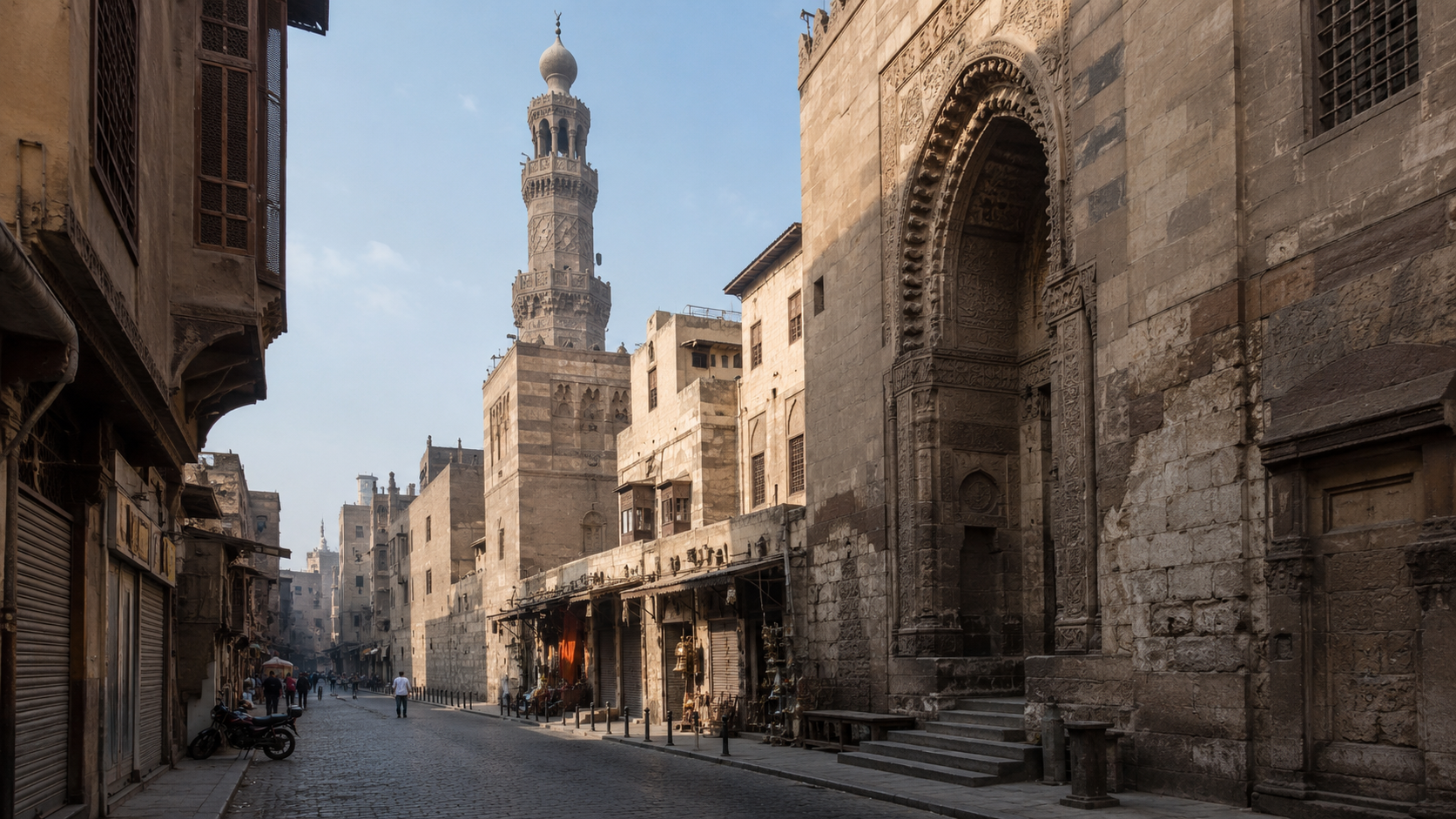
Islamic Cairo is not a quiet museum district.
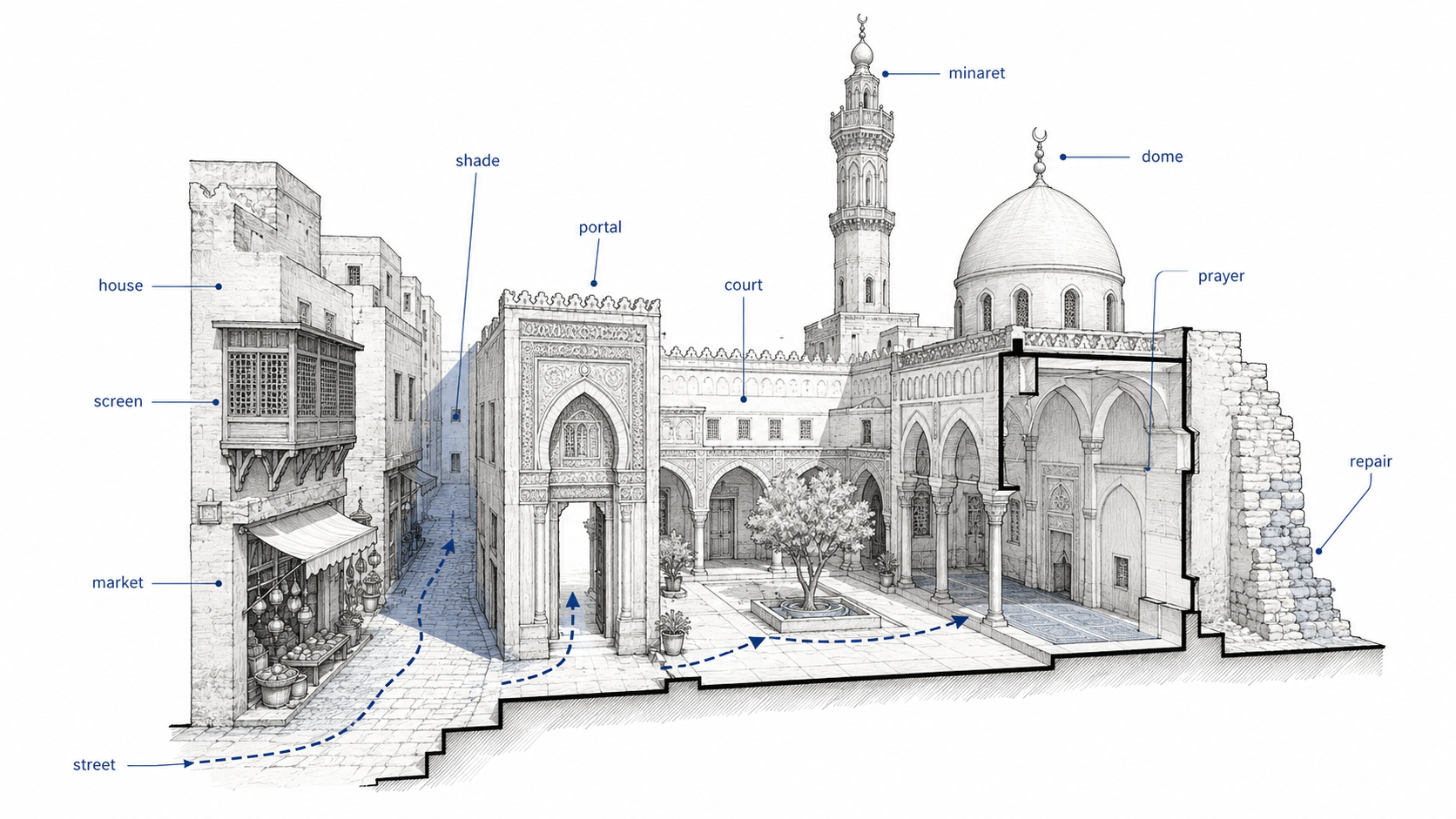
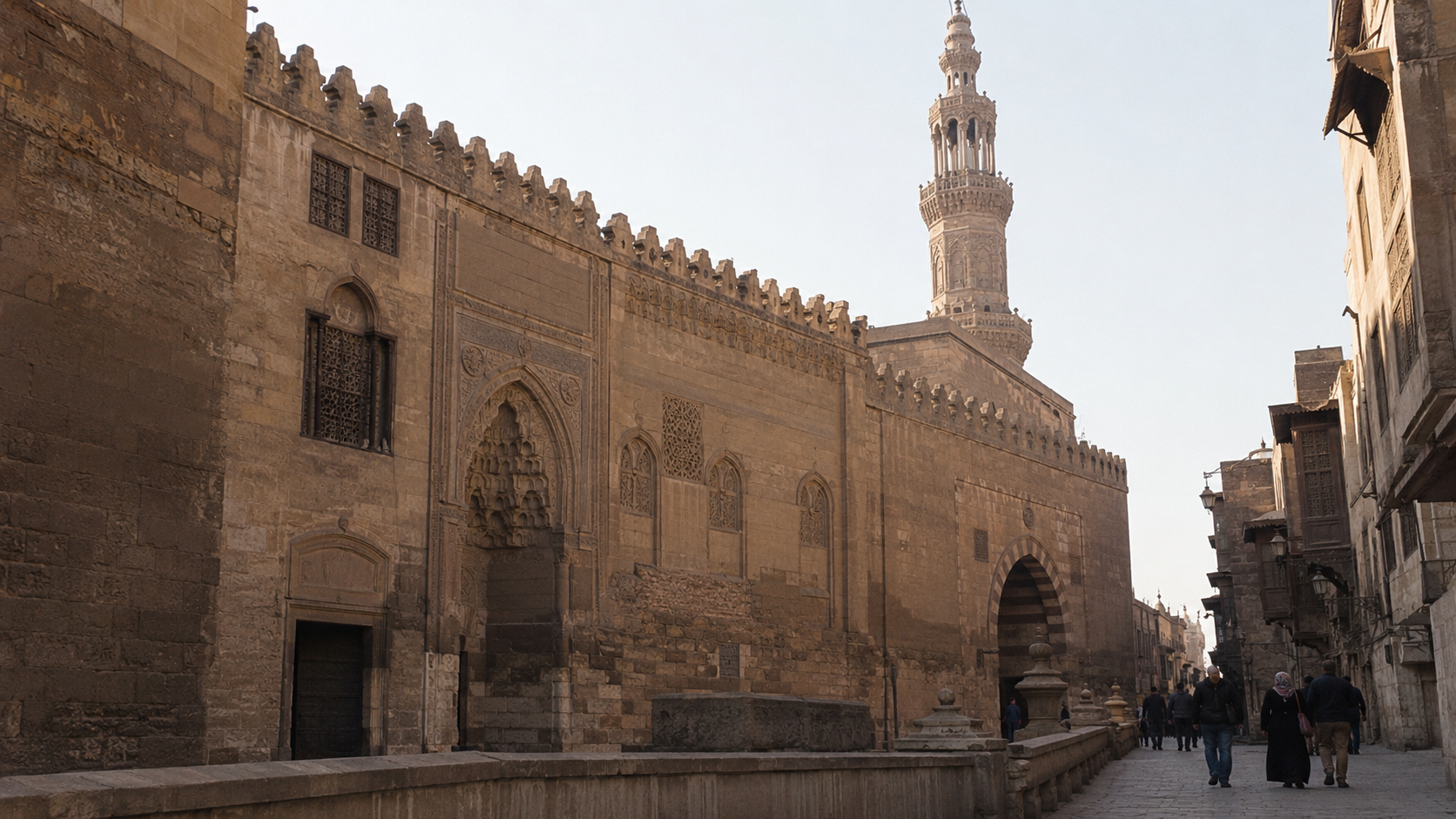
That is the first thing to understand. The architecture sits inside traffic, markets, workshops, apartments, prayer, dust, repair, tourism, and daily life. A carved portal may face a busy street. A Mamluk minaret may rise above shop signs. A courtyard may still cool a building that was never meant to be sealed behind glass.
That tension is the value of the place. Islamic Cairo shows how architecture survives when it remains part of a working city. It also shows what happens when old buildings face pressure from pollution, crowding, weak maintenance, bad repairs, tourism, and rushed cosmetic fixes.
For the parent topic, start with Islamic architecture. For the wider historical sequence, read Islamic architecture history. This page focuses on Cairo: how the city’s Islamic architecture works on the ground.
What Islamic Cairo Means
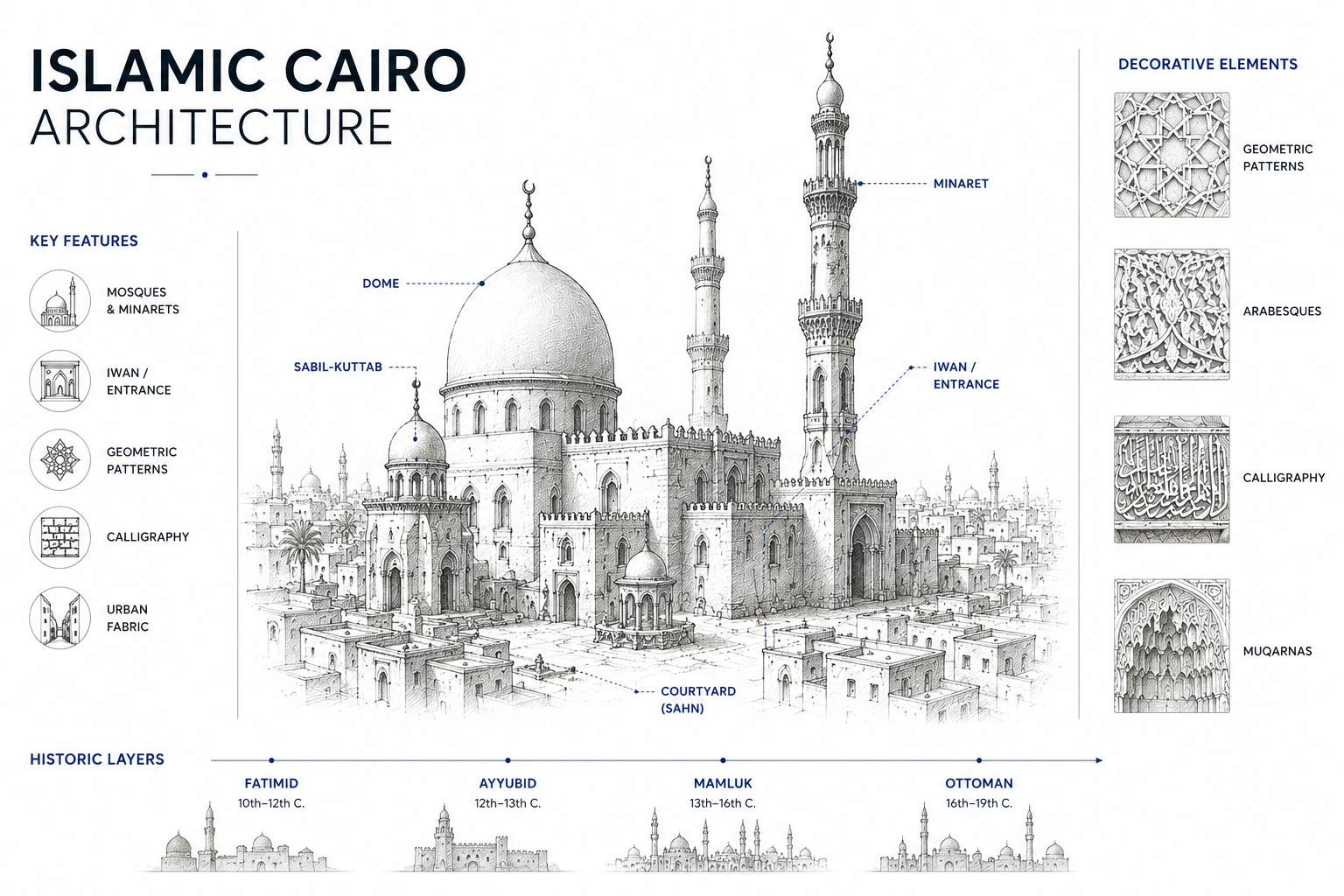
“Islamic Cairo” usually refers to the historic districts of Cairo shaped by Islamic rule, building, trade, religion, and urban life from the Fatimid period onward. It includes major mosques, madrasas, tombs, city gates, markets, houses, sabil-kuttabs, caravanserais, and streets such as Al-Muizz Street.
It is not the same as “Old Cairo,” which is often used for older Coptic, Roman, and early Christian areas. The names overlap in tourist speech, but architecturally they are different study zones.
The most useful way to read Islamic Cairo is by layers:
- Fatimid planning, gates, and early mosque foundations;
- Ayyubid walls, military works, and the Citadel;
- Mamluk mosques, madrasas, tombs, portals, minarets, and street architecture;
- Ottoman additions, houses, domes, and later mosque layers;
- modern preservation, tourism, traffic, repair, and urban pressure.
The City Teaches Through Layers
Islamic Cairo does not explain itself neatly.
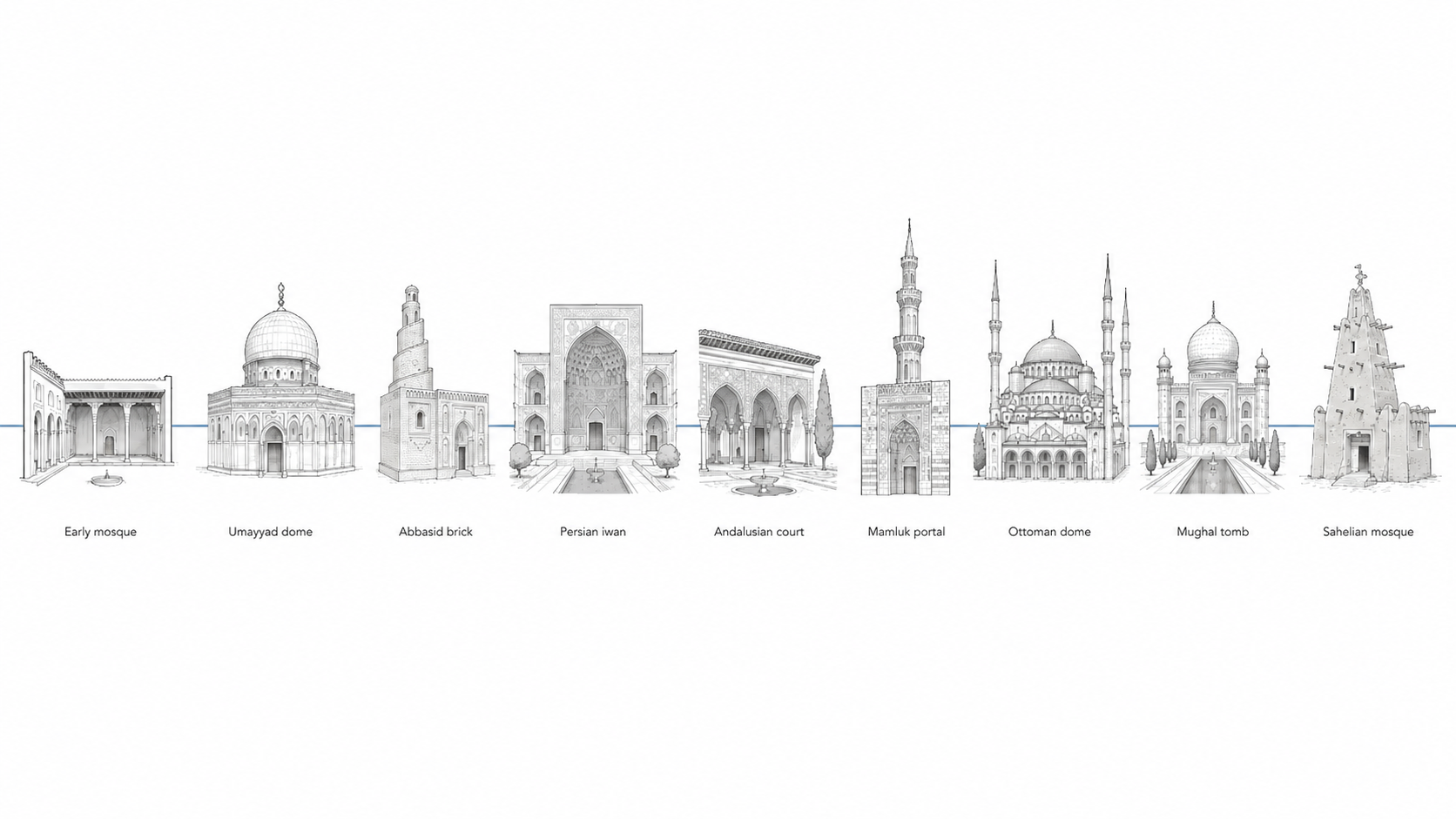
That is why it is so useful for architecture students. You rarely see a pure style sample. You see buildings that were founded in one period, repaired in another, expanded later, damaged, restored, reused, and surrounded by new city life.
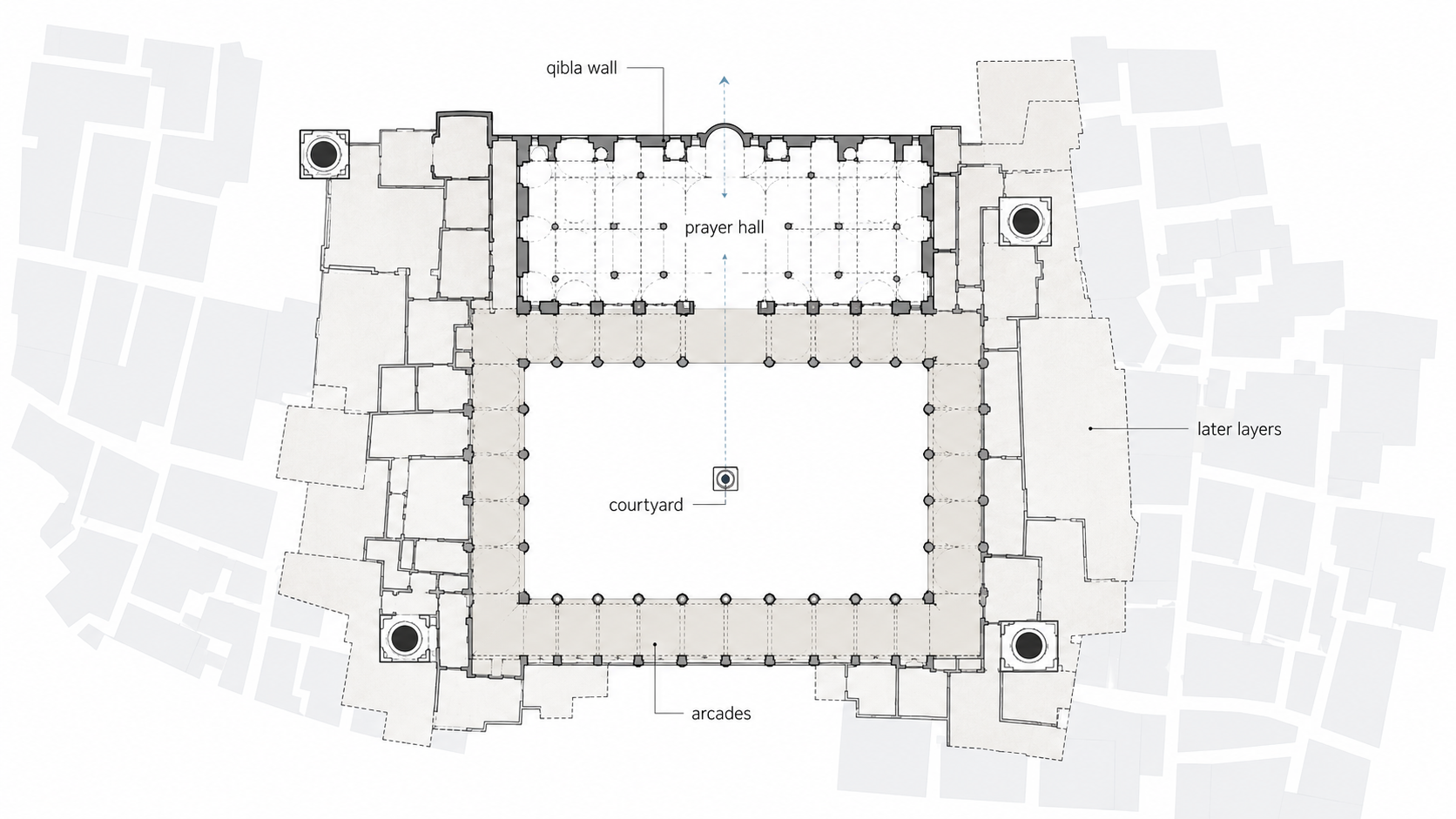
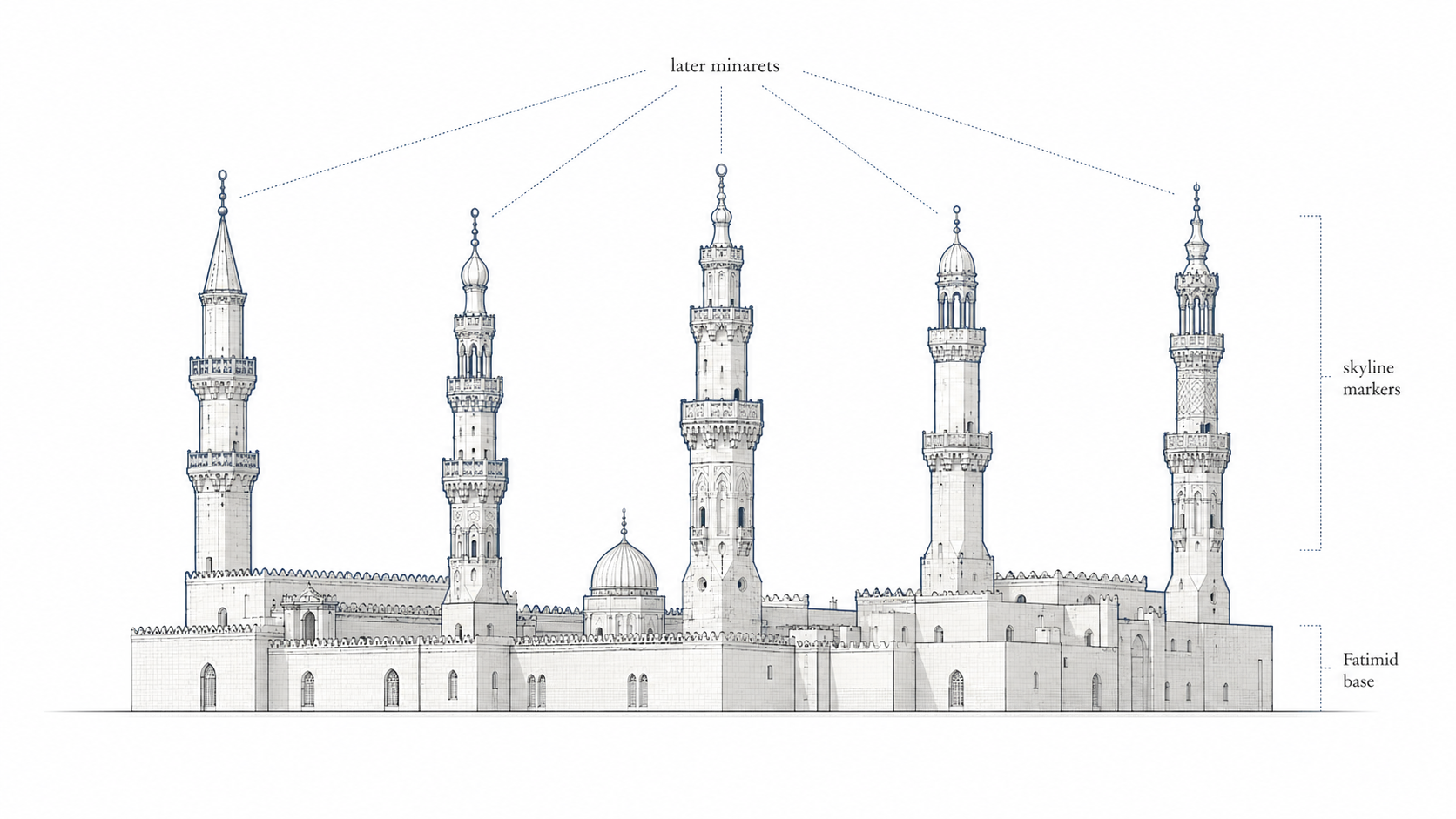
Al-Azhar Mosque is a good example. It began as a Fatimid foundation, but later additions changed its skyline, minarets, courtyard edges, and public identity. The building should not be read as one frozen style. It is a long architectural record.
Islamic Cairo Timeline
The periods below are useful, but they overlap in the actual city. Cairo’s buildings were repaired, altered, and reused. A table can organize the history, but the streets are messier.
| Period | Approximate dates | What changed architecturally | What to study |
|---|---|---|---|
| Fatimid | 969–1171 | New capital planning, city gates, early mosques, ceremonial streets, Al-Azhar foundation | Al-Azhar Mosque, Al-Hakim Mosque, Bab al-Futuh, Bab al-Nasr, Bab Zuweila, Al-Muizz Street |
| Ayyubid | 1171–1250 | Defensive walls, Citadel construction, military urban logic, political control of the city | Cairo Citadel, Ayyubid wall remains, defensive siting |
| Mamluk | 1250–1517 | Monumental mosques, madrasas, mausoleums, stone portals, complex minarets, dense street architecture | Sultan Hasan Mosque, Qalawun Complex, Barquq Complex, Al-Ghuri Complex, Mamluk minarets |
| Ottoman | 1517–1805 | Domestic houses, sabil-kuttabs, Ottoman mosque additions, altered skylines, later urban layers | Bayt al-Suhaymi, Ottoman houses, sabil-kuttabs, later mosque additions |
| Modern period | 1805–today | European influence, traffic, conservation, restoration, tourism pressure, urban renewal, loss and repair | Al-Azhar Park, Darb al-Ahmar, restored monuments, damaged surfaces, modern streets around historic fabric |
Fatimid Cairo: Walls, Gates, and Al-Azhar
Fatimid Cairo began as a planned royal city. Its early architecture was tied to power, procession, religious authority, and urban control.
The surviving gates are important because they show Cairo as a fortified and ceremonial city, not only a collection of mosques. Bab al-Futuh, Bab al-Nasr, and Bab Zuweila are architectural thresholds. They mark entry, defense, authority, and movement into the city.
Al-Azhar Mosque is the other major Fatimid anchor. It began as a mosque and became one of the most important institutions of Islamic learning. Architecturally, it is useful because the building’s present form is layered. The original foundation matters, but so do the later additions.
For the full case study, use Al-Azhar Mosque.
Ayyubid Cairo: Defense and the Citadel
The Ayyubid layer changed Cairo’s relationship to defense.
Saladin’s Citadel shifted power to a raised military and political site overlooking the city. Walls, gates, and military planning became part of the architectural story. This is not the decorative side of Islamic Cairo, but it matters. A city is shaped by defense as much as by prayer halls and markets.
The Citadel also became a platform for later architecture, especially under Muhammad Ali. That creates one of Cairo’s most visible layered conditions: medieval defensive siting with later Ottomanizing mosque architecture above it.

Mamluk Cairo Is the Main Architecture Lesson
If you only have time to study one architectural layer in Islamic Cairo, study the Mamluk city.
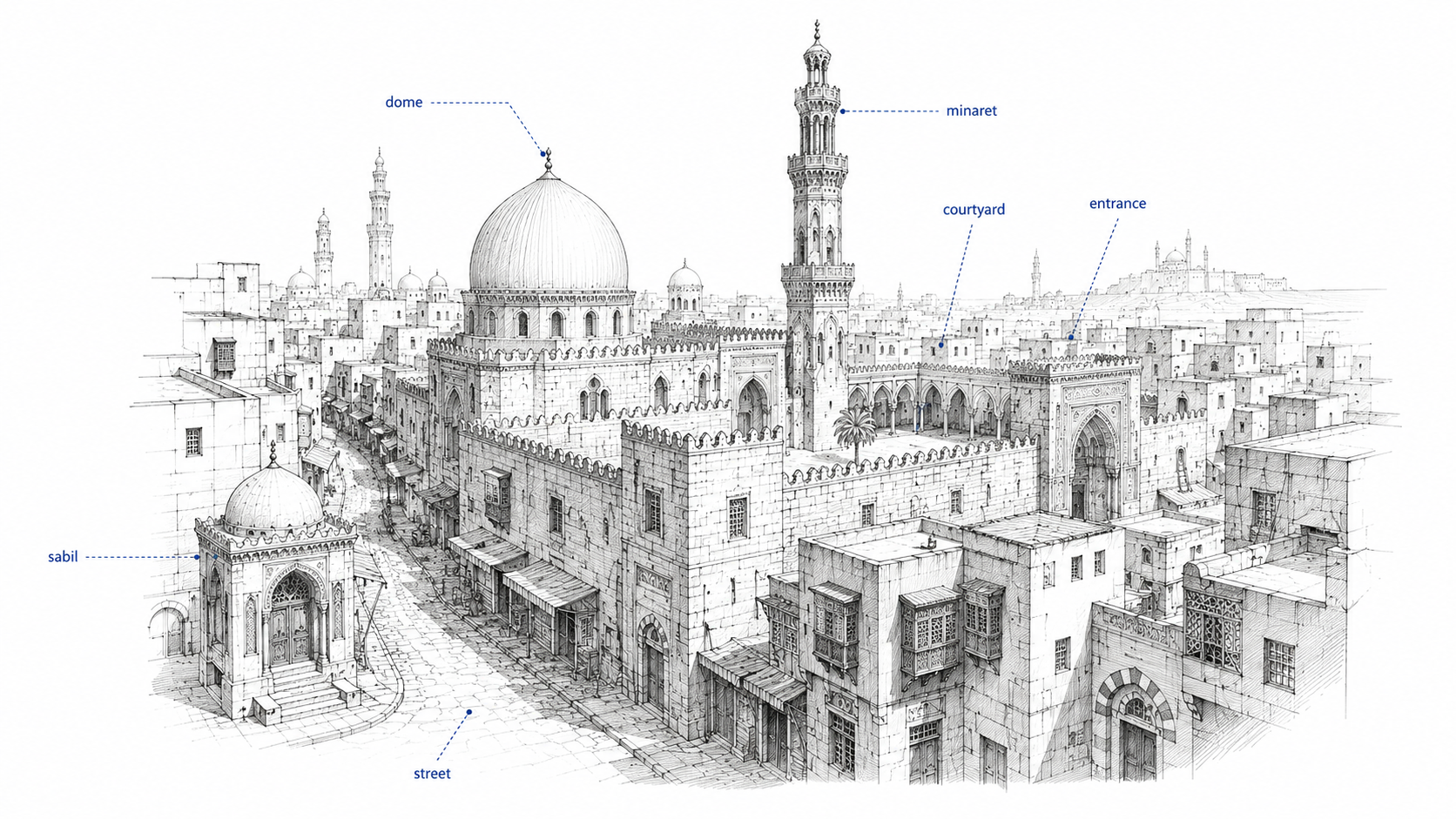
Mamluk Cairo is dense, vertical, urban, and public. The buildings often meet the street directly. Portals project authority. Minarets become skyline markers. Domes signal tombs. Stone carving, muqarnas, marble, inscriptions, and shadow work together at the edge of the street.
This is why Mamluk monuments do not feel like isolated objects. They are street buildings. They sit beside markets, alleys, housing, shops, and traffic. Their architecture is partly about how a religious or charitable institution announces itself inside a crowded city.

The Sultan Hasan Mosque is one of the clearest examples. It has scale, mass, a powerful portal, a large court, madrasa planning, and strong urban presence. The Qalawun Complex shows another side: mosque, madrasa, mausoleum, and medical-charitable functions tied to the public street.
Minarets, Domes, and the Cairo Skyline
Islamic Cairo’s skyline is not one clean type of minaret or dome.
Fatimid, Mamluk, Ottoman, and later layers changed the skyline over time. Mamluk minarets can be especially complex, with stacked tiers, balconies, carving, and changing profiles. Domes often mark tombs and mausoleums, giving the city a rhythm of burial, patronage, and religious presence.

For the broader feature, see minarets.
Courtyards, Shade, and the Teaching Edge
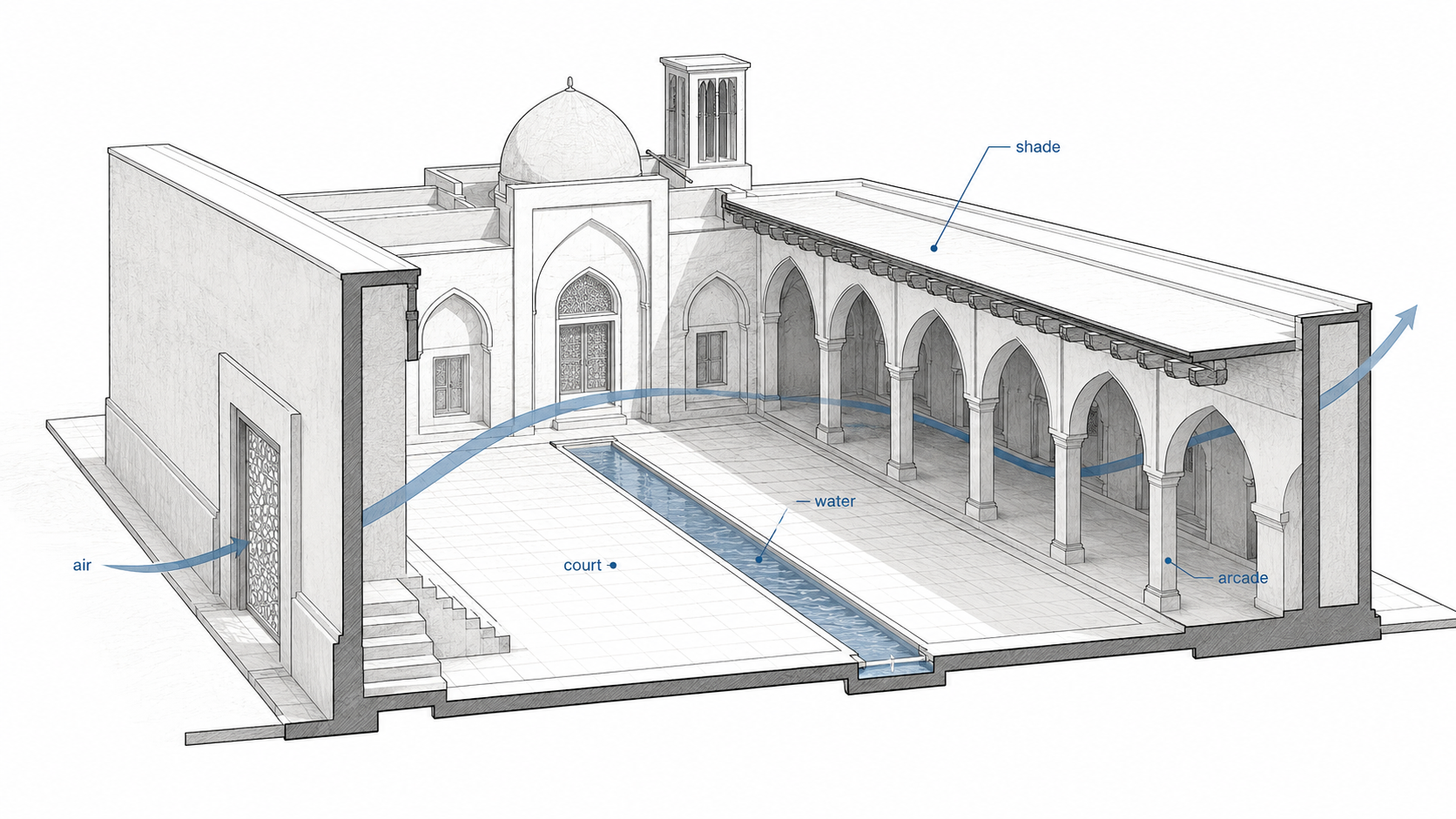
Cairo’s mosque courtyards are not just open space.
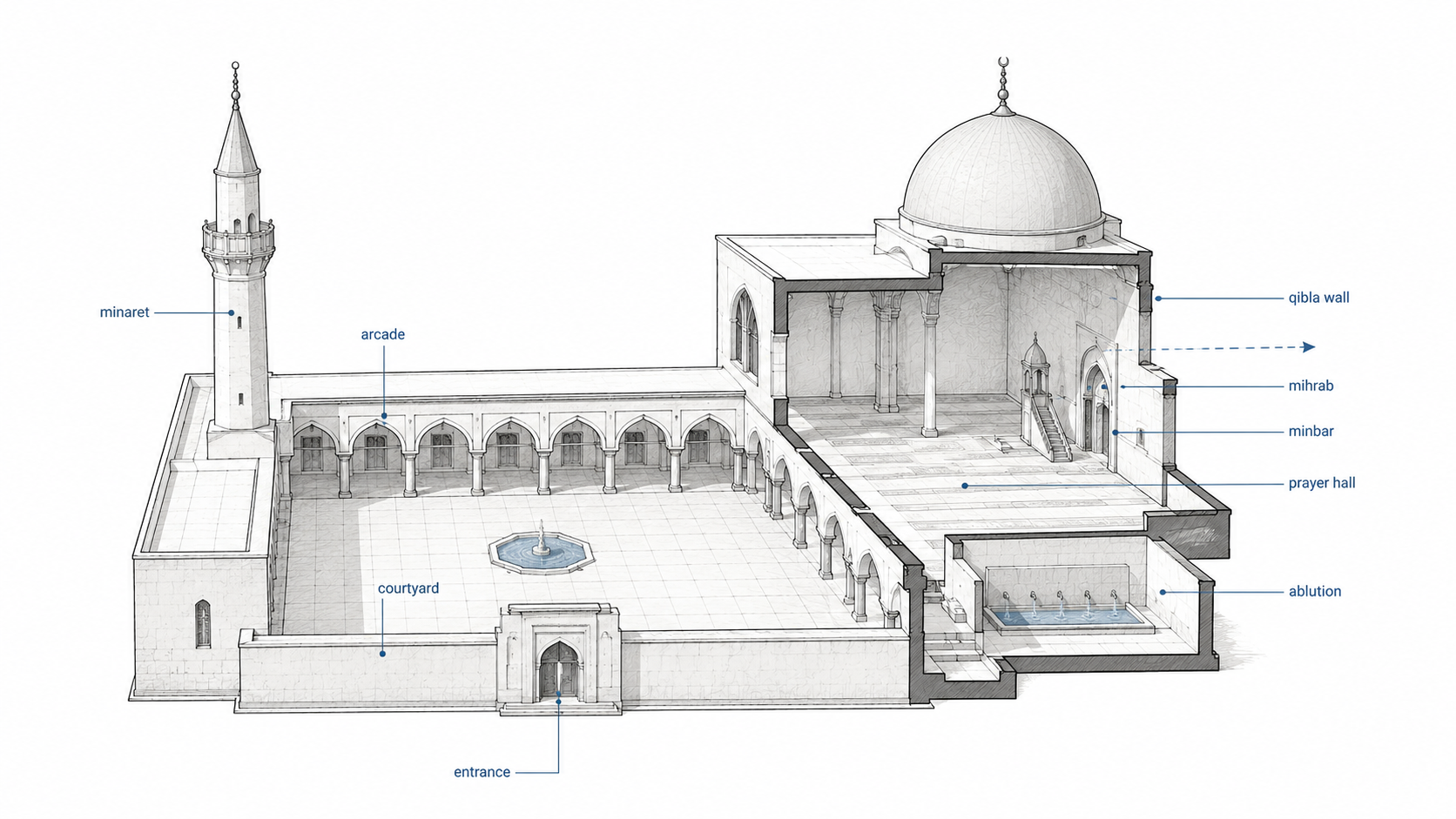
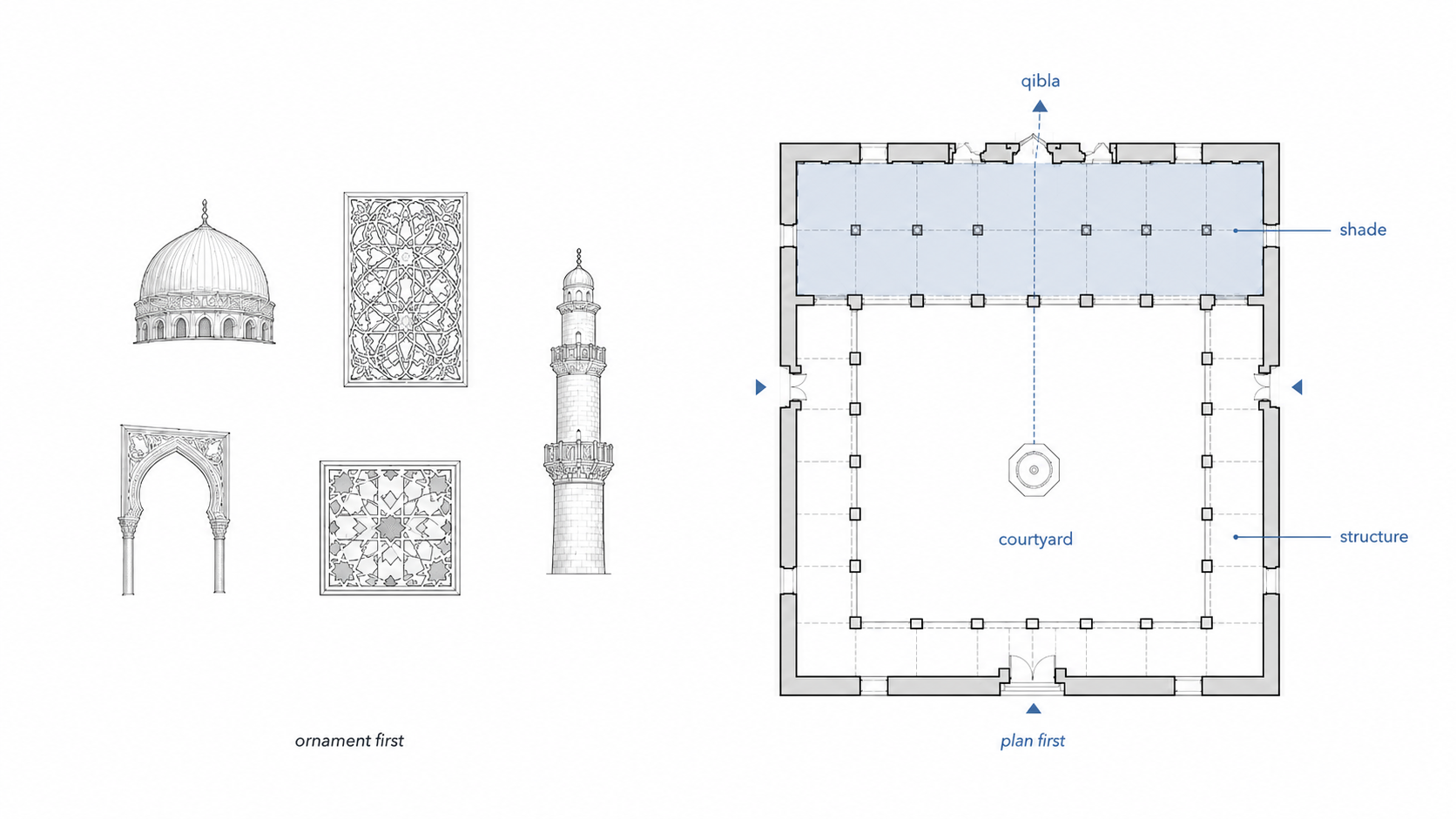
They organize heat, light, movement, teaching, prayer preparation, and social use. The open center lets light into the building. Arcades create shade. Fountains and ablution points change the pace of movement. The prayer hall edge gives the courtyard direction.

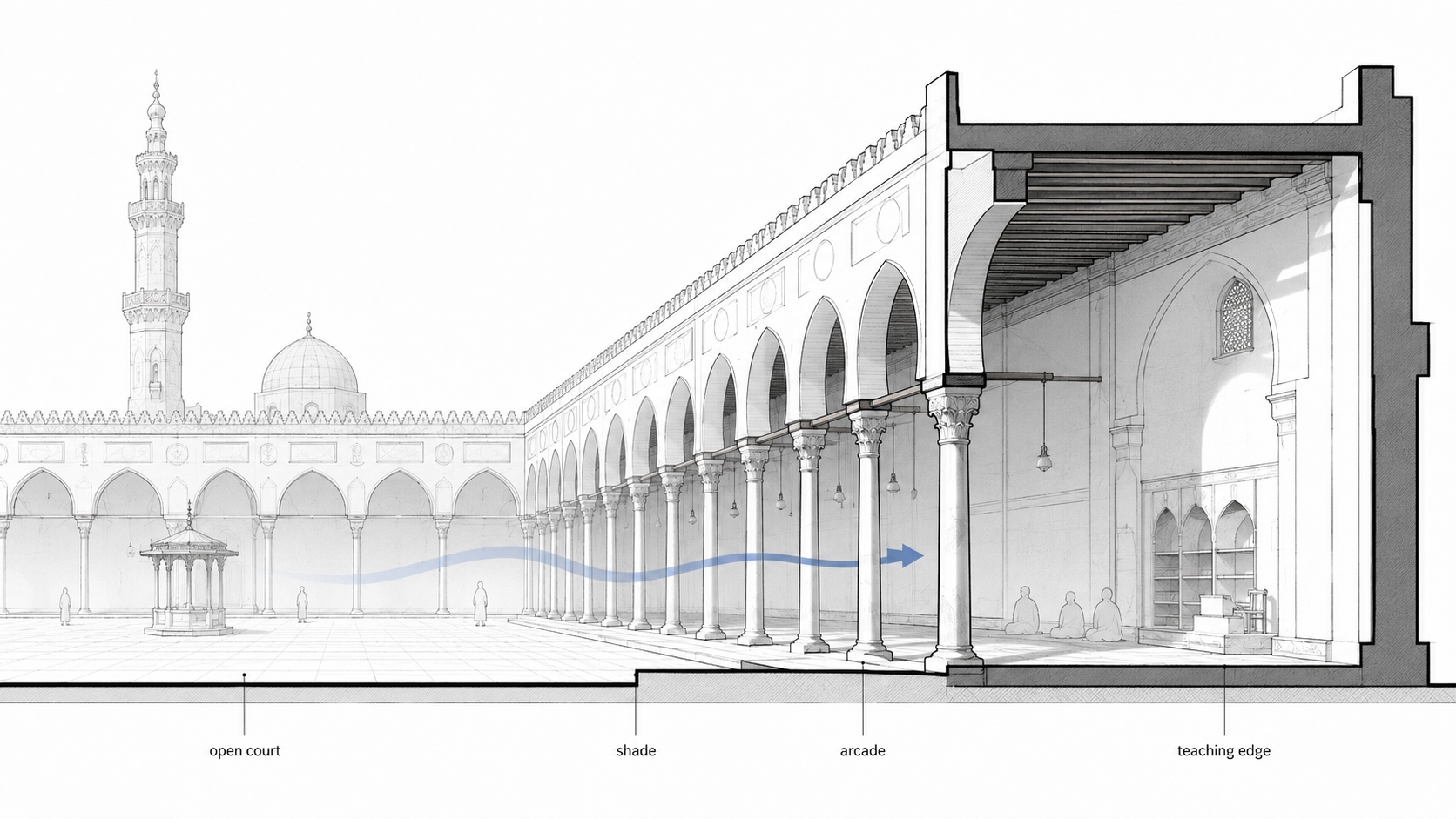
For the courtyard design system, read courtyards in Islamic architecture.
Streets, Markets, and Buildings That Still Work
Islamic Cairo’s architecture is strongest when read with the street.
Al-Muizz Street, Khan el-Khalili, Darb al-Ahmar, and the areas around major mosques show how religious buildings, markets, houses, workshops, and public services once worked together. The city was not planned around cars. It was shaped around walking, shade, trade, water, prayer, and social contact.
Narrow streets reduce harsh sun. Building edges create shade. Shopfronts keep the street active. Sabils supplied water. Mosques and madrasas anchored neighborhoods. Courtyard houses protected privacy while still giving rooms air and light.

Houses, Mashrabiyas, and Private Climate Control
Islamic Cairo is not only mosque architecture.
Traditional houses such as Bayt al-Suhaymi show how domestic architecture handled privacy, heat, gendered movement, guests, family life, and airflow. The street wall could be guarded, while the interior opened to courtyards, screens, upper rooms, and shaded spaces.
Mashrabiyas are especially important. They are not only decorative wooden screens. They filter light, allow air movement, protect privacy, and soften the edge between room and street.
For the screen system, read mashrabiya designs.
Material, Climate, and Repair
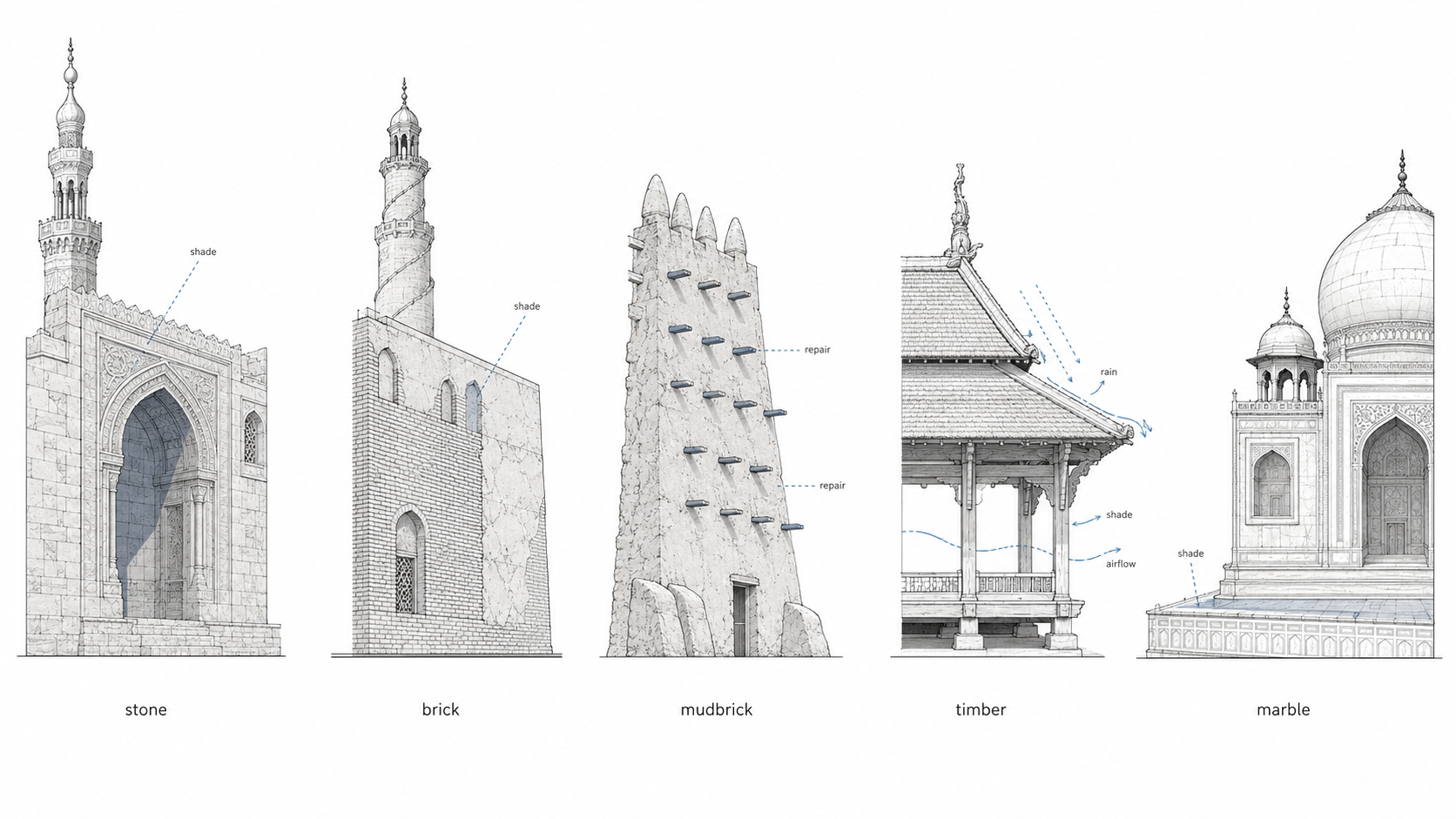
Cairo’s historic architecture is tied to material behavior.
Stone, brick, plaster, wood, marble, lime mortar, tile, and painted surfaces do not age the same way. They absorb water differently. They shed heat differently. They need different repairs. A wall that looks worn may still be sound. A freshly painted wall may be hiding trapped moisture and salt damage.
That is why restoration in Islamic Cairo is not only about making buildings look clean. It is about understanding what the wall is made of, how water moves through it, how salts appear, how stone is repointed, and what finishes allow the material to breathe.
Where Preservation Goes Wrong
A dangerous repair can look good for a few months.
That is one of the hardest lessons in old masonry. Painting over stained stone, cracked plaster, salt damage, or decayed lime finishes may make a wall look “restored,” but it can trap moisture behind the surface. Once water cannot escape, the wall keeps deteriorating under the new finish.
The problem is not every coating. Traditional limewash, used correctly, can be breathable and protective. The problem is modern impermeable paint used as a shortcut over historic material that needs drying, repointing, cleaning, stabilization, or proper conservation.
| Bad shortcut | Why it fails | Better conservation logic |
|---|---|---|
| Painting over damp stone or plaster | Traps moisture and salts behind the surface. | Find the moisture source, let the wall dry, then use compatible breathable finishes. |
| Hiding cracks with cosmetic filler | Leaves movement, settlement, or water problems unresolved. | Diagnose structure and water first, then repair the crack with compatible material. |
| Using hard cement mortar on soft historic masonry | Can damage softer stone or brick and block drying. | Use mortar compatible with the original masonry and exposure conditions. |
| Replacing craft detail with flat modern copies | Loses depth, shadow, handwork, and historic reading. | Document first, repair only what needs repair, and keep surviving fabric where possible. |
Al-Azhar Park and Darb al-Ahmar
The modern conservation story is not only about individual monuments.
Al-Azhar Park and Darb al-Ahmar matter because they connect landscape, historic walls, housing, craft, public space, and neighborhood work. The lesson is simple: preservation fails when it treats buildings as isolated photo objects. It works better when streets, residents, jobs, utilities, and public space are part of the repair.
That does not mean every project is perfect. It means the scale of the problem is urban. A restored dome surrounded by failing services, blocked drainage, collapsing housing, or displaced residents is not enough.
What to Look For While Walking Islamic Cairo
Do not walk Islamic Cairo like a checklist of landmarks.
Walk it like a section drawing. Look at street width, shade, wall thickness, shop edges, upper windows, minaret placement, domes, portals, courtyards, thresholds, and how old buildings meet modern pressure.
- Start with the street before the monument.
- Look at how the entrance controls movement from noise into shade.
- Check whether the courtyard cools, gathers, or organizes the building.
- Study minarets as skyline and wayfinding devices.
- Look for repair scars, new plaster, paint, salt, cracks, and patched stone.
- Separate original fabric, later additions, and modern repairs.
- Ask what still works for people using the place today.
Key Places to Study
A short architectural list is more useful than a tourist dump. These places show different lessons.
| Place | Period or layer | What to study |
|---|---|---|
| Al-Azhar Mosque | Fatimid foundation with later additions | Courtyard, qibla wall, learning institution, minarets, layered growth |
| Al-Hakim Mosque | Fatimid | Fortress-like mass, early mosque planning, strong exterior presence |
| Bab Zuweila | Fatimid gate | Urban threshold, defense, street control, elevated view of the city |
| Sultan Hasan Mosque | Mamluk | Scale, portal, court, madrasa planning, stone mass, urban authority |
| Qalawun Complex | Mamluk | Public institution, mausoleum, madrasa, hospital function, street facade |
| Al-Ghuri Complex | Late Mamluk | Market setting, stonework, shadow, paired urban architecture |
| Bayt al-Suhaymi | Ottoman-era domestic architecture | Courtyards, mashrabiyas, privacy, airflow, social hierarchy |
| Muhammad Ali Mosque | 19th-century Ottomanizing layer | Citadel setting, domes, skyline, later political image |
| Museum of Islamic Art, Cairo | Collection and study resource | Objects, fragments, craft, inscriptions, material culture outside the buildings |
The Building as Palimpsest
Islamic Cairo is easiest to misunderstand when each monument is forced into one clean label.
Buildings here often work like palimpsests. A Fatimid foundation may carry Mamluk or Ottoman changes. A mosque may have a later minaret, a rebuilt courtyard edge, a restored facade, or a modern street pressing against it. The visible building is not always the same age in every part.
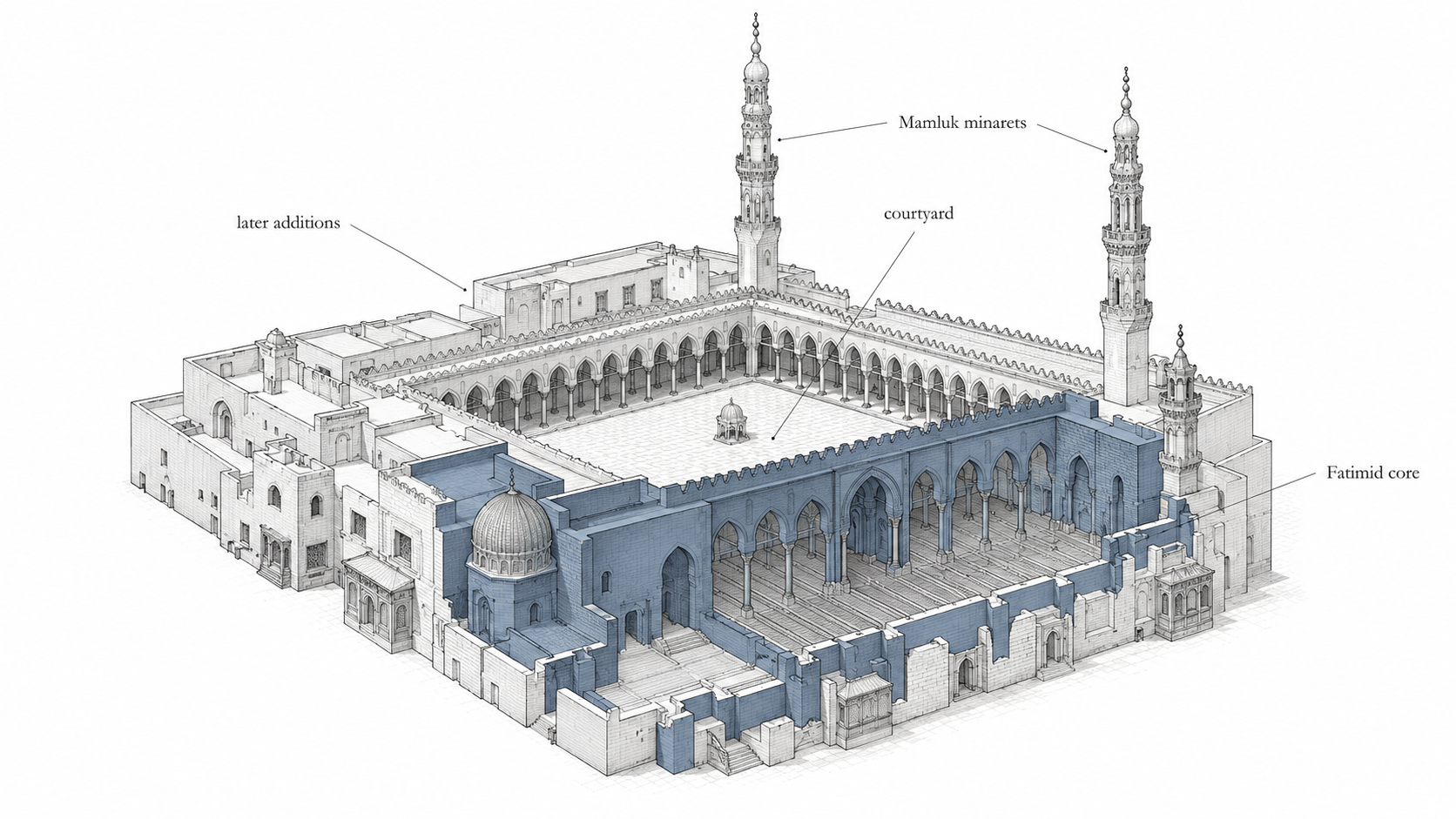
This is not a weakness. It is the reason Cairo matters. The city teaches architectural time better than a clean reconstruction ever could.
How Islamic Cairo Shaped Modern Egypt
Islamic Cairo shaped modern Egypt by giving the capital a visible architectural memory.
Its minarets, gates, mosques, markets, courtyards, and dense street fabric became part of Cairo’s identity. Modern Egyptian architecture, tourism, preservation, religious education, craft culture, and national heritage debates all continue to draw from this district.
The influence is not always direct copying. Sometimes it appears as restored stonework. Sometimes as a mosque image in a modern skyline. Sometimes as debates over what should be protected, painted, repaired, demolished, or opened to tourists.
What Students Usually Miss
Students often photograph the dome, the portal, or the pattern and miss the city.
The stronger reading starts with use. Who enters? Where is the shade? How does the building meet the street? What does the courtyard do? Which part is original, and which part was added later? What has been restored badly? What material is failing?
That reading gives Islamic Cairo its real value. The district is not only a collection of beautiful Islamic monuments. It is a living test of urban architecture, conservation, climate response, and public memory.
Recommended reference: Doris Behrens-Abouseif’s Islamic Architecture in Cairo is a useful reference for readers who want a serious monument-by-monument understanding of the city’s Islamic architectural layers.
What Cairo Still Teaches
Islamic Cairo matters because it refuses to be simple.
It is beautiful, damaged, crowded, repaired, misread, and still used. Its architecture is not only in domes, arches, minarets, and carved stone. It is in the way a building meets the street, how a courtyard cools a space, how a screen protects a room, and how old material survives under pressure.
That is the lesson worth keeping. Islamic Cairo is not architecture frozen in history. It is architecture still fighting to work.
FAQ
What is Islamic Cairo?
Islamic Cairo is the historic area of Cairo shaped by Islamic rule, architecture, religious life, trade, and urban development. It includes mosques, madrasas, gates, markets, houses, tombs, streets, and public institutions from many periods.
Is Islamic Cairo the same as Old Cairo?
Not exactly. Old Cairo often refers to older Coptic and Roman areas, while Islamic Cairo usually refers to the historic Islamic districts shaped from the Fatimid period onward. Tourists may use the names loosely, but the architecture is different.
What period is most important for Islamic Cairo architecture?
The Mamluk period is one of the most important for visible monuments, portals, minarets, madrasas, mausoleums, and street architecture. The Fatimid, Ayyubid, Ottoman, and modern layers also matter.
What are the best buildings to study in Islamic Cairo?
Start with Al-Azhar Mosque, Al-Hakim Mosque, Bab Zuweila, Sultan Hasan Mosque, Qalawun Complex, Al-Ghuri Complex, Bayt al-Suhaymi, and the Muhammad Ali Mosque at the Citadel.
Why is Islamic Cairo important for architects?
It shows how buildings handle heat, shade, prayer, trade, public life, craft, repair, and dense urban fabric. It is useful because the architecture is still embedded in a living city.
What is the biggest preservation problem in Islamic Cairo?
There is no single problem. Historic Cairo faces pressure from pollution, traffic, water damage, weak maintenance, crowding, tourism, poor repairs, and development pressure. Cosmetic repair can be especially dangerous when it hides moisture or material decay.
Can visitors walk through Islamic Cairo?
Yes, many areas can be explored on foot, especially around Al-Muizz Street and nearby monuments. Visitors should check current local conditions, opening rules, dress expectations, and site access before going.
References and Resources
- UNESCO World Heritage Centre: Historic Cairo
- Aga Khan Trust for Culture
- Archnet: Islamic architecture resources
- The Metropolitan Museum of Art: The Mosque
Read This Next
For the parent topic, read Islamic architecture. For the historical sequence, use Islamic architecture history. For the feature-level guide, continue with characteristics of Islamic architecture.
For related design systems, read Islamic arches, courtyards in Islamic architecture, mashrabiya designs, muqarnas architecture, and Islamic geometric patterns.
For Cairo case studies, continue with Al-Azhar Mosque, Ibn Tulun Mosque, and Museum of Islamic Art, Cairo.