
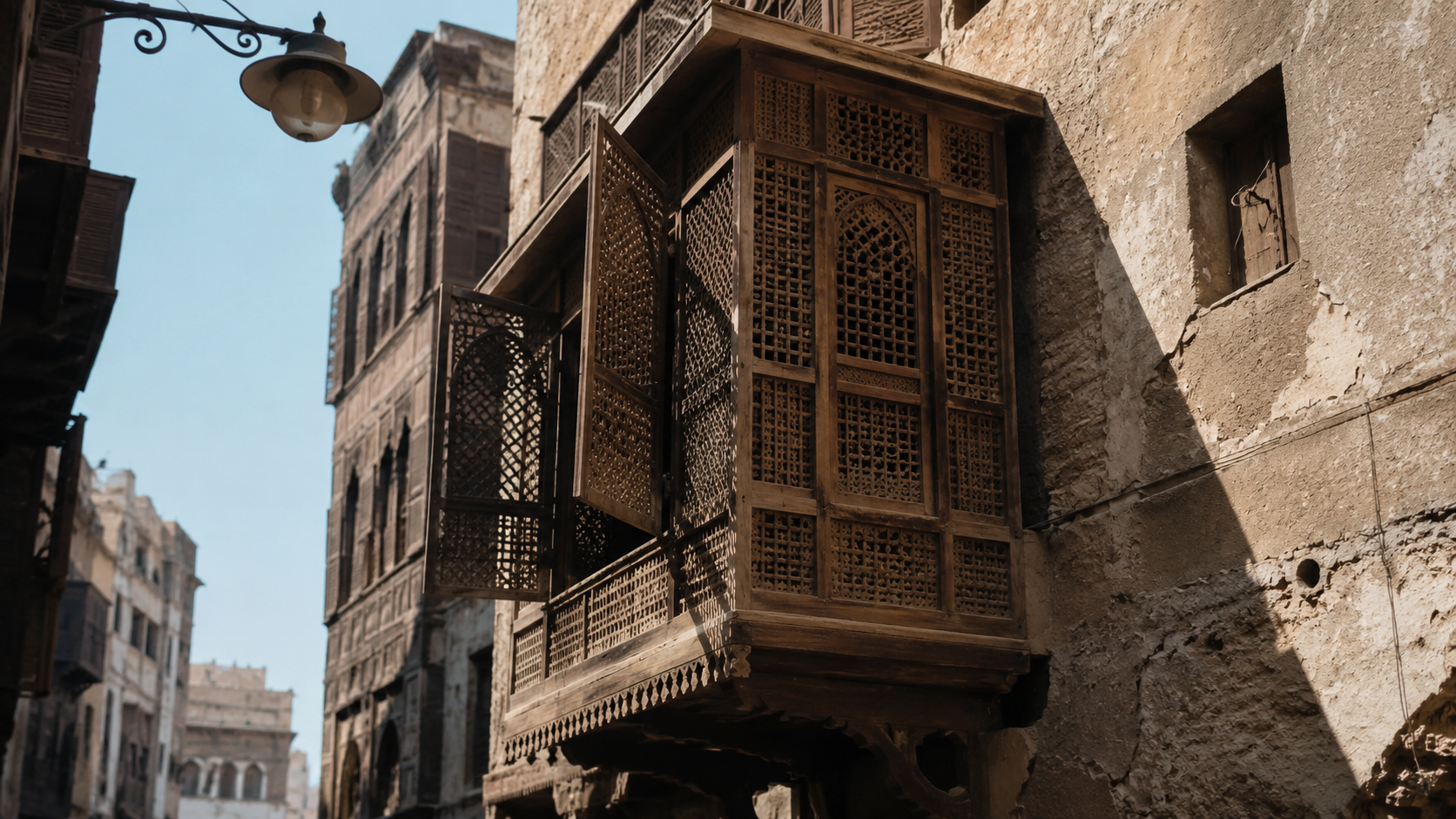
A mashrabiya has to handle sun first.
The screen cuts glare, lets air move, and keeps the room private from the street. It can make a hot window usable without closing it off.
The pattern matters, but it is only one part. Opening size, screen depth, material, wall thickness, street width, and sun direction all change how the mashrabiya works.
For the broader design tradition, start with Islamic architecture. For related surface systems, use Islamic geometric patterns and arabesque patterns. This page focuses on the mashrabiya itself: how it works, where it came from, what modern designers get right, and what they often copy badly.
What Is a Mashrabiya?

A mashrabiya is a projecting or flat lattice screen used in windows, balconies, upper rooms, partitions, and sometimes larger facade systems. Traditional examples are usually made from wood and built from many small turned or carved pieces arranged into geometric openings.
The word is most closely associated with architecture in Egypt, the Levant, the Gulf, Iraq, the Arabian Peninsula, and other Islamic building traditions. Similar screening ideas appear under different names and forms across the Islamic world.
The basic idea is simple: let the room breathe without exposing it fully.
That one idea explains much of the form. The screen needs openings for air and sight. It needs density for privacy and shade. It often projects outward to increase usable room area, catch air, and create a deeper shaded zone. It also gives the facade depth, texture, and shadow.
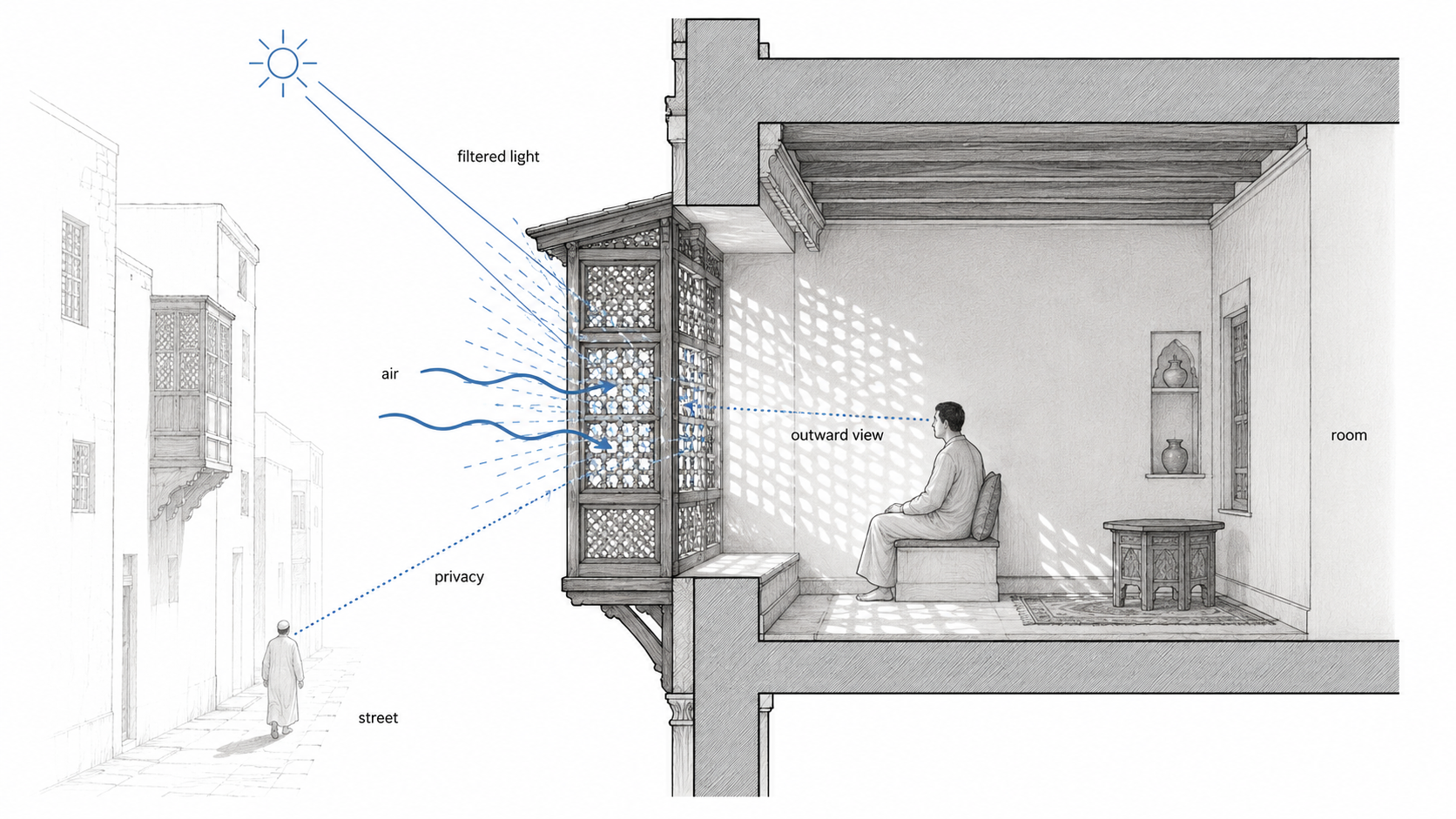
What a Mashrabiya Actually Does
A good mashrabiya solves several problems at once. That is why it lasted so long.
| Job | How the mashrabiya helps | What changes the result |
|---|---|---|
| Privacy | Allows people inside to look out while reducing visibility from the street. | Pattern density, room brightness, street distance, and viewing angle. |
| Shade | Breaks direct sun before it reaches the room. | Depth of screen, sun angle, lattice size, and wall orientation. |
| Airflow | Lets air move through the screen instead of blocking the window completely. | Opening size, projection, cross-ventilation, and room layout. |
| Light control | Turns harsh sunlight into filtered light and patterned shadow. | Material thickness, opening shape, and interior surface color. |
| Street edge | Creates a layered facade between private life and public space. | Height above street, projection, adjacent buildings, and balcony use. |
This is the part modern copies often miss. A mashrabiya is not only a pattern pasted onto glass. It is a climate and privacy device with a physical depth.
Light, Air, Privacy, and View
The mashrabiya works because it creates an uneven relationship between inside and outside.
During the day, the street is often brighter than the room. A person inside can see through the small openings toward the brighter exterior. A person outside sees a darker, broken surface and cannot read the room as easily. That is the privacy advantage.
At the same time, the screen reduces direct glare. The interior gets light, but not the full force of the sun. Air can still pass through. The room stays connected to the street without becoming exposed to it.

This relationship can reverse at night. If the interior is brightly lit and the street is dark, visibility from outside can increase. That is why curtains, shutters, deeper screens, or layered interior treatment may still matter.
Pattern Density Changes Everything
The pattern is not only a visual choice.
A very open mashrabiya gives more air and view but less privacy and shade. A dense screen gives stronger privacy and sun control but may darken the room and reduce airflow. A medium pattern often works best because it balances comfort, privacy, and daylight.
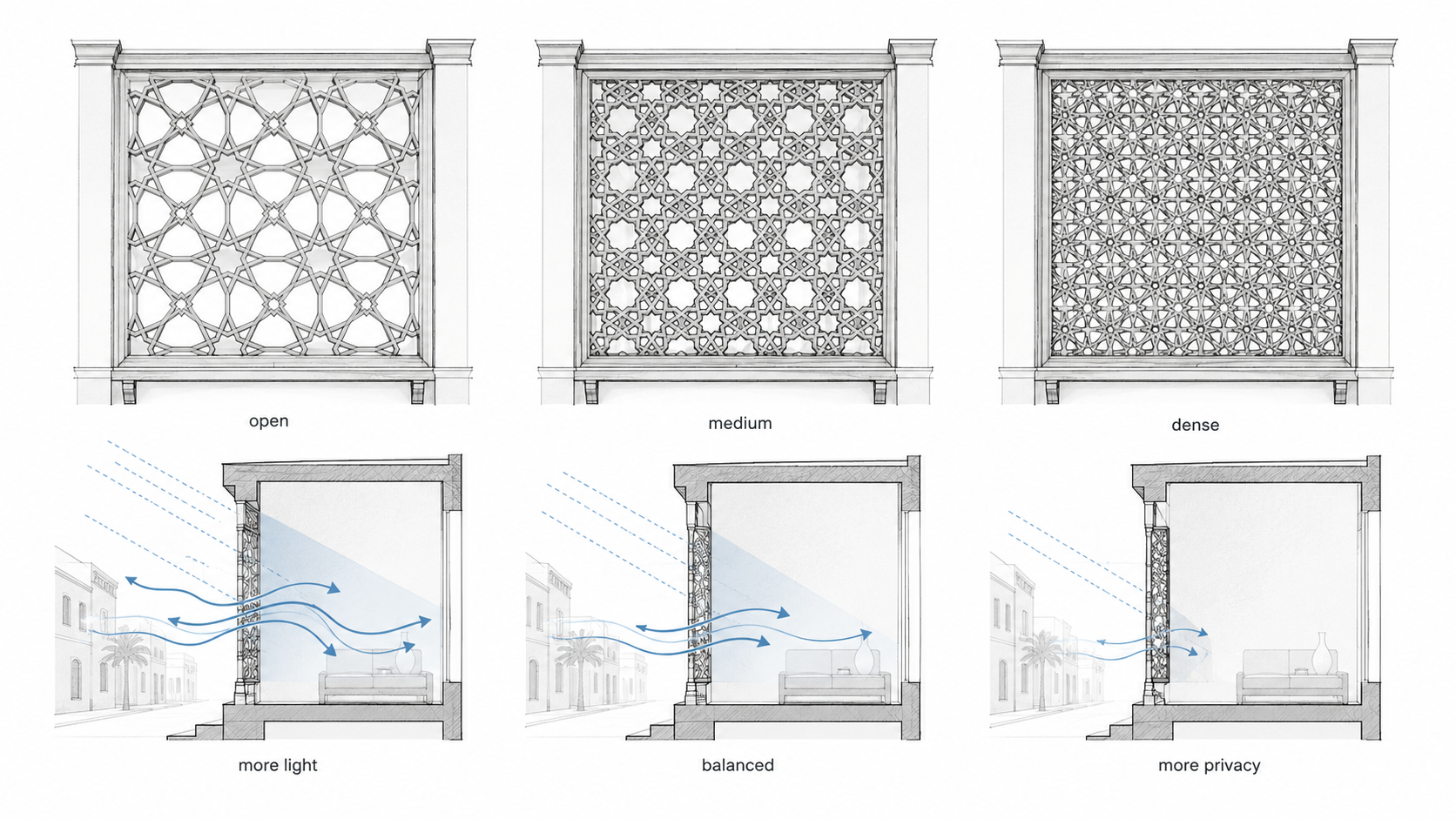
| Pattern density | Best for | Possible problem |
|---|---|---|
| Open lattice | More daylight, more air, stronger outward view. | Less privacy and weaker sun control. |
| Medium lattice | Balanced privacy, airflow, filtered light, and shade. | Needs careful scale so it does not look weak or busy. |
| Dense lattice | Strong privacy, shade, glare reduction, and visual enclosure. | Can reduce airflow, darken the room, and collect dust. |
This is why a screen that looks beautiful in a catalog can fail on a building. Pattern density must match the climate, orientation, room use, and distance from the street.
Where Mashrabiyas Came From
Mashrabiyas grew from the needs of hot, dense cities.
They became especially important in places where houses faced narrow streets, strong sun, dust, and close neighbors. A normal open window created privacy problems. A sealed wall created heat and darkness. The mashrabiya gave builders another option.
The form developed across several Islamic regions, including Egypt, Iraq, the Gulf, the Arabian Peninsula, the Levant, and Ottoman-influenced areas. The details changed by place. Cairo screens do not look exactly like Jeddah screens. Palace examples do not behave like everyday house windows. Modern facade panels do not work like traditional projecting wooden boxes.
Still, the same architectural question keeps returning: how can a building open to air and light without exposing everything inside?
Regional Differences
Mashrabiya design changed because wood, climate, craft, and urban life changed.
| Region or setting | Common character | Design lesson |
|---|---|---|
| Historic Cairo | Deep wooden screens on houses, upper rooms, and street-facing facades. | Privacy and airflow mattered in dense streets and inward-facing homes. |
| Jeddah and Red Sea towns | Large timber rawashin and projecting facade screens. | Wooden shade systems became part of the street image and climate strategy. |
| Ottoman and palace settings | Refined interior screens, partitions, and balcony screens. | The screen could manage privacy, hierarchy, and ceremonial viewing. |
| Modern Gulf facades | Metal or aluminum panels inspired by traditional lattice logic. | The idea shifts from domestic privacy to solar control and identity. |
For the wider city context, read Islamic Cairo. For the courtyard side of this privacy and climate system, use courtyards in Islamic architecture.
Materials: Wood, Metal, Aluminum, and Composite Panels
Traditional mashrabiyas were usually wood. Modern versions use many materials.
That does not make every material equal. Wood gives depth, warmth, repairability, and craft. Aluminum gives lightness and weather resistance. Steel can be strong but needs corrosion protection. Composite panels can be affordable, but they may lack the depth and shadow of real latticework.
| Material | Where it works | What to watch |
|---|---|---|
| Wood | Traditional houses, heritage interiors, upper windows, room dividers, restored facades. | Needs protection from moisture, sun exposure, insects, and poor joinery. |
| Aluminum | Modern facades, outdoor panels, large screens, commercial buildings. | Can look flat if it has no depth; coating quality matters. |
| Steel or metal | Exterior screens, gates, robust panels, modern architectural features. | Needs corrosion control and careful detailing around fixings. |
| Composite or MDF | Interior panels, mockups, wall features, decorative screens. | Not suitable for every humid, exterior, or load-bearing condition. |
For small interior mockups or non-structural decorative panels, ready-made options can be useful for testing scale and shadow before committing to custom work. A simple mashrabiya panel search on Amazon can help compare common pattern sizes and materials, but final building work should be checked against code, fire rating, structure, moisture, and installation needs.
Traditional Uses
The strongest traditional use is the upper-floor street screen.
That placement makes sense. The screen protects private rooms while still letting occupants watch the street, catch air, and use daylight. It also gives the facade depth. Instead of one flat wall with holes, the building gets projecting wooden boxes, shadow pockets, and layered edges.
Mashrabiyas also appear as balcony enclosures, interior partitions, screens between public and private zones, and devices for controlling views inside palaces or large houses.

Traditional vs Modern Mashrabiya
A traditional mashrabiya usually belongs to a room, a street, and a daily privacy problem. A modern mashrabiya-inspired facade often belongs to a larger environmental problem: too much sun on glass.
That difference matters. The old screen is usually close to the body. It shapes how someone sits, looks out, catches air, and remains unseen. The modern screen is often larger, flatter, and tied to solar control, brand identity, and facade performance.
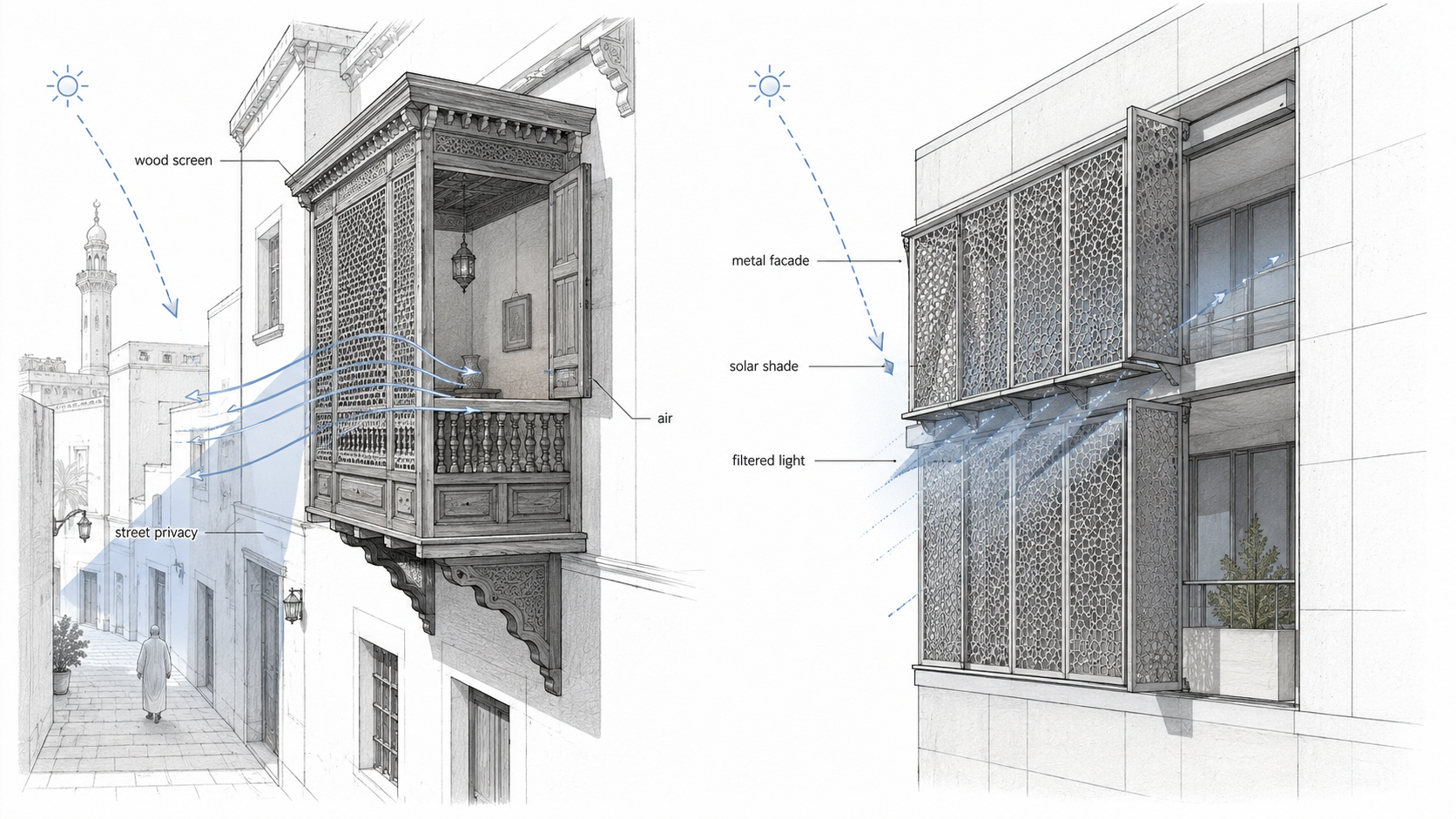
Modern Mashrabiya Design
Modern architecture often borrows the mashrabiya because it solves a current problem: too much sun on glass.
In hot climates, a glass facade without shade can create glare, heat gain, and dependence on mechanical cooling. A mashrabiya-inspired screen can reduce direct solar exposure, filter daylight, and give the building a regional identity.
The best modern examples translate the logic, not only the look. They ask what the screen is supposed to do: block low sun, reduce heat, protect privacy, create a public facade, or soften interior light.
The weak version treats mashrabiya as branding. It places a pattern over a facade without changing heat gain, glare, privacy, or building performance. That may create an Islamic-looking surface, but the older architectural intelligence is mostly gone.
Modern Uses That Make Sense
Mashrabiya-inspired design works best when the screen has a real job.
- Exterior facade shading for hot or bright elevations.
- Privacy screens for apartments, hotels, clinics, and cultural buildings.
- Interior partitions where light and air should pass but views need softening.
- Courtyard edges that need shade without full enclosure.
- Balcony screens where privacy, airflow, and sun control overlap.
- Museum, library, or mosque facades where filtered light supports the building use.
This matters because mashrabiya is often sold as pattern. Architects should read it as performance first.
What Gets Copied Badly
Mashrabiya is easy to copy badly because the pattern is so recognizable.
A flat laser-cut panel can look close in a rendering, but it may fail as architecture. If it has no depth, no shadow, no airflow strategy, no maintenance access, no weather detailing, and no relationship to the window behind it, it becomes applied decoration.
The common failures are predictable:
- patterns that are too dense for airflow;
- patterns that are too open for privacy;
- thin flat panels that cast weak shadows;
- metal screens that overheat in direct sun;
- wood screens placed where rain and sun will destroy them quickly;
- decorative panels installed without cleaning access;
- screens that block emergency egress or create unsafe attachments;
- fake “Islamic” patterns used without understanding scale or geometry.
A useful test is simple: remove the mashrabiya from the design. Does the room become hotter, brighter, less private, or less usable? If nothing changes except the image, the screen was probably decoration.
The Maintenance Problem People Forget
Mashrabiyas collect dust.
That sounds minor until the screen is large, high, dense, exposed to street pollution, or built from fragile wood. The smaller and deeper the openings, the harder the screen can be to clean. In historic cities, dust, humidity, insects, cracked paint, missing pieces, and bad repairs can slowly change the way the screen looks and works.
Modern versions have their own problems. Aluminum panels need good coating. Steel needs corrosion protection. Exterior fixings need inspection. Large facade panels need safe access for cleaning and repair. A beautiful screen that cannot be maintained becomes a future liability.
This is why mashrabiya design should include maintenance from the start. The screen should not only look good on installation day. It should still work after sun, dust, rain, repairs, and years of use.
Patterns: Geometry, Arabesque, and Scale
Mashrabiya patterns often use geometry because repetition gives the screen order.
Geometric patterns can be tight, open, star-based, grid-based, circular, or interlaced. Arabesque and floral motifs can soften the pattern and make the screen feel less rigid. Modern patterns may simplify the geometry so panels can be cut, assembled, and replaced more easily.
Scale matters more than complexity. A very fine pattern may look impressive up close but disappear from the street. A large pattern may work on a facade but feel crude inside a small room. The best patterns are matched to viewing distance, sunlight, material thickness, and the size of the opening.
For pattern background, continue with Islamic geometric patterns and arabesque patterns.
Before You Use Mashrabiya in a Project
Do not start with the prettiest pattern.
Start with the problem. Is the space too exposed? Too bright? Too hot? Too visible from the street? Does it need air but not full openness? Does the screen need to be outside, inside, fixed, sliding, operable, structural, decorative, or removable?
- Identify the real need: shade, privacy, airflow, filtered light, facade identity, or interior separation.
- Check orientation and sun angle before choosing pattern density.
- Choose material based on exposure, maintenance, fire rating, weight, and attachment.
- Test the pattern at full scale, not only on a screen.
- Plan cleaning and repair access.
- Make sure the screen does not block egress, ventilation requirements, or window operation.
- Use cultural references carefully. A pattern is not a shortcut to authenticity.
Mashrabiya and the Rest of Islamic Architecture
Mashrabiya works best when it is read with the larger building system.
In a house, it often belongs with courtyards, thick walls, shaded rooms, upper floors, street edges, and private family life. In a mosque or public building, screens may help control light, privacy, threshold, and visual hierarchy. In modern facades, the screen may become part of a solar-control system.
It connects to several Islamic design systems:
- courtyards, because inward-facing space and privacy often work together;
- arches, because screens often sit within framed openings;
- muqarnas, because both systems use depth and repetition to shape light;
- characteristics of Islamic architecture, because mashrabiya is one feature inside a larger design vocabulary;
- Islamic Cairo, because historic houses, screens, streets, and courtyards still show the urban logic behind the feature.
The Same Problems Still Exist
Rooms still need daylight without glare. Hot walls still need shade. People still need privacy without shutting the room off from the street.
A mashrabiya does those jobs with one screen when it is designed well. It filters light, moves air, protects privacy, and gives the wall depth.
The pattern is only part of it. The screen earns its place when the room works better because it is there.
FAQ
What is mashrabiya in architecture?
Mashrabiya is a lattice screen used in Islamic architecture, often on windows, balconies, or partitions. It helps control privacy, light, shade, and airflow.
What is a mashrabiya made of?
Traditional mashrabiyas are usually wood. Modern versions may use aluminum, steel, bronze, composite panels, concrete, or other facade materials.
What is the purpose of mashrabiya?
Its main purposes are privacy, filtered light, ventilation, shade, and a softer transition between inside and outside.
Is mashrabiya only decorative?
No. The decorative surface is only one part of it. A real mashrabiya also affects heat, glare, airflow, view, and privacy.
Can mashrabiya be used in modern buildings?
Yes. Modern buildings often use mashrabiya-inspired screens as sun shades, privacy panels, facade systems, or interior partitions.
What is the difference between mashrabiya and jali?
Both are perforated screen traditions, but mashrabiya is usually associated with wooden lattice screens in Islamic architecture, while jali often refers to carved stone or perforated screens common in South Asian architecture.
What pattern works best?
There is no single best pattern. Open patterns give more air and light. Dense patterns give more privacy and shade. The right choice depends on orientation, room use, climate, and viewing distance.
Read This Next
For the larger tradition, read Islamic architecture. For the historical sequence, continue with Islamic architecture history. For the main features, use characteristics of Islamic architecture.
For related design systems, continue with Islamic geometric patterns, arabesque patterns, courtyards in Islamic architecture, Islamic arches, and muqarnas architecture.