
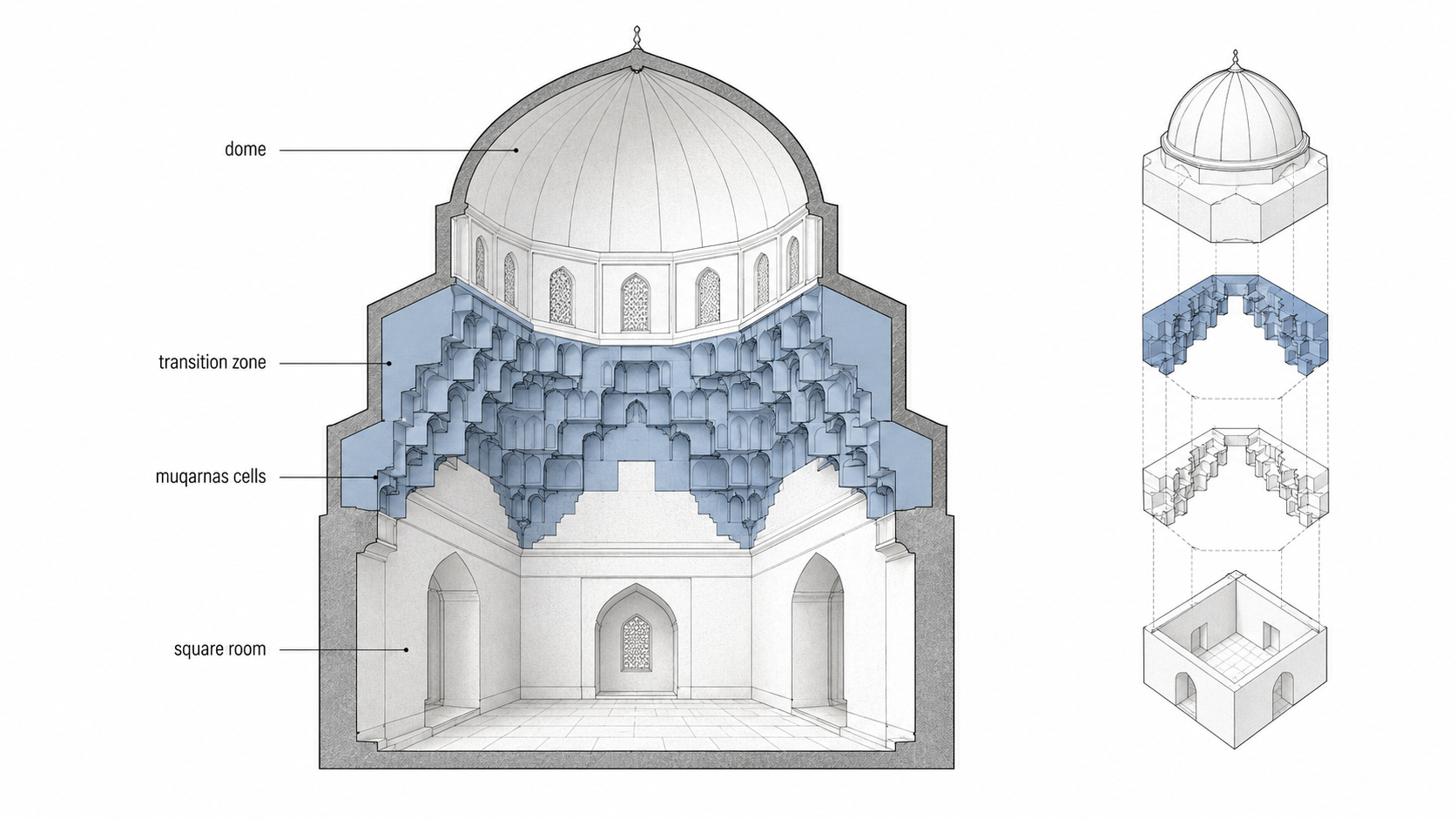
Muqarnas looks decorative until you notice where it appears.
It usually shows up where a building has a difficult problem: a square room needs to meet a dome, a flat wall needs to become a deep portal, an iwan needs a shadowed crown, or a niche needs more depth than a simple arch can give it.
That is the better way to read muqarnas. It is not only honeycomb ornament. It is a way of turning transitions into architecture.
In the larger subject of Islamic architecture, muqarnas belongs beside arches, domes, iwans, mihrabs, courtyards, geometric pattern, and calligraphy. It often sits between those systems, where one surface has to become another.
What Is Muqarnas?
Muqarnas is a three-dimensional ornamental system made from small stepped cells, niches, brackets, or tiers. The cells can look like honeycomb, stalactites, folded niches, or tiny stacked vaults, depending on region, material, and scale.
The word is often used for Islamic honeycomb vaulting, but that phrase is only partly useful. Honeycomb describes the visual effect. It does not explain the architectural job.
Muqarnas can appear under domes, inside portals, above mihrabs, in squinch zones, on cornices, inside iwans, under balconies, and across ceilings. Sometimes it helps manage a transition. Sometimes it is mostly ornamental. Often it is both.
| Simple Term | Better Reading | Where You See It |
|---|---|---|
| Honeycomb vaulting | A visual description, not the full architectural meaning | Ceilings, domes, portals, and palace rooms |
| Stalactite ornament | A common nickname, but it can make the system sound decorative only | Muqarnas domes, niches, and vault transitions |
| Muqarnas | A stepped cellular system that can shape transition, depth, shadow, and surface | Islamic buildings across Iran, Central Asia, Egypt, North Africa, Spain, Turkey, and South Asia |
The Joint Is the Point
Muqarnas is easiest to understand at the joint.
A dome does not naturally sit on a square room. A portal does not naturally jump from a flat façade into a deep ceremonial entrance. A corner does not naturally become a soft, glowing, stepped surface. Muqarnas often appears where the building needs to make one geometry become another.
That is the part many descriptions miss. They talk about beauty, complexity, and mathematics, which are all fair. But the useful architectural question is simpler: what was hard to connect here?
Look at the corner, the ceiling edge, the squinch, the niche, or the portal crown. Muqarnas often turns a technical or spatial problem into a controlled field of shadow.
Where Muqarnas Appears
Muqarnas is not one building part. It is a system that can attach to many parts of a building.
| Location | What Muqarnas Does There | What to Look For |
|---|---|---|
| Under a dome | Softens the move from wall or corner to curved ceiling | Stepped cells that break the transition into smaller layers |
| Portal | Deepens the entrance and creates a shadowed threshold | Nested cells above the doorway or inside the entry recess |
| Mihrab | Gives the prayer niche more depth and visual weight | Small cellular tiers above or inside the niche |
| Iwan | Turns a large vaulted opening into a layered ceremonial edge | Muqarnas at the crown, corners, or inner surfaces of the iwan |
| Ceiling | Creates a suspended field of depth, light, and pattern | Cells spreading across the surface rather than only at a joint |
| Cornice or balcony underside | Turns a horizontal edge into shadow and rhythm | Small repeating brackets or stepped cells under the projection |
Muqarnas Is Not the Same as an Arch, Squinch, or Pendentive
Muqarnas often appears near arches, squinches, and domes, so it gets confused with them.
An arch spans an opening. A squinch helps a square room carry a dome or octagonal transition. A pendentive is a curved triangular surface that helps a dome sit over a square bay. Muqarnas can appear in those zones, but it is not the same thing.
The confusion makes sense because muqarnas often lives where structural geometry is already changing. It can decorate a squinch. It can cover a transition zone. It can sit inside an arch. But the muqarnas system is the cellular, stepped, layered treatment of that surface.
| Element | Main Job | How It Relates to Muqarnas |
|---|---|---|
| Arch | Spans an opening and carries load | Muqarnas can decorate or deepen the arch zone. |
| Squinch | Bridges a corner so a dome can sit above a square room | Muqarnas can fill or elaborate the squinch. |
| Pendentive | Uses curved triangular surfaces to support a dome over a square bay | Muqarnas can appear nearby, but it is not the same structural form. |
| Muqarnas | Creates a stepped cellular transition, surface, or ornamental field | It can be structural, semi-structural, or mostly ornamental depending on the building. |
How Muqarnas Works Visually
Muqarnas breaks a large surface into small readable units.
Instead of one plain curve, one flat corner, or one heavy mass, the viewer sees hundreds of smaller steps. Light catches the edges. Shadows collect inside the cells. The surface starts to shift as you move.
This is why muqarnas can make a heavy portal feel lighter, a dome transition feel more gradual, or a palace ceiling feel almost suspended. The effect is not only decorative. It changes scale. It changes shadow. It changes how the eye reads the depth of the building.
Materials Change the Effect
Muqarnas can be carved, molded, built up, assembled, painted, or tiled.
Material changes everything. Stone muqarnas can feel heavy and structural. Plaster muqarnas can become fine, deep, and delicate. Brick muqarnas can be more geometric and construction-driven. Tile can make the cellular system brighter and more legible from a distance. Wood can turn muqarnas into a suspended ceiling system.
| Material | Typical Effect | Where It Often Appears |
|---|---|---|
| Stone | Weight, shadow, carved depth | Mamluk portals, mosque entrances, exterior niches |
| Stucco or plaster | Fine detail, deep surfaces, delicate interiors | Palaces, mihrabs, interior vaults, Andalusian work |
| Brick | Modular construction and stepped geometry | Iran, Central Asia, Seljuk and Persian traditions |
| Tile | Color, pattern, reflection, distance reading | Persian and Central Asian domes, iwans, portals |
| Wood | Lightness and ceiling craft | Interior ceilings, smaller chambers, regional adaptations |
Muqarnas in Islamic Architecture
Muqarnas is strongly associated with Islamic architecture because it appears across many Islamic regions and building types. It fits the broader design language well: geometry, repetition, transition, shadow, surface order, and layered meaning.
It also avoids the flatness that can happen when pattern is treated only as a two-dimensional surface. Muqarnas makes geometry physical. The pattern projects, recedes, catches light, and changes with the viewer’s position.
That makes it different from tile pattern, calligraphy, or arabesque ornament. Those can be deep and architectural too, but muqarnas turns the surface itself into a small spatial field.
For the broader list of related systems, see characteristics of Islamic architecture.
Regional Differences Matter
Muqarnas does not look the same everywhere.
A Mamluk stone portal in Cairo, a Persian iwan, an Alhambra palace ceiling, and an Ottoman mosque detail can all use muqarnas, but the material, scale, depth, and role change.
| Region or Tradition | Typical Muqarnas Use | What Changes |
|---|---|---|
| Persian and Seljuk | Iwans, domes, portals, and courtyard edges | Strong geometric organization, tile, brick, and large transition zones |
| Mamluk Cairo | Stone portals, minarets, domes, and entrance crowns | Deep carved shadows and strong street presence |
| Andalusian / Moorish | Palace ceilings, domed chambers, niches, and delicate interiors | Plaster, lightness, repetition, and intricate interior effect |
| Maghreb | Entrances, plaster interiors, mosque and palace details | Strong relation to carved plaster, tile, and courtyard architecture |
| Ottoman | Portals, niches, mosque details, and selective transition zones | Often more restrained beside large dome systems and tile surfaces |
| Mughal and South Asian | Niches, gateways, decorative transitions, and interior surfaces | Often mixed with stone carving, marble, inlay, and local craft traditions |
Muqarnas at the Alhambra
The Alhambra is one of the easiest places for beginners to recognize muqarnas.
Its palace interiors use muqarnas as ceiling, vault, shadow field, and atmosphere. The cells are not there just to show skill. They make the ceiling feel lighter than it is. They break down scale. They catch light from different angles. They help the room feel layered rather than capped by one plain surface.
That is why “muqarnas Alhambra” is a useful search term. The Alhambra gives a clear visual example, but it should not become the only example. Muqarnas also belongs to mosque portals, domes, mihrabs, iwans, and urban religious buildings across the Islamic world.
For the regional context, use Islamic and Moorish architecture in Spain and Alhambra Palace architecture.
Muqarnas in Mosques, Palaces, and Madrasas
Muqarnas changes by building type.
In a mosque, it may strengthen the mihrab, frame a portal, soften a dome transition, or give a minaret and entrance more visual weight. In a palace, it can create a dreamlike ceiling or a delicate transition between wall and roof. In a madrasa, it can mark the entry, iwan, or teaching courtyard with more ceremony.
The same system can serve different levels of importance. A small muqarnas niche might mark a detail. A large muqarnas portal can dominate a street.
How to Recognize Muqarnas
Start by looking for depth.
Flat pattern is not muqarnas. A carved floral border is not muqarnas by itself. A simple arch is not muqarnas. Muqarnas usually has stepped, cellular, niche-like depth. It looks built from small repeating pockets, shelves, or miniature vaults.
- Look at corners where a dome, vault, or ceiling changes shape.
- Look inside deep portals above the entrance.
- Look above the mihrab or in niche crowns.
- Look under projecting balconies, cornices, or minaret details.
- Look for cells that catch light and cast small shadows.
How to Draw Muqarnas Without Faking It
Do not start with random honeycomb.
Start with the architectural condition. Is the muqarnas under a dome, inside a portal, above a mihrab, or across a ceiling? The setting controls the geometry.
Then draw the big transition first: square to octagon, wall to arch, portal recess to crown, corner to dome, or flat ceiling to cellular surface. Only after that should you add the smaller cells.
- Draw the main wall, bay, niche, dome, or portal.
- Mark the transition zone where the geometry changes.
- Break that zone into horizontal tiers.
- Add repeated cells or niches within each tier.
- Use shadow to show depth, not heavy outline.
- Keep the pattern tied to the structure around it.
This is the same study habit used for other Islamic architectural systems: understand the building first, then the surface. For a broader approach, see Islamic architecture history.
Common Mistakes When Describing Muqarnas
| Mistake | Why It Fails | Better Reading |
|---|---|---|
| Calling it only decoration | It ignores transitions, shadows, scale, and spatial depth. | Ask where it sits and what geometry it is mediating. |
| Calling every honeycomb ceiling muqarnas | Some ceilings imitate the look without the same architectural logic. | Look for stepped cells tied to a transition, niche, vault, or ceiling field. |
| Confusing muqarnas with an arch | An arch spans; muqarnas subdivides and layers a surface. | Separate the opening from the cellular treatment around it. |
| Ignoring material | Stone, stucco, brick, tile, and wood create different effects. | Read the material before judging the style. |
| Using Alhambra as the whole story | The Alhambra is important, but muqarnas appears across many Islamic regions. | Compare Andalusian, Persian, Mamluk, Ottoman, and South Asian examples. |
What Modern Designers Can Learn From Muqarnas
The useful lesson is not to paste honeycomb pattern onto a ceiling.
Muqarnas teaches a better habit: treat transitions carefully. Where a wall becomes a ceiling, where a room meets a dome, where a façade becomes an entrance, or where a public edge becomes a shaded threshold, the joint deserves design.
A modern building does not need historic muqarnas to learn from it. It can use layered soffits, stepped reveals, acoustic ceiling fields, filtered light, modular shading, or faceted transitions. The point is not imitation. The point is turning a difficult joint into a designed moment.
FAQ
What is muqarnas?
Muqarnas is a stepped cellular system used in Islamic architecture. It can look like honeycomb, stalactites, or small nested niches, and it often appears in domes, portals, mihrabs, iwans, and ceiling transitions.
What does muqarnas mean in architecture?
Architecturally, muqarnas helps turn a transition into a designed surface. It can soften the move from wall to dome, deepen a portal, mark a niche, or create a ceiling field of shadow and depth.
Is muqarnas structural?
Sometimes it can be tied to structural transition, but many examples are partly or mostly ornamental. The answer depends on the building, material, period, and location of the muqarnas.
Why is muqarnas called honeycomb vaulting?
The small repeated cells can look like honeycomb, especially in ceilings and domes. Honeycomb vaulting is a useful visual nickname, but muqarnas is the more precise architectural term.
Where is muqarnas found?
Muqarnas appears across Islamic architecture, including Persian, Seljuk, Mamluk, Moorish, Ottoman, Central Asian, North African, and South Asian buildings. It is common in portals, domes, iwans, mihrabs, niches, and palace ceilings.
What is muqarnas in the Alhambra?
At the Alhambra, muqarnas appears in palace ceilings and chambers where it creates depth, shadow, lightness, and a layered interior atmosphere. It is one of the clearest examples for beginners to study.
How is muqarnas different from a squinch?
A squinch bridges a corner so a dome can sit above a square room. Muqarnas can appear in a squinch zone, but it refers to the stepped cellular treatment, not the squinch itself.
Read This Next
For the broader parent topic, start with Islamic architecture. For related features, continue with characteristics of Islamic architecture, Islamic arches, Islamic geometric patterns, and arabesque patterns.
For regional examples, read Islamic and Moorish architecture in Spain, Alhambra Palace architecture, and Al-Azhar Mosque.