
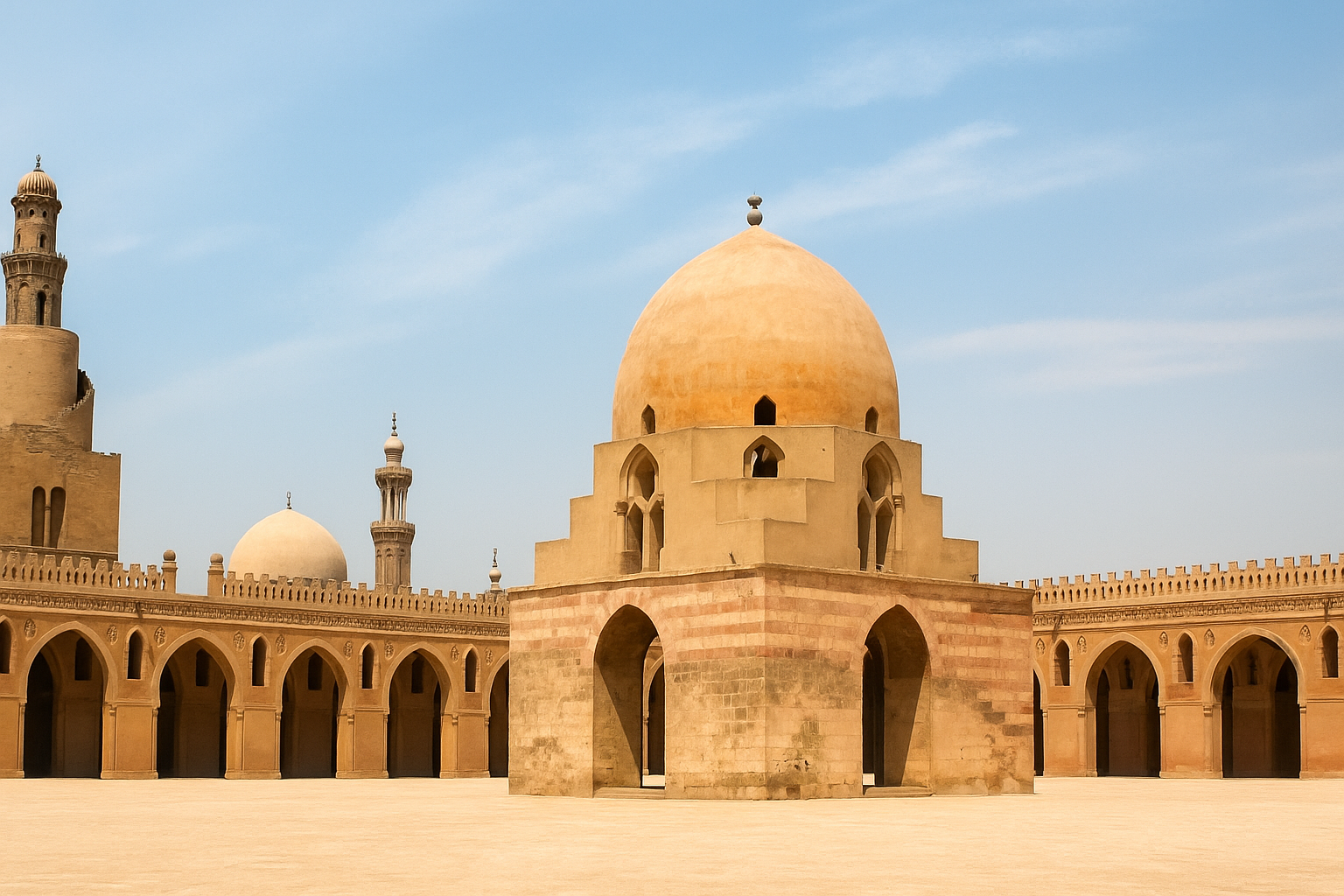
Ibn Tulun Mosque: What Architects Should Notice About Its Form
I went to Cairo to walk real buildings, not read plaques. The Ibn Tulun Mosque is the one I kept returning to. It is brick, plaster, sun, and shadow. No gloss. No shiny fix. More than eleven centuries old and still doing its job.
Context: Where, when, and why it still stands
The mosque sits on Gebel Yashkur in historic Cairo. Ahmad Ibn Tulun commissioned it and builders raised it between 876 and 879 CE. Many early mosques were rebuilt or wrapped in later structures. This one kept its bones. It remains the oldest mosque in Cairo that survives close to its original form. That matters. You can still read the plan without guesswork.
If you want a wider view of how this district grew and why certain sites held their ground, see a short guide to Islamic Cairo’s urban fabric. For how regional climate shaped building choices in Egypt, this overview helps frame the context: Egyptian mosque and city patterns.
First encounter: the wall that teaches silence
You approach through tight streets. Then a long blind wall takes the noise out of your head. It is brick under plaster. Thick. Unapologetic. No tile. No banding. Just load and weathering. Between this wall and the prayer hall is a wide buffer zone, the ziyāda. It is not leftover land. It is a deliberate quiet strip that absorbs dust, sound, and heat before you enter the court.
Courtyard logic is the backbone of many Islamic buildings. For comparisons across major examples, study this primer on sahn courtyards and how they work.
The courtyard: proportion instead of decoration
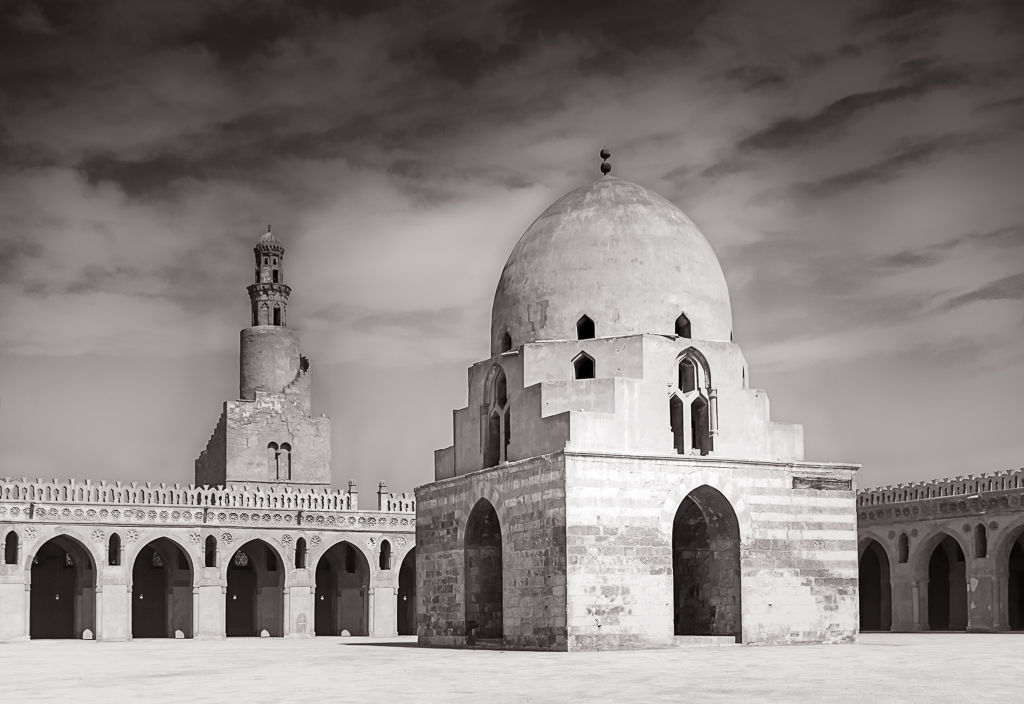
Inside, the court is square and open. Arched arcades on four sides repeat a single bay. Light slides across plaster and brick. Nothing competes with shadow. It feels calm because the geometry is consistent. No one tried to rescue weak proportion with ornament. The space does not need it.
To contrast court expression at a later date, read how Ottoman grandeur wraps the same core idea in stone and tile in a history of the Blue Mosque’s layout.

Material choice: why brick won here
Cairo can build in stone. Ibn Tulun is brick. Fired units, stacked fast, skinned in lime plaster. Brick made tall pointed arches possible without heavy carved jambs. It sped construction, eased repair, and kept weight reasonable across wide spans. It also breathes. The wall is not a veneer. It is structure, buffer, and sometimes a stair.
To see how other regions push vertical systems with a different material palette, the Ottoman high period offers a useful counterpoint: Sinan’s structural playbook.
Ceiling and roof: carpentry that knows its limits
The prayer hall carries a timber roof. Painted beams, flat spans, clear rhythm. No false coffers. No hidden iron. It reads like honest carpentry that trusts repetition. Timber bridges the bays and leaves the wall to do the heavy lifting.
If you map the section at noon, you see how roof overhangs and arcade depth cut glare while keeping air moving. Simple moves, big changes in comfort.
Aisles and arches: structure as a walking tool
Pointed brick arches run in long files. The span to rise ratio is consistent, so your stride finds a tempo. Shade is not an accident. Each bay throws a predictable patch of cool air. You can cross the court edge to edge without stepping into harsh sun for long. That is climate design, not style.
For a clean breakdown of how arch profiles shift performance and feel, see a working guide to arches in Islamic architecture.
The mihrab: a focused cut, not a spectacle
Stand at the main mihrab. It is recessed deep enough to read from the far side of the hall. Stucco carving is restrained. The niche marks direction with shape, depth, and a sharp play of light. You do not need gilding to understand the point of the wall. The room aligns around a simple void.
If you are mapping ornament, use this site to see where geometry carries meaning without overload: clean, functional pattern logic.

Circulation: people first, then views
You can walk the perimeter under shade, climb discreet stairs inside the wall, then reach the roof. You can watch the district without leaving the building. Routes are clear. No choke points. No forced vistas. The plan assumes use, not just looks. That is why this place still works when the crowd changes size through the day and week.
When you study circulation at city scale, connect this to how streets and courts nest across districts in the Egyptian urban lens.
The minaret: a spiral taught by brick
The current spiral minaret dates to a later rebuild, likely 13th century. It still teaches the same lesson. Mass first. Carve the stair out of solid fabric. The ramp wraps a thick core. It is a tower that accepts weather and time without delicate parts. You climb it and understand how gravity is managed in turns and landings.
For a broader reading of minaret types and why this one reads so stark, see minaret anatomy across regions.
Climate intelligence: thickness, shadow, air
Cairo is hot for much of the year. The design answers with simple tools. Thick walls hold the day’s heat away from the prayer hall. Deep arcades edit the sun. The open court lets hot air rise and pull breezes across the floor. The building does not fight climate with machines. It collaborates with it.
When you compare this to Saharan and Iberian adaptations, you see the same logic evolve with local material and wind. A good cross section of those ideas is here: Moorish adaptations in Spain.
What the finish tells you about maintenance
Plaster over brick means easy patching. Salt bloom, chips, cracks. You limewash and move on. The finish is not a museum piece. It is a working skin you refresh on a cycle. That is why the wall still looks like a wall. Builders designed with maintenance in mind.
Edges, doors, and the useful thickness of walls
Many doors sit flush with the plaster and then dive into deep reveals. The jamb is a small room. Stairs are hidden in the wall mass. Niches take tasks off the floor. The wall does three jobs at once: it holds the roof, makes a path, and cools a threshold. You get function without clutter.
What photos miss and your body catches
- Light is soft, not dramatic. It glides along plaster and fades into the arch springings.
- Echo is present but short. Speech stays legible across the hall.
- Floor temperature shifts with shade bands through the day. Bare feet know the section better than drawings do.
- Smell of dust and lime tells you where the last wash happened. Maintenance has a scent here.
Design lessons you can steal today
Spend on space, not finish. The court gives value every hour of the day. Polished stone would not add much.
Let structure set the rhythm. The arch bay trains movement and frames light. You do less when the span is right.
Make walls do more. Thicken them. Hide routes, storage, and stairs. Gain performance without visual noise.
Draw the section first. Shade, air, and sound live in section. Plan comes second once the section works.
For more on how core elements carry meaning and performance together, this overview helps keep focus on essentials: form, function, and meaning working as one.
What Stuck With Me: One Thing I Can’t Unsee Now
I walked Ibn Tulun four times in one week. Morning, noon, late afternoon, and after prayer. What stuck is not the arches or the plan. It’s the way the building uses thickness as a resource.
Not styling. Not symbolism. Just mass doing work: cooling air, hiding stairs, cutting glare, holding sound, storing tools, guiding movement. Walls here are not boundaries. They’re machines.
Once you see it, you start to resent skinny walls and drywalls pretending to be structure. You understand why rooms overheat, why sound leaks, why buildings feel thinner every decade. Thickness is not waste. It’s performance. We traded it for finishes, HVAC, and fake efficiency. Maybe that was the real loss.
I didn’t plan to take that lesson home, but here we are — sketching new envelopes with fat walls doing five jobs at once. Space inside the wall, not just between them. That’s what this mosque quietly hands you 1,100 years later.
A short build note: speed without waste
Historical accounts point to a three year construction window. That only works when materials are close, assembly is repetitive, and details are buildable by many hands. Brick, lime, timber. One arch type. One bay module. It is a system more than a composition.
Common confusions I had before visiting
Is it plain because they were poor? No. It is plain because proportion and climate do the heavy lifting. Rich finish would not improve performance here.
Is the spiral minaret original? No. It was rebuilt in a later period. The lesson remains valid. Mass and gravity set the rules either way.
Is the court empty by accident? No. Empty space is the program. Gathering, airflow, and light control depend on it.
Walking method for students and teams
- Walk the arcades at three speeds. Count steps per bay. Note when shade fails.
- Sketch the section at 9, 12, and 15 hours. Mark glare zones. Mark breeze paths.
- Sit by the mihrab and read sound. Clap once. Count the decay. Move two bays. Repeat.
- Trace one door from street to court. Measure reveal depth with your hand span. Note temperature change.
Then ask one design question on your own project: what can your wall do besides hold up the roof. Answer that before you pick finishes.
Comparative threads worth pulling
To see how this early Egyptian logic echoes and evolves, pair your field notes with these focused reads:
- Arches as structure and light frames
- Geometric pattern that stays functional
- Islamic architecture from origins to global reach
MUST READ
Islamic Architecture: Form, Function and Meaning — Robert Hillenbrand
Buy on Amazon
Short reason: clear explanations of space, section, and use. No fluff. Good diagrams.
FIELD PICK
Architecture for the Poor — Hassan Fathy
Buy on Amazon
Short reason: how earth and brick can deliver dignity and comfort with simple means.
Closing note
I left the site through the same narrow streets I came in. Dust on shoes. Lime on fingers. No hunt for perfect photos. I had what I needed. A plan that breathes. A wall that works. A roof that trusts timber. If you build houses, schools, or small civic rooms, there is enough here to guide your next section without any marble or glass. Start with thickness. Respect the sun. Spend on space. The rest will hold.
FAQ
Is Ibn Tulun still an active mosque?
Yes. It’s not a museum. You can walk, sit, pray, and hear the call to prayer here. Bring respect and patience — not a tripod and checklist.
Why is it so plain compared to famous Ottoman or Persian mosques?
Different context, different goal. Here, proportion, light, and climate do the work. Other regions had different materials, rulers, and budgets. Plain doesn’t mean incomplete.
Did the spiral minaret influence later minarets?
Indirectly. The form echoes older Mesopotamian towers and sets a type, but later Ottoman minarets went slender and vertical. This one teaches mass and wind, not silhouette.
How long did it take to build?
Around three years. That speed only works when a design leans on repeatable modules, local material, and craft that doesn’t require court artisans.
What part should architects study first?
The section. Stand at the court edge at noon and look up. You’ll see shade, mass, airflow, and comfort created without machines. Then walk the wall and learn how it hides paths and stairs.
Can this logic work in modern housing?
Yes, if you stop thinking of walls as surfaces. A wall can store, stabilize, cool, and organize. Make it thick again. Put stuff in it. Don’t waste the depth.
Where can I explore similar climate-smart buildings?
Start here: Moorish courtyards in Spain. Then compare bigger imperial scale here: Sinan’s mosque at scale in Istanbul. Different climates, same logic: shade, air, thickness.
Why do some parts look newer?
Repair happens in waves. Limewash and plaster patches are expected. This is a lived building, not a preserved relic. You’ll see both original mass and later fixes side-by-side.
Can I climb the minaret?
Sometimes, with a guard’s help, depending on the day. Bring good shoes. The stair is steep and carved into the wall. No guardrails. It’s the best structural lesson on site if you’re lucky enough to go up.