
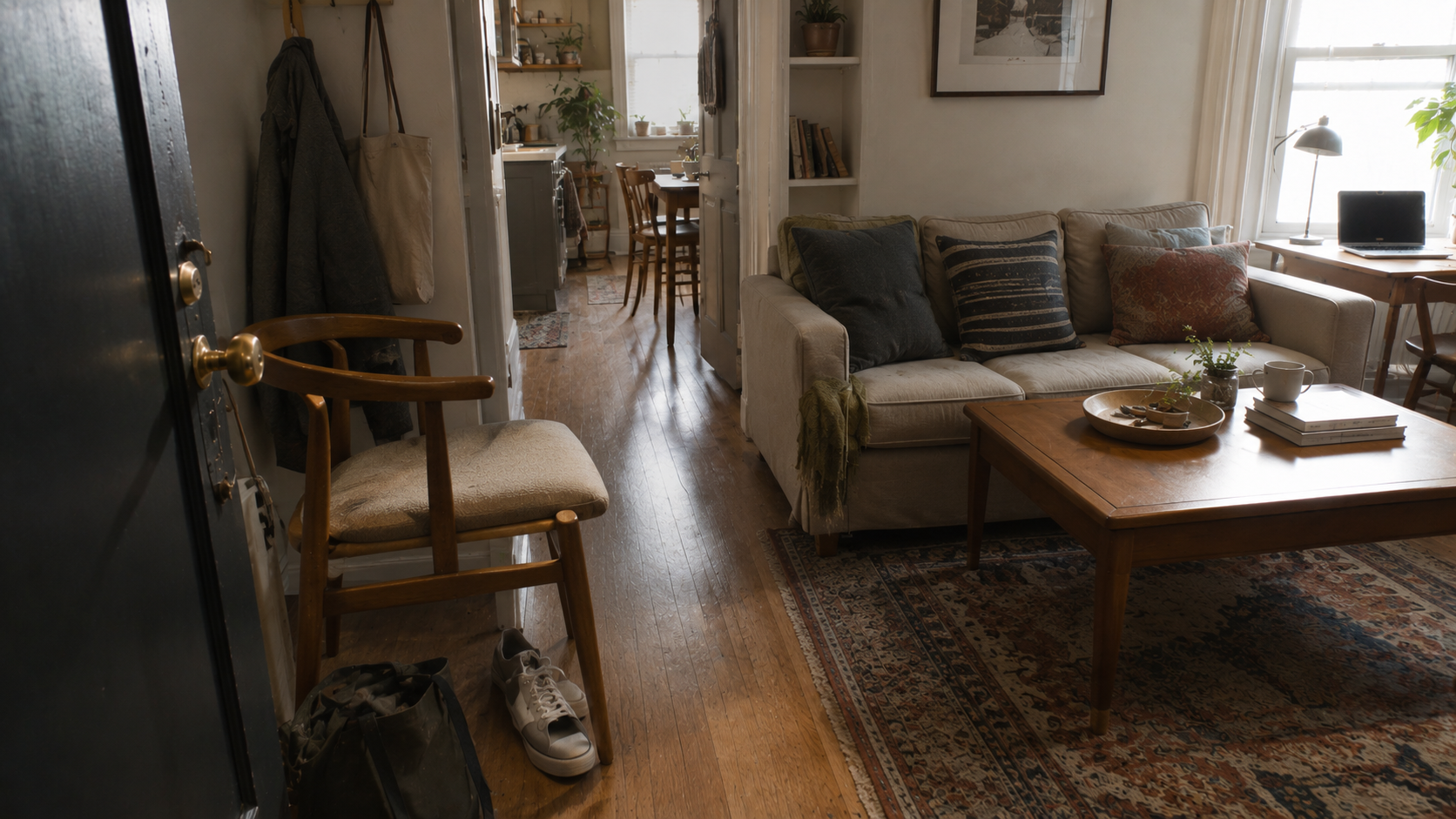
Image by ArchitectureCourses.org. A room can look finished and still fail if movement, light, edges, and clearances were not planned first.
A room can look beautiful and still fight you every day.
The chair blocks the door. The kitchen island eats the walking path. The desk sits in glare. The gallery looks dramatic until visitors bunch at the first display. The open office feels open until every phone call leaks across the room.
That problem starts with space, not style.
Spatial design is the work of making a place function before anyone decorates it. It deals with movement, layout, scale, light, privacy, sound, furniture, thresholds, and how people use the room when nobody is posing for the photograph.
What Spatial Design Means
Spatial design is the planning of space as something people move through, pause in, share, avoid, work inside, and remember. It sits between architecture, interior design, space planning, exhibition design, landscape design, and experience design.
The word sounds broad because the work is broad. A spatial designer may shape a small apartment, a museum route, a retail floor, a school corridor, a workplace, a public plaza, or a temporary installation. The scale changes. The same questions keep coming back.
Where does the body enter? Where does it slow down? What gets seen first? What feels private? What feels exposed? What happens when two people pass each other? What gets stored, hidden, heard, lit, blocked, or wasted?
That is spatial design. It is less about adding things and more about making the space stop working against the user.
Where Spatial Design Overlaps With Other Design Work
Spatial design touches several fields, but it should not become a loose word for “nice design.” The useful way to separate it is by the problem each field is trying to solve.
| Topic | Main job | Common failure |
|---|---|---|
| Spatial design | How space, movement, scale, light, and use work together. | The space looks good but feels awkward in daily use. |
| Spatial planning and design | Arranging zones, paths, adjacencies, and functions. | The rooms exist, but they are in the wrong relationship. |
| Interior space planning | Room layout, furniture clearance, circulation, and daily habits. | The room is furnished before the path is solved. |
| Interior and spatial design | The field, career path, school language, and portfolio direction. | The work gets reduced to decoration instead of space-making. |
| Space planning essentials | Beginner checks for early design work. | The plan is polished before the basics are tested. |
Spatial Design Starts Before the Floor Plan Looks Finished
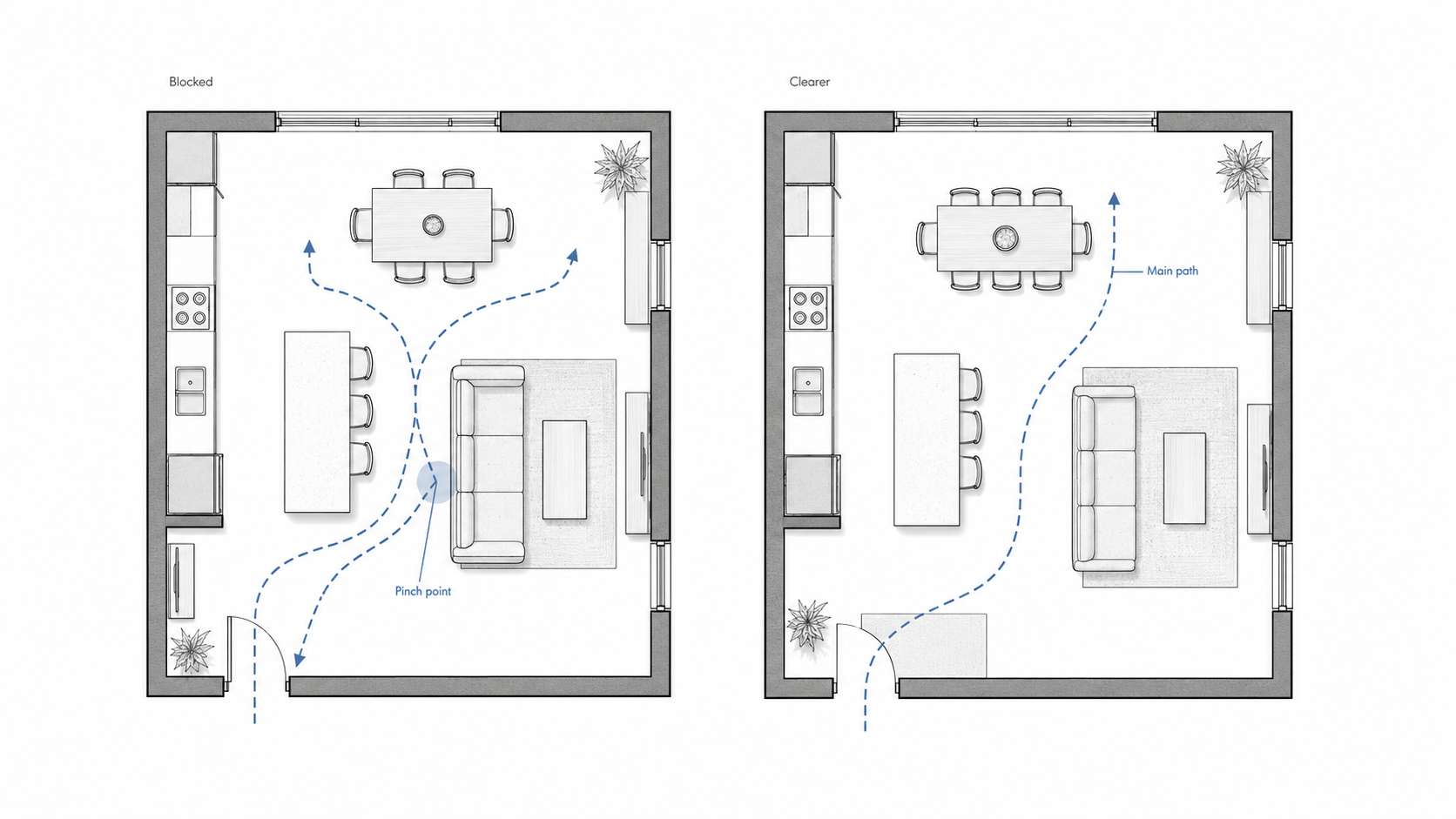
Illustration by ArchitectureCourses.org. Spatial design starts by fixing movement before style.
The first mistake is judging a layout too early because it looks tidy on paper.
A clean plan can still have bad space. A symmetrical room can still waste movement. A large room can feel tight if the furniture blocks the useful path. A small room can feel calm if the edges are handled well.
Good spatial design usually starts with rough questions, not perfect drawings.
- Where does the body move first?
- What should be visible from the entry?
- Where does the user need a landing zone?
- What should feel open, and what should feel protected?
Only after those questions are answered does the plan deserve polish.
The Parts That Decide Whether a Space Works
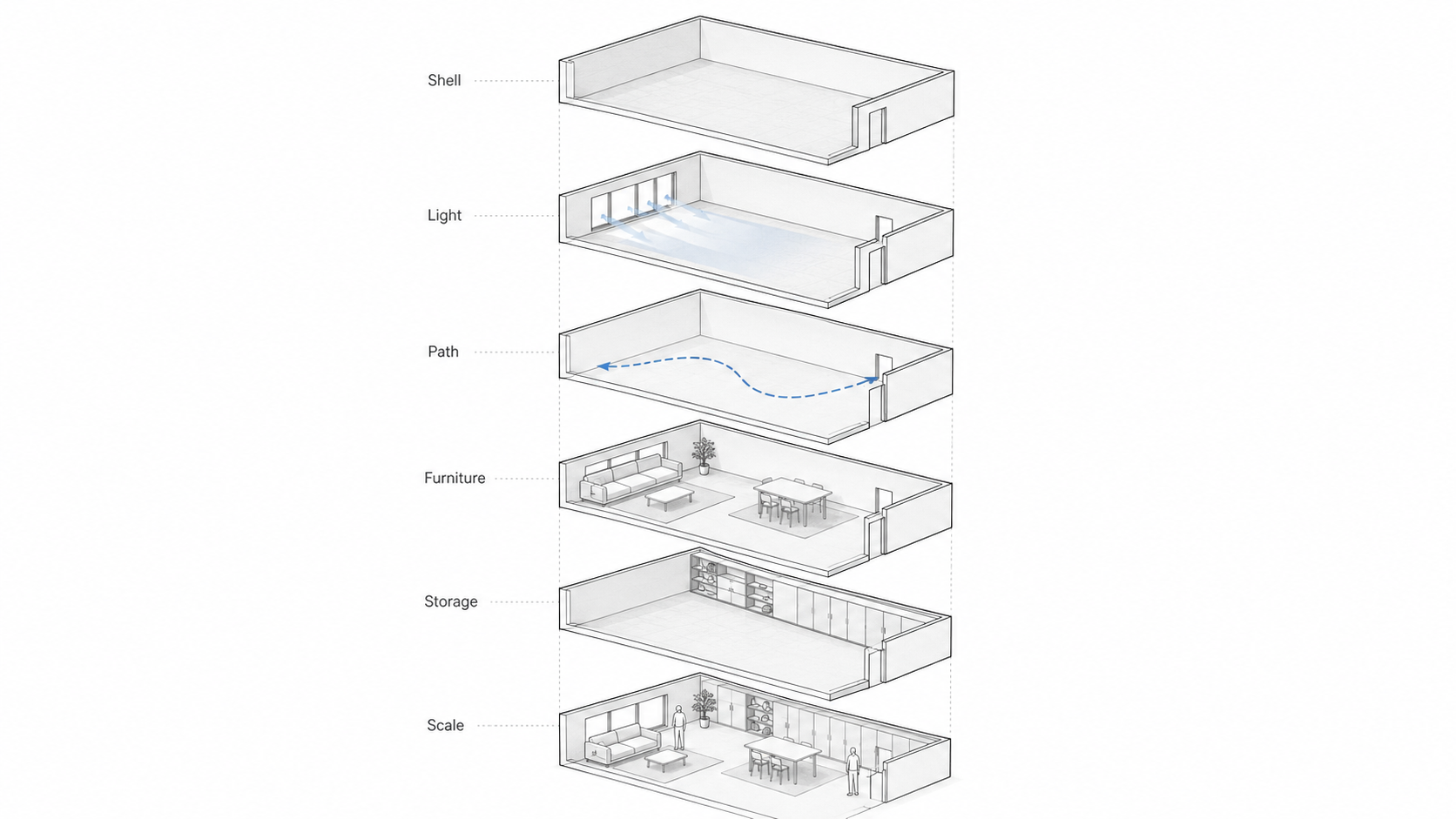
Illustration by ArchitectureCourses.org. Shell, light, movement, furniture, storage, and scale all affect whether a room works.
Spatial design is not one decision. It is a stack of small decisions that either support each other or fight each other.
Movement
Movement is the first test. A space can have expensive finishes and still fail because the path through it is awkward. If someone has to turn sideways, dodge a table, cross a work zone, or walk through a private area to reach a public one, the layout is asking too much.
In a home, movement shows up in kitchen aisles, door swings, hallway pinch points, and furniture clearances. In a public building, it shows up in entries, queues, exits, stair locations, and where people stop without blocking others.
Adjacency
Adjacency means what belongs near what. A kitchen near dining makes sense. A noisy meeting room beside quiet work does not. Storage near the point of use usually saves more frustration than a larger storage room placed badly.
This is where many attractive plans fall apart. The spaces exist, but they are in the wrong relationship.
Edges
Edges are where rooms meet doors, windows, walls, furniture, cabinets, stairs, counters, and openings. Bad edges create daily irritation.
A door swings into a chair. A sofa floats with no anchor. A bed blocks a closet. A window looks good in elevation but leaves no place for a desk. A beautiful stair lands in the wrong place.
Edges are boring until they are wrong. Then they dominate the whole room.
Scale
Scale is the relationship between the body and the space. A ceiling can feel generous or cold. A corridor can feel calm or mean. A room can be large but still badly proportioned.
For a deeper design foundation, the related page on scale and proportion in architectural design fits naturally here.
Light and View
Light is spatial. It tells people where to go, where to sit, what matters, and what feels safe. A dark middle zone in a home changes how the whole plan feels. A bright window at the end of a corridor can pull movement forward. Glare can ruin a workspace even when the layout looks correct.
Natural light has its own design logic, so the supporting page on natural lighting in architectural design belongs close to this topic.
Sound and Privacy
A plan can look open and generous, then fail because sound travels too far. Privacy is not only a bedroom or bathroom issue. It affects work calls, study corners, reception areas, classrooms, restaurants, and shared homes.
Spatial design asks where noise starts, where it lands, and where someone can step away without leaving the whole space.
Spatial Design vs Interior Design
Interior design often deals with finishes, furniture, material palettes, lighting, style, and the feel of interior rooms. Spatial design reaches earlier into the arrangement of space itself.
There is overlap. A strong interior designer thinks spatially. A strong spatial designer understands furniture, finish, and atmosphere. The difference is the order of concern.
| Question | Interior design usually asks | Spatial design usually asks |
|---|---|---|
| Room use | What furniture, lighting, finishes, and mood fit this room? | Is this room the right size, shape, and location for the activity? |
| Movement | How should furniture be arranged? | Where should movement happen before furniture is placed? |
| Comfort | What materials and lighting make the room feel right? | What layout, scale, edge, view, and noise conditions make the room usable? |
| Problem solving | How can the room look better? | Why does the room feel wrong before styling? |
Spatial design matters in both architecture and interiors because it catches problems that paint, furniture, and styling cannot fix later.
Where Spatial Design Saves Renovation Money
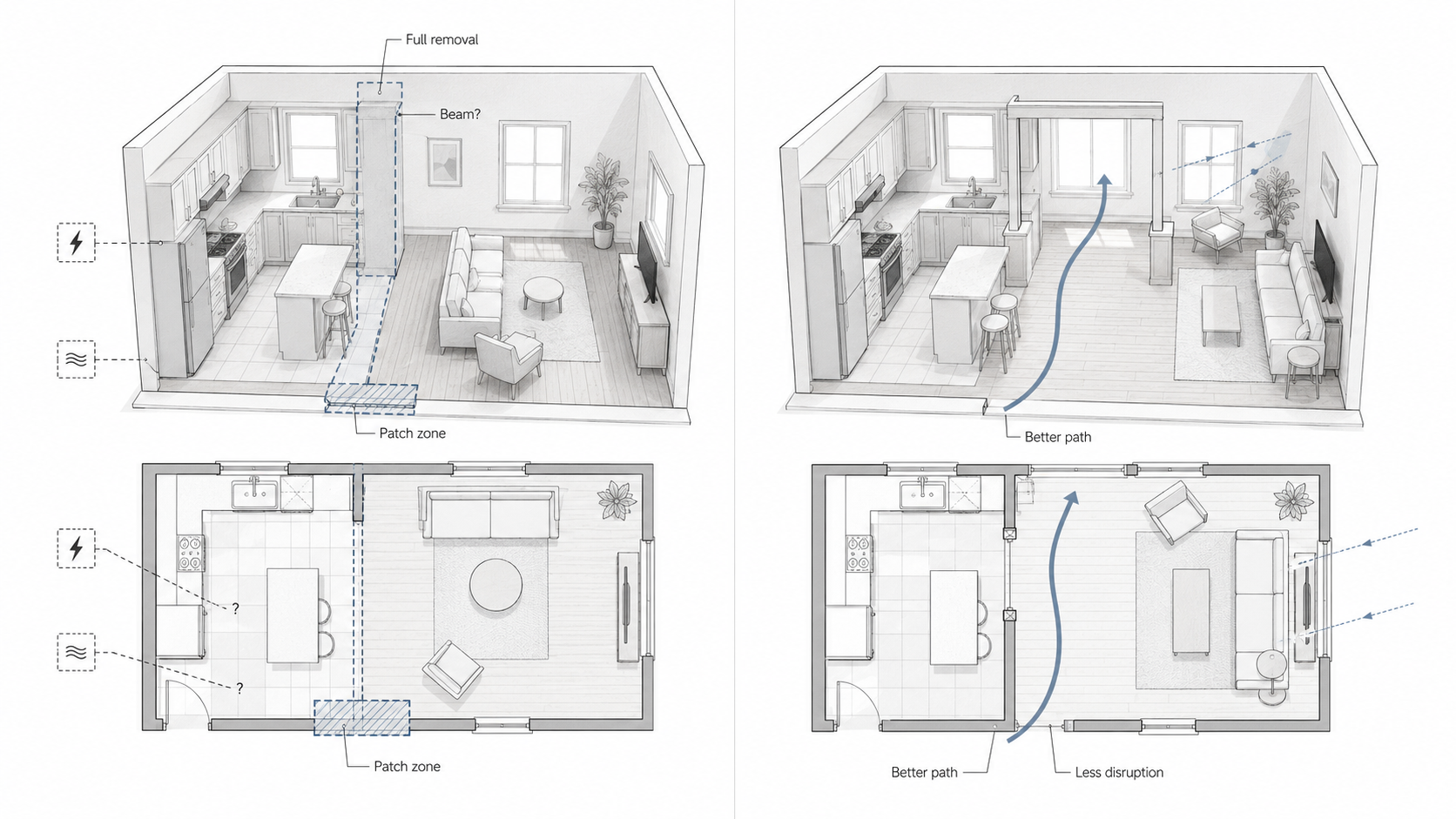
Illustration by ArchitectureCourses.org. A spatial check can stop the wrong renovation decision before demolition starts.
Spatial design can sound academic until a renovation starts.
Then the layout becomes money. Moving a wall, shifting a sink, changing a kitchen island, relocating a bathroom door, adding a window, or opening a room can trigger structure, plumbing, electrical, HVAC, flooring, drywall, trim, and permit questions.
A spatial check before renovation does not answer every construction question. It does something more basic: it helps you avoid paying for the wrong change.
A homeowner may think the kitchen needs a full wall removal when a wider opening, better light path, and cleaner furniture layout would solve the daily problem. A small bedroom may not need built-ins everywhere; it may need the bed moved away from the closet path. A living room may not need new furniture first; it may need one clear route from entry to seating.
This is the same reason many renovation problems start as layout problems, not finish problems. Before opening a wall or ordering cabinets, it helps to study how the space works in plain plan view. The same logic shows up in projects like open floor plan ranch house renovations and ranch house kitchen layout problems, where movement, light, structure, and daily use have to be solved before the room looks better.
That is why spatial design connects naturally to renovation. It slows the decision down before money gets locked into demolition, cabinets, flooring, or custom work.
The Drawing That Finds the Mistake Fastest
A basic plan is useful, but a movement overlay is often more honest.
Take the plan and draw the main path from entry to each important use: door to sofa, kitchen to table, bed to closet, reception to waiting, gallery entry to first display, desk to printer, classroom door to seats.
Then mark where the paths cross, tighten, or stop.
That simple overlay usually reveals the problem faster than a long design explanation. The room may have enough square footage, but the usable path is broken. The hallway may be wide enough, but the stopping point is in the wrong place. The office may have enough desks, but the quiet zone sits in the loudest path.
This connects with architectural drawings, because the drawing is not only presentation. It is a way to catch bad decisions before they become expensive.
A Room Usually Fails at the Edges
The center of a room gets too much attention. The edge usually causes the trouble.
Edges hold doors, windows, outlets, switches, cabinets, radiators, shelving, stair openings, curtains, desks, beds, sofas, and built-ins. A bad edge turns into a daily problem because it is where movement meets use.
A kitchen island may look fine in the center of a plan, but the edge between the island and refrigerator decides whether the kitchen works. A bedroom may look calm in a rendering, but the closet edge decides whether the bed placement is practical. A public lobby may look generous, but the edge near the entry decides whether people block the door while waiting.
Good spatial design checks the edge before celebrating the room.
The Space After Three Weeks
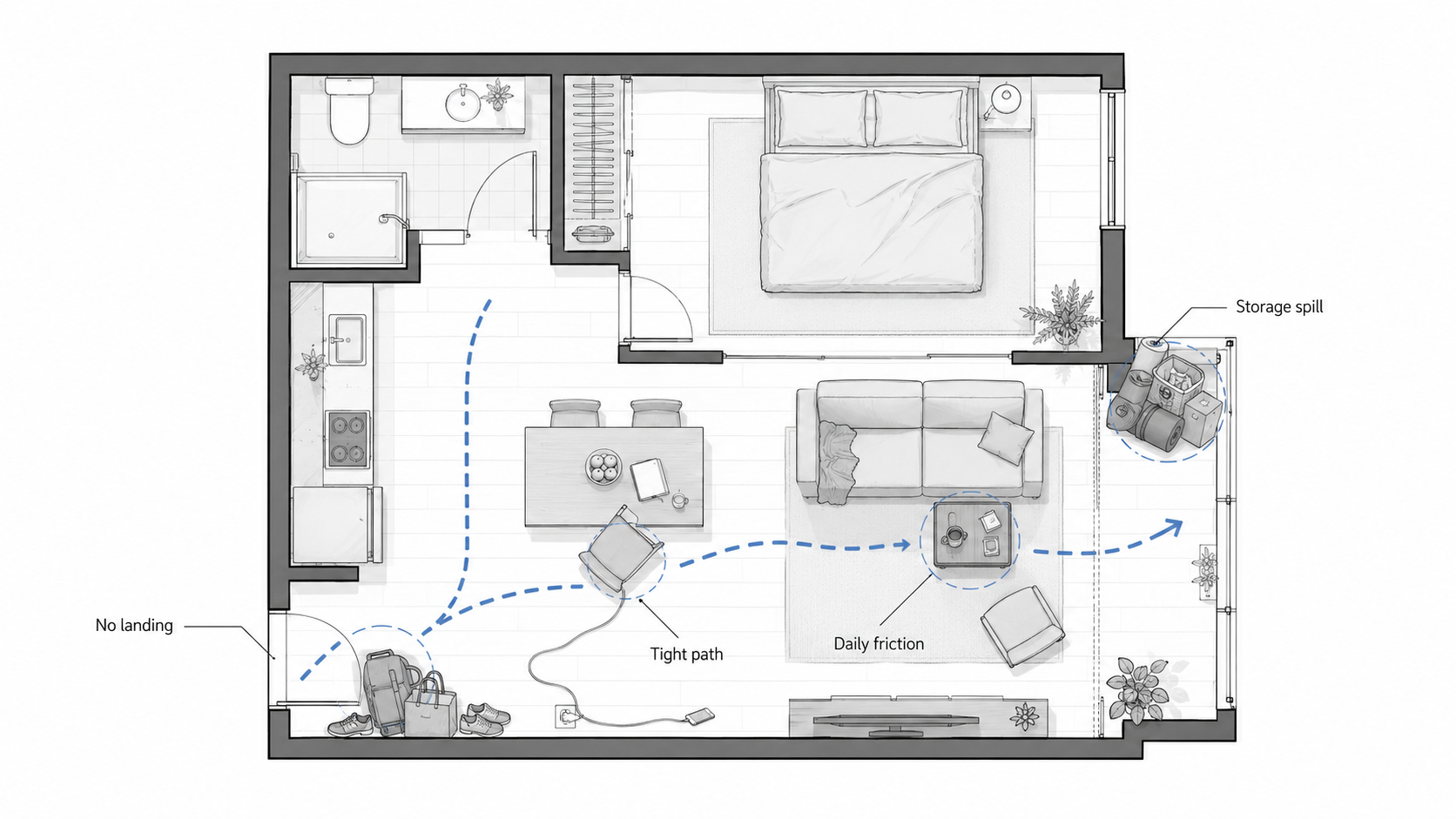
Illustration by ArchitectureCourses.org. A layout is not proven when empty. It is proven after daily use.
A layout can impress on day one and irritate by week three.
That is when the hidden spatial problems show up. Bags pile where no landing zone was planned. A dining chair hits the wall every time someone sits down. The bright desk becomes unusable in afternoon glare. The open living room has no quiet corner. The office lounge becomes a corridor because it sits on the main path.
A space is not proven when it photographs well. It is proven when repeated use does not create friction.
Before approving a layout, imagine the ordinary mess: coats, shoes, chargers, backpacks, dishes, laptops, deliveries, cleaning supplies, guests, noise, pets, maintenance access, and someone trying to pass while another person stands still. If the plan only works when empty, it is not finished.
Spatial Design Examples
Spatial design becomes clearer when the examples are ordinary.
Small apartment
The problem is rarely only size. The deeper issue is usually overlap. Eating, working, relaxing, storage, and entry all compete for the same few square feet.
A spatial fix may mean creating one clean path, using furniture as a light divider, keeping storage near the entry, and giving the work zone a visual boundary without building a wall.
Kitchen and dining area
The layout fails when cooking, eating, passing, and gathering all collide. The island may be too large. The refrigerator may sit across the main path. The dining chairs may block a door.
The spatial question comes before the cabinet finish: can someone cook while another person passes, opens the fridge, or sits down?
Museum or gallery
A gallery is not only a series of rooms. It is a route. Visitors need entry, pause, focus, transition, and exit. If the first display creates a crowd, the whole sequence suffers.
Good exhibition spatial design gives people room to arrive before asking them to pay attention.
Office
Workplace spatial design is not solved by open space alone. Open space can support collaboration, but it can also spread noise and remove places for focus.
A better office plan usually mixes shared areas, quiet zones, small rooms, clear circulation, and spaces where someone can pause without standing in a corridor.
School or studio
Learning spaces need movement, storage, visibility, pin-up space, group work, quiet work, and messy work. A studio that looks open can fail if storage is missing or every path cuts through someone else’s work area.
For students, this connects directly to human-centered design and architecture. The user is not an abstract figure in a plan. The user carries things, waits, turns, reaches, talks, gets tired, and needs a place to stop.
Common Spatial Design Mistakes
Starting with furniture instead of movement
Furniture should support the path, not fight it. When a sofa, island, bed, table, desk, or display case blocks the natural route, the plan becomes frustrating even if every object is attractive.
Confusing open space with usable space
Empty area is not always useful area. A large middle zone with no edge, no purpose, and no comfortable relationship to light or furniture can feel wasted.
Forgetting landing zones
Every space needs places where activity begins and ends. Entry needs a drop zone. Kitchen needs counter landing space. Work needs a place for bags and cables. A gallery needs arrival space. A classroom needs storage and transition space.
Ignoring door swings and service access
Door swings are small on paper and large in use. Service access matters too. A room that blocks cleaning, maintenance, storage, outlets, equipment, or mechanical access will punish the user later.
Letting style hide the bad plan
Good styling can make a bad plan look finished. It cannot make the path wider, move the glare, fix the noise, add storage, or change the relationship between rooms.
How To Check a Spatial Design Before Committing
Use a rough test before spending money on drawings, furniture, finishes, or construction.
- Trace the main paths. Draw how someone enters, crosses, sits, works, cooks, waits, exits, and stores things.
- Mark the pinch points. Look for tight corners, crossing paths, door conflicts, blocked cabinets, and furniture that forces awkward movement.
- Check the edges. Study every wall and opening. That is where doors, furniture, light, outlets, storage, and daily use collide.
- Test the slow places. Every good space needs places to pause. If the only place to pause is in the path, the plan needs work.
This is the practical difference between a diagram that looks clean and a space that works.
How AI Helps With Spatial Design
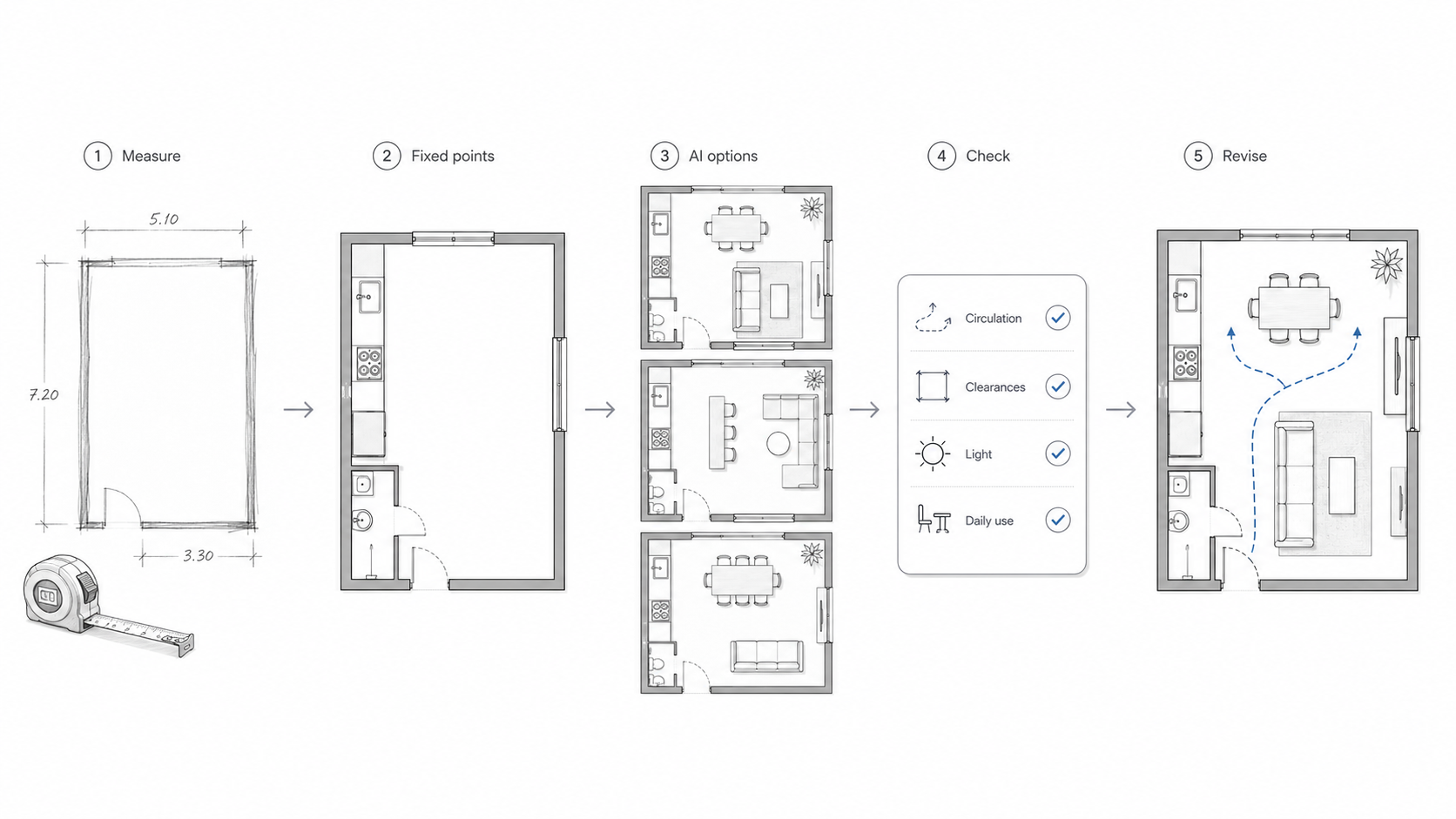
Illustration by ArchitectureCourses.org. AI helps most when it tests the layout before it decorates the room.
AI can help ordinary people see layout problems earlier. It can also make a bad layout look convincing.
The difference is the prompt.
A weak prompt asks for “a beautiful living room” or “a modern kitchen layout.” That usually produces an image with no proof that the room works. The path may be too tight. The furniture may block a door. The island may be too large. The window may land behind a cabinet. The image looks finished, but the spatial design is still guessing.
A better prompt gives AI the boring facts: room size, door locations, window locations, fixed plumbing, furniture needs, storage needs, daylight problems, and the main daily frustration.
Use AI To Test the Layout
Before choosing style, ask AI to test how the space works. Use it like a second set of eyes, not like a decorator.
Create three layout options for a 12 ft by 15 ft living room with one entry door, one large window, a sofa, two chairs, a TV wall, and a clear walking path from the entry to the kitchen. Flag furniture clearance problems, door swing conflicts, glare issues, wasted corners, and where a person would naturally drop bags or chargers.
That kind of prompt forces the tool to think about use, not only appearance.
Ask AI the Questions a Contractor Will Not Ask
AI is useful before renovation because it can help you compare options before anyone opens a wall.
Ask what happens if the island gets smaller. Ask whether a partial wall opening solves the same problem as a full wall removal. Ask where the path tightens. Ask which furniture piece is causing the conflict. Ask what fixed items should not move unless there is a strong reason.
Then take those questions into the real project. AI can help you prepare, but it cannot verify structure, plumbing, HVAC, electrical work, code, or permit requirements.
What AI Still Gets Wrong
AI can miss construction reality. It may ignore load-bearing walls, plumbing stacks, HVAC routes, outlets, window heights, cabinet depths, appliance clearances, stair rules, and real furniture sizes. It may also make a room look larger than it is.
Use AI for options, questions, and early layout testing. Do not use it as proof that a wall can move, a kitchen can be reworked, or a bathroom can be replumbed without checking the building.
The Basic Spatial Checklist Still Matters
AI works better when the person using it understands the basics. Check the path. Check the edges. Check the light. Check the door swings. Check where things land after three weeks of use.
Without those basics, AI only makes the wrong idea look more polished.
Where 3D Spatial Design Helps
3D tools help when height, volume, light, ceiling shape, stairs, openings, or sightlines matter. A flat plan may not show why a room feels compressed, why a ceiling plane matters, or why a view line pulls attention across the space.
But 3D does not fix weak thinking by itself. A model can make a bad layout look convincing. The useful question is still simple: does the model reveal movement, scale, light, and the way the body uses the space?
Use 3D when the plan cannot answer the question alone. Use the plan when the problem is circulation, furniture clearance, door swings, storage, and adjacency.
Spatial Experience Design
Spatial experience design focuses on how a place feels over time as someone enters, moves, pauses, notices, interacts, and leaves. It appears in museums, retail, events, hospitality, offices, campuses, public space, and branded environments.
The weak version becomes spectacle. It adds screens, themes, dramatic lighting, or immersive effects before the route is clear.
The stronger approach starts with the user’s sequence. What do they understand first? Where do they slow down? What changes their mood? What do they miss? Where do they feel crowded, lost, exposed, or calm?
Then design the space around that sequence.
What Makes Spatial Design Worth Studying
Spatial design is worth studying because it trains a designer to see beyond objects. It builds the habit of asking how the whole environment behaves.
That habit matters in architecture school, interior design, exhibition design, workplace design, public space, hospitality, retail, and digital/physical experience work.
For someone building a portfolio, the best spatial design work usually shows process: rough plan, circulation overlay, adjacency diagram, section, light study, furniture test, and one or two finished views. A polished render alone is weaker than a clear explanation of why the space works.
FAQ
What is spatial design?
Spatial design is the practice of shaping how space works. It deals with movement, layout, scale, light, privacy, sound, furniture, thresholds, and the relationship between people and place.
Is spatial design the same as interior design?
No. They overlap, but spatial design usually starts earlier. It focuses on the structure and behavior of space before finishes, furniture style, and decoration take over.
What is spatial planning?
Spatial planning is the arrangement of zones, paths, uses, and relationships. In interiors, it decides how rooms, furniture, circulation, storage, and activity fit together.
Does spatial design matter in renovation?
Yes. It helps you test whether the layout problem is movement, light, storage, furniture, adjacency, or structure before spending money on demolition, cabinets, flooring, or custom work.
Can AI help with spatial design?
Yes, but only when it is used to test the layout. Give AI the room size, fixed doors and windows, furniture needs, problem areas, and daily-use issues. Do not rely on a pretty AI image as proof that the space works.
What does a spatial designer do?
A spatial designer studies how people use a place, then shapes the layout, movement, scale, edges, transitions, and experience. The work may happen in interiors, exhibitions, public space, offices, retail, education, or architecture-related design.
What is 3D spatial design?
3D spatial design uses three-dimensional thinking or modeling to study volume, height, light, view, sequence, and movement. It is useful when a flat plan cannot explain how the space will feel.
What is spatial experience design?
Spatial experience design focuses on the user’s journey through a place. It looks at arrival, movement, pause, interaction, mood, memory, and how the environment shapes behavior.
Why does spatial design matter in small spaces?
Small spaces have less tolerance for bad decisions. A door swing, chair clearance, storage gap, or blocked path can make the whole room feel wrong.
How do you know if a layout has good spatial design?
Trace the main paths, check the edges, test furniture clearances, study light and noise, and imagine the space after several weeks of use. A good layout still works when life is happening inside it.
Read This Next
For the process side, start with spatial planning and design. That page should explain zoning, adjacency, circulation, and how rough spatial decisions become a workable plan.
For room-level layout decisions, use space planning and layout in interior design before buying furniture, moving walls, or assuming a room needs a full remodel.
If you are looking at the field, degree, or career path, go to interior and spatial design. That page focuses on what students study, what portfolios need, and where the work can lead.
For beginner checks, keep space planning essentials nearby.
If the problem is scale, the next useful page is scale and proportion in architectural design.