
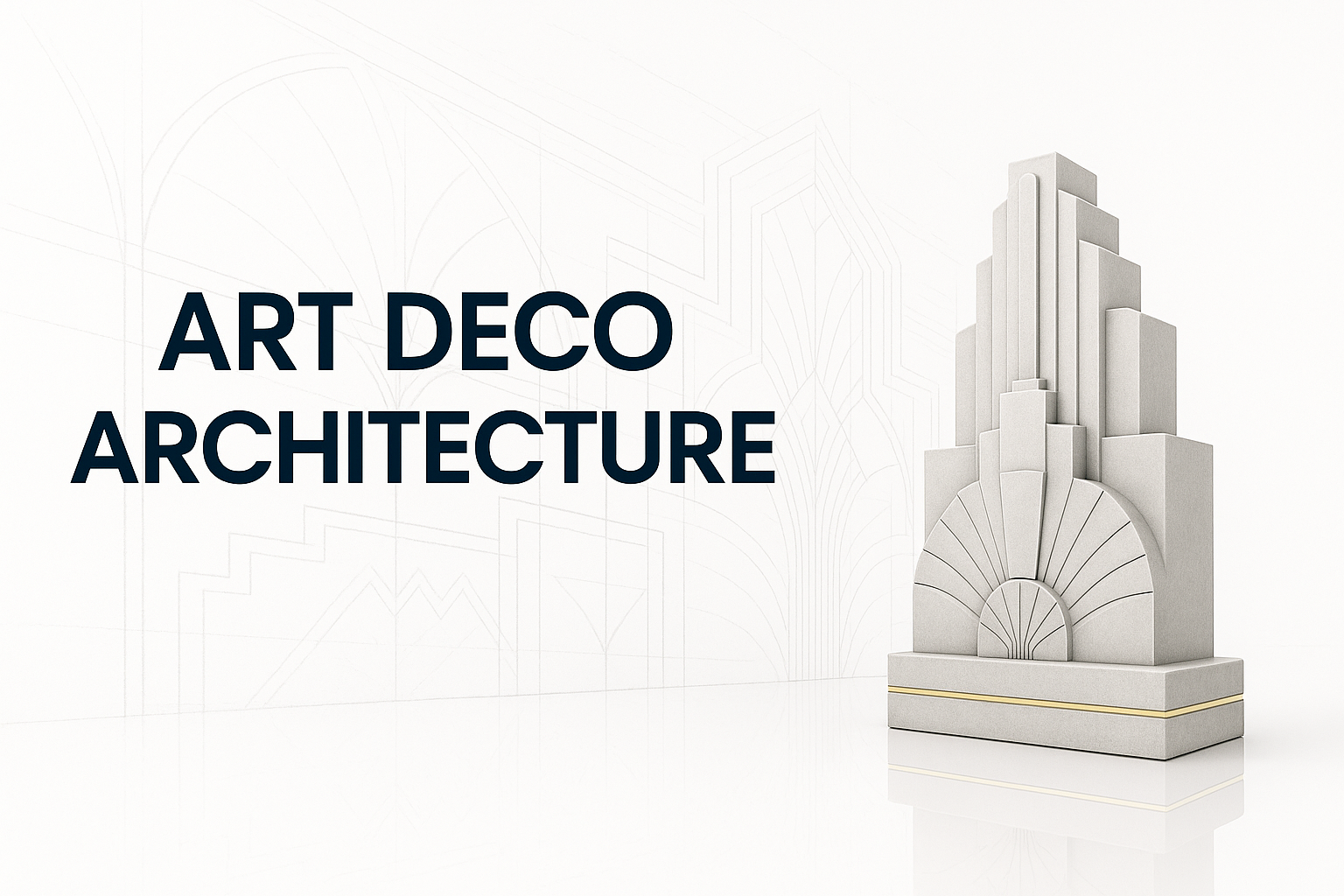
Art Deco Architecture: From the Roaring Twenties to Today
Art Deco came out of the 1920s with one goal: make buildings look powerful. Skyscrapers rose with sharp edges and stepped crowns. Hotels and theaters gleamed with chrome, marble, and glass. It was bold, geometric, and glamorous, and it signaled progress at a time when cities wanted to show off.
What makes it stick a century later is its balance. The lines are clean and modern, but the ornament gives warmth and drama. A single Deco move, like a sunburst door, a chevron floor, or a tower top lit at night, can transform a space instantly.
Below we break down where the style came from, the features that define it, and how it still shapes design today.
Context: This discussion of Art Deco architecture forms part of a broader study of Art Deco, which includes analysis of its architectural, interior, and cultural dimensions.
The Origins of Art Deco Architecture
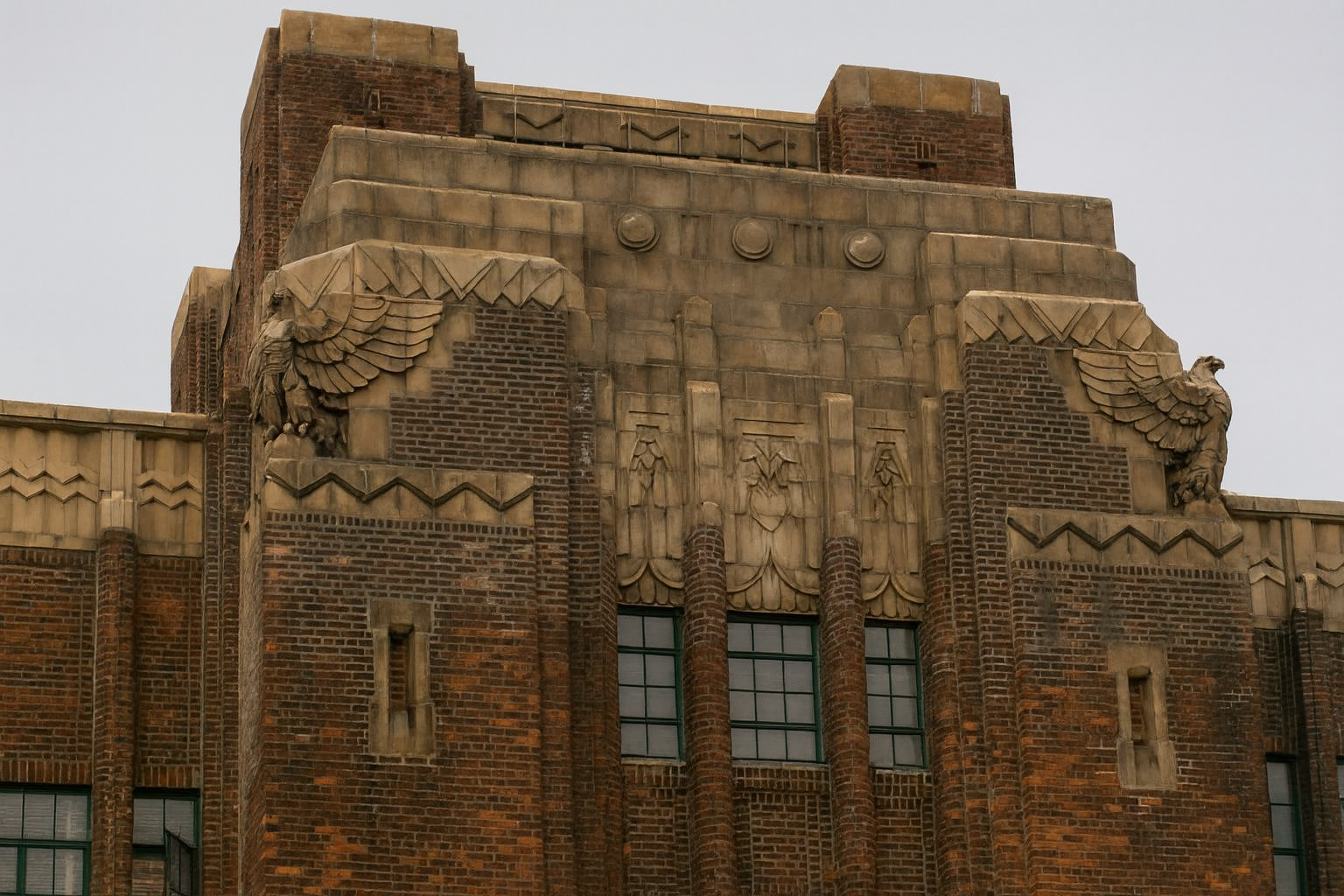
IMAGE: Art Deco entrance tower of the Harlem Armory, built in 1933 for the Harlem Hellfighters, later restored with a $2.2 million facade renovation.
Born in the 1920s
Art Deco came out of a world ready to celebrate after World War I. Cities wanted progress, and designers delivered bold forms, sharp geometry, and glamorous materials.
The Paris Exhibition
In 1925, the Paris Exposition showcased this new style to the world. Chrome, glass, lacquered wood, and exotic motifs caught global attention and set the tone for Deco’s rise.
Global Influences
Tutankhamun’s tomb, Mayan temples, African masks, and Asian patterns all fed into the look. The result was modern but rich with cultural references.
Early Masters
Architects like Raymond Hood, Robert Mallet-Stevens, and Eliel Saarinen pushed the style into skyscrapers, train stations, and urban landmarks.
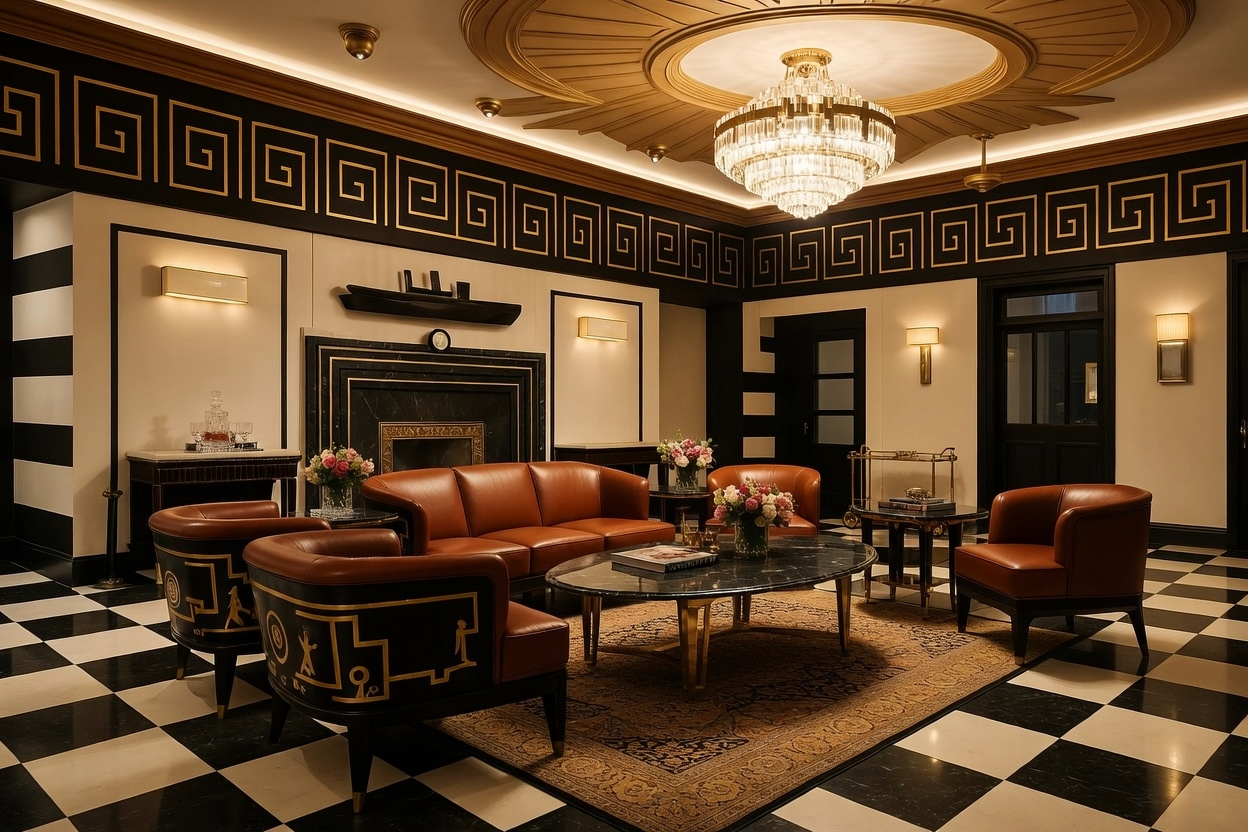
Why It Lasted
It balanced modern lines with drama. Deco was sleek but never plain, glamorous but practical. That’s why it still feels fresh today.
Art Deco Architecture: The Bold Style That Shaped Modern Design
Learn how Art Deco redefined architecture with its geometric patterns, luxury materials, and timeless elegance.
MAIN FEATURES
How to Spot Real Art Deco Details
Art Deco Elements That Actually Define the Style
Geometry in Action
Look for zigzags, chevrons, and sunbursts carved into facades or tiled into floors. The Chrysler Building in New York is the textbook exterior example, but on the inside, Radio City Music Hall’s ceiling patterns carry the same geometry. If you’re reworking interiors, even a single chevron-patterned rug or mirror frame can channel Deco immediately.
Materials That Show Off
Art Deco loved marble lobbies, chrome fixtures, and glossy black granite. Walk into Rockefeller Center in Manhattan and you’ll see polished stone everywhere, paired with metallic detailing. On the residential side, many Miami Beach homes used terrazzo flooring with inlaid patterns—a material worth replicating in modern renovations because it’s durable and still looks glamorous.
Colors With Punch
Think black paired with gold, emerald, sapphire, or ruby. It wasn’t subtle. The Paramount Theatre in Oakland, California, shows this best with its emerald walls and gold accents. If you’re looking at interiors today, a jewel-toned sofa against neutral walls can pull the same visual weight without overpowering.
Shine and Metal
Steel, chrome, and brass framed doors, railings, and even furniture. The Eastern Columbia Building in Los Angeles has turquoise terracotta trimmed with gold leaf that still glows at sunset. Interiors leaned on mirrors with chrome borders or brass-trimmed cabinets. In smaller spaces, metallic light fixtures do the job.
Decorative Motifs
Stylized flowers, rising sunbursts, and stepped patterns told people “this is progress.” Step into the Guardian Building in Detroit and look up—the ceilings are mosaics of sunburst and geometric forms. If you’re hunting for Deco interiors, theaters and old train stations are where these details usually survived.
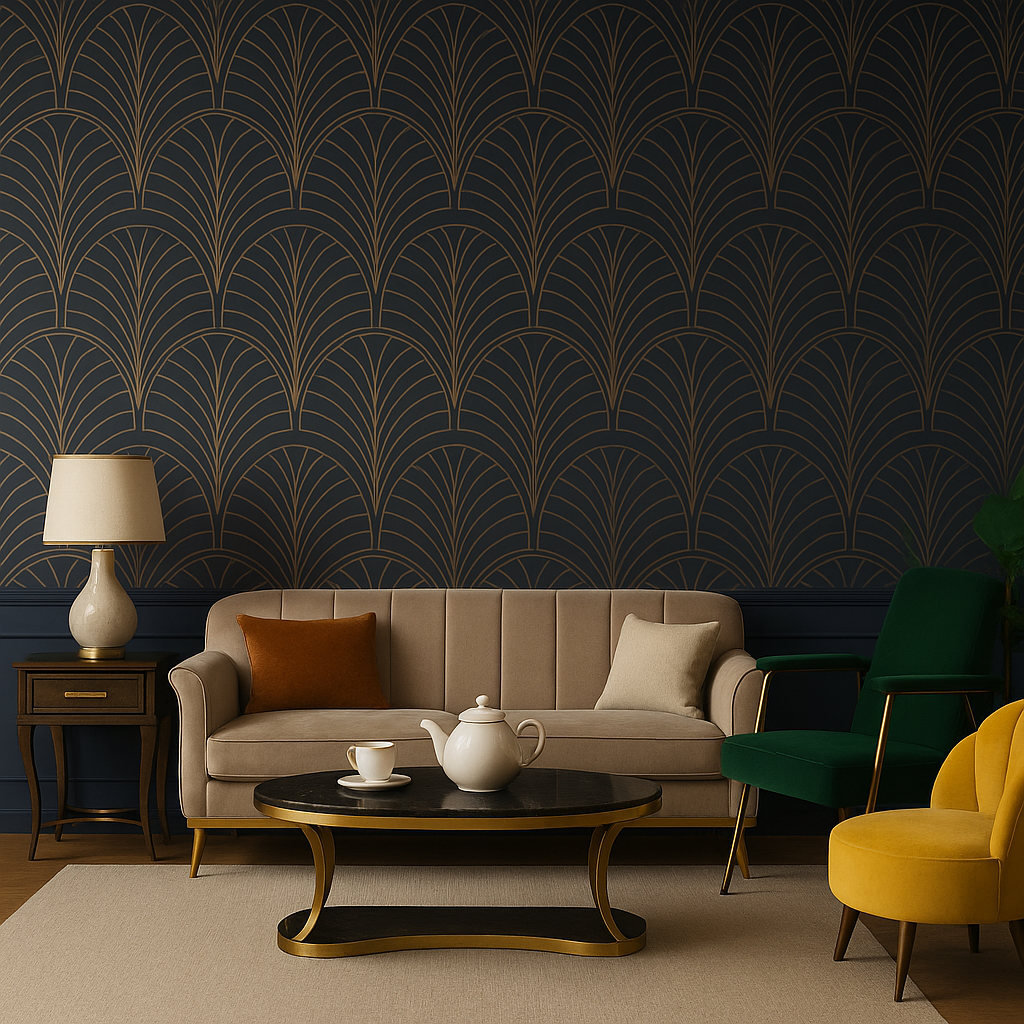
Vertical Reach
Art Deco skyscrapers weren’t shy about height. Narrow windows and lines pulled your eye skyward, topped with crowns or spires. The Empire State Building is the obvious example. In interiors, the vertical theme translated into tall doors, elongated mirrors, and layered lighting. A trick still used in Deco-inspired homes is extending curtains right to the ceiling to fake that height.
Streamlined Corners
In Miami Beach, Deco shifted tropical. Rounded balconies, smooth plaster walls, and pastel paint gave buildings a softer vibe. Drive down Ocean Drive and you’ll see it block after block. For interiors, this meant curved bar counters or rounded sofa backs—details worth copying if you want Deco without the heaviness.
Detail Everywhere
No piece was too small. Door handles, elevator panels, and even light switches were designed to fit the theme. In restored Deco hotels, like The Waldorf Astoria in New York, you’ll notice repeating motifs from lobby to bathroom. If you’re doing a modern take, consistency matters—choose a shape or motif and carry it through furniture, lights, and textiles.
Texture That Balances
Smooth glass next to rough stone, polished wood against patterned tile. Deco always played rough against sleek. Look at the terrazzo floors with inlaid brass lines in Chicago’s Carbide & Carbon Building. Today, you can borrow that idea by mixing matte black paint with glossy metal accents in interiors.
Crowns and Parapets
The tops of buildings became signatures. The Chrysler spire, the Eastern Columbia’s golden crown, or the Paramount Theatre’s neon marquee—all examples of Deco drama. Interiors mirrored this idea with statement chandeliers and layered ceilings. Even in a modern apartment, a bold pendant light can act as that “crown.”
How to Spot Deco Today
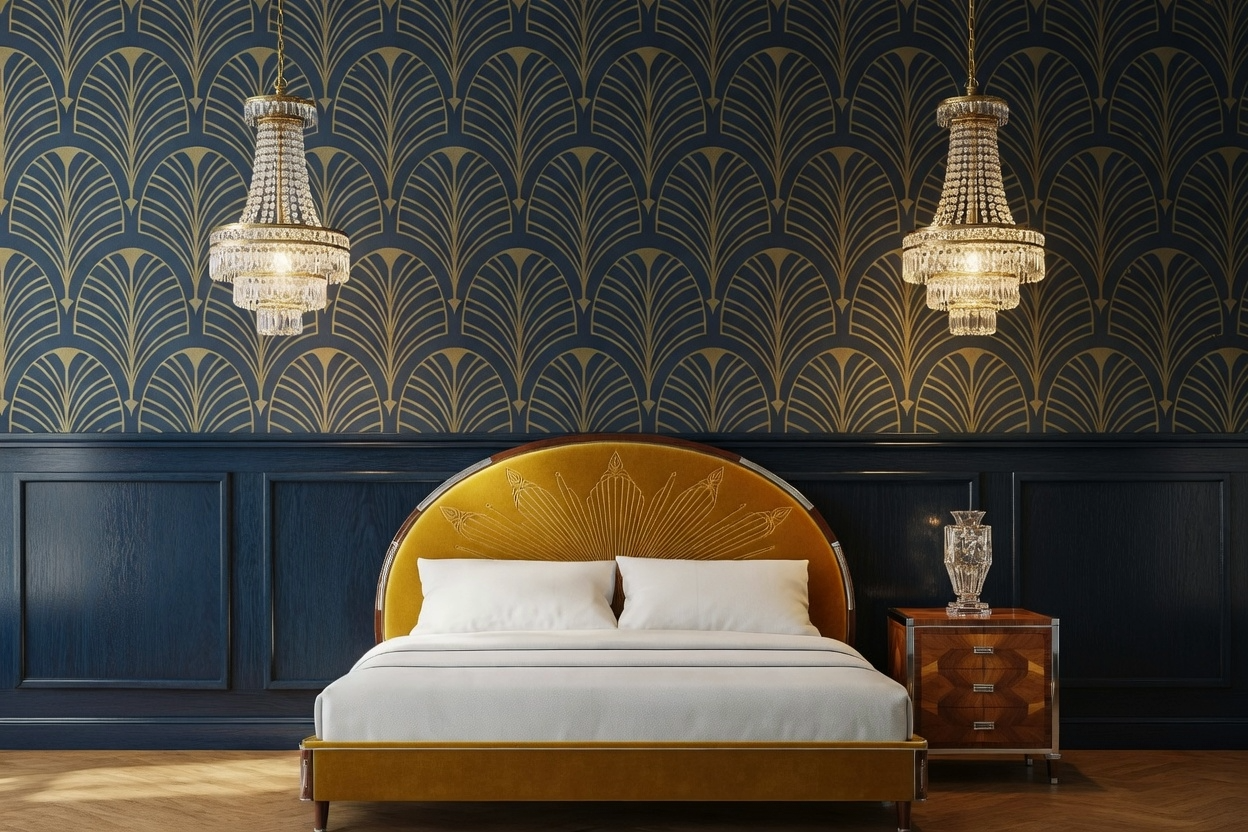
-
Exteriors: Look up at crowns, spires, and patterned facades in older theaters, banks, and skyscrapers.
-
Interiors: Hunt for terrazzo floors, mirrored walls, chrome trim, and stylized ceiling patterns.
-
Cities Worth Visiting: New York (skyscrapers), Miami (Tropical Deco), Los Angeles (theaters and department stores), Detroit (Guardian Building), and Paris (where it all began).
Art Deco is not a subtle style. When you find it, you know it. And when you use it, even in small ways, it immediately adds confidence and presence to a space.
See also: Art Deco Characteristics: A Visual Guide
Art Deco at Home: Why It Still Works
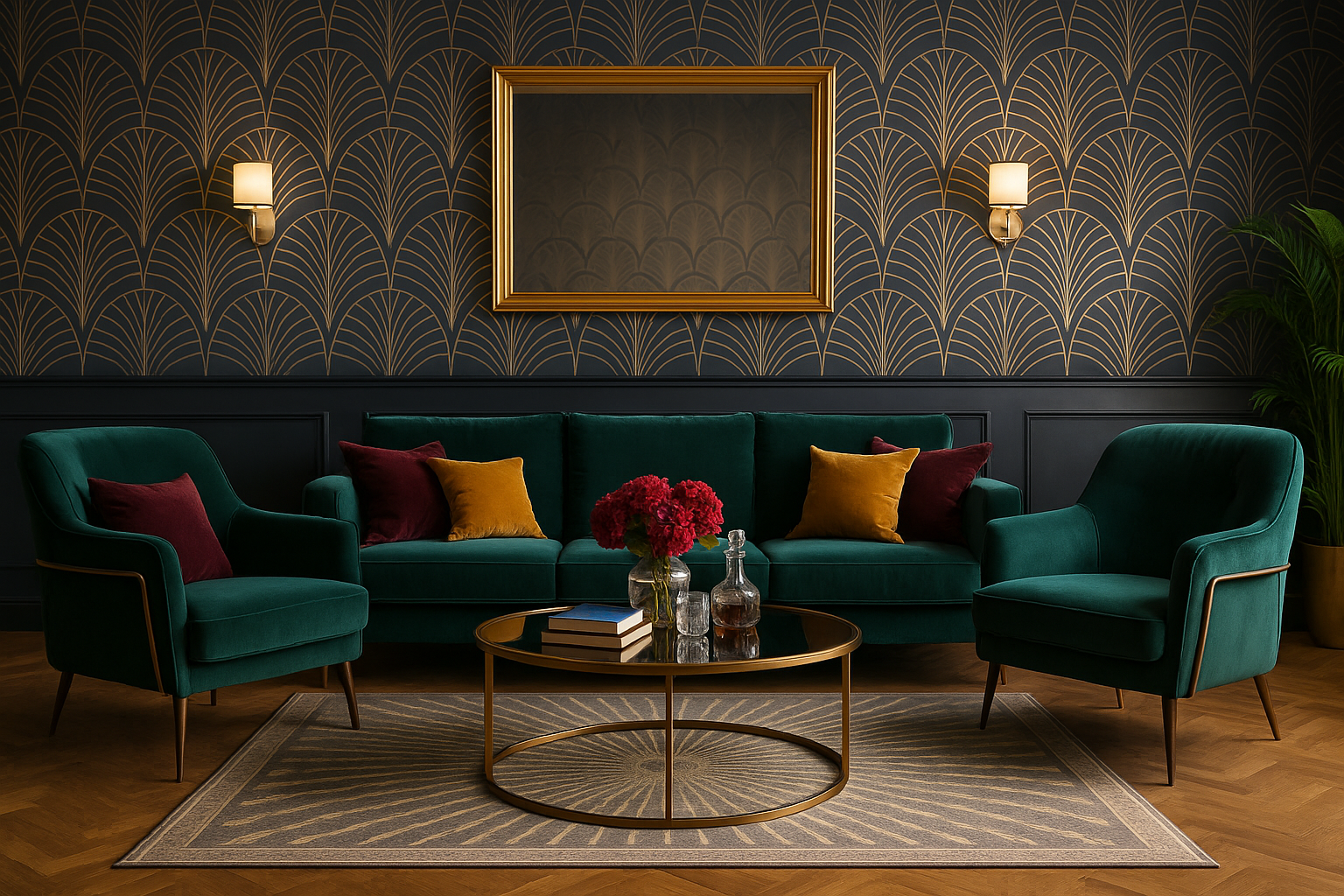
Most people picture the Chrysler Building or Miami hotels when they hear “Art Deco.” But the style was just as powerful in residential design. From Los Angeles bungalows to London townhouses, Deco homes mixed glamour with everyday comfort.
What to Look For Outside
● Vertical lines and stepped forms on facades
● Geometric motifs in gates, railings, or door carvings
● Bold entryways with chrome, brass, or stone detailing
● Stained glass windows with zigzags or sunbursts
What You’ll Find Inside
● Rich colors like emerald, sapphire, and ruby paired with gold or chrome
● Streamlined furniture—curved sofas, lacquered cabinets, inlaid tables
● Statement lighting: tiered chandeliers, frosted sconces, metallic lamps

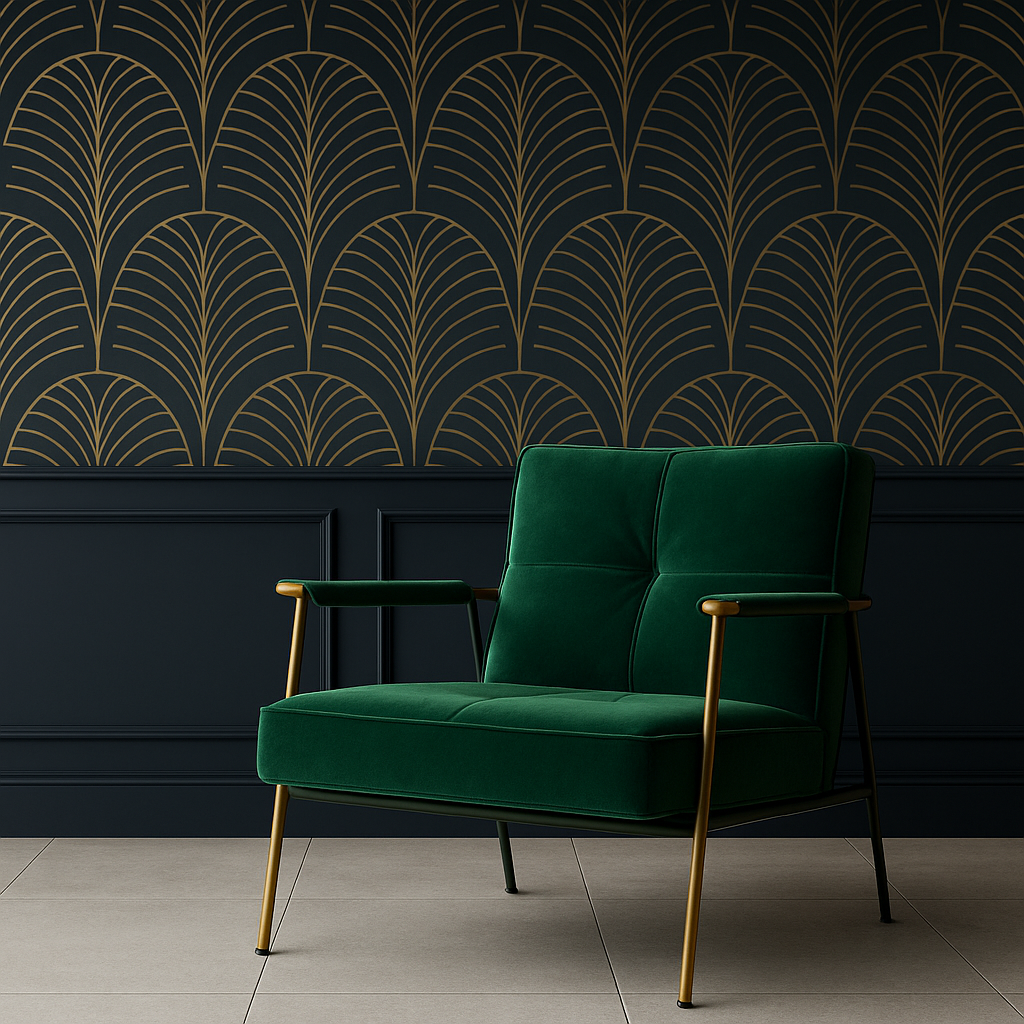
This Art Deco chair is up for grabs on Amazon. If it’s caught your eye, don’t wait—get it now before it’s gone for good. Perfect for adding that bold, stylish touch to your space!
Modern Use
You don’t need a 1930s house to get Deco at home. Keep or restore any original tiling, fireplaces, or cabinetry if you have them. If not, add one strong feature—a sunburst mirror, a geometric rug, or a brass chandelier—and balance it with modern finishes.

Why It Still Shines
Art Deco homes feel timeless because they’re bold without being fussy. They balance clean geometry with rich materials, giving a sense of drama that still works in 2025.
You might like: Art Deco House Characteristics, History, and Design Strategies for Today
How Art Deco Stacks Up Against Other Styles
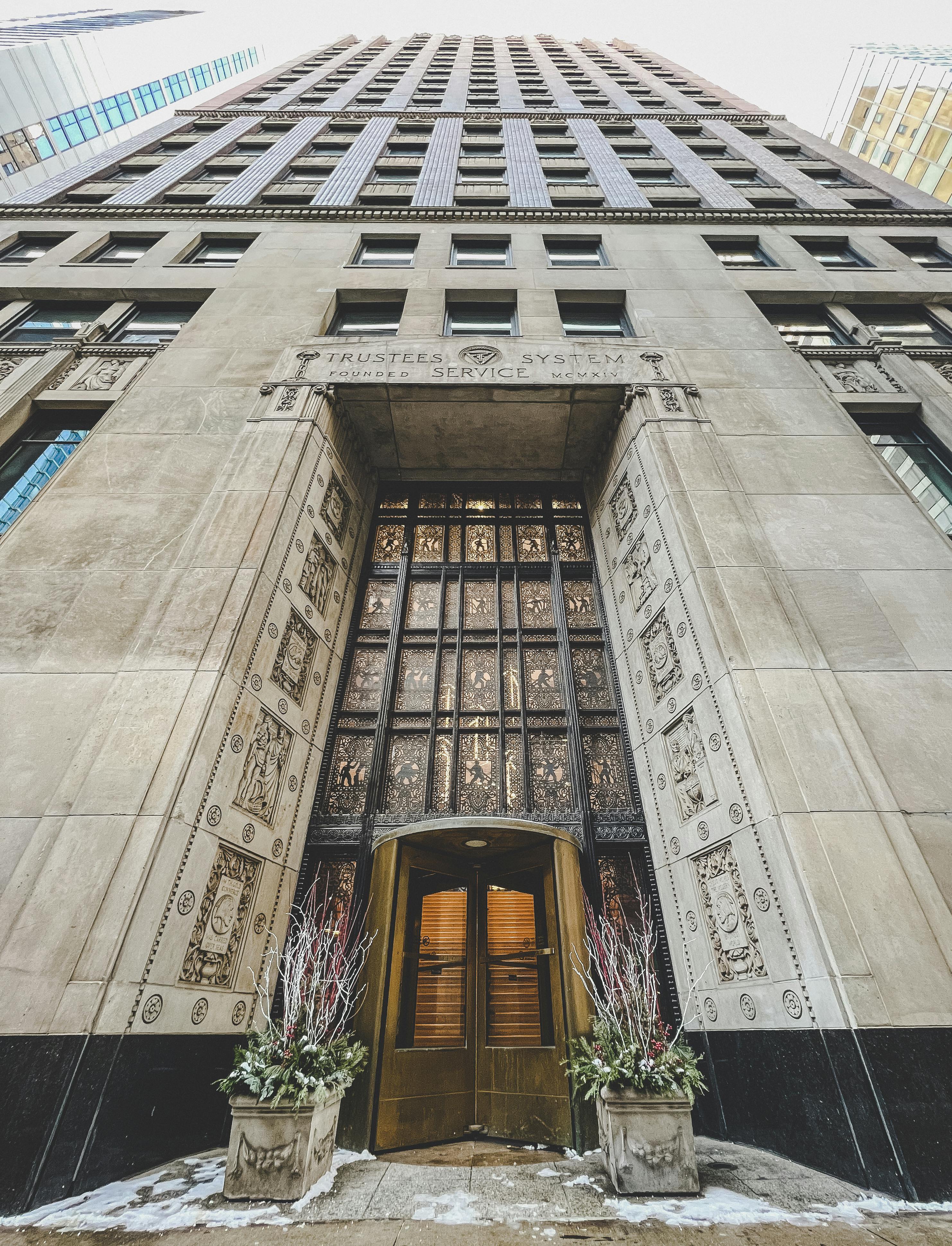
Art Deco didn’t happen in a bubble. It grew alongside other big design movements—and often pushed back against them. Here’s how it compares when you put them side by side.
Art Nouveau vs Art Deco
Art Nouveau was all about curves and nature. Flowing lines, floral motifs, ironwork shaped like vines. Victor Horta’s townhouses in Belgium are perfect examples. They feel organic, almost dreamlike.
Art Deco flipped the script. It went geometric, hard-edged, and industrial. Think the Chrysler Building’s chrome spire and sharp chevrons.
● Where you’ll see Nouveau: early 1900s homes with stained glass, soft lines, and floral iron railings.
● Where you’ll see Deco: 1920s–30s skyscrapers, theaters, and bold residential facades.
Bottom line: Nouveau feels handcrafted and romantic. Deco feels powerful and modern.
Bauhaus vs Art Deco
Bauhaus stripped design down to pure function. Clean white boxes, no ornament, everything reduced to utility. The Bauhaus Dessau building in Germany says it all.
Art Deco, on the other hand, embraced function and flair. Yes, the Empire State Building is practical, but walk into its marble-and-metallic lobby and you feel the difference.
● Bauhaus fits: modern minimal homes, no clutter, everything pared back.
● Deco fits: when you want drama, luxury, and statement pieces that still work.
Bauhaus was about restraint. Deco was about showmanship.
Streamline Moderne: Deco’s Sleeker Cousin
By the 1930s, Deco softened into Streamline Moderne. Curved corners, horizontal bands, and designs inspired by speed and machines.
Example: Bullocks Wilshire in Los Angeles—still Deco at its core, but sleeker, smoother, less ornamented.
Why it matters: The Great Depression made lavish Deco feel out of touch, so Moderne offered a stylish but more affordable version.
You’ll still see it in diners, train stations, and mid-century storefronts.
What This Means for You
If you’re looking at buildings or planning interiors, here’s the cheat sheet:
● Love organic curves and natural motifs? You’re in Art Nouveau territory.
● Want function with no fuss? That’s Bauhaus.
● Want bold glamour that still works in today’s spaces? That’s Deco.
● Want retro curves and horizontal speed lines? That’s Streamline Moderne.
Deco wins longevity because it does both: it’s functional enough to live with and glamorous enough to turn heads.
You might like: Free Art Deco Course: Everything You Need to Know About the Iconic Style
Modern Art Deco Today
Art Deco isn’t just a relic of the 1920s. Its bold lines, rich materials, and geometric patterns are still alive in architecture, interiors, and even product design.
Architecture
Deco continues to shape skylines.
● Skyscrapers: Look at New York’s Chrysler Building for the original playbook, then compare to newer towers that echo its vertical emphasis with glass and steel.
● Hotels: Boutique hotels in Miami still use Tropical Deco curves, pastel colors, and neon details that draw tourists from around the world.
● Homes: New builds borrow Deco symmetry and detailing but soften it with modern materials.
Pro Tip: If you’re working on a modern project, combine sleek glass and concrete with Deco motifs like vertical trims or patterned facades. One bold detail can carry the whole design.
Interiors
Deco interiors have been reimagined for comfort and scale.
● Furniture: Velvet sofas with brass legs, lacquered tables with chrome trim.
● Lighting: Tiered chandeliers, mirrored sconces, and geometric pendants.
● Patterns: Chevron rugs, sunburst mirrors, geometric wallpapers.
Example: A project I handled in Los Angeles used a single emerald velvet armchair, a gold bar cart, and a monochrome chevron rug to bring Deco into a modern loft without feeling overdone.

This exact Art Deco-inspired chair is available on Amazon. If you like it, grab it now before it's gone for good. Don't wait—these pieces sell fast!
Pro Tip: Pick two or three Deco signatures—say lighting and a rug—and let the rest of the room breathe with neutral tones.
Technology
Deco’s streamlined look even shows up in gadgets and products.
● Watches: Cartier’s Tank watch, still a Deco classic, inspires new models today.
● Cars: Many electric vehicles use smoothed, aerodynamic lines inherited from Streamline Moderne.
● Tech: Smartphone casings and app fonts sometimes borrow Deco’s symmetry.
How to Bring Deco Into Your Own Space
You don’t need a 1930s skyscraper to live with Deco. A few smart choices make it work at home.
Lighting First
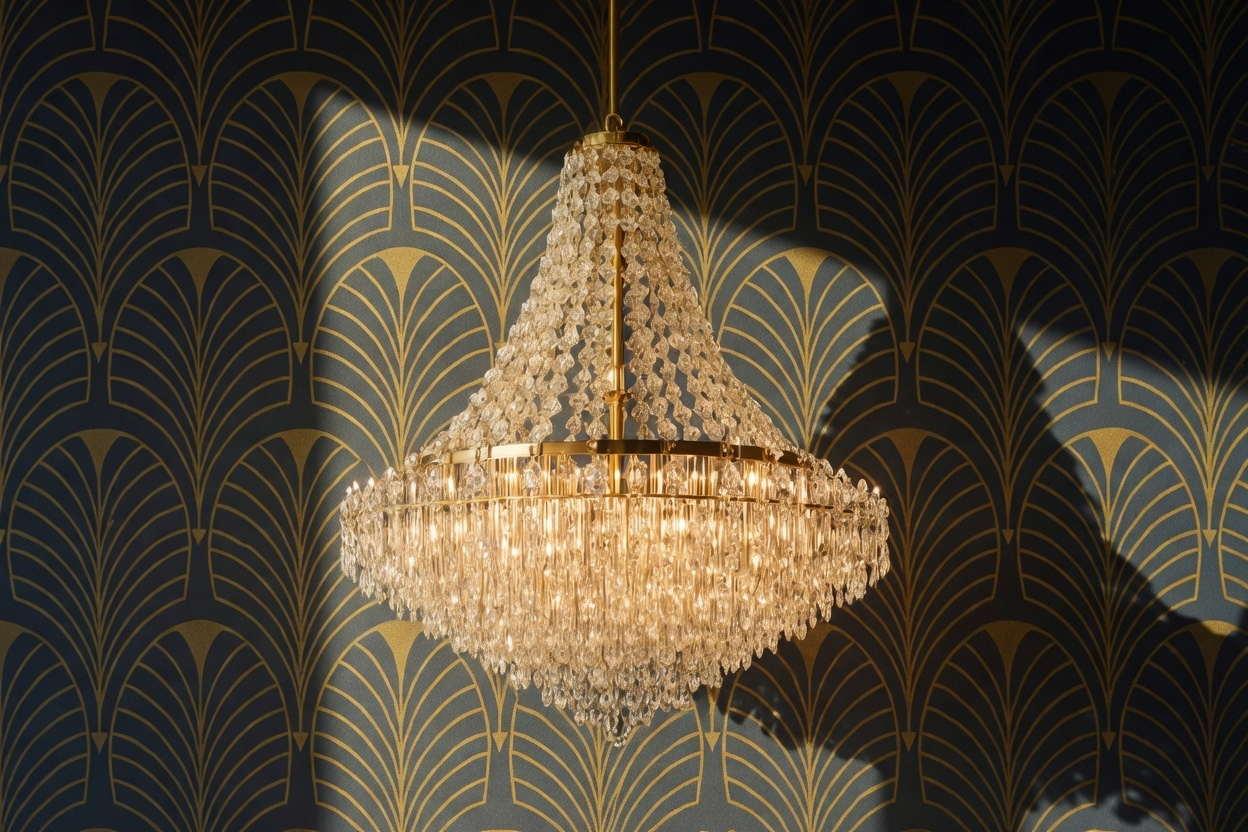
Deco lighting is sculpture. A chandelier or even a pair of mirrored sconces can shift an entire room’s mood.
Play With Materials
Think chrome, marble, lacquer, or smoked glass. They reflect light and add depth. Balance with soft fabrics—velvet, leather, or linen—to avoid coldness.
Use Bold Patterns Wisely
Chevron, zigzag, or sunburst designs give instant Deco energy. Rugs, backsplashes, or accent walls are safer than covering an entire room.
Go Rich With Color
Emerald green, deep sapphire, black, and gold are Deco’s signature palette. Pair them with white or cream so the bold tones don’t overwhelm.
Room Ideas
● Living Room: A sunburst mirror over the fireplace.
● Bedroom: A scalloped headboard and metallic bedside lamps.
● Kitchen: A geometric tile backsplash with chrome hardware.
● Bathroom: Black-and-white floor tiles and a bevel-edged mirror.
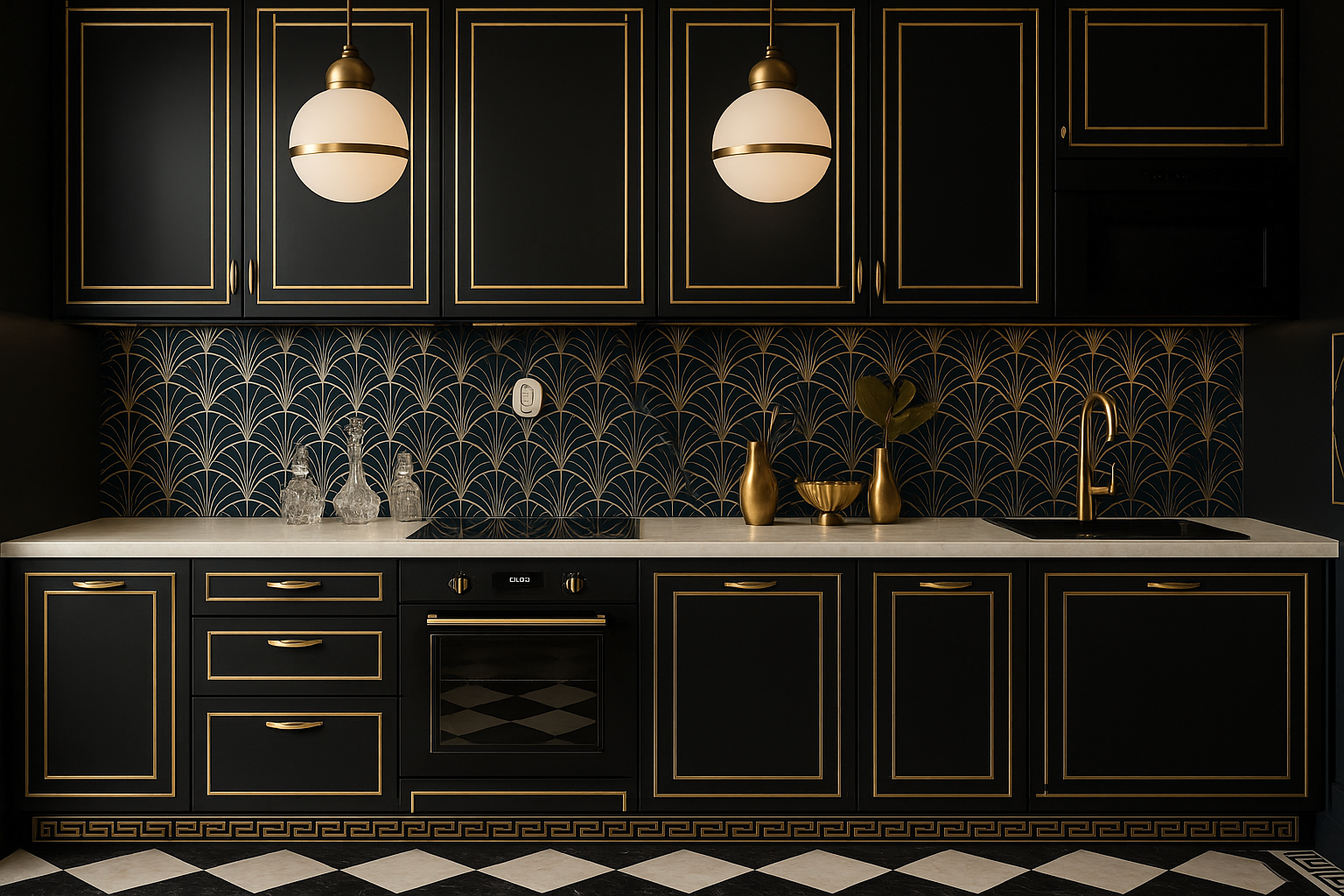
Art Deco works today because it mixes drama with structure. Too much feels theatrical, but a few thoughtful elements—lighting, patterns, or color—can give any space Deco character without losing comfort.
See also: Mastering Art Deco Interior Design: Secrets from the Experts
Art Deco in Urban Landscapes
Art Deco wasn’t just for theaters and hotels. Entire cities wore the style.
Miami: Ocean Drive in South Beach is a pastel Deco playground. Porthole windows, curved balconies, and neon at night turn the strip into a retro stage.
Shanghai: The Peace Hotel and Cathay Theatre show how Deco mixed with Chinese motifs in the 1930s. Look for bold geometry softened with local patterns.
New York: Skyscrapers like the Chrysler and Empire State pushed Deco upward. Stepped facades, spires, and crown details made ambition visible.
Mumbai: Marine Drive, the “Queen’s Necklace,” is lined with Deco apartments. Rounded balconies and tropical details give the style an Indian twist.
Napier, New Zealand: After a 1931 quake, the town rebuilt entirely in Deco. Today it hosts an annual festival with vintage cars and costumes.
Art Deco shaped skylines as much as single facades. These cities prove it was never just style—it was urban identity.
Famous Art Deco Buildings Around the World
Art Deco left fingerprints on skylines across the globe. Some buildings became icons, others local treasures. Here are the ones that define the style and show its range.
United States
Chrysler Building, New York
Nothing says Deco like the Chrysler’s stainless-steel crown with its sunburst pattern. Built in 1930, it borrowed from the auto industry with hubcap and gargoyle details. It’s the skyscraper as jewelry.
Empire State Building, New York
Everyone knows its height, but fewer look at the lobby. Inside, you’ll see Deco murals and lighting that scream 1930s luxury. The outside is restraint, the inside is glam.
France
Palais de Tokyo, Paris
Built in 1937, it’s stripped-down French Deco: geometric, monumental, and almost minimal. Proof that Deco didn’t have to be dripping with ornament to make an impact.
United Kingdom
Hoover Factory, London
Once an appliance factory, now apartments. Its colorful zigzags and bold facade made industry look stylish in the 1930s. A rare case where a factory felt like a celebration.
Australia and New Zealand
Napier, New Zealand
Rebuilt after a 1931 earthquake, Napier became a full town of Deco. Walk Marine Parade and you’re basically in an open-air museum. The annual Art Deco Festival keeps the city’s identity alive.
Latin America
Edificio Kavanagh, Buenos Aires
When it opened in 1936, it was the tallest building in South America. Sleek, vertical, and unapologetically modern, but built with local craftsmanship that gave it weight and authenticity.
Why These Landmarks Matter
Each city used Deco differently—New York as ambition, Paris as refinement, Napier as identity. Together they prove Deco wasn’t just decoration. It was about power, optimism, and a new way of seeing cities.
Why Restoring Art Deco Buildings Is So Difficult
Keeping Deco alive isn’t easy. The materials are glamorous but fragile, and updates often clash with the original vision. Here’s what preservation really takes.
Aging Materials
Chrome pits. Marble stains. Lacquer fades. Every restoration project starts with cleaning or replacing these luxuries. Example: a 1930s theater I worked on needed every inch of its chrome trim polished and re-plated. Months of detail work for a shine most people notice in seconds.
Modern Needs vs. Authenticity
Air conditioning, elevators, fire codes—all essential, none part of the 1930s. The challenge is weaving them in without wrecking the Deco detailing. In one office project, we hid new ductwork inside the ceiling coffers so the ornate plaster survived untouched.
Fragile Ornamentation
Mosaics, carved stone, and patterned spandrels are signature Deco, but they’re fragile. I’ve seen water damage wipe out an entire tile mural. Restoring it meant re-creating each tile by hand—a process of months, not weeks.
Environmental Strain
Coastal Deco, like Miami’s, takes a beating from salt air. Metals corrode twice as fast. Preservation there often means coating every piece of metalwork with weather-resistant finishes.
Cost and Craft
Finding artisans who still know Deco-era techniques—lacquering, gilding, hand-cut inlays—is tough. And expensive. For one client’s doors, it took us six months to find a workshop able to match the original lacquer.
What Works
● Hire specialists in historic preservation, not just general contractors.
● Budget for constant upkeep. Deco details don’t survive on neglect.
● Look for grants or heritage funds—true Deco restoration isn’t cheap.
Inside the Craft of Art Deco Restoration
A lot of the hard work in Deco preservation is invisible. The public sees the glamour, but behind it are painstaking details.
Metal Finishes
Restoring chrome or brass often means electroplating, not just polishing. The shine you see in Deco lobbies today is rarely original—it’s a restoration.
Materials
Rare woods and marbles are often impossible to source. The trick is using composites or reclaimed material that capture the look while keeping costs down.
Geometric Patterns
Floors and facades used custom designs. You can’t buy replacements off the shelf. We’ve used digital scanning and 3D printing to replicate missing tiles when originals are gone.
Stained Glass
Deco loved stained glass with bold geometry. Restoring them requires artisans still using kiln-fired techniques—skills that are vanishing fast.
Why It Matters
Every polished surface or repaired spire is more than a fix—it’s keeping a cultural story alive. Deco wasn’t shy, and neither should its preservation be.
What Art Deco Still Teaches Us Today
Art Deco isn’t just nostalgia. It’s skyscrapers that became symbols of ambition. It’s homes that still feel modern a century later. And it’s details—chevrons, sunbursts, chrome—that keep inspiring designers today.
Whether you’re preserving a landmark, renovating a house, or just buying a Deco lamp, you’re not just decorating. You’re keeping a style alive that defined optimism and modernity for an entire generation.
And that’s why it still matters.
FAQs
55 Most Asked Questions About Art Deco Architecture Answered
Basics
1. What is Art Deco architecture in simple terms?
Art Deco is a 1920s–30s style defined by bold geometry, luxury materials, and symmetry. Think strong vertical lines, zigzags, sunbursts, chrome, and marble. It was about showing progress and glamour.
2. How is Art Deco different from Art Nouveau?
Art Nouveau is soft and curvy, with floral lines. Art Deco is sharp and geometric, with machine-inspired shapes. Compare Gaudí’s Casa Batlló (Nouveau) to New York’s Chrysler Building (Deco).
3. Why is Art Deco called “Deco”?
The name comes from the 1925 Paris “Exposition Internationale des Arts Décoratifs et Industriels Modernes,” where the style was first showcased. “Arts Décoratifs” shortened into “Art Deco.”
4. When did Art Deco architecture start?
It began in the early 1920s, peaked in the 1930s, and faded after World War II. Some regions, like Miami, carried Deco well into the 1940s.
5. Is Art Deco only about buildings, or does it include interiors too?
It covers both. Interiors used mirrored furniture, chrome lighting, bold patterns, and jewel tones. Deco homes were just as glamorous as Deco skyscrapers.
History and Origins
6. Where did Art Deco architecture first appear?
Paris is where it started, but it spread quickly to New York, London, Shanghai, and beyond.
7. What role did the 1925 Paris Exposition play in spreading Art Deco?
It was the world’s first full showcase of the style — pavilions full of bold, modern luxury. Designers from every country brought ideas home, spreading Deco globally.
8. How did World War I influence the rise of Art Deco design?
After the devastation, people wanted optimism, glamour, and progress. Deco’s bold, shiny aesthetic matched the mood of the “Roaring Twenties.”
9. Why did Art Deco become popular in the 1920s and 1930s?
It fit the times. Cities were growing, industries were booming, and people wanted buildings that looked powerful and modern.
10. What cultures influenced early Art Deco patterns and motifs?
Egyptian, African, Asian, and Mayan motifs all made their way into Deco. The discovery of Tutankhamun’s tomb in 1922 especially fueled the Egyptian craze.
Key Features
11. What are the main features of Art Deco buildings?
Vertical lines, stepped facades, geometric ornament, symmetry, chrome, marble, glass, and bold colors.
12. How can you spot an Art Deco facade?
Look for repeating zigzags, chevrons, sunbursts, or stepped crown tops. Many Deco facades also mix stone with metallic accents.
13. Why does Art Deco use so many geometric shapes?
It was a celebration of the machine age. Geometry symbolized order, progress, and modernity.
14. What materials were most common in Art Deco architecture?
Chrome, brass, stainless steel, marble, glass, exotic woods, lacquer, and sometimes terracotta.
15. What colors define Art Deco style?
Black, gold, silver, deep greens, blues, reds, and jewel tones. Pastels came later in Miami’s Tropical Deco.
Interiors and Homes
16. What does an Art Deco home look like inside?
It’s glamorous but ordered. Bold rugs, mirrored furniture, chrome light fixtures, and jewel-tone walls balanced with neutrals.
17. How do you decorate a living room in Art Deco style?
Add a geometric rug, a velvet sofa, a sunburst mirror, and chrome lamps. Stick to symmetry — matching pieces on each side of the room.
18. What type of furniture is considered Art Deco?
Streamlined shapes, curved armchairs, lacquered wood, chrome legs, and inlays of exotic materials like ivory or mother-of-pearl.
19. How is Art Deco lighting different from other styles?
It’s dramatic. Tiered chandeliers, frosted glass sconces, and metallic lamps were staples. Lighting was as decorative as it was functional.
20. Can Art Deco work in small apartments?
Yes — focus on accents. A chevron rug, a bold mirror, or one statement light can add Deco flair without overwhelming the space.
Famous Buildings
21. What is the most famous Art Deco building in the world?
The Chrysler Building in New York City, with its stainless-steel crown and sunburst spire.
22. Why is the Chrysler Building considered the icon of Art Deco?
It embodies everything Deco loved: height, symmetry, chrome, and decorative flair tied to modern industry. Even the gargoyles are modeled after Chrysler car hood ornaments.
23. Which landmarks in Miami show Tropical Deco?
Hotels along Ocean Drive in South Beach — like the Colony Hotel and the Carlyle. Pastels, curves, and neon signs define the look.
24. What are the top Art Deco sites in Paris?
The Palais de Chaillot, Palais de Tokyo, and Théâtre des Champs-Élysées are standout Deco landmarks.
25. Which Asian cities showcase strong Art Deco architecture?
Shanghai and Mumbai are leaders. Shanghai has the Peace Hotel and Cathay Theatre. Mumbai has Marine Drive lined with Deco buildings.
Global Reach
26. Is Art Deco architecture common in the UK?
Yes, especially in London. Look at the Hoover Factory, Daily Express Building, and London Underground stations from the 1930s.
27. Why is Mumbai called a hidden Art Deco capital?
It has one of the largest collections of Deco buildings in the world — second only to Miami.
28. What happened in Napier, New Zealand, that made it an Art Deco town?
A 1931 earthquake destroyed much of the town. It was rebuilt in Deco style, giving it a unified look still celebrated today.
29. How did Latin America interpret Art Deco design?
Buenos Aires embraced Deco in skyscrapers like Edificio Kavanagh, while Havana mixed Deco with local tropical motifs.
30. Where can I see Art Deco skyscrapers outside New York?
Chicago, Los Angeles, Buenos Aires, and Shanghai all have major Deco towers.
Comparisons with Other Styles
31. How does Art Deco differ from Bauhaus?
Bauhaus stripped away ornament, focusing on pure function. Art Deco celebrated glamour and decorative detail.
32. What is the difference between Art Deco and Streamline Moderne?
Streamline Moderne (1930s) simplified Deco into curves and horizontals, inspired by cars, ships, and speed. Deco was bolder and more vertical.
33. How does Art Deco compare to Gothic Revival?
Gothic Revival is ornate with pointed arches and medieval vibes. Art Deco is geometric, symmetrical, and rooted in modernity.
34. Can Art Deco blend with modern minimalist design?
Yes — many designers mix Deco patterns or metallic accents with minimal interiors for warmth.
35. Why do some people confuse Art Deco with Mid-Century Modern?
Both use clean lines, but Deco is more decorative and luxurious, while Mid-Century Modern is simpler and more casual.
Modern Applications
36. Is Art Deco still used in new buildings today?
Yes. Many luxury condos and hotels borrow Deco geometry, symmetry, and bold finishes.
37. How do architects adapt Art Deco to modern materials?
They use glass, steel, and composites but echo Deco’s shapes — zigzags, vertical lines, symmetry.
38. What does “Neo Art Deco” mean?
It refers to modern adaptations of Deco, often blending old motifs with sustainable materials and tech.
39. How can homeowners add Art Deco flair without a full renovation?
Add geometric rugs, metallic mirrors, bold lighting, and jewel-tone accents.
40. Are hotels still being built in Art Deco style?
Yes. Many boutique hotels use Deco for instant glamour, especially in New York, Miami, and Shanghai.
Preservation and Restoration
41. Why is it difficult to preserve Art Deco buildings?
Because many used materials like chrome and marble that weather poorly. Restoring them takes specialized skills.
42. What materials in Art Deco buildings age the worst?
Chrome corrodes, marble stains, and lacquer loses its shine.
43. How do you restore Art Deco stained glass?
It requires traditional glass-painting and kiln-firing techniques — often done by specialist artisans.
44. Can Art Deco structures be updated with modern HVAC and still look authentic?
Yes, but it takes care. Ducts and vents need to be hidden or designed to mimic original detailing.
45. What cities have the best preservation programs for Art Deco landmarks?
Miami, Mumbai, Napier, and New York all actively protect their Deco heritage.
Practical and Design Tips
46. How can I add Art Deco elements to a modern home?
Start with a bold mirror, geometric rug, or metallic lighting. Keep it symmetrical.
47. What patterns should I use to capture an Art Deco feel?
Chevron, sunburst, zigzag, fan motifs, and stepped shapes.
48. Which metals work best in Art Deco interiors?
Chrome, brass, and polished steel.
49. How do I balance bold Deco colors with neutral tones?
Use jewel tones for accents and keep walls or large surfaces neutral.
50. What flooring styles were popular in Art Deco homes?
Terrazzo, geometric tiles, and parquet with chevron or herringbone patterns.
Lifestyle and Culture
51. Why is Art Deco associated with Hollywood glamour?
Because 1930s movie palaces and sets used Deco’s shiny, dramatic aesthetic to dazzle audiences.
52. What role did jazz culture play in shaping Art Deco design?
Jazz’s rhythm and energy influenced Deco’s bold lines and dynamic patterns.
53. Why does Art Deco feel timeless even today?
Its balance of clean geometry with luxurious details feels both modern and classic.
54. Are Art Deco homes valuable in today’s housing market?
Yes. Restored Deco homes often sell at a premium due to their rarity and bold design.
55. How do collectors identify authentic Art Deco furniture and fixtures?
Look for symmetry, exotic woods, chrome or lacquer, and geometric inlays. Original pieces often have heft and high-quality craftsmanship.
Related
Art Deco Interior Design and Decor
-
Art Deco Interior Design: Defining features of Deco interiors.
-
Art Deco Interior Examples: Real projects that showcase the style.
-
Gothic Art Deco Interiors: Blending Gothic drama with Deco glamour.
-
History of Art Deco Interiors: How interiors evolved through the 1920s–30s.
-
Modern Art Deco Interiors: Contemporary homes inspired by Deco.
Art Deco Movement and Timeline
-
Art Deco Movement: Origins, growth, and global influence.
-
History of Art Deco: Milestones that shaped the style.
-
Art Deco Timeline: Key years when Deco peaked worldwide.
-
Art Nouveau vs Art Deco Timeline: Comparing two iconic movements.
Art Deco Architecture
-
Art Deco Buildings: Iconic global examples.
-
Art Deco Architectural Features: What sets the style apart.
-
Art Deco Architecture History: The rise and spread of Deco.
-
Famous Art Deco Architects: Designers who shaped the movement.
-
Art Deco Architectural Elements: Facades, motifs, and materials.
-
Art Deco Cities: Urban centers dominated by Deco design.
-
Best Art Deco Buildings: Must-see landmarks around the world.
Notable Landmarks
-
Chrysler Building Art Deco Style: A skyscraper icon.
-
Empire State Building Art Deco Influence: Deco details often overlooked.
-
Miami Art Deco District: South Beach and Tropical Deco.
-
Hoover Building, London: A colorful industrial landmark.
-
Eastern Columbia Building, Los Angeles: A Deco gem of California.
Art Deco and Other Movements
-
Art Deco vs Modernism: Differences in philosophy and design.
-
Art Deco and Streamline Moderne: Deco’s sleek offshoot.
-
Bauhaus vs Art Deco: Function versus glamour.
-
Victorian Gothic vs Art Deco: Contrasting old-world detail with Deco boldness.
Art Deco Design Elements
-
Art Deco Patterns: Zigzags, chevrons, sunbursts, and fans.
-
Art Deco Geometric Design: The language of symmetry and shape.
-
Art Deco Sculptures: Decorative and architectural statuary.
-
Art Deco Art Style: Visual motifs beyond architecture.
Art Deco Homes
-
Art Deco House Style: Common features of residential Deco.
-
Small Art Deco Houses: Compact homes that carry Deco flair.
-
1930s Art Deco Homes: Original residences from the Deco era.
-
Art Deco Residential Architecture: Private homes with Deco details.
Art Deco Products and Designers
-
Art Deco Jewelry: Bold, glamorous pieces of the era.
-
Famous Art Deco Designs: Iconic objects that defined the style.
-
Art Deco Furniture: The evolution of Deco furniture design.
-
Eileen Gray Art Deco Furniture: Contributions of a pioneering designer.
Art Deco Artists and Influencers
-
Tamara de Lempicka: The painter who defined Deco portraiture.
-
Raymond Hood: Architect behind Deco skyscrapers.
-
Robert Mallet-Stevens: French Deco modernist.
-
Eliel Saarinen: Northern European Deco master.
-
Victor Horta: From Art Nouveau to Deco influence.
Iconic Art Deco Locations
-
Art Deco City Halls: Civic buildings in Deco style.
-
Miami Art Deco Style: Pastel colors, neon, and Tropical Deco.
-
Most Art Deco Cities: Global capitals of Deco heritage.
Art Deco in Media
-
Art Deco Posters: History of Deco in print.
-
Art Deco Architecture Posters: Celebrating buildings in graphic design.
-
Chrysler Building Poster: A Deco icon in visual culture.
Educational Resources
-
Best Books on Art Deco Architecture: In-depth reference texts.
-
Art Deco Art Books: Visual guides to the movement.
-
Art Deco Poster Prints: Collectible and educational reproductions.
References
International & Preservation Organizations
ICADS — global network. icadsartdeco.org
Art Deco Society of New York — tours and research. artdeco.org
Art Deco Society of California — advocacy and events. artdecosocietyofcalifornia.org
Art Deco Society of Los Angeles — preservation and tours. artdecola.org
Art Deco Mumbai Trust — documentation and walks. artdecomumbai.com
Free Art Deco Course — history and practice. architecturecourses.org
CIVIS University Course — From Art Nouveau to Art Deco. civis.eu
V&A Online — Art Deco: Style and Design. vam.ac.uk
UCLA Extension OLLI — glassmakers across movements. uclaextension.edu
ÉnsAD Paris — design grande école. ensad.fr
Société des artistes décorateurs — early Deco engine. Wikipedia
1925 Paris Exposition — Deco’s launchpad. Wikipedia
Les Arts Décoratifs — museum collections. madparis.fr