
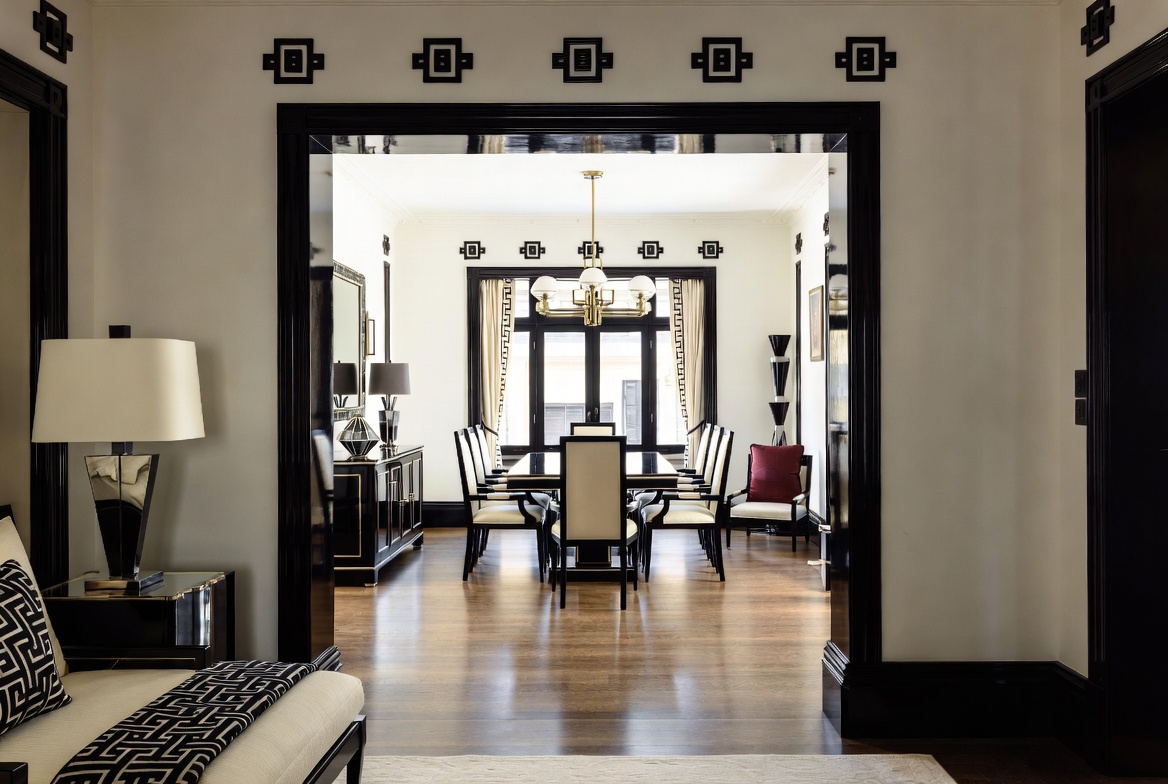
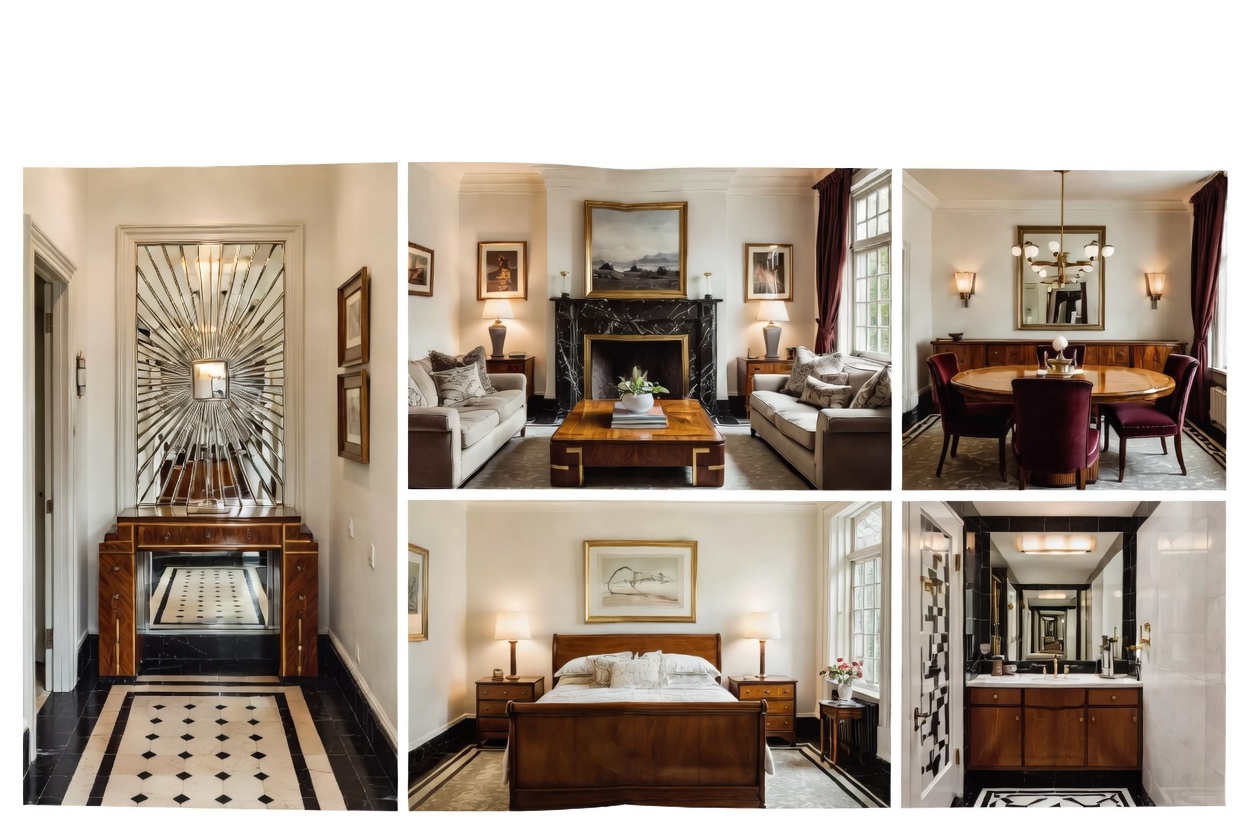
Image by ArchitectureCourses.org. Black trim, geometric detailing, and a clear room-to-room sequence show how Art Deco can carry through a home without repeating the exact same move in every space.
Art Deco is easy to overdo.
A room can look sharp with a few Deco moves. It can also start looking fake fast. Too much contrast. Too much shine. Too many shapes fighting for attention.
The style works better when a few things do the job. Strong furniture. Clean lines. Good lighting. Good materials. Then stop.
This guide looks at that room by room: living room, bedroom, kitchen, dining room, bathroom, hallway, and office. Where the style helps, where it starts to feel forced, and where money makes a difference.
Worth Knowing: if you want the building side first, read Art Deco Architecture. If you want the style traits in a faster visual format, go to Art Deco Characteristics: A Visual Guide.
| Room | Best First Move | What Goes Wrong | What to Protect |
|---|---|---|---|
| Living room | One strong rug, mirror, or chandelier | Too many patterns and reflective surfaces | Clear center, good lighting, strong furniture scale |
| Bedroom | Headboard and paired bedside lighting | Too much shine around the bed | Calm palette, symmetry, storage |
| Kitchen | Backsplash, hardware, or pendants | Trying to make every cabinet dramatic | Function, clean surfaces, one finish direction |
| Dining room | Table and chandelier | Weak anchor and too many side gestures | Table scale, wall restraint, lighting |
| Bathroom | Tile, mirror, sconces | Tiny metallic clutter everywhere | Finish consistency, easy cleanup, strong mirror |
| Hallway or office | One mirror, one lamp, one strong desk or console | Treating it like leftover space | Order, symmetry, breathing room |
Living rooms can take the most Deco
This is the room that can hold the biggest gesture. A darker sofa. A patterned rug. A serious chandelier. A large mirror over the fireplace. Enough wall to let one move land properly.
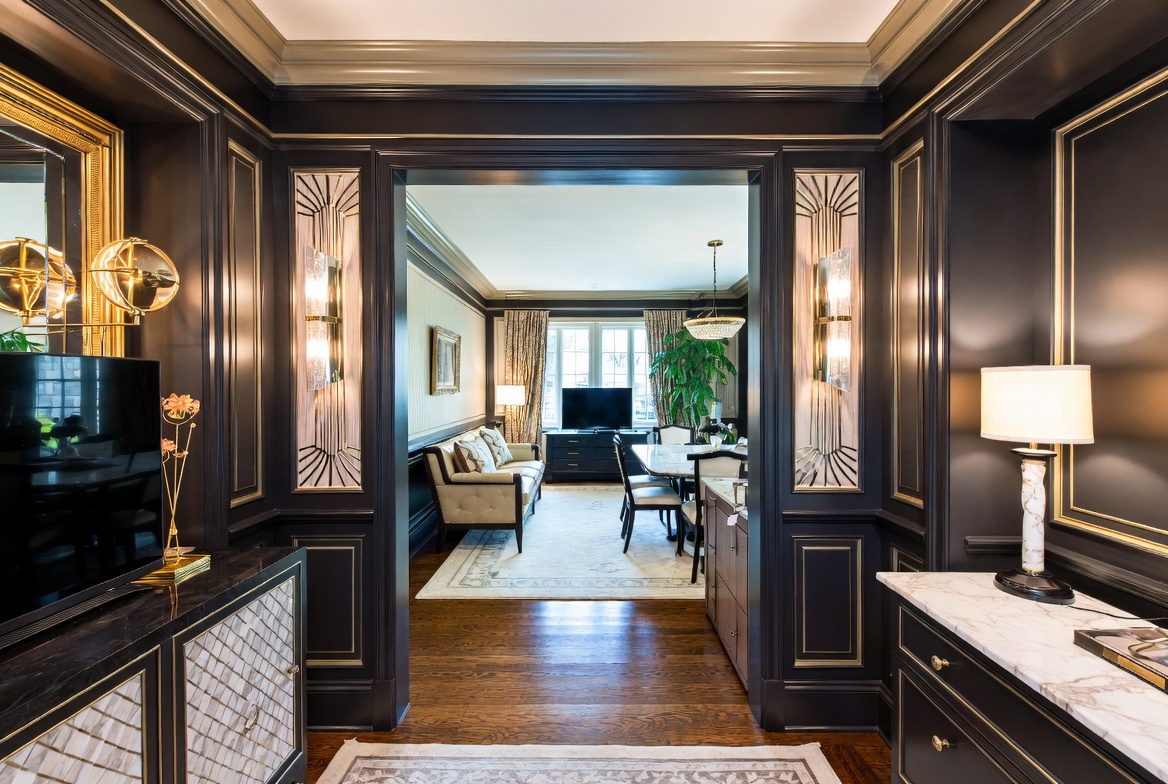
Image by ArchitectureCourses.org. Dark paneling, metallic accents, and repeated Deco detailing help connect one room to the next.
That does not mean the room wants everything at once. In fact, that is where it breaks down. Deco living rooms fail when every surface tries to be the star. Bold rug. bold wallpaper. bold drapes. mirrored side tables. brass coffee table. black ceiling. It sounds glamorous in theory and exhausting in real life.
Start with one anchor
A Deco living room needs a center. It can be the rug, the light fixture, the sofa, or the wall over the fireplace. Pick one and let it lead.
A rug is often the cleanest place to start. It grounds the furniture and brings in geometry without forcing the walls to work too hard. If the rug has strong pattern, the walls need to quiet down. If the wall carries the drama, the floor should settle back.
Furniture needs shape, not noise
Curved arms, waterfall edges, darker wood, fluted fronts, velvet, lacquer. Those moves carry Deco well. What does not help is filling the room with many small “Deco-style” pieces that all compete for space.
A strong sofa and one good chair will do more than five weak accent pieces. The room should feel chosen, not assembled from a search result page.
Metal and mirror need restraint
Brass works. Chrome works. Nickel works. Pick one main finish and let a second one show up lightly if needed. That is enough. Too many finishes in a Deco room make it feel indecisive.
Mirrors help because they sharpen the light and push the room outward. But one large mirror with the right scale beats three little ones trying to fake the effect.
Lighting is not a finishing touch here
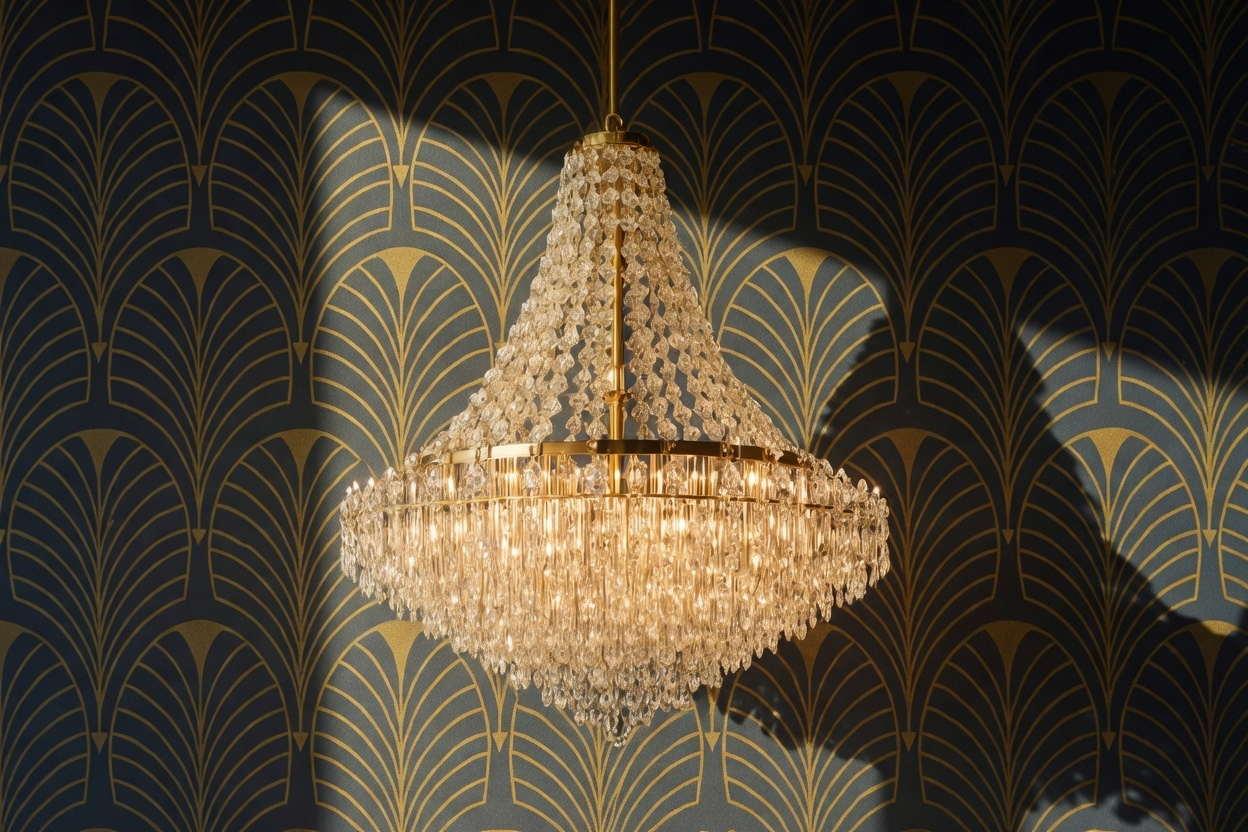
Lighting is part of the structure of a Deco room. A tiered chandelier, frosted sconces, or a floor lamp with some presence can do more than another round of styling objects.
One hard overhead light will flatten the whole room. Deco needs glow, not glare.
Also Useful: if you want the bigger design logic behind these moves, read Art Deco Interior Design.
Bedrooms need a quieter hand
A bedroom can carry Deco very well, but it cannot carry the same amount of it as a living room. This is where the style needs editing.
The bed wall does most of the work. Once that is strong enough, the rest of the room should support it instead of competing with it.
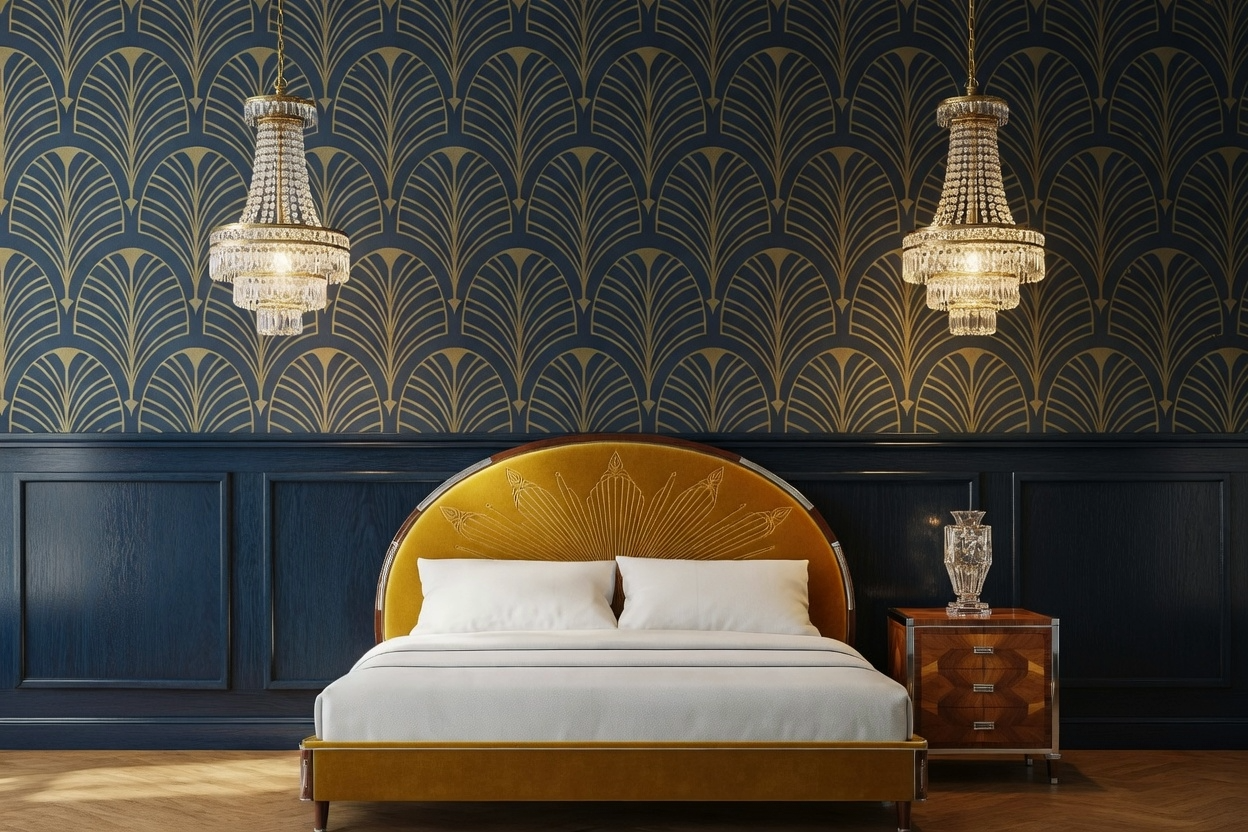
The headboard is the main move
Scalloped velvet, a geometric panel, darker wood, mirrored detailing if the room can take it. One strong headboard can make the room read Deco very quickly.
The trouble starts when the headboard is dramatic, the wallpaper is dramatic, the bedding is dramatic, and the lamps are dramatic. The room stops feeling composed and starts feeling noisy.
Color should feel rich, not crowded
Deep green works well. Navy works well. Cream and black work well. Dusty rose with chrome or pale gray with darker accents can work too. The trick is keeping the palette tight.
Bedrooms handle jewel tones better when there is enough plain surface around them. Cream bedding. Pale walls. One darker curtain. One polished lamp. That balance matters.
Storage decides whether the room still feels Deco
Clutter kills this style fast. Good bedside tables, a dresser that can actually hold things, under-bed storage if the room is tight. Those parts are not side issues. They decide whether the room stays crisp or turns into a pile of objects.
Bedside symmetry helps more than extra styling
Paired lamps. Balanced nightstands. One mirror or one framed print over the dresser. Deco likes visual order, and bedrooms benefit from that without needing much else.
Dining rooms can hold more drama than kitchens
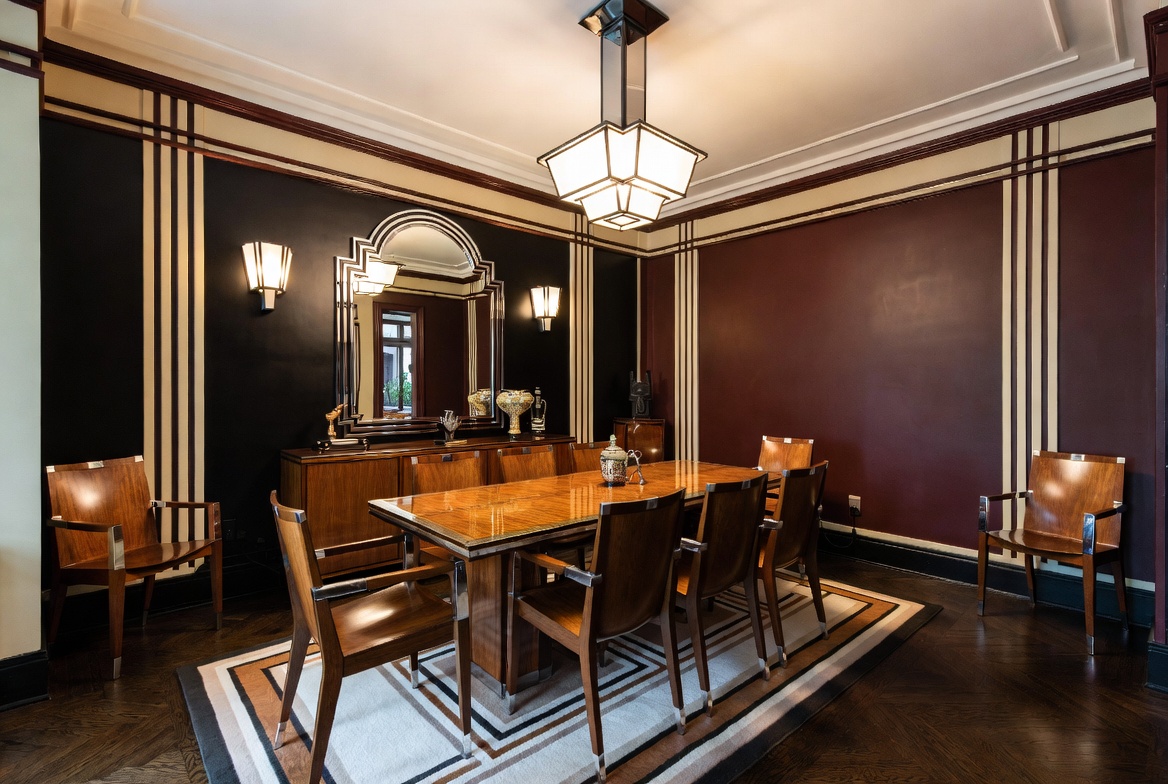
Image by ArchitectureCourses.org. Polished wood furniture, angular lighting, and disciplined wall geometry give this dining room a clear Art Deco character.
These two rooms sit near each other, but they do not want the same treatment.
The dining room can take the stronger gesture. The kitchen still has to survive daily use.
Dining rooms need a real anchor
The table has to lead. Glass with a strong base. Darker wood with cleaner lines. Velvet chairs if the room can take them. A chandelier that actually holds the ceiling.
If the table is weak, the room starts leaning on small accessories to make up for it. That never ends well. A dining room needs one serious object at its center.
Walls should support the table, not fight it
One mirror, one larger print, one stronger wall tone. That is enough in most cases. Dining rooms do not need lots of little wall pieces. They need one move with weight.
Kitchens need sharper decisions
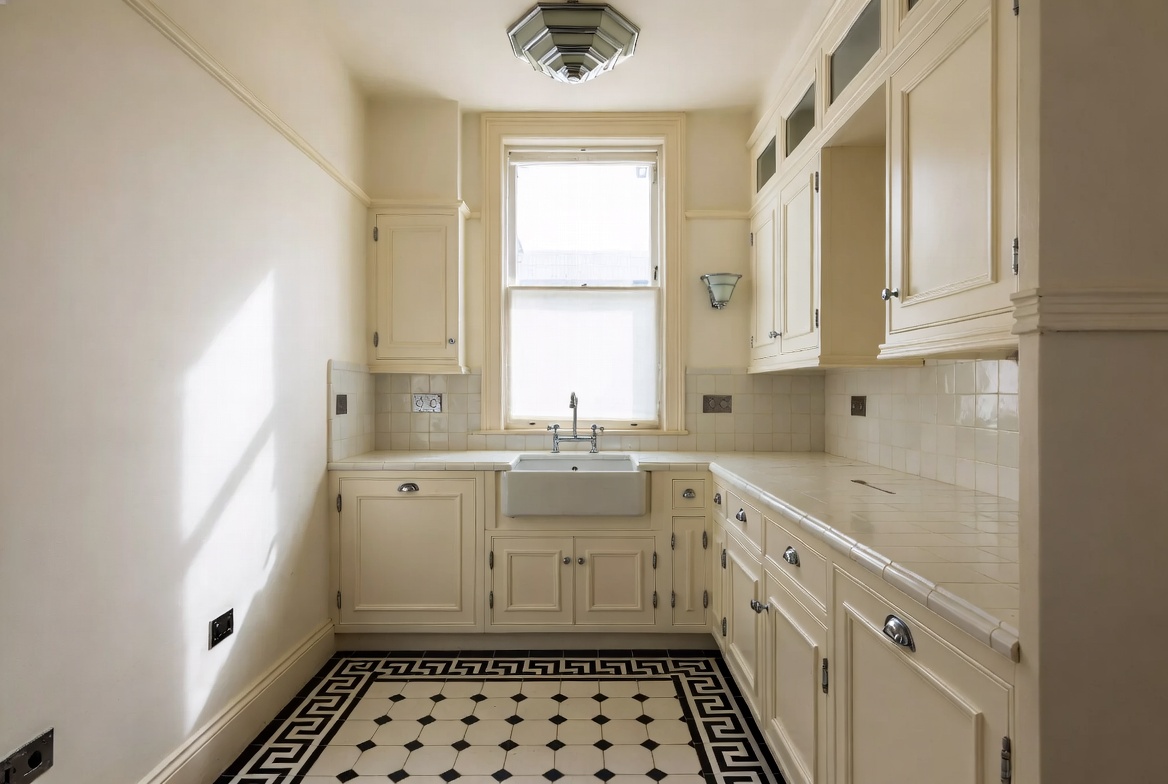
The backsplash is the easiest place to bring in Deco geometry. Chevron, fan, diamond, ribbed tile, or a stronger black-and-white pattern can work. Hardware matters too. Brass or chrome pulls can shift a plain kitchen a long way.
What does not help is trying to make every cabinet front, stool, and open shelf into a style statement. The kitchen will push back on that fast.
Do this instead of this
| Do This | Instead of This | Why It Works Better |
|---|---|---|
| One backsplash pattern | Pattern on backsplash, floor, and stools | The room keeps one clear point of focus |
| One finish family for hardware and lights | Brass pulls, chrome faucet, black pendants, gold accents | The room feels more edited |
| One strong chandelier over the table | Weak fixture plus lots of tabletop styling | The dining room gets its structure from above |
Bathrooms can carry the style with less effort
Bathrooms are small, so a few good moves go far. That is the upside. The downside is that small rooms show bad choices immediately.
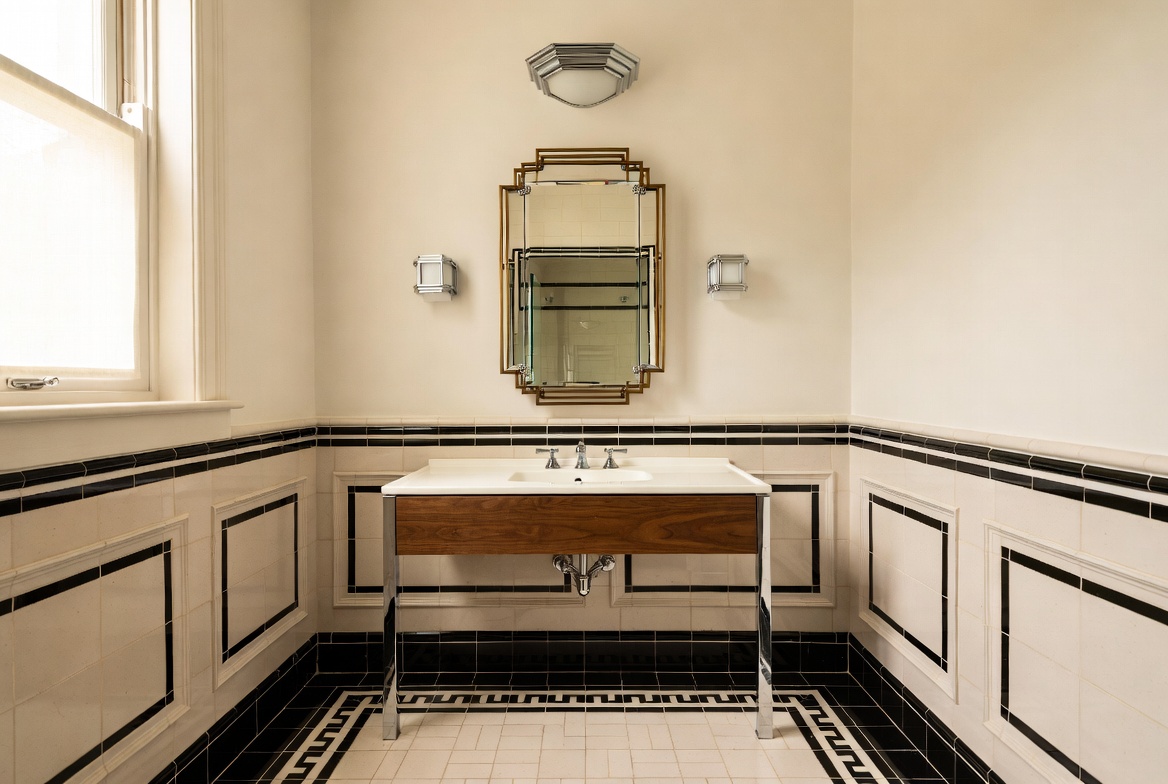
Image by ArchitectureCourses.org. A stepped mirror, black border tile, chrome fittings, and restrained geometry give this bathroom a clear Art Deco character.
Tile does most of the work
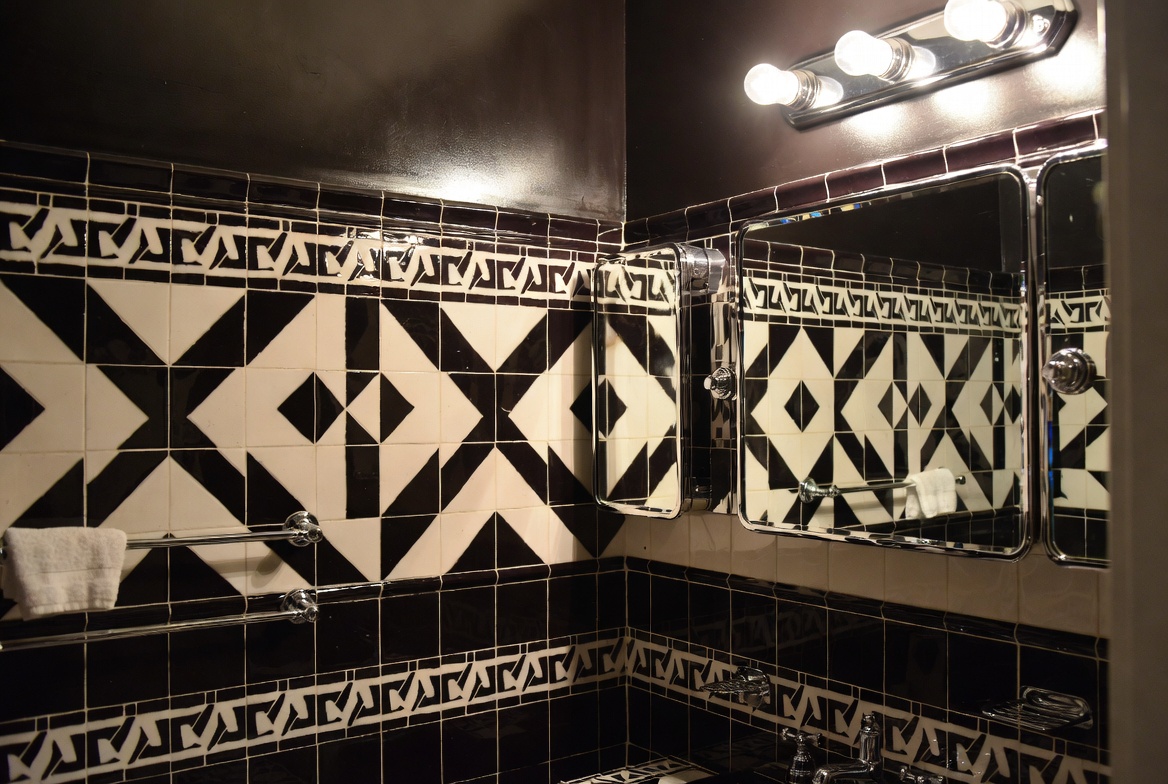
Image by ArchitectureCourses.org. In a small Deco bathroom, the tile can carry most of the style. Here, the black border, patterned floor, and restrained palette do the heavy lifting without crowding the room.
Black and white is the obvious route, but not the only route. Deep green, cream, pale gray, or a strong border can all work. The pattern needs enough quiet surface around it so the room can breathe.
Geometry belongs in the tile or the mirror before it belongs in every accessory.
The mirror and sconces are the easiest win
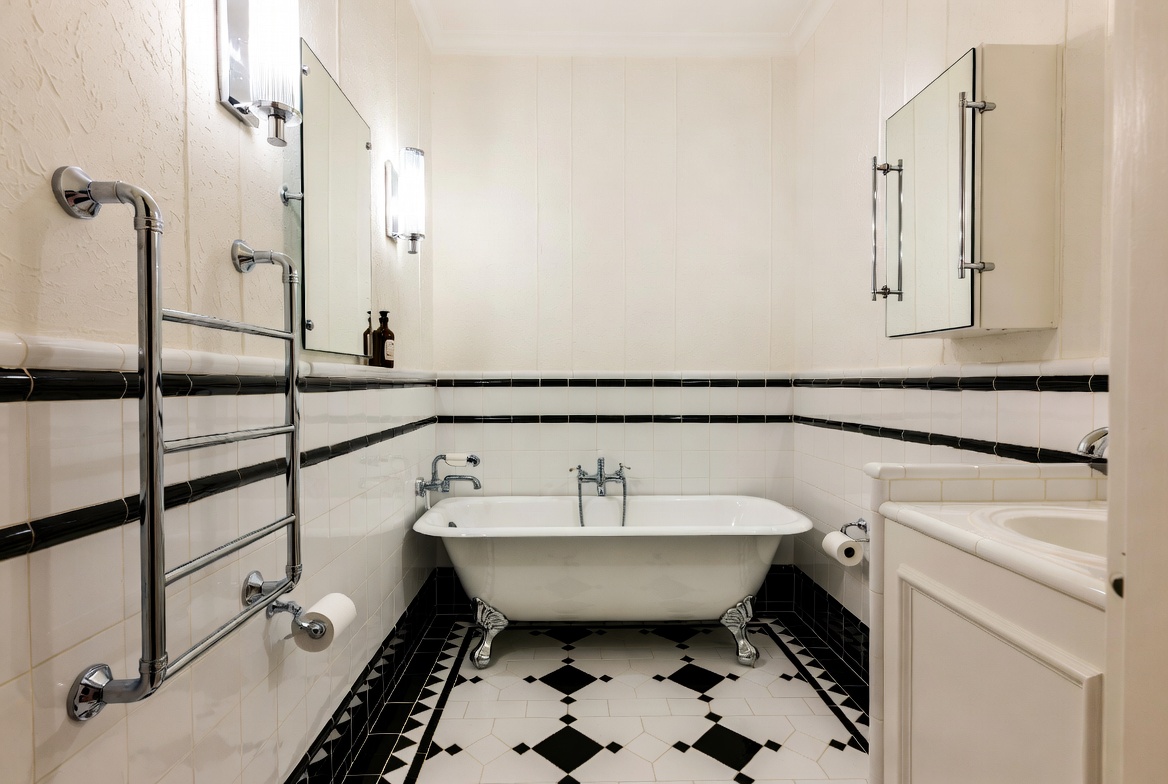
Image by ArchitectureCourses.org. A strong mirror, bold tile geometry, and simple lighting can push a small bathroom into Deco territory faster than a room full of accessories.
A better mirror with a stronger shape and a pair of sconces can do more for a Deco bathroom than almost anything else. This is one of the highest-return moves in the whole house.
Finish drift will ruin the room
Chrome, brass, or nickel. Pick one and stay with it. Bathrooms are too small to handle a lot of finish mixing. The room needs discipline more than variety.
Glamour has maintenance attached
That is the less fun part. Polished metal shows water spots. Grout stains. Mirrors need wiping. A Deco bathroom looks good when it is cared for. That is part of the deal.
Hallways and offices only need a few strong moves
These rooms are easy to treat like leftovers. That is a mistake. A little Deco goes a long way here.
Hallways
A runner, one mirror, a pair of sconces, or a stronger wall color can be enough. Hallways respond well to repetition. That might be paired lights, a row of matching frames, or one repeated trim line.
The hall should feel intentional, not overworked.
Home offices
An office needs a good desk first. Then one strong lamp, maybe one mirror or one framed print, and enough storage to keep the room clean. Black lacquer can work. Dark wood can work. Chrome can work. The desk has to lead.
The easy mistake here is building a Zoom background instead of a room that supports actual work. Deco can give an office authority, but the room still has to function for long hours.
One More Thing: for the history side of the style, go next to Art Deco History.
Spend here, not here
| Spend Here | Not Here | Why |
|---|---|---|
| One strong light fixture | Many small decorative objects | Lighting changes the room faster and more clearly |
| One good mirror | Several cheap metallic accents | Scale and reflection beat clutter |
| One good rug or headboard | Many matching “Deco-style” accessories | A room needs an anchor before it needs filler |
| Better hardware or tile | Trend pieces with weak finishes | Material quality shows fast in this style |
What goes wrong fast
Art Deco has a short path from sharp to silly. The same mistakes keep showing up.
- Too many patterns. One strong pattern can work. Several at once start fighting each other.
- Cheap metallic finishes. Weak gold, thin chrome, bad mirror, plastic shine. This style exposes shortcuts fast.
- Bad scale. Heavy pieces in a small room crush it. Tiny pieces in a large room disappear.
- Too much shine. Mirror, brass, chrome, lacquer, glass, polished stone. All good. Not all at once on every surface.
- Forgetting daily use. The chair still has to feel good. The kitchen still has to work. The bath still has to clean easily.
Where Deco works best
It does not need a whole house to land.
One living room can carry it. One bedroom can carry it. One bathroom can carry it. A hallway can carry just enough of it to set the tone for the rooms after it.
That is often the smarter move anyway. A full Deco house takes money, restraint, and a strong eye. Fragments are easier and often better. One chandelier. One mirror. One rug. One bath with the right tile and lighting. That can be enough.
The point is not to dress the whole house in one costume. The point is to use the style where it still has something to say.
Related Reading: Art Deco Architecture Explained: A Complete Guide for Design Lovers
FAQ
- What defines Art Deco interior design? Geometry, symmetry, stronger materials, polished surfaces, and a tighter sense of order.
- What is the easiest way to add Deco to a room? Start with one clear move: a mirror, a light fixture, a rug, a headboard, or a backsplash.
- Can a small apartment handle Deco? Yes, but in smaller doses. One or two strong moves work better than a full-room theme.
- What ruins the look fastest? Too many patterns, cheap metallic finishes, bad lighting, and too much shine in one room.
- Does Deco have to be expensive? It helps to spend on one or two pieces with good materials instead of buying many weak stand-ins.