

NYC Local Law 97: The Rule Everyone’s Designing Around
Local Law 97 is the ghost at every design table in New York. Architects talk about aesthetics. Owners talk about rent rolls. Engineers pull up models. But in the background sits a set of numbers carved into law: by 2030, cut building emissions 40 percent. By 2050, cut 80 percent. Fail, and the city fines you until you’re underwater.
You can’t sketch a tower or manage a renovation here without those targets creeping into the conversation. And if you want to understand what this law is doing to New York, don’t read the brochure. Walk the city.
How Local Law 97 Is Reshaping Architecture in New York
Local Law 97 is forcing NYC buildings to cut emissions by 40% by 2030. Learn what this means for owners, architects, and design decisions.
The Empire State Building: Old Bones Made to Work

Everyone knows the Empire State Building. Few know it became a test case for deep retrofits. Inside those limestone walls, engineers rebuilt over 6,000 windows into triple-glazed units, added insulation behind radiators, and re-engineered the chiller plant.
The result: nearly 40 percent less energy used, over $4 million saved a year.
I brought a group of students there one January. The tour guide pointed out the observation deck. I pointed at a radiator tucked against a wall. “That’s the retrofit,” I told them. “The insulation behind that radiator is doing more for the city than the view upstairs.”
The lesson? Demolition is not the only answer. Keeping the bones and upgrading the systems can out-perform new construction. Local Law 97 makes that logic mandatory.
Condo Boards in Panic

The loudest echoes of the law aren’t in Midtown towers—they’re in co-op basements. Picture twenty shareholders packed into a room with folding chairs, arguing over whether they need new windows when “the old ones still open.”
One board I sat with in Queens faced fines projected at $250,000 a year by 2030. Their reserves? Barely $100,000. They weren’t fighting about design—they were fighting about whether their maintenance fees would double.
This is where Local Law 97 feels harsh. It doesn’t care about reserves. It just measures emissions. Some owners shrug. Some panic. The smart boards bring in consultants now, before the deadlines crush them.
One Bryant Park: Systems You Can’t See
Stand at 42nd and Sixth and you’ll see the Bank of America Tower gleaming in glass. Tourists point up. Engineers point down. In the basement sits a cogeneration plant that powers itself and reuses waste heat. A greywater system cycles millions of gallons every year.
I once asked a facilities engineer what mattered most. He said, “Everyone loves the spire. The spire doesn’t pay the bills. The plumbing does.”
Local Law 97 rewards this kind of hidden work. You can’t fake compliance with shiny facades. The numbers come from your utility bill.
Hudson Yards: Stormwater Under Glass
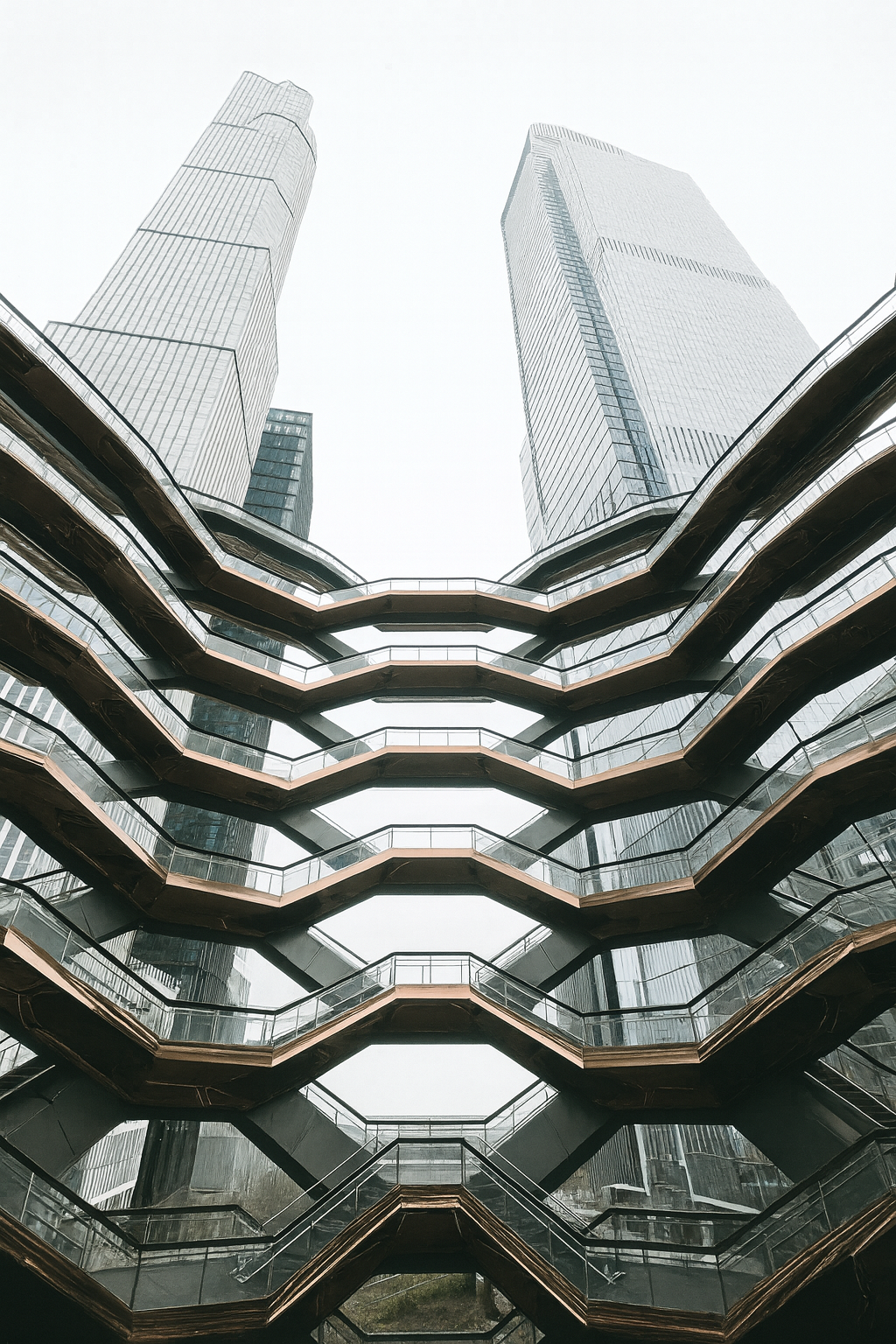
Critics call Hudson Yards glossy, sealed off, too private. Fair. But under the plazas sit tanks that collect 10 million gallons of stormwater. In planters along the square, bioswales filter runoff. The glass facades are tuned to orientation—less solar heat gain, more daylight.
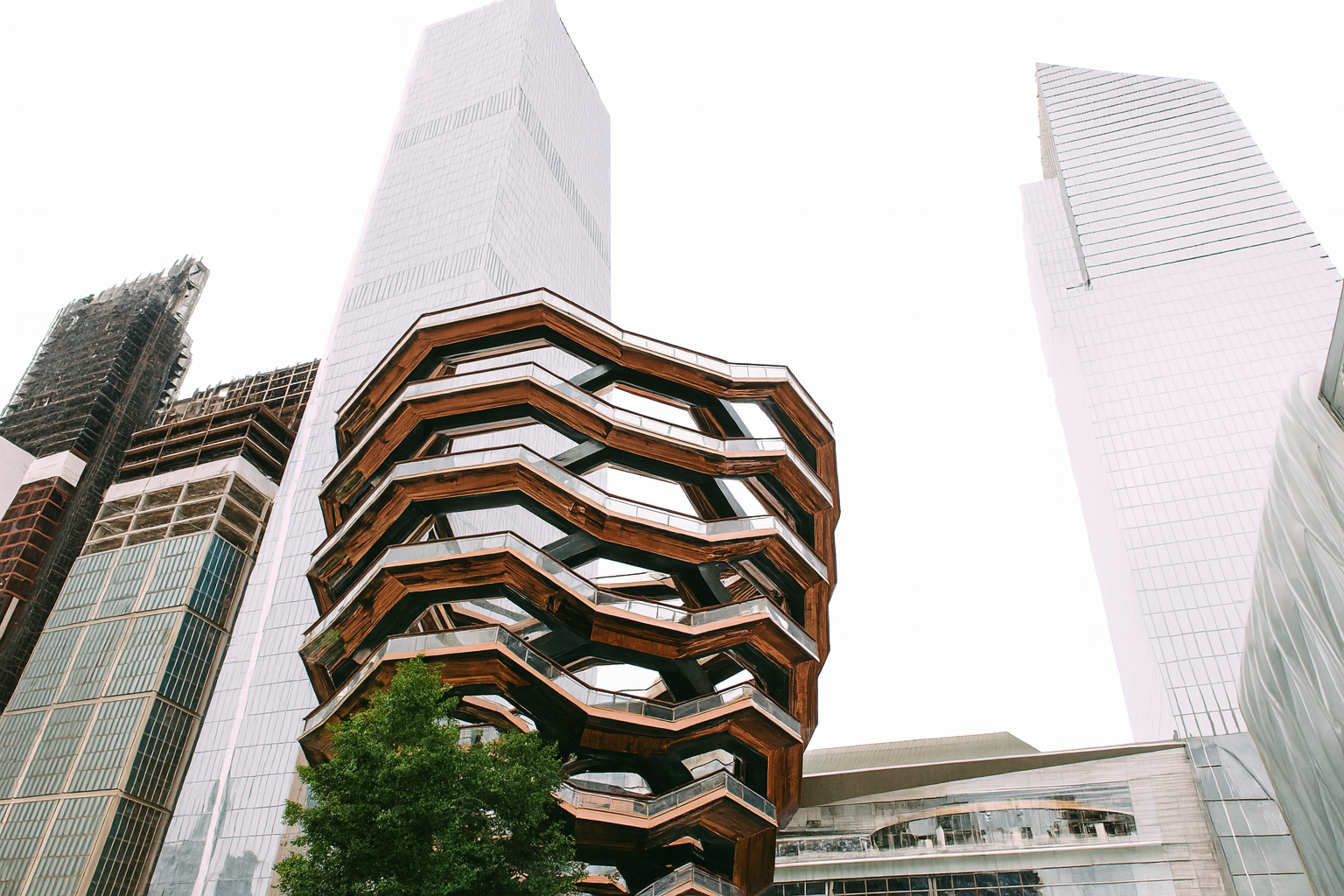
I walk students through and ask them to look down instead of up. They all take pictures of the Vessel. Then I make them study the drains, the grates, the way water moves. That’s where the law shows itself: in the details you don’t Instagram.
You might like: NYC Green Architecture: What Architects Are Building for 2030
Local Law 97 in Practice
Numbers Before Pictures
You feel the law before you read it. In every meeting room, on every drawing set, it hangs over the table. The conversations have shifted.
A few years ago, developers would pull out renderings first. They wanted shiny glass, something to market to brokers. Now the first slide in the deck is an energy model. Numbers before pictures. Someone always asks, “What’s our emissions profile?” before anyone asks about views. A fully glazed facade that looked like money ten years ago now looks like a liability, because the carbon math doesn’t lie. One Midtown client scrapped an entire concept because the annual fines penciled higher than the rent premiums they thought a glass tower would bring.
Engineers Take the Lead
The pecking order in design meetings has flipped. Engineers no longer sit quietly at the end of the table waiting to check compliance boxes. They run the charrettes. They set the baselines for envelopes, HVAC loads, daylighting. I’ve sat in sessions where the architect’s sketches were basically reacting to the engineer’s load curve. Some designers hate it, but it’s the new normal. You cannot ignore the people who know the kilowatts.
A New Value System on Site
On site, the trades tell the same story. Envelope contractors are the busiest people in the city. Air sealing crews, insulation specialists, glazing firms — they’re booked months out. One contractor laughed when I asked about lead times: “We used to get called for value engineering cuts. Now we’re the value.” You see scaffolds not for new glass towers, but for wrapping old brick shells in continuous insulation.
Accountants and Lawyers in the Room
Colleagues put it in blunt terms. One told me, “We used to design for brokers. Now we design for accountants and lawyers.” And he’s right. Every square foot is checked against a spreadsheet of energy use, fines avoided, savings gained. Lawyers draft lease language about who pays if the building misses its carbon target. Accountants run ten-year payback scenarios for heat pumps versus penalties. Architecture in New York has always been political, financial, and visual. Now it is legal, too.
The Quiet Revolution
There are odd cultural shifts. I’ve seen design teams argue over whether to lower a lobby ceiling just to reduce conditioned volume. I’ve watched developers pick duller glass because its solar heat gain coefficient was better. Brokers grumble, but tenants notice lower bills, not renderings. That’s the quiet revolution: the building that performs will lease, no matter how modest the brochure looks.
See also: Sustainable Design Strategies in Architecture: A Practical Guide
NYCHA Retrofits: The Largest Test
New York’s public housing stock—170,000 apartments—is the elephant in the room. Old, leaky, often neglected. Local Law 97 doesn’t exempt them. Crews are swapping windows, dropping in heat pumps, and tightening envelopes one campus at a time.
I walked through one retrofit in Brooklyn. Tenants were frustrated. Scaffolding everywhere, noisy PTAC installs, new controls they didn’t understand. An older resident asked me, “Why can’t they just leave the old heaters? They worked.”
This is the tension: compliance is mandatory, but communication lags. I’ve argued more than once that every NYCHA lobby should have a live energy savings display. Show tenants the drop in kilowatt hours. Turn the disruption into a visible win.
The Workforce Gap
The law didn’t just create demand—it exposed the shortage of people who can actually deliver. Air-sealing crews, commissioning agents, envelope contractors—everyone is booked out years.
Unions are adding training. Community colleges are offering crash courses. But the reality? Right now, there aren’t enough hands. Deadlines don’t slow down just because the labor isn’t there.
One superintendent told me, “I can get solar panels quoted in a week. I can’t get anyone to properly seal our windows for six months.” That’s the bottleneck.
Schools, Boardwalks, and the Public Realm
Local Law 97 doesn’t stop at towers. Schools in Queens and Staten Island are now being built net-zero ready, with solar on roofs and tight envelopes. I walked one new elementary school where the rooftop array powered classrooms below. The kids didn’t care about LEED—they cared that the lights never flickered.
Down in Rockaway, the boardwalk rebuilt after Sandy counts too. Recycled plastic lumber, integrated dunes, resilient design. It’s not glamorous, but it keeps the community alive.
These are the projects that prove sustainability isn’t just for Midtown towers. The law pushes it into daily life—schools, boardwalks, housing projects.
Local Law 97: The Rule Changing How New York Builds
Where It Hurts
Local Law 97 and NYC Buildings: Deadlines, Fines, and Design Shifts
Not every building has the money. Walk into a six-story co-op in Brooklyn Heights and you’ll hear owners arguing about assessments they can’t afford. Small landlords are staring at retrofit quotes higher than their annual rent roll.
I’ve seen resentment boil up. “Why us? Why now?” The answer is blunt: because 70 percent of emissions in New York come from buildings. You can’t hit climate targets without forcing the math onto real walls and windows.
Fines Under Local Law 97: How They Really Play Out
How the math works
The penalty is $268 per metric ton of CO₂ over your limit, per year. That sounds abstract until you run it. A midtown office tower missing its target by 5,000 tons pays about $1.3 million every year until it fixes the systems. A co-op missing by 200 tons still faces $53,600 annually — a painful hit for a volunteer board.
Is it fair?
Architects see both sides. On one hand, it forces owners to act. Without a stick, most retrofits never happen. On the other, the law hits buildings that can least afford it: co-ops with elderly residents, or nonprofits in old masonry shells with little money for upgrades. I’ve sat in board meetings where people asked, “Why are we paying for pollution when we’re barely making the mortgage?”
What it feels like in design meetings
Developers of big towers treat fines as line items — sometimes cheaper than a full retrofit in the short term. Architects hate that logic, because it delays real change. Meanwhile, in community housing projects, the fear of fines often sparks action: window swaps, envelope repairs, even pilot heat-pump programs. It’s a push-pull between compliance costs and upgrade costs.
Loopholes and extensions
There are carve-outs: hospitals, certain affordable housing, and some nonprofit institutions get different timelines. Owners can also apply for “good faith effort” adjustments if they prove they’ve started retrofits but aren’t finished. That buys time, but not forever.
From an architect’s perspective
The fines feel blunt, but they change the brief. When I design now, I don’t just pitch aesthetics — I show owners the financial risk of doing nothing. Every ton over the cap has a dollar sign. It’s math that makes the case for insulation and smart systems. One owner told me: “You sold me on heat pumps not with sustainability, but with the fact that it cost less than paying the city.”
Local Law 97 NYC: Why Every Project Now Starts With Energy Numbers
From retrofits to skyscrapers, Local Law 97 is rewriting the playbook for NYC architecture. See what the law requires and how projects are adapting.
Where It Works
Look at Moynihan Train Hall. Adaptive reuse with efficient HVAC and daylighting baked in. Or the Brooklyn Navy Yard, where old trusses carry new solar arrays. Or Industry City, where acres of flat roofs now host panels feeding the grid.
None of this happened by goodwill. It happened because the law set the stick, and design teams found the carrots in efficiency savings.
Lessons From the Street
What ties all these stories together isn’t glossy design. It’s trade-offs.
The Empire State retrofit: cheaper than rebuilding.
Hudson Yards: stormwater design hidden under plazas.
Solar 1: tiny building with outsized influence.
One Bryant Park: invisible systems that drive compliance.
Walk the city with these in mind, and stop staring only at spires. Ask what’s happening in the walls, on the roofs, in the basements. That’s where Local Law 97 lives.
Local Law 97 in Context: How Other Cities Push or Don’t
New York’s Local Law 97 is heavy-handed, no question. It forces the issue with hard numbers and fines. Other cities go about it differently, and that matters when we compare what gets built.
London
London does not have one sweeping carbon law like Local Law 97. It leans on planning approvals and strict energy performance certificates. If your building fails the rating, you struggle to lease it. That market pressure acts like a fine, just dressed up as “compliance.” I once walked a site in Southbank where the developer shaved off floor area to hit daylight and efficiency targets simply because tenants would walk if they did not. No single law, but the same end result.
Paris
Paris ties carbon directly to national energy codes. Every few years the baseline shifts tighter. You design today knowing tomorrow’s regulations will be stricter. Architects there expect to retrofit early. It feels more like a constant squeeze than New York’s big hammer.
Milan
And then there is Milan. The Vertical Forest towers—those residential skyscrapers draped in trees—were not born from fines. They came from a design ambition to change how a tower feels in the city. Bosco Verticale works because it solved heat, shade, and livability while looking dramatic. No one passed a law demanding “put trees on your balconies.” The architect, Stefano Boeri, made it happen because the culture and market rewarded it. That’s the reminder: sometimes design leads policy, not the other way around.

Los Angeles
LA leans harder on incentives than punishment. Solar mandates for new houses, rebates for green roofs, streamlined permits for all-electric projects. Developers respond because it makes the math easier, not because they fear fines.
The lesson
New York’s approach is unique. It uses penalties to drag laggards forward. Milan shows culture can lead. LA shows carrots can work. Paris shows slow, steady rules matter. Local Law 97 is just one flavor of forcing change. It will not be copied everywhere, but it does prove one thing: left to the market alone, most cities move too slow.
How to Use This Guide
For students
Do not just copy skylines. Sketch the details nobody shows in renderings. Green roofs, stormwater drains, mechanical rooms, control panels hidden in basements. That is where the future is being built.
For architects
Run the numbers. A tight envelope might add five to ten percent on paper, but the payback is steady and the fines for missing targets are brutal. The real design decisions now are about orientation, insulation, and loads, not just form.
For citizens
You do not need a tower to take part. Join a community solar program. It is cheaper than buying your own panels and it feeds clean power back into the same grid you depend on. Even renters can join in.
The lesson
Everyone has a role. From a student with a notebook to a landlord sweating over bills, the future of New York’s architecture depends on thousands of small, smart choices stacking together.
The Honest State of Play
Deadlines will slip. Transmission upgrades take years. Some buildings will fight fines instead of fixing systems. But the direction is locked. Local Law 97 turned sustainability from a press release into a requirement.
I tell students this: the ambition of New York used to be height. Now it’s carbon. If you want to understand the city’s next skyline, don’t look up. Look at the details that decide whether a building passes or pays.
Local Law 97 Compliance: A Practical Guide for NYC Buildings
Local Law 97 and Carbon Cuts: What It Means for Design and Construction
FAQ
Local Law 97 in Plain English
1. What exactly is Local Law 97?
It’s New York City’s climate law that caps carbon emissions from large buildings. By 2030, they must cut 40 percent. By 2050, 80 percent. If they miss, fines stack up in the millions every year.
2. Who has to comply?
Any building over 25,000 square feet. That covers most office towers, co-ops, rentals, schools, and even churches. About 50,000 properties in total.
3. What happens if a building can’t afford upgrades?
That’s the tension. Co-ops and small landlords complain they don’t have the cash for new systems. Some try to lobby for extensions. Others phase upgrades window by window or floor by floor. The fines don’t go away — so delay only costs more later.
4. What kind of retrofits actually work?
Start with the envelope. Air sealing, insulation, smarter windows. Then update HVAC, controls, and lighting. The Empire State retrofit proved you can cut almost 40 percent with these steps. Without touching the bones.
5. How are architects and engineers reacting?
Every schematic review now starts with an energy budget. Architects don’t just draw elevations — they sketch shading and glass ratios by orientation. Engineers are at the center of design meetings. Local Law 97 turned energy modeling into a first step, not an afterthought.
6. What are the biggest obstacles?
Workforce and time. There aren’t enough trained installers, commissioning agents, or heat-pump techs. Supply chains lag. And thousands of buildings need work at once. Everyone is scrambling.
7. Does this law actually change the skyline?
Yes, but subtly. You won’t see flashy “green” towers sprouting everywhere. You’ll see retrofits: older towers with tuned façades, shaded glass, and rooftop solar tucked in. The skyline shifts from the inside out. Less waste, smaller bills, quieter systems. That’s the real architectural change.