
NYC Green Architecture: A Field Guide for Students and Architects
How Buildings Are Going Green
New York has never built quietly. From the Dutch gables of the 1600s to the steel spires of the 20th century, the city has always tested the limits of design. Today, the test is carbon. Every architect here knows the number: 40 percent of emissions come from buildings. That’s what Local Law 97 was written to crush, and it’s the reason green architecture in New York isn’t an option—it’s survival.
I’ve walked these sites with students, colleagues, even skeptical developers. Each one tells you something different about what sustainable design really takes: money, politics, patience, and sometimes just stubborn detail work. Let’s go through them.
NYC Green Architecture: The Push Toward Net-Zero Buildings
NYC Green Architecture Explained by an Architect Who’s Walked It
See how NYC green architecture is moving toward renewables and net-zero design. Learn which buildings, policies, and projects are shaping the city’s sustainable future.
Local Law 97: The Rule Everyone’s Designing Around
From Rooftop Solar to Net-Positive Towers: NYC’s Green Architecture Vision
What the Law Says
Local Law 97 is blunt. By 2030 every large building in New York must cut emissions by 40 percent. By 2050 that number jumps to 80. If you miss the target the fines are not polite reminders. They run into the millions every year. That is enough to turn green design from a choice into survival math.
How It Shows Up in Practice
On paper it looks like a regulation. On the ground it changes every conversation. I have sat in design meetings where owners stop talking about façade aesthetics and start asking for payback schedules. Engineers who used to be buried in the appendix are now leading the room. Every architect I know keeps the law’s numbers in their head as tightly as zoning setbacks. You feel it in the details: glass ratios, HVAC sizing, even the way roofs are pitched for solar.
What’s Already Moving
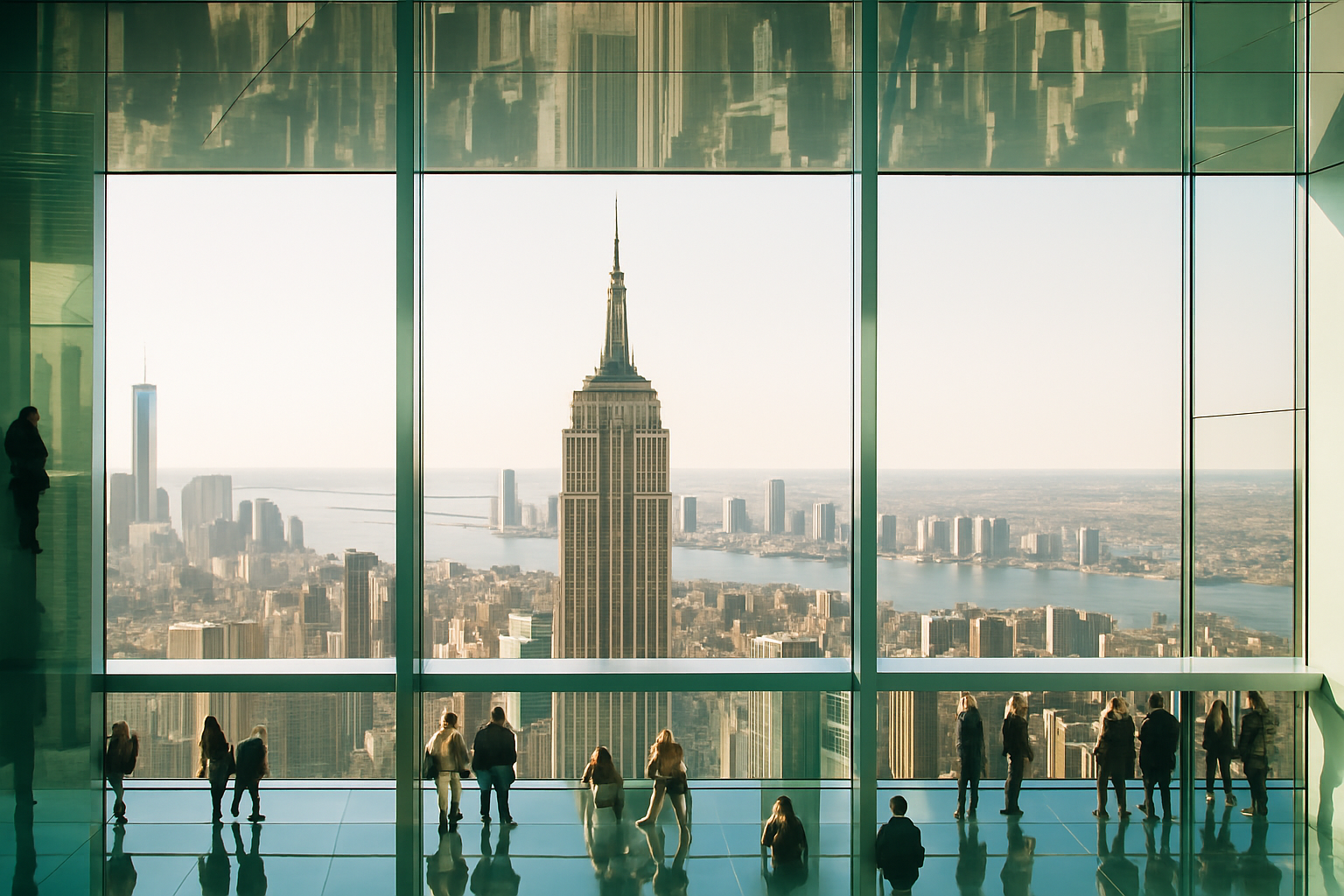
The Empire State Building proved retrofits can work long before the fines arrived. Its energy bills dropped by 38 percent after a deep overhaul with new windows, smarter cooling, and insulation behind old radiators. That retrofit became the case study everyone points to when skeptical clients ask if the law is survivable.
Now office towers are racing to repeat the trick. I have walked through Midtown lobbies where construction boards cover the windows and scaffolds run up the façade, not for cosmetic upgrades but for envelope tightening. Condo boards that ignored efficiency for decades are suddenly paying energy consultants to model their buildings. Entire industries like commissioning agents, envelope contractors, and energy auditors are booked out because everyone wants to dodge the fines before they arrive.
Where It Hurts
Not every building has the cash. In co-op basements you still hear residents grumble: “Why replace these windows? They still open fine.” For small landlords the upfront costs can feel like a death sentence. I have been in meetings where the law is not seen as climate policy at all but as a threat to affordability. The frustration is real and financing tools have not caught up to the scale of the mandate.
Why It’s a Turning Point
New York has written ambition into law. Without Local Law 97 sustainability here would still be an optional brochure flourish like a green wall or a PR-ready solar panel. With it performance is no longer negotiable. From Midtown glass towers to Brooklyn walk-ups every project now has to prove its carbon math not just its aesthetics.
This is not the kind of law that makes headlines every day, but it is the one reshaping the skyline in silence. Every retrofit, every new tower, every co-op struggling with budgets is orbiting around the same rule. Local Law 97 is the quiet backbone of New York’s green future.
You might like: Local Law 97 NYC: What Architects and Building Owners Need to Know
Living With Green Architecture in NYC: What an Architect Sees
Inside NYC’s Green Architecture Movement: Towers, Roofs, and Streets
An architect’s take on NYC green architecture. Real examples of renewable buildings, climate-ready streets, and net-zero design shaping the city by 2030.
Why I Still Walk the City
I don’t trust renderings. I don’t trust press releases. If you want to know whether a building is really “green,” you have to stand outside it, walk inside, maybe peek at the roof if you’re lucky enough to get access. This city has been my classroom and my headache for decades.
One Bryant Park: Banking on Efficiency
Stand at 42nd and Sixth, and you’ll see a glass tower that changed the rules. The Bank of America Tower, better known as One Bryant Park, was the first LEED Platinum skyscraper in New York.
What to look for:
-
Triple-glazed glass that reduces heat loss and glare.
-
A cogeneration plant in the basement that supplies its own electricity and heating.
-
An advanced greywater system that recycles water for toilets and cooling.
Behind the scenes:
I remember a facilities engineer there telling me: “Most of what’s impressive here is invisible. People see glass. What pays the bills is the plumbing and controls.” The building reuses millions of gallons of water a year.
Lesson: High performance in Manhattan isn’t just about shape. It’s about mechanical guts.
The Empire State Building Retrofit: Old Bones, New Tricks

Everyone knows the Empire State Building. Few know it quietly became one of the greenest skyscrapers in the country.
What they did:
-
Replaced 6,500 windows with triple-glazed retrofits done in-house, saving $17 per window per year in energy costs.
-
Added insulation behind radiators, cutting winter heat loss.
-
Installed smart elevators that regenerate energy as they descend.
Numbers that matter:
-
38% reduction in energy use.
-
$4.4 million saved annually on utilities.
I once had a student complain, “Why not just build new?” The retrofit shows why: carbon is already spent when a building goes up. Keeping the bones and reworking the systems beats demolition every time.
Solar 1: A Classroom on the River
Walk down to the East River near Stuyvesant Cove Park, and you’ll find Solar 1. It’s small, a one-story box clad in wood, but it’s one of the most important buildings in the city.
Why it matters:
-
It’s the first self-sustaining solar-powered building in NYC.
-
It functions as an education hub, running workshops on renewable energy for schools, architects, and the public.
I once took a class there in winter. Inside, the lights, heat, and systems were all running on the panels overhead. A student whispered: “This place feels like a lab disguised as a shack.” That’s the point—it shows sustainability isn’t about looks, it’s about systems.
Hudson Yards: A City Built From Scratch
Love it or hate it, Hudson Yards is where developers proved you can build a new Manhattan district under the weight of 21st-century regulations.
Details to notice:
-
70% of the site is built over active train yards on a giant platform—one of the largest in the world.
-
Every building was designed with advanced glass, HVAC, and water systems to comply with new energy codes.
-
The public square uses a rainwater collection system that stores 10 million gallons annually to irrigate landscaping.
Walking students here, I point out the Vessel. They all take pictures of its honeycomb stairs. Then I make them look down: storm drains designed to catch and redirect water, hidden planters that double as bioswales. That’s the real green design here.
The Shed: A Building That Moves
Next door, The Shed is a cultural building with a skin that literally slides open on rails.
Architectural trick: The telescoping shell is insulated, air-sealed, and designed to expand or contract depending on use. It means the building doesn’t waste energy heating or cooling empty space.
Takeaway: Flexibility is sustainability. A structure that can change function avoids the need for demolition decades later.
Green Roofs on SoHo Cast-Iron Buildings
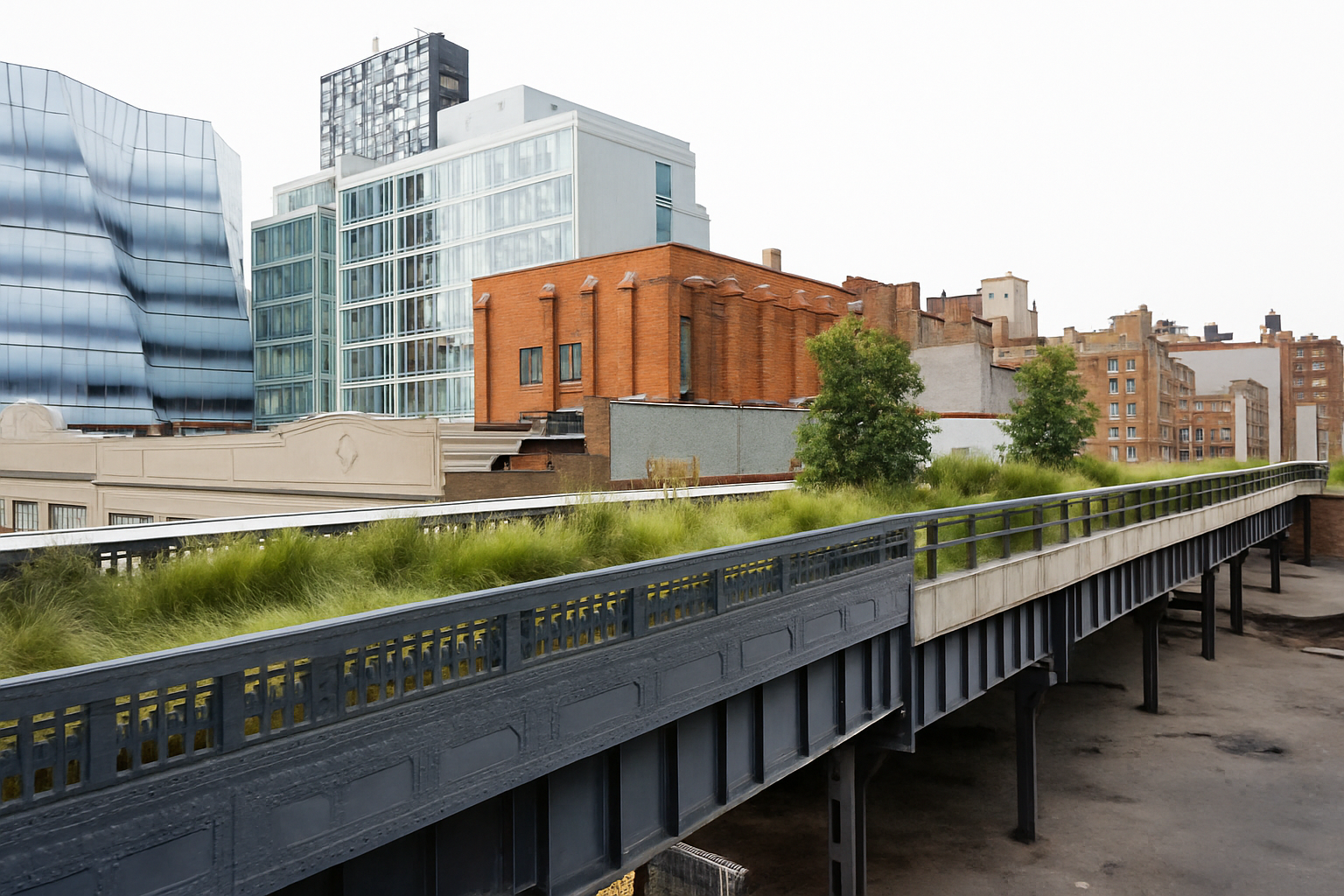
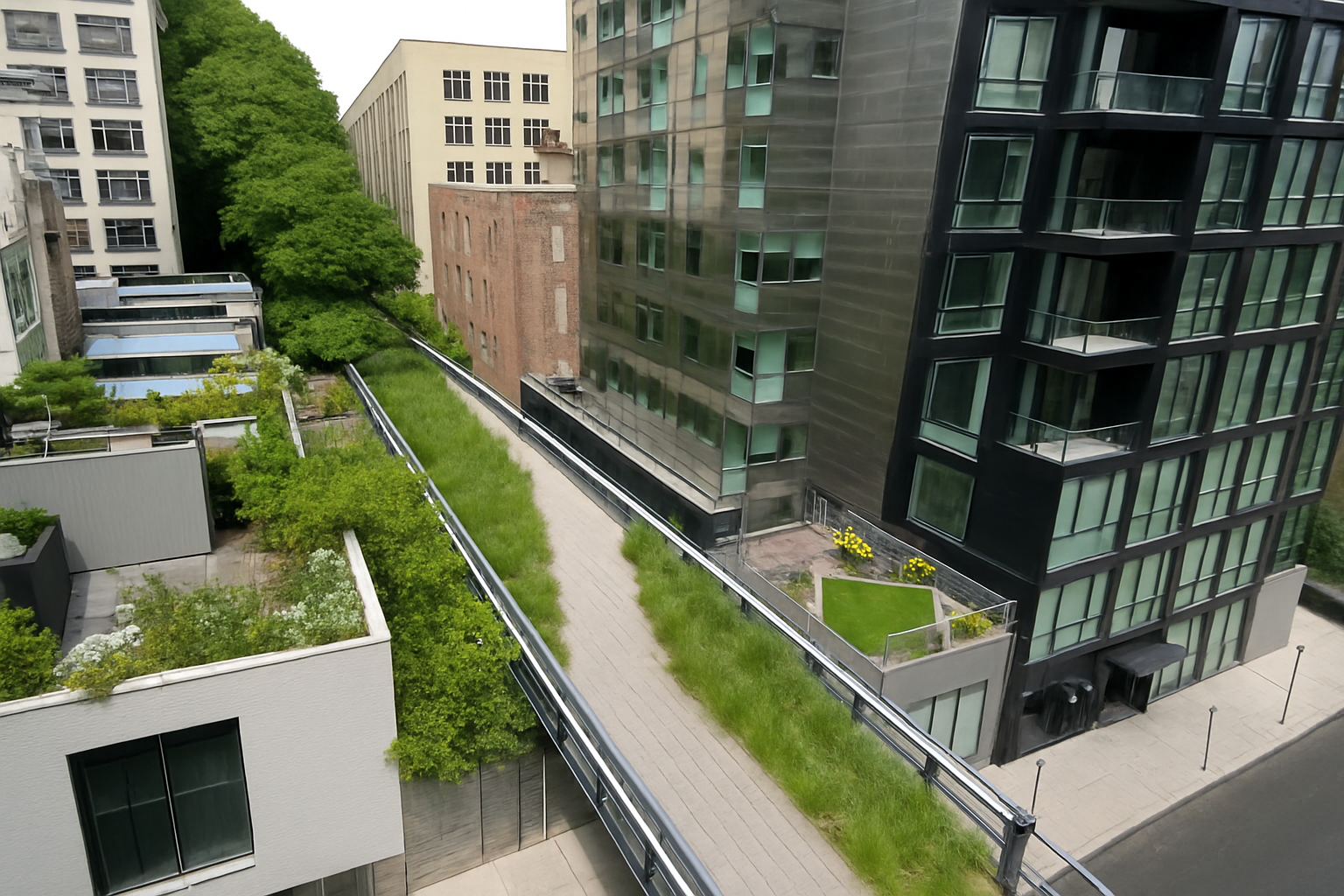
Climb any old cast-iron roof in SoHo, and you’ll see a quiet revolution. Green roofs aren’t just about plants. They cool buildings, manage stormwater, and extend roof lifespans.
Example: One restored building on Greene Street added a shallow green roof that dropped indoor summer temperatures by almost 10°F.
I walked a group of undergrads up there last year. One asked, “Why bother? It’s not visible from the street.” The owner answered: “Because ConEd bills are visible every month.”
Staten Island’s Rooftop Solar Giant
You wouldn’t expect it, but Staten Island hosts the largest rooftop solar array in an urban area in the U.S.
-
Covers over 3 million square feet.
-
Generates enough energy for 1,200 homes annually.
It sits on a warehouse, proving you don’t need a glass tower to make impact. Students always forget warehouses exist as canvases. In sustainability, they’re gold.
One Vanderbilt: Tall, Clear, and Efficient
Next to Grand Central, One Vanderbilt rises 1,401 feet. What makes it matter isn’t just the height.
Green features:
-
LEED Gold certified.
-
Uses efficient curtain walls, daylighting strategies, and a modern HVAC system.
-
Built with direct access to transit, cutting transportation emissions.
An architect I know who worked on the project told me: “We didn’t design it to look green. We designed it to perform green. The rating came after.”
Transit as Architecture: Moynihan and East Side Access
I tell students not to skip train halls. Moynihan Train Hall is adaptive reuse at its best with old post office shells turned into daylight-filled concourses powered by efficient systems. East Side Access buried miles of new tunnels and included some of the most advanced ventilation and lighting systems in the city.
What to look for: the mechanical rooms, the light wells, the cooling plants. Transit is not just trains, it is energy, air, and space.
If anything is missing, it is clearer integration with the street above. Moynihan glows inside, but step outside and the urban edge feels thin. The next generation of transit projects should blur the line better between building, city, and infrastructure.
Batteries in the Boroughs
Solar without storage is just a half measure. Con Edison has started dropping community batteries into Brooklyn and Queens, big white containers that store solar and release it when the grid peaks.
They are easy to miss, tucked next to substations or warehouses, but they are the glue that makes all this renewable talk real.
One thought: the batteries could be less anonymous. Imagine if the casing carried data displays showing charge and discharge cycles, or murals done by local artists. Right now they look like bland boxes. They could be civic landmarks of the clean energy grid.
Public Architecture as Green Infrastructure
NYCHA Retrofits: Housing at Scale
New York’s public housing stock is massive, old, and leaky, with more than 170,000 apartments. Crews are rolling out heat pumps, new windows, and envelope upgrades campus by campus.
What you see: scaffolding over courtyards, PTAC heat pumps going in one window at a time, tenants frustrated when work drags on.
Why it matters: no private developer works at this scale. If NYCHA succeeds, it proves decarbonization can reach working-class housing, not just Midtown towers.
What’s missing: transparency. Even a lobby screen showing real-time energy savings could turn confusion into pride and make the project a teaching tool.
Schools as Net-Zero Labs
The School Construction Authority has built some of the city’s first net-zero-ready schools. Walk one in Queens or Staten Island and you’ll find solar roofs, tight envelopes, efficient HVAC.
Why it matters: kids learn in these spaces every day. If you want the next generation to understand green design, start with schools.
What would make it better: put the systems in plain sight. A rainwater tank on the playground with a clear label. A cafeteria display showing how much energy the roof made that morning. These touches would make sustainability part of the curriculum.
Rockaway Boardwalk: Resilience on the Shore
After Hurricane Sandy, the Rockaway boardwalk was rebuilt with recycled plastic lumber and integrated dunes. It’s survival architecture, not glamour. Stand there on a stormy day and you see how form and ecology blend.
Lesson: resilience doesn’t always look like towers and curtain walls. Sometimes it’s a boardwalk that will not wash away in the next storm.
What’s missing: shade. The boardwalk works against storms, but on hot days it feels bare. Solar-roofed pavilions could provide shelter and generate power for lights or concessions.
Industry City, Sunset Park
Not all adaptive reuse is about lofts. Industry City has layered on solar arrays, efficiency retrofits, and green manufacturing hubs inside its old industrial blocks. Walk the rooftops and you will see panels spread across acres of flat space.
Architectural insight: the future grid is not just out at sea with wind farms. It is rooftops like these feeding the load right where it is needed.
If there is a gap, it is at street level. Much of the complex still feels closed off. Opening more courtyards to the public, with visible energy dashboards or shaded plazas, could turn the site into both a power plant and a neighborhood square.
You might liek: Building a Truly Green NYC Apartment: What It Takes in 2025
Lessons From the Street

What ties all these projects together isn’t glossy design. It’s trade-offs. Always trade-offs.
The Empire State Building retrofit is the obvious example. Everyone wanted to replace it at one point. Developers were convinced newer towers would outclass it forever. But they didn’t. Instead, they proved you could take old bones and re-engineer them. Six thousand windows re-glazed on site, insulation slipped behind radiators, smarter cooling systems grafted onto a Depression-era frame. It wasn’t about style. It was about deciding that retrofitting was cheaper and faster than rebuilding, and carbon math backed it up.
Hudson Yards sits on the opposite end of the spectrum. Billions of dollars. An entirely new platform over live rail yards. Shiny towers that architects love to hate. And yet, under the plazas you find stormwater systems catching millions of gallons, bioswales hidden in the landscaping, drains disguised as paving joints. The lesson: even a district criticized for its urbanism hides performance moves that matter. They don’t make the press releases, but they keep the project alive.
Solar 1 is at the other scale again. Just a wooden box on the East River, modest enough to walk past without looking. But inside, it runs itself entirely on solar power. No backup grid in normal operation. That kind of experiment doesn’t look like much, but when students sit inside in the winter and realize the heat above them is coming straight off the roof, the lesson lands harder than any lecture.
And then there’s One Bryant Park, glassy and corporate, yet what actually matters is invisible. Greywater recycling loops, cogeneration engines in the basement, a whole plumbing system designed to shave off millions of gallons. Stand outside, and it looks like any Midtown tower. Step inside with an engineer, and suddenly you see what makes it work.
If you walk these sites, don’t just stare up. Everyone does that. Ask yourself: what’s happening in the walls, on the roofs, down in the basements? That’s where the real story is. That’s where the future is being built.
How to Use This Guide
This isn’t meant to be another brochure about sustainability. It’s a walking kit. A way to read the city differently.
Students: Bring a notebook. Don’t waste time sketching façades you can find in photographs. Draw what the photos never show: the edge of a green roof, the vent details, the way shading devices cut glare. Look at where the pipes land, how the conduits run, where water collects. That’s what matters when you start designing.
Architects: Forget renderings for a while. Study the premiums. A retrofit usually runs five to ten percent above code minimum, sometimes more if the geometry is tricky. But the payback is real, both in money and in resilience. Talk to the commissioning agents, not just the design team. They’ll tell you where the project bled or saved.
Citizens: You don’t need a tower to play a role. Join a community solar program. It’s cheaper than putting panels on your own roof and helps stabilize the grid. Even renters can do it. If you’ve ever complained about ConEd bills, that’s your entry point into this entire story.
And whoever you are, when you walk past a project, don’t ask “is it beautiful?” Ask “is it working?” Beauty fades fast if the systems behind it are broken. The real test of green architecture isn’t the render. It’s how the building feels five years later when the roof is still tight, the bills are lower, and the systems are humming without complaint.
Closing
New York’s skyline has always been about ambition. The difference now is the ambition isn’t tallest—it’s cleanest.
Walk the streets. Visit these sites. Look past the glass and ask the right questions. That’s how you’ll really understand NYC green architecture.
Sources
- NYSERDA (New York State Energy Research and Development Authority): Provides information on renewable energy initiatives in New York. NYSERDA
- U.S. Environmental Protection Agency (EPA): Offers insights into green building practices and their benefits. EPA Archive
- U.S. Green Building Council: Dedicated to promoting sustainable building design and construction. U.S. Green Building Council