
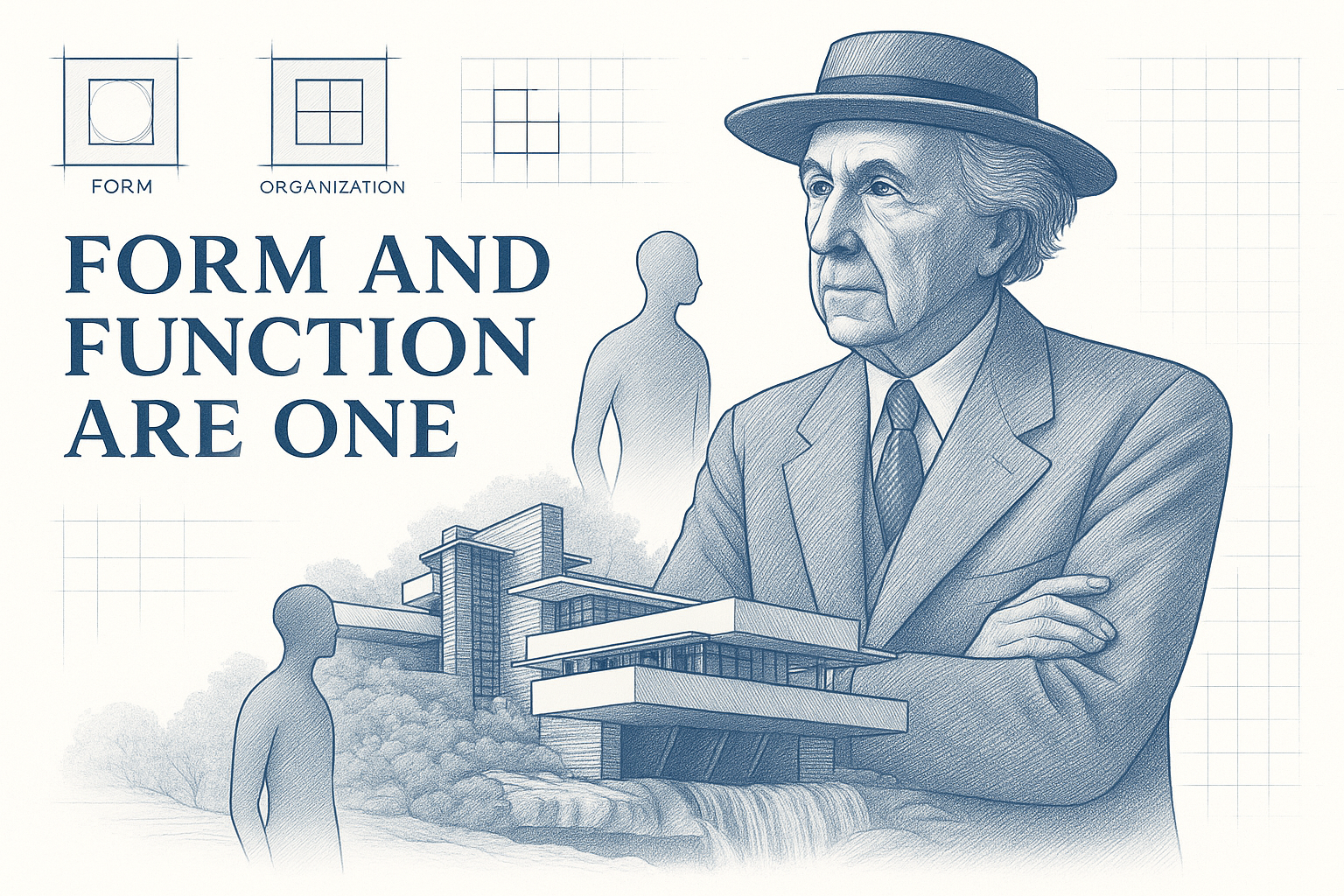
Frank Lloyd Wright’s Genius: Where Form Meets Function—Naturally
No one changed modern architecture like Frank Lloyd Wright.
He didn’t just draw buildings—he redefined how they should feel. Every wall, roofline, and window was guided by a radical idea:
Form and function aren’t separate. They’re one.
Wright believed a house should grow from its landscape, not sit on top of it. It should breathe with the people living inside it. He called this organic architecture—and it still fuels design thinking a century later.
“Form and function should be one, joined in a spiritual union.” — Frank Lloyd Wright
This wasn’t just talk. From the Prairie houses to Fallingwater, he proved that you can make a home both beautiful and truly livable—by letting nature lead the way.
Wright’s work teaches us something timeless:
If you want design that lasts, don’t just aim for “cool.”
Aim for honest. Human. Harmonious.
Read also: Merging form with function
Wright’s Architectural Beginnings: The Roots of Organic Architecture
How It All Started: Wright’s Roots in Nature & Purpose
Frank Lloyd Wright didn’t stumble into greatness—he was shaped by his surroundings. Raised on the open plains of Wisconsin, his first real classroom wasn’t a studio—it was nature.
That early exposure laid the foundation for his idea of “organic architecture”—design that doesn’t just sit on the land but grows from it.
Wright didn’t just take inspiration from trees and hills. He learned from Louis Sullivan, the “father of skyscrapers,” who coined the famous phrase: “Form follows function.”
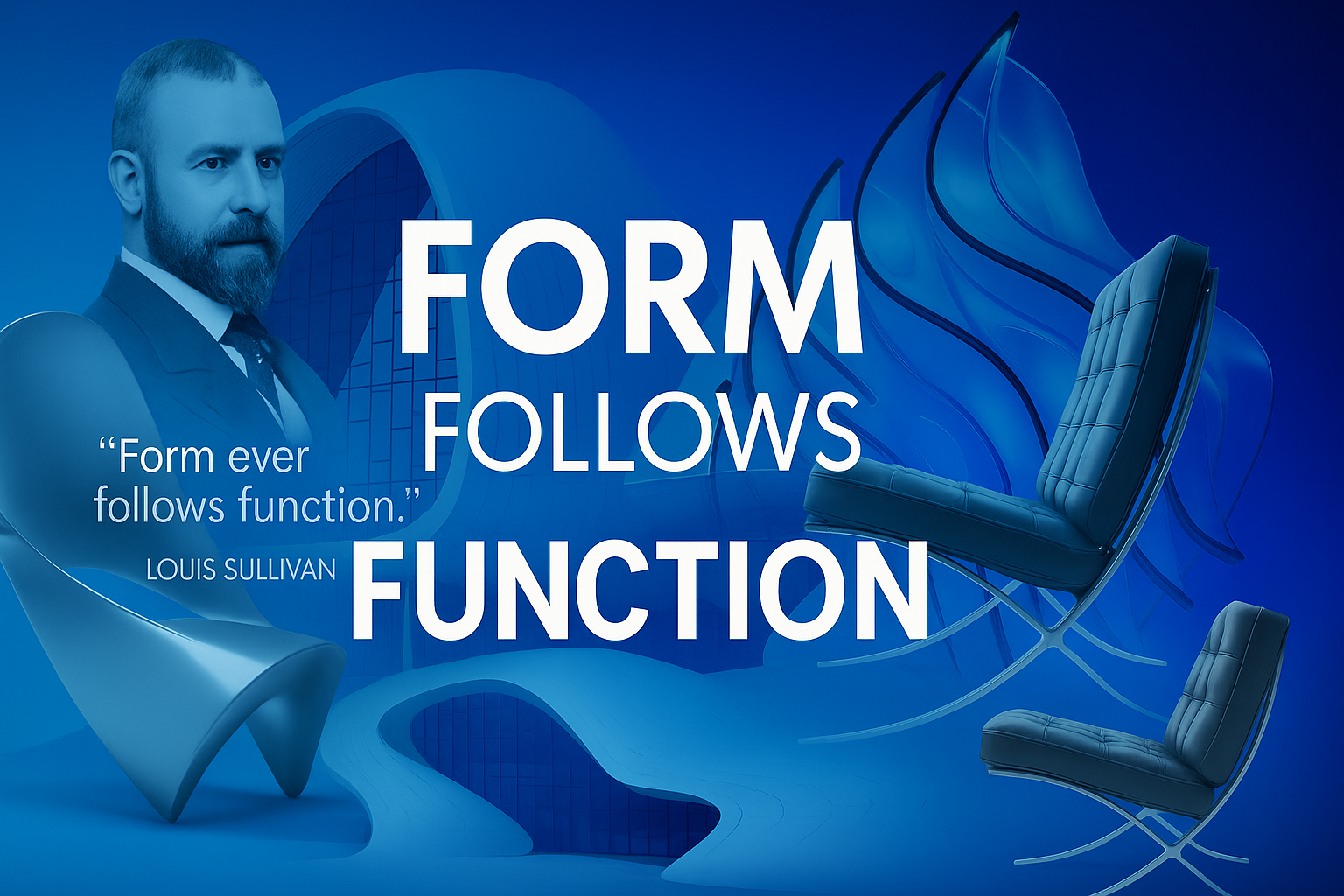
But Wright pushed it further:
Form and function should be one. Not form first. Not function first. One unified design that works beautifully and lives beautifully.
Early Innovation: Johnson Wax Headquarters
When Frank Lloyd Wright designed the Johnson Wax Headquarters in Wisconsin (1936), he defied expectations. Instead of cubicles and sharp corners, he built a forest of slender mushroom columns—made of concrete.
Most engineers said it couldn’t be done. He proved them wrong.
Wright didn’t chase beauty. He shaped space to support work, light, and collaboration. The open-plan layout and translucent ceiling tiles created a warm, diffused glow—long before “wellness design” was a thing.
→ It wasn’t about looks. It was about inventing a new way to work. And it still works today.
Prairie Style: The First Truly “American” Architecture
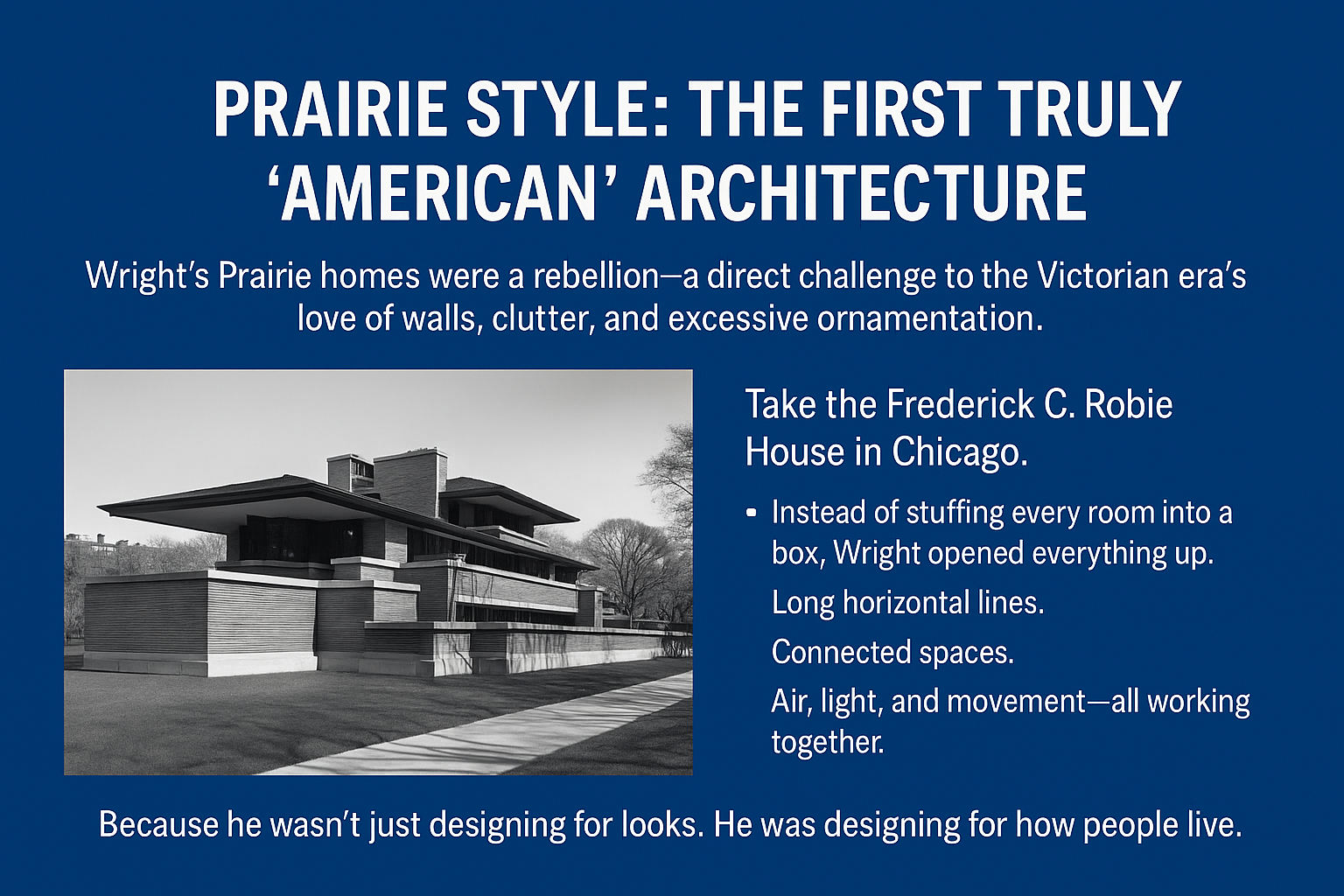
IMAGE: Frank Lloyd Wright’s Prairie-style architecture shown through a home with horizontal lines, open interior flow, and integrated design focused on livability.
Wright’s Prairie homes were a rebellion—a direct challenge to the Victorian era’s love of walls, clutter, and excessive ornamentation.
Take the Frederick C. Robie House in Chicago.
Instead of stuffing every room into a box, Wright opened everything up. Long horizontal lines. Connected spaces.
Air, light, and movement—all working together.
Because he wasn’t just designing for looks.
He was designing for how people live.
What Wright Was Really Saying
Here’s the lesson:
Don’t design something just to impress.
Design to make people’s lives feel better.
Ask yourself:
→ “Will someone feel relaxed here?”
→ “Will they know where to go without being told?”
→ “Will it function and feel beautiful?”
That’s what Wright mastered.
And that’s what you can carry forward—whether you’re designing a home, a bench, or a brand.
Related: Form follows function
Recommended Reading:
- Frank Lloyd Wright: Natural Design, Organic Architecture: Lessons for Building Green from an American Original – Illustrated, by Alan Weintraub
Wright’s Vision of Form and Function: A Lesson for All Designers
Wright’s Vision of Form and Function: A Lesson Every Designer Needs
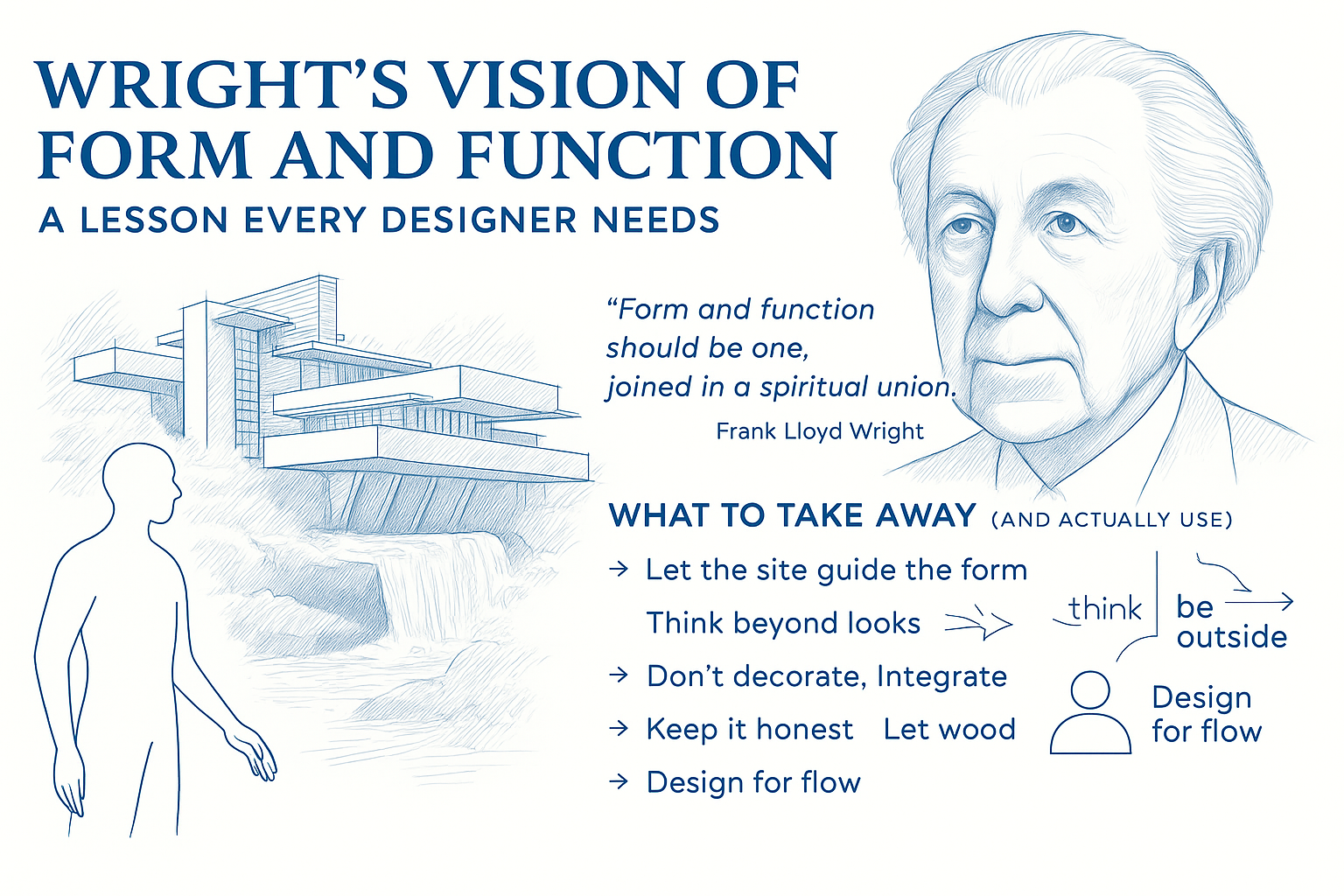
IMAGE: Example of Frank Lloyd Wright’s design where architectural form directly follows function, using horizontal lines, open plans, and natural materials.
Frank Lloyd Wright didn’t just design buildings. He designed experiences—structures that worked for the people inside them, while still being beautiful.
At the heart of his philosophy?
Form and function aren’t enemies—they’re soulmates.
Wright believed design shouldn’t be flashy just for show. Every angle, every overhang, every material had a reason behind it. His work was grounded, thoughtful, and deeply tied to human life and nature.
Take Fallingwater.
It’s not just a house on a hill—it’s a home built over a waterfall.
Those iconic cantilevered terraces? They aren’t just cool—they pull you outside, connect you to the trees, the water, the rhythm of the site.
“Form and function should be one, joined in a spiritual union.” — Frank Lloyd Wright
What to Take Away (and Actually Use)
▪ Let the site guide the form → Don’t fight the land. Design with it.
▪ Think beyond looks → Ask: how does this space feel? How will people live in it?
▪ Don’t decorate. Integrate. → Beauty comes from purpose, not add-ons.
▪ Keep it honest → Use materials authentically. Let wood be wood. Let concrete be concrete.
▪ Design for flow → If it feels clunky, it probably is. Step back and rework it.
Bottom Line:
Design is about serving people—quietly, naturally, beautifully.
Recommended Reading
- Fallingwater: A Frank Lloyd Wright Country House by Edgar Kaufmann Jr
Organic Architecture: Nature Meets Architecture
Organic Architecture: Where Buildings and Nature Work Together
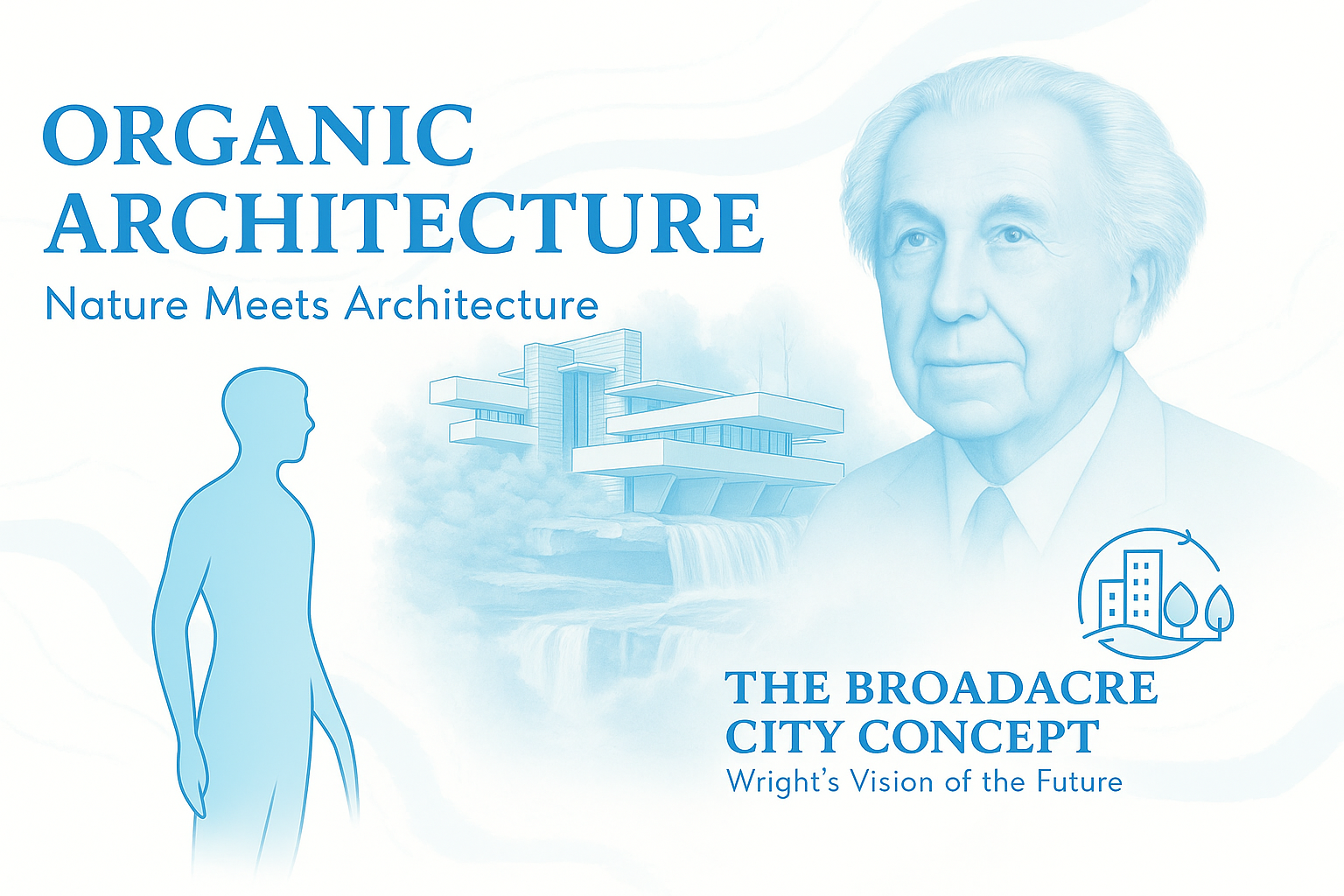
Frank Lloyd Wright made houses feel like they belonged to the land. His idea of organic architecture means buildings should grow out of their surroundings, not just sit on top of them.
Fallingwater is the best example. He built it right over a waterfall. Inside, you hear the water. You see trees through long windows.
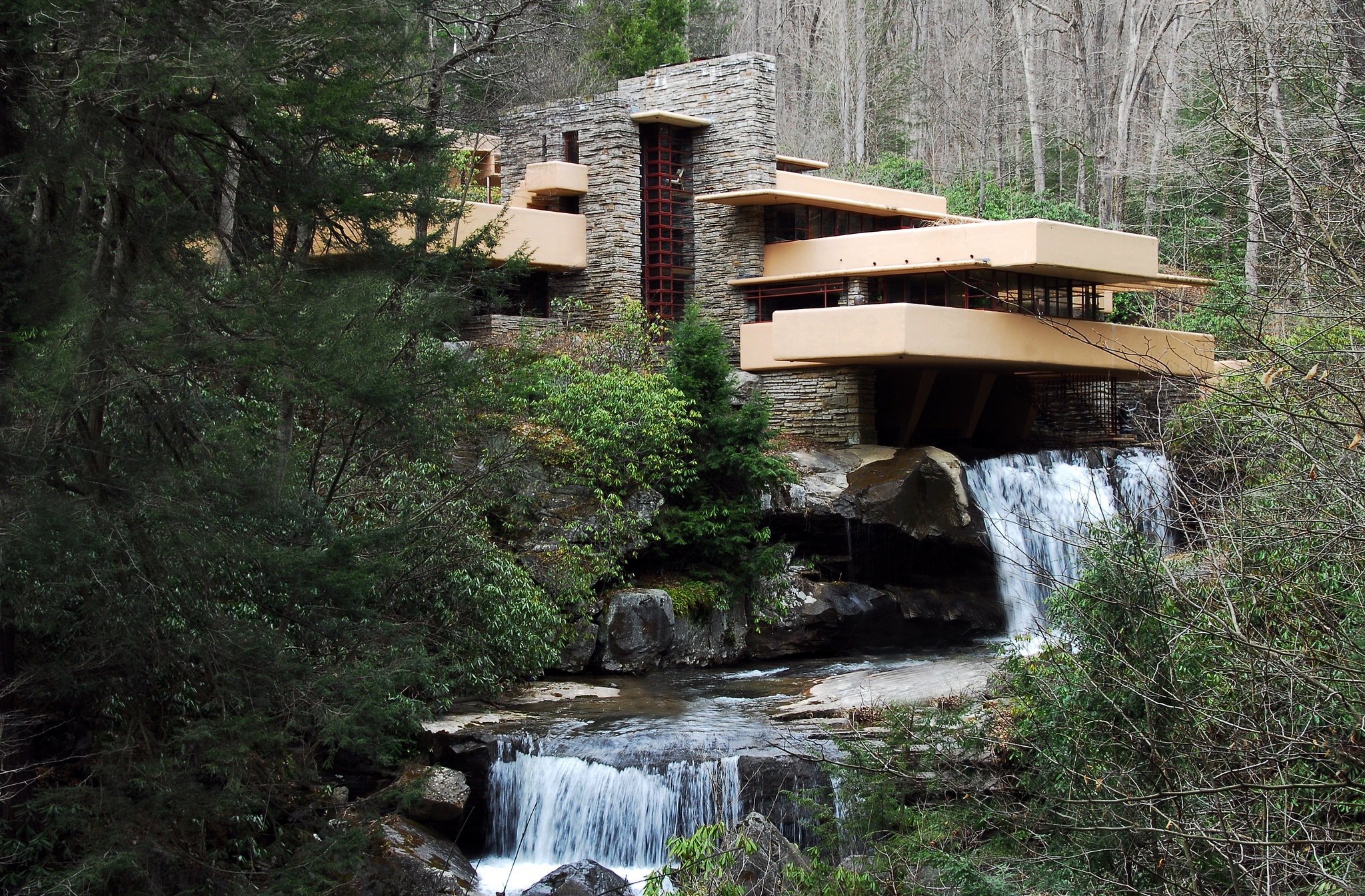
IMAGE: Fallingwater exemplifies organic design—built atop a waterfall with local stone, long windows framing forest views, and terraces extending like tree branches to merge architecture with nature.
The stone came from the site itself. The terraces stretch out like branches. It doesn’t fight nature—it becomes part of it.
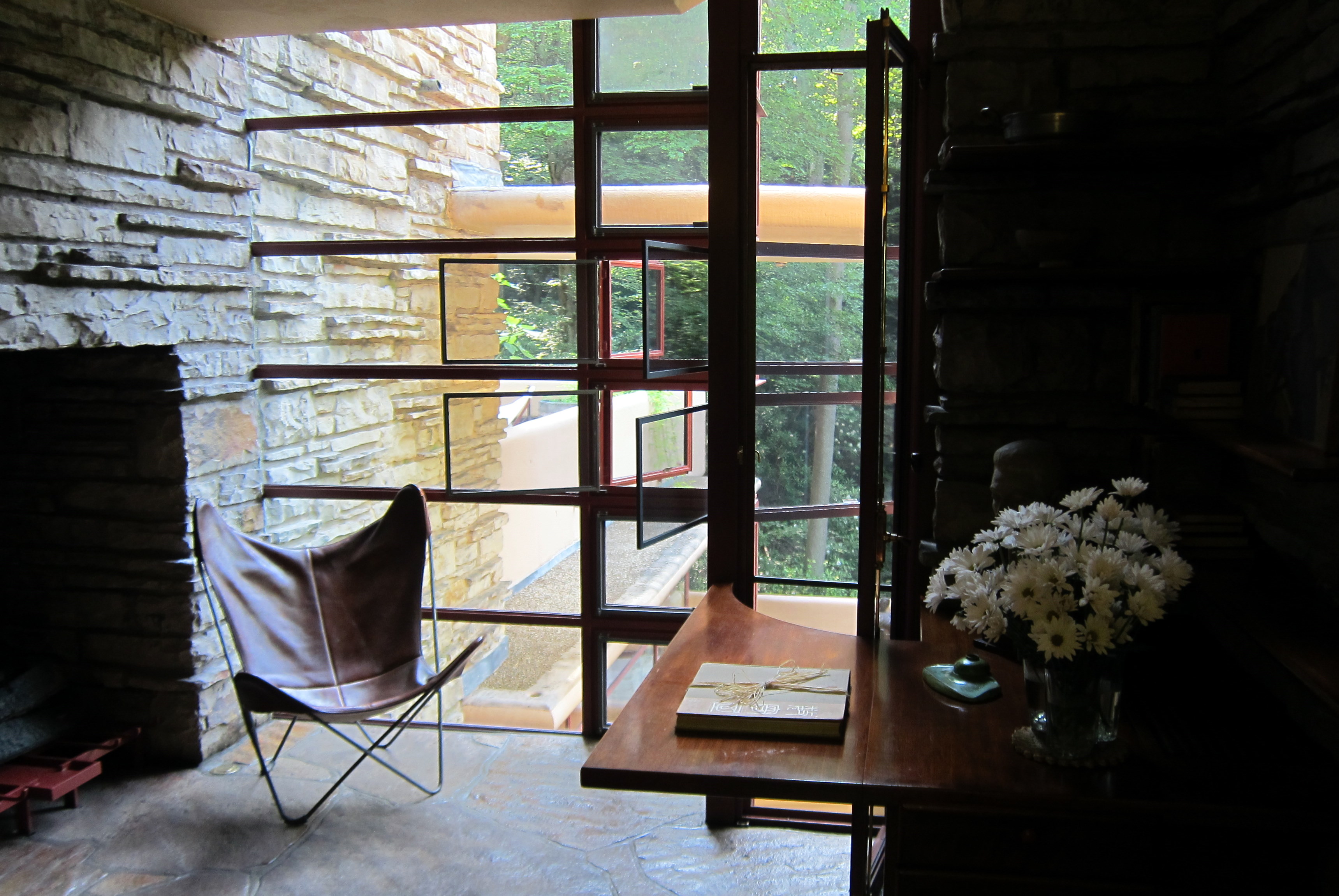
IMAGE: Interior view of Fallingwater’s dressing room featuring built-in desks, corner casement windows, and vertical light shaft that visually dissolves walls, blending stone, glass, and nature in Frank Lloyd Wright’s organic design.
➡ Key Lesson:
Start with the land. Don’t design your building first and then force it into place. Think: Where’s the sun? What’s the view? How does it feel here? Let the site shape your ideas.
Broadacre City: Wright’s Big Idea for a Better Way to Live
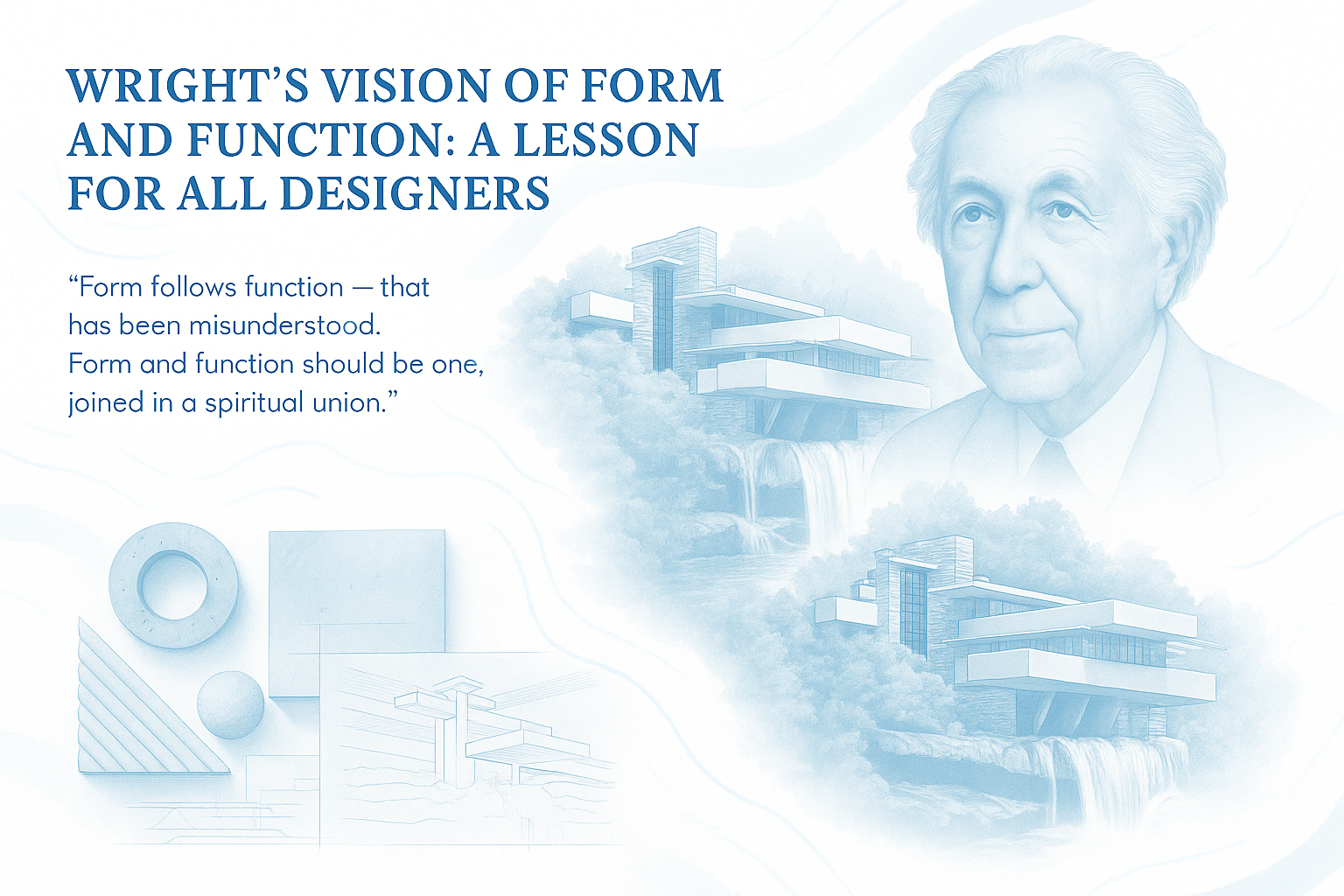
Frank Lloyd Wright believed people should have space—real space. In his vision of Broadacre City, every family had their own acre of land. Enough room to grow food, work from home, and stay connected to neighbors—without noise, traffic, or crowded towers.
He imagined communities built around people’s actual needs. Nature would be part of daily life. Homes would be surrounded by trees, not jammed between concrete walls.
➡ Why it still matters:
Wright’s idea planted the seed for today’s talk about green cities, local living, and more human-centered design. It’s not just about buildings—it’s about how we live.
Related: What Makes Building Shapes Feel Right?
Frank Lloyd Wright's Legacy in Sustainable Architecture: What We Can Still Learn Today
Why Wright Still Matters
Frank Lloyd Wright was thinking green before anyone called it that. He believed buildings should belong to their surroundings.
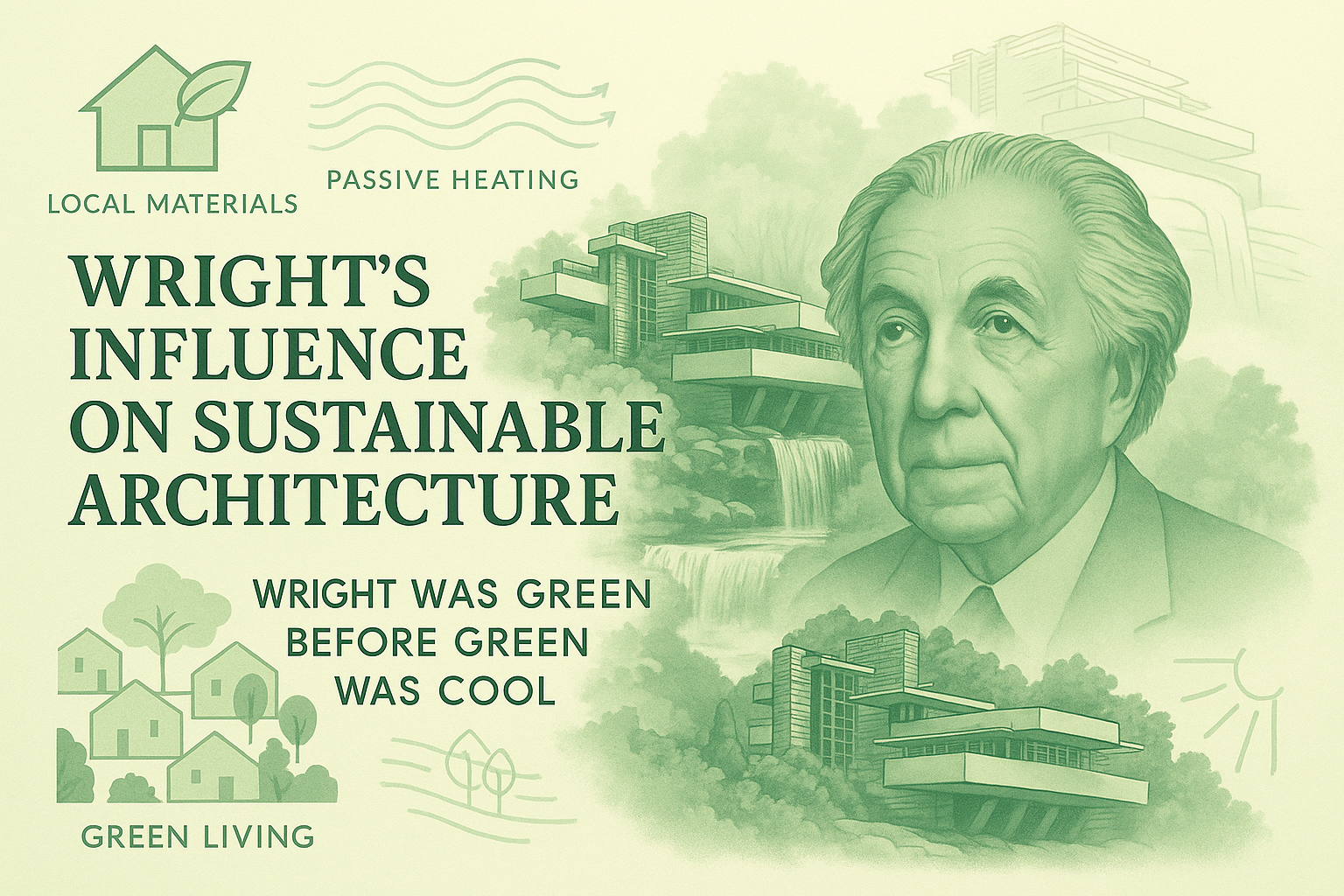
That meant using local materials, shaping forms to match the landscape, and designing spaces that worked with nature instead of fighting it.
What He Did Before It Was Cool
-
Local, Natural Materials
Wright sourced stone, wood, and other building materials straight from the sites he built on. It wasn’t about style—it was about respect for place."A building should appear to grow easily from its site," Wright often said.
- Passive Design Strategies
He used sunlight, shadows, cross-breezes, and orientation long before "passive solar" had a name. - Examples:
- Fallingwater (1935): Built directly over a stream, it uses native stone and cantilevered terraces that blend into the landscape.
- Hanna House (1937): Designed to follow the sun with open plans and clerestory windows that warm rooms in winter and vent heat in summer.
- Taliesin West (1937): His desert retreat in Arizona used local rock and smart airflow to manage heat.
Real Takeaway for Designers Today
Wright didn’t "add" sustainability as a feature. He started there.
- Want to make a sustainable home? Start by walking the site.
- Don't hide HVAC systems; design a building that barely needs one.
- Don’t just throw on solar panels—think about the angle of the sun year-round.
This is the part most people miss. Wright made buildings that breathe, shade, shelter, and open up. They feel good because they work with the world around them.
Broadacre City: His Big Urban Idea
Wright also imagined entire communities shaped by nature and independence. In Broadacre City, every family would have an acre of land, a house, a garden, and their own slice of sky. There were no tall buildings or traffic-packed downtowns. It was about freedom, light, and balance.
Sound familiar? Today we call that an agrihood. Wright imagined it nearly a century ago.
How It Holds Up Today
Wright’s core ideas are showing up again:
- Site-specific design is standard in LEED certification.
- Passive heating/cooling cuts energy use in modern homes.
- Biophilic design borrows from his belief in seamless indoor-outdoor flow.
He helped invent what we now call "climate-responsive" architecture.
What You Can Take from Him
- Always design for the real environment, not the idealized one.
- Let function lead form. But make the form beautiful.
- Embrace limits—topography, materials, budget—and work with them.
Wright’s work reminds us: Sustainability isn’t a checklist. It’s a mindset.
And that mindset? Still revolutionary.
Explore More
The Frank Lloyd Wright Foundation has deep archives, virtual tours, and student programs. If you're serious about understanding green design at the roots—go there.
https://franklloydwright.org
Also: Why Does Size Matter in Architecture?
What Today’s Architects Can Learn from Wright
So, what can you take away from all of this? Wright teaches us that the best designs are those that solve real problems. Here’s a quick checklist inspired by Wright’s genius:
- Don’t Overcomplicate: Simplicity can be more powerful than intricate designs. Sometimes, less really is more.
- Let the Site Speak: Whether you’re designing on a mountainside or in a dense urban setting, the site should guide your design. Don’t fight the environment—work with it.
- Form Follows Function (For Real): It’s easy to get caught up in trying to design something that looks groundbreaking. But Wright reminds us that the beauty comes when design serves a purpose.
Pro Tips for Architects
- Work with Nature, Not Against It: When you’re designing, think about how the landscape can inform your building’s shape and layout.
- Less is More: Simplicity doesn’t mean boring. Clean lines, open spaces, and natural materials can create something timeless.
- Be Practical: Always consider how people will actually use the space you’re designing. A beautiful space that’s impractical to live or work in isn’t a success—it’s a failure.
- Experiment: Don’t be afraid to push boundaries. Wright didn’t just stick to one style—he was constantly innovating. Challenge yourself to do the same.
See also: What Are the Properties of Form in Architecture?
Frank Lloyd Wright’s Approach to Spatial Psychology in Architecture
Frank Lloyd Wright’s Genius: Designing for the Mind, Not Just the Eye
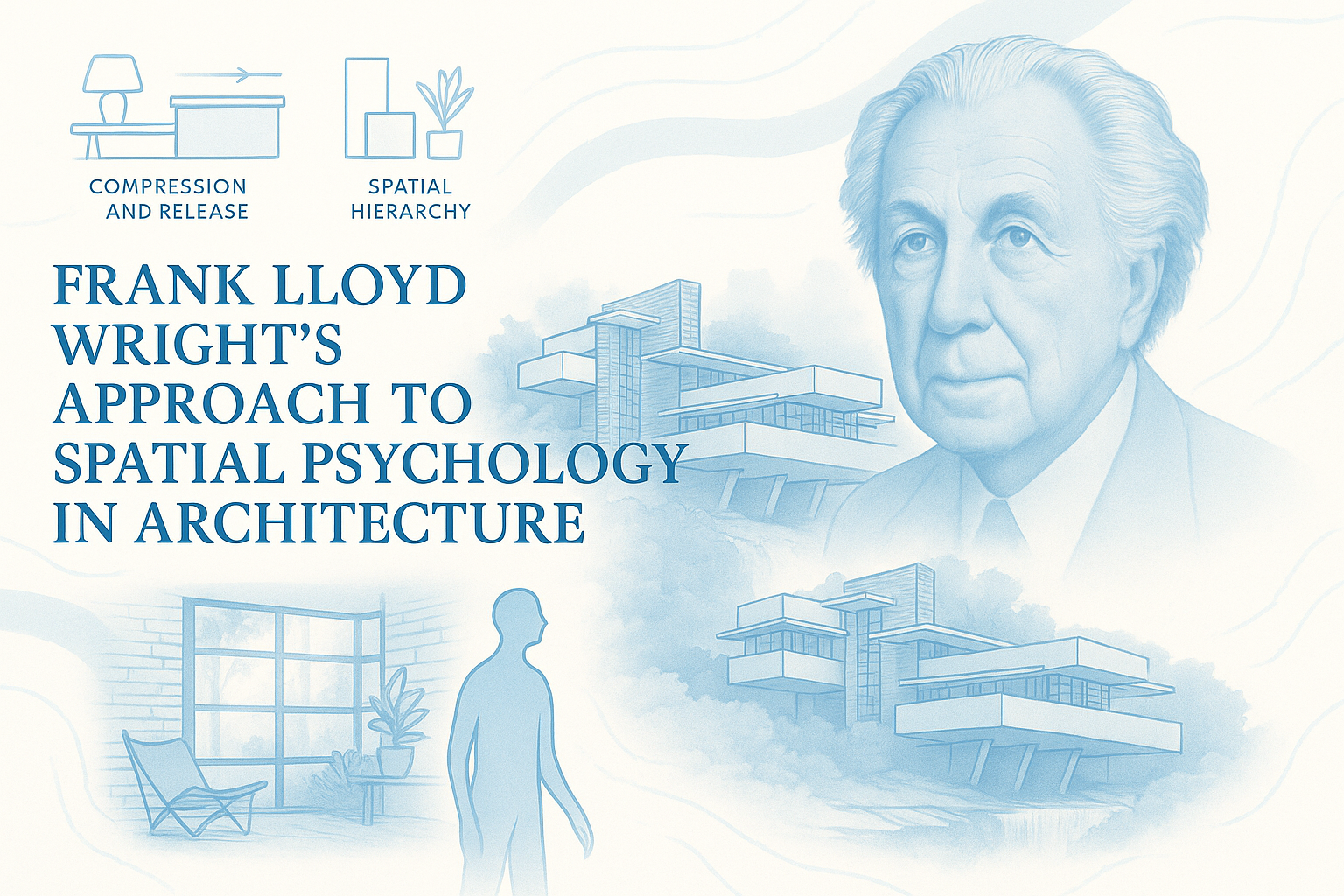
IMAGE: Explore Frank Lloyd Wright’s approach to spatial psychology—how compression and release, spatial hierarchy, and nature-inspired elements can shape emotional well-being in architecture today.
Frank Lloyd Wright cared deeply about how his designs made people feel. He believed that space could shape emotion, behavior, and how people connect with one another.
He wasn’t designing for blueprints. He was designing for the human experience.
Here’s how he did it—and how we still use his moves today.
1. Space That Speaks to People
Wright treated architecture like psychology. He knew how to make a space feel open, calm, grounded—or exciting, expansive, intimate.
He always asked:
"How does this space affect the people inside it?"
Modern takeaway:
● Design for mood, not just use.
● Think flow, not just layout.
● Homes and offices should feel as good as they look.
2. Compression + Release = Emotion
Wright’s classic move? Tight, low-ceiling entries that suddenly open into soaring, light-filled rooms. That tension and relief creates a subtle emotional effect—like a breath of fresh air.
Try it yourself:
→ Lead visitors from a small hallway into a wide living area.
→ In retail or museums, build anticipation, then reveal.
→ Don’t just move people—guide how they feel moving.
3. Flow Without Walls
Wright rejected the “boxy room” model of his era.
He used open plans, partial dividers, built-ins, and strategic furniture placement instead of walls.
Result? Rooms felt connected but purposeful—calm, yet functional.
Modern fix:
→ Create zones with rugs, light, or shelving.
→ Don’t break flow—shape it.
4. Natural Light = Mental Health
Wright’s homes flood with daylight—windows everywhere, even wrapping around corners. He aligned rooms to capture winter sun and shaded them in summer.
He didn’t just use light. He designed with it.
Tip:
→ Think sunpaths early in your plan.
→ Skylights, high transom windows, or window walls boost wellness instantly.
5. Nature Isn’t a Backdrop. It’s a Partner.
Wright didn’t “add” nature to his buildings. He built with it.
Stone from the land. Floorplans that hugged trees. Lines that followed terrain.
Takeaway:
→ Let the site lead. Don’t force your design onto it.
→ Think: “How do I make this structure belong here?”
6. The Psychology of Movement
Wright designed how people move through space. He choreographed views, framed nature, shaped paths.
This wasn’t decoration—it was emotional storytelling through architecture.
Real-world move:
→ Use narrow halls or darker tones to guide energy.
→ Then reward users with openness, light, and beauty.
Final Thought: Why Wright Still Wins
Wright proved that form and function weren’t enough. Feeling matters.
Today, we call it biophilia, user-centered design, or wellness architecture—but he did it first.
He taught us that buildings don’t just shelter us.
They shape us.
TL;DR: Use Wright’s Tools Today
✓ Layer tight + open spaces for emotion
✓ Let rooms flow but still serve a purpose
✓ Design with nature, not around it
✓ Think about how light moves and feels
✓ Guide users emotionally through layout
Design like that—and you’re not just building.
You’re changing lives.
Final Takeaways: What Wright Really Taught Us
● Form and function should work together—not compete. A space that works feels better too.
● Organic design isn’t just about style—it’s about respect. Your building should live with the landscape, not just next to it.
● Practical can still be beautiful. Wright didn’t sacrifice looks for use—he merged them.
● He was early to human-centered, sustainable thinking. Way before “green” became a buzzword, Wright was building homes that breathed with their environment.
Bottom line?
Design is how people live! Let your next project reflect that.
Make it functional. Make it feel right.
And let it belong to its place.
FAQ
Frank Lloyd Wright, Design, and Real-World Impact
Philosophy & Influence
Q: What was Frank Lloyd Wright’s biggest design belief?
A: That form and function are one—you can’t separate how a building looks from how it works.
Q: What did Wright mean by "organic architecture"?
A: Buildings should grow with the land, not just sit on it. He used natural materials and followed the landscape's flow.
Q: Why is Wright’s work still important today?
A: His ideas shaped modern design: open floor plans, sustainable materials, site-specific architecture—Wright was doing it a century ago.
Q: How is Wright connected to sustainable architecture?
A: He used local materials, natural ventilation, passive solar heating, and designed for the site—all core ideas in green building today.
Q: What is “compression and release” in architecture?
A: It’s a psychological design trick Wright used: tight spaces that open into large ones to create emotional impact.
Q: Did Wright invent user-centered design?
A: Not officially—but he practiced it. Every room had a purpose tied to how people moved, interacted, and felt.
Buildings & Styles
Q: What are Frank Lloyd Wright’s most iconic buildings?
A:
• Fallingwater – Built over a waterfall
• Guggenheim Museum – Spiral ramp in NYC
• Robie House – Prairie style perfection
• Unity Temple – Early use of concrete
• Taliesin (WI & AZ) – His personal homes and studios
Q: What is Prairie Style architecture?
A: Horizontal lines, open floor plans, overhanging roofs—meant to echo the flat Midwestern plains.
Q: What’s the difference between Prairie Style and Usonian?
A: Prairie was bigger and more ornate. Usonian homes were affordable, compact, and designed for the average American family.
Q: What’s Broadacre City?
A: Wright’s vision for a decentralized, nature-connected community—each family on an acre, self-sustaining but still connected.
Q: What kind of materials did Wright use?
A: Stone, wood, brick, concrete—usually sourced locally. His goal was always harmony with nature.
Practical Application & Inspiration
Q: How can I use Wright’s ideas in modern design?
A:
✓ Start with the site—don’t fight it
✓ Think about light, flow, and feeling
✓ Use natural materials when possible
✓ Design for humans, not just aesthetics
Q: What is spatial psychology in design?
A: The idea that space changes how we feel and behave. Wright used design to shape experience—mood, movement, connection.
Q: Can I use Wright’s principles in small spaces?
A: Absolutely. Wright’s Usonian homes were compact but intentional—every corner had meaning and use.
Q: What’s an example of passive solar design Wright used?
A: South-facing windows to let winter sun in; deep overhangs to block summer heat. It’s smart design without gadgets.
Q: What can interior designers learn from him?
A: Flow, warmth, simplicity. He believed the interior should feel natural—with open layouts, built-ins, and layered lighting.
Q: Did Wright believe in symmetry?
A: Not strictly. He used balance, but not always perfect symmetry. He let the function and site shape the form.
For Students & Young Designers
Q: Why should students still study Wright?
A: He covers everything: beauty, function, sustainability, psychology, and user experience. It’s a masterclass in one portfolio.
Q: Is Wright useful if I design digitally or in urban settings?
A: Yes. His ideas on flow, material honesty, and human needs apply everywhere—digital or physical, city or countryside.
Q: What’s one idea from Wright I can use right now?
A: Design from the inside out. Think first about how the space will be used, then let the exterior form follow.
Q: Did Wright ever design furniture or interiors?
A: Yes—he designed everything, down to the rugs, lighting, and door handles. It was total design control.
Q: Where can I learn more about Wright?
A: Visit the Frank Lloyd Wright Foundation for detailed archives, blueprints, and virtual tours.
Recommended Reading
- Frank Lloyd Wright: Natural Design, Organic Architecture: Lessons for Building Green from an American Original – Illustrated, by Alan Weintraub
- Fallingwater: A Frank Lloyd Wright Country House by Edgar Kaufmann Jr
Related
Design – Form and Function in Architecture
-
What Is Organic Architecture According to Frank Lloyd Wright?
Frank Lloyd Wright Didn’t Just Work With Nature—He Made Buildings That Were Nature -
Form Follows Function in Architecture and Design
Understanding the classic design principle that function shapes form. -
Architectural Form Examples: How Shape Defines Function
Case studies showing the link between architectural shape and function. -
Clustered Form Architecture: Function, Space, and Design
Examining designs where clustered forms create functional spatial arrangements. -
Scale and Proportion in Architectural Design: Balancing Form and Function
How scale and proportion influence harmony between design and utility. -
Form Meets Function: Principles for Great Architectural Design
Guidelines for integrating practical use with visual appeal in architecture. -
How Form, Function, and Meaning Shape Islamic Architecture
Insights into the cultural and symbolic aspects influencing Islamic architectural forms. -
Mashrabiya Designs: History, Beauty, and Functionality
Exploring the architectural and functional significance of Mashrabiya screens. -
Creating Beautiful and Functional Spaces: Expert Tips for All Levels
Practical advice on designing spaces that are both attractive and useful. -
Interior Design Functional Elegance: Practical Tips for Stunning Interiors
Tips for achieving both elegance and functionality in interior spaces. -
Gothic Elements in Architecture: A Study of Form and Function
Exploring Gothic design features and their dual aesthetic and practical roles. -
Design Basics in Architecture & Building: The Fundamentals!
Introduction to core design principles for architecture and construction. -
Color Psychology Basics: What Every Designer Should Know
How colors influence perception and mood in design. -
Introduction to Interior Design: Understanding the Basics
Foundational concepts for beginners in interior design. -
Basic Design and Architecture: A Must-Read Guide for Students
Essential design and architecture knowledge for students. -
Basic Techniques and Principles of Architectural Drawing
Core drawing skills and principles for architectural representation. -
Architecture Basic Design: Key Concepts Every Student Must Know
Fundamental design ideas critical for architecture students.
Learn – Education and Fundamentals
-
Free Architecture Courses with Certificate: Top Online Platforms to Learn and Earn
Guide to free online architecture courses offering certification. -
The Principles of Design: Transforming Ideas into Visual Excellence
Core design principles for creating effective visual work. -
Understanding the Basics of Architecture: A Beginner’s Guide
Introductory guide to architecture fundamentals. -
Woodworking Basics: A Friendly Beginner’s Guide
Introduction to woodworking skills for beginners. -
Basic Elements for Sustainable Architecture
Key components involved in sustainable building design. -
Graphic Design Basics
Fundamentals of graphic design for beginners. -
Basics Architecture: Beams and Frames
Introduction to beams and frames in structural design. -
Design Elements In Architecture: Basics Explained Simply
Simplified explanation of important design elements in architecture.
Resources
- Frank Lloyd Wright Foundation: Explore Wright’s philosophy on organic architecture
- U.S. Green Building Council: Learn about modern sustainable practices