

Properties of Form Every Architecture Student Must Know
How Good Architects Use Form to Solve Real Design Problems
Learn the core properties of form in architecture with clear examples and practical insights. This guide cuts the fluff and gets to what actually matters.
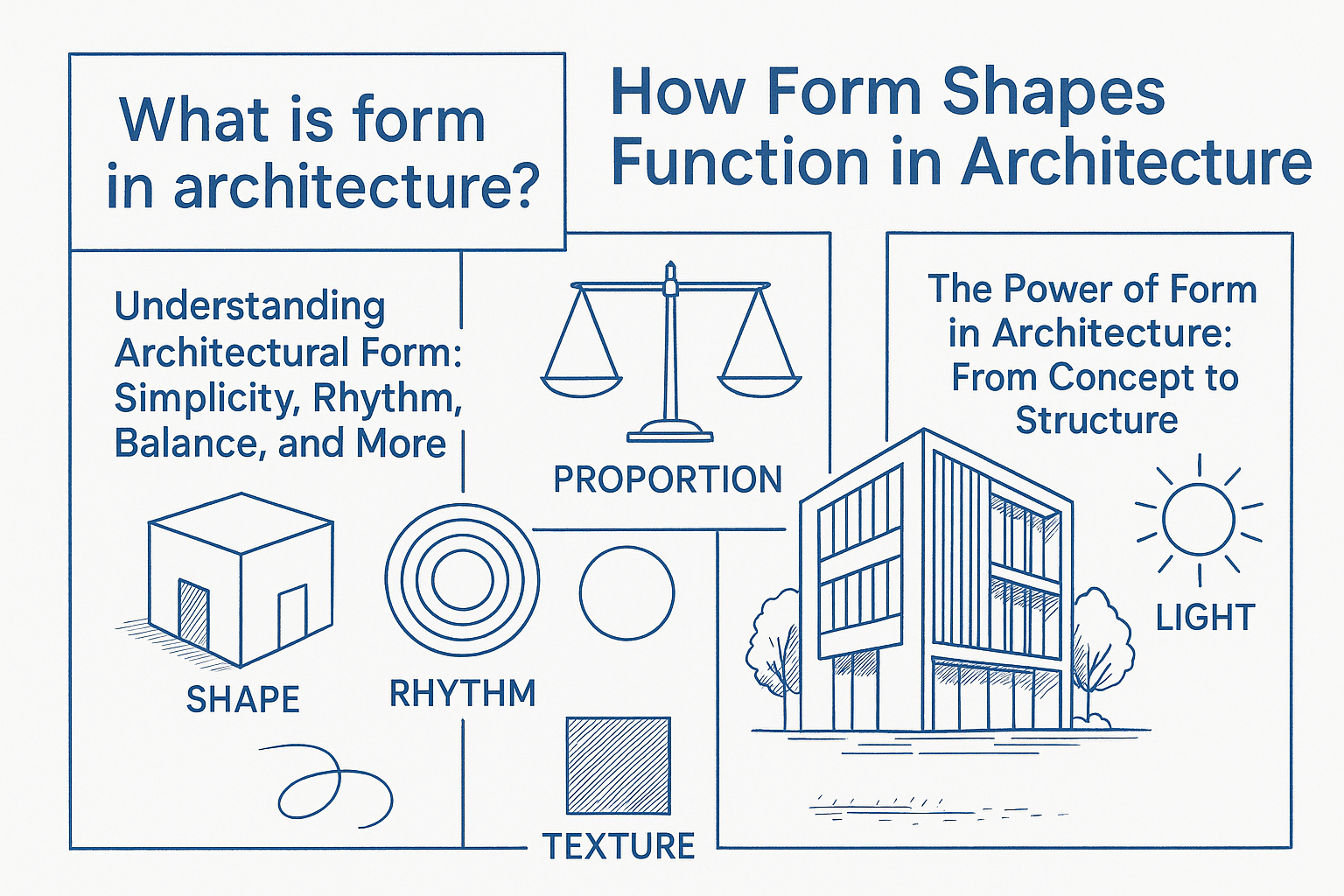
Properties of Form in Architecture
What Does "Form" Really Mean in Architecture?
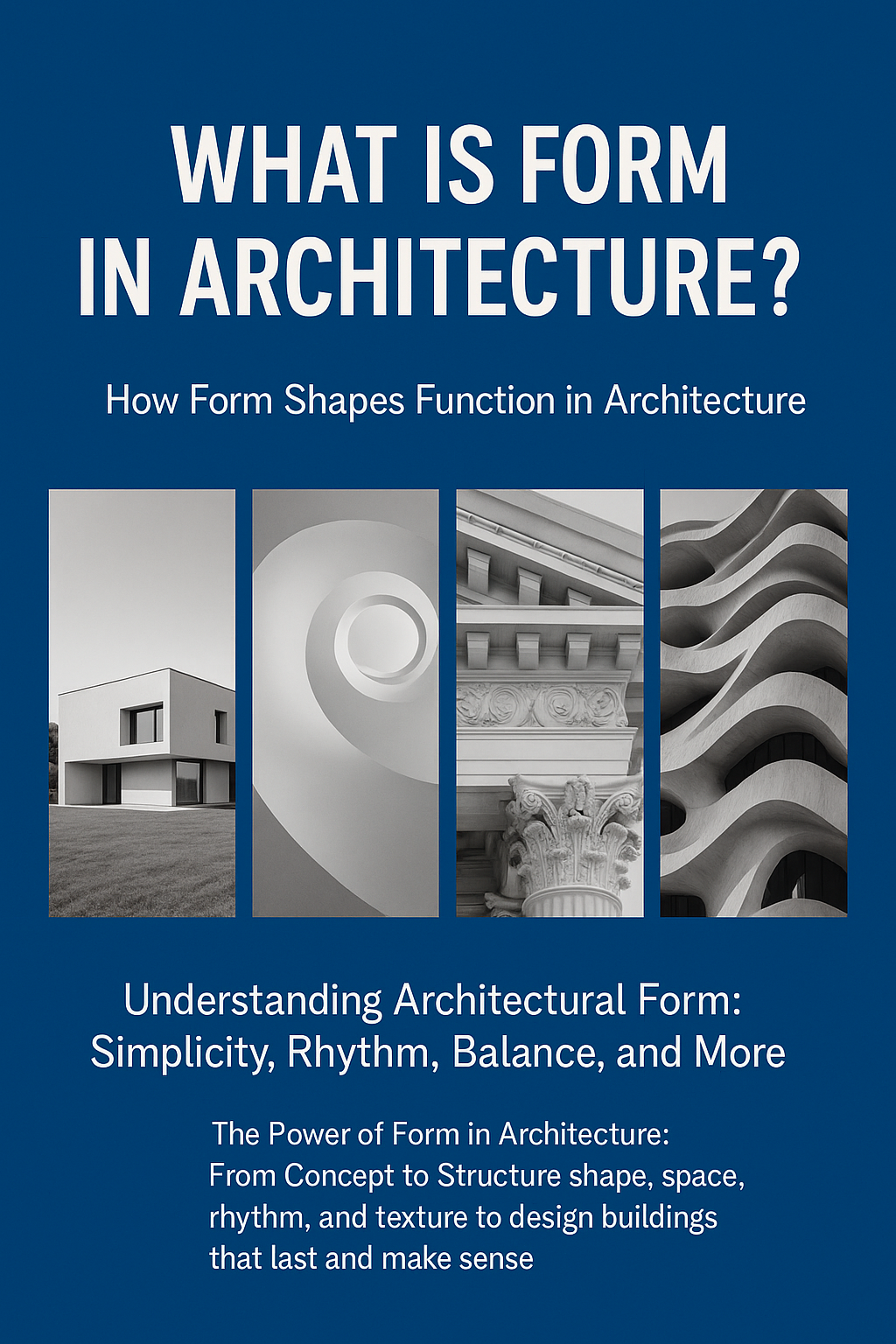
IMAGE: Core properties of architectural form, showing how shape and mass influence function, emotion, and problem-solving in design.
Form is the basic shape, mass, or configuration of a building. But it’s not just about looks. Form is how architecture speaks—how it tells you what a space is, how to use it, and how it fits into the world around it.
Form can:
- Suggest purpose (church vs warehouse)
- Affect emotion (comfort vs awe)
- Solve problems (light, views, circulation)
Without good form, even the most expensive building falls flat.
Architectural Form Explained: Key Design Elements That Make a Building Work
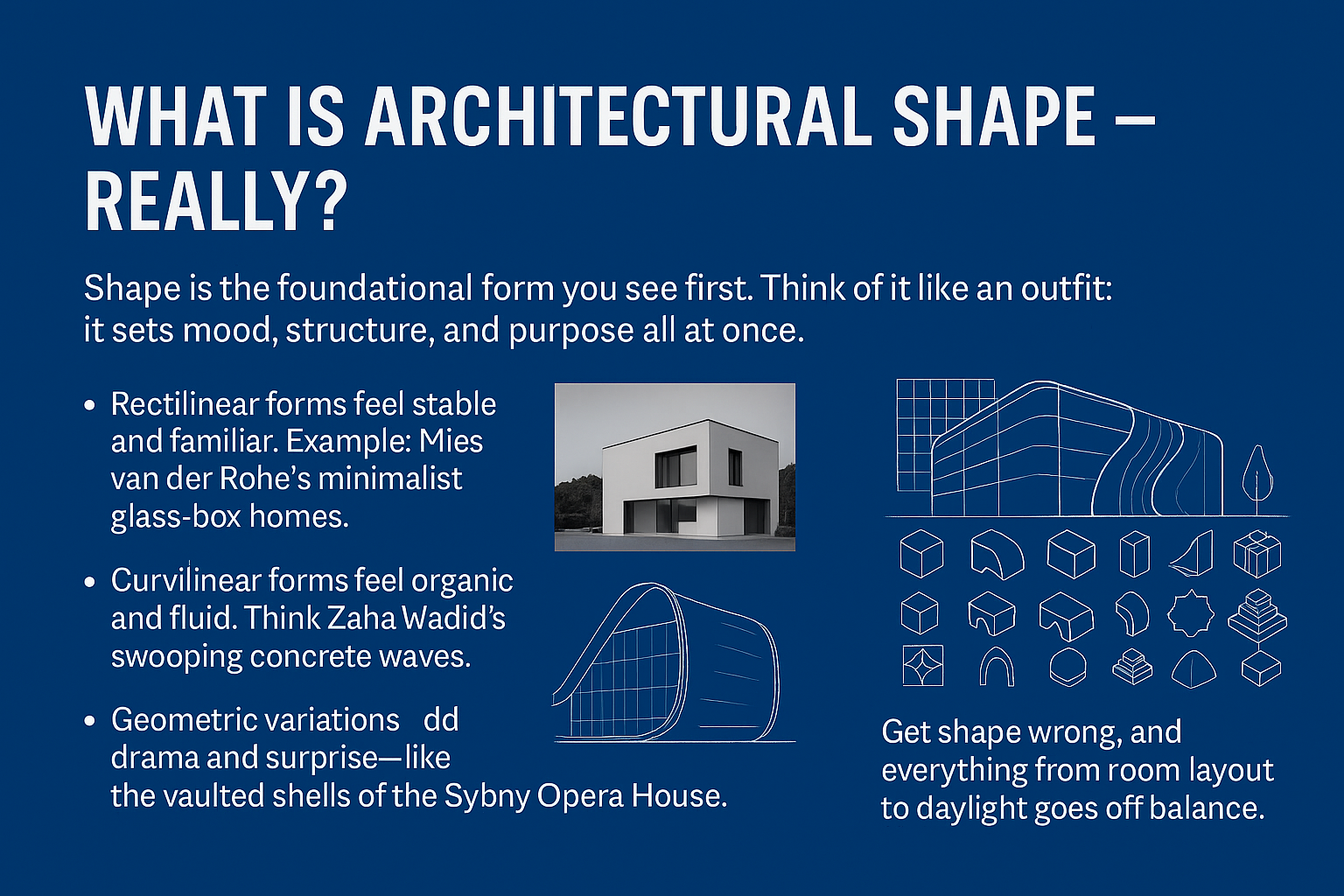
1. Shape: The Most Basic Building Block
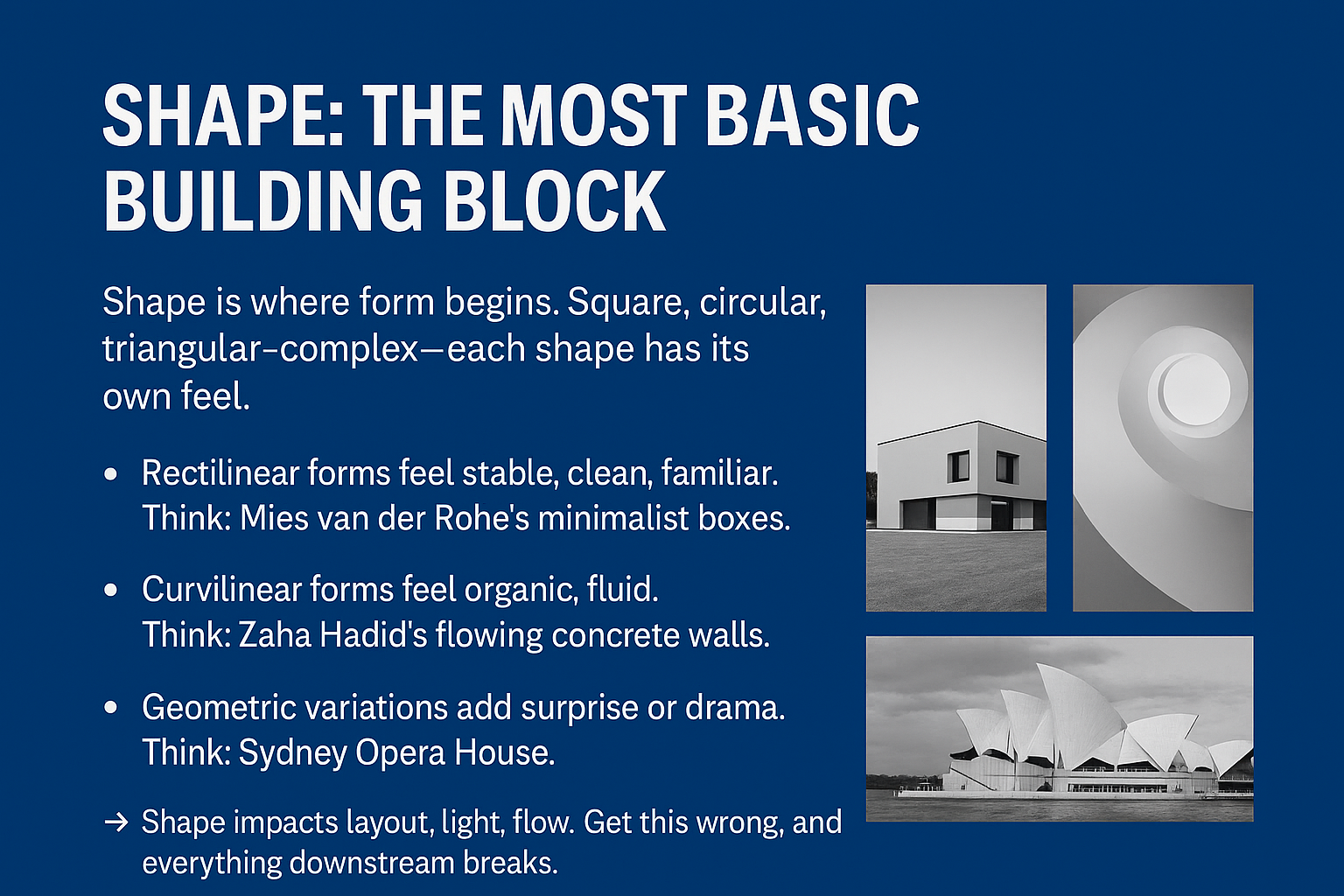
Shape is where form begins. Square, circular, triangular, complex—each shape has its own feel.
● Rectilinear forms feel stable, clean, familiar. Think: Mies van der Rohe’s minimalist boxes.
● Curvilinear forms feel organic, fluid. Think: Zaha Hadid’s flowing concrete walls.
● Geometric variations add surprise or drama. Think: Sydney Opera House.
→ Shape impacts layout, light, flow. Get this wrong, and everything downstream breaks.
2. Size: The Scale of Space and Presence
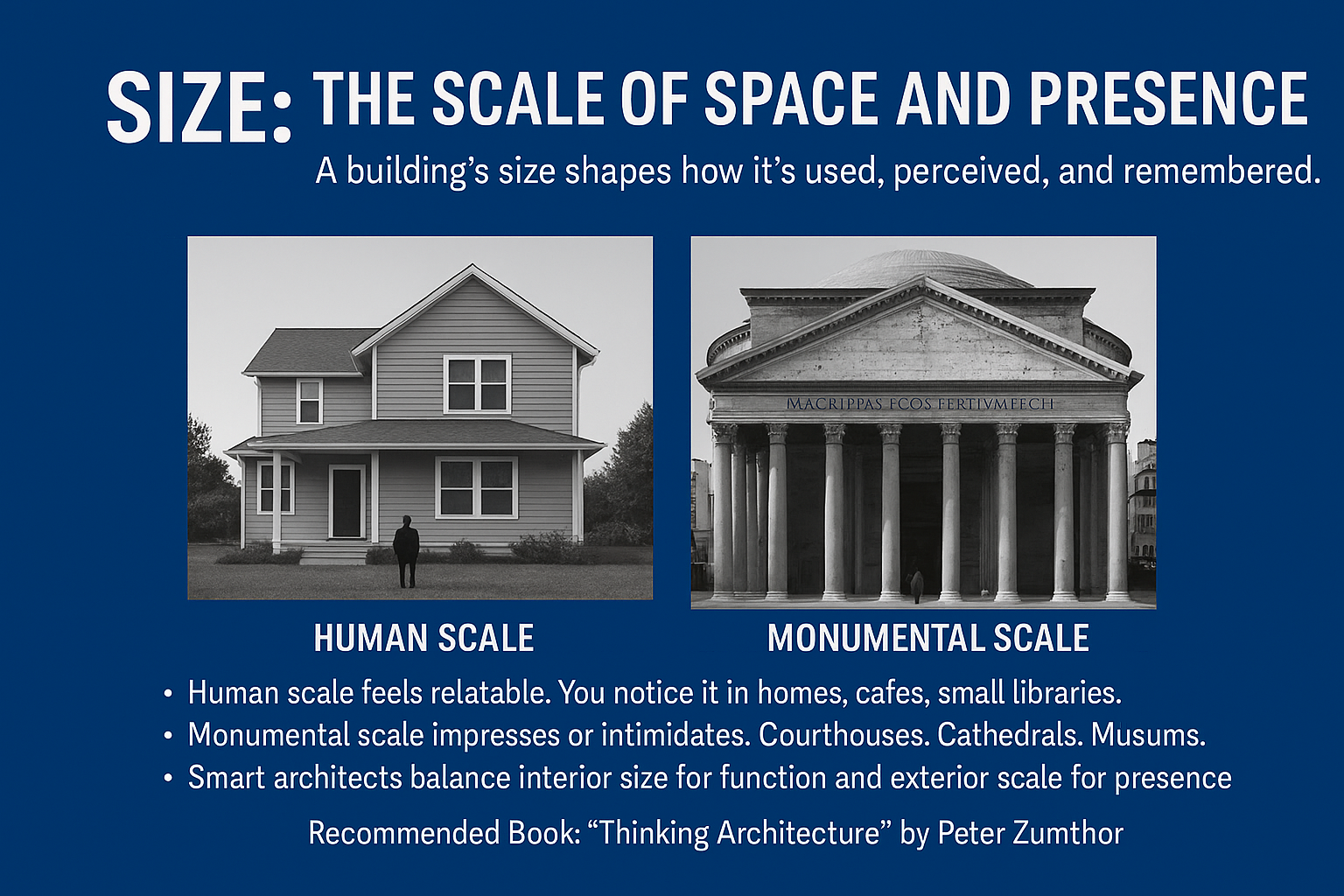
IMAGE: Comparison of architectural scale, contrasting human-scale buildings like homes with monumental structures like cathedrals for spatial impact.
A building’s size shapes how it’s used, perceived, and remembered.
- Human scale feels relatable. You notice it in homes, cafes, small libraries.
- Monumental scale impresses or intimidates. Courthouses. Cathedrals. Museums.
Smart architects balance interior size for function and exterior scale for presence.
Quick example: The Pantheon in Rome feels vast inside, yet fits in a tight urban site. It nails both.
Recommended Book Title: "Thinking Architecture" by Peter Zumthor"
3. Color: Not Just Decoration
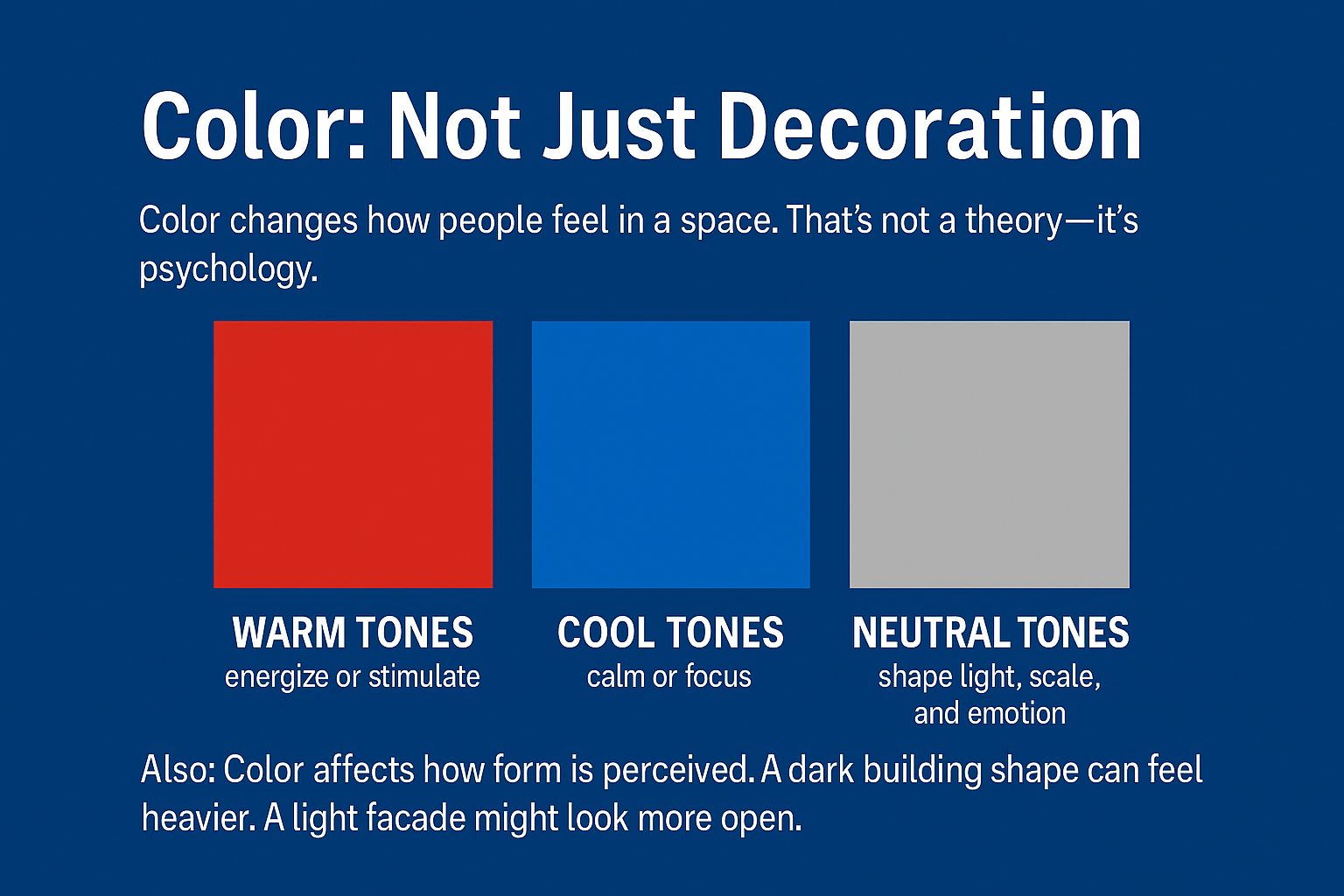
Color changes how people feel in a space. That’s not a theory—it’s psychology.
- Warm tones (red, yellow) energize or stimulate.
- Cool tones (blue, green) calm or focus.
- Neutral tones (white, gray, beige) help shape light, scale, and emotion.
Also: Color affects how form is perceived. A dark building shape can feel heavier. A light facade might look more open.
4. Texture: How a Building Feels Up Close
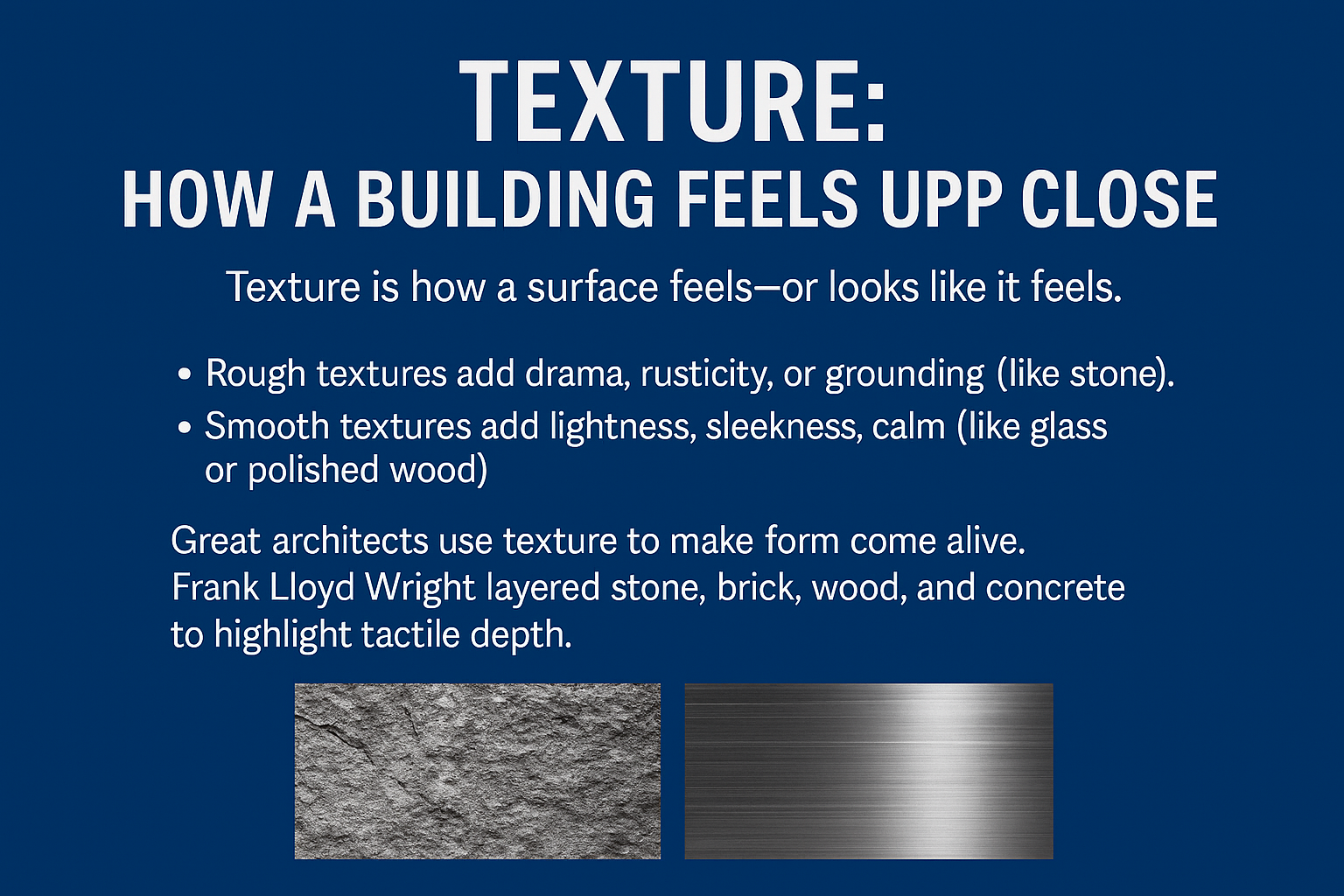
IMAGE: Architectural graphic showing how rough and smooth textures shape mood, depth, and tactile experience in building design.
Texture is how a surface feels—or looks like it feels.
● Rough textures add drama, rusticity, or grounding (like stone).
● Smooth textures add lightness, sleekness, calm (like glass or polished wood).
Great architects use texture to make form come alive. Frank Lloyd Wright layered stone, brick, wood, and concrete to highlight tactile depth.
5. Line: Direction and Intent
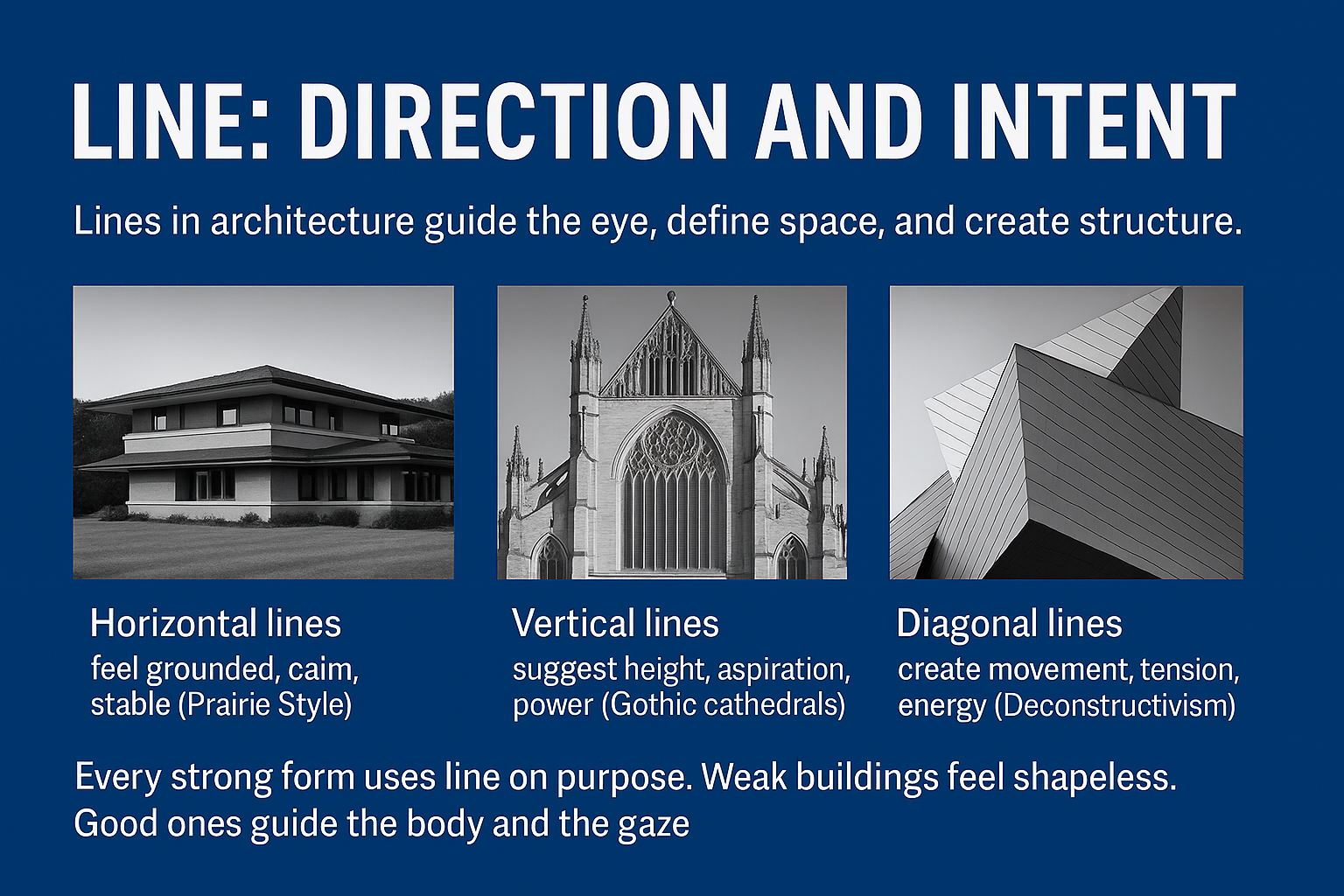
IMAGE: Architectural lines—horizontal for calm, vertical for height, and diagonal for movement—used to shape form and emotion.
Lines in architecture guide the eye, define space, and create structure.
▪ Horizontal lines feel grounded, calm, stable (Prairie Style). ▪ Vertical lines suggest height, aspiration, power (Gothic cathedrals). ▪ Diagonal lines create movement, tension, energy (Deconstructivism).
Every strong form uses line on purpose. Weak buildings feel shapeless. Good ones guide the body and the gaze.
Recommended Book Title: "Form, Space, and Order" by Francis D.K. Ching
6. Volume and Massing: Form in 3D
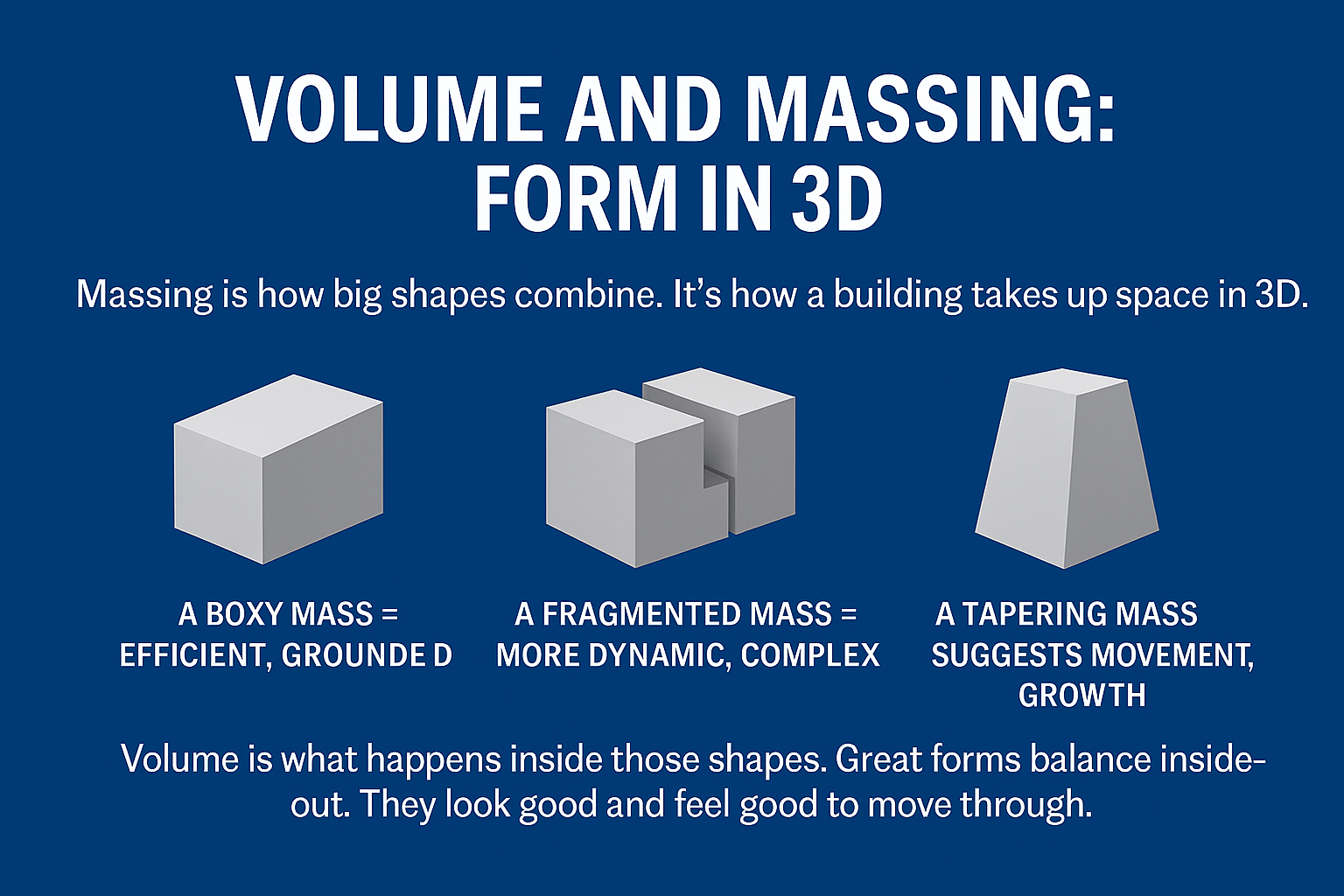
IMAGE: Showing how volume and massing shape a building’s form, from grounded boxes to dynamic fragmented structures and tapered silhouettes.
Massing is how big shapes combine. It's how a building takes up space in 3D.
● A boxy mass = efficient, grounded ● A fragmented mass = more dynamic, complex ● A tapering mass = suggests movement, growth
Volume is what happens inside those shapes. Great forms balance inside-out. They look good and feel good to move through.
7. Proportion: Harmony You Can Feel
Ever walked into a room and thought, “This just feels right”? That’s proportion.
● Golden Ratio: Often used to define beautiful relationships ● Modular Design: Le Corbusier’s proportional systems based on the human body
Bad proportion = awkward, clunky, or overwhelming. Good proportion = balance you notice without knowing why.
8. Scale: Relative Size That Makes or Breaks Design
Scale is how big something feels in relation to something else. A 10-foot wall feels tall in a bedroom, short in a stadium.
Architects use scale to:
- Make people feel small (monuments)
- Make spaces feel intimate (nooks)
- Bring rhythm to facades
Big mistake? Ignoring human scale.
9. Symmetry vs Asymmetry: Order vs Surprise
Symmetry creates calm, formal, balanced designs.
Asymmetry adds energy, modernism, and dynamic flow.
● Classical temples = strict symmetry ● Modern homes = careful asymmetry (but not random)
Don’t just pick one. Use both on purpose.
10. Rhythm and Repetition: Beat of the Built World
Repeating elements (windows, columns, modules) create rhythm.
Rhythm gives:
- Visual structure
- Expectations
- Pleasure
Break rhythm, and you create surprise. Good forms know when to stay steady and when to shock.
11. Hierarchy: What Comes First
Hierarchy tells you what matters.
- Big entrance
- Main tower
- Centered dome
Hierarchy helps orientation, use, and symbolism. You always know where to go.
Think: Churches, town halls, museums—all use architectural hierarchy to lead.
12. Light: The Final Shaper of Form
Light can flatten or reveal form. It’s the final, moving piece of every design.
- Skylights stretch forms upward
- Shadow lines give facades depth
- Directional light highlights texture
Great forms use light. They don’t just survive it.
Real Story: What It Took to Build Real Form
In the late '90s, a team restoring a mid-century civic building in Toronto discovered that the clean modernist form only worked because every concrete panel had been hand-leveled and measured by site crew.
Each line of shadow? Deliberate. Every seam? Lined with string before pour.
The form wasn’t "clean." It was hard-won.
IN FOCUS
Shape vs Massing vs Volume
Shape: The 2D outline of a surface. Think: square, circle, triangle.
Massing: The overall bulk and composition of forms in 3D. Think: how blocks of space stack, connect, or offset.
Volume: The spatial experience inside the mass. Think: the voids, openness, and flow you feel when you walk through.
Each of these elements plays a unique role, but together, they define how a building is read, felt, and used.
Pro Tip: Start with a strong massing model before refining shape and volume. Mass defines presence. Volume defines experience.
Final Thought
Form isn’t fluff. It’s not just “how it looks.” It’s the core of what makes a building readable, livable, and memorable.
Form is:
- Purposeful
- Structured
- Emotional
And above all: it’s designed.
Want to design better? Master form first.
Recommended Book Title: "Form, Space, and Order" by Francis D.K. Ching
Why: The best starter on spatial and form logic for architecture students
FAQ
Properties of Form in Architecture
1. What does "form" mean in architecture? Form in architecture refers to the shape, volume, massing, and visual structure of a building. It determines how a building looks, feels, and functions in its space.
2. Why is form important in architecture? Form affects how people interact with a space, how light moves, and how a building fits its purpose and context. It can suggest emotion, guide movement, and solve real-world design challenges.
3. How does architectural form impact function? Form and function go hand in hand. For example, a curved form can enhance acoustics in an auditorium, while rectilinear forms may improve efficiency in a warehouse.
4. What is the difference between shape and form in architecture? Shape is a 2D outline (like a square or circle), while form is the 3D structure that results from shaping volume and space.
5. What is "massing" in form? Massing refers to the composition of the building's volumes. It’s about how the big shapes combine to give the structure visual and physical presence.
6. How does color affect form in architecture? Color influences how form is perceived. Dark colors can make a building feel heavier and more grounded, while light colors can make it feel lighter and more open.
7. What is human scale in form? Human scale means designing spaces that feel comfortable and intuitive to the human body. It's about proportion, size, and how spaces relate to people.
8. What role does proportion play in good form? Proportion creates harmony and visual balance. Techniques like the Golden Ratio or Le Corbusier’s Modulor system help architects achieve designs that feel "right."
9. How do architects use rhythm in form? By repeating elements (windows, beams, columns), rhythm brings structure and predictability. It helps people understand and enjoy the building visually.
10. What is architectural hierarchy? Hierarchy guides the user’s attention to the most important parts of a building—like a main entrance, dome, or tower—creating clarity and meaning.
11. How does light shape architectural form? Light enhances depth, texture, and mood. Good form considers natural and artificial lighting to amplify the building’s structure and experience.
12. How does symmetry or asymmetry affect form? Symmetry creates order and calm. Asymmetry adds energy and surprise. Great design uses both strategically based on purpose.
13. Can form be both expressive and functional? Yes. The best forms do both—they make a statement and solve a need. Think: Fallingwater by Frank Lloyd Wright.
14. What books help deepen understanding of form?
- Form, Space, and Order by Francis D.K. Ching
- Thinking Architecture by Peter Zumthor
- The Timeless Way of Building by Christopher Alexander