
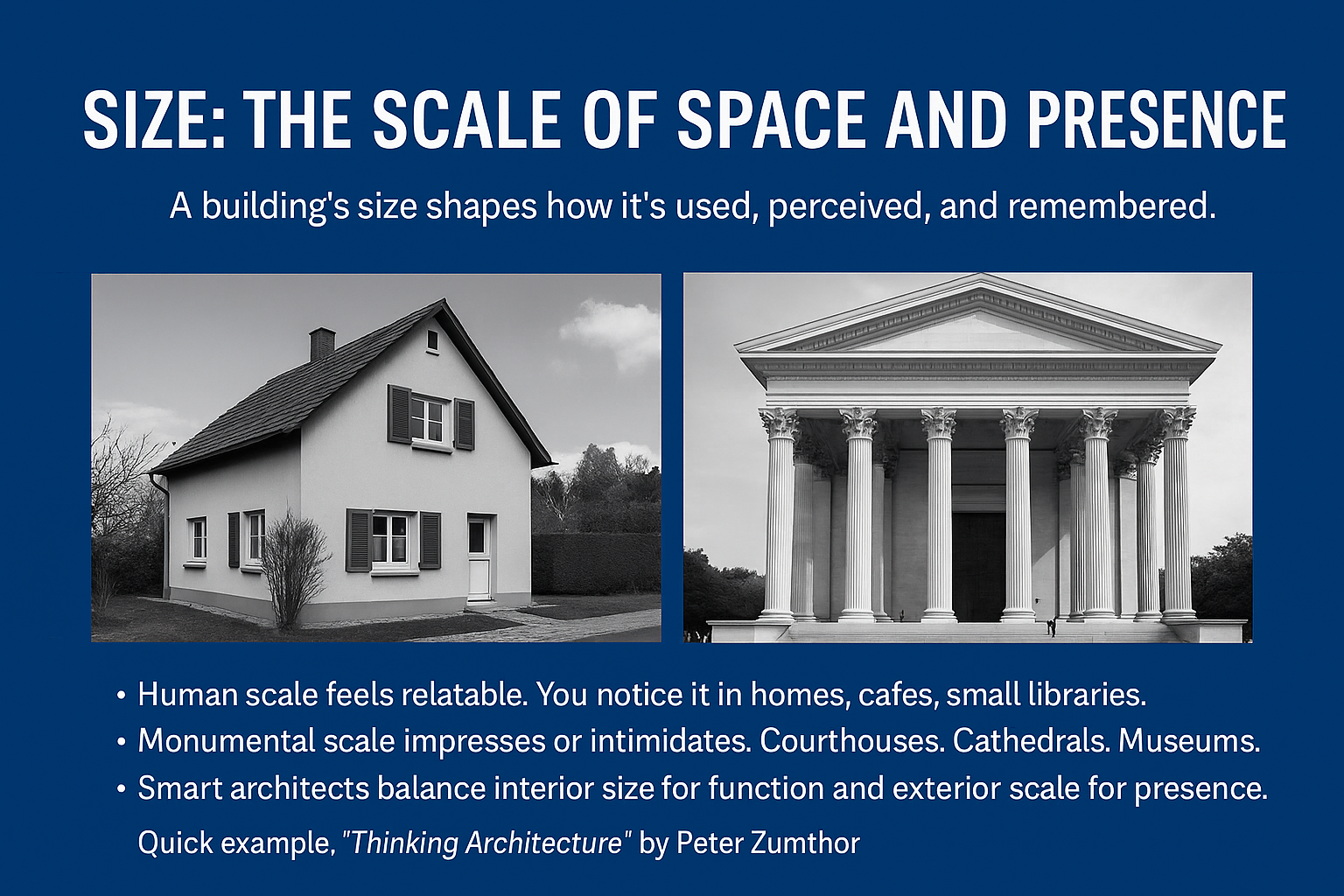
IMAGE: Comparing human-scale and monumental-scale buildings, highlighting their impact on perception, function, and presence with clear icons and examples.
How Does Building Size Shape Human Experience?
What Makes Monumental Scale Feel Overwhelming?
Size isn’t measurements—it’s how a space feels.
Here’s how architects balance human scale (homey) with monumental presence (jaw-dropping), so buildings work and leave a mark.
What You’ll Learn
-
Why size influences function and emotion
-
When small feels inviting—and when it limits use
-
How large scale can empower—or overwhelm
-
Ways to get size right in design
Why Size Really Matters
Every dimension sends a message. Too small—and it feels cramped. Too large—and it feels cold or intimidating. Getting size right means thinking about action, emotion, and memory.
Learn why size isn’t just dimensions—it’s perception, use, and presence.
What Is Human Scale?
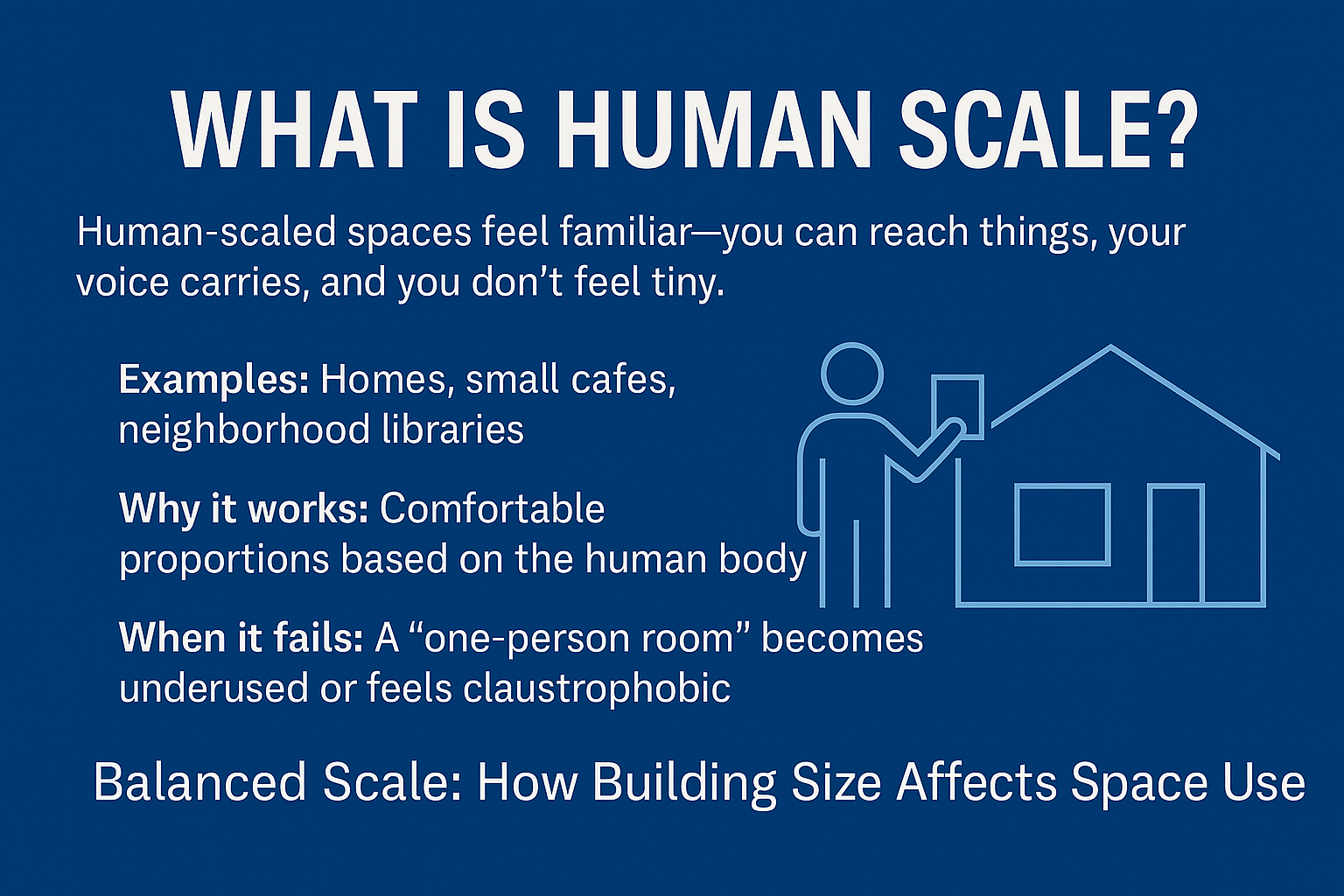
IMAGE: Human scale in architecture with relatable examples like homes, highlighting comfort and spatial balance.
Human‑scaled spaces feel familiar—you can reach things, your voice carries, and you don’t feel tiny.
-
Examples: Homes, small cafes, neighborhood libraries
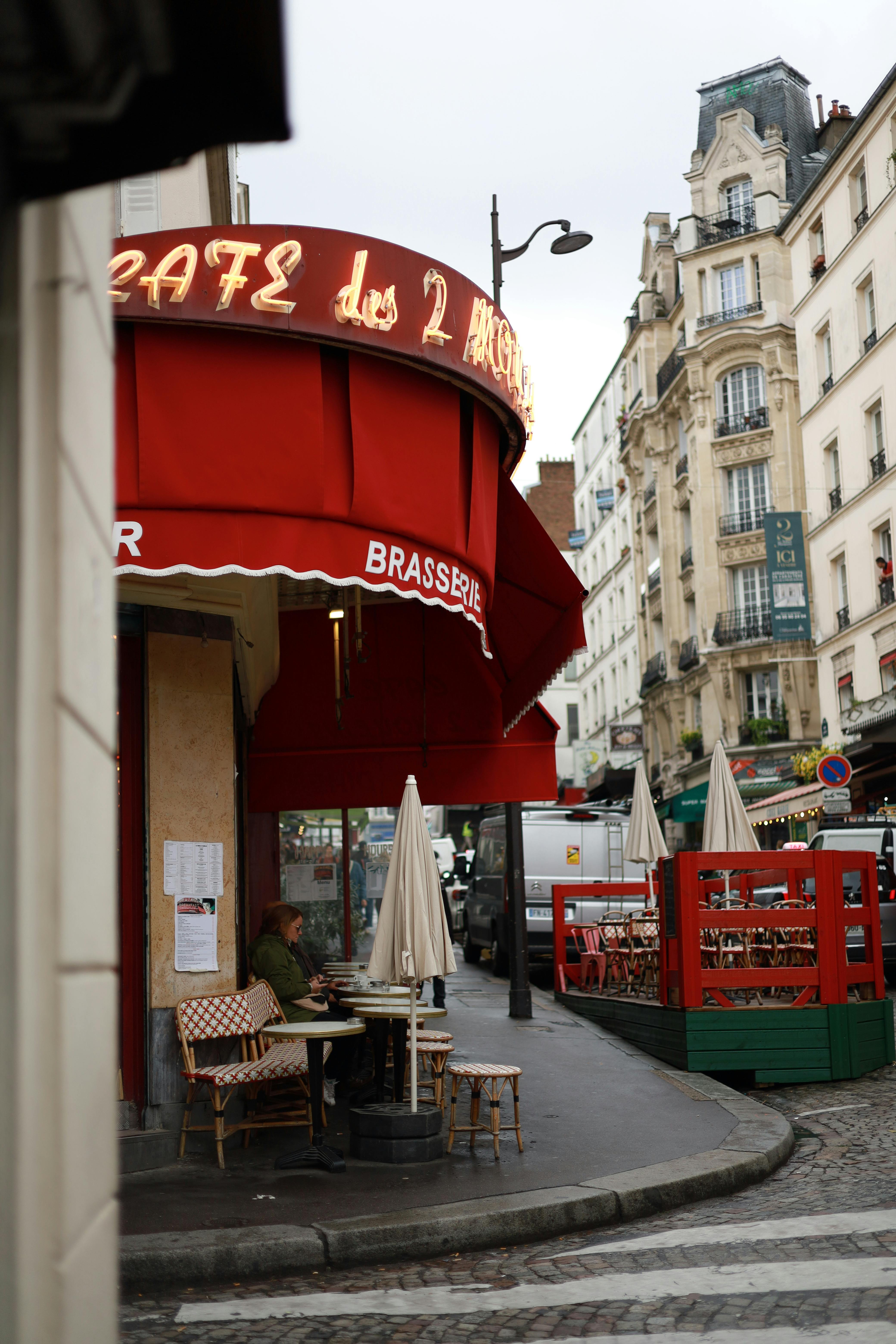
IMAGE: Parisian cafe illustrating human-scale architecture, where spatial proportions create comfort and intimacy in daily settings.
-
Why it works: Comfortable proportions based on the human body
-
When it fails: A “one-person room” becomes underused or feels claustrophobic
Balanced Scale: How Building Size Affects Space Use
What Is Monumental Scale?
Monumental scale aims to impress—make people feel small, inspired, or intimidated.
-
Examples: Courthouses, museums
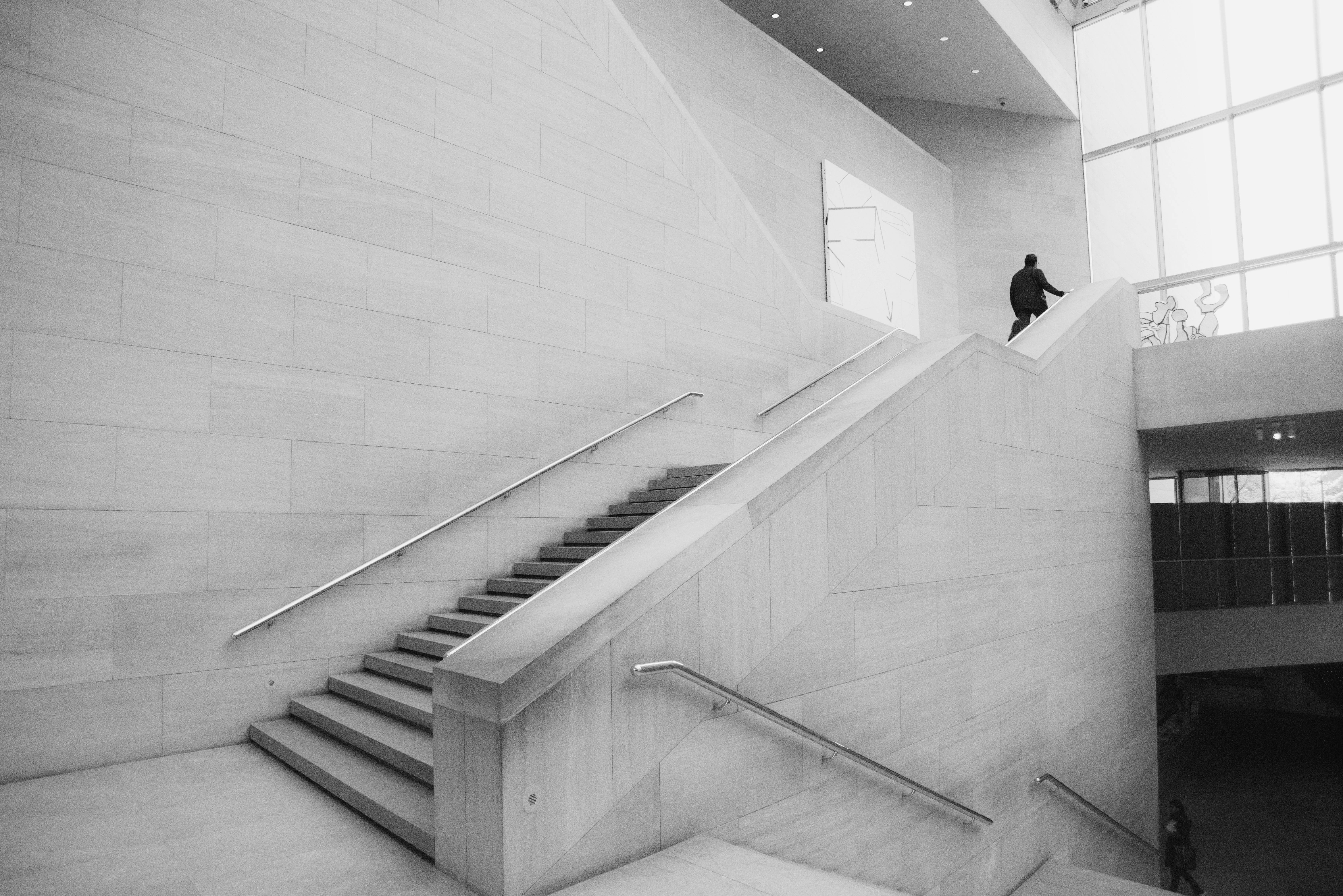
IMAGE: A monumental museum interior, illustrating the awe of large-scale architecture.
-
Why it works: Large volumes can inspire awe and symbolize power
-
When it fails: A school-shaped museum feels cold, unwelcoming
Example: The Pantheon in Rome nails it—immense dome inside, sits neatly in a city block. It amazes from within without overwhelming the neighborhood.
Human vs Monumental Scale: What’s the Difference?
Mistakes: What Happens When Size Goes Wrong
✕ All-glass cafe with human scale = feels lost in the city
✕ Oversized entrance lobby = echoes, feels uninviting
✕ Cathedral-like ceiling in a family home = the space overwhelms daily life
Is Your Building the Right Size for Its Purpose?
Real-world tips on balancing interior function with exterior scale, from cozy to iconic.
Expert Voice
“Architecture is the learned game, correct and magnificent, of forms assembled in the light.” —Le Corbusier
(Scale and light work together to make forms speak.)
Does Size Shape Function? Here’s What Architects Know
What Happens When Size Fails
Tiny homes whose doorways you duck to enter → Pitched as “cozy,” but users feel cramped after a week.
Massive warehouse-style school gyms → Impressive, but hard to coach in; voices echo and connection gets lost.
Mid-size offices with cathedral ceilings → Feels noble—but monthly heating bills skyrocket and staff report reduced morale.
How to Apply This: 5‑Point Checklist
□ Is the main room designed to match likely activity? (e.g. ceiling height for social meetings vs. focus work)
□ Can people reach, see, open, sit, and move naturally?
□ How much reverence do you want visitors to feel?
□ Does your size support HVAC, lighting, and structural cost expectations?
□ What memory do you want the space to leave?
Comparison: Good vs Typical Mistakes
| Aspect | Ideal Use | Common Mistake |
|---|---|---|
| Scale | Human‑scaled bedrooms | Cathedral-ceiling in bedroom |
| Function | Closed hallway in museum | Museum bright open-plan |
| Emotion | Café-sized lobby (warm) | Overbuilt lobby (cold echoes) |
| Presence | Modest exterior, tight fit | Oversize façade blocking light |
| Cost | Sized for efficiency | Oversized shell + wasted space |
Real Example
Pantheon:
-
Human feel: You can walk a circle of friends around the oculus below easily
-
Monumental impression: The soaring dome still dwarfs you
-
Balance: Sits neatly within its context, not a mega-structure in its time
In Focus
Height + Perception
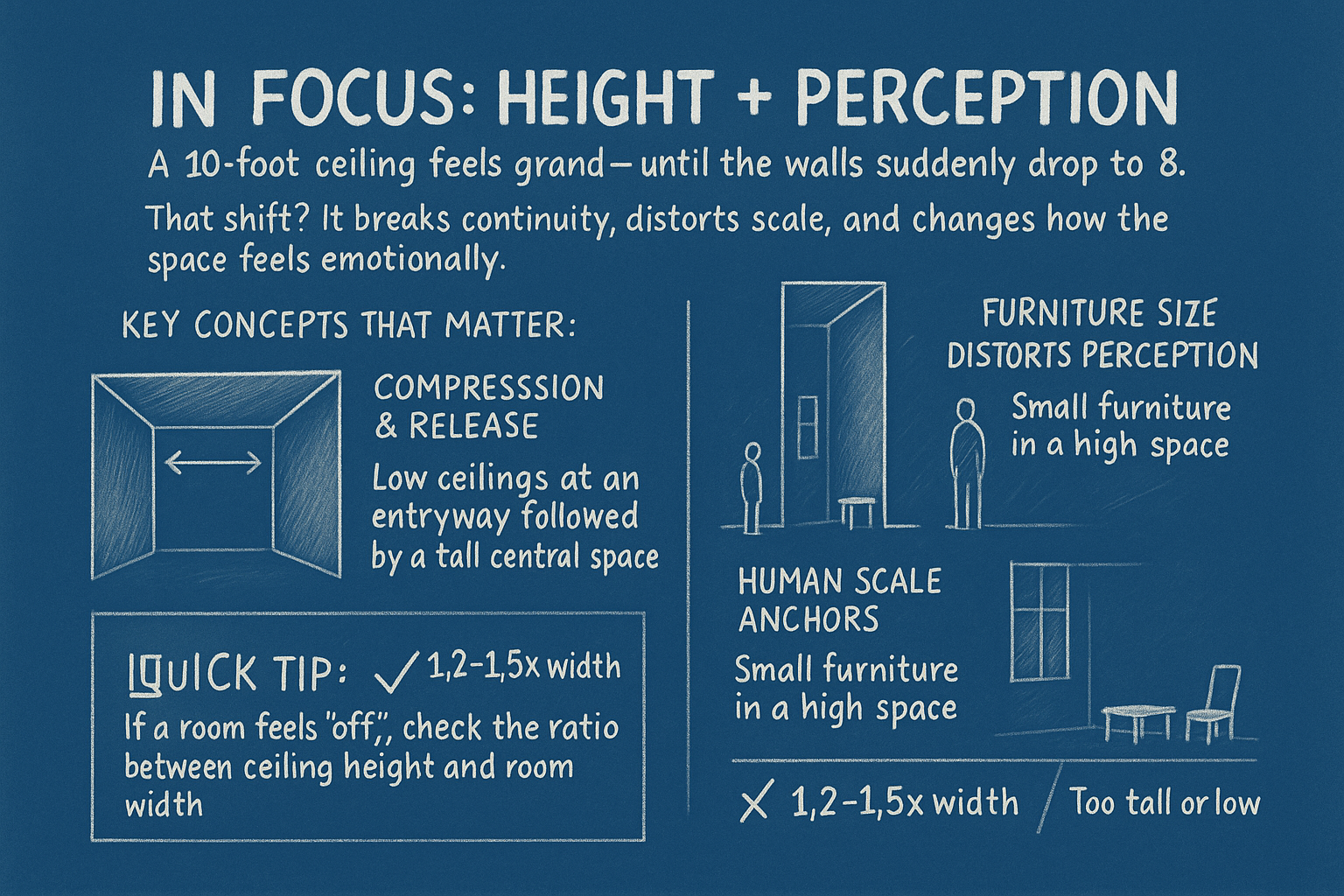
IMAGE: Breakdown of how ceiling height shapes perception, comfort, and emotional tone across homes, libraries, and public spaces.
A 10-foot ceiling feels grand—until the walls suddenly drop to 8.
That shift? It breaks continuity, distorts scale, and changes how the space feels emotionally.
Height on its own doesn’t guarantee spaciousness. It’s the proportion of height to width, depth, light, and even furniture scale that creates a sense of balance—or imbalance.
Key Concepts That Matter:
● Compression & Release:
Low ceilings at an entry create a feeling of compression. When followed by a tall central space, it creates dramatic release—used famously by Frank Lloyd Wright in his Usonian homes.
● Tall ≠ Better:
A high ceiling in a narrow hallway can feel like a shaft. Without width or natural light, it feels towering—not welcoming.
● Human Scale Anchors:
Spaces feel more relatable when you include visual anchors at eye level—windowsills, picture rails, or wall paneling that “ground” vertical height.
● Furniture Size Distorts Perception:
A small table under a soaring ceiling makes a room feel empty. Scale your furniture to reinforce—not fight—the vertical volume.
Real-Life Example:
In one Toronto library renovation, designers raised the reading room ceiling from 8'6" to 10', but left narrow stacks at the original height. The result?
→ The reading area felt open, warm, and expansive.
→ But transitioning between areas felt like stepping down emotionally—users reported discomfort without knowing why.
That’s proportion at play. You don’t just feel it—you remember it.
Quick Tip:
If a room feels “off,” check the ratio between ceiling height and room width.
✓ A ceiling that's 1.2–1.5x the room width usually feels balanced.
✕ Go too tall or too low and the space loses its spatial clarity.
What Real Experts Actually Do
-
✓ Use body‑based dimensions early in design
-
✓ Use mock-up rooms before building
-
→ Test ceilings, door widths, window heights with real users
Extra Tips You’ll Thank Yourself For
● Sketch interior sections with human figures drawn in
→ Check sightlines, reach, sight-blocks
✓ Run a quick “duck-walk test” in the entry hallway—you or a friend actually pass through it and give feedback
Gritty “What It Took” Sidebar
Buildings with perfect scale aren't cheap—masonry guilds often built mock-ups, adjusted repeatedly.
The Pantheon’s dome had to be recalculated after foundation cracks appeared.
Even modern architects build full-scale timber frames before committing to steel or concrete.
Related: The Parthenon’s Design and Architectural Features Explained by an Architect
Final Wrap‑Up
Size isn’t just a number—it defines how a space makes you feel and how you perform in it.
Get it too small, and you’ll start to shrink.
Make it too big, and the space starts to dwarf you.
But when you strike that balance—like the Pantheon—you create a building that feels both alive and lasting.
What to Do Next:
Sketch your project in section. Drop in a figure. If the ceiling sits more than 2 ft above their reach, consider lowering it.
That detail could be the difference between a space that works—and one that works beautifully.
FAQ
Q: How tall should ceilings be for a cozy library?
Generally 9–10 ft. It feels generous without losing intimacy.
Q: Can I fake scale with finishes?
Texture can help—but only real volume counts. A small room painted dark still feels small.
Q: What if budget limits size?
Prioritize human-scale in daily-use zones and treat impressive spaces as occasional features.
✓ Key option: multi-purpose rooms with foldable partitions.
✕ Mistake: sacrificing main areas to save on seldom-used features.