

How Does Shape Affect Function and Emotion in Architecture?
Why Do Curves and Angles Matter in Building Design?
Shape sets the stage. It determines how we move, feel, and use space. Below, we break down how clean boxes, flowing curves, or bold gestures shape architecture—and what happens when you get it wrong.
What Is Architectural Shape — Really?

Shape is the foundational form you see first. Think of it like an outfit: it sets mood, structure, and purpose all at once.
● Rectilinear forms feel stable and familiar. Example: Mies van der Rohe’s minimalist glass‑box homes.
● Curvilinear forms feel organic and fluid. Think Zaha Hadid’s swooping concrete waves.
● Geometric variations add drama and surprise—like the vaulted shells of the Sydney Opera House.
Get shape wrong, and everything from room layout to daylight goes off balance.
Shape Matters: From Boxes to Opera Houses
Are You Getting Shape Wrong in Your Designs?
Can the Right Shape Change How a Space Works?
Hard Truth
Most architects pick shapes based on style or trend. That’s backward. Shape must solve a problem—physically and emotionally—before anything else.
Shape: The Most Basic Building Block
What Is Shape in Architecture?
Shape is the foundation of form. It’s the first decision you make—and if you get it wrong, nothing downstream works.
● Squares and rectangles feel solid and grounded.

IMAGE: Modern architectural design highlighting squares and rectangles as basic shapes that feel solid and grounded.
● Circles feel fluid, inclusive, and calm.

IMAGE: Warning sign by a vessel window illustrating circular shapes that feel fluid, inclusive, and calm!
● Triangles feel dynamic, directional, even unstable.

IMAGE: Dome building in Valencia, Spain, showcasing triangular shapes that convey dynamism and direction.
The most iconic architecture starts with bold, intentional shapes. Think Sydney Opera House’s sail-like curves or Mies van der Rohe’s rectangular purity.
→ Shape is emotional. It defines layout, flow, and how people feel inside and outside the space.
What Happens When Shape Goes Wrong
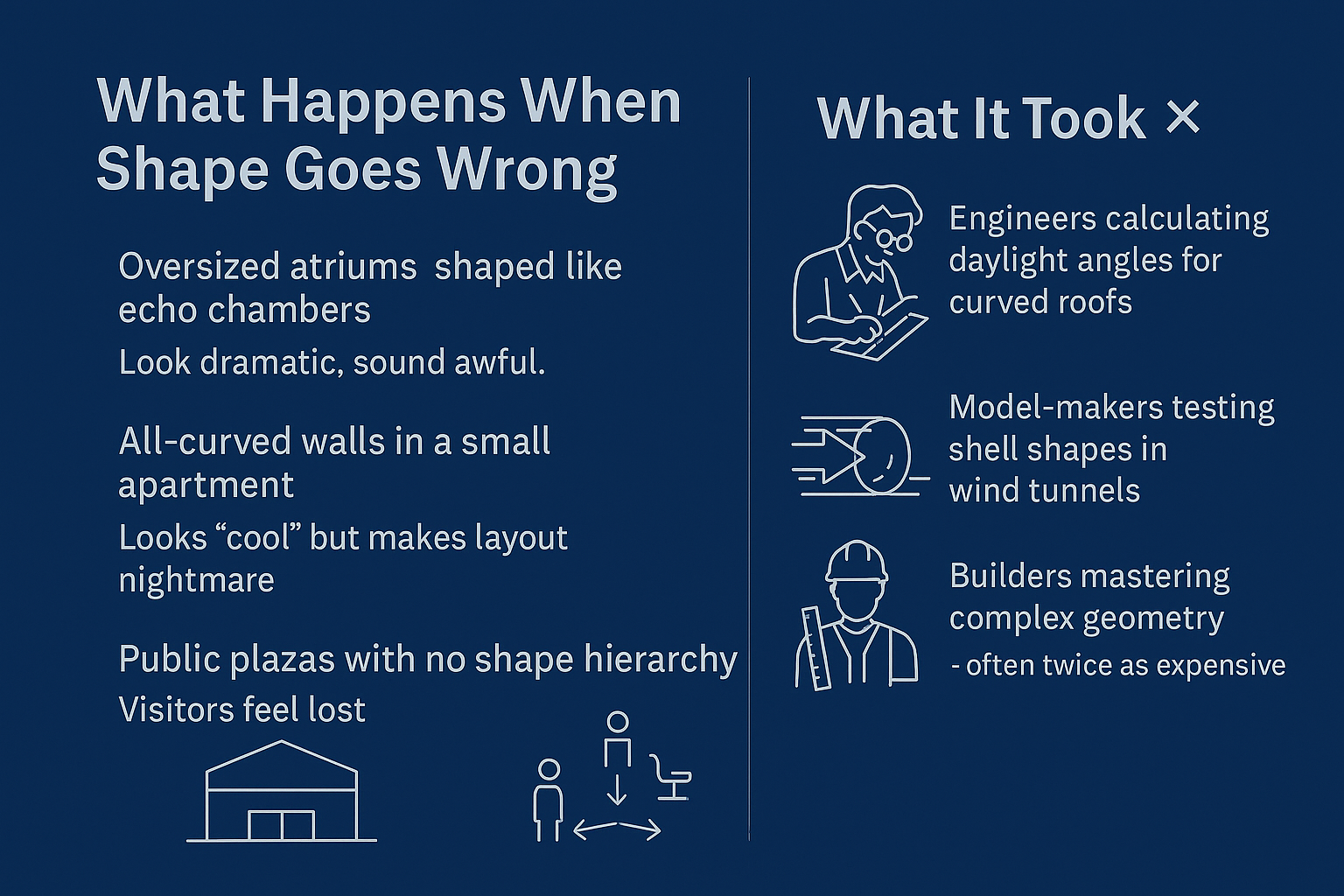
IMAGE: Common architectural form failures, like oversized echoing atriums and poorly shaped public spaces, showing the real-world cost of bad design.
1. Oversized atriums shaped like echo chambers → Look dramatic, sound awful. Useless for real conversation.
2. All-curved walls in a small apartment → Looks “cool” but makes furniture layout a nightmare.
3. Public plazas with no shape hierarchy → Visitors feel lost. No orientation. No reason to stay.
What Happens When It Goes Wrong ✕
-
All-box offices with no natural light = dull, unhealthy spaces.
-
Curved malls with no clear circulation = shoppers lost.
-
Iconic forms used carelessly = Instagram shots, not places people live in.
“What It Took” Sidebar
-
Engineers calculating daylight angles for curved roofs
-
Model‑makers testing shell shapes in wind tunnels
-
Builders mastering complex geometry — often twice as expensive
"Form ever follows function." — Louis Sullivan
This isn’t a cliché—it’s a warning. If your shape doesn’t match the function, the building fights its own purpose.
How to Apply This: 5-Point Shape Checklist
-
□ Define purpose: is it cozy, awe‑inspiring, or efficient?
-
What shape expresses the core purpose of the space?
-
-
□ Pick shape accordingly: square for order, curve for flow.
-
Are circulation and flow guided by the shape?
-
-
□ Test physically or virtually: check light, movement, interaction.
-
Does the shape support natural light and openness?
-
-
□ Prototype bedside: even cardboard models help
-
Can furniture and users interact with the shape easily?
-
-
□ Review feedback: does it feel right in real or virtual walkthrough?
-
How does the shape read from outside—inviting or confusing?
-
Understand how square, curved, or bold forms influence light, layout, and user experience.
See how shape choices—from rectilinear to dramatic curves—shape function, emotion, and space quality.
Good vs. Bad Use of Shape
| Use of Shape | Bad Example | Good Example |
|---|---|---|
| Apartment Layout | Awkward pie-shaped rooms | Rectilinear rooms with clear zones |
| Museum Entrance | Indistinct blob, no clear direction | Strong geometric entry pavilion |
| Library Design | Overly complex, confusing shapes | Simple rectangle with skylit atrium |
| School Classrooms | Irregular curves + wasted corners | Boxy, adaptable rooms with flow |
Shape Comparison Grid
| Shape Type | Classic Use | Modern Interpretation |
|---|---|---|
| Rectilinear | Mies’s glass boxes, clean plans | Modular housing, grid‑based layouts |
| Curvilinear | Classical curves in bridges/pavilions | Sculptural facades, fluid interior flow |
| Geometric Drama | Gothic arches, domes | Iconic forms like ACERO opera houses |
How Shape Guides Layout, Light, and Flow
What It Looks Like in Practice
-
Rectilinear houses: tight layouts, crisp daylighting, simple plans.
-
Curved galleries: spiral flow, soft acoustics, intuitive movement.
-
Geometric drama: columns and roofs that signal “this matters” as you walk in.
Now vs. Then
Then (Retro): Houses built as boxes because they were easy.
Now: Sustainable homes with curved roofs that channel rain into cisterns. One shape serving function and ecology.
Shape Comes First
Before material, before size, before even function—you start with shape. It’s how humans perceive space first. It frames light, guides the body, and sets the emotional tone.
Get shape right, and everything else becomes easier to design.
Get it wrong, and you’re forever patching a flawed foundation.
→ Shape is the DNA of form. Respect it.
“A building should speak of its purpose.” — Louis I. Kahn
For deeper reading: Form, Space, and Order by Francis D.K. Ching (Amazon best‑seller) — it breaks down shape impacts in real-world terms.
FAQ
Q: Do curved shapes cost more?
A: Usually yes—complex geometry means complex engineering and construction.
● But they can reduce finishes and boost energy performance if designed well.
Q: Are rectangular buildings outdated?
A: Not at all. Boxes are still efficient and easy to adapt. But they can feel cold if not balanced with light, texture, or greenery.
Shapes are like grammar in writing—they set tone. A square is plain, a curve is poetic, and a bold form feels like a statement.
Final Thoughts
Shapes aren’t decoration—they are the design.
Get shape right, and everything else flows. Get it wrong, and even a luxury project feels off. That's why architecture starts here—with clear, honest form that matches purpose and feels right to the people who use it.
So, there it is: shape stripped down to its essence. Smart choices here mean everything that follows works, feels good, and lasts.
Related
Design – Form and Function in Architecture
- What is Form in Architecture? Principles, Examples, and Applications
- What Are the Properties of Form in Architecture?
- Why Does Size Matter in Architecture?
- What Is Organic Architecture According to Frank Lloyd Wright?
- Form Follows Function in Architecture and Design
- Architectural Form Examples: How Shape Defines Function
- Clustered Form Architecture: Function, Space, and Design
- Scale and Proportion in Architectural Design: Balancing Form and Function
- Form Meets Function: Principles for Great Architectural Design
- How Form, Function, and Meaning Shape Islamic Architecture
- Mashrabiya Designs: History, Beauty, and Functionality
- Creating Beautiful and Functional Spaces: Expert Tips for All Levels
- Interior Design Functional Elegance: Practical Tips for Stunning Interiors
- Gothic Elements in Architecture: A Study of Form and Function
- Design Basics in Architecture & Building: The Fundamentals!
- Color Psychology Basics: What Every Designer Should Know
- Introduction to Interior Design: Understanding the Basics
- Basic Design and Architecture: A Must-Read Guide for Students
- Basic Techniques and Principles of Architectural Drawing
- Architecture Basic Design: Key Concepts Every Student Must Know
Learn – Education and Fundamentals
- Free Architecture Courses with Certificate: Top Online Platforms to Learn and Earn
Guide to free online architecture courses offering certification. - The Principles of Design: Transforming Ideas into Visual Excellence
Core design principles for creating effective visual work. - Understanding the Basics of Architecture: A Beginner’s Guide
Introductory guide to architecture fundamentals. - Woodworking Basics: A Friendly Beginner’s Guide
Introduction to woodworking skills for beginners. - Basic Elements for Sustainable Architecture
Key components involved in sustainable building design. - Graphic Design Basics
Fundamentals of graphic design for beginners. - Basics Architecture: Beams and Frames
Introduction to beams and frames in structural design. - Design Elements In Architecture: Basics Explained Simply
Simplified explanation of important design elements in architecture.