
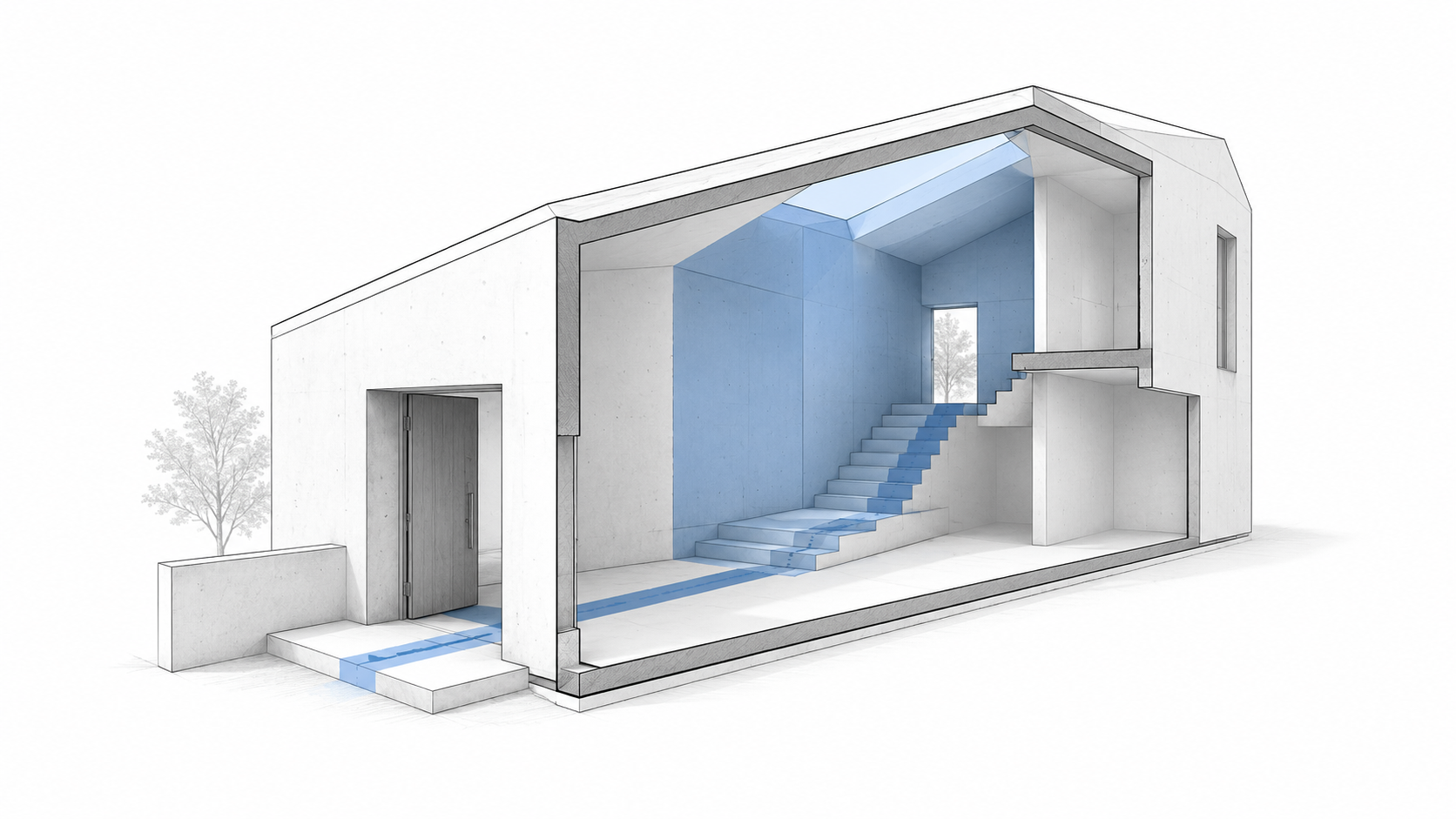
Illustration by ArchitectureCourses.org. A building’s form can be read through its mass, interior void, entry, openings, movement path, and roof logic.
Architectural form starts with shape, but the outside silhouette is only one piece. Form includes mass, volume, openings, roof shape, entry, structure, and the space carved inside the building.
A good form does more than look interesting. It helps rooms work, brings in light, gives people a clear way to move, and makes the building feel settled on its site.
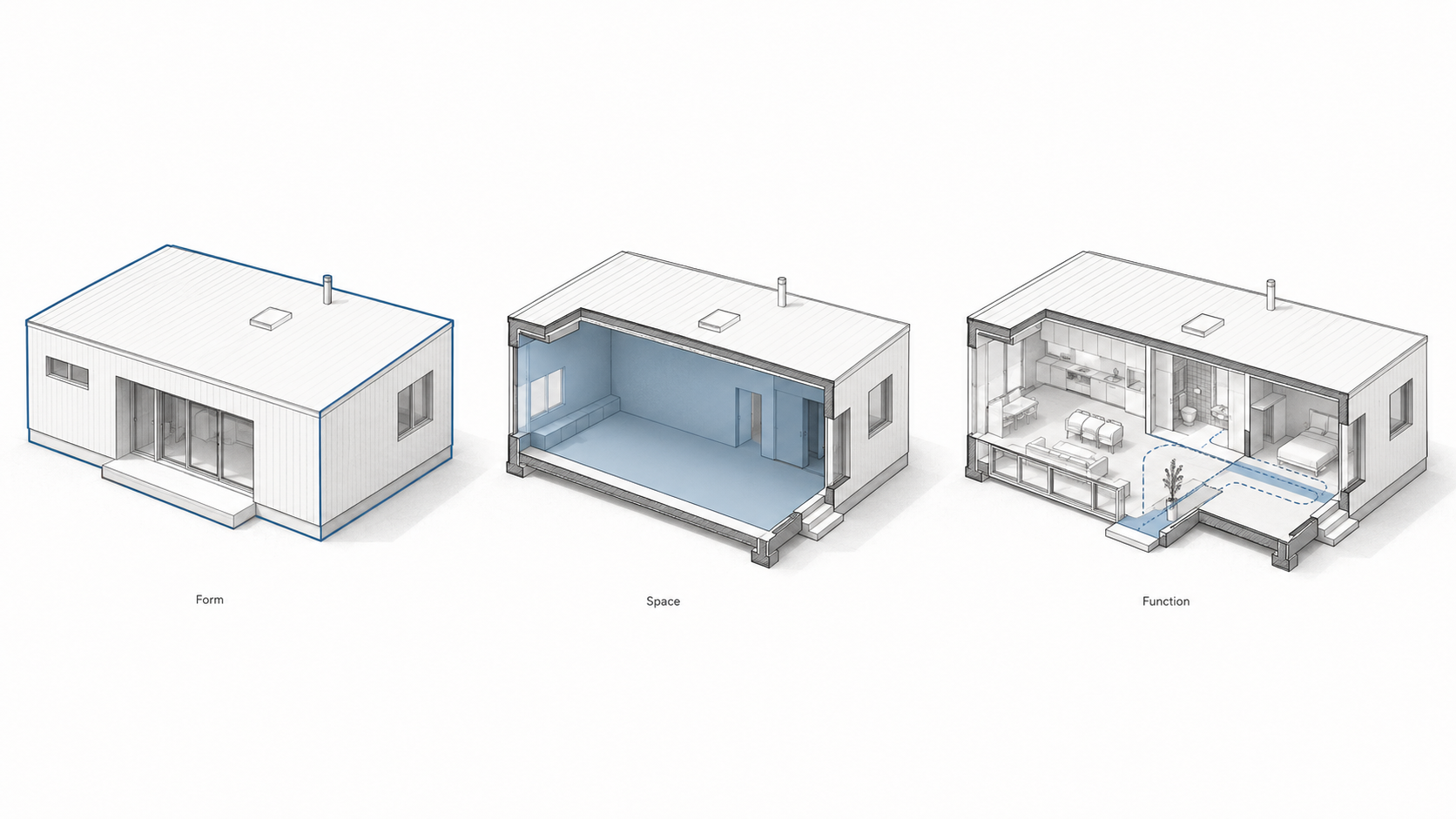
Illustration by ArchitectureCourses.org. Form is the outer shape of the building, space is the volume inside it, and function is how entry, rooms, movement, and use work through that shape.
What Form Means in Architecture
In architecture, form is the physical shape and three-dimensional organization of a building. It includes the building’s height, width, depth, roof, walls, openings, projections, cuts, and overall mass.
A simple rectangular building has form. A courtyard house has form. A tower, a long school wing, a small chapel, a museum carved around daylight, and a house raised on pilotis all use form differently.
The mistake is treating form as decoration. Form is not a costume placed on a plan after the useful work is done. It changes the plan, the section, the structure, the light, and the way the building is built.
Form, Space, and Function Work Together
Form is the mass. Space is what the mass contains or shapes. Function is what the space must do.
These three do not stay separate for long. Move a wall, and the room changes. Cut a courtyard, and the building gains light and outdoor space. Raise a roof, and the section changes. Stretch the building into a long bar, and circulation becomes a bigger part of the design.

Illustration by ArchitectureCourses.org. A building form works better when the plan, entry, daylight, structure, circulation, and roof logic support each other instead of fighting the use of the building.
This is the practical side of form follows function. The phrase gets repeated so often that it can sound empty. In real design work, it means the building shape should not make the plan worse, the roof harder to drain, the structure harder to understand, or the interior harder to use.
The Shape Gets Expensive After the First Sketch
The part students and beginners miss is that form creates obligations. A curved wall needs a way to be framed, detailed, waterproofed, insulated, finished, and repaired. A deep cantilever needs structure. A roof that looks clean in elevation still has to drain. A dramatic void still has to bring light somewhere useful instead of creating a cold, dark leftover space.
This is where weak form becomes expensive. The drawing may look strong, but the cost appears later in the structure, roof edges, window alignment, awkward room shapes, custom fabrication, or extra coordination. A form that needs special detailing everywhere is not automatically wrong. It just has to earn that cost.
Before trusting a form, ask what it makes harder. Does it make the plan clearer or stranger? Does it simplify the roof or create more valleys? Does it help daylight or bury the middle of the building? Does the structure land cleanly, or does every floor need a new excuse?
A good architectural form can still be bold. It just should not hide all its problems until the section, structure, and roof plan show up.
When the Plan Starts Complaining
Weak form often looks exciting in the first sketch and becomes painful later.
The problems usually show up in ordinary places: a dark middle room, a hallway that eats too much floor area, a roof valley that collects water, a stair that ruins the plan, a window pattern that does not match the rooms, or a structural grid that has nothing to do with the shape above it.
That is why form should be tested early. Ask where people enter, where daylight reaches, where the roof drains, where structure lands, and what rooms are forced into awkward shapes. If the answer is unclear, the form is probably not ready.
Basic Types of Architectural Form
Most architectural form can be understood through a few basic organizing ideas. These are not style labels. They are ways of arranging mass and space.
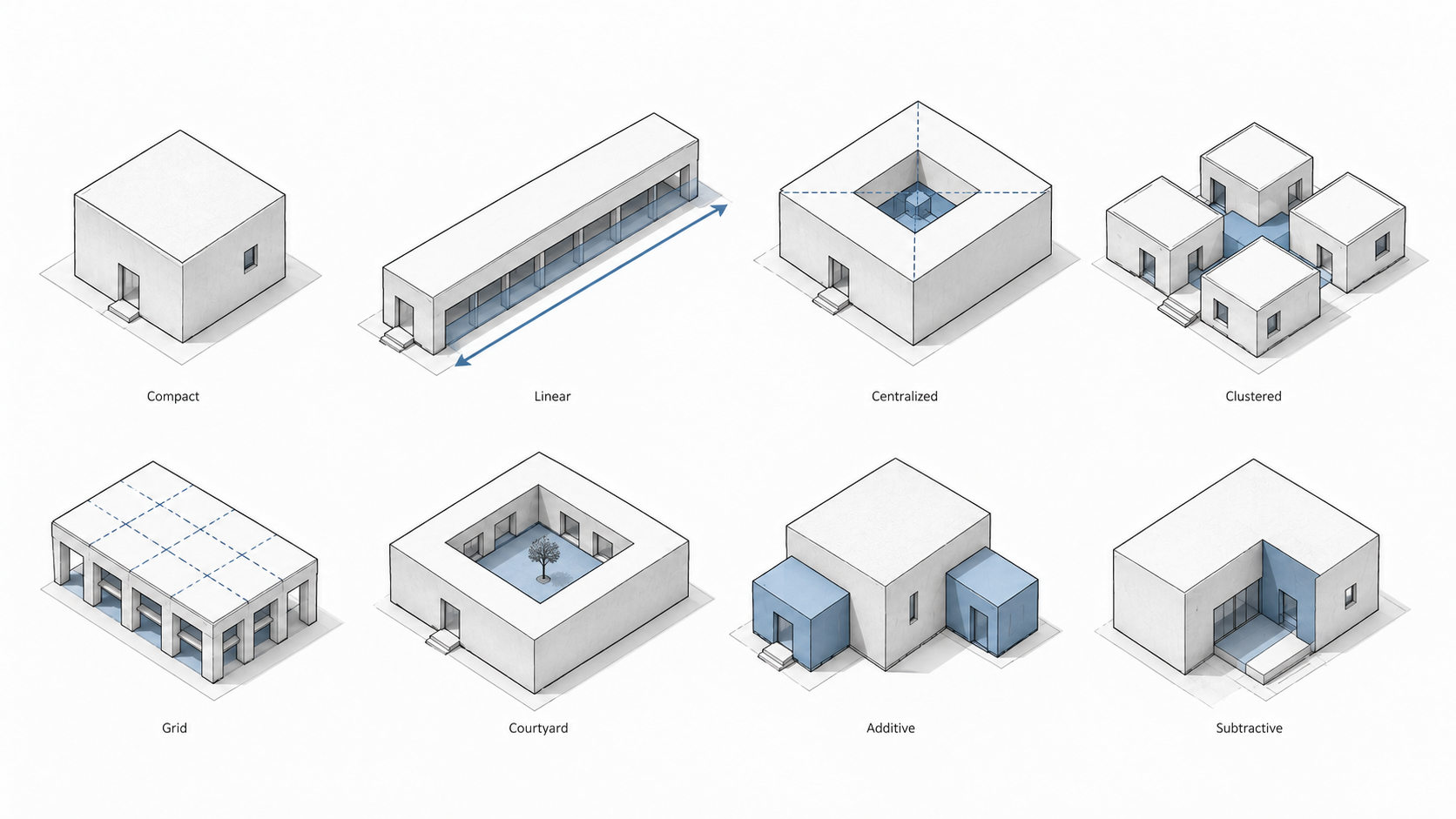
Illustration by ArchitectureCourses.org. Basic architectural forms can be compact, linear, centralized, clustered, gridded, courtyard-based, additive, or subtractive. Each one organizes space, movement, and meaning in a different way.
Compact form keeps the building tight and efficient. It can feel stable, protected, and simple to build, but it may need careful daylight planning.
Linear form stretches space along a path. It works well for schools, galleries, housing bars, transit buildings, and narrow sites where movement is part of the design.
Centralized form organizes rooms around a clear center. That center might be a hall, courtyard, atrium, worship space, or shared public room. The page on centralized form in architecture goes deeper into this idea.
Clustered form groups several masses together. It can make a building feel less rigid and more village-like, especially when the parts gather around outdoor space. See clustered form architecture for the more focused version.
Additive form starts with one mass and adds pieces to it. Wings, porches, stair volumes, towers, and service blocks can all create additive form. The dedicated page on additive form in architecture is the better place for the full breakdown.
Subtractive form begins with a larger mass and cuts space from it. Courtyards, terraces, recesses, light wells, and carved entries are common subtractive moves.
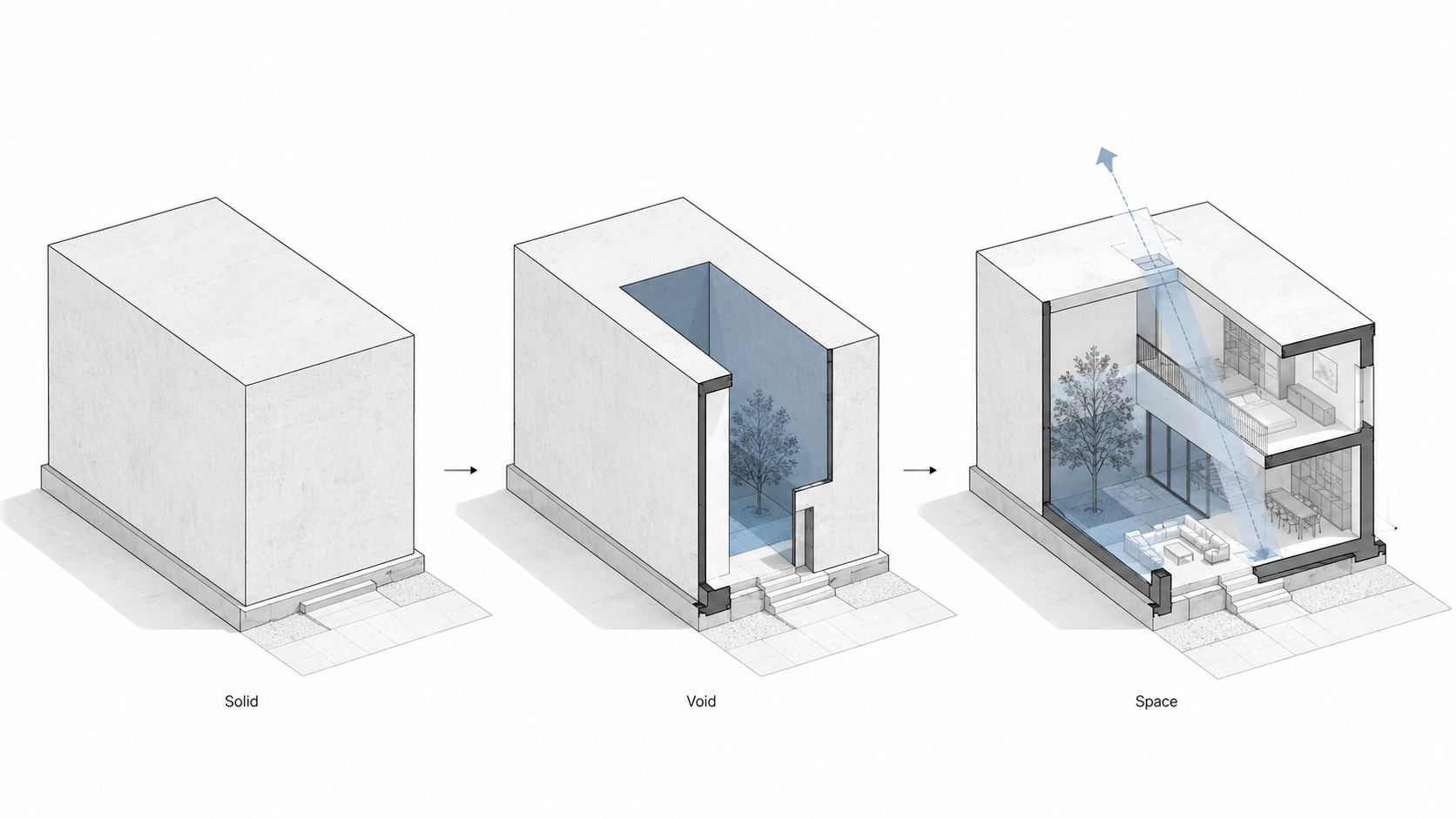
Illustration by ArchitectureCourses.org. Subtractive form starts with a solid mass, removes a void, and turns that carved space into daylight, entry, courtyard, and usable interior volume.
What Form Communicates
Form also affects how a building feels before anyone understands the plan. A compact block can feel stable. A long bar can feel directional. A courtyard can feel protected. A lifted or carved form can feel more public and open.
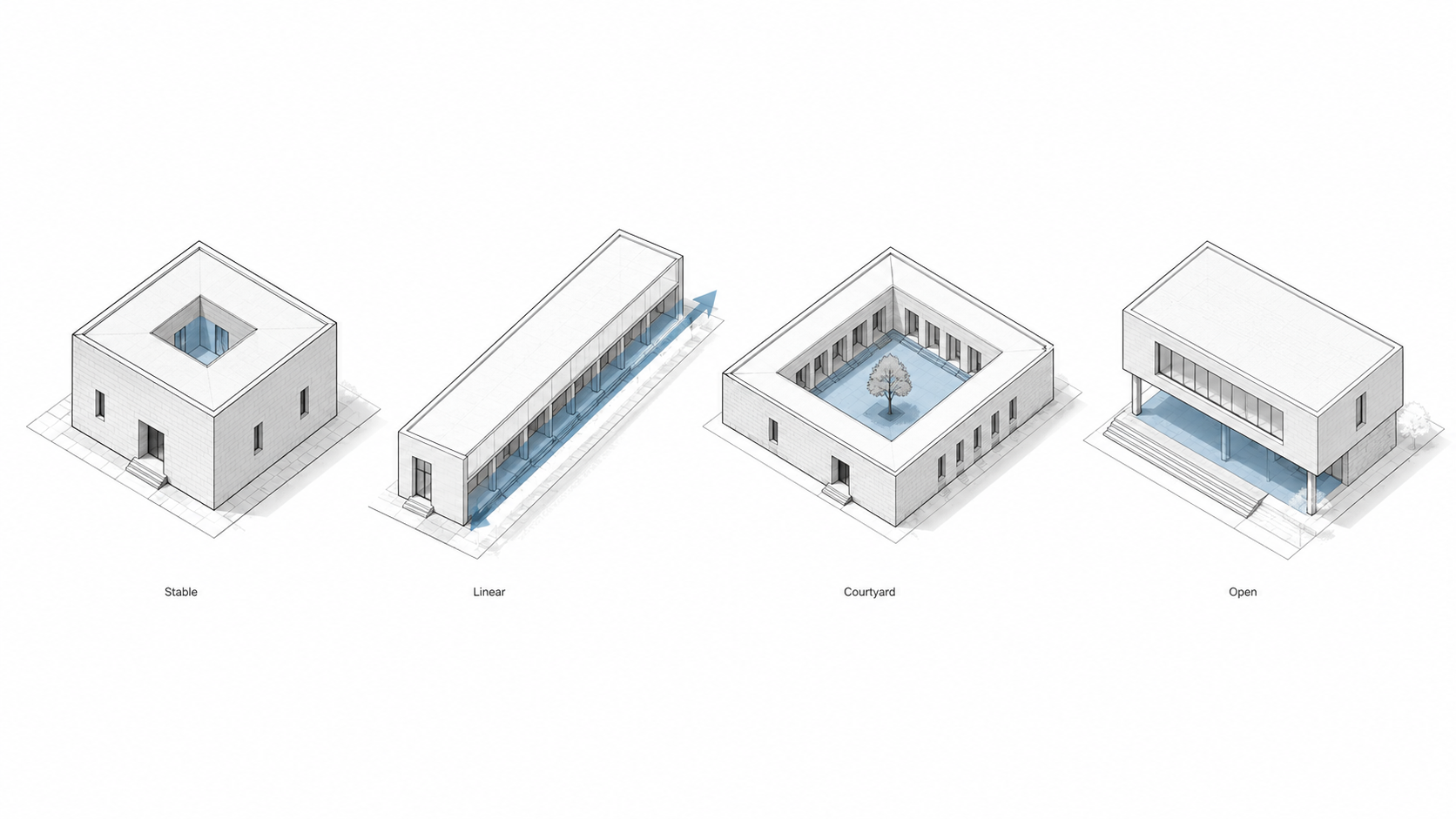
Illustration by ArchitectureCourses.org. Form affects more than appearance. A compact mass, a long bar, a courtyard, or a lifted opening can change how a building feels and how people use it.
This is where form can easily become vague writing. Instead of saying a form is “dynamic” or “iconic,” look at what it actually does. Does it gather people? Direct movement? Create shade? Mark an entrance? Hold a corner? Make the structure legible?
| Form Move | What It Can Do | What to Watch |
|---|---|---|
| Compact block | Feels stable, efficient, and contained. | Can create dark interior zones if openings are weak. |
| Long linear bar | Clarifies movement and sequence. | Can waste space if the corridor becomes too dominant. |
| Courtyard cut | Brings light, air, and protected outdoor space into the plan. | Needs careful drainage, privacy, and orientation. |
| Raised or lifted mass | Creates threshold, shade, or public ground space. | Can become expensive if structure is not resolved early. |
| Additive wings | Lets a building grow in parts. | Can look messy if joints, rooflines, and circulation are ignored. |
Examples of Architectural Form
Examples help, but they should not turn the page into a famous-building slideshow. The useful question is not “Is this building famous?” It is “What is the form doing?”
Geometric form uses clear volumes such as blocks, bars, cylinders, planes, grids, and repeated structural bays. These forms often create order and legibility. They can also become stiff if the plan, light, and human scale are not handled well.
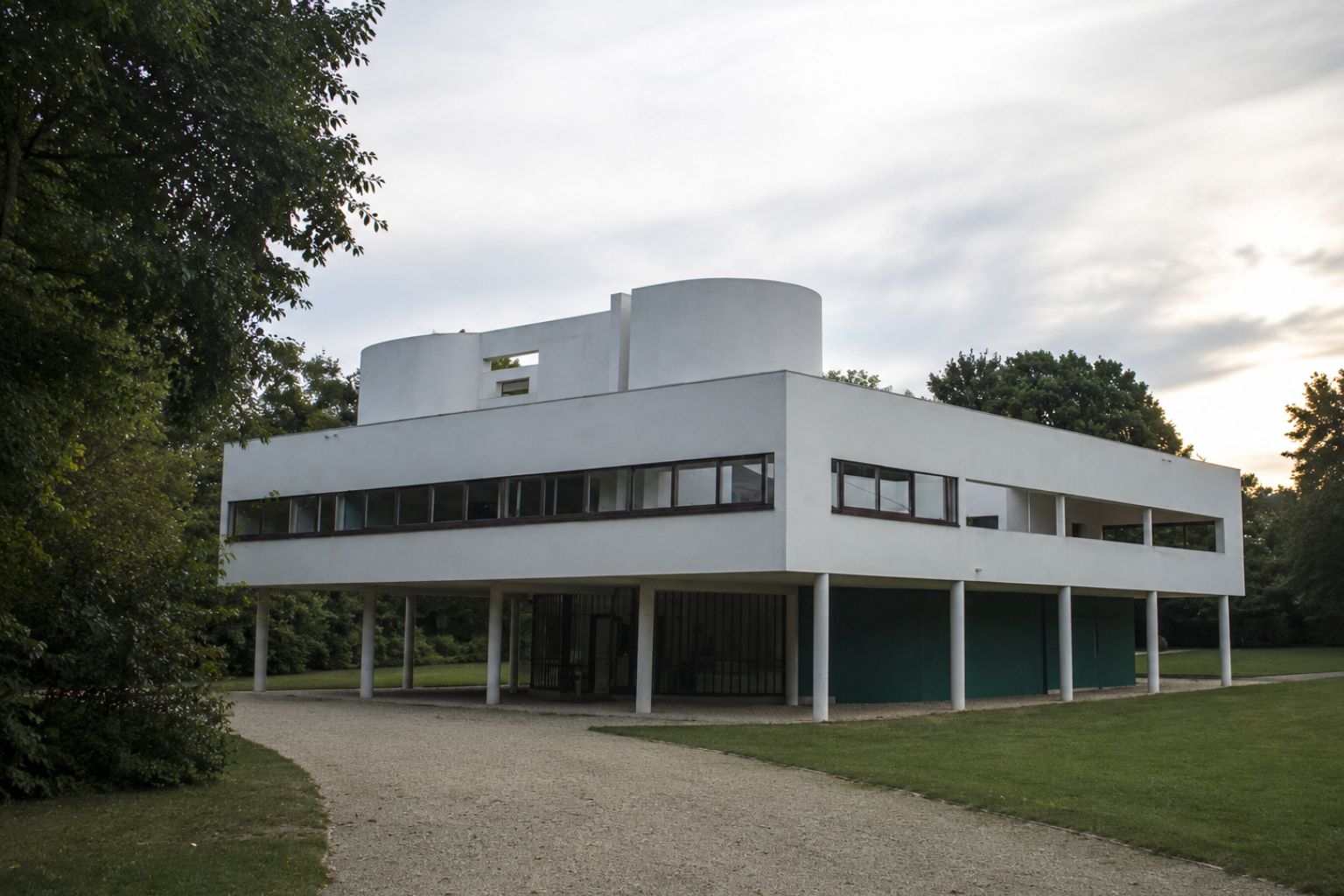
Villa Savoye is often used to explain modern geometric form: a clean white volume, lifted ground plane, ribbon windows, and a simple composition that depends on proportion, light, and circulation.
Organic form responds more directly to landscape, movement, structure, or natural patterns. It may use curves, irregular massing, or forms that appear to grow from the site. Organic form still needs discipline. If the roof, structure, and plan do not work, the result becomes expensive sculpture.
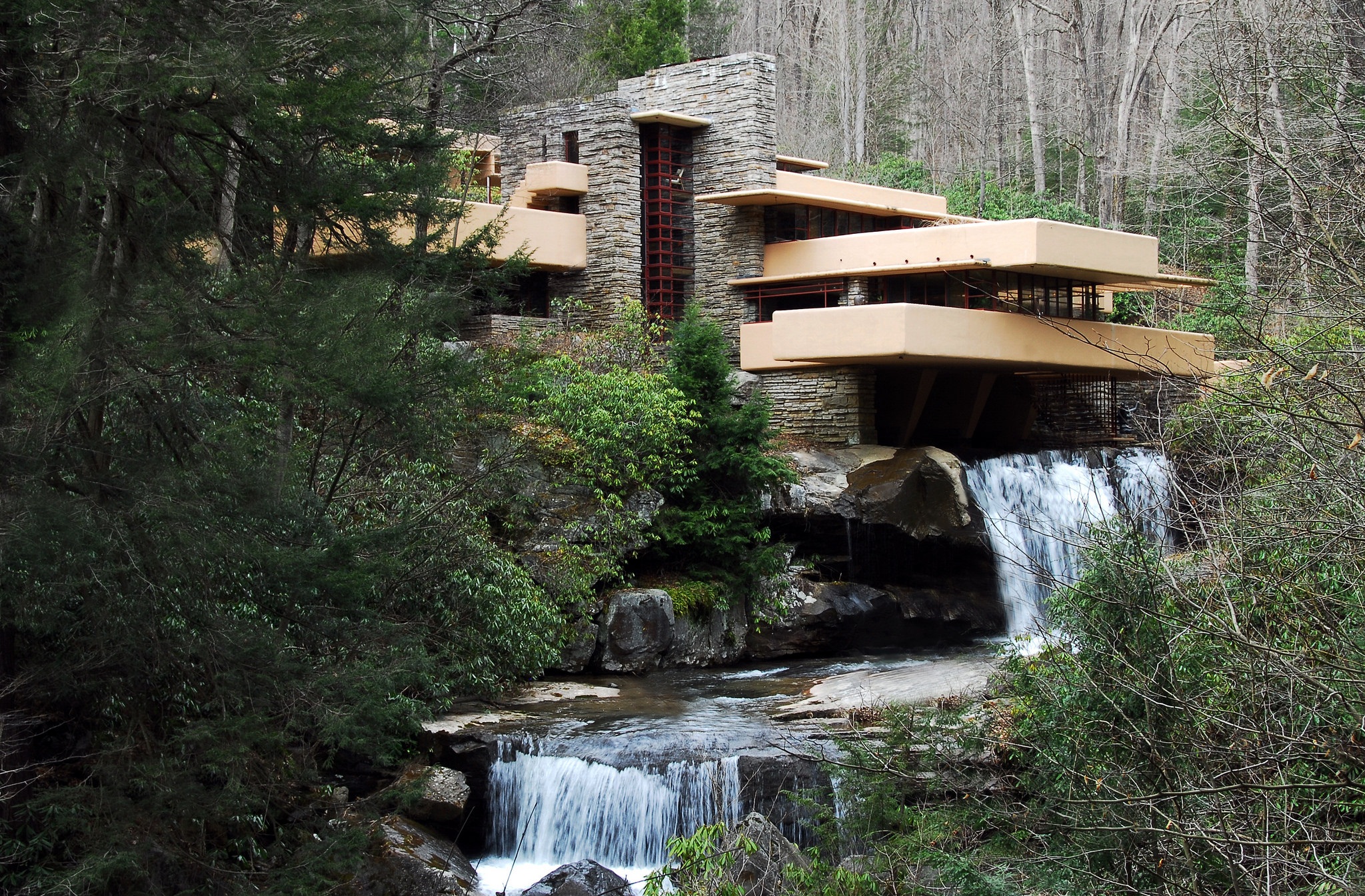
Fallingwater is a useful example because the form is tied to the site. The cantilevered horizontal planes, stone core, water, and terrain work together instead of reading as separate decoration.
For more examples, use the dedicated support page: Architectural Form Examples.
How Form Develops
Form usually does not arrive finished. It develops through small decisions.
Illustration by ArchitectureCourses.org. Architectural form often develops through simple decisions: start with a mass, cut space from it, open an entry, bring in light, and refine the building into usable rooms and circulation.
A designer might start with a simple block, cut a courtyard, open an entry, raise part of the roof for light, then adjust the mass so rooms, structure, and circulation make sense. That process is more useful than chasing an interesting shape too early.
This is why massing studies matter. They let you test shape before the design hardens. If a massing option creates bad rooms, strange roof drainage, or a confusing entrance, it is cheaper to fix it in a study model than after the plan is developed.
Modern Form Is About Performance Too
Modern architectural form is often discussed as style, but performance matters more. Shape affects daylight, heat gain, shade, air movement, structure, cost, and maintenance.
A deep overhang can shade glass. A courtyard can bring light into the middle of a dense plan. A sloped roof can move water cleanly. A compact building can reduce envelope area and heat loss. Those are form decisions with physical consequences, not style notes.
Technology can help test form, but software does not make a form good by itself. A digital model can expose clashes, daylight problems, and awkward circulation. It cannot decide what the building should be.
Properties of Form to Check
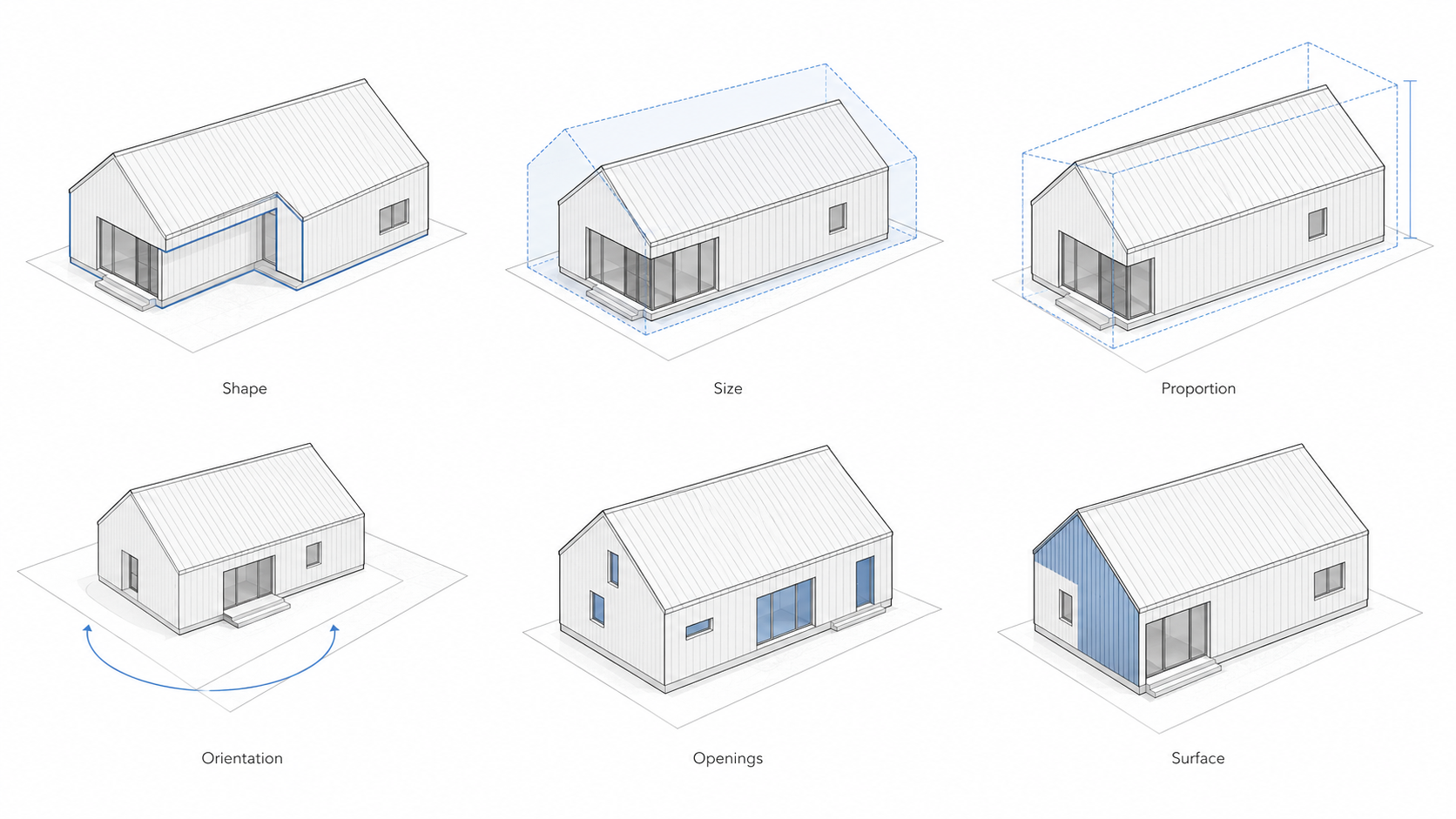
Illustration by ArchitectureCourses.org. The properties of architectural form include shape, size, proportion, orientation, openings, and surface. Small changes to one property can change how the same building reads and works.
The properties of form in architecture are the basic traits that change how a building reads and works.
- Shape: the outline or basic geometry of the mass.
- Size: the physical scale of the building or part.
- Proportion: the relationship between height, width, depth, and parts.
- Orientation: how the form faces sun, wind, street, view, and site.
- Openings: where the form is cut for light, entry, ventilation, and view.
- Surface: the texture, material, rhythm, and depth of the skin.
Proportion deserves special attention because it affects whether a building feels settled or awkward. The page on scale and proportion in architectural design is a useful next step after this one.
Simple Checks Before You Trust a Form
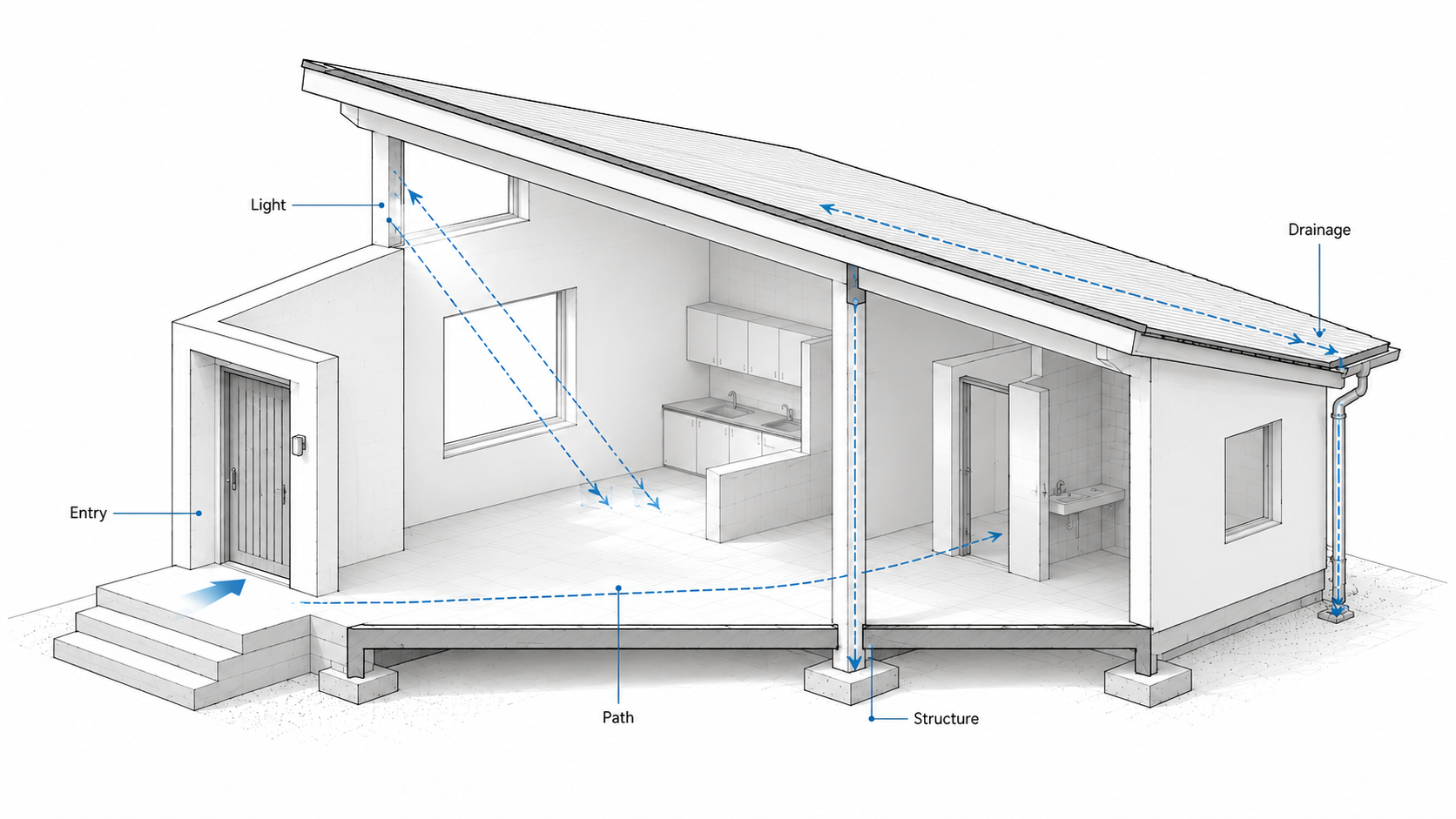
Illustration by ArchitectureCourses.org. A building form should be checked against entry, daylight, roof drainage, structure, and circulation before the shape is trusted.
Before a building form goes too far, test it against ordinary questions.
- Where does a person enter, and is that entry obvious without adding a giant sign?
- Which rooms get daylight, and which rooms are trapped in the middle?
- Where does the roof drain, and does the shape create avoidable valleys or flat dead spots?
- Does the structure land cleanly, or is the form pretending gravity is optional?
- Does the form help the plan, or is the plan being forced to obey a shape?
These checks are not glamorous, but they separate useful form from shape-making.
Read This Next
For a deeper look at examples, read Architectural Form Examples. For the vocabulary behind this page, read What Are the Properties of Form in Architecture?. For a focused principle page, read Form Follows Function in Architecture and Design.
Also useful: Building Forms in Architecture, Architectural Shapes and Forms, and Clustered Form Architecture.
Book Notes
If you want a book-level reference, Francis D.K. Ching’s Introduction to Architecture is useful for form, space, order, and basic design vocabulary.
For the practical connection between form, structure, systems, and building decisions, The Architect’s Studio Companion is the stronger reference.
Affiliate disclosure: ArchitectureCourses.org may earn a commission if you buy through some links on this page, at no extra cost to you.
FAQ
What is form in architecture?
Form is the three-dimensional shape and organization of a building. It includes mass, volume, walls, roof, openings, structure, and the spaces created inside and around the building.
Is form the same as shape?
Not exactly. Shape is usually the outline or geometry. Form is broader. It includes shape, volume, depth, proportion, surface, openings, and how the building occupies space.
Why does form matter?
Form affects how a building looks, but it also affects use, light, circulation, structure, cost, and how the building meets the site.
What is the difference between form and function?
Function is what the building or space must do. Form is the shape and organization that supports that use. When the two are disconnected, the building may look interesting but work poorly.
What are common types of architectural form?
Common types include compact, linear, centralized, clustered, grid, courtyard, additive, and subtractive forms.
What makes an architectural form expensive?
Curves, cantilevers, deep cuts, unusual roof shapes, custom windows, and unresolved structure can all raise cost. The form itself is not the problem; the problem is when the shape creates detailing, drainage, framing, or fabrication work the design did not account for early.
What is the difference between form and massing?
Massing is the early study of building volume. Form is the more complete architectural result, including mass, proportion, openings, roof shape, structure, surface, and the spaces shaped inside and around the building.