
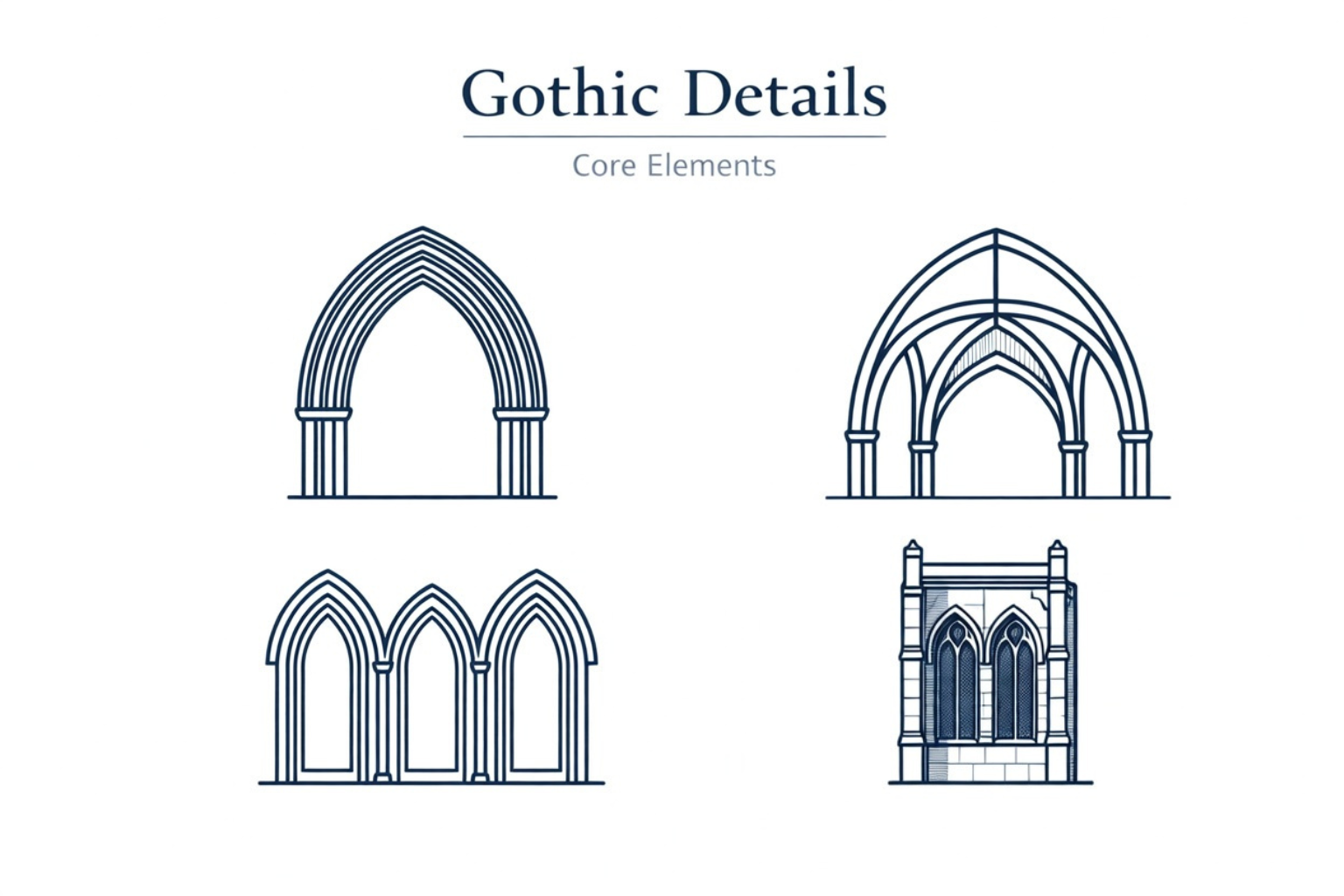
Illustration by ArchitectureCourses.org. Key Gothic architectural elements, including pointed arches and layered arch profiles, shown as a compact visual overview.
Gothic architecture is not one detail repeated over and over.
It is a set of elements that work together. Openings sharpen. Walls open up. Ceilings become more legible. Rooflines get more active. The whole building starts pulling upward instead of sitting on the ground like one heavy block.
That is why an elements page matters. Not to dump vocabulary. To show how the parts build the style.
This page stays on the elements themselves: what they are, what they do, and how they work together in secular architecture. For the broad starter page, go to Introduction to Gothic Architecture. For the fast spotting page, use Characteristics of Gothic Architecture. For the structural side, go to Gothic Structures.
What Counts As A Gothic Element
Some elements are doing structural work. Some are shaping light, rhythm, or surface. Some do both.
| Element | What It Does | What It Changes |
|---|---|---|
| Pointed arch | Sharpens openings and handles loads more flexibly | Height, proportion, and visual pull |
| Ribbed vault | Organizes the ceiling through a visible framework | Interior structure and room shape |
| Buttressing | Helps manage outward thrust beyond the wall line | Wall thickness and opening size |
| Tracery | Divides and refines large openings | Depth, pattern, and facade grain |
| Gables, pinnacles, towers | Carry the skyline and reinforce ascent | Silhouette and distance-read |
| Layered moldings and carved profiles | Give edges, openings, and surfaces more definition | Texture, rhythm, and finish |
Pointed Arches
This is the element most people notice first.
The pointed arch changes the shape of windows, portals, arcades, and vaults. It also changes the whole mood of the building. A rounded arch feels broader and more settled. A pointed arch feels sharper, narrower, and more directed.
That matters because Gothic architecture depends on controlled vertical movement. The opening itself is already helping the building rise.
It also matters structurally. The pointed arch gave builders more flexibility in span and proportion than older round-arch systems. That is one reason it became so central to Gothic building.
For the support page, go to Pointed Arch.
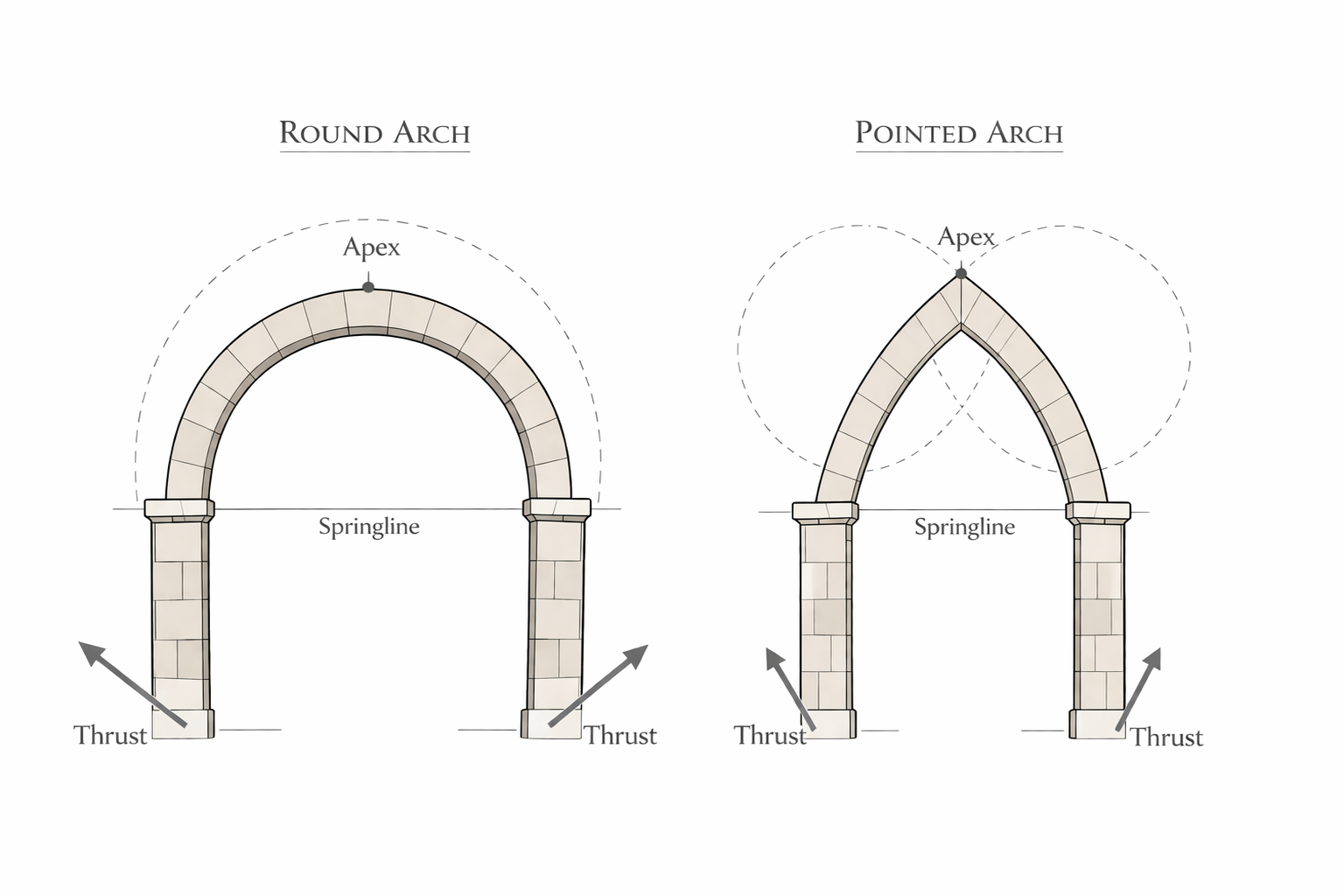
Illustration by ArchitectureCourses.org. Round and pointed arch geometry compared, including apex, springline, and thrust.
Ribbed Vaults
Ribbed vaults are one of the clearest Gothic elements because they turn the ceiling into something you can read.
Instead of one continuous heavy shell, the ceiling is organized by ribs. Those ribs define the geometry, clarify the span, and give the room a stronger directional order.
This is why Gothic interiors rarely feel flat. The ceiling is not passive. It is shaping the space.
Ribbed vaults also matter because they link structure and appearance so tightly. They are not just hidden engineering. They are part of the visible language of the room.
For the support page, go to Rib Vaults.
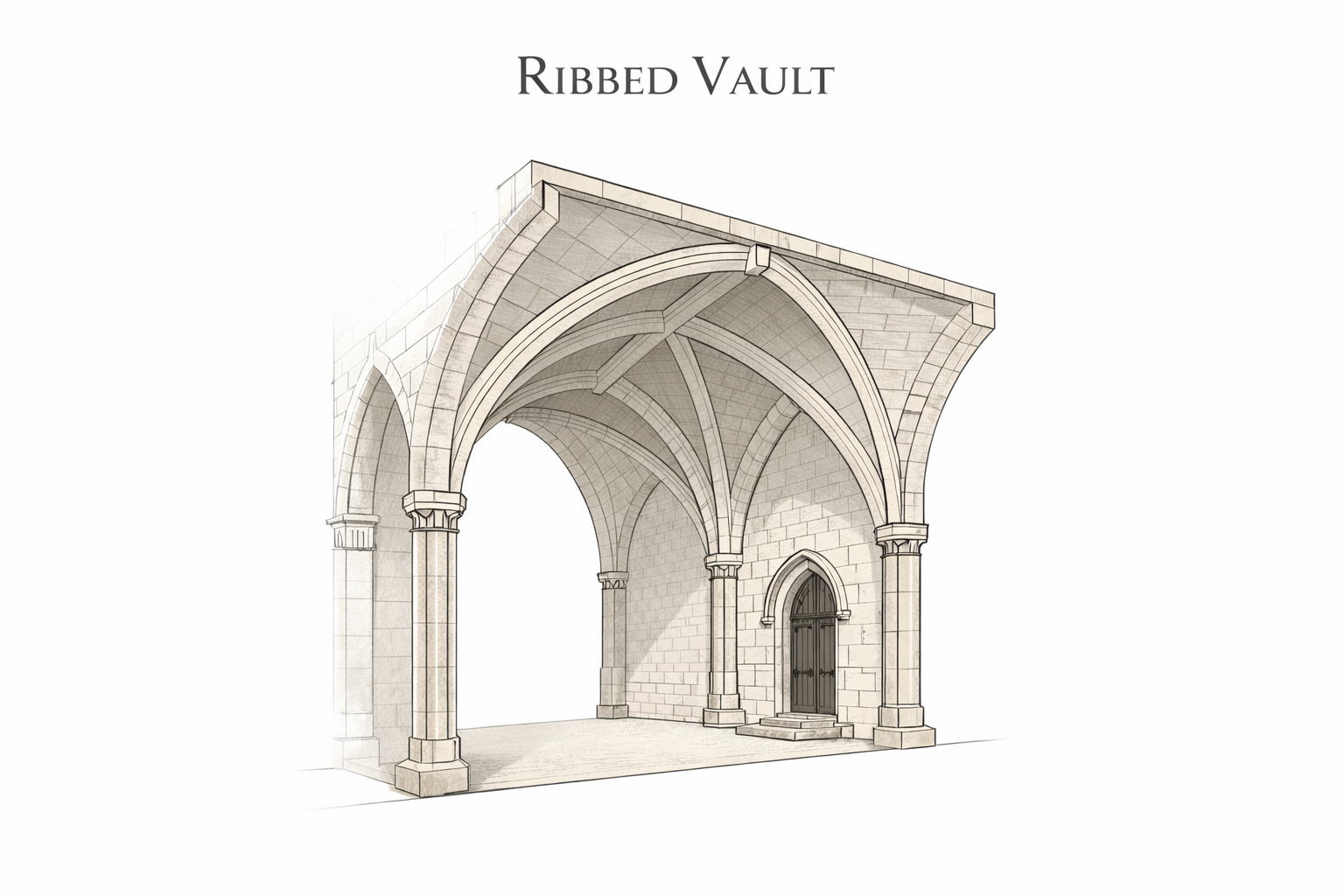
Illustration by ArchitectureCourses.org. A ribbed vault structure showing how intersecting ribs organize the ceiling and carry loads to the supports.
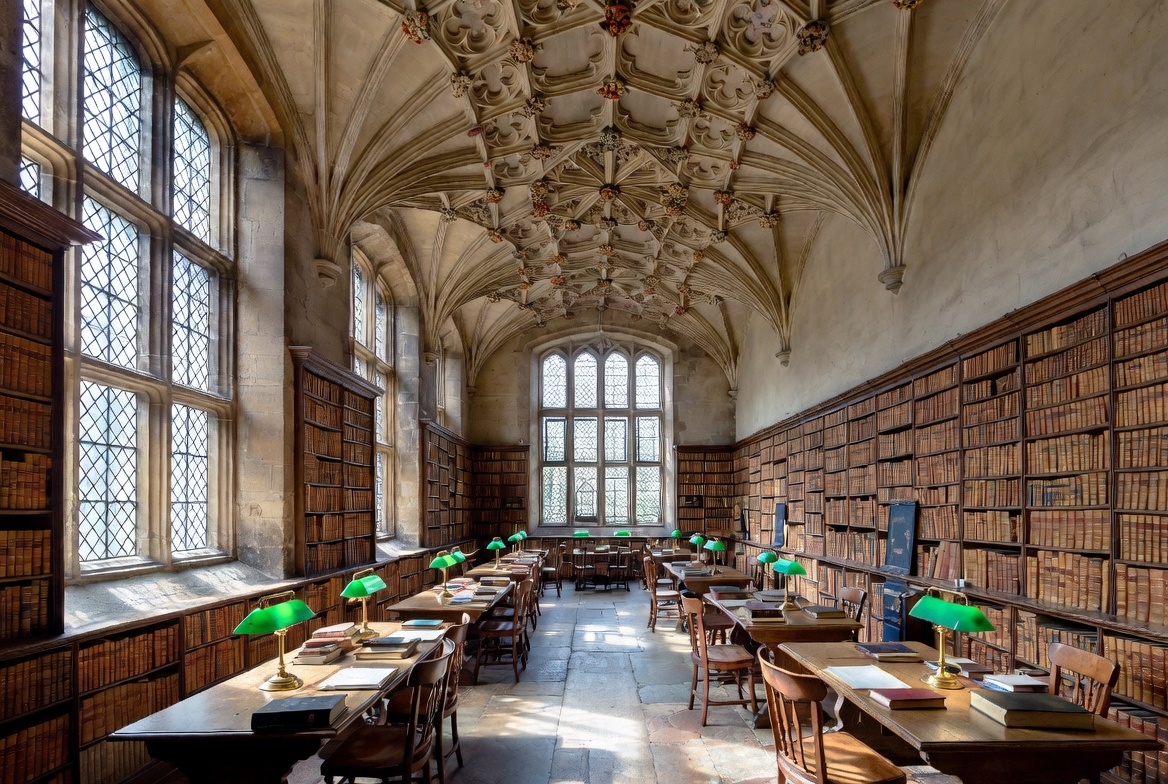
Image by ArchitectureCourses.org. A Gothic interior with pointed arches and vaulting, showing how the ribbed ceiling shapes the room.
Buttressing
Buttressing is one of the key Gothic elements even when the reader does not notice it first.
Once vaults and roofs push outward, the building has to answer that force. Buttressing is part of that answer. It helps move structural pressure away from the wall line and into a broader support system.
That matters because it changes what the wall can be. More opening. Less blunt mass. More light. More articulation.
It is also one reason Gothic facades often feel lighter than the material should allow. The building is still heavy. It is just being handled more strategically.
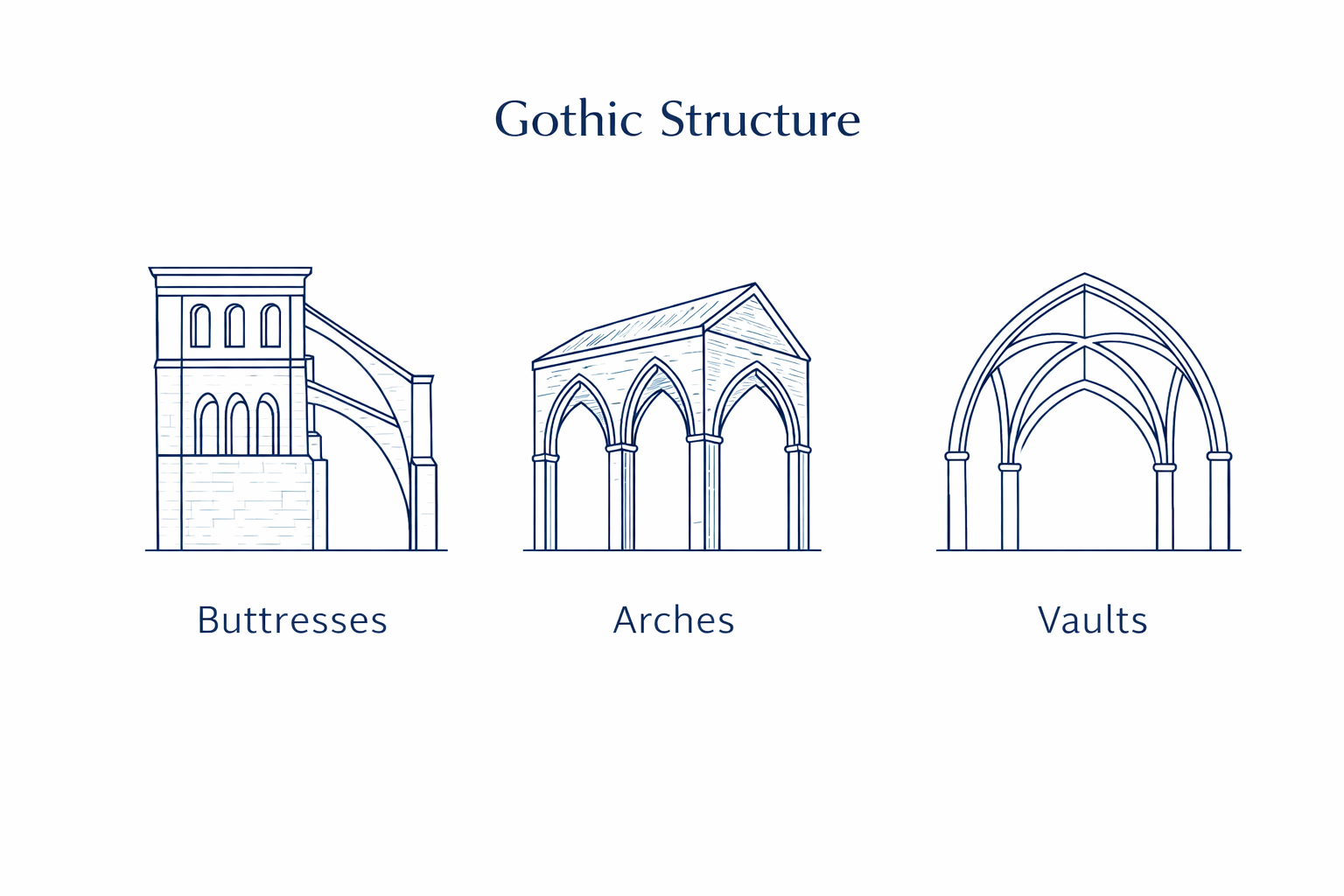
Illustration by ArchitectureCourses.org. Simplified Gothic structure showing arches, vaulting, and buttressing working together as one system.
Tracery
Once openings grow larger, the edge of the opening becomes much more important.
That is where tracery starts doing real work. It divides a large opening into smaller fields, gives the facade finer grain, and turns a raw opening into something shaped and resolved.
Good tracery is not decoration pasted on top of a window. It is part of the opening itself. That is why it matters so much in Gothic architecture. It connects structure, surface, and light at the same time.
For the deeper support page, use Gothic Tracery.
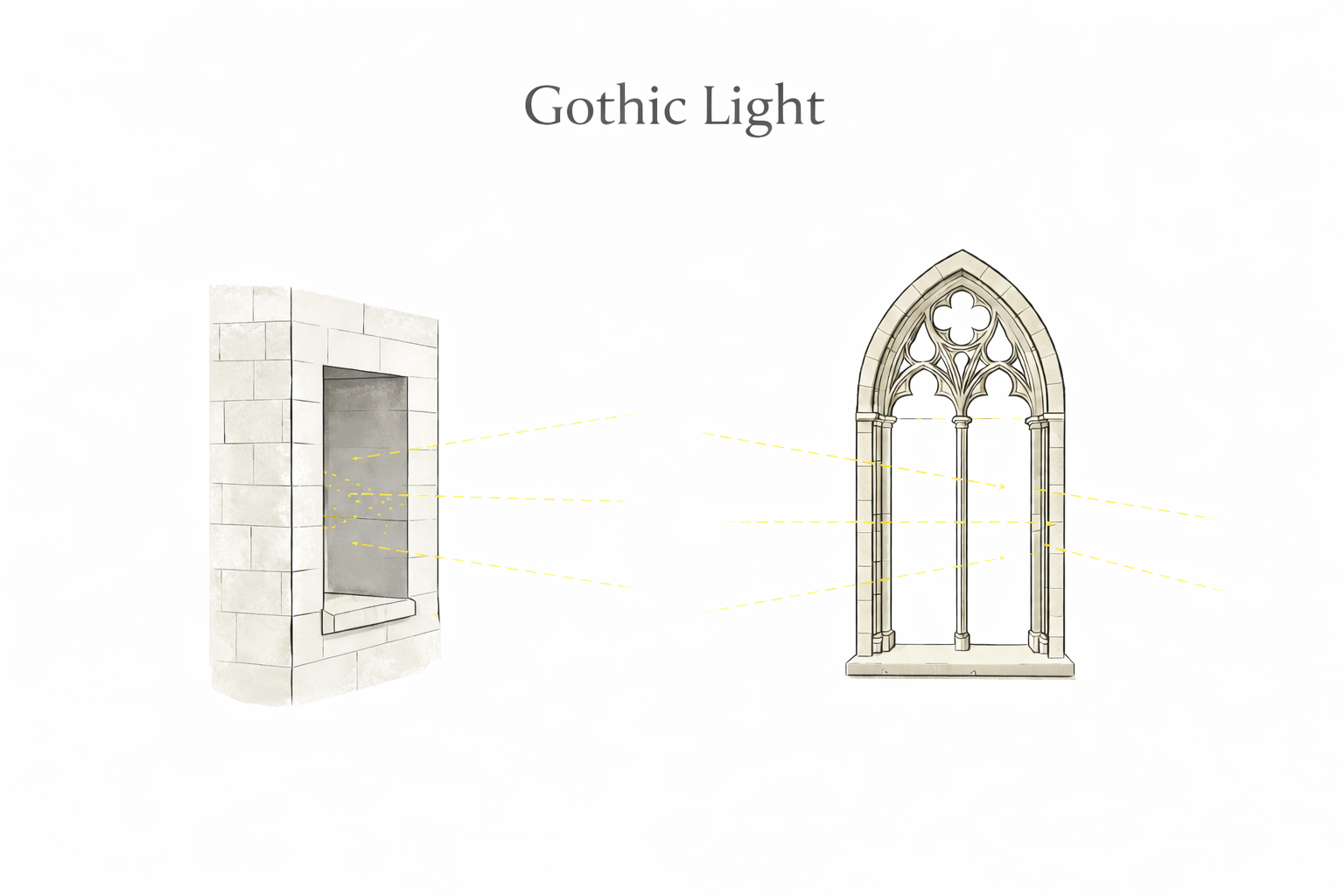
Illustration by ArchitectureCourses.org. A plain wall opening compared with a Gothic tracery opening, showing how tracery changes light, depth, and surface rhythm.
Lighter Wall Zones
This is one of the most important Gothic elements, even though it is not one object you can point to.
Earlier heavy masonry traditions often depend on thick wall presence. Gothic starts loosening that. The facade becomes less about one continuous load-bearing mass and more about the relationship between supports, openings, patterns, and vertical divisions.
That shift is one reason Gothic architecture feels so different from Romanesque even when they share some broad medieval DNA. The wall is still there. It just is not being asked to do everything in the same blunt way.
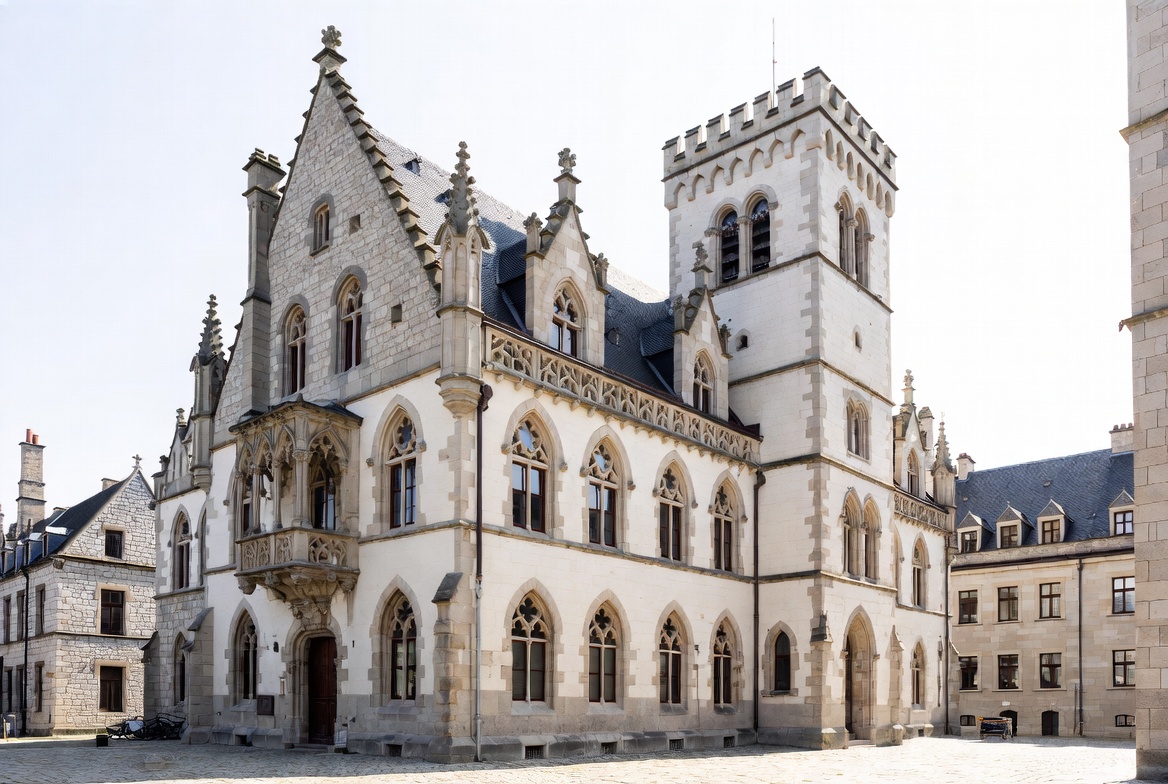
Image by ArchitectureCourses.org. A Gothic civic building with pointed windows, tracery, and steep rooflines, showing how much of the facade can shift from blank wall to articulated opening.
Windows And Light
Windows in Gothic architecture are not just holes cut into stone.
They are stretched, framed, patterned, and often grouped to reinforce the building’s upward movement. Even when the glazing is simple, the opening itself is carrying design weight.
This is why Gothic buildings often feel more luminous even before you start talking about color or decoration. The facade has been reorganized to give light more room.
That is also why openings and tracery need to be read together. The size of the opening changes the wall. The tracery changes how the opening feels from both inside and outside.
Gables, Towers, Pinnacles, And The Skyline
Some Gothic elements do most of their work from a distance.
Gables sharpen the roof edge. Towers reinforce the vertical pull. Pinnacles keep the skyline from going flat. Together they make the top of the building active instead of blunt or dead.
This is one reason Gothic architecture reads so clearly from across a square or down a street. You can feel the style before you inspect the moldings.
The skyline is one of the things that helps the whole building cohere. The lower facade starts the upward motion. The top of the building finishes it.
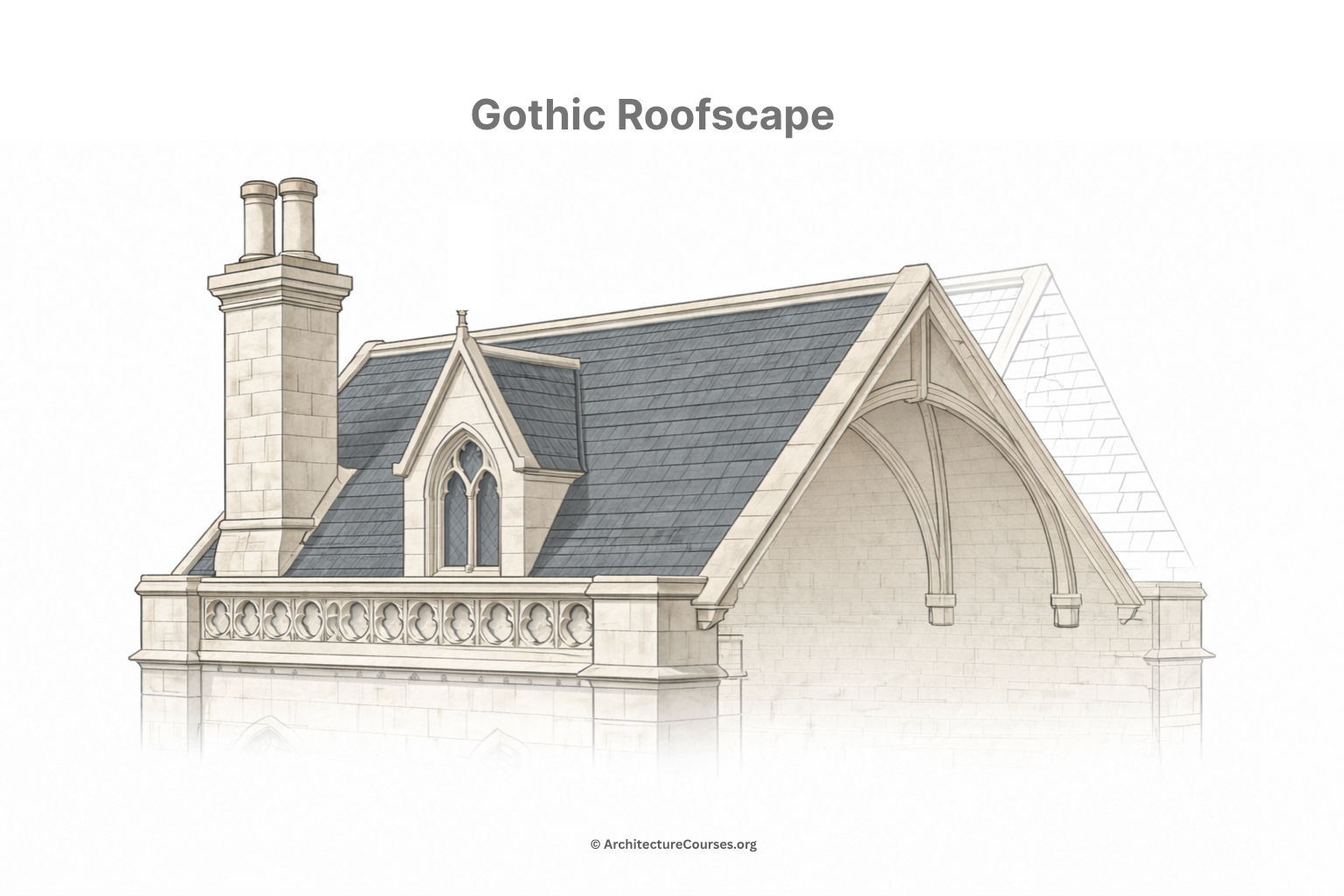
Illustration by ArchitectureCourses.org. A Gothic roofscape with steep pitch, dormers, chimneys, and pointed gable detailing.
Layered Edges, Moldings, And Carved Profiles
Not every Gothic element is a major structural move.
Some work at the scale of the edge. Openings get layered profiles. Doorways deepen. Molding lines multiply. Carving sharpens corners and transitions. These details do not carry the whole building, but they make the larger system read more clearly.
This is where Gothic can become very rich without falling apart. The detail usually reinforces the main direction of the building instead of fighting it.
Exterior And Interior Need To Agree
One of the strengths of Gothic architecture is that the exterior and interior are usually speaking the same language.
The opening rhythms outside are echoed in the structure inside. The roofline’s upward push is matched by the ceiling’s internal logic. The facade’s articulation is not random because the room behind it is often organized with similar discipline.
That is why Gothic buildings can feel coherent even when they are visually dense. The parts are related.
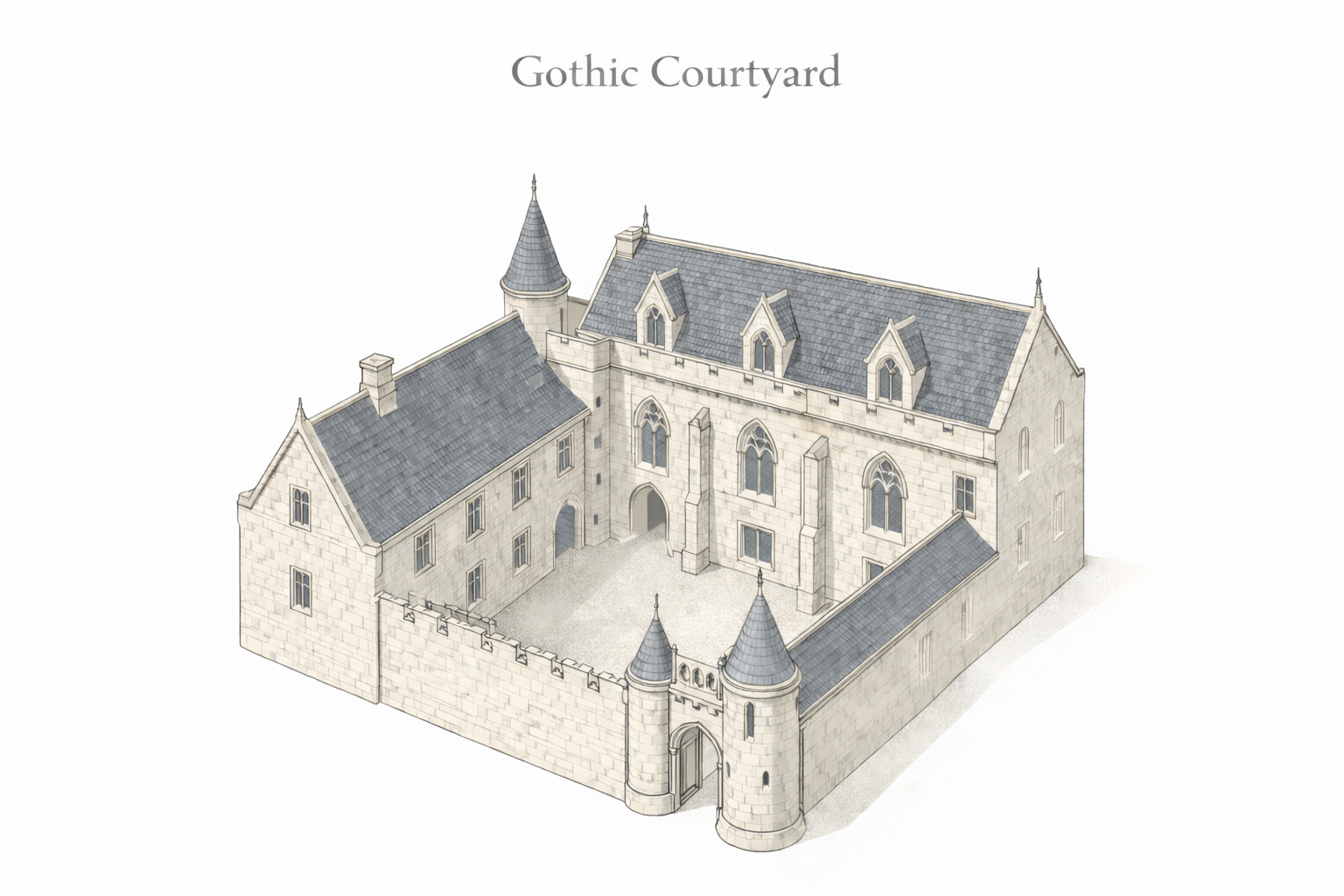
Illustration by ArchitectureCourses.org. An axonometric Gothic courtyard showing enclosure, roof massing, towers, and pointed openings working together.
Secular Buildings Show The Elements Clearly
This matters because Gothic elements are often easier to understand in secular buildings than people expect.
Town halls, castles, palaces, courts, colleges, guild halls, and urban houses all use the same language in different ways.
Brussels Town Hall is useful for reading vertical rhythm, skyline work, and public facade control. The Doge’s Palace in Venice is useful for seeing how arcades, tracery, and lighter surfaces can change the whole feel of Gothic architecture. Ca’ d’Oro shows the language at urban domestic scale. Lübeck Town Hall and Albrechtsburg Castle show how Gothic elements work in civic and fortified settings.
These examples matter because they stop the page from turning into one repeated building type. They show the range of the elements themselves.
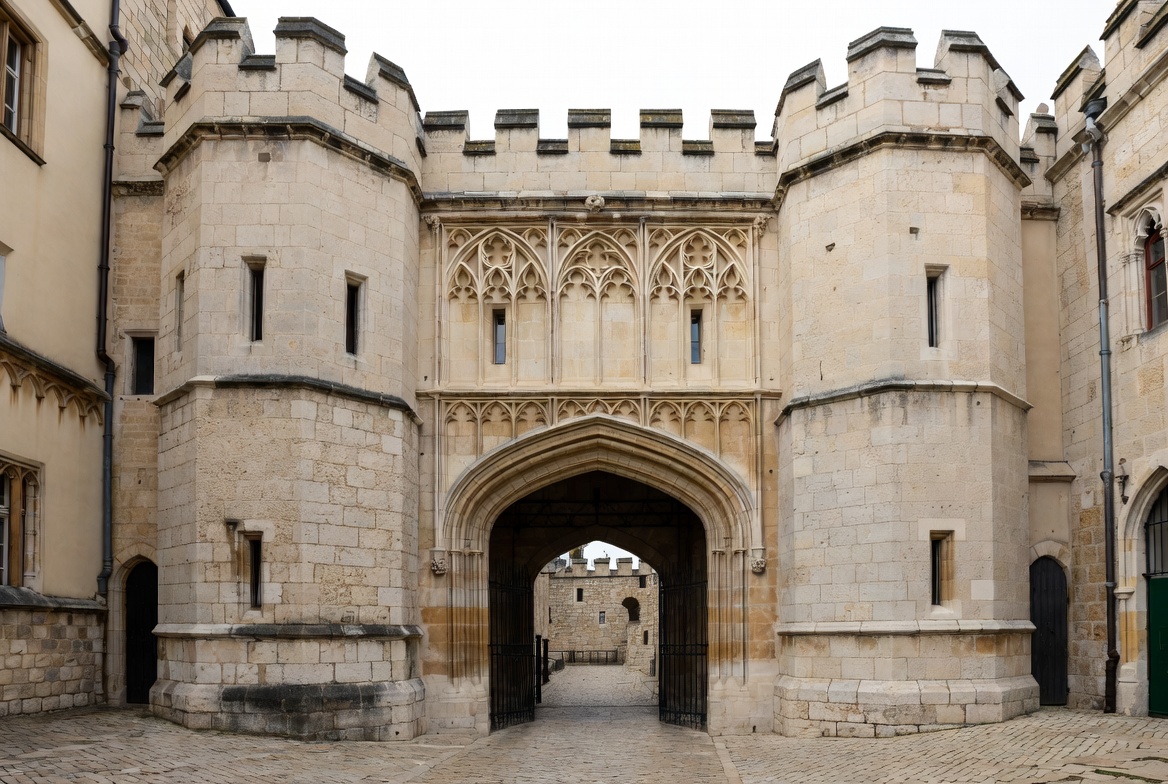
Image by ArchitectureCourses.org. A secular Gothic gatehouse with pointed arch entry, towers, and strong stone massing.
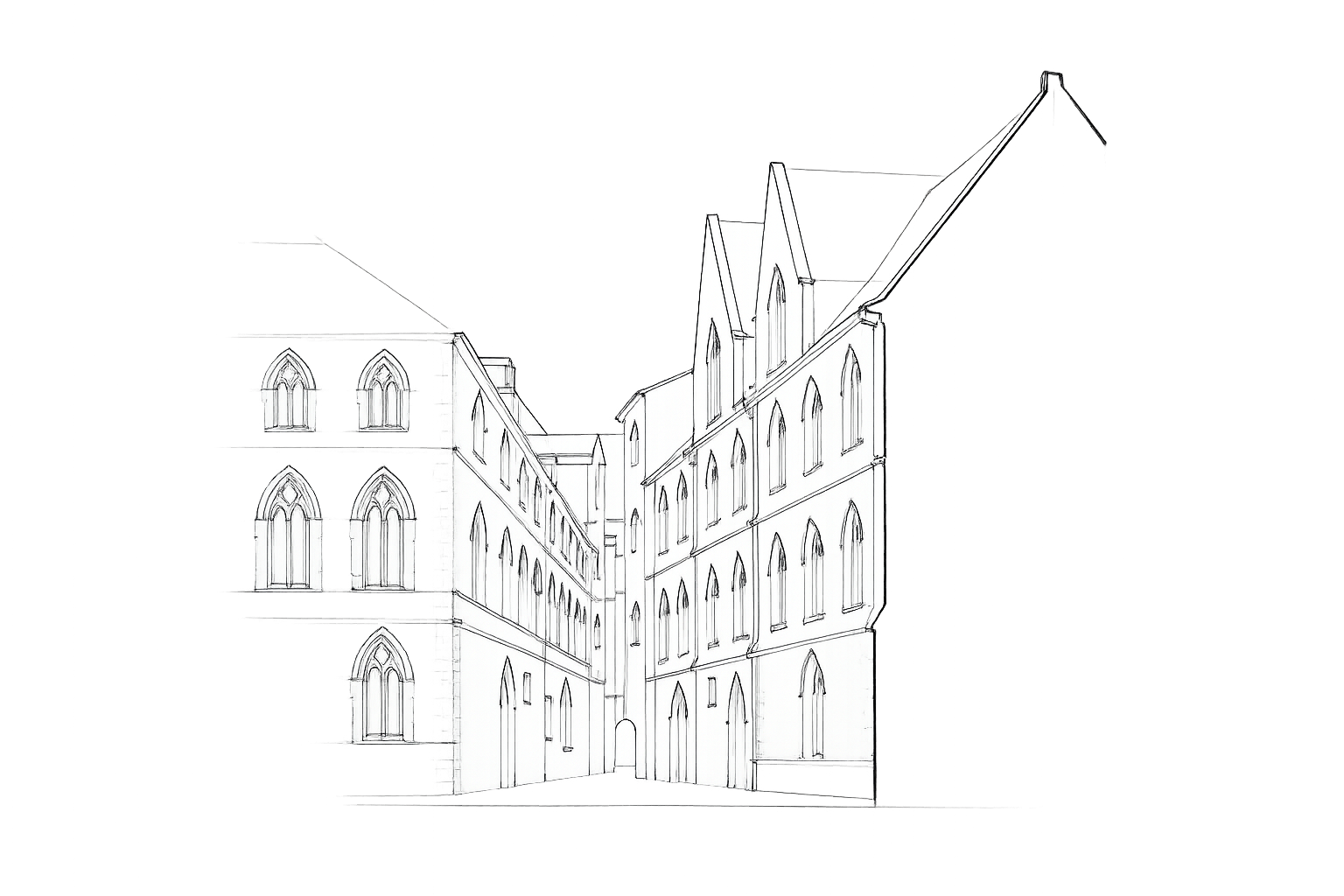
Illustration by ArchitectureCourses.org. A secular Gothic street with repeated pointed-window facades and narrow urban proportions.
How The Elements Shift By Region
Gothic elements do not look exactly the same everywhere.
French Gothic often feels more axial and disciplined. English Gothic can lean more into prolonged linear development and, later, more elaborate vaulting. German Gothic can push mass, height, and urban scale differently. Venetian Gothic often feels lighter, more open, and more tied to trade-city facades and surface rhythm.
The family resemblance stays. The accent changes.
That is why the regional pages matter: French Gothic Architecture, English Gothic Architecture, and Gothic Architecture in Germany.
Where People Flatten The Elements
The first mistake is reducing Gothic architecture to pointed arches alone.
The second is separating ornament from structure too cleanly, as if one is serious and the other is superficial.
The third is treating all Gothic buildings as if they use the same element mix at the same intensity.
A better method is simpler. Read the opening. Read the wall. Read the ceiling. Read the skyline. Then see how the smaller details reinforce those larger moves.
Quick Element Checklist
If you need a fast read on site, use this order:
- Are the main openings pointed?
- Do the windows stretch upward rather than sit broad and low?
- Is there tracery or another patterned division inside the opening?
- Does the ceiling show ribs or vault structure?
- Does the facade feel more open and articulated than one heavy wall mass?
- Do the roofline and skyline keep pulling the eye upward?
That sequence catches most of the essential elements quickly.
Read This Next
For the broad starter page, go to Introduction to Gothic Architecture.
For the fast recognition page, use Characteristics of Gothic Architecture.
For the structural side, go to Gothic Structures.
For the broader language of the style, use Gothic Architecture Style.
For the historical development, go to History of Gothic Architecture.
FAQ
What Are The Main Gothic Elements In Architecture?
Pointed arches, ribbed vaults, buttressing, tracery, lighter wall zones, and active rooflines do most of the work.
Is Tracery Only Decorative?
No. It refines the opening, shapes light, and helps large window zones feel controlled instead of blank.
Are Gothic Elements Structural Or Decorative?
Both. Some elements carry loads more directly, while others shape surface, light, and rhythm. In strong Gothic architecture, they work together.
Did Secular Buildings Use Gothic Elements Too?
Yes. Town halls, castles, palaces, colleges, courts, and urban houses all used Gothic elements in different combinations.
Why Do Gothic Elements Read So Clearly From Far Away?
Because the silhouette, openings, and skyline are all reinforcing the same upward movement before the smaller details even come into focus.
Why Do Gothic Elements Still Matter?
Because they show how structure, openings, surface, and light can be coordinated into one architectural language instead of treated as separate problems.