
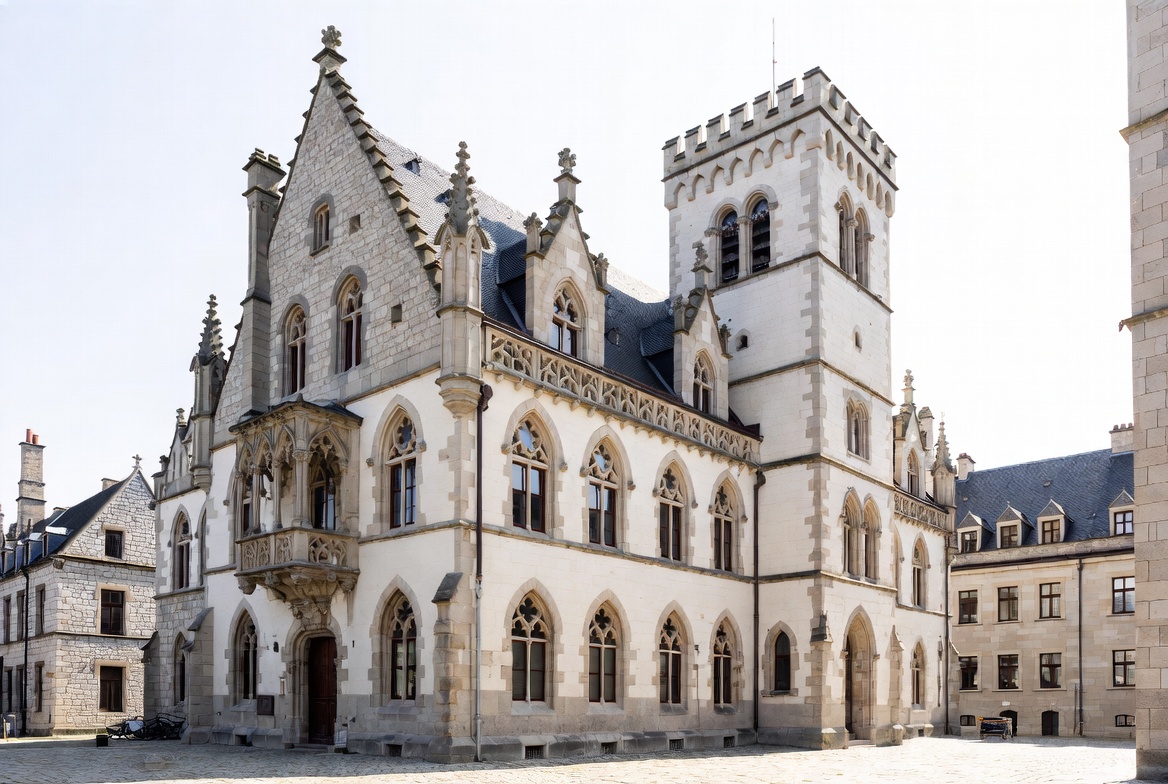
Gothic style reads fast once you know what to look for.
It is not just the pointed arch. It is the whole building: sharper rooflines, taller proportions, deeper openings, more carved edges, and a wall that feels lighter and more worked than the heavy masonry that came before it.
That is why Gothic still stands apart. The style pulls upward, but it also stays controlled. The parts repeat, line up, and reinforce each other instead of drifting into decoration for its own sake.
Read This Next: Introduction to Gothic Architecture for the broader shift behind the style, Characteristics of Gothic Architecture for the faster recognition guide, and Gothic Structures for the structural side of the system.
Read The Building Before The Details
Step back first.
A Gothic building usually announces itself from a distance. The silhouette rises. The roofline sharpens. Towers, gables, and pinnacles keep the top edge active. The façade does not sit flat. It lifts in stages.
You can often read that before you are close enough to inspect carving, tracery, or mouldings.
A building can borrow pointed windows and still not read as Gothic. The style only lands when the massing, the wall, the openings, and the skyline are all moving in the same direction.
That direction is upward, but not only upward. Gothic style also breaks a large wall into smaller, more articulate parts. It wants depth in the opening. Pattern in the surface. Structure that shows enough to shape the composition.
What Makes A Building Read As Gothic
| Style Move | How It Reads | What It Does To The Building |
|---|---|---|
| Vertical emphasis | The eye keeps moving upward | Makes the building feel taller, leaner, and more driven |
| Pointed openings | Sharper, less blunt than rounded forms | Changes the mood and the proportions at once |
| More open wall zones | Less blank masonry, more window and tracery | Lightens the façade and breaks up heavy mass |
| Ribbed ceilings and vaulting | The ceiling has visible structure and direction | Turns the interior into part of the style, not just enclosure |
| Tracery and patterned surfaces | Openings become shaped fields instead of empty cuts | Adds precision and finish without losing clarity |
| Legible support | The building looks carried rather than packed solid | Lets the wall open up and the silhouette get lighter |
The Building Wants To Rise
This is one of the strongest Gothic instincts.
Piers get slimmer. Openings stretch. Rooflines sharpen. Towers and pinnacles reinforce the same pull. Even a smaller Gothic building can feel taller than it is because the composition keeps directing the eye higher.
That is not only about height. It is about control. A Gothic façade often feels organized around ascent. Lower elements carry the upper ones. Openings stack in a readable rhythm. The skyline does not just end. It finishes with intent.
That is why the style can feel forceful without becoming clumsy. The verticality is not random exaggeration. It is structured.
The Wall Stops Doing Everything Alone
This is where Gothic style starts to pull away from earlier heavy masonry traditions.
The wall does not disappear, but it stops behaving like one blunt block carrying the full burden and doing all the visual work at the same time.
Support becomes more articulated. The wall opens up more. Openings grow larger and deeper. Tracery starts refining what would otherwise be a raw void in the façade.
The result is one of the clearest Gothic effects: the building feels lighter without pretending that the material is light. Stone still reads as stone. Mass still reads as mass. But the composition is more open, more divided, and more legible.
That shift is one reason Gothic style stays memorable. It gives masonry a more active face.
Pointed Arches Matter, But They Need Help
The pointed arch is one of the clearest Gothic signals.
It changes the shape of windows, portals, arcades, galleries, and vaults. It sharpens the whole profile of the building.
But it is not enough on its own.
A single pointed opening does not create Gothic style any more than a single column creates classicism. The arch needs the right proportions around it. It needs reinforcement from the wall rhythm. It needs a façade and roofline that support the same sense of lift.
That is why some revival work feels convincing and some does not. The arch is easy to borrow. The larger language is harder.
Openings Are Never Just Holes In A Wall
Gothic openings are shaped, stretched, framed, and divided. They are treated as major design events, not just functional cuts through masonry.
Tracery is a big part of that. It breaks a large opening into smaller shapes and rhythms. It gives the façade finer grain. It keeps large glazed or open zones from feeling empty.
Good tracery does not read like decoration pasted over an opening. It completes the opening. It gives it structure, proportion, and finish.
That is one reason Gothic can move between severity and delicacy so well. A façade can still have real mass and authority while the openings stay light and refined.
For the narrower detail page, go to Gothic Tracery.
The Roofline Carries A Lot Of The Style
Gothic style is not confined to the wall face.
Gables sharpen the top edge. Towers anchor the vertical pull. Pinnacles keep the skyline from going dead. Even when the lower façade is heavy, the upper outline can keep the whole composition moving upward.
This is why Gothic often reads so strongly from a distance. You are not seeing tracery first. You are seeing silhouette.
Later revival architects understood that. Even when they were not reconstructing medieval structural logic in a strict way, they knew the roofline and skyline could carry a huge part of the style.
The Interior Follows The Same Logic
The interior is not a separate subject.
The same impulses that shape the exterior show up inside. Vertical pull. More open wall zones. More visible structure. More patterned surfaces. More depth and direction in the room.
Ribbed ceilings are part of that. So are taller proportions and stronger lines moving across the interior. The room does not feel accidental. It grows out of the same logic that shapes the façade.
That is why Gothic interiors often feel composed even when they are visually rich. The structure is helping organize the style instead of fighting it.
For the interior-focused page, use Interior Design in Gothic Architecture.
Secular Gothic Opens The Style Up
If Gothic is explained only through the same familiar monumental examples, the style starts to feel narrower than it was.
Secular Gothic fixes that. Town halls, palaces, guild halls, cloth halls, gatehouses, colleges, courts, and urban houses all carried Gothic language in different ways.
Brussels Town Hall is one of the strongest civic examples. The tower controls the skyline. The façade is busy, but not loose. The vertical force is clear from a distance.
The Doge’s Palace in Venice shifts the style toward something lighter and more open. It still reads as Gothic, but not as a northern stone formula. The rhythm is different. The surface is more open. The city around it changes the style.
Ca’ d’Oro pushes Gothic into an elite urban house. Siena’s Palazzo Pubblico turns it into civic identity. Albrechtsburg Castle shows the style working in a princely residence. The Town Hall of Lübeck shows what happens when Gothic settles into a mercantile city.
Once you look at buildings like these, the style stops feeling repetitive. It becomes broader, more adaptable, and more alive.
Why French Gothic, English Gothic, And Venetian Gothic Do Not Feel The Same
Because they are not solving the same local problem with the same local material in the same local city.
Materials change style. Climate changes style. Craft traditions change style. Urban conditions change style. Patronage changes style.
French Gothic often feels more disciplined and axial. English Gothic can feel more prolonged and linear. German Gothic can push mass and height differently. Venetian Gothic opens toward trade, lighter surfaces, and a Mediterranean setting.
The family resemblance stays, but the accent changes.
That is why a good style page explains the shared language without pretending all Gothic looks alike.
The regional pages should carry that further: French Gothic Architecture, English Gothic Architecture, and Gothic Architecture in Germany.
Proportion Is A Big Part Of The Style
Gothic style is not only about parts. It is also about how those parts are proportioned against each other.
Openings are often narrower and taller. Vertical divisions are stressed more than horizontal ones. The façade is broken into stages, but those stages usually reinforce ascent instead of fighting it.
Even when a façade is broad, Gothic proportion tries to keep the composition from sagging. The building can be large without feeling flat. Busy without feeling thick. Rich without losing direction.
That is one reason later copycat versions often fail. They borrow motifs without getting the proportions right.
Why Gothic Style Returned Later
Because the style had enough force to survive translation.
Later revival work did not always revive the whole medieval structural system. Sometimes it borrowed the silhouette. Sometimes the vertical pull. Sometimes the asymmetry, roofline, and patterned openings. Sometimes the public seriousness the style could project.
That is why Gothic Revival is not a side note. It is part of the afterlife of the style.
Strawberry Hill shows one domestic version. St Pancras shows another at a much larger urban scale. Manchester Town Hall shows how Gothic language could still project authority in a civic setting centuries later.
That is the handoff point for Gothic Revival Architecture and later Victorian Gothic Architecture.
Where The Style Gets Misread
First, people reduce Gothic style to pointed arches.
Second, they talk about ornament as if the structure underneath does not matter.
Third, they act as if the whole style belongs to one repeated set of buildings and one repeated mood.
That is where the page goes dull.
A better read is simpler. Look at the massing. Look at the wall. Look at the openings. Look at the roofline. Then look at how the details sharpen what the building has already started doing.
Why The Style Still Holds Up
Gothic style lasts because it has backbone.
It is not memorable only because it looks dramatic. It holds up because the visual language grows out of structural and spatial changes strong enough to carry meaning.
It gives buildings a clearer skeleton. It gives façades more rhythm. It makes height feel controlled instead of clumsy. It lets mass feel lighter without pretending the building is weightless.
That is why the style can be adapted, revived, borrowed, or translated and still keep force.
Read This Next
For the broad starter page, go to Introduction to Gothic Architecture.
For the faster recognition page, use Characteristics of Gothic Architecture.
For the structural side, go deeper with Gothic Structures.
For the timeline and development story, use History of Gothic Architecture.
And once the newer pages are live, the strongest next jumps will be French Gothic Architecture, English Gothic Architecture, Romanesque vs Gothic Architecture, and Gothic vs Renaissance Architecture.
FAQ
What Defines Gothic Architecture Style?
Vertical emphasis, pointed openings, lighter wall zones, tracery, buttressing, and a sharper silhouette do most of the work.
Is Gothic Style Just Decorative?
No. The style works because the structure, the openings, and the façade rhythm support each other.
How Is Gothic Different From Romanesque?
Romanesque tends to feel heavier and rounder. Gothic feels sharper, more open, and more strongly pulled upward.
Did Gothic Style Shape Secular Buildings Too?
Yes. Town halls, palaces, guild halls, colleges, courts, and urban houses all carried Gothic language in different ways.
Why Does Gothic Look Different From One Region To Another?
Because local materials, climate, craft traditions, and urban conditions changed how the style was adapted.
Why Did Gothic Return In Later Centuries?
Because its visual language stayed powerful. Later architects kept reusing its vertical pull, rooflines, openings, and public presence.