
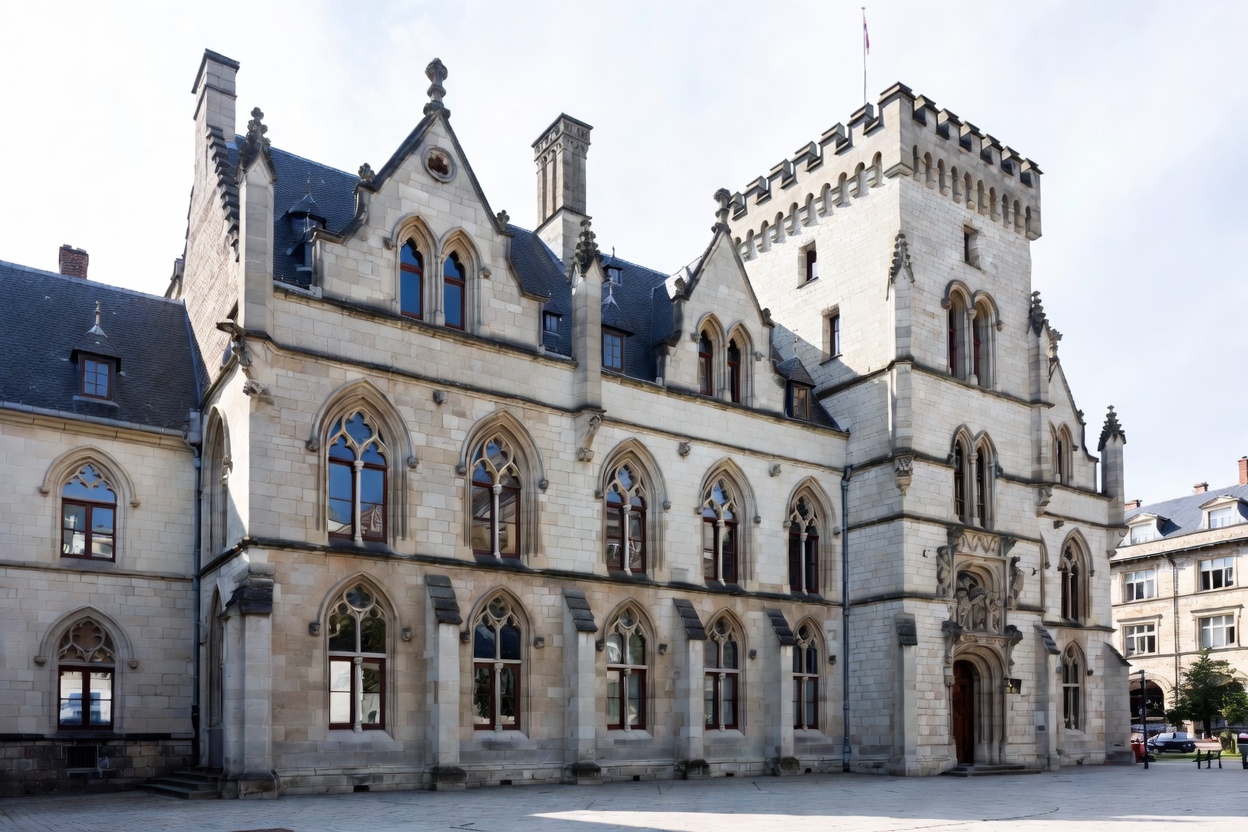
Image by ArchitectureCourses.org. A Gothic building with pointed windows, tracery, and steep rooflines.
Gothic architecture changed what masonry buildings could do.
It pushed height, light, and span farther without asking thick walls to do all the work alone. That is the real shift. Pointed arches, rib vaults, tracery, and buttressing matter because they solved that problem while giving the style its sharp upward pull.
Read Gothic that way and it stops looking like a list of old features. It starts reading as a structural system with a clear visual effect: more lift, more daylight, less dead weight in the wall, and more reach than earlier masonry systems could manage.
It also does not stay fixed in one form. The logic holds, but the proportions, details, and overall character shift from place to place and period to period.
Read This Next: Gothic Architecture Style for the broader language of the style, Characteristics of Gothic Architecture for faster visual recognition, and Gothic Structures for the structural side of the system.
What Changed
Earlier medieval masonry could be powerful, but it often leaned on thick wall mass, smaller openings, and heavier visual weight.
Gothic did not throw masonry away. It reorganized it.
Pointed arches gave builders more freedom in span and height. Rib vaults turned the ceiling into a readable framework instead of one continuous shell. Buttressing shifted support outward. Larger openings became possible because the wall was no longer being asked to do everything by itself.
The result was not just taller buildings. The result was a new kind of space.
Interiors could feel more open. Façades could feel more layered. The whole building could read as a system of lines, forces, and openings instead of a heavy block with holes cut into it.
| Shift | What You See | Why It Matters |
|---|---|---|
| Pointed arches | Sharper openings and stronger upward pull | More freedom in height, span, and proportion |
| Rib vaults | Ceilings read as a framework | Loads are organized more clearly across the roof structure |
| Buttressing | Support moves beyond the wall face | Walls can open up more without losing stability |
| Larger openings | More glass, more pattern, less blank wall | Light and façade composition both change |
| Vertical emphasis | The building seems to rise | Mass feels lighter and more directional |
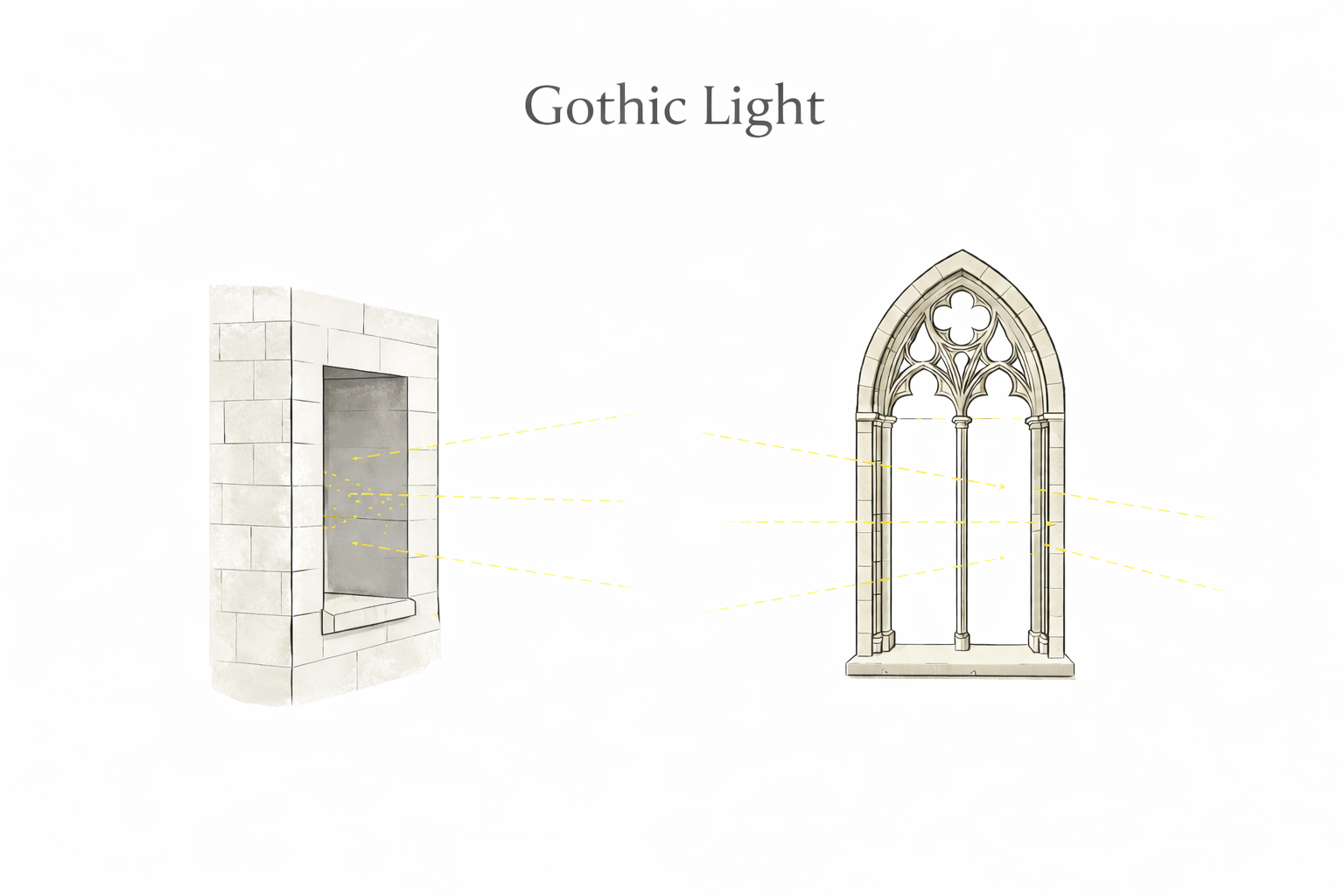
Illustration by ArchitectureCourses.org. A plain wall opening and a Gothic tracery opening compared. The Gothic version shows how opening shape changes light, depth, and the way the wall reads.
What Gothic Architecture Is
At the broadest level, Gothic architecture is a medieval building language built around height, skeletal support, larger openings, patterned surfaces, and strong vertical emphasis.
That definition is better than saying Gothic is “architecture with pointed arches.” Pointed arches matter, but they are not enough on their own.
Gothic is a system. The structure, the openings, and the visual rhythm are all tied together.
That is why the style still reads so clearly now. You do not need a specialist’s vocabulary to feel the difference. A Gothic building pulls the eye upward. It breaks wall mass into more articulate parts. It gives the roof and ceiling a more visible logic. It makes the façade feel active rather than inert.
Some Gothic buildings are spare. Some are dense with pattern. Some feel severe. Others feel delicate. The range is wide, but the underlying logic still holds.
The First Things To Notice
Pointed Arches
This is the clearest entry point.
Pointed arches change both the look and the behavior of the building. They can rise higher, adapt more easily to different widths, and direct force more flexibly than a rounded arch. They also sharpen the whole mood of a façade or interior.
Rounded arches feel grounded. Pointed arches feel tensile. That difference matters before you even get into the engineering.
Rib Vaults
Rib vaults are where the ceiling starts to read as structure instead of just enclosure.
The ribs define the geometry of the space. They show how the ceiling is organized. They give the roof a visible order that earlier heavy vaulting often hides.
This is one reason Gothic interiors feel less static. The ceiling is doing more than covering the room. It is shaping the room.
Buttressing
This is one of the big turning points in the whole story.
When support moves outward, the wall can relax. More openings become possible. Elevations get lighter. The building stops behaving like one continuous mass of masonry.
That is why Gothic can feel lighter even when the material is still heavy stone.
Tracery
As openings grow larger, the edge of the opening becomes more important.
Tracery divides the opening into smaller shapes and patterns. It gives the façade finer grain. It also keeps large openings from looking empty or unresolved.
Good tracery does not just decorate a hole in the wall. It completes the opening.
Vertical Pull
Gothic does not just stand. It rises.
Piers get slimmer. Rooflines sharpen. Gables lift. Window groups stretch upward. Towers and pinnacles reinforce the same movement.
That upward pull is one of the quickest ways to spot the style, even from a distance.
For the shorter feature-led page, see Characteristics of Gothic Architecture. For the deeper details page, go to Gothic Elements in Architecture.
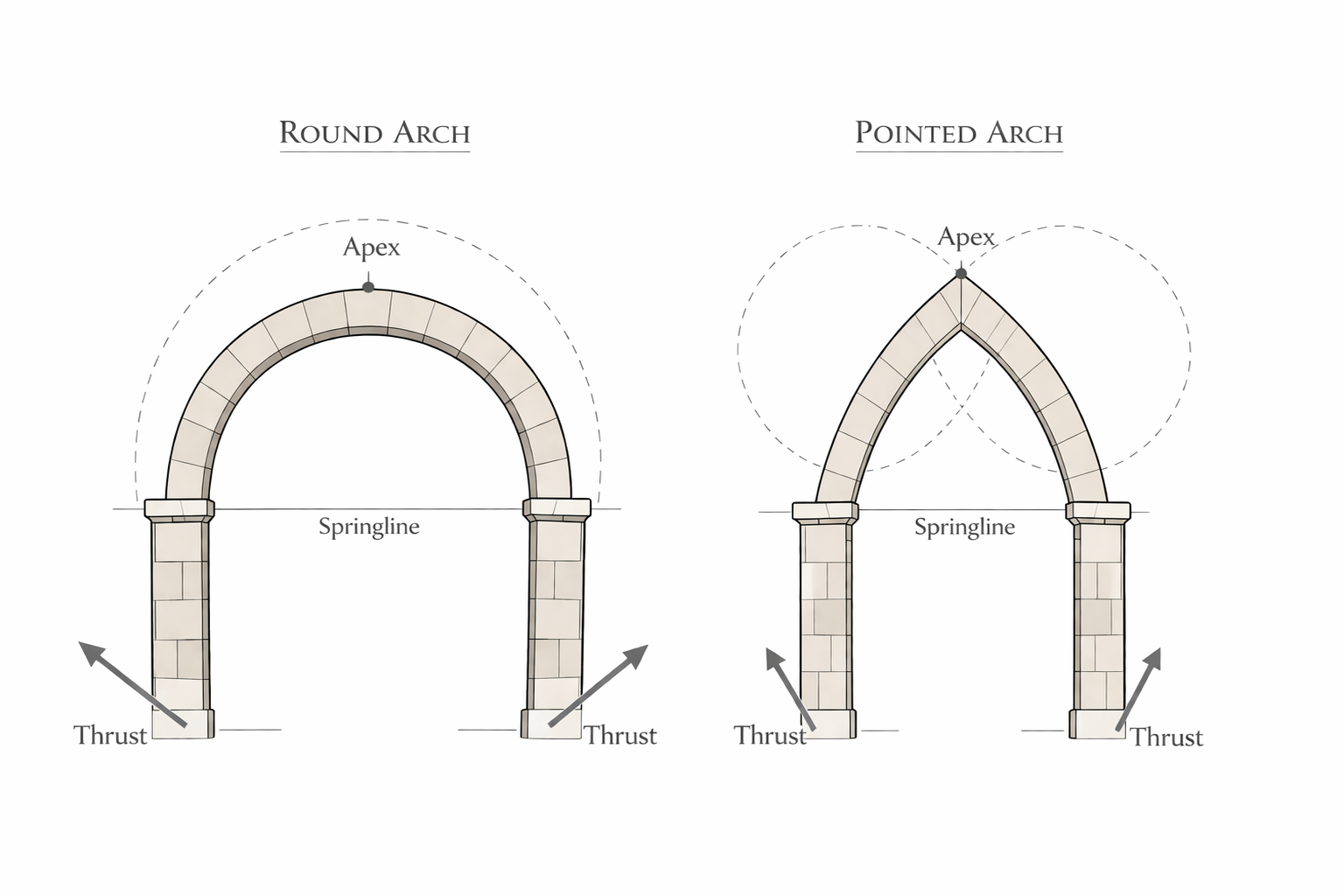
Illustration by ArchitectureCourses.org. Round and pointed arch geometry compared. The pointed profile helps explain why Gothic openings feel sharper and more tensile.
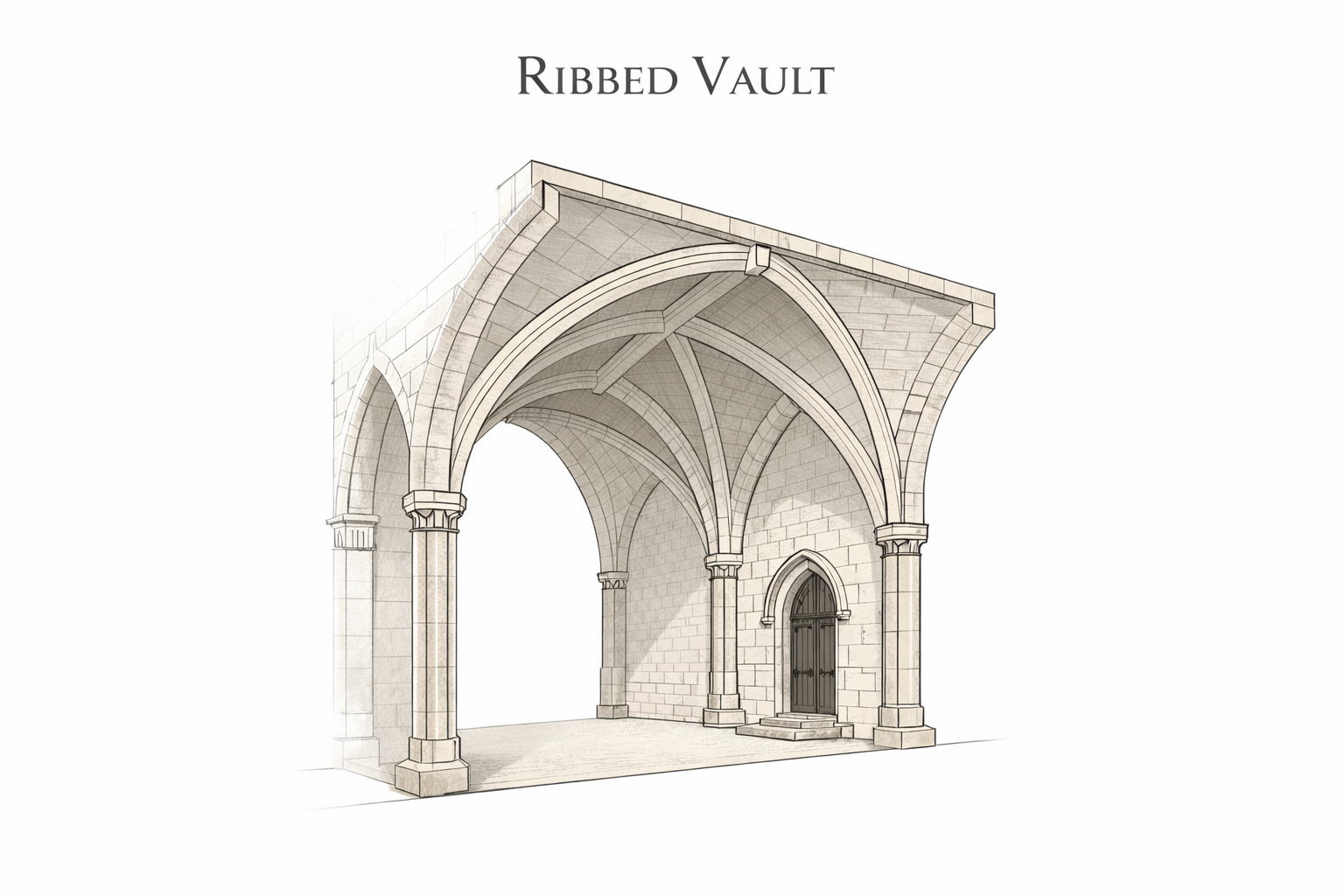
Illustration by ArchitectureCourses.org. A ribbed vault organized by intersecting ribs. It shows why Gothic ceilings feel framed and directional rather than buried inside one heavy shell.
How Gothic Differs From Romanesque
The fastest way to understand Gothic is to put it next to Romanesque.
Gothic grows out of earlier medieval building practice. It does not appear from nowhere. But the shift is still clear enough to read quickly.
Romanesque architecture tends to feel heavier, rounder, and more wall-driven. Gothic feels sharper, more open, and more structured by visible lines of force.
Romanesque openings are smaller. Gothic openings push larger. Romanesque mass sits harder on the ground. Gothic starts to lift. Romanesque rhythm can feel chunkier. Gothic rhythm gets leaner and more vertical.
That is the short version. The fuller comparison belongs on Romanesque vs Gothic Architecture.
It Did Not Stay In One Building Type
This is where broad Gothic pages often lose energy. They keep circling the same narrow set of examples and flatten the style.
Gothic was not confined to one building type. It shaped secular architecture too.
Town halls, guild halls, cloth halls, palaces, gatehouses, colleges, courts, and urban houses all carried Gothic language in different ways. Once you look there, the style gets broader and more interesting.
Brussels Town Hall is one of the clearest civic examples. It shows how Gothic could define an urban public façade with authority and vertical force.
The Doge’s Palace in Venice takes the style in a different direction. It is lighter, more open, and more tied to the rhythm of a mercantile city.
Ca’ d’Oro shows Gothic working at the scale of an elite urban house. It does not read like a copy of northern masonry. It reads like a local adaptation shaped by climate, trade, and craft.
Siena’s Palazzo Pubblico proves the point again. Gothic could define the center of civic life, not just ceremonial architecture.
This matters because it changes how Gothic should be introduced. A good intro should show the style as a broad design language, not trap it inside one repetitive lane.
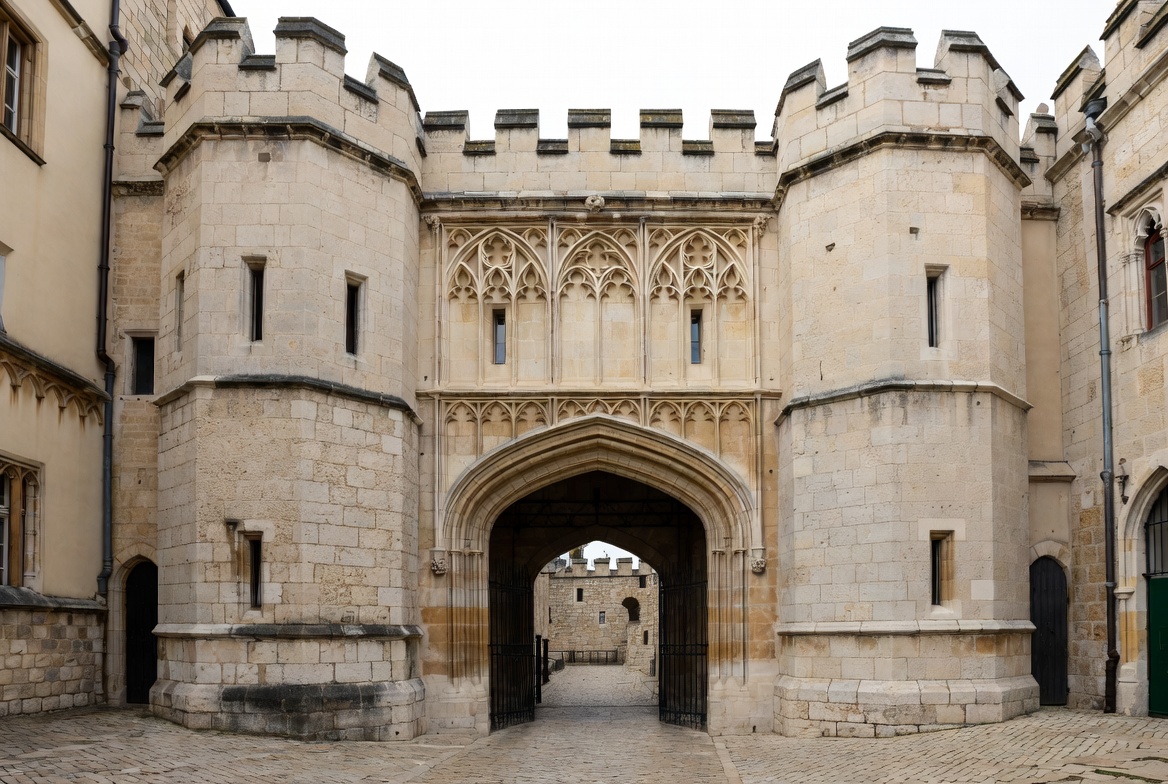
Image by ArchitectureCourses.org. A Gothic gatehouse with a pointed entry, towers, and heavy stone massing. It fits the part of the style that moved into fortified, civic, and palace-related buildings.
Why Region Matters
Gothic never looked exactly the same everywhere.
Local materials changed it. Climate changed it. Craft traditions changed it. Politics changed it. Urban form changed it.
French Gothic leans one way. English Gothic develops a different rhythm and profile. German Gothic pushes the style differently again. Venetian Gothic opens it toward a more mercantile and Mediterranean setting.
That is why one broad intro page can only do so much. It should explain the family, not flatten every region into one image.
The regional splits belong on French Gothic Architecture, English Gothic Architecture, and Gothic Architecture in Germany.
There is also a wider development story behind the style. Gothic did not emerge in isolation from the rest of the Mediterranean world. Trade, contact, and transmission mattered.
That is why Islamic Influences on the Development of Gothic Architecture belongs in the cluster. Not as a slogan page. As a serious page about influence, contact, and development.
How The Style Spread
Gothic spread because it worked.
It gave builders a way to push height, light, and structure further without abandoning masonry. It gave patrons and cities a visual language that could look ambitious, orderly, and memorable. It gave façades a stronger silhouette. It gave interiors more lift.
And once a style carries both structural advantage and visual force, it tends to travel.
Builders adapt it. Patrons ask for it. Local workshops reshape it. Cities claim it as part of their public image. That is how one regional innovation turns into a wider European family of forms.
Why Gothic Came Back Later
Gothic had staying power because it solved more than one problem at once.
It gave architecture a clearer skeleton. It gave façades rhythm. It gave height more control. It gave buildings a sharper profile and more visual tension.
That is why later revival phases kept reaching back to it.
They did not always revive the full medieval system. Sometimes they borrowed the vertical pull. Sometimes the pointed openings. Sometimes the asymmetry, gables, towers, and patterned surfaces. Sometimes the institutional weight.
Strawberry Hill brought one version of that revival into domestic architecture. Manchester Town Hall pushed it into civic expression. St Pancras station and hotel showed how Gothic language could still project force in a new urban age.
That is why Gothic Revival Architecture matters in this cluster, and why Victorian Gothic Architecture deserves its own page instead of being buried inside a narrow interiors angle.
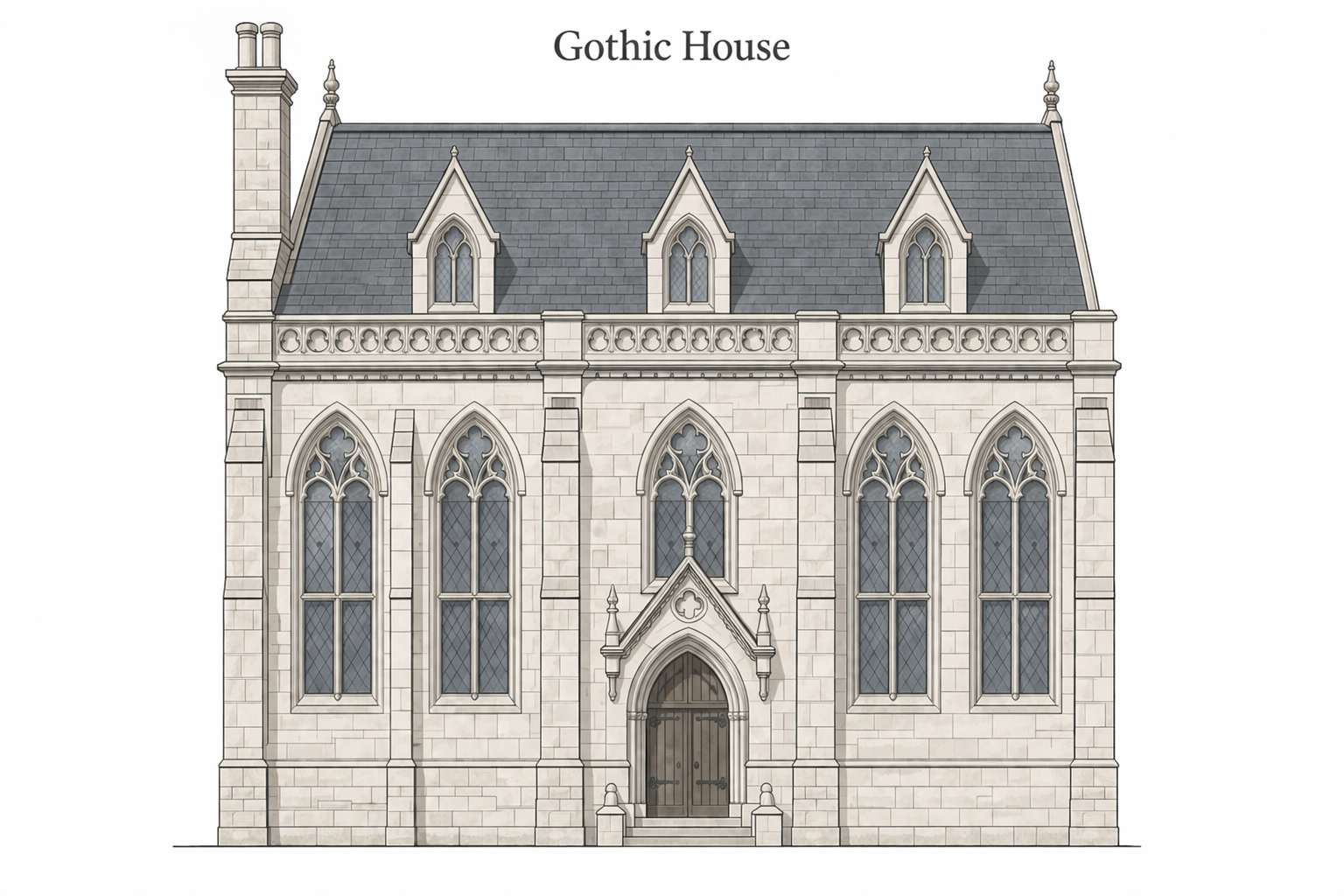
Illustration by ArchitectureCourses.org. A Gothic house front with steep rooflines, pointed openings, and strong vertical rhythm. It fits the domestic side of the style and the revival branch that comes later.
How To Read A Gothic Building Quickly
If you want a fast read on site, use this order.
Look at the arches first. Are they pointed?
Then read the wall. Is it behaving like heavy mass, or more like a supported frame with openings?
Then look for support beyond the main wall line.
Then check the openings. Plain, or patterned with tracery?
Then step back and judge the silhouette. Broad and grounded, or sharply vertical?
That short sequence gets you much further than memorizing isolated terms without knowing what they do.
Why Gothic Still Matters
Because it changed the relationship between structure and appearance.
It showed that a masonry building could be more open without losing force. It showed that height did not have to mean blunt mass. It showed that structure could generate visual language instead of sitting behind it.
That is a long afterlife. One that reaches beyond the medieval period and beyond revival phases too.
Even when later architects borrowed only fragments of Gothic, they were borrowing something meaningful: a sharper opening, a clearer skeleton, a stronger vertical pull, a more active façade.
Read This Next
For the broader visual side, go to Gothic Architecture Style.
For the faster recognition page, use Characteristics of Gothic Architecture.
For the structural side, go deeper with Gothic Structures.
For the historical timeline, use History of Gothic Architecture.
And once the newer pages are live, the strongest next jumps will be Romanesque vs Gothic Architecture, Gothic vs Renaissance Architecture, French Gothic Architecture, and English Gothic Architecture.
FAQ
What Is Gothic Architecture In Simple Terms?
It is a medieval architectural system built around pointed arches, rib vaults, buttressing, larger openings, and a strong upward pull.
When Did Gothic Architecture Begin?
It begins in 12th-century France and then spreads across Europe, changing as it moves.
What Are The Main Features To Look For?
Start with pointed arches, rib vaults, buttressing, tracery, larger openings, and the stronger vertical movement in the overall composition.
Was Gothic Architecture The Same Everywhere?
No. The family traits stay recognizable, but French, English, German, Venetian, and later revival versions do not look identical.
Did Gothic Shape Secular Buildings Too?
Yes. It shaped town halls, palaces, colleges, gatehouses, courts, cloth halls, and urban houses.
Why Does Gothic Architecture Still Matter?
Because it changed how masonry buildings handled load, light, height, and visual rhythm, and those ideas kept influencing later architecture.