

Image by ArchitectureCourses.org. A Gothic interior with crossing ribs, pointed arches, and clear vault bays overhead.
Rib vaults changed what a masonry ceiling could do.
They made ceilings easier to organize, easier to read, and easier to carry across taller and more ambitious interiors. That is why they matter.
A lot of weaker pages turn rib vaults into vague Gothic decoration. They are not. A rib vault is a structural ceiling system built around ribs, webbing, and clear load paths.
This page stays on that one job: what a rib vault is, what its parts are, how the load moves, why it mattered, and how to tell it apart from a groin vault.
Read This Next: Gothic Structures for the wider structural system, Pointed Arch for the arch logic behind the vault, and History of Gothic Architecture for the longer development story.
What A Rib Vault Is
A rib vault is a vaulted ceiling built around a framework of intersecting ribs.
The ribs form the main structural lines. The thinner masonry or webbing fills the spaces between them. Instead of one heavy continuous shell doing all the work, the vault is organized into a clearer skeleton and infill system.
That is the basic idea. The ribs define the shape, help direct the load, and make the ceiling legible.
This is why rib vaults feel different from earlier heavy vaulting. The ceiling starts to read as a structured framework rather than one solid curved mass.
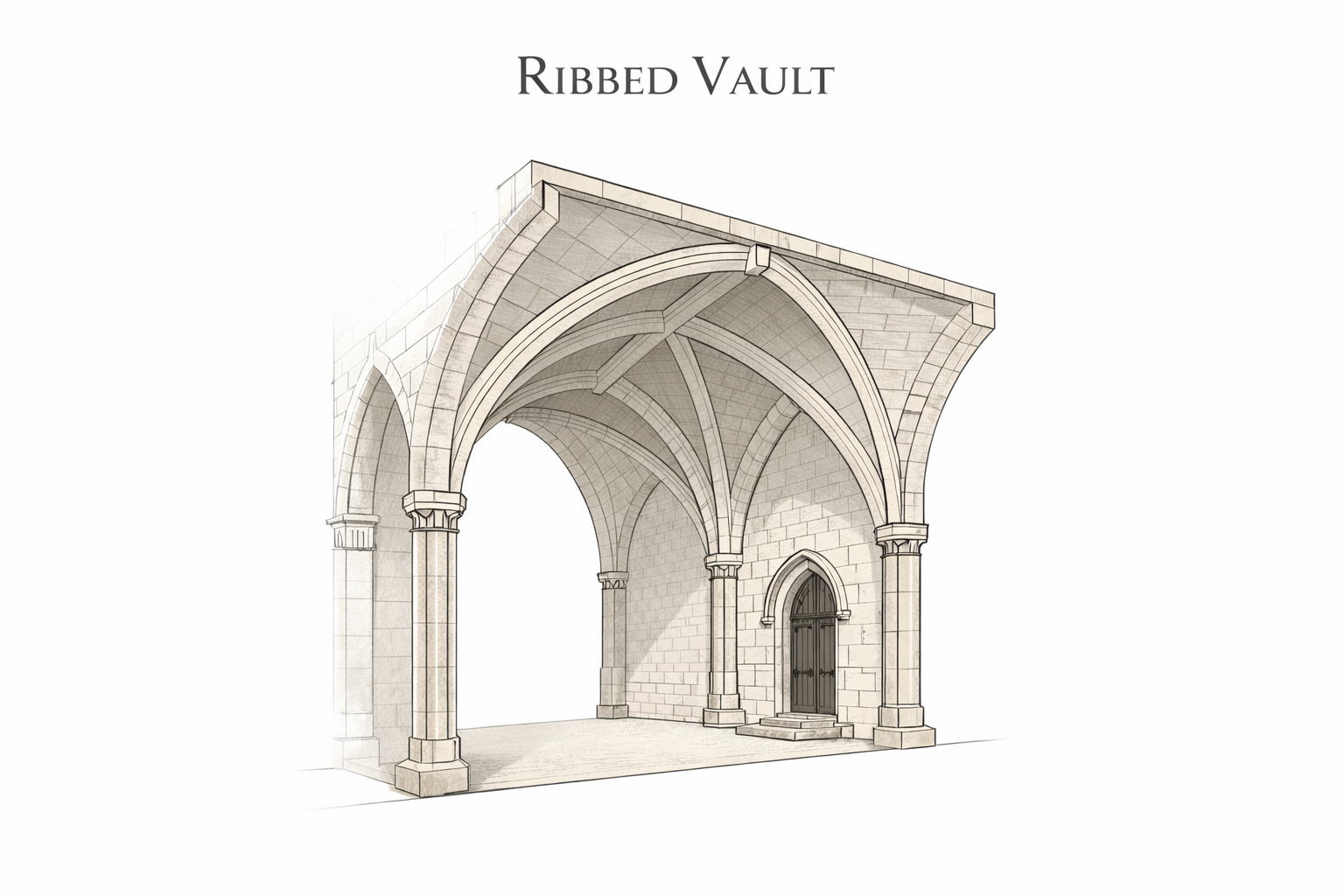
Illustration by ArchitectureCourses.org. A ribbed vault structure showing intersecting ribs, bay divisions, and the path down toward the supports.
The Main Parts Of A Rib Vault
| Part | What It Is | What It Does |
|---|---|---|
| Ribs | Arched structural lines crossing the vault | Organize the ceiling and carry the main load lines |
| Webbing | Thin masonry panels between the ribs | Fill the vault surface between the structural lines |
| Springing points | Where the ribs rise from their supports | Transfer force down into piers or columns |
| Piers or columns | Vertical supports below the vault | Receive the concentrated loads from the ribs |
| Bosses | Decorative or covering elements at rib intersections | Finish the junction visually and sometimes conceal joints |
| Bay | The area of space covered by one vault unit | Sets the footprint and rhythm of the ceiling system |
How The Load Path Works
The fastest way to understand a rib vault is to follow the load.
The webbing spans between the ribs.
The ribs gather and direct that load along clearer structural lines.
Those lines run down into the springing points, then into piers or columns below.
From there, the load goes into the foundations.
That is the real advantage. The ceiling is no longer asking every inch of wall to carry the same burden in the same blunt way.
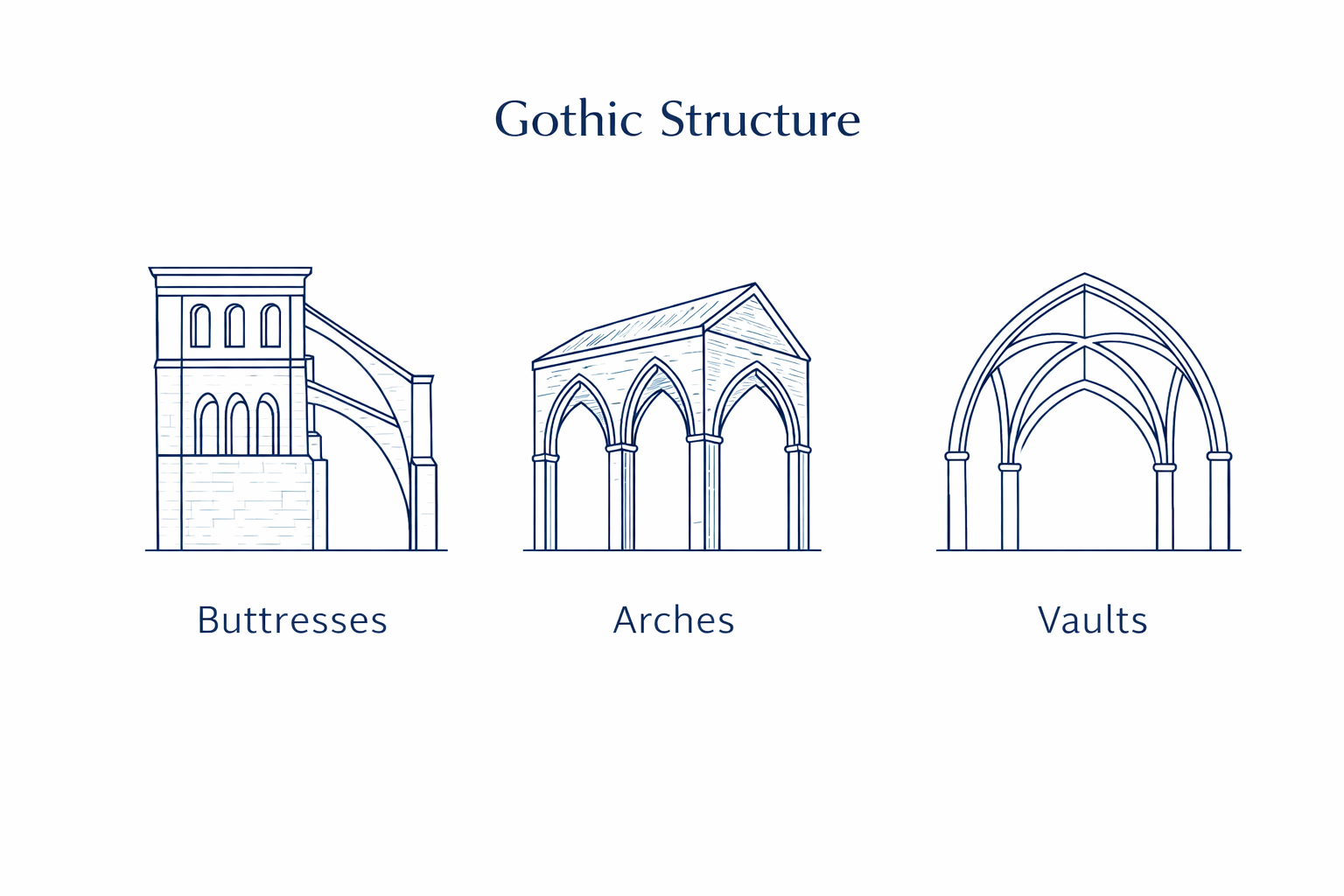
Illustration by ArchitectureCourses.org. Simplified Gothic structure showing arches, vaulting, and buttressing working together to move load through the system.
Why Rib Vaults Mattered
They gave builders more control.
Once the ceiling load could be organized more clearly, walls could open up more. Openings could grow larger. Interiors could rise higher. The room could feel lighter even when the material was still heavy stone.
Rib vaults also made the ceiling more expressive. Structure stopped hiding so completely. You could see the logic overhead.
That mix of structural control and visual clarity is why rib vaults became such a major part of Gothic building.
Why Rib Vaults Feel Lighter Than Barrel Vaults
A barrel vault tends to read as one continuous curved mass.
A rib vault breaks that mass into a framework and thinner panels. Even if the total structure is still substantial, the eye reads it differently. The ribs create order, rhythm, and direction.
This matters visually, but it also matters structurally. A rib vault organizes the ceiling more precisely and makes the support system easier to concentrate at specific points.
That is one reason rib vaults helped move architecture away from darker, heavier interiors and toward taller, more open ones.
Rib Vault Vs Groin Vault
These two get mixed up constantly.
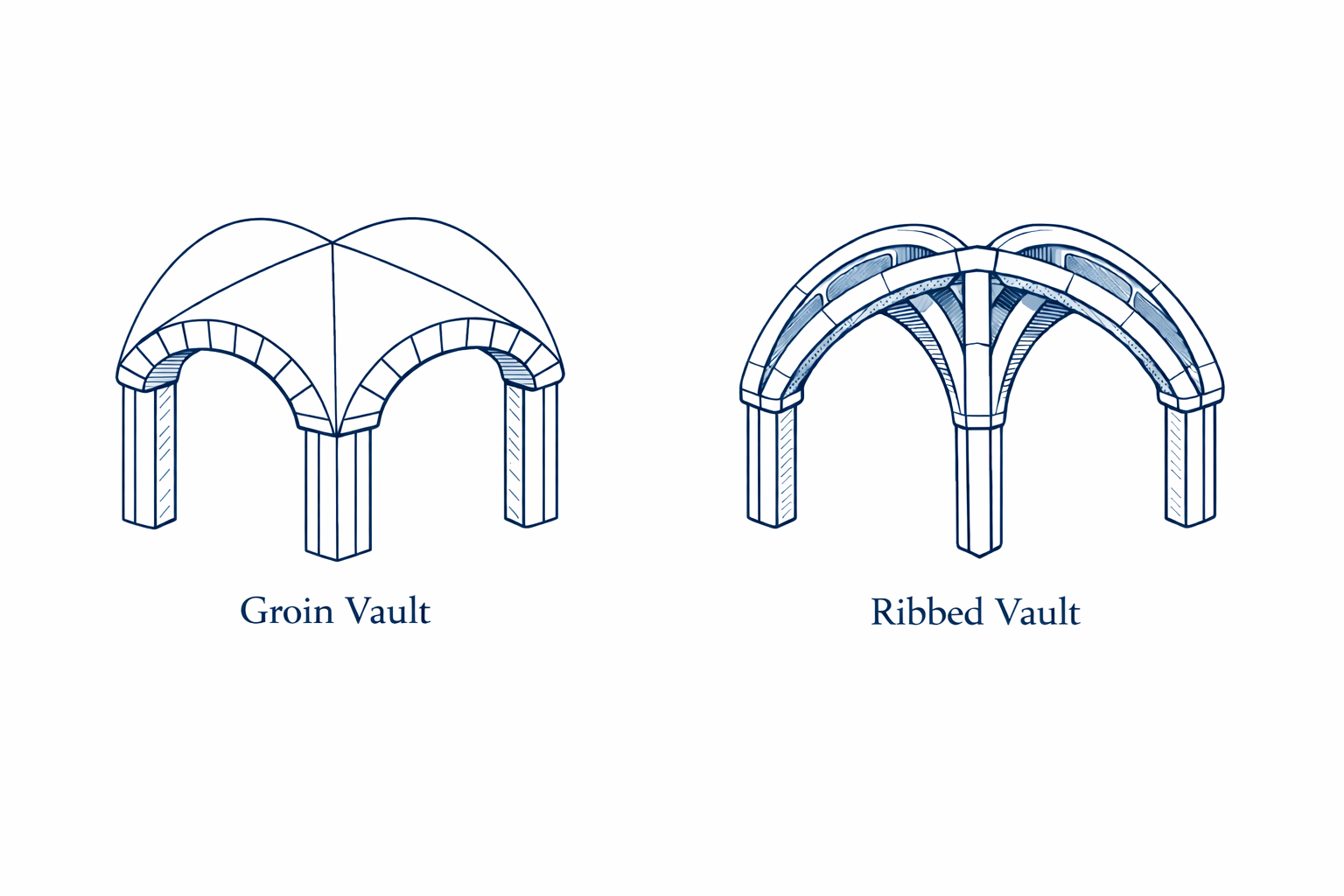
Illustration by ArchitectureCourses.org. Comparison of a groin vault and a ribbed vault structural system.
A groin vault is formed by the intersection of two barrel vaults. A rib vault uses ribs as a more explicit structural framework.
| Groin Vault | Rib Vault |
|---|---|
| Intersection of two barrel vaults | Framework of ribs with webbing between |
| Heavier continuous surface | More legible structural skeleton |
| Simpler visual pattern | Stronger directional rhythm overhead |
| Less flexible visually and structurally | More adaptable to varied bay shapes and richer ceiling design |
If you want the quick visual test, look for the ribs first. If the ceiling reads as a clear network of structural lines, you are probably looking at a rib vault.
What The Webbing Does
The webbing is the infill between ribs.
It matters because a lot of people notice the ribs and then stop there. But the vault is not only ribs. The webbing completes the ceiling surface and spans the spaces between the structural lines.
Once you start noticing that relationship, the whole vault becomes easier to read. The ribs are not decoration laid on a finished ceiling. The ceiling is organized around them.
How To Read One On Site
If you are standing in a hall and want to identify a rib vault fast, use this order.
- Look up for crossing ribs.
- Find the panels or webs between those ribs.
- Trace the ribs down to where they spring from the support.
- Check whether the bay is square, rectangular, or more complex.
- Notice whether the ribs are doing only structural work or also creating a decorative pattern.
That sequence is usually enough to tell whether you are looking at a rib vault and how ambitious the design really is.
Common Rib Vault Types
Not every rib vault looks the same.
Some are simpler and more structural. Some become highly elaborate.
| Type | Basic Pattern | What It Tends To Do |
|---|---|---|
| Quadripartite | Four-part division | Clear, efficient, and common in many Gothic interiors |
| Sexpartite | Six-part division | More complex geometry and more segmented ceiling rhythm |
| Lierne and tierceron variants | Additional ribs beyond the main framework | Increase complexity and visual richness |
| Fan vault | Ribs spreading in a fan-like pattern | Pushes rib logic toward a more ornamental late-Gothic effect |
Why Rib Vaults Fit Architecture So Well
Rib vaults are often explained through the same familiar monumental interiors, but the structural logic works just as well in castles, halls, colleges, palaces, and court buildings.
That makes sense. Rib vaults are good at covering bays clearly, concentrating load, and giving a room a more ordered ceiling without turning it into one heavy shell.
They also add visual authority. A room with a rib-vaulted ceiling tends to feel more deliberate, more formal, and more finished than a plain vaulted room.
Where People Get Rib Vaults Wrong
The first mistake is treating the ribs like surface decoration.
The second is confusing rib vaults with any ceiling that happens to cross or curve.
The third is thinking the whole achievement is height, when the real breakthrough is clearer load organization and more flexible enclosure.
A rib vault is not just a pretty ceiling pattern. It is a structural ceiling system that also happens to be visually strong.
Why Rib Vaults Still Matter
Because they show what happens when structure becomes readable.
The ribs do not just hold the ceiling. They explain the ceiling. They make the room’s overhead geometry visible, and they make the transfer of force easier to understand.
That is why rib vaults still matter as architecture, not just as history. They show how structural logic can shape space, light, rhythm, and finish all at once.
Quick Checklist
If you need a fast read, check these in order:
- Are there ribs crossing overhead?
- Can you see webbing between them?
- Do the ribs spring from clear supports below?
- Does the ceiling read as a framework rather than one continuous mass?
- Does the vault divide the room into clear bays?
If yes, you are reading a rib vault properly.
Read This Next
For the wider structural system, go to Gothic Structures.
For the arch logic underneath the vault, use Pointed Arch.
For the broader element page, go to Gothic Elements in Architecture.
For the comparison page, use Groin Vaults.
FAQ
What Is A Rib Vault?
A rib vault is a vaulted ceiling built around a framework of ribs, with thinner webbing filling the spaces between those structural lines.
What Do The Ribs Actually Do?
The ribs organize the ceiling and help direct loads down into the supports below.
What Is The Webbing In A Rib Vault?
The webbing is the thinner infill surface between the ribs that completes the vault.
How Is A Rib Vault Different From A Groin Vault?
A groin vault comes from the intersection of barrel vaults. A rib vault uses ribs as a more explicit structural framework.
Why Were Rib Vaults Important?
They helped builders organize loads more clearly, reduce dependence on heavy continuous walls, and create taller, lighter interiors.
Are Rib Vaults Structural Or Decorative?
They are structural first, but they also shape the room visually in a very strong way.