

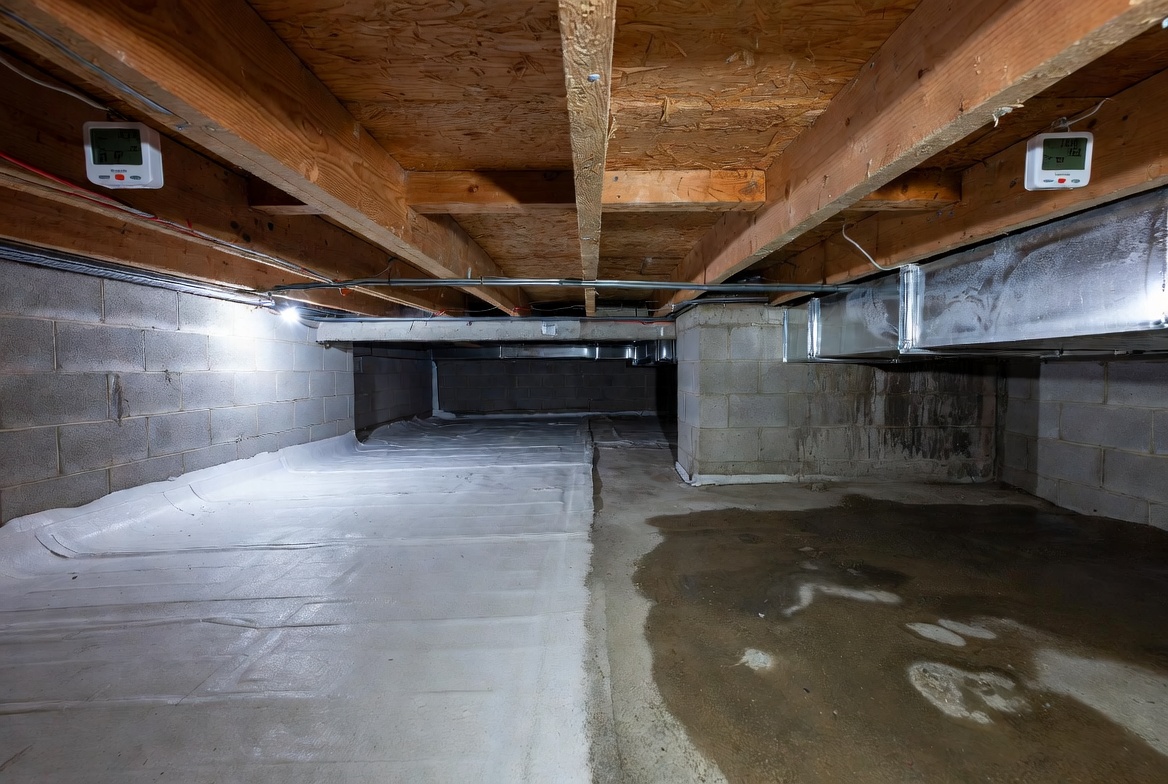
A crawl space can be too wet before it ever smells swampy.
Humidity problems usually build slowly. Wet soil, outside air, weak sealing, bad drainage, unfinished dehumidifier setup. By the time the signs are obvious, the crawl has often been running humid for a while.
The real question is not whether it feels damp once. It is whether the humidity is staying too high, whether that is becoming a structural or air-quality problem, and whether the crawl is telling you the whole moisture system is off.
Worth knowing: if you still are not sure whether the crawl should stay vented or go sealed, keep Crawl Space Vapor Barriers and Vent Covers: What Works, What Backfires, Crawl Space Encapsulation Done Right: Moisture First, Air Second, and Crawl Space Encapsulation vs Vapor Barrier Only open nearby while you read this.
The Quick Answer
For most crawl spaces, sustained relative humidity below 60% is the safer side of the line. That does not mean every crawl should sit at the same exact number every hour of the year. It means once the crawl is spending long stretches above 60%, you should stop treating it like a harmless little fluctuation.
As a practical field rule:
| Relative Humidity in the Crawl Space | How to Read It | What It Usually Means |
|---|---|---|
| Below 50% | Usually controlled | Good sign in a sealed crawl if the readings stay stable and the crawl is dry |
| 50% to 60% | Usually acceptable | Often a workable range, especially if the crawl is otherwise dry and stable |
| 60% to 70% | Warning zone | You may not have an obvious disaster yet, but the crawl is drifting in the wrong direction |
| Above 70% for long stretches | Red flag | That is not “normal crawl-space humidity” anymore; the moisture system needs attention |
The mistake is not a single humid reading on one bad weather day. The mistake is a crawl that keeps living in the warning zone and nobody asking why.
Normal Does Not Mean the Same Thing in Every Crawl Space
This is where people get trapped by forum answers and oversimplified advice.
There is no single perfect crawl-space humidity number that applies everywhere, because crawl spaces are not all built the same way and they are not all supposed to behave the same way.
A sealed crawl with a real liner, sealed vents, and active humidity control should usually behave much more predictably than a vented crawl on a damp site. A vented crawl in a dry climate is different from a vented crawl in a hot-humid climate. A low-clearance crawl with wet ducts and a weak access door is different from a cleaner crawl under a fairly well-managed house.
So “normal” has to be read in context.
That said, the practical dividing lines still matter:
- Below 60% is generally the safer side.
- Persistent readings above 60% deserve attention.
- Persistent readings above 70% are not something to shrug off in an enclosed crawl.
The question is not whether the crawl ever crosses those numbers. The question is whether it keeps living there.
What High Crawl Space Humidity Usually Means
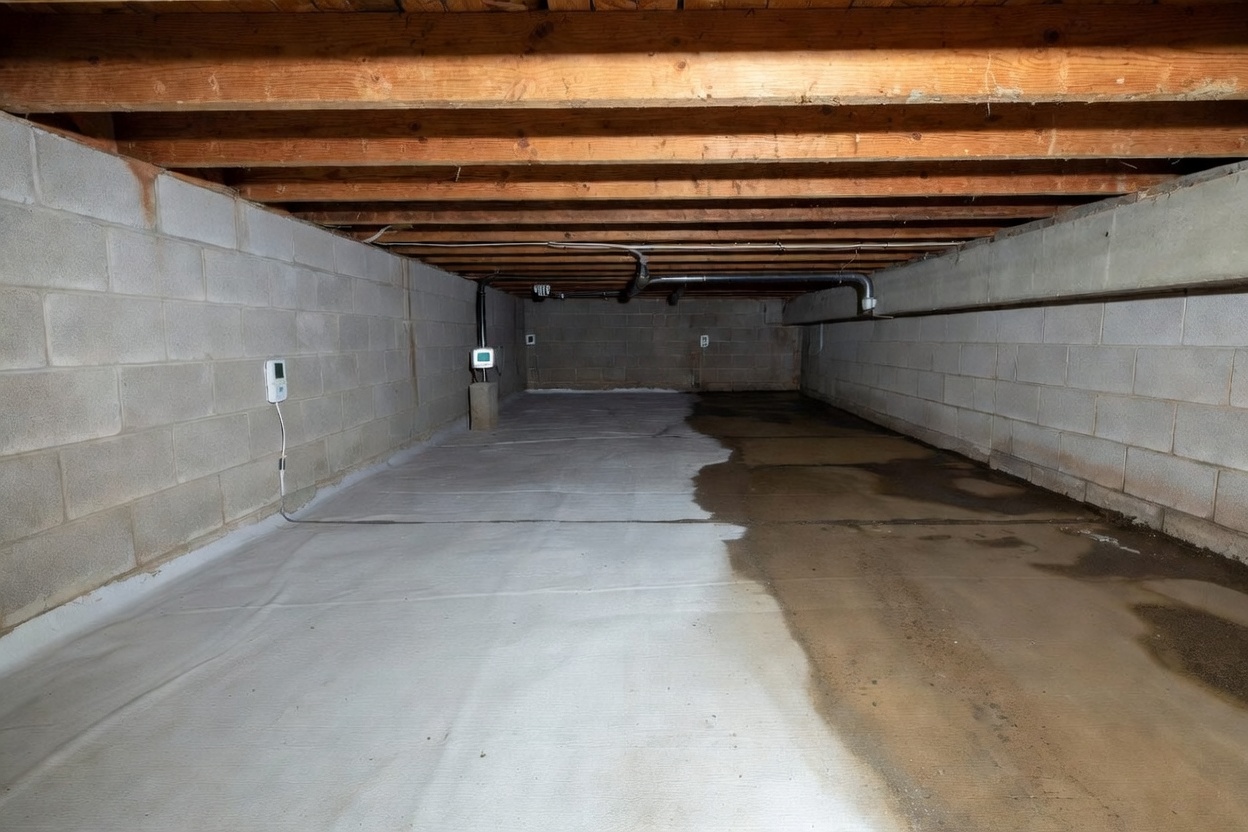
High crawl space humidity is usually a symptom of a larger moisture problem, such as ground vapor, bulk water, or weak moisture control details. Image by ArchitectureCourses.org.
High humidity in a crawl space is usually a symptom, not the root problem.
That matters because people often try to solve the symptom with the wrong tool. They buy a dehumidifier before fixing the liner. Or they seal vents before fixing drainage. Or they install a new liner while the outside grade is still feeding water toward the foundation.
If crawl humidity is elevated, one of these is usually happening:
- Ground vapor is getting into the crawl. No liner, a weak liner, untaped seams, gaps at piers, or loose perimeter details.
- Bulk water is still part of the story. Standing water, muddy soil, damp wall bases, or wet conditions after rain.
- Humid outside air is being drawn into the crawl. Common in vented crawl spaces, especially in humid climates.
- The crawl is sealed, but not really controlled. Vents closed, liner down, but no real humidity strategy afterward.
- The crawl has a local moisture source. Plumbing leak, sweating ducts, wet insulation, or something else feeding moisture directly into the space.
That is why humidity readings are useful. They do not just say “wet” or “dry.” They tell you whether the crawl is behaving like a controlled space or drifting because one of the systems underneath it is weak.
What People Get Wrong About the 60% Line
A lot of people hear “keep it under 60%” and turn that into one of two bad interpretations.
The first bad interpretation is panic:
“The crawl hit 61% once, so something is wrong.”
The second bad interpretation is complacency:
“It sits at 65% most of the summer, but that is probably just how crawl spaces are.”
Neither of those is smart.
The better read looks like this:
- One reading is not the whole story. Check the trend.
- Time matters. Is the crawl above 60% for an hour, a day, or weeks?
- Weather matters. Did a storm just roll through? Did the season just shift?
- The assembly matters. Is this a vented crawl, a sealed crawl, or a weird half-state in between?
A crawl that occasionally brushes 60% and then drops back is different from a crawl that sits at 67% for weeks and keeps smelling worse by midsummer.
That is why logging matters more than one inspection.
When Humidity Becomes Dangerous
“Dangerous” is not just about mold headlines. In crawl spaces, dangerous usually means one of three things:
- the wood and framing stay damp enough for too long
- the air in the crawl starts affecting the house above
- the humidity is telling you the crawl is no longer managing moisture the way it should
That can show up as:
- musty smell migrating into the living space
- wet or sagging insulation
- condensation on ducts or piping
- rusting fasteners, straps, or metal components
- wood that feels persistently cool and damp instead of dry and stable
- mold growth on framing, sheathing, or stored materials
Once the crawl is showing those signs, the humidity is no longer just a number. It is now evidence that the assembly is underperforming.
| Sign | What It Usually Suggests | What to Do First |
|---|---|---|
| Musty smell in the crawl or house | Persistent moisture, weak liner, weak vent strategy, or poor drying | Check RH trend, liner continuity, and water history |
| Condensation on ducts or pipes | Air in the crawl is too humid for the surface temperature | Check venting, liner, sealing, and dehumidification strategy |
| Wet wall bases or damp band after rain | Bulk water or perimeter moisture path is still active | Start outside with drainage and runoff |
| RH above 70% for long stretches | The crawl is not under control | Stop calling it “normal” and diagnose the system |
Vented Crawl vs Sealed Crawl: Humidity Does Not Mean the Same Thing
This matters more than most crawl-space advice admits.
Vented Crawl Space
A vented crawl is more exposed to outside weather swings. In some dry climates, that can behave well enough. In hot-humid or mixed-humid conditions, it can behave badly because the outside air is not drying the crawl. It is loading the crawl with moisture.
That is why a vented crawl can look dry enough in one season and then run ugly in another. The humidity pattern is tied to the outside air more directly.
Sealed or Encapsulated Crawl Space
A sealed crawl should behave more predictably. That is the whole point.
If a sealed crawl is still spending long stretches high, that usually means something in the system is off:
- the liner is weak or incomplete
- the vents are not really sealed
- the access door leaks
- bulk water is still in play
- the crawl was closed without a real humidity-control plan
So high humidity in a sealed crawl is often more revealing. The whole point of the sealed crawl is control. If the RH is still wandering high, the system is telling on itself.
Read this next: if you are still sorting out that bigger strategy question, go to Conditioned Crawl Space vs Encapsulated Crawl Space and Can You Use a Dehumidifier in a Crawl Space Without Encapsulation?.
What Actually Works vs What People Commonly Do Wrong
| What Actually Works | What People Commonly Do Wrong |
|---|---|
| Track humidity over time with a real monitor | Judge the crawl by smell alone |
| Look for trends after rain, seasonal shifts, and changes to the crawl | Take one dry-day reading and call the crawl fine |
| Keep a sealed crawl under deliberate humidity control | Seal the crawl and “figure out humidity later” |
| Fix outside water first when the crawl still gets wet after storms | Buy a dehumidifier to cover for bad drainage |
| Use humidity as a clue to the whole system | Treat the RH number like the only issue that matters |
The Detail People Miss
The most important humidity question is not “what is the reading right now?”
It is:
What pattern does this crawl space keep repeating?
Does it spike only after rain? Does it climb every summer? Does it stay high in a sealed crawl even after the liner went down? Does it only look bad in one corner? Does it improve when the dehumidifier runs, or is the machine working hard and the crawl still drifting high?
That is where good monitoring becomes useful.
If you do not have a real monitor yet, do not guess from odor and memory. Use Best Crawl Space Hygrometers and Humidity Monitors. If the crawl is already sealed and the next question is equipment, go to What Size Crawl Space Dehumidifier Do You Need? and Best Crawl Space Dehumidifiers.
Humidity Does Not Tell You the Same Thing as Water
This is the other mistake people make. They see high RH and assume there must be standing water somewhere.
Not always.
A crawl space can run humid because of:
- bare or poorly covered soil
- humid outside air entering a vented crawl
- a sealed crawl with no active moisture control
- weak perimeter continuity at the liner edges
And a crawl can also have water problems that are not obvious every day. That is why the crawl should be checked after hard rain, not just on a convenient dry weekend.
If the crawl gets wet after storms, the humidity number matters, but it is not the first problem anymore. The first problem is the water path.
Before you move on: if you suspect that is what is happening, go to Crawl Space Drainage System: When You Need One, What It Includes, and What It Does Not Fix and Cost to Install a Sump Pump in a Crawl Space.
How to Read Crawl Space Humidity in One Walkthrough
- Check the reading. Is the crawl under 60%, in the 60 to 70% warning range, or spending long stretches above 70%?
- Check the pattern. Was this one spike, or does the crawl keep coming back to the same high range?
- Check the system type. Is the crawl vented, sealed, or stuck in a weird half-state?
- Check after rain. If the crawl changes dramatically after storms, you may have a water-path problem, not just a humidity problem.
- Check the liner and perimeter. A sealed field means less than people think if the edges are loose and the piers are open.
- Check whether humidity control exists. A sealed crawl without a real humidity strategy is not finished.
The point is not to memorize one number. The point is to diagnose the crawl correctly.
Use This When / Avoid This When
| Use This | When | Avoid This | When |
|---|---|---|---|
| Humidity monitor and trend tracking | You need to understand what the crawl is doing over time | One quick smell test | You want to know whether the crawl is actually under control |
| Dehumidification | The crawl is sealed and the remaining problem is air moisture load | Dehumidification as the first fix | The crawl still has active drainage or liner failures |
| Drainage and water management | The crawl still gets wet after storms | Buying gadgets first | The water path is still active |
| Sealed-crawl humidity control | The vents are closed and the crawl is intended to be managed | “We’ll see how it does later” logic | The crawl is already enclosed and drifting humid |
Quick Checklist
- Treat sustained RH below 60% as the safer side of the line.
- Treat persistent 60% to 70% RH as a warning zone, not normal background noise.
- Treat persistent RH above 70% in an enclosed crawl as a real red flag.
- Use trends, not one isolated reading.
- Check the crawl after rain, not just on a dry day.
- Do not use a dehumidifier to cover for bulk water or a bad liner job.
- Remember that sealed crawls are supposed to be more predictable, not less.
What To Do Next
This part matters: if the crawl is reading high and you still do not know whether the system should stay vented or go sealed, go to Crawl Space Vapor Barriers and Vent Covers: What Works, What Backfires and Crawl Space Encapsulation vs Vapor Barrier Only.
Also useful: if the crawl is already sealed and the next problem is moisture equipment, use What Size Crawl Space Dehumidifier Do You Need? and Best Crawl Space Dehumidifiers.
Before you move on: if the crawl still smells bad in the house, read Why Does My Crawl Space Smell in the House?.
If you still need the bigger picture: use Conditioned Crawl Space vs Encapsulated Crawl Space and House Foundations: What You Need to Know Before Construction.
FAQ
What Is Normal Humidity in a Crawl Space?
The practical answer is that sustained humidity below 60% is usually the safer side of the line. Occasional movement happens, but a crawl that lives above that range needs attention.
Is 65% Humidity Too High in a Crawl Space?
It is not instant disaster, but it is not a “forget about it” number either. If the crawl keeps coming back to 65% and above, that is a warning pattern, not just a random reading.
Is 70% Humidity Dangerous?
If an enclosed crawl is staying above 70% for long stretches, yes, that is a real red flag. At that point the crawl is not under control.
Should a Sealed Crawl Space Stay Under 60%?
That is the safer working target. A sealed crawl should behave more predictably than a vented one, so sustained high RH in a sealed crawl usually means something in the system is weak.
Can a Dehumidifier Fix High Crawl Space Humidity?
Sometimes, but only if the crawl is already behaving like a sealed manageable enclosure. A dehumidifier is not the first fix for standing water, bad drainage, open vents, or a shredded liner.
What Is the Biggest Mistake People Make?
Treating one humidity reading like the whole story, or treating a dehumidifier like a substitute for fixing the crawl itself.
What Should I Read After This?
If you need to track the crawl better, go to Best Crawl Space Hygrometers and Humidity Monitors. If you need equipment next, go to What Size Crawl Space Dehumidifier Do You Need?.
Official Sources
- EPA: Mold Course Chapter 2 — Humidity
- EPA: Mold Course Chapter 9 — Prevention
- EPA: Mold Remediation in Schools and Commercial Buildings Reference Guide
- ENERGY STAR: Quick Reference on Closed Crawl Spaces
- ENERGY STAR / Building America: Guide to Closing and Conditioning Ventilated Crawlspaces
- Building America Solution Center: Pre-Retrofit Assessment of Crawlspaces and Basements
- U.S. Department of Energy: Moisture Control