
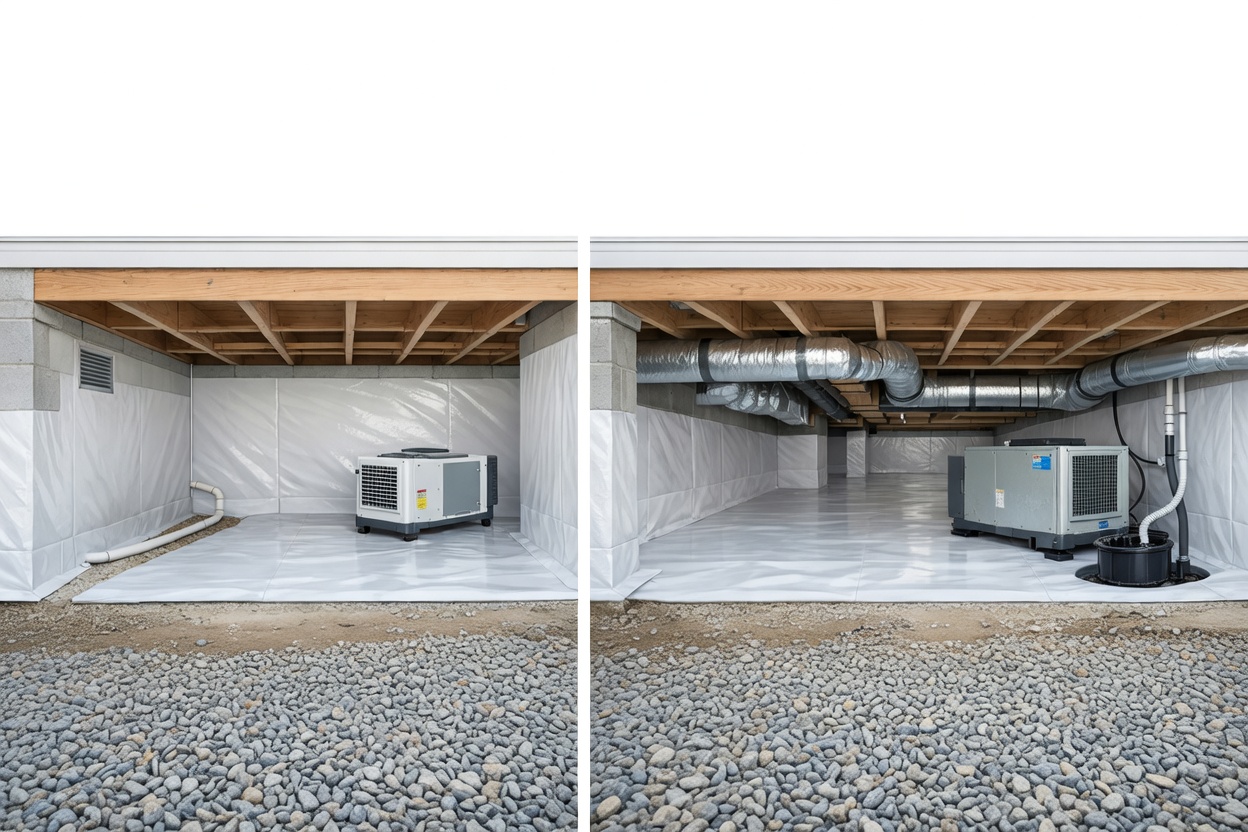
What size crawl space dehumidifier do you need? Usually not the size people pick first.
Most people start with square footage. Then they look at pint ratings. Then the quotes get confusing fast because one unit is priced like a basic box and another comes bundled with a pump, duct kit, hanging kit, and enough add-ons to make the decision look more technical than it is.
The real question is moisture load, not floor area alone.
How wet is the crawl? Is it sealed or vented? Is there bulk water? Is the liner actually done right? Is there a drain nearby, or does the unit need a pump? Is the space tight enough that service access becomes part of the decision? Those details change the right answer fast.
This page is the decision version, not the soft version.
- What dehumidifier size really depends on
- When a 70-pint unit is enough
- When you should jump to 90 to 100+ pints
- What square footage gets wrong
- Why drainage and access matter more than people think
- What actually works vs what people commonly do wrong
Worth knowing: if the crawl space is still vented, muddy, or taking on water after storms, do not start with the dehumidifier. Start with Crawl Space Vapor Barriers and Vent Covers: What Works, What Backfires, Crawl Space Encapsulation Done Right: Moisture First, Air Second, and Exterior Foundation Waterproofing.
The Quick Answer
If the crawl space is small, fairly tight, and already dry enough that you are mainly controlling residual humidity, a unit in the 70-pint class is often enough.
If the crawl space is larger, leakier, more humid, or harder to dry because the space is not truly tight yet, you usually end up in the 90- to 100-pint class.
If the crawl is still taking on water, has muddy soil after rain, or smells bad because the whole assembly is still loose and wet, the answer is not “buy a bigger dehumidifier.” The answer is that you are sizing equipment for the wrong problem.
| Crawl Space Condition | Starting Point | Why |
|---|---|---|
| Tight, sealed crawl under about 1,800 to 2,200 square feet with moderate load | 70-pint class | Often enough when the crawl is already behaving reasonably well |
| Larger or wetter sealed crawl, or one with stronger seasonal load | 80- to 100-pint class | More buffer and faster pull-down after seasonal spikes |
| Very damp, loosely sealed, or not fully corrected crawl | Fix the crawl first, then size | A bigger machine does not replace water management or air sealing |
That is the blunt version. The rest of the page is how to tell which row you are actually in.
Square Footage Is Not Enough
This is the first thing to get straight. Two crawl spaces with the same footprint can need very different equipment.
Example:
- House A has a sealed liner, tight access door, sealed vents, decent wall detail, good drainage, and no standing water history.
- House B has the same square footage, but the liner is patchy, the access door leaks, the vents were sealed badly, one downspout still dumps near the wall, and summer humidity hits the crawl like a hammer.
Those are not the same load.
House B can make the same nominal dehumidifier look undersized even if the unit itself is fine. That is why published coverage ranges jump around so much. The same unit can cover very different crawl-space sizes depending on how tight or loose the space is and how much moisture keeps getting fed into it.
The practical question is not just “how big is the crawl?” It is “how hard does this crawl make the machine work?”
If the crawl still has liner problems, do not skip the assembly work. Fix that first with Crawl Space Vapor Barrier Installation: How to Do It Right the First Time, Crawl Space Vapor Barrier Thickness Guide, and Best Crawl Space Vapor Barrier Tape.
What Actually Decides the Right Size
There are five things that matter more than people expect.
1. How Well the Crawl Is Sealed
A truly sealed crawl is easier to control. A half-sealed crawl is expensive nonsense. If the vents are still leaking, the access door is loose, and the liner is not really continuous, the dehumidifier is fighting outside air and ground moisture all at once.
2. Whether Bulk Water Is Still in the Picture
If water still reaches the crawl after storms, do not size from square footage. Fix the water path first. Otherwise you are using dehumidification to mop up a water-management failure.
3. The Real Moisture Load
Some crawl spaces are basically fine but sticky in summer. Others are wet all season long. Others spike only after rain or shoulder-season weather swings. The machine you need depends on how often the crawl crosses into trouble, not just how it looks on one dry afternoon.
4. Drainage Setup
This gets missed constantly. A dehumidifier is a water-moving device. If it has nowhere reliable to dump condensate, the rating on the box is not your main problem anymore.
5. Access and Clearance
Low-clearance crawl spaces change what you can physically fit, hang, service, and drain. A machine that looks perfect on paper can become a maintenance headache if the crawl is shallow and awkward.
Use This Instead of Guessing
| Question | If the Answer Is Yes | What It Usually Means |
|---|---|---|
| Are the vents sealed and the crawl genuinely closed? | Yes | You can size like a managed sealed crawl, not a constantly reloaded vented space |
| Is the liner continuous, taped, and carried properly? | Yes | The dehumidifier is not fighting raw soil vapor as hard |
| Does water still appear after hard rain? | Yes | Stop sizing equipment and fix drainage first |
| Is there a reliable drain path or pump path? | No | Drain strategy may decide the model before pint rating does |
| Is the crawl low enough that service access is difficult? | Yes | Low-profile units and hanging/duct options matter more |
| Does RH stay high for long stretches even after basic fixes? | Yes | You likely need more capacity or a better-sealed crawl, sometimes both |
What Size Range Usually Makes Sense
Here is the practical version most people actually need.
70-Pint Class
This is often the right starting point for smaller or mid-size sealed crawl spaces that are already reasonably tight and not under heavy ongoing moisture stress.
It is a good fit when:
- the crawl is sealed and lined properly
- the footprint is modest
- you are maintaining conditions more than rescuing the space
- clearance is tight and a compact machine matters
This is also the class where many crawl-space-specific machines live. The reason is simple: a lot of crawl spaces are low, awkward, and do not need commercial-scale drying if the assembly is already under control.
Also useful: if you are comparing actual units instead of sizing logic, go to Best Crawl Space Dehumidifiers.
80- to 100-Pint Class
This range starts making more sense when the crawl is larger, the humidity load is stronger, or you want more recovery after seasonal spikes. It is also where you land when the crawl may technically be sealed, but not perfectly enough that a lighter-duty unit can coast.
It is a good fit when:
- the crawl footprint is larger
- the climate is humid enough that recovery speed matters
- the crawl includes more under-house complexity, ducts, or long perimeter runs
- you want more cushion instead of sizing right at the edge
That spread is not marketing weirdness alone. It is a reminder that enclosure quality matters as much as nominal capacity.
Above 100 Pints
This is usually where you are either dealing with very large crawl-space or basement systems, unusually high load, or you are creeping toward whole-house or multi-zone logic rather than a simple crawl-space maintenance unit. If you get here, stop buying by headline pint rating and start looking at the actual assembly, ducting, and service plan.
What Actually Works vs What People Commonly Do Wrong
| What Actually Works | What People Commonly Do Wrong |
|---|---|
| Size after the crawl is sealed, lined, and water-managed | Use a dehumidifier to compensate for standing water or a bad liner job |
| Pick a size range based on load, not just square feet | Buy the cheapest 70-pint unit and hope it can fix anything |
| Plan the condensate drain before you buy | Figure out later that there is no gravity drain and the bucket setup is useless |
| Choose low-profile equipment if the crawl is low and ugly | Buy a tall portable unit that is miserable to service under the house |
| Use RH tracking to see what the crawl is doing over time | Judge everything by smell or one quick visit on a dry day |
The Detail People Miss
The machine does not just need capacity. It needs a place to put the water.
This sounds basic. It is not treated that way in a lot of buying advice.
In a crawl space, condensate removal is often the ugly practical detail that decides whether the install is clean or annoying. Some units are set up for gravity drainage if you have slope and an appropriate outlet path. Others may need a pump arrangement. Some crawl-space machines are sold specifically around drain logic because nobody wants to belly-crawl under the house to babysit water collection.
If the crawl is low and there is no easy fall to drain, that may push you toward a unit or accessory setup you would not have chosen by pint rating alone.
That is also why the cheapest portable room dehumidifier is often the wrong answer here. The crawl does not care that it was on sale. It cares whether the unit fits, drains, survives, and can actually hold conditions over time.
Read this next: if you need the monitoring side too, pair this page with Best Crawl Space Hygrometers and Humidity Monitors.
Do Not Use a Dehumidifier to Solve the Wrong Problem
This is where a lot of money gets wasted.
A crawl-space dehumidifier is good at removing moisture from air. It is not a substitute for:
- grading that still runs water toward the house
- downspouts dumping at the perimeter
- a missing or shredded ground liner
- open vents in a crawl that is trying to be sealed
- wet ducts and active plumbing leaks
- radon mitigation in a radon-prone crawl
That last one matters. EPA’s crawl-space guidance is clear that crawl-space radon reduction is typically handled with submembrane suction under a sealed plastic sheet, not by dehumidification. A dehumidifier may help the crawl feel drier. It is not a radon fix.
How to Pick the Right Size in One Walkthrough
- Measure the crawl footprint. Start there because you still need a baseline.
- Check whether the crawl is truly sealed. If the vents, hatch, and perimeter are still loose, your sizing number is about to lie to you.
- Look for water history. Mud, stains, tide marks, wet insulation, rust, recurring musty smell after rain.
- Decide whether you are maintaining or rescuing. A maintenance unit can be smaller than a rescue unit.
- Check the drain path. Gravity if possible. Pump if needed. Figure this out before you buy.
- Check clearance and service space. Can the unit fit? Can it be serviced later without hating your life?
- Pick a range, not a magic number. For many sealed crawls that means starting around the 70-pint class and moving into the 80- to 100-pint class when the crawl is larger, wetter, or less forgiving.
The point is not false precision. The point is getting into the right equipment class for the actual load.
If you are still not sure whether your crawl really needs a smaller liner-focused fix or a full sealed system, pause and use Crawl Space Encapsulation vs Vapor Barrier Only before you buy equipment around the wrong strategy.
Use This When / Avoid This When
| Use This | When | Avoid This | When |
|---|---|---|---|
| Compact 70-pint-class crawl-space unit | The crawl is sealed, moderately loaded, and low clearance matters | Small portable room dehumidifier | You need crawl-space durability, drainage, and long-run control |
| 80- to 100-pint-class unit | The crawl is larger or humidity spikes hard enough that recovery speed matters | Oversizing blindly | You have not fixed the crawl itself and are trying to buy your way past it |
| Gravity drain setup | You have clean slope and reliable discharge path | Improvised drain logic | You are guessing where the water will go later |
| Pump-ready setup | There is no clean fall to drain | Bucket-based portable logic | The unit is under the house where nobody will empty it consistently |
What If You Are Between Sizes?
If the crawl is truly sealed and the load looks moderate, choosing the upper end of the reasonable range is usually safer than choosing the absolute minimum.
Why? Because crawl spaces do not stay static.
Weather shifts. Shoulder season hits. A downspout clogs. A hatch gets left sloppy after service. A sealed crawl that behaved fine in April may work harder in July.
That does not mean “buy the biggest one you can afford.” It means do not size right on the edge if the crawl has any history of seasonal spikes or the enclosure quality is only okay instead of excellent.
Quick Checklist
- Do not size from square footage alone.
- Check whether the crawl is really sealed or only sort of sealed.
- Fix bulk water and drainage issues before buying equipment.
- Use the 70-pint class as a starting point for smaller or moderate-load sealed crawls.
- Move toward 80 to 100+ pints when the crawl is larger, wetter, or less forgiving.
- Choose the drainage method before you choose the model.
- Track humidity over time instead of relying on smell alone.
- Do not confuse dehumidification with radon mitigation.
What To Do Next
This part matters: if the crawl is not really sealed yet, go back to Crawl Space Encapsulation Done Right: Moisture First, Air Second.
Also useful: if the weak point is still the liner and perimeter detail, read Crawl Space Vapor Barrier Installation: How to Do It Right the First Time, Crawl Space Vapor Barrier Thickness Guide, and Best Crawl Space Vapor Barrier Tape.
Before you move on: if you are still not sure whether the crawl should stay vented or go fully closed, use Crawl Space Vapor Barriers and Vent Covers: What Works, What Backfires.
If you still need the bigger picture: go back to House Foundations: What You Need to Know Before Construction and compare the crawl-space strategy against the wider foundation lineup.
FAQ
Is a 70-pint dehumidifier enough for a crawl space?
Often, yes, for a smaller or moderate-load sealed crawl space that is already under decent control. No, not automatically for every crawl with the same square footage. Enclosure quality and moisture load matter.
Should I buy by square feet or pints per day?
Start with square feet, but finish with load. Pint rating matters more once you understand how wet, leaky, and seasonally stressed the crawl actually is.
What is the biggest mistake people make?
Using a dehumidifier to compensate for water intrusion, sloppy sealing, or a bad crawl-space assembly. The machine ends up working too hard because the crawl was never corrected properly.
Do I need a pump?
You need a reliable drainage path. If gravity drainage is not practical, then yes, pump logic or a pump-capable setup may matter more than the nominal pint rating.
Can I just use a portable room dehumidifier?
Sometimes physically, but it is usually not the best crawl-space answer. Crawl spaces need equipment that fits, drains reliably, and can survive long-run service conditions under the house.
What humidity should I aim for?
The safe idea is not to let the crawl live in sustained high humidity. Track it over time and pay attention to seasonal spikes. If the space keeps drifting high, the answer may be more than just equipment size.
Will a bigger dehumidifier always fix the problem faster?
Only if the crawl itself is already behaving like a sealed, manageable enclosure. Bigger equipment does not correct wet walls, standing water, open vents, or a bad liner job.
What page should I read after this?
If you are still deciding whether the crawl needs a liner job or full system treatment, read Crawl Space Encapsulation vs Vapor Barrier Only. If you are already comparing actual units, go to Best Crawl Space Dehumidifiers.