
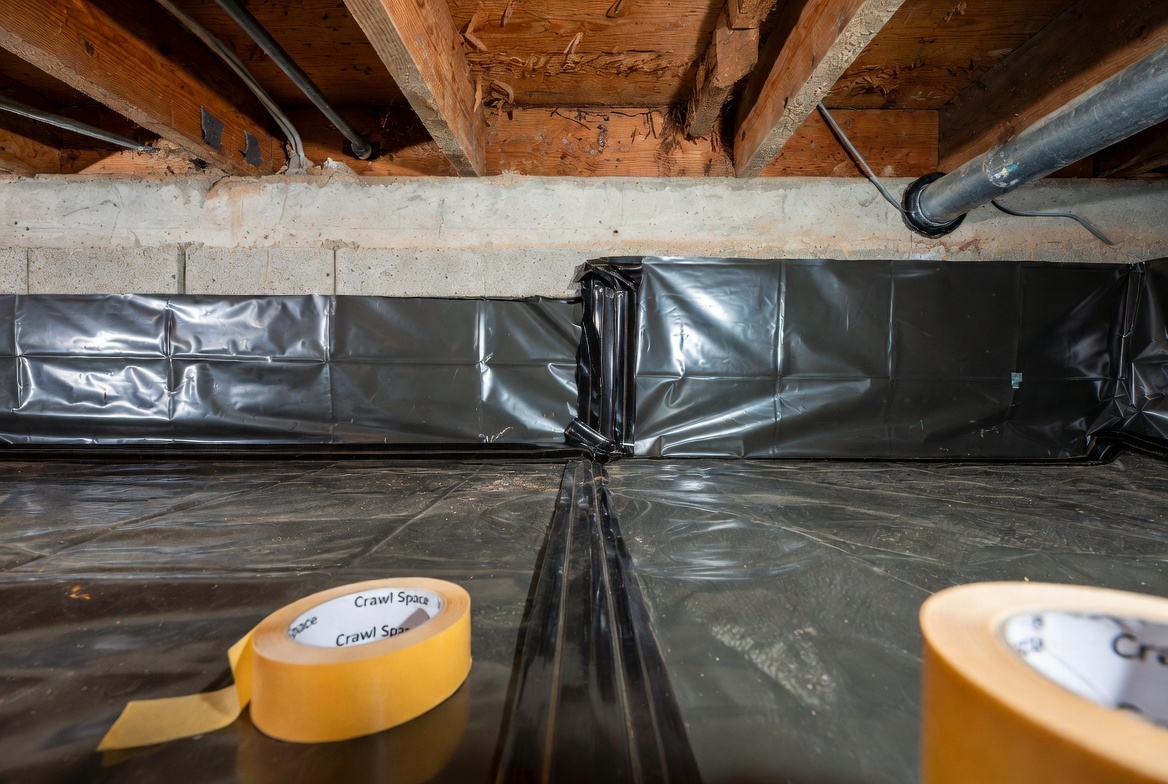
A crawl space liner usually does not fail in the middle of the floor.
It fails at the overlap, at the pier wrap, up the wall, or at the cut around a pipe that looked fine on install day and starts peeling later.
That is why tape matters so much. This is not one-product territory. Field seams, surface bonds, and patch details do different work, and the wrong tape shows up fast once the crawl gets damp, dirty, and hard to service.
A thick liner still needs the right seam tape, the right bonding tape, and the right patch tape. Miss that, and the liner stops acting like a sealed system.
Worth knowing: if the liner itself is still the weak point, keep Crawl Space Vapor Barrier Thickness Guide, Crawl Space Vapor Barrier Installation: How to Do It Right the First Time, and Crawl Space Encapsulation vs Vapor Barrier Only nearby while you read this.
The Quick Picks
| Pick | Best For | Why It Stands Out | Main Trade-Off |
|---|---|---|---|
| StegoCrawl Tape | Best overall seam tape for premium crawl-space encapsulation systems | Designed specifically for StegoCrawl Wrap, low permeance, strong long-term adhesion, 3.75" x 180' roll | Best fit if you are already in the Stego system, less universal outside that system |
| Americover Vapor Tape | Best all-around seam tape for many poly liners | Heavy-duty 4" x 180' tape, made for sealing seams, overlaps, patches, and penetrations on liners up to 20 mil | Not a double-sided bonding tape for rough surface attachment |
| Americover 2-Sided Butyl Tape | Best for bonding liner to concrete, masonry, wood, and textured surfaces | Double-sided butyl, reinforced backing, strong airtight bond for overlaps and liner-to-surface transitions | Not the main exposed seam-finish tape most people want across the field |
| StegoTack Tape | Best premium system-matched bonding strip | Double-sided adhesive strip made specifically to bond StegoCrawl and Stego Wrap to concrete, masonry, wood, and metal | System-oriented and shorter roll length than broad seam tapes |
| 3M All Weather Flashing Tape 8067 | Best specialty tape for tricky perimeter and penetration details | Aggressive acrylic adhesive, bonds to damp surfaces, strong conformability and tear resistance | Not a full-field crawl-space seam tape replacement |
Best Overall: StegoCrawl Tape
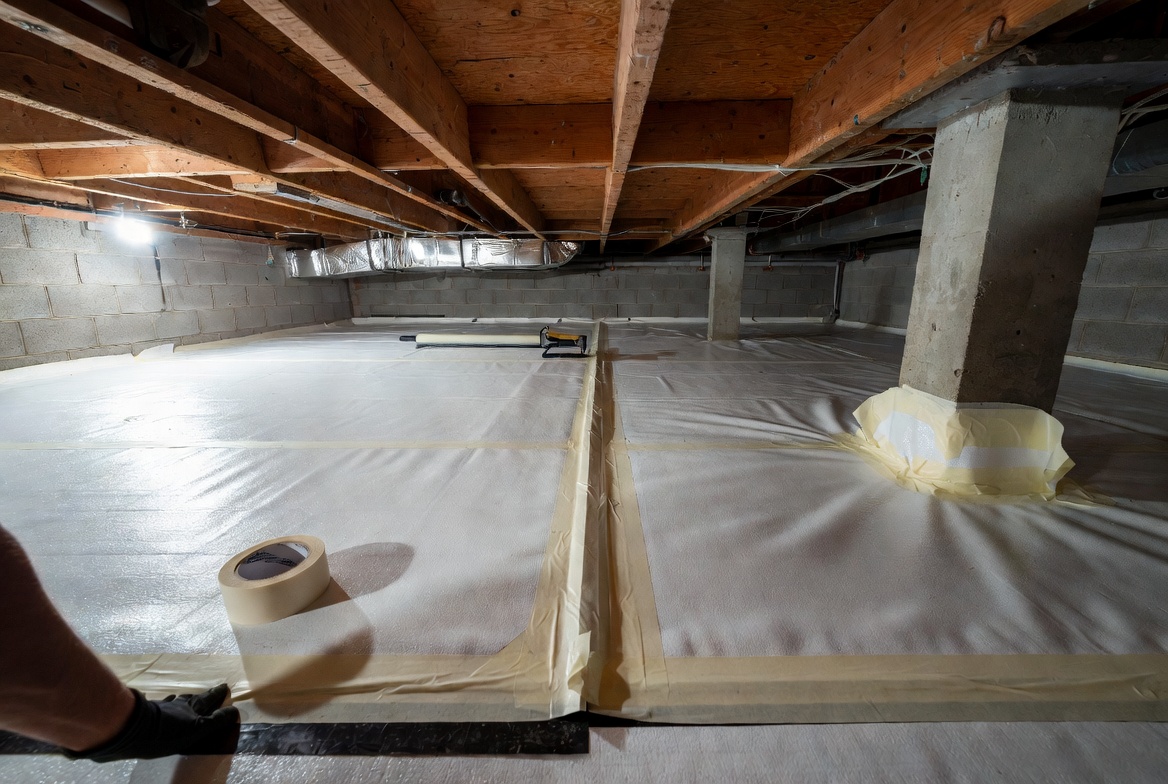
Vapor barrier tape being applied across overlapping seams during crawl space installation. Image by ArchitectureCourses.org.
If you want the cleanest overall recommendation for a serious crawl-space encapsulation job, this is the one I would start with.
Why? Because it is not pretending to be everything for everyone. It is a crawl-space-specific seam tape made specifically to work with StegoCrawl Wrap. That matters more than people think.
Stego lists StegoCrawl Tape as a low-permeance, pressure-sensitive tape designed to complement StegoCrawl Wrap, with strong initial tack, long-term adhesion, and a roll size of 3.75" by 180'. The product page also lists total thickness at 8 mils and permeance at 0.03 perms, which is exactly the kind of spec language you want to see for a real crawl-space system component instead of a vague “waterproof tape” label.
That system match is the real reason this tape wins the overall slot.
Too many crawl-space jobs use a liner from one source, random tape from somewhere else, and a wall detail improvised on the fly. Sometimes that works. Sometimes it becomes the seam that wrinkles, lifts, or starts to look tired long before the liner itself is done.
StegoCrawl Tape makes sense when:
- you are using StegoCrawl Wrap or staying close to that system logic
- you want a true seam-and-patch tape, not just a cheap sealing strip
- you care about long-term adhesion more than bargain price
- you want a clean white finished look across the liner field
Where it is not the automatic answer is on mixed-brand jobs where the rest of the system is not Stego-based. In that case, a more general-purpose seam tape can make more sense.
Best for: full crawl-space encapsulation jobs where the seam tape should behave like part of a real membrane system, not like an afterthought.
Best All-Around Seam Tape: Americover Vapor Tape
If you are not locked into one manufacturer’s full crawl-space system and you want one solid seam tape for a wide range of poly liner jobs, this is the easier all-around pick.
Americover’s Vapor Tape is straightforward in the best way. The official product page positions it for sealing seams, overlaps, patches, and penetrations on vapor barriers up to 20 mil thick, and lists it in a 4" by 180' roll size. That matters because it tells you two useful things immediately:
- it is broad enough to cover a lot of real residential crawl-space seam work
- it is not just a “light plastic only” accessory that starts tapping out when the liner gets heavier
Americover also explicitly frames it as suitable for crawl-space encapsulation, basement vapor barriers, and radon mitigation liners. That broader positioning is helpful if your job is not a pristine one-brand encapsulation kit and you still need a real seam tape, not a hardware-store substitute.
Why it earns this spot:
- 4-inch width is useful without feeling oversized for ordinary seam work
- 180-foot roll length is practical for real crawl-space coverage
- officially positioned for liners up to 20 mil thick
- strong fit for plastic-to-plastic seams, patches, and general encapsulation field work
Where this tape is not the first choice is when you need the liner to bond aggressively to rough concrete, masonry, or wood. That is where seam tape and bonding tape stop being the same thing.
Best for: general seam sealing on polyethylene crawl-space liners when you want one strong, flexible, broad-use tape instead of a system-locked specialty product.
Best for Liner-to-Concrete and Rough-Surface Bonding: Americover 2-Sided Butyl Tape
This is where a lot of DIY crawl-space jobs start losing the plot.
People buy a good seam tape, then expect it to behave like a real bonding product on concrete, masonry, wood, rough transitions, and awkward perimeter details. That is not always what the seam tape is for.
Americover’s 2-Sided Butyl Tape earns a place because it is clearly built for a different job. The official product page describes it as a premium double-sided butyl tape for vapor barriers, crawl-space liners, and construction plastics, designed to create a strong airtight bond on both smooth and textured surfaces. The reinforced backing is also a real plus because it helps prevent the “rubber-band effect” where some butyl tapes stretch and then try to pull back after installation.
That matters in crawl spaces, especially when:
- you are bonding liner to concrete or masonry
- you need cleaner overlap bonding before finishing seams
- you are working on surfaces that are not ideal and want more aggressive tack
- you want a double-sided product that behaves more like a true bonding strip
This is not the tape I would use as the main visible seam-finish tape across the whole floor field. That is not its best role. This is the tape I would use when I need the liner to actually grab a surface or when I want overlap bonding that feels more structural and less hopeful.
Best for: bonding liner to concrete, masonry, wood, and textured overlap situations where ordinary seam tape is not enough.
Best Premium System-Matched Bonding Strip: StegoTack Tape
This is the Stego-side answer to the butyl-bonding problem.
StegoTack Tape is not your main exposed field seam tape. It is a double-sided adhesive strip meant to bond and seal StegoCrawl, Stego Wrap, and related materials to concrete, masonry, wood, metal, and other surfaces. Stego lists it at 2" by 50', made from a blend of synthetic rubber and resins, and calls out that it is highly flexible and moldable.
That makes it one of those products that looks boring until you actually need it.
Why it belongs here:
- it is purpose-built for bonding Stego membrane systems to real substrates
- it is more system-correct than improvising with random double-sided tape
- it is especially useful at the transitions where crawl-space jobs often start to look sloppy
I would use this when the project is already Stego-oriented and the goal is not just “stick plastic together,” but “keep the liner connected cleanly to the surfaces that matter.”
The trade-off is simple: shorter roll length and more system-specific logic. That is fine if the project matches the system. Less fine if you just want one broad tape to use everywhere on a mixed-material DIY crawl.
Best for: premium Stego-based installs where the bonding detail matters as much as the field seam.
Best Specialty Tape for Hard Perimeter and Penetration Details: 3M All Weather Flashing Tape 8067
This one needs a warning label right away: it is not a full crawl-space seam-tape replacement.
But it still deserves a place on this page, because crawl-space jobs are not just flat field seams. There are ugly details too: damp surfaces, weird transitions, perimeter patches, tricky penetrations, and spots where a more aggressive conformable flashing tape makes more sense than ordinary vapor-barrier seam tape.
3M says its 8067 flashing tape sticks and stays stuck at lower and higher temperatures than traditional flashing tapes, adheres even to damp surfaces, and resists UV exposure for up to 12 months. The product is designed around exterior wall flashing and penetration work, not crawl-space seam fields, but the qualities that make it strong there are exactly why it becomes useful in crawl-space edge-case details.
I would consider this for:
- difficult perimeter transitions
- harder-to-seal penetrations
- repairs where the substrate is not ideal
- spots where standard seam tape keeps feeling a little too optimistic
I would not use this as the main answer to “what seam tape should I buy for my crawl-space liner?” That is not the job.
Best for: specialty perimeter and penetration details where the crawl-space tape job starts looking more like tricky flashing work.
What Actually Works vs What People Commonly Do Wrong
| What Actually Works | What People Commonly Do Wrong |
|---|---|
| Use seam tape for seams and bonding tape for bonding | Expect one random tape to do every job under the house |
| Match the tape to the liner system when possible | Mix liner and tape types with no thought about compatibility |
| Clean and dry the seam area as much as practical before taping | Blame the tape for dirt, moisture, and bad prep |
| Use heavier-duty bonding products on concrete and rough surfaces | Try to force ordinary seam tape onto dusty masonry and hope |
| Take penetrations and piers as seriously as open floor seams | Do a neat field and then leave a weak messy perimeter |
There Is No Single Best Tape for Every Part of the Job
This is the real point of the page.
If you are doing a crawl-space liner job right, you may need:
- a primary seam tape
- a bonding strip or butyl tape for liner-to-surface attachment
- and sometimes a more specialized tape for problem details
That is normal.
It does not mean the system is overly complicated. It means the crawl is real. Flat plastic-to-plastic field seams are one problem. Bonding a liner at the perimeter or around rough transitions is another. The mistake is pretending those details all behave the same.
What I Would Not Buy First
I would not start with:
- generic duct tape
- foil HVAC tape
- cheap packaging tape
- random “waterproof repair tape” with no crawl-space or membrane logic behind it
Those products are good at being the wrong thing in a crawl space.
The cheapest tape is often the most expensive tape because it gives you the false confidence to close up the job before the weak points start peeling, wrinkling, or creeping apart.
I also would not use tape alone where the assembly clearly wants mechanical attachment or a more complete perimeter detail. Tape is part of the system. It is not the whole system.
The Detail People Miss
The middle of the liner is not where most tape jobs prove themselves. The perimeter is.
People get obsessive about which tape is “best,” then rush the hardest part of the job:
- wall run-up details
- piers and post wraps
- corners that bunch and wrinkle
- pipes and penetrations
- rough surfaces that were never clean enough for ordinary seam tape
That is why this page keeps splitting the picks by use case. Because a good seam tape can still be the wrong tool at the perimeter, and a strong bonding tape can still be the wrong choice across long exposed field seams.
The best crawl-space tape setup is the one that admits the crawl has more than one kind of detail.
When You Need More Than Tape
If the liner is still stopping low at the wall, if the access door leaks, if the vents are half-sealed, or if the crawl still takes on water after storms, do not act like a better roll of tape is the missing fix.
Tape matters. It is not magic.
If the crawl still is not behaving, you may be in one of these situations instead:
- the liner thickness is wrong for the abuse level
- the crawl should have been encapsulated, not just ground-covered
- the perimeter water problem is still active
- humidity control is missing
- the crawl is actually smelling because the whole system is off, not because the seam tape is weak
Before you move on: if that sounds familiar, go to Crawl Space Drainage System: When You Need One, What It Includes, and What It Does Not Fix, Why Does My Crawl Space Smell in the House?, and Crawl Space Encapsulation Done Right: Moisture First, Air Second.
How I Would Pick the Right Tape in One Walkthrough
- Decide what job the tape is doing. Seam sealing, liner-to-surface bonding, or specialty repair detail?
- Check the liner system. If the job is Stego-based, using the matched tape products makes more sense than improvising.
- Look at the substrate. Smooth plastic is one thing. Dusty masonry is another.
- Check the environment. Low-clearance ugly crawl with rough transitions? That often pushes you toward tougher bonding or flashing-style detail products.
- Buy the seam tape and bonding tape separately if needed. That is usually smarter than forcing one tape to do both jobs badly.
Quick Checklist
- Use seam tape for seams and overlaps across the field.
- Use double-sided butyl or system-matched bonding tape for liner-to-surface attachment.
- Use specialty tape only where the detail really calls for it.
- Do not use generic duct, foil, or packaging tape in crawl-space liner work.
- Clean and dry the work area as much as practical before taping.
- Take piers, penetrations, and perimeter run-up as seriously as the open floor field.
- Remember that a better roll of tape does not fix bulk water or a bad crawl-space strategy.
What To Do Next
This part matters: if you still are not sure whether the crawl should get a basic liner job or a full closed system, go to Crawl Space Encapsulation vs Vapor Barrier Only.
Also useful: if the liner itself is still the weak point, go to Crawl Space Vapor Barrier Thickness Guide and Crawl Space Vapor Barrier Installation: How to Do It Right the First Time.
Before you move on: if the crawl is already sealed and the next issue is equipment and monitoring, use What Size Crawl Space Dehumidifier Do You Need?, Best Crawl Space Dehumidifiers, and Best Crawl Space Hygrometers and Humidity Monitors.
If you still need the bigger picture: use Conditioned Crawl Space vs Encapsulated Crawl Space and House Foundations: What You Need to Know Before Construction.
FAQ
What Is the Best Tape for Crawl Space Vapor Barrier Seams?
For a premium matched crawl-space system, StegoCrawl Tape is the strongest overall seam-tape choice here. For a broader general-purpose poly-liner seam tape, Americover Vapor Tape is the more flexible all-around pick.
Can I Use Duct Tape on a Crawl Space Vapor Barrier?
No. Duct tape is not the right product for crawl-space liner seams or perimeter details. It is one of the fastest ways to make a decent liner job start failing early.
What Is the Best Tape for Sticking Liner to Concrete Walls?
That is usually a bonding-tape question, not just a seam-tape question. Americover 2-Sided Butyl Tape and StegoTack Tape are the stronger fits in that kind of detail work.
Is Double-Sided Butyl Tape Better Than Seam Tape?
Not automatically. It is better for bonding liner to surfaces and for certain overlap details. It is not always the right exposed seam-finish tape across the field.
Do I Need More Than One Tape for a Crawl Space Job?
Often, yes. Real crawl-space work usually goes better when you treat plastic-to-plastic seams, liner-to-wall bonding, and tricky penetrations as different detail types instead of forcing one tape to do every job.
What Is the Biggest Mistake People Make?
Buying by “waterproof” label alone and ignoring whether the tape is actually meant for seam work, bonding work, or specialty detail work.
What Should I Read After This?
If the liner install itself is still the bigger issue, go to Crawl Space Vapor Barrier Installation: How to Do It Right the First Time. If you are still deciding on crawl-space strategy, go to Crawl Space Encapsulation vs Vapor Barrier Only.