
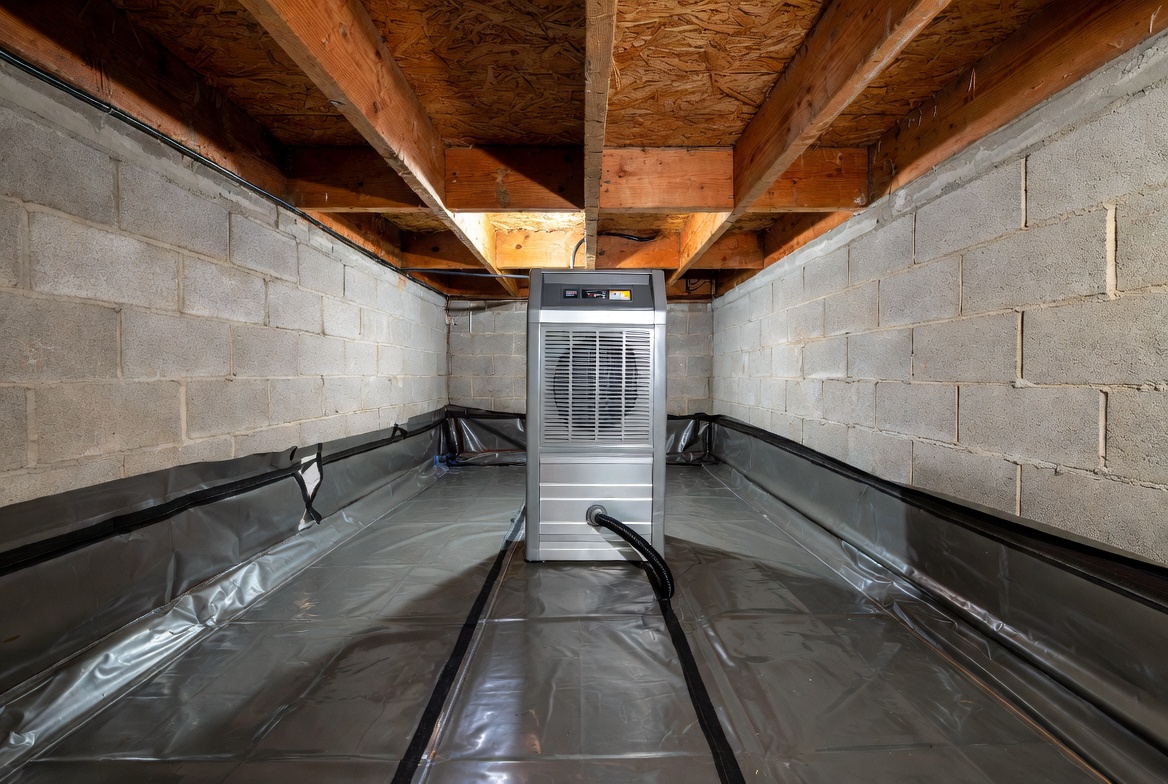
Most crawl space dehumidifier roundups get the setup wrong. They review these machines like ordinary basement units.
They are not.
A crawl space dehumidifier works in a rougher space with worse access, worse drainage, and less room for installation mistakes. Low clearance matters. Pump options matter. Hanging kits matter. Service access matters. And if the crawl is still vented, wet, leaky, or badly sealed, even a good unit can look like the wrong one because it is trying to solve the wrong problem.
So this page is not built around pint rating alone.
The best crawl space dehumidifier is usually not the biggest one. It is the one that fits the space, matches the moisture load, and can stay installed and draining without becoming a maintenance problem.
Worth knowing: if you have not sized the crawl yet, start with What Size Crawl Space Dehumidifier Do You Need?. If the crawl still is not properly sealed, go to Crawl Space Encapsulation Done Right: Moisture First, Air Second and Crawl Space Vapor Barrier Installation: How to Do It Right the First Time before you buy equipment around a broken assembly.
The Quick Picks
| Pick | Best For | Why It Stands Out | Main Trade-Off |
|---|---|---|---|
| Santa Fe Compact70 | Best overall for most sealed crawl spaces | Low-profile form factor, strong crawl-space sizing, MERV-13 filtration, proven crawl-space orientation | Not the cheapest option |
| Santa Fe Oasis105 | Best step-up for larger or heavier-load crawl spaces | More capacity, stronger sizing range, better fit when 70-pint-class feels too light | Bigger machine, higher cost |
| AprilAire E070 | Best compact AprilAire option | Very compact footprint, sealed-crawl positioning, simple professional-grade package | Less sizing headroom than the bigger step-up units |
| AprilAire E100 | Best higher-capacity AprilAire option | 100-pint class, sealed-crawl or whole-home flexibility, strong upgrade path | More machine than many smaller crawls need |
| AlorAir Sentinel HD55P | Best budget-minded pump/gravity-drain option | Compact, both gravity and pump draining, easier entry price than many premium crawl-space units | Smaller coverage and lower filter/spec package than the premium crawl-space leaders |
Best Overall: Santa Fe Compact70
If you only wanted one safest recommendation for most sealed residential crawl spaces, this is the one I would start with.
The Compact70 lands in the sweet spot that a lot of crawl-space machines miss. It is small enough to make sense in low-clearance environments, but it is still built like an actual crawl-space unit instead of a room dehumidifier trying to survive under a house.
Why it works so well for this page:
- Santa Fe lists it for tightly sealed crawl spaces up to 2,600 square feet, which is enough headroom for a lot of real residential jobs.
- It is low profile at roughly 12" by 12" by 21", which matters more than people think once you are actually under the house.
- It uses a MERV-13 filter, which is better than the throwaway filter situation you see on weaker units.
- Its operating range and crawl-space sizing are clearly presented for crawl-specific use, not just broad basement marketing.
This is the machine I like when the crawl is already sealed or very close, the humidity problem is real but not absurd, and the owner wants a serious solution without jumping straight into bigger, noisier, or more expensive equipment.
It is not the right answer when the crawl is larger, leakier, or still behaving like a half-sealed mess. That is where people blame the machine for what is really a crawl-space assembly problem.
Best for: sealed crawl spaces that are moderately sized, low clearance, and serious enough to justify a premium crawl-space unit.
Best Step-Up for Larger or Heavier-Load Crawls: Santa Fe Oasis105
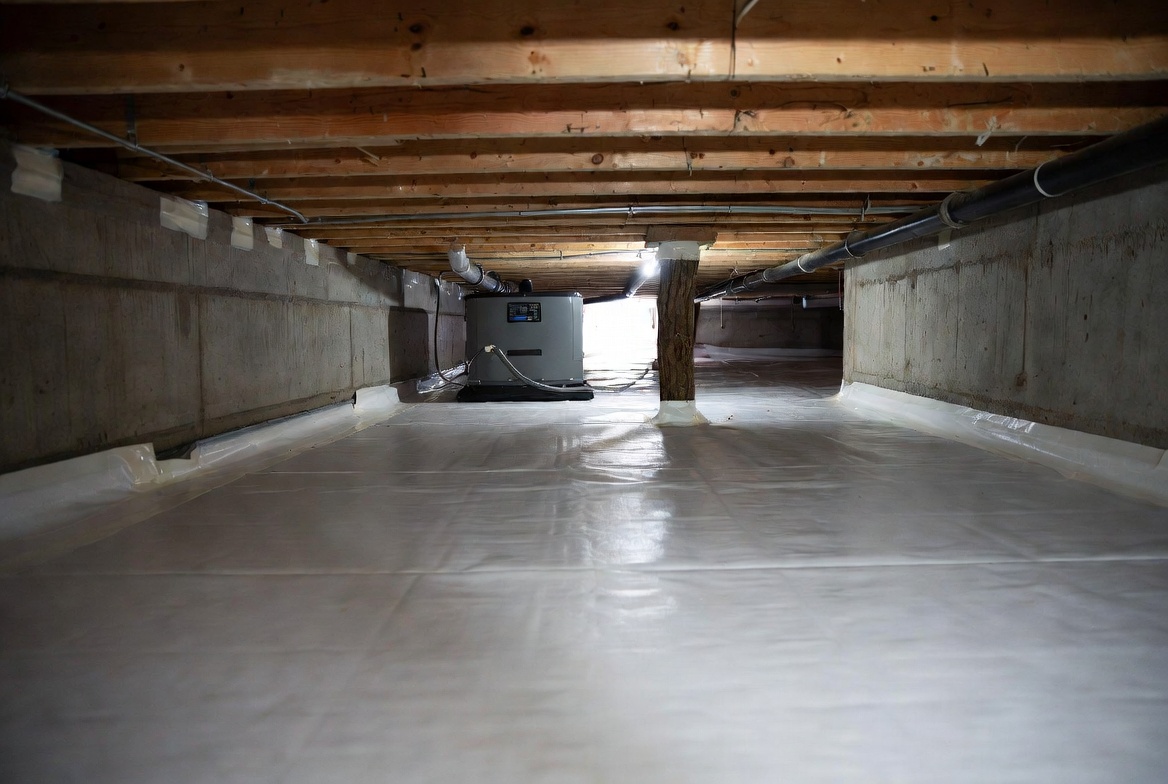
Installed dehumidifier inside a sealed crawl space system. Image by ArchitectureCourses.org.
This is the one you move to when the 70-pint class starts feeling like it might be enough on paper but a little too close to the edge in real life.
The Oasis105 makes sense when the crawl is larger, the seasonal load hits harder, or you want more recovery speed after summer spikes and shoulder-season humidity swings.
Why it earns the step-up slot:
- Santa Fe lists it up to 3,300 square feet for tightly sealed crawl spaces and 2,900 for moderately sealed ones.
- It has a stronger airflow and larger capacity class than the Compact70.
- It is still presented as a crawl-space-appropriate solution, not just a generic big dehumidifier.
- It works better for crawl spaces where the owner wants more cushion instead of sizing right on the edge.
This is a good choice when the crawl is big enough that the smaller compact class starts feeling optimistic, or when the enclosure is good but not perfect and you want a little more breathing room.
Where people get this wrong is using a machine like this to cover for bulk-water issues, sloppy liners, or weak perimeter sealing. A larger unit can help manage a higher air moisture load. It does not fix mud, seepage, or bad crawl-space planning.
Best for: larger sealed crawl spaces, heavier seasonal moisture load, and owners who want more recovery capacity.
Best Compact AprilAire Option: AprilAire E070
If you want a compact pro-grade crawl-space machine and you prefer the AprilAire route, the E070 is the cleanest fit.
What makes it appealing is not just the 70-pint class. It is the combination of sealed-crawl positioning, small footprint, and straightforward professional-grade framing. AprilAire lists it specifically for sealed crawl spaces and basements, with dimensions around 12.5" by 12.5" by 25". That size alone makes it easier to picture under real houses than some bulkier units do.
Why it works:
- compact physical size for crawl-space use
- 70-pint class capacity for smaller to moderate-load sealed crawls
- clear sealed-crawl positioning from the manufacturer
- good fit when you want something cleaner and more professional than a generic room unit
The reason this is not my automatic overall winner is that Santa Fe’s crawl-space sizing language is more directly crawl-focused and the Compact70 still feels slightly more purpose-built around that exact use case. But if you are already leaning AprilAire, or the E070 fits your install conditions better, this is still a very good answer.
Best for: compact sealed-crawl installs where you want a pro-grade machine without jumping into larger capacity classes.
Best Higher-Capacity AprilAire Option: AprilAire E100
This is the AprilAire move when the crawl no longer feels like a compact 70-pint-class job.
The E100 sits in the 100-pint class and is positioned by AprilAire for basements, sealed crawl spaces, or whole-home use. That broader positioning is actually part of the appeal here. If the crawl space is larger, the load is stronger, or the house may eventually want a bigger dehumidification strategy, the E100 gives you a stronger upgrade path than stopping at the smaller unit.
What stands out:
- 100-pint class capacity
- still physically compact enough to be realistic for many crawl installations at roughly 14" by 15" by 26"
- professional-grade build and clear sealed-crawl suitability
- good fit when you want more machine without jumping into more awkward commercial-style equipment
This is not the one I would buy for a smaller crawl just because more sounds better. But if the crawl is on the large side, if moisture spikes hard, or if you simply want more margin, the E100 is one of the cleaner higher-capacity options in this part of the market.
Best for: larger sealed crawl spaces, stronger humidity loads, or homeowners wanting more headroom than the compact class gives.
Best Budget-Minded Pump/Gravity Option: AlorAir Sentinel HD55P
I am putting this here carefully.
Not because it is bad. Because this is the part of the market where the price gets tempting and people start comparing everything to premium crawl-space machines as if the build, filtration, support, and long-term fit are always the same. They are not.
The Sentinel HD55P still earns a place because it fills a real use case:
- it is compact
- it supports both gravity draining and pump draining
- the spec sheet positions it up to 1,500 square feet
- it is a lower-entry alternative to the premium crawl-space field
That makes it interesting for smaller crawl spaces, tighter budgets, or installs where the drain logic matters as much as raw pint class.
Where I would be careful is treating it like a direct replacement for the more established crawl-space-first machines above. If you want the strongest crawl-space package and the budget allows it, I still lean Santa Fe or AprilAire first. If you need a more affordable compact unit with both drain approaches available and the crawl is not huge, this is the budget-minded one I would look at before wandering into random consumer room units.
Best for: smaller sealed crawl spaces, tighter budgets, and installs where pump-or-gravity flexibility matters.
What I Would Not Buy First
This part matters more than the picks.
I would not start with a generic portable room dehumidifier unless the crawl is unusually easy, unusually accessible, and the owner fully understands the drainage and service limitations.
Why:
- they are often physically awkward under a house
- drainage setup is often worse
- they are not built around the same crawl-space installation logic
- service access under a house is already bad enough without using the wrong form factor
I also would not buy by pint rating alone. A crawl-space machine with a better profile, better drain setup, and a better crawl-space fit can outperform a technically bigger but badly matched unit in real use.
What Actually Works vs What People Commonly Do Wrong
| What Actually Works | What People Commonly Do Wrong |
|---|---|
| Pick the unit after the crawl is sealed and the liner is behaving like a real system | Use the dehumidifier to compensate for a bad crawl-space assembly |
| Choose by load, drain setup, and access | Choose by square footage alone |
| Use compact low-profile units where low clearance is real | Buy a big room unit that is miserable to fit and service |
| Choose more capacity when the crawl is large or seasonally hard to pull down | Run a too-small unit at the edge and hope for the best |
| Track humidity with a monitor and verify how the crawl actually behaves | Judge everything by smell or one quick dry-day visit |
How I Would Match These to Real Crawl Spaces
| Scenario | Best Fit | Why |
|---|---|---|
| Smaller sealed crawl, low clearance, solid liner, moderate load | Santa Fe Compact70 or AprilAire E070 | Compact class, crawl-appropriate form factor, enough capacity for many mid-size jobs |
| Larger sealed crawl with stronger seasonal load | Santa Fe Oasis105 or AprilAire E100 | More headroom and better recovery after humidity spikes |
| Budget-sensitive smaller crawl with awkward drain needs | AlorAir Sentinel HD55P | Pump/gravity flexibility and lower-entry price |
| Half-sealed crawl with muddy history and outside water issues | None yet | Fix the crawl first, then buy equipment |
The Detail People Miss
The machine does not just need capacity. It needs a place to put the water.
This gets missed constantly, and it is one reason crawl-space installations go sideways. A crawl-space dehumidifier is a water-moving device. If the drain path is bad, the install is bad. If the crawl is too low to service the machine cleanly, that matters. If you need a pump path and pretend gravity will somehow happen, that matters too.
That is one reason this page does not just reward “biggest pint number wins.” Drain logic and install reality matter just as much.
Also useful: if you need the humidity-reading side of this decision too, go to Best Crawl Space Hygrometers and Humidity Monitors and Crawl Space Humidity: What’s Normal, High, and Dangerous?.
Do Not Use a Dehumidifier to Solve the Wrong Problem
A crawl-space dehumidifier is not a drainage system.
It is not a substitute for:
- downspouts dumping beside the foundation
- bad grading
- missing or shredded liner
- open vents in a crawl that is trying to act sealed
- active leaks
- radon mitigation in a radon-prone crawl
If the crawl still is not sealed properly, or if you are still debating whether equipment makes sense without encapsulation, go to Can You Use a Dehumidifier in a Crawl Space Without Encapsulation? before you buy your way into a partial fix.
How to Pick the Right One in One Walkthrough
- Check whether the crawl is truly sealed. If not, stop and fix that first.
- Look for water history. Mud, staining, tide marks, wet insulation, or recurring storm issues change the whole decision.
- Measure the footprint. Still useful, just not enough by itself.
- Decide whether the crawl is moderate-load or heavier-load. That tells you whether the 70-pint class is enough or whether you should step up.
- Figure out the drain path before you choose the unit.
- Check physical clearance and future service access.
- Buy the machine that fits the crawl, not just the spec sheet headline.
Quick Checklist
- Do not buy by square footage alone.
- Fix bulk water and crawl-space sealing before sizing equipment.
- Use compact crawl-space-specific units when clearance is tight.
- Use the 70-pint class for smaller or moderate-load sealed crawls.
- Step up when the crawl is larger, wetter, or less forgiving.
- Choose the drainage method before you choose the model.
- Track humidity over time instead of trusting smell alone.
What To Do Next
This part matters: if you still are not sure whether the crawl needs a liner job or a full sealed system, go to Crawl Space Encapsulation vs Vapor Barrier Only.
Also useful: if the crawl still is not sealed correctly, go to Crawl Space Encapsulation Done Right: Moisture First, Air Second and Crawl Space Vapor Barrier Installation: How to Do It Right the First Time.
Before you move on: if you still need the sizing decision, use What Size Crawl Space Dehumidifier Do You Need?.
If you still need the bigger picture: go back to House Foundations: What You Need to Know Before Construction and compare the crawl-space strategy against the wider foundation lineup.
FAQ
What is the best crawl space dehumidifier overall?
For most sealed residential crawl spaces, the Santa Fe Compact70 is the strongest all-around starting point because it balances crawl-space-specific sizing, low-profile fit, and purpose-built installation logic well.
Is a 70-pint dehumidifier enough for a crawl space?
Often, yes, for smaller or moderate-load sealed crawls. No, not automatically for every crawl with the same footprint. Load, sealing quality, and drainage setup matter.
Should I buy a bigger dehumidifier just to be safe?
Only if the crawl itself is already behaving like a sealed, manageable enclosure. Bigger equipment does not correct wet walls, standing water, or a bad liner job.
Can I use a regular room dehumidifier in a crawl space?
Sometimes physically, but it is usually not the best crawl-space answer. Crawl spaces reward better fit, better drain logic, and lower-profile equipment.
Do I need a pump?
You need a reliable drain path. If gravity drain is not realistic, then yes, a pump-ready setup becomes a real part of the decision.
What if the crawl still smells musty after installation?
That usually means the machine solved only one part of the problem. Water intrusion, poor sealing, bad liner continuity, humid outside air, or radon concerns may still be in play.
What should I read after this?
If you are still deciding whether the crawl needs a machine at all, go to Can You Use a Dehumidifier in a Crawl Space Without Encapsulation?. If you are comparing monitoring tools too, go to Best Crawl Space Hygrometers and Humidity Monitors.