
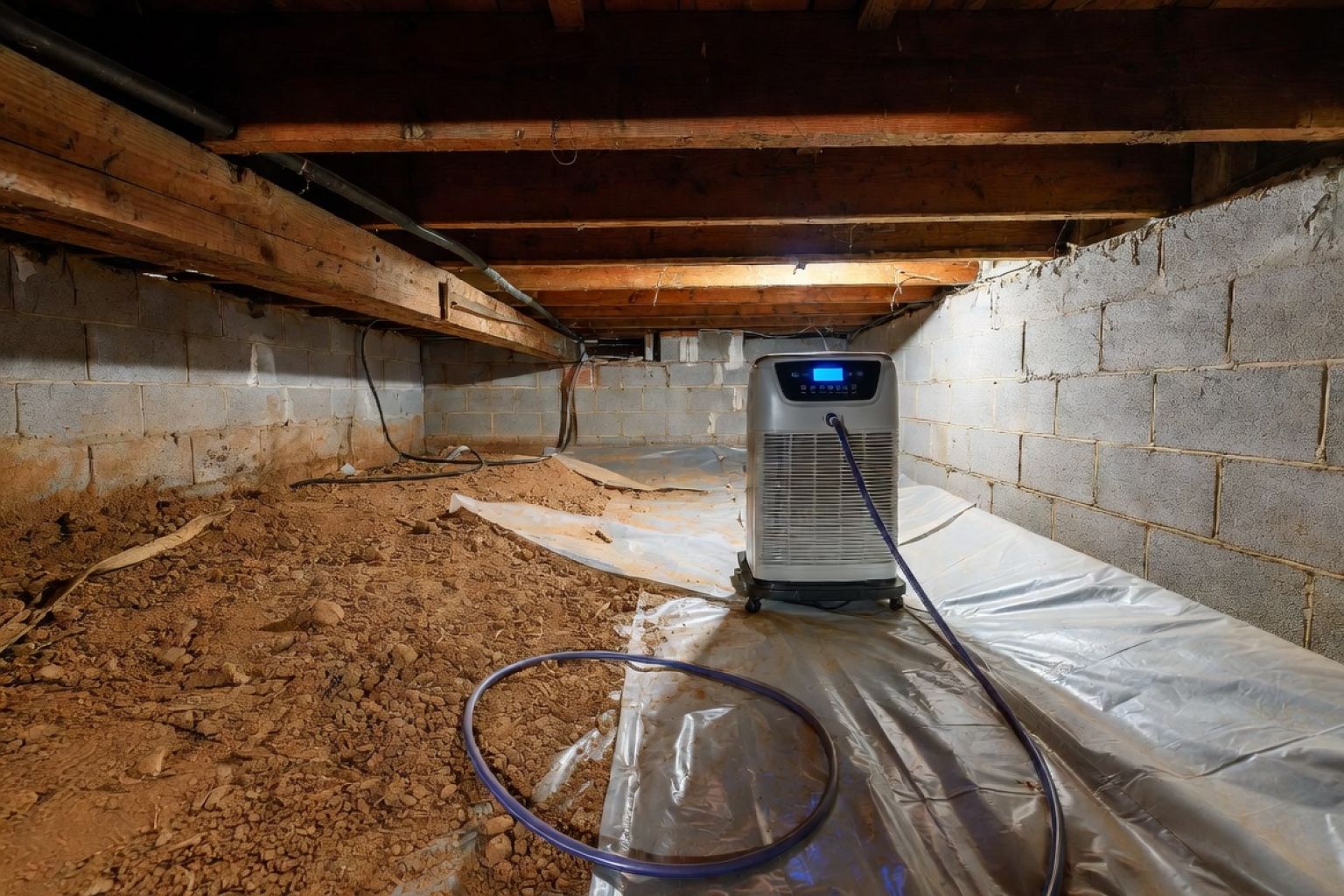


Can a crawl space dehumidifier work without encapsulation? Yes. Sometimes.
The problem is what you are asking it to do. A dehumidifier can pull moisture out of the air. It cannot fix exposed soil, open vents, bulk water after rain, a weak liner, or a bad drain setup. In the wrong crawl, the unit just runs hard, costs money, and hides a moisture problem that is still there.
So the real question is not whether you can run one in an unencapsulated crawl. You can. The real question is when that makes sense, when it is only a temporary move, and when it is a costly substitute for sealing, drainage, and ground-vapor control done properly.
Worth knowing: if you are still sorting out the bigger crawl-space strategy first, keep Crawl Space Encapsulation vs Vapor Barrier Only, Crawl Space Vapor Barriers and Vent Covers: What Works, What Backfires, and Crawl Space Encapsulation Done Right: Moisture First, Air Second nearby while you read this.
The Short Version
Yes, you can use a dehumidifier in a crawl space without encapsulation. In some houses, it helps. In some houses, it is a useful temporary stabilizer. In some houses, it is the only realistic short-term move before the bigger crawl-space work happens.
But no, it is usually not the best long-term answer if the crawl still has exposed soil, weak or missing ground cover, open vents in a humid climate, repeated wetting after storms, or no real drain plan for the unit itself.
A dehumidifier without encapsulation makes the most sense when the crawl is already fairly dry structurally, the main problem is air moisture rather than bulk water, and the owner needs a practical humidity-control move before or instead of full encapsulation.
It makes the least sense when the crawl is still basically a wet, open, poorly controlled space and the machine is being asked to outwork the whole assembly.
| Situation | Use a Dehumidifier Without Encapsulation? | Why |
|---|---|---|
| Mostly dry crawl, decent ground cover, moderate humidity problem | Sometimes yes | Can be a reasonable control move if the crawl is otherwise fairly stable |
| Vented crawl in a humid climate with seasonal RH spikes | Maybe, but usually not as the only answer | The unit may be fighting outside air and a weak assembly at the same time |
| Standing water, muddy soil, damp wall base after rain | No, not as the first move | You still have a water-path problem |
| Sealed crawl not yet fully controlled | Often yes | Dehumidification may be the missing humidity-control piece |
| Exposed soil, no liner, open vents, no drain path | Usually no | You are trying to buy your way past a bad crawl-space setup |
What the Machine Helps With
A crawl-space dehumidifier removes moisture from air.
That sounds obvious. It matters because people still expect it to solve things it does not solve.
A dehumidifier can:
- reduce relative humidity in the crawl air
- help prevent the crawl from lingering in the 60% to 70% and above range
- improve conditions for wood, ducts, and the air above if the crawl is otherwise close to being under control
- help stabilize a crawl while other corrections are happening or after they are finished
A dehumidifier cannot:
- stop water from entering the crawl
- replace a missing or shredded ground vapor barrier
- turn an open humid crawl into a controlled sealed crawl by itself
- fix bad grading, runoff, seepage, or a weak perimeter detail
- replace radon mitigation where radon is the actual problem
That distinction is the whole page.
DOE guidance aimed at homeowners makes the same basic point in plainer language: before installing a dehumidifier, contractors should rule out other moisture sources such as an uncovered dirt floor, improper site grading, and related moisture defects. That is not anti-dehumidifier guidance. It is anti-wrong-order guidance.
When It’s a Reasonable Move
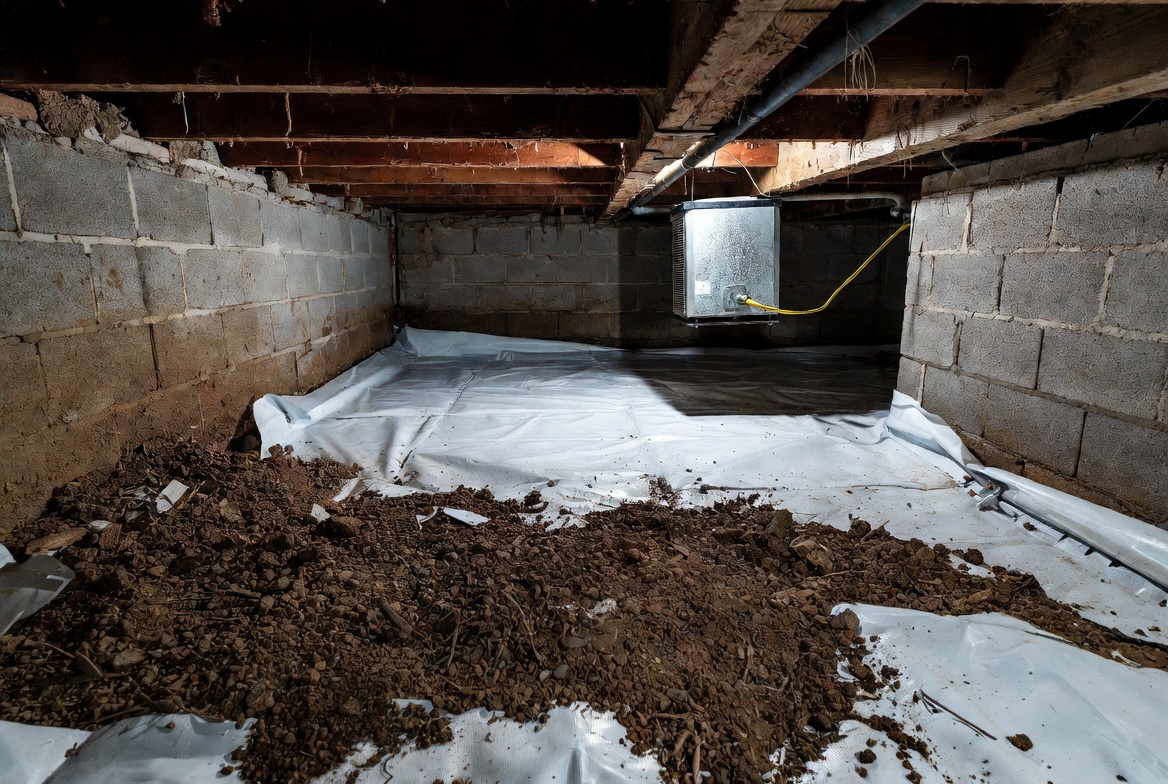
Image by ArchitectureCourses.org. A partial liner and a dehumidifier can help, but they do not fully control crawl space moisture by themselves.
This is the part the internet usually handles badly, because it wants yes/no answers.
There are real cases where a dehumidifier without full encapsulation can be a reasonable move.
1. The Crawl Is Basically Dry, But Humid
This is the best-case scenario for a dehumidifier-only approach.
The crawl does not have repeated standing water. The walls are not wet after rain. The soil may already have some ground cover, or at least the main problem is not obvious mud and seepage. The real complaint is persistent high humidity, musty air, or summer spikes.
In that kind of crawl, a dehumidifier can help. It is not fixing a structural water problem. It is managing an air-moisture problem.
2. The Crawl Is in Transition
Sometimes the crawl is on the way to a better system, but the work is being phased.
Maybe the liner was improved but the full encapsulation scope is not happening yet. Maybe drainage is being corrected first and the crawl needs help holding conditions while the owner decides what comes next. Maybe the crawl is functionally on its way to a sealed strategy but the humidity-control piece is needed before everything else is finished.
That is a legitimate use case. In fact, ENERGY STAR’s crawlspace retrofit guide explicitly allows temporary dehumidifiers to bring humidity down before the rest of the conditioned-crawl retrofit continues, while still requiring standing-water issues to be corrected first.
3. The Crawl Is Staying Vented for Real Reasons
Not every crawl is going to become fully encapsulated.
Sometimes the house, climate, budget, service needs, or local limitations push the owner toward keeping the crawl vented while still trying to manage humidity better. In that case, a dehumidifier may be a practical partial answer if the crawl is otherwise dry enough and not taking on water.
That does not make it the best answer. It just makes it a real one.
4. The Owner Needs a Short-Term Stabilizer
Sometimes the crawl is bad enough that waiting is not wise, but the full scope cannot happen immediately.
In that case, using a dehumidifier as a short-term stabilizer while you line up drainage, liner upgrades, or encapsulation work can be reasonable. Not elegant. But reasonable.
When It Turns Into a Half-Fix
This is the part people want to skip.
A dehumidifier without encapsulation usually disappoints when the crawl still has one or more of these problems:
- standing water or muddy soil after storms
- weak or missing ground liner
- open vents feeding warm humid outside air into the crawl
- wet wall bases or visible seepage
- no good drain path for the unit itself
- owner expectation that the machine will replace fixing the crawl
That is when the machine becomes the cleanup crew for the wrong building assembly.
And the problem with that is not just energy use. The problem is confusion. The crawl gets a little better, or maybe stays a little less bad, and the owner starts thinking the system is “handled.” Meanwhile the real moisture path is still active.
That is the kind of half-fix that drags on for years.
Vented Crawl vs Sealed Crawl: The Dehumidifier Does Not Mean the Same Thing
This matters a lot.
Vented Crawl Space
In a vented crawl, a dehumidifier is often fighting two loads at once:
- the crawl’s internal moisture load
- outside air that keeps reloading the crawl with humidity
That can still help in some houses. But it is a harder fight, especially in humid climates. A dehumidifier in a vented crawl can work more like a compromise tool than a clean system answer.
Building America research has shown that some vented crawls can perform acceptably in certain climates and site conditions, but that does not make humid vented crawls easy to control mechanically. The key condition is still that site water is well managed and prolonged high RH is not part of the normal pattern.
Sealed or Conditioned Crawl Space
In a sealed crawl, a dehumidifier makes much more system sense.
Building America guidance explicitly lists stand-alone dehumidifiers as a common moisture-control option in sealed basements and crawlspaces, and ENERGY STAR’s closed-crawl guidance also treats active moisture control as part of the finished system.
That does not mean every sealed crawl automatically needs one. But it does mean the machine is operating in an assembly that is actually trying to be controlled.
So if you ask, “Can I use a dehumidifier without encapsulation?” the practical answer is:
Yes, but it works better the closer the crawl already is to being controlled.
Dehumidifier Only vs Vapor Barrier Only vs Full Encapsulation
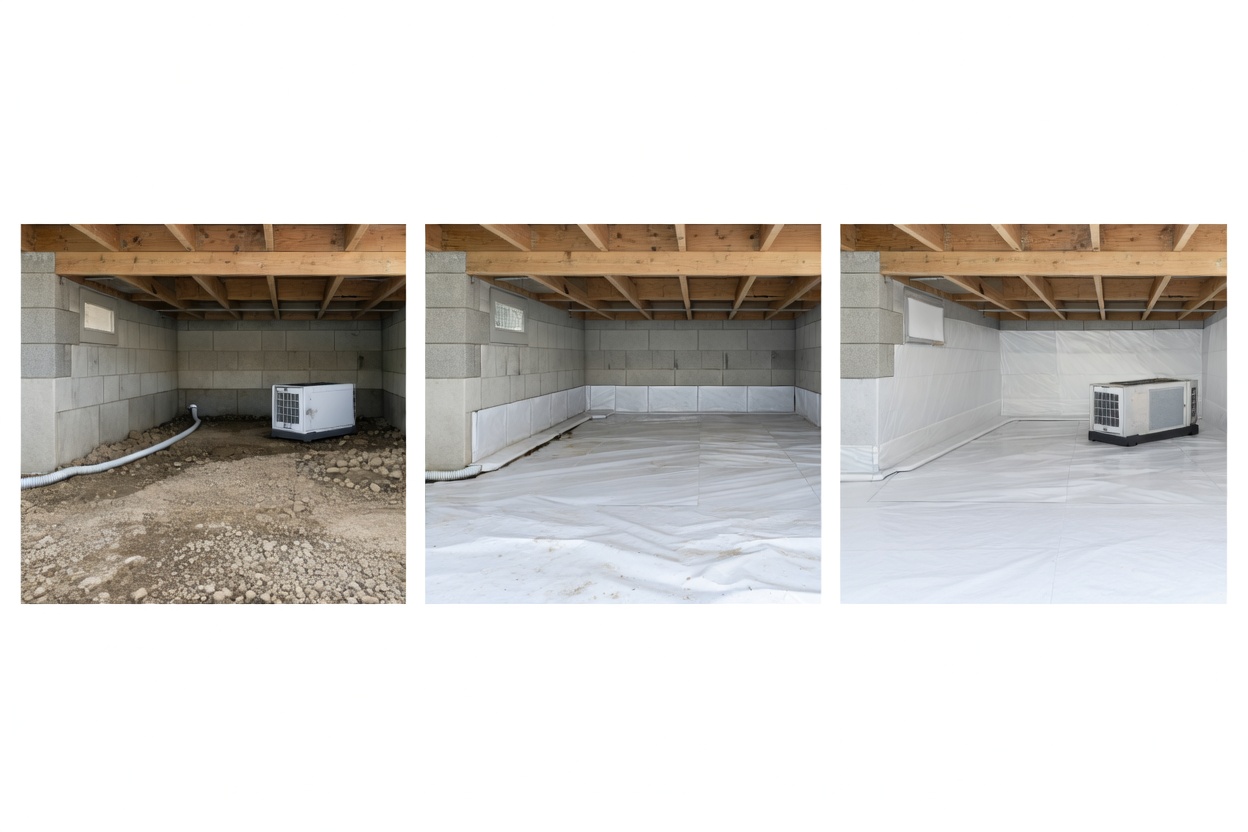
Image by ArchitectureCourses.org. Side-by-side crawl space comparison showing dehumidifier-only control, ground vapor barrier only, and full encapsulation with sealed liner and dehumidifier.
| Approach | What It Helps | What It Does Not Solve | Best Use Case |
|---|---|---|---|
| Dehumidifier only | Air moisture load | Bulk water, exposed soil, weak assembly, open vents in humid conditions | Mostly dry crawl with humidity drift, or temporary stabilization |
| Vapor barrier only | Ground vapor coming off exposed soil | Bulk water, vent-driven humidity, full crawl-space air control | Dry enough crawl with exposed soil and no need for a full sealed system |
| Full encapsulation | Ground vapor, air leakage, vent logic, and humidity control as one system | Bulk water that was never fixed, bad site drainage | Crawl that needs full, deliberate moisture control |
This is why so many crawl-space arguments go nowhere. People are comparing tools that solve different layers of the problem.
A dehumidifier does not replace a liner. A liner does not replace drainage. Encapsulation does not excuse bad runoff. And a vented crawl with a machine in it is still a vented crawl unless the rest of the system changed too.
What Works vs What Backfires
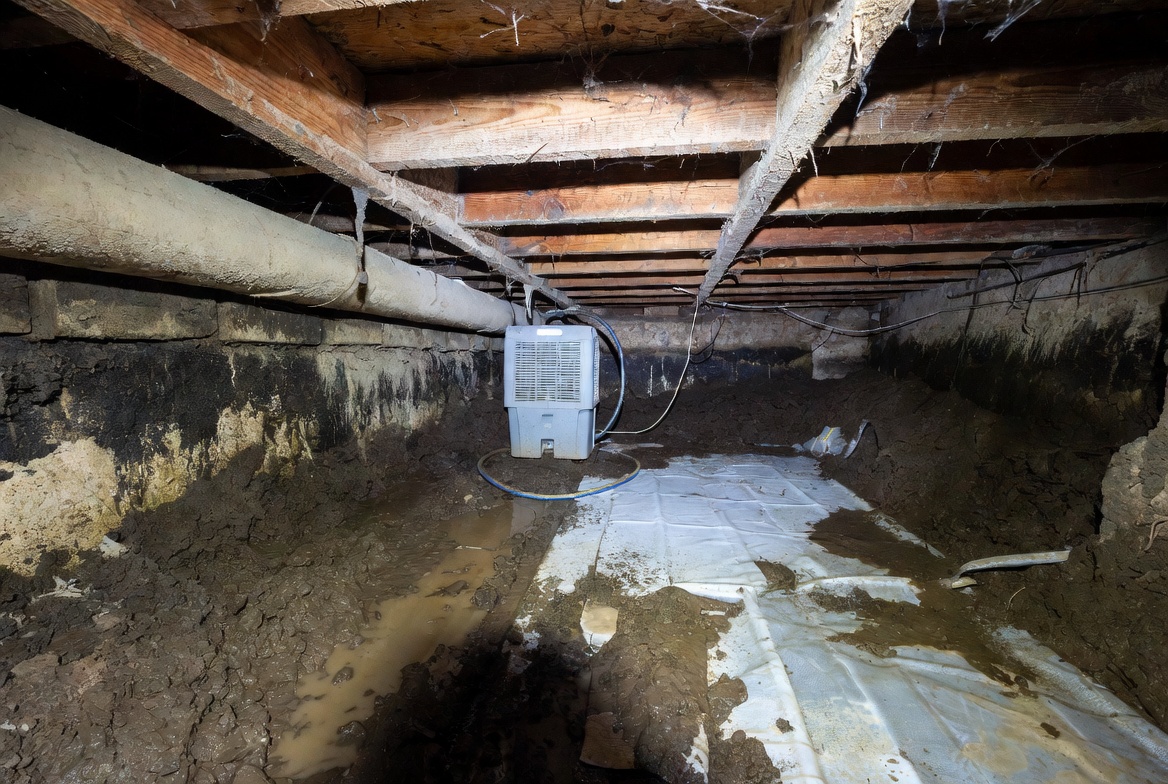
Image by ArchitectureCourses.org. High crawl space humidity is often a symptom of standing water, exposed soil, or weak liner details, not just a dehumidifier problem.
| What Actually Works | What People Commonly Do Wrong |
|---|---|
| Use a dehumidifier after water history, liner condition, and vent strategy are understood | Buy the machine first and ask questions later |
| Use dehumidification to control residual humidity in a mostly dry crawl | Use dehumidification to compensate for standing water or a bad liner |
| Plan the drain path before install | Put the unit under the house and figure the water out later |
| Track humidity over time | Judge success by whether the crawl smells a little better for a week |
| Use the machine as part of a crawl-space strategy | Treat the machine like the whole strategy |
The Part People Skip
The machine does not just need capacity. It needs a reasonable crawl to live in.
That sounds small. It is not.
A crawl-space dehumidifier still needs:
- a place to drain
- enough access for service
- a crawl that is not constantly being reloaded by water or exposed soil
- monitoring so you can tell whether the crawl is actually improving
This is why a dehumidifier-only approach sometimes works in one house and looks useless in another. The machine may be similar. The crawl is not.
If you are not tracking RH properly yet, fix that first with Best Crawl Space Hygrometers and Humidity Monitors and Crawl Space Humidity: What’s Normal, High, and Dangerous?.
How to Read Your Crawl First
- Check whether the crawl gets wet after rain. If yes, fix that first.
- Check the ground condition. Bare soil or a weak liner means the machine is fighting avoidable ground vapor.
- Check whether the crawl is vented or sealed. A dehumidifier in a vented crawl has a harder job.
- Check whether the real problem is air moisture or a wet assembly.
- Check whether you can give the machine a real drain path and service access.
- Decide whether this is a short-term stabilizer or the long-term plan.
If the crawl is mostly dry, mostly lined, and mostly stable, a dehumidifier without full encapsulation can be reasonable.
If the crawl is still structurally wet or open to the weather, the answer is usually not “buy a bigger unit.”
Use This When / Avoid This When
| Use This | When | Avoid This | When |
|---|---|---|---|
| Dehumidifier without full encapsulation | The crawl is mostly dry and the problem is mostly air humidity | Dehumidifier without full encapsulation | The crawl still gets wet, muddy, or reloaded by open humid air |
| Temporary dehumidification | You are stabilizing the crawl while lining up larger fixes | “Temporary” that becomes the permanent non-plan | No one ever fixes the actual crawl issues |
| Dehumidifier as part of a sealed-crawl strategy | The crawl is actually being controlled as a system | Dehumidifier as a substitute for sealing and liner continuity | The crawl assembly is still loose and unfinished |
What to Check First
- Yes, a dehumidifier can run without full encapsulation.
- No, that does not make it the best answer in every crawl.
- Do not use it as the first fix for standing water or wet wall bases.
- Do not expect it to replace a missing or weak ground liner.
- It makes more sense in a mostly dry crawl than in a wet, open one.
- It works best when the crawl is already close to being controlled.
- Plan drainage and monitoring before install, not after.
Where This Leads Next
This part matters: if you still are not sure whether the crawl needs a liner job or a full sealed system, go to Crawl Space Encapsulation vs Vapor Barrier Only.
Also useful: if the real problem is humidity behavior, use Crawl Space Humidity: What’s Normal, High, and Dangerous? and Best Crawl Space Hygrometers and Humidity Monitors.
Before you move on: if you are already committed to moisture equipment, go to What Size Crawl Space Dehumidifier Do You Need? and Best Crawl Space Dehumidifiers.
If you still need the bigger picture: use Conditioned Crawl Space vs Encapsulated Crawl Space and House Foundations: What You Need to Know Before Construction.
FAQ
Can a Dehumidifier Work in a Crawl Space Without Encapsulation?
Yes. It can work, especially when the crawl is mostly dry and the main problem is residual humidity. It is just not always the smartest long-term fix.
Will a Dehumidifier Fix a Musty Crawl Space by Itself?
Sometimes it helps, but only if the mustiness is mostly from air moisture. If the crawl still has exposed soil, seepage, weak liner details, or outside water problems, the smell usually comes back unless those are fixed too.
Can I Put a Dehumidifier in a Vented Crawl Space?
Yes, but it is often a compromise move. In humid climates, the unit may be fighting outside air as much as the crawl itself.
Do I Need Encapsulation First?
Not always. But the closer the crawl already is to being lined, sealed, and controlled, the more effective dehumidification usually becomes.
What Is the Biggest Mistake People Make?
Using a dehumidifier to compensate for bulk water, a bad liner, or an unfinished crawl-space strategy instead of fixing the crawl itself.
When Is a Dehumidifier Without Encapsulation Most Reasonable?
When the crawl is mostly dry, the water history is manageable, and you are using the machine to control humidity, not to excuse a wet assembly.