
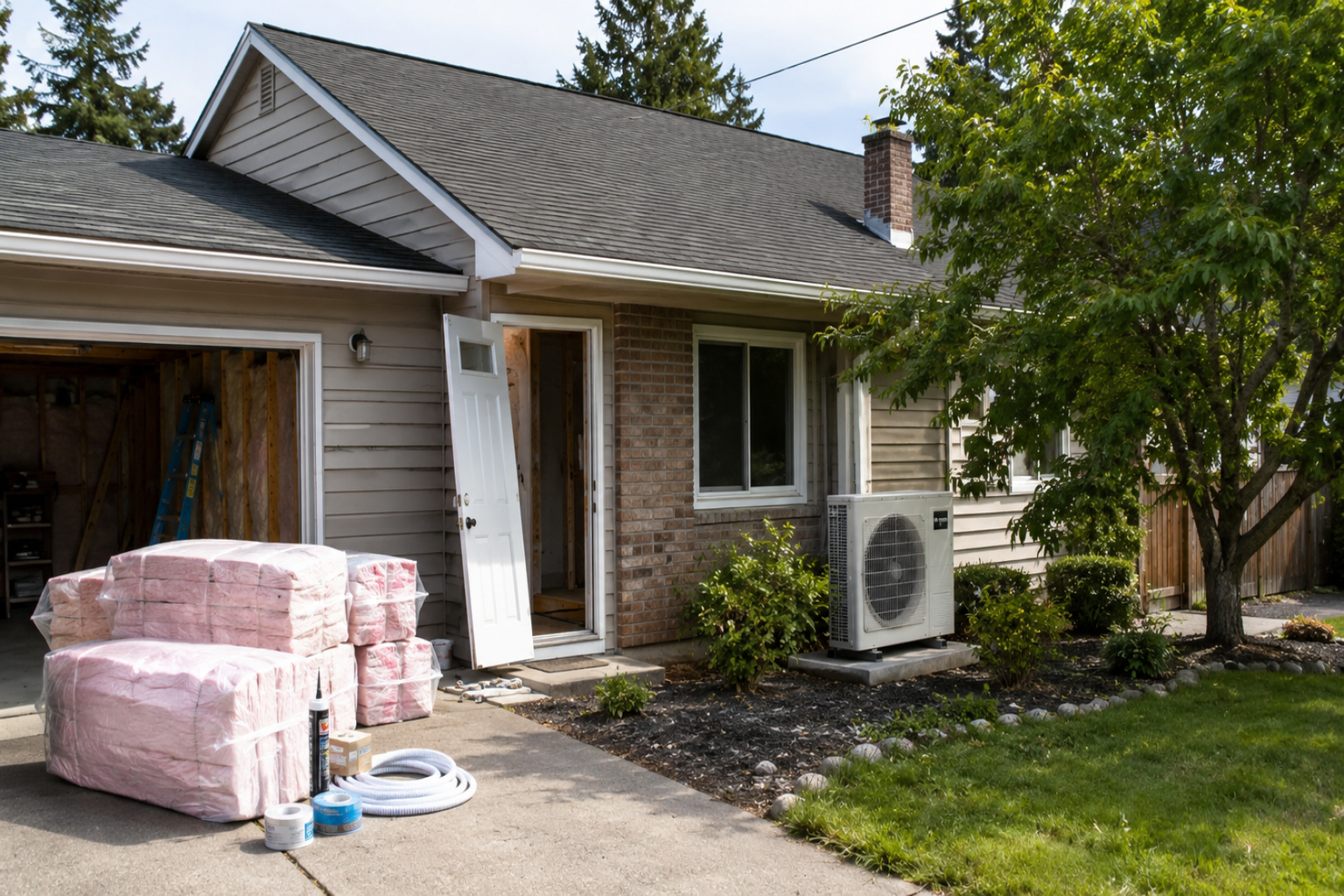
Do not buy the green upgrade first.
Check the house.
Air leaks, wet walls, weak insulation, bad bath fans, old windows, and oversized equipment can waste more money than the solar panels save.
Fix the leaks. Keep water out. Insulate where it counts. Ventilate on purpose. Then size the heating, cooling, and renewable systems.
That is the part that makes the house cheaper to run and better to live in.
Start With The House, Not The Products
Product-first green design wastes money.
A house with air leaks, wet crawl spaces, weak attic insulation, poor bath fans, and old duct leaks will not become efficient because one expensive product was added. The product may help, but it is still sitting on top of a weak building.
Start with a walk-through:
- Where does the house feel cold or hot?
- Where do you smell musty air?
- Which rooms need fans, space heaters, or window AC to feel normal?
- Where is there condensation on glass, walls, or ceilings?
- How old are the roof, windows, furnace, AC, water heater, and insulation?
- Which rooms are dusty, damp, noisy, or hard to clean?
Those answers matter more than a green label. They tell you where the house is failing.
For the wider health-and-sustainability path, use healthy sustainable housing. That page explains why moisture, air quality, materials, comfort, and durability have to be solved together.
The Right Order For Eco-Friendly Home Upgrades
The order matters.
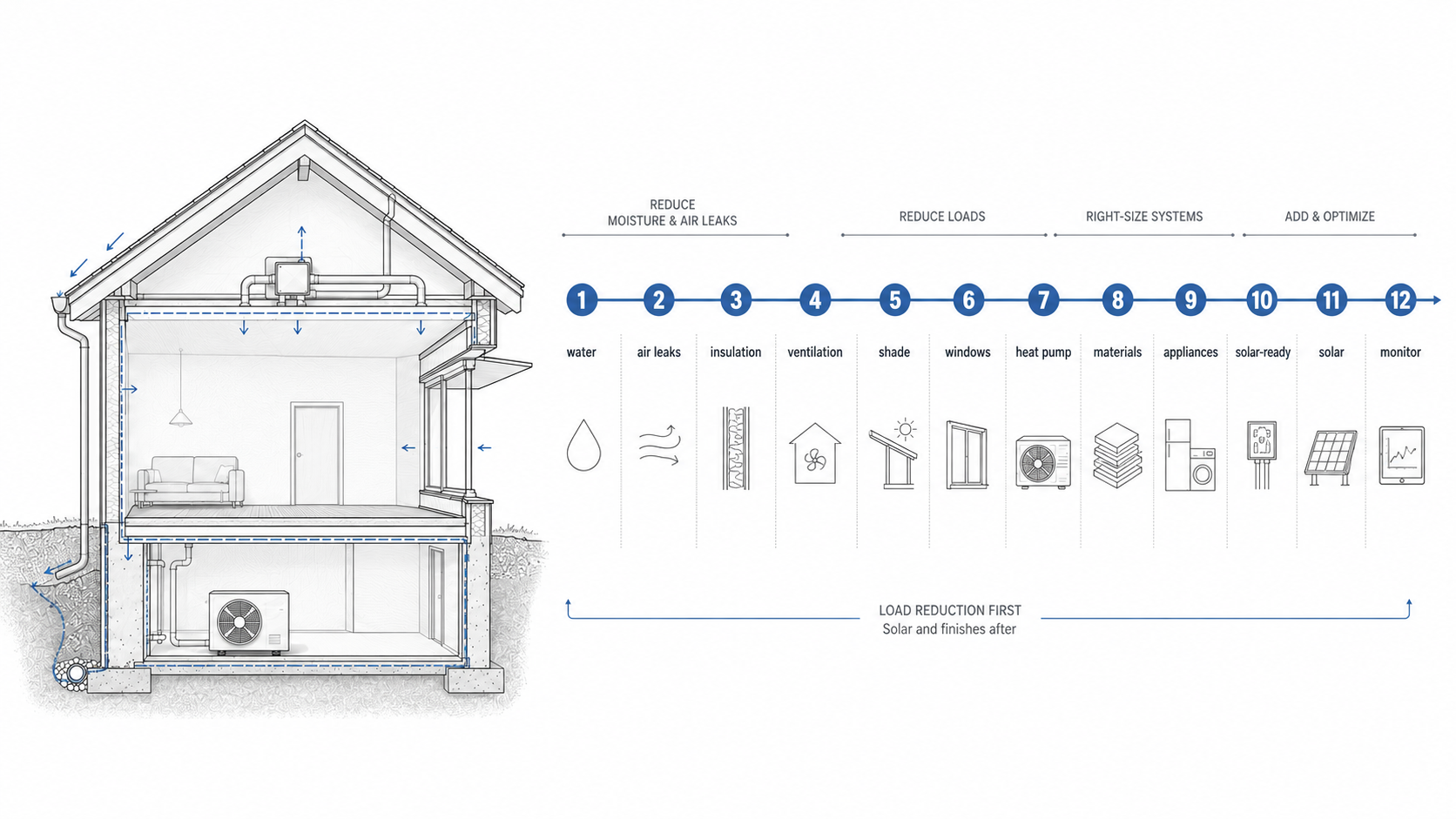
A good sequence looks like this:
- Fix water, leaks, drainage, and damp areas.
- Air seal the major gaps.
- Add insulation where it changes comfort and load.
- Add proper ventilation and local exhaust.
- Improve windows, doors, shading, and daylight where needed.
- Right-size heating, cooling, and hot water.
- Choose low-emission, durable, cleanable materials.
- Prepare the roof, wiring, and panel for future solar or batteries.
- Add solar when the roof, shade, rates, and budget make sense.
- Monitor comfort, humidity, energy use, and maintenance.
That sequence is not exciting. It works.
If you are renovating instead of building new, read eco renovations before you buy materials or equipment. Retrofit work needs a different order than new construction.
Fix Water Before You Chase Energy Savings
Water ruins green upgrades.
Wet insulation stops performing. Damp crawl spaces smell. Roof leaks rot sheathing. Foundation water raises indoor humidity. Poor bath exhaust feeds mold. Once that happens, the house can be efficient on paper and unhealthy in daily life.
Check these areas first:
- roof leaks and old flashing;
- gutters and downspouts;
- grading that slopes toward the house;
- damp basements and crawl spaces;
- plumbing leaks under sinks and tubs;
- bathroom and kitchen exhaust;
- condensation on windows or cold corners.
Do not add insulation over moisture trouble. Do not seal walls that cannot dry. Do not install new flooring over a damp slab and call it sustainable.
If the house already smells damp, send the reader to house smells musty. If the problem is bigger than odor, use home moisture, leaks, and water damage.
Air Sealing Is Usually A Better First Move Than New Windows
Drafts make a house feel worse than the utility bill can explain.
Air leaks often happen at attic hatches, rim joists, top plates, recessed lights, plumbing holes, wiring holes, chimneys, bath fans, duct chases, basement sills, and leaky doors. Small gaps can add up to a house that never feels settled.
Air sealing is not caulking every random crack you can see. The biggest leaks are often hidden in attics, basements, crawl spaces, and utility penetrations.
A blower-door test is the cleaner way to find them. It gives a leakage number before work starts and a second number after work is done. That matters because it proves whether the upgrade changed the house or only changed the invoice.
After air sealing, check ventilation. A tighter house needs a plan for fresh air and moisture removal. Tight without ventilation is not healthy.
Insulation Has To Match The Assembly
Insulation saves energy only when it is installed in the right place, at the right thickness, with the right air control and moisture logic.
The common mistake is adding insulation while ignoring air leaks. Air moves through gaps, around batts, along joists, and through old framing pockets. That leaves cold spots, condensation risk, and rooms that still feel uneven.
Start with the highest-impact areas:
- attic or roof insulation;
- rim joists and basement edges;
- crawl space walls or floors, depending on the plan;
- ductwork in unconditioned spaces;
- wall insulation only when the wall can dry safely.
Green insulation is not automatically the right insulation. Cellulose, mineral wool, wood fiber, hemp, sheep wool, fiberglass, and foam all have places where they work and places where they cause trouble.
Use sustainable insulation for the broader material comparison. For health and safety questions, use the safest insulation to use.
Ventilation Is Not Optional After Tightening The House
A leaky house gets accidental fresh air. That does not mean it gets good air.
Once air sealing and insulation improve, the house needs controlled ventilation. Otherwise moisture, odors, carbon dioxide, cooking particles, cleaning chemicals, and material emissions can stay inside longer.
Ventilation has three jobs:
- exhaust moisture and pollutants at the source;
- bring in outdoor air in a controlled way;
- avoid pressure problems that pull dirty air from garages, crawl spaces, attics, or wall cavities.
Bathrooms need fans that actually exhaust outdoors. Kitchens need real exhaust, not just a noisy recirculating hood that moves grease and particles around. Tighter homes may need whole-house ventilation, especially after major air sealing.
For indoor air basics, use air quality tips for a healthier home. That page should support this one where the reader needs health-specific detail.
Windows Are Not Always The Best First Upgrade
New windows are easy to sell because people can see them.
They are not always the best first move. If the attic is under-insulated, the rim joist leaks, the crawl space is damp, and the bath fan is weak, new windows may not fix the main problem.
Replace windows when they are rotten, unsafe, badly leaking, or far below the performance needed for the room. Otherwise, look at targeted fixes first:
- weatherstripping;
- air sealing around the frame;
- interior storm windows or secondary glazing;
- exterior shading;
- curtains or cellular shades where comfort is the issue.
Daylight matters too. Bigger glass is not automatically better. It can overheat rooms, create glare, fade finishes, and increase cooling demand. The better move is useful light, controlled heat, and windows that fit the climate.
For design support, use natural lighting in architectural design and energy-efficient windows.
Right-Size Heating And Cooling After The Load Drops
Do not size new equipment for the old leaky house.
After air sealing, insulation, duct repair, window work, and ventilation planning, the heating and cooling load can change. That is when heat pumps, mini-splits, boilers, ducts, radiators, or hybrid systems should be sized.
Oversized equipment costs more, cycles badly, can be louder, and may not control humidity well. Smaller equipment can work better when the house shell is improved first.
Heat pumps can be a strong eco-friendly house upgrade because they move heat instead of making heat by burning fuel in the house. But they still need the right design:
- load calculation;
- correct outdoor unit size;
- indoor unit placement;
- duct condition or ductless layout;
- cold-climate performance where needed;
- backup strategy if the climate or house requires it;
- maintenance access.
If cost is the main question, use heat pump cost. Keep this page focused on order and fit, not equipment shopping.
Eco-Friendly Materials Should Be Durable, Low-Emission, And Repairable
Materials are where greenwashing gets loud.
A material can be natural, recycled, local, certified, low-carbon, or trendy and still be wrong for the room. Bathrooms, basements, kitchens, bedrooms, and entry areas do not need the same finish strategy.
Judge materials by five tests:
- Does it release strong odors or pollutants indoors?
- What happens if it gets wet?
- Can it be cleaned without special products?
- Can it be repaired instead of replaced?
- Will it last long enough to justify its impact?
A durable, washable, low-emission finish may be the better eco choice even if it looks less natural. A fragile natural material that stains, swells, or needs early replacement may not be sustainable in that location.
For deeper material selection, use sustainable house materials and materials selection.
Solar Comes After The Roof And The Load
Solar panels can be a good move. They are just not the first move for every house.
The roof has to be ready. Shade has to be checked. The electrical panel has to be reviewed. Utility rules matter. The owner has to understand tax credits, rebates, net metering, and whether they own the system.
Solar works better after the house demand is reduced. A smaller load can mean a smaller system, a simpler battery plan, and less wasted money.
Before solar, ask:
- How old is the roof?
- Will the roof need replacement during the panel life?
- Does shade hit the roof during key hours?
- Is the service panel ready?
- What does the utility pay for exported power?
- Does a battery solve a real outage or rate problem?
For solar cost and incentive logic, use solar incentives. For a full home-energy path, use renewable energy home design.
Eco-Friendly Roofing Is Part Of The House Plan
The roof affects insulation, attic temperature, moisture, solar, stormwater, fire exposure, and replacement waste.
A roof that lasts longer can be more sustainable than a cheaper roof that gets torn off twice. A light-colored roof may help in a hot climate. A metal roof may support long service life and solar planning. A green roof may help stormwater and heat island issues, but only when structure, waterproofing, drainage, and maintenance are handled correctly.
Do not choose roofing from a product list. Choose it from roof condition, climate, slope, drainage, structure, and future solar plans.
For that decision, use ecofriendly roofing.
The Upgrade That Fails Three Months Later
The failure usually shows up after the contractor leaves.
The house looked better. The product sounded green. The invoice was paid. Then the room still felt cold, the fan was too loud, the new floor cupped near the entry, the window corners grew condensation, or the heat pump short-cycled because the load was never calculated.
This happens when upgrades are treated like separate purchases instead of one house system.
The safest rule is simple: do not cover a problem until you know why it exists.
- Do not insulate damp framing.
- Do not air seal without checking ventilation.
- Do not buy solar before checking roof life.
- Do not replace windows before checking the attic and leaks.
- Do not choose a green material before checking water, cleaning, and wear.
The eco-friendly house that works is not the one with the most upgrades. It is the one with the fewest avoidable failures.
Best Upgrades By House Problem
Match the upgrade to the pain point.
| Problem | Check first | Better upgrade path | Do not start with |
|---|---|---|---|
| Cold rooms | Air leaks, attic insulation, ducts, windows. | Air sealing, insulation, duct sealing, then equipment sizing. | New furnace or heat pump alone. |
| Hot upstairs | Attic insulation, roof heat, air leaks, shading. | Air sealing, insulation, shading, ventilation, right-sized cooling. | Oversized AC. |
| Musty smell | Water leaks, crawl space, basement, bath fans. | Moisture repair, drainage, exhaust, humidity control. | Air fresheners or new flooring. |
| High bills | Envelope, ducts, equipment age, behavior. | Audit, air sealing, insulation, equipment upgrade, solar later. | Solar before load reduction. |
| Poor air | Sources, moisture, exhaust, filtration. | Source control, exhaust, ventilation, filtration. | Scented products. |
| Old finishes | Water, wear, emissions, cleaning. | Durable, low-emission, repairable materials. | Trendy green surfaces. |
The Proof Checklist: How To Know The Upgrade Worked
Do not trust a green upgrade just because it was installed.
Ask what changed. A good project leaves proof behind: photos, readings, model numbers, commissioning notes, moisture checks, airflow checks, and a maintenance plan. Without proof, the homeowner is guessing.
| Upgrade | Proof to ask for | Why it matters |
|---|---|---|
| Air sealing | Before-and-after blower-door number. | Shows whether leakage actually dropped. |
| Insulation | Photos before cover-up, depth/R-value, problem areas noted. | Hidden work is hard to verify later. |
| Bath fans | Outdoor termination, airflow check, timer or humidity control. | Many fans make noise but move little air. |
| Heat pump | Load calculation, model numbers, commissioning settings. | Prevents oversizing and comfort problems. |
| Materials | Product data, emissions information, cleaning instructions. | Prevents green labels from replacing actual performance. |
| Solar readiness | Roof age, shade check, panel capacity, conduit path. | A future solar plan should not require tearing work apart. |
This is the difference between an upgrade and a sales receipt. The work should leave the house easier to understand, not just better looking.
If You Are Renovating An Older House
Older houses need patience.
They may have lead paint, asbestos materials, knob-and-tube wiring, damp basements, old plaster, balloon framing, uninsulated walls, old ducts, weak bath fans, or assemblies that dry differently than modern walls.
The wrong eco upgrade can damage an older house. Interior insulation can create condensation if vapor and drying are ignored. Tightening the shell can make old combustion appliances unsafe if venting is not checked. Replacing windows can remove useful storm-window logic and add cost without solving the main leak path.
Use renovation openings carefully. If a kitchen, bathroom, attic, or basement is already open, that is the time to run wiring, seal leaks, add exhaust, improve insulation, and prepare for future heat pumps or solar.
For broader renovation planning, use green remodeling.
If You Are Building New
New construction is easier because the shell, systems, materials, and site can be planned together.
Start with:
- simple building shape;
- good orientation for sun and shade;
- water-managed roof and wall assemblies;
- continuous air barrier;
- continuous insulation where practical;
- planned mechanical ventilation;
- right-sized heating and cooling;
- low-emission materials;
- solar-ready roof and electrical planning;
- easy maintenance access.
For new construction, use building a sustainable house. For performance targets, use net zero architecture.
Where To Spend And Where To Save
Spend on work that is hard to reach later.
- roof and water control;
- air sealing behind drywall;
- attic and crawl space insulation;
- ducts in hidden spaces;
- bath and kitchen exhaust;
- electrical rough-ins for future equipment.
Save on work that can be changed later.
- decorative finishes;
- countertops;
- cabinet fronts;
- smart devices that do not fix the building;
- solar batteries before you know your true load.
A simple house with a good shell, quiet ventilation, and right-sized equipment will beat a flashy house with poor sequencing.
A Practical Phase Plan
You do not have to do everything at once.
| Phase | Work | Why it comes here |
|---|---|---|
| Phase 1 | Leaks, drainage, roof trouble, crawl space or basement moisture. | Water damage can ruin every later upgrade. |
| Phase 2 | Audit, blower-door test, air sealing, attic and rim-joist insulation. | Comfort and load reduction start here. |
| Phase 3 | Ventilation, bath fans, kitchen exhaust, filtration. | Tighter homes need controlled air. |
| Phase 4 | Heat pump, water heater, ducts, controls. | Equipment should match the improved house. |
| Phase 5 | Durable low-emission materials and room finishes. | Finishes last longer after moisture is solved. |
| Phase 6 | Solar, battery, EV charging, monitoring. | Renewables work better after demand is lower. |
Questions To Ask Before Hiring
Ask questions that expose sequencing.
- What problem are we solving first?
- Have we checked moisture before adding insulation?
- Will air sealing change ventilation needs?
- Are we sizing equipment to the current load or the improved load?
- What work will be hidden behind drywall later?
- What maintenance does this product need?
- Can this material handle water, cleaning, pets, kids, and daily wear?
- Is the roof ready for solar now, later, or not at all?
- How will we verify the work after installation?
If the contractor only talks about products and not the house, slow down.
FAQ
What is an eco-friendly house?
An eco-friendly house uses less energy, wastes fewer materials, protects indoor air, handles moisture well, and lasts longer without constant replacement. It is not defined by one product.
What should I fix first in an eco-friendly house?
Fix water and air leaks first. Then add insulation, ventilation, right-sized systems, durable materials, and renewable energy when the house is ready.
Are solar panels the best eco-friendly home upgrade?
Solar can be a good upgrade, but it works better after the roof is sound and the house load is reduced. A leaky, poorly insulated house needs shell work before solar.
Are new windows worth it?
Sometimes. Replace rotten, unsafe, or badly leaking windows. If the windows are sound, air sealing, attic insulation, shading, or storm windows may give better value first.
Can a house be too airtight?
A tight house is not the problem. A tight house without proper ventilation is the problem. Air sealing should be paired with source control, exhaust, and fresh-air planning.
What materials are best for an eco-friendly house?
Choose materials that are durable, low-emission, repairable, cleanable, and suited to the room. Natural or recycled labels are useful only when the material performs well in that location.
Should I use a heat pump in an old house?
Maybe, but reduce the load first. Air sealing, insulation, duct repair, and ventilation planning can make the heat pump smaller, quieter, and more effective.
What is the biggest eco-friendly home mistake?
Buying products out of order. Solar, heat pumps, windows, and green finishes work better after moisture, air leaks, insulation, ventilation, and roof condition are handled.
Read This Next
Start with healthy sustainable housing if indoor air, moisture, materials, and comfort are part of the goal. For retrofit work, read eco renovations and green remodeling. For shell work, use sustainable insulation and the safest insulation to use. For materials, go to sustainable house materials. If solar or roof replacement is part of the plan, read ecofriendly roofing, solar incentives, and renewable energy home design.
Sources and reference links
- ENERGY STAR: ENERGY STAR Home Upgrade
- ENERGY STAR: Why Seal and Insulate?
- U.S. Department of Energy: Professional Home Energy Assessments
- U.S. Department of Energy: Blower Door Tests
- U.S. Department of Energy: Air Sealing Your Home
- U.S. Department of Energy: Whole-House Ventilation
- U.S. Department of Energy: Air-Source Heat Pumps
- U.S. Department of Energy: Ductless Mini-Split Heat Pumps
- U.S. Environmental Protection Agency: Improving Indoor Air Quality
- U.S. Environmental Protection Agency: The Inside Story: A Guide to Indoor Air Quality
- U.S. Environmental Protection Agency: A Brief Guide to Mold, Moisture and Your Home
- U.S. Department of Energy: Passive Solar Homes
- ENERGY STAR: Rooftop Solar