
Energy-Efficient Windows: The Field Guide I Give Every New Hire
Quick and practical: you’ll learn how to read the NFRC label (U factor, SHGC), when low E or triple pane glass actually pays off, and how to choose windows that fit your climate, not just the brochure. We’ll end with a simple install checklist so the performance you paid for shows up on site.
What “energy-efficient” really means (and how to read the label)
How I read a window label on site
I walk up, find the NFRC sticker, and look at two things first. U-factor: how fast heat moves through the whole unit. Lower is tighter. On real labels you’ll see roughly 0.20–1.20. SHGC: how much sun becomes heat indoors. Go lower on hot west and south facades; in cold regions a moderate SHGC can help you through winter. Then I glance at VT (how bright rooms feel) and CR (condensation resistance). If AL (air leakage) is listed, lower means fewer drafts. That’s the read.
NFRC: the truth rectangle
Sales sheets love center-of-glass numbers. The NFRC label doesn’t. It reports whole-window performance—glass and frame—so you can compare brands on equal terms. Learn that rectangle once and you can ignore most of the brochure poetry.
ENERGY STAR v7.0, translated
The current criteria are climate-based and tighter than the last round. In the Northern zone, a qualifying window needs a U-factor of 0.22 or lower. Skylights and patio doors follow their own thresholds—don’t assume a slider qualifies just because a casement does. There’s also a yearly Most Efficient list that sets a higher bar than basic certification.
If you want the design logic behind these choices, read Green Architecture Principles Every Architect Should Know. For whole-home targets that windows need to support, see Net Zero Architecture: Everything You Need to Know.
Low-E without the jargon (what to spec and why)
Coatings that do the work
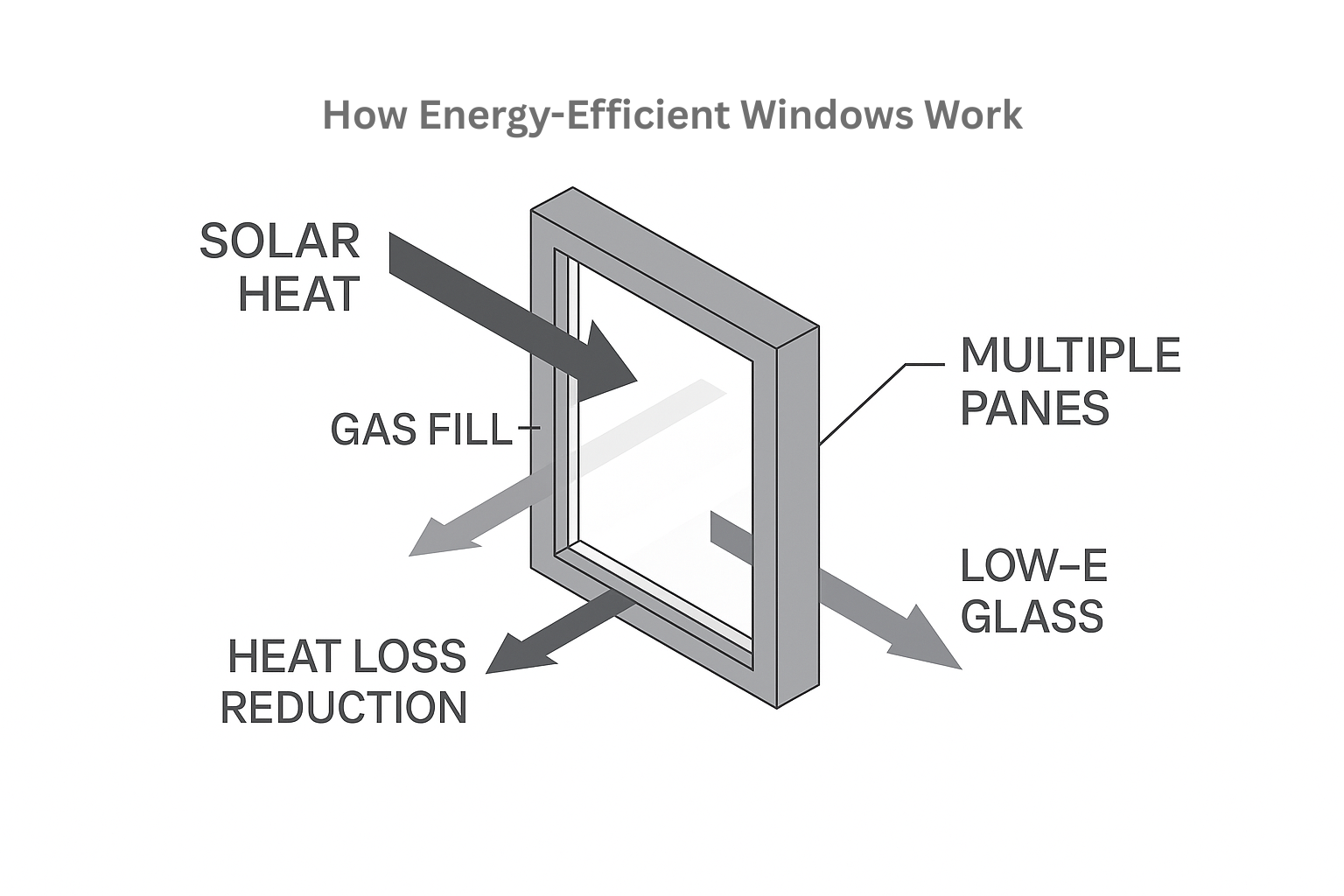
Soft-coat low-E is the modern default in double and triple glazing. It delivers lower U-factors and lower SHGC, so you get tighter insulation and better control of summer heat. Hard-coat low-E has a tougher surface and can live on single glazing; it lets in more solar gain, which can be useful on cold-climate south facades where passive heat makes sense.
Gas fills & spacers that move the needle
Argon is standard and cost-effective. Krypton earns its keep in tight triple panes or thin IGUs where the cavity is small. Use warm-edge spacers to reduce edge losses and improve condensation resistance. Note them in the spec; don’t turn them into a thesis.
Marketing names → performance numbers
Labels like “Low-E3” or “366” are fine as shorthand, but I always translate them back to the two targets that matter for the project: the U-factor and SHGC that fit the climate and each façade’s orientation. Numbers beat adjectives every time.
Pair glass choices with a sane envelope: Sustainable Insulation That Saves Energy and Cuts Costs. For broader material trade-offs and prioritization, see Materials Selection: Best Practices.
Match specs to climate & orientation (so rooms feel right)
ENERGY STAR zone targets in plain English
Use the ENERGY STAR climate zone map as a baseline. Northern projects now demand U-factor ≤ 0.22. Warmer zones lean on lower SHGC to keep out summer heat. Each region has its own comfort band—knowing it means you don’t overspend on glass that isn’t built for your climate.
Orientation cheat sheet
South/West facades: push SHGC down and add exterior shading to survive hot afternoons.
North-facing glass in cold zones: allow a bit more SHGC—free passive gains without cooking the room.
East: morning sun can be harsh if bedrooms or workspaces face it; spec glazing that tempers the glare.
Double vs triple pane: when it pays off
Cold climates and noisy sites are where triple glazing earns its cost. Lab tests show real HVAC savings, but comfort—the quiet, the lack of drafts, the even surface temps—is what wins clients. In mild zones, the math often favors a well-detailed double.
Tie fenestration back to your whole-home plan: Renewable and Clean Energy for Homes. For projects chasing deep efficiency, revisit Net Zero Architecture.
Replacement, price, and the money side (credits, rebates, payback)
What things really cost
Window prices move with frame material (vinyl, fiberglass, wood, aluminum), size and custom shapes, glazing stack (double, triple, coatings, gas fills), and installation conditions (flashing, repair of old openings). Do not price windows without also budgeting for air sealing and proper flashing. A cheap install burns the savings of the glass.
U.S. federal tax credit (25C) — what counts
You can claim 30% of the product cost up to $600 per year for windows and skylights. Labor does not qualify for this window credit. The program runs through Dec 31, 2025. Starting in 2025, you need the manufacturer’s Qualified Product Identification Number (PIN) on the invoice, plus the NFRC label photo. Keep both for your tax file.
Rebates and stacking without getting burned
State or utility rebates often stack with federal 25C. But many treat the rebate as a purchase price adjustment—so your federal credit applies to the net cost. Example: a $2,000 window package with a $500 state rebate leaves $1,500 as the base for your 25C credit. Always read the fine print before buying.
For the broader incentives landscape, see Renewable Energy for Commercial Buildings: Costs, Benefits, and Incentives. Want a systems-level view before you sign a contract? Check Sustainability: Principles and Practice (3rd Ed.).
If you can’t replace: storm windows & smart retrofits
Low-E storm windows that hold their weight
On single-pane or old aluminum frames, adding a low-E storm can shift comfort overnight. DOE and PNNL studies peg savings between 10–30% on heating/cooling, often at about a third of full replacement cost. The big lesson: storms are not just “cheap add-ons.” They are a phase strategy. In historic work where you can’t rip out sash, storms are the bridge that buys you another decade before full window replacement.
Start with air before glass
Seal gaps first. A $20 tube of caulk or a weatherstrip kit can stop drafts faster than a $500 sash swap. Once the box is tight, then stack glass performance. You’ll feel it immediately—no more condensation streaks at the sill, and the HVAC stops short-cycling. Clients notice the comfort before they ever notice the bill.
Shade beats over-spec glass in summer
Too many specs push very low SHGC glass that kills winter comfort. A smarter move in hot sun is exterior shading—awnings, overhangs, even trees. Films and interior shades help too, but they never beat a physical block on the exterior. Think sequence: control the sun outside first, then fine-tune with coatings.
When you pick retrofit materials, skip the greenwash. See Sustainable Building Materials: What Works and What Fails. For real product categories that perform, review Sustainable Materials Examples.
Frames & operating types (pick the right body for the glass)
Frame materials that make or break performance
Vinyl: Cheapest way into efficiency. Good U-factors if the frame isn’t hollow junk. Check for reinforcement or you’ll see warping over time.
Fiberglass: Stable under heat and cold, holds slim profiles, and resists bowing. A solid “buy once, cry once” option.
Wood/clad: Classic look with modern glazing. Interior stays warm; exterior cladding cuts the paint cycle. Maintenance still matters—rot kills fast if detailing is sloppy.
Thermally broken aluminum: The modernist favorite. Sleek lines, but in cold zones you must specify thermal breaks or you’ll get condensation and frozen frames.
Operable types and what they really deliver
Casement & awning: Seals compress tight, so air leakage is low. Often the best performer on the NFRC label.
Double-hung: Good for ventilation and mandatory in historic fits. Efficiency varies—always check the Air Leakage (AL) number. Some pass, some leak like sieves.
Sliders: Simple, cheap, and common. But you trade performance. Inspect the AL and water resistance. If it’s not rated tight, expect drafts.
Skylights & specials
ENERGY STAR skylights exist and should be treated like mini roof windows. Check U-factor and SHGC the same way you would for vertical glazing. Always add interior shades or exterior controls—otherwise you’re just baking the room.
For real material trade-offs with cost notes, see Types of Sustainable Materials: Real Costs and Trade-Offs. For smarter build methods, check Methods of Sustainable Construction: What Works, What Wastes Money.. For whole-building context beyond windows, I hand teams The Whole Building Handbook.
Buying, installation, and QA (what makes or breaks performance)
How to shop like a pro
Take a photo of the NFRC label and keep it with your invoice. That’s your proof if anything fogs or fails. Confirm the numbers match your ENERGY STAR v7.0 climate zone. U-factor and SHGC must line up with your location. Ask for a written install scope that lists flashing sequence, insulation/air-sealing, and back dams. Read the warranty—glass seal and fogging coverage are where most fights happen.
Installation checklist that prevents callbacks
Get these basics right or even the best-rated unit will leak:
- Back dam or sill pan at the rough opening
- Square, shim, and set plumb
- Continuous exterior sealant, low-expansion foam inside
- Layered flashing in proper order (sill → jambs → head)
- Head flashing that actually sheds water
- Air barrier continuity: tie window to WRB and interior layer
- Photo log each step: rough opening, flashing, insulation, final close-up
Brands without the fanboying
Andersen, Marvin, Pella, Milgard—big names all publish ENERGY STAR-compliant stacks with low-E options. But a logo does not save a bad install. Judge windows by the label numbers and the quality of the crew that sets them.
For strategies you can hand to clients, see Sustainable Design Strategies in Architecture, and tie your QA process to Green Building Practices.
FAQ
Are triple-pane ENERGY STAR windows worth it in my climate?
Often in colder zones and noisy sites. Check your zone’s U-factor target (North ≤ 0.22) and model the comfort/savings. Comfort plus air-leakage control usually tip the decision.
What’s the average energy savings from new windows?
It depends on what you’re replacing and your climate. Research shows meaningful heating/cooling reductions with well-specified triples; don’t over-generalize—show your assumptions.
Hot climates: low SHGC or window films/shades?
Start with lower SHGC glazing on west/south and add exterior shading where feasible; films and interior shades can help, but exterior shade controls heat best.
How do low-E storm windows compare to full replacement?
On tight budgets or historic facades they can deliver ~10–30% savings and much better comfort at a fraction of full replacement cost—great as a phased approach.
Do tax credits cover labor for windows?
No. The 25C window credit applies to product cost only (up to $600/year). Keep the invoice, label photo, and in 2025 include the manufacturer’s PIN on your return.
Tools & Downloads
- NFRC Label Cheatsheet (PDF) — annotated label with U/SHGC/AL/CR callouts.
- Orientation Matrix (PDF) — which SHGC to favor by climate and orientation.
- Installation QA Checklist (PDF) — flashing order, air seal, insulation, photo log.