


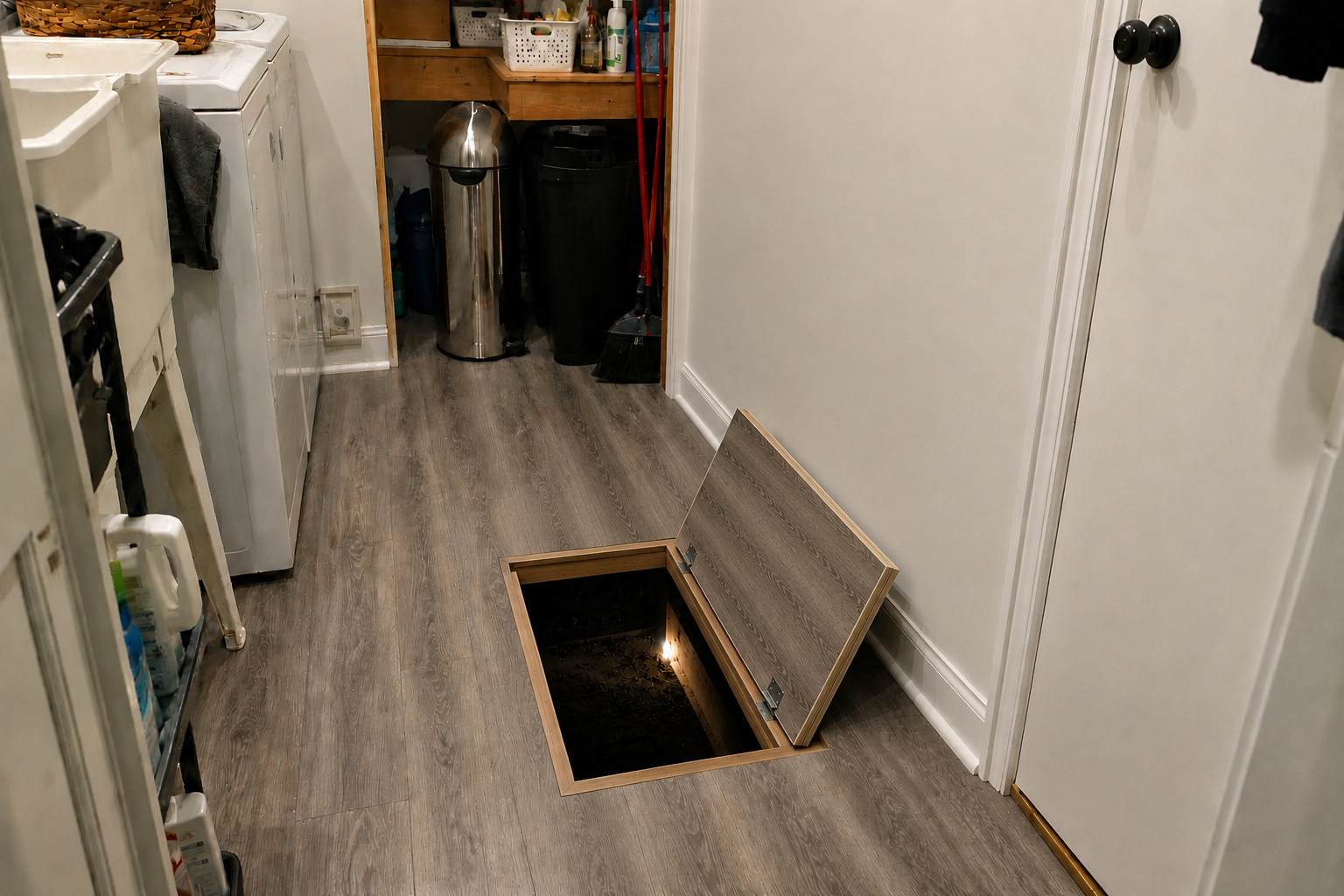
Indoor crawl-space access sounds smart until the hatch lands in the wrong room.
The idea is easy to like. No wet trip outside. No fighting with a stuck exterior panel in the mud. Easier inspections. Easier plumbing work. Easier service when something fails under the floor.
Then the hatch ends up in a bedroom closet with a bad seal. Or in a hallway floor that always feels suspicious. Or above a crawl space that still smells damp in summer. Now the “convenient” access point is also a smell path, an air-leak path, and a thing people try not to look at.
That is the real decision here. Inside access can be a good upgrade. It can also be a clean way to bring crawl-space problems into the house faster.
Image by ArchitectureCourses.org. Interior crawl-space access works best when the hatch is placed in a utility room and built as a solid, framed part of the floor.
Do not cut a hole in the floor yet
I would decide whether the crawl deserves interior access before deciding where the hatch goes.
If the crawl is dry enough, reasonably controlled, and worth entering on a regular basis, interior access can make sense. If the crawl still gets wet after rain, smells stale, grows mold, or has obvious humidity trouble, an indoor hatch can turn a bad crawl into a more convenient bad crawl.
That is not an upgrade.
Read this next: If the crawl still feels damp, go first to crawl space humidity, water in a crawl space after rain, or crawl space mold remediation. A better access point will not fix the crawl underneath it.
Why people want inside access in the first place
Because exterior access is often terrible.
The outside door is too small. The panel sticks. The grade is muddy. The opening faces the wrong side of the house. Every inspection turns into a filthy awkward crawl before the real crawl even starts. In winter it is worse. In rain it is worse. If the house has mechanicals below the floor, or plumbing that keeps needing attention, the frustration piles up fast.
That is why inside access keeps sounding like the better move. In the right house, it often is.
But convenience is only half the question. The other half is whether you are putting that convenience above a crawl space that behaves well enough to live under the same roof opening.
When inside access makes sense
There are houses where this is the better answer.
- the exterior access is awkward, undersized, or badly located
- the crawl needs regular inspection or service
- plumbing, electrical, or mechanical equipment below the floor gets accessed often enough to matter
- the crawl is reasonably dry and controlled
- there is a low-stakes interior room where a hatch can live without becoming a daily annoyance
That last part matters more than people expect. Some rooms can absorb an access hatch. Some cannot.
| If the Situation Looks Like This | Inside Access Usually Makes | Why |
|---|---|---|
| Dry crawl, poor exterior access, utilities below floor | More sense | You are solving a real maintenance problem |
| Damp or musty crawl with no moisture control | Less sense | You are creating an interior opening over a problem space |
| Good exterior access already exists | Less sense | The gain may be too small to justify it |
| Closet, utility room, laundry, or mudroom location available | More sense | Those rooms handle a hatch better than main living areas |
| Living room, bedroom, or main circulation path only | Less sense | The hatch becomes a daily design and comfort problem |
Bad room, bad idea
This is where a lot of otherwise decent access ideas go wrong.
An interior crawl-space hatch does better in a utility room, laundry room, mudroom, secondary closet, or some other low-drama part of the house. Those places already tolerate service access, awkward floor interruptions, and the kind of minor visual compromise that comes with a removable hatch.
Put the same hatch in a bedroom, living room, dining room, or a tight main hallway and it becomes part of the room in a bad way. People notice it every day. Furniture has to work around it. Rugs get used to hide it. Then somebody needs access and the room has to be torn apart again.
There are exceptions. But the rule is simple: the more public and finished the room feels, the worse an interior crawl hatch usually ages.
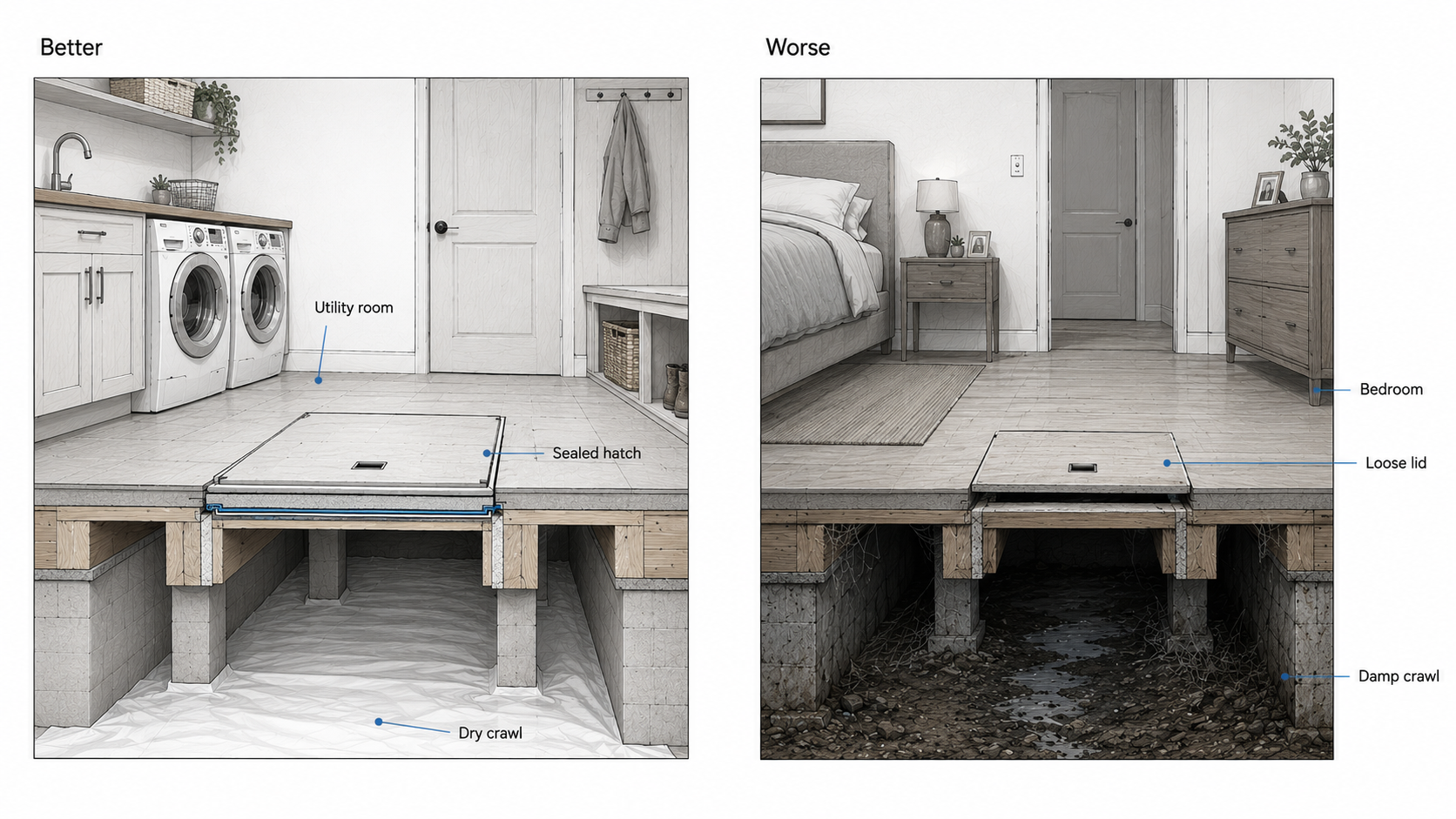
Illustration by ArchitectureCourses.org. Interior crawl-space access works best when the hatch is sealed, insulated, large enough for service, and placed in a low-stakes room above a dry crawl space.
The crawl below has to earn the opening above
This is the test that matters.
If the crawl below still smells damp, still grows mold, still holds wet insulation, or still takes on outside humidity and dirt, then cutting an indoor access hatch is often just improving your route to a bad space.
That is not the same as solving the problem. It is only making the problem easier to visit.
This is why interior access tends to work better over a drier crawl, a better-sealed crawl, or a crawl that is already moving toward a more controlled condition.
If the house is headed in that direction, use crawl space encapsulation vs vapor barrier only and conditioned crawl space vs encapsulated crawl space before treating the hatch as the main project.
Inside hatch vs exterior door
Sometimes the outside door still wins.
| Access Type | Works Better When | Common Downside |
|---|---|---|
| Exterior crawl-space door | You want separation between house interior and crawl conditions | Can be awkward in bad weather or tight exterior locations |
| Interior hatch | You need frequent access and have a good room location above a decent crawl | Can bring air leakage, smell, noise, and visual disruption into the house |
If the exterior door is simply undersized or badly installed, fixing that may be the cleaner move. Not every bad exterior access point means the house needs an indoor hatch.
Also useful: Compare this page with crawl space door, crawl-space door installation, and replacing a crawl-space door before deciding exterior access is a lost cause.
Air seal matters more than people think
The hatch should close like part of the floor, not like a loose lid over a utility hole.
If the hatch leaks air, you feel it. If the crawl below is damp, you may smell it. If the crawl carries cooler or warmer seasonal air than the room above, the hatch becomes a weak spot in the floor plane. That is why a sloppy lid ruins the whole idea fast.
An interior hatch needs better fit than people assume. Better bearing. Better edge condition. Better gasket or weatherstrip logic. Better fastening or latching so the lid actually pulls down and stays closed instead of just resting there.
A hatch that technically covers the opening but never really seals is the version people end up regretting.
Insulate it like it belongs in the floor
This part gets skipped because people focus on the opening, not the lid.
But if the hatch sits in the floor plane, it has to behave more like floor than flimsy panel. That means the lid assembly needs enough stiffness and insulation to avoid turning into a little thermal weak spot you can feel every winter.
The exact assembly depends on the floor and the house. The basic point does not. A thin lid with no real insulation feels cheap fast, even if the carpentry looks tidy on day one.
Size still matters here too
A lot of interior hatches get drawn too small because the floor opening feels more invasive than an exterior door.
That instinct is understandable. It can also be shortsighted.
If a person still cannot get through comfortably, if tools still do not fit well, if the opening is so tight that every inspection turns into body contortion, then the hatch has not solved much. It has only moved the frustration inside.
A workable interior hatch does not need to be huge. It does need to be honest about what kind of access the crawl actually needs.
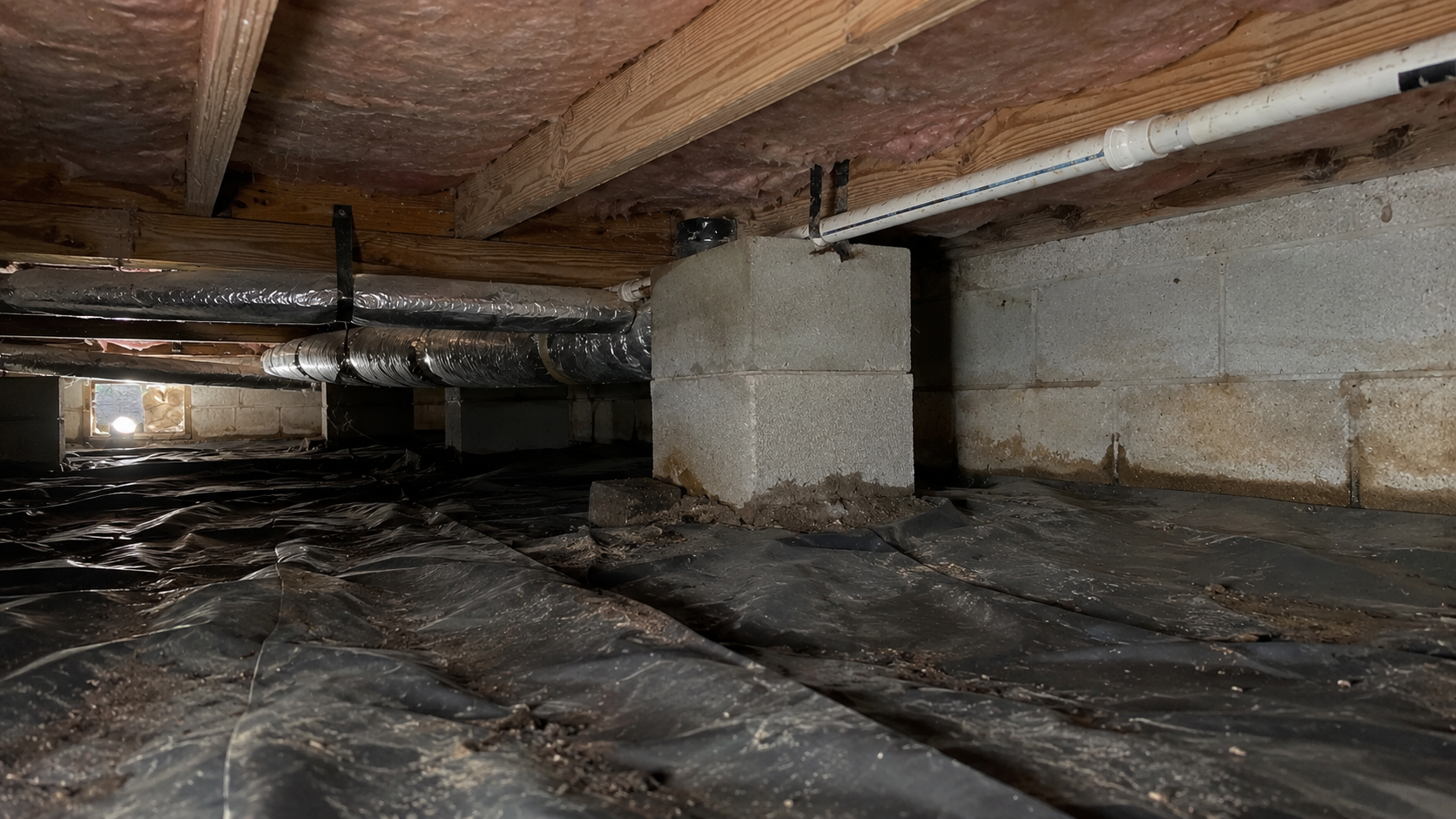
Image by ArchitectureCourses.org. Tight clearance, ducts, and low framing already make crawl-space work harder. A too-small interior hatch only adds another bottleneck before the real work even starts.
Structure is where some of these ideas die
This page is not a framing guide, but it still needs to say this plainly: the floor above the crawl is doing real work.
You do not just cut wherever the room layout feels convenient.
Joists, bearing lines, utilities, finished flooring, and room use all push back on hatch location. Some “perfect” hatch spots disappear the minute the floor framing gets looked at honestly. That is normal. It is better to lose a convenient sketch than to carve up the wrong part of the floor.
If the only interior location that works well for the room cuts across a bad structural or mechanical spot, it is probably not the right location.
Noise and smell are part of the decision
People focus on access. They should. But comfort matters too.
An interior hatch changes how the room above feels if it leaks air, creaks, carries smell, or always reminds people there is a crawl space under their feet. That is why utility rooms and closets handle these hatches better. The tolerance for awkwardness is higher there.
In a cleaner dry crawl with a well-built hatch, those problems can stay minor. In a damp crawl with a loose lid, they stop being minor quickly.
What people get wrong first
- adding interior access above a crawl that still has moisture or smell problems
- putting the hatch in the wrong room
- making the opening too small to solve the real access problem
- treating the lid like a cover instead of part of the floor
- ignoring framing and utility conflicts until too late
The expensive mistake is building a neat interior hatch over a crawl that still behaves badly or over a floor location that never wanted it there.
What I would check before choosing inside access
- whether the crawl is dry enough and controlled enough to justify an interior opening
- whether the exterior access is truly beyond fixing or just inconvenient
- whether there is a low-stakes room that can absorb the hatch well
- whether the opening size will be honestly useful
- whether the floor framing and utilities can accept the location cleanly
If those answers are still weak, the hatch idea is early.
Read this next
If the bigger issue is that the exterior access door is bad, start with crawl space door and replacing a crawl-space door.
If the crawl still feels damp or stale, go first to crawl space humidity and water in a crawl space after rain.
If the real need is more regular inspection, use crawl-space inspection.
FAQ
Is crawl-space access from inside the house a good idea?
Sometimes. It works best when the crawl is dry enough, the hatch lands in the right room, and you actually need easier access often enough to justify it.
Where should an interior crawl-space hatch go?
Usually in a utility room, laundry, mudroom, or secondary closet rather than a main living area or bedroom.
Can an interior crawl-space hatch let smells into the house?
Yes. If the crawl is damp, moldy, or badly sealed, the hatch can become an easy smell and air-leak path.
Should an interior crawl-space hatch be insulated?
Yes. If it sits in the floor plane, it should behave more like floor than loose cover.
When is exterior access still the better move?
When the crawl is still dirty or damp, when good exterior access can still be built cleanly, or when the only interior hatch locations would land in bad rooms or bad floor framing spots.