
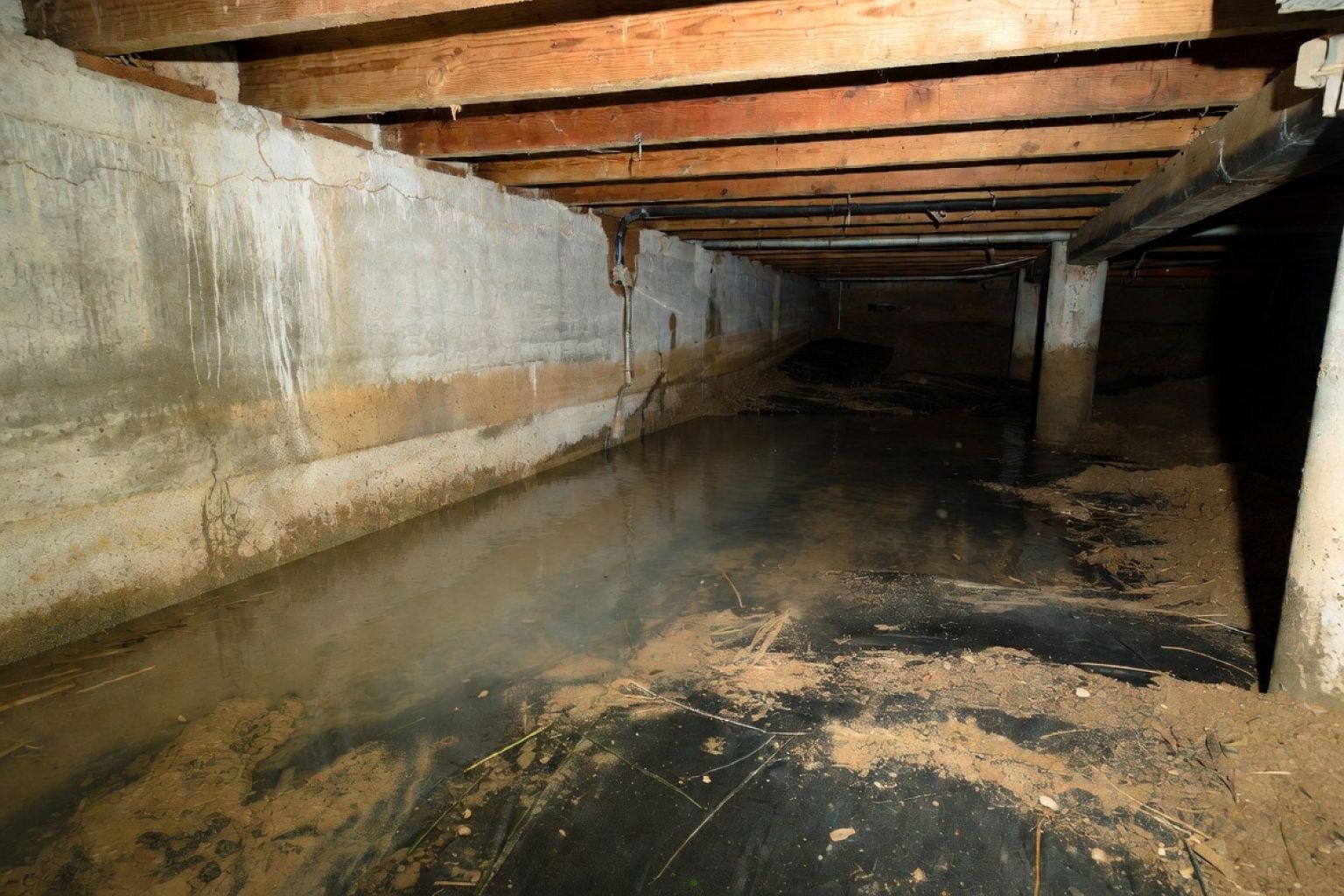


Water in a crawl space after rain is a drainage problem until proven otherwise.
The crawl space is where the water shows up. It is not always where the problem starts. Roof runoff, bad grading, rising groundwater, failed drainage, or a leak can all put water under the house, but they do not get fixed the same way.
That is why the first move is not a dehumidifier, a sump pump, or a new liner. It is figuring out the water path. A downspout dumping beside the foundation needs a different fix than groundwater pushing up from below.
Start there: when water after rain is a real problem, how to narrow down the source fast, what to fix outside first, and when drainage, a sump pump, a vapor barrier, or full encapsulation actually make sense.
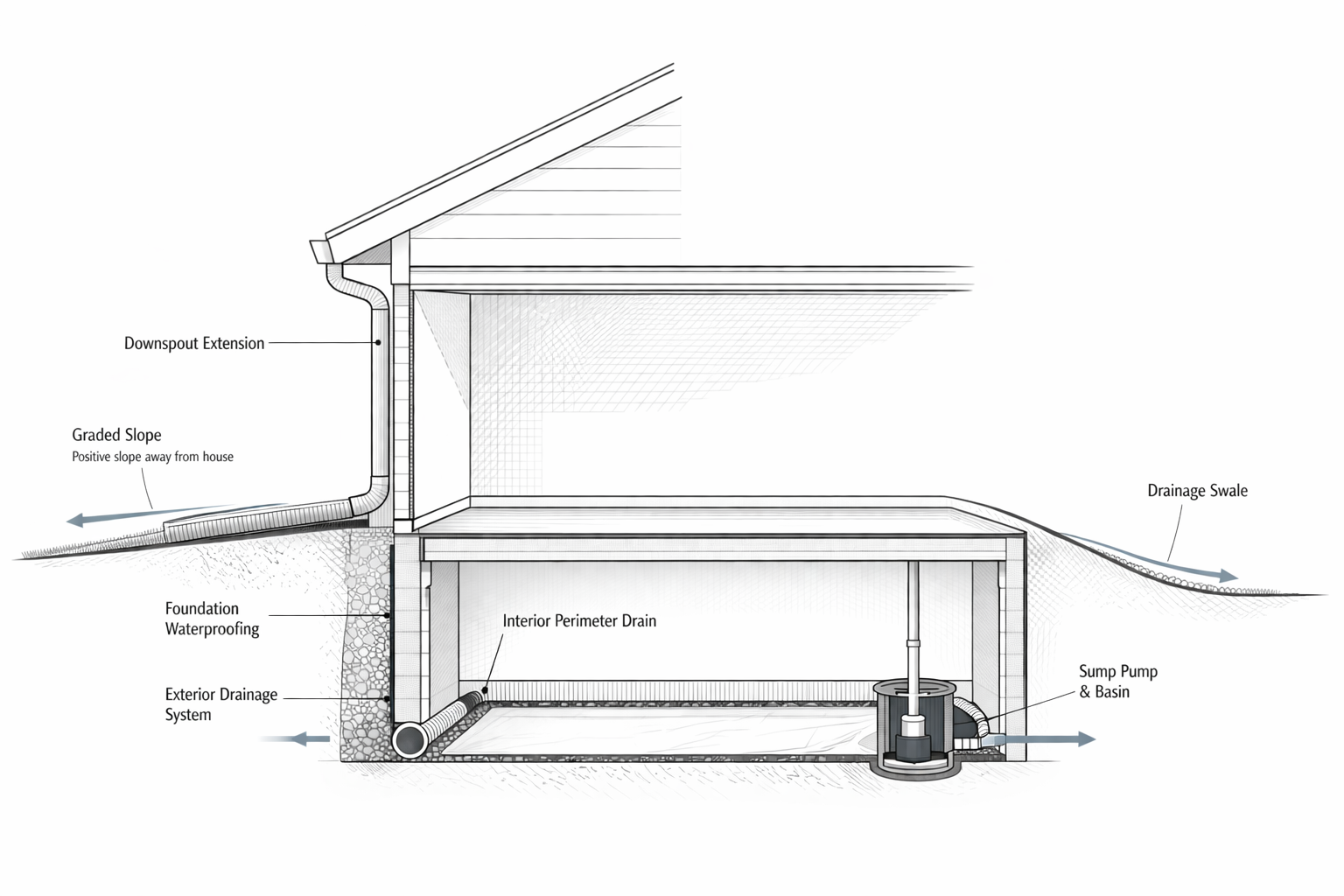
Image by ArchitectureCourses.org. Water escaping from the crawl space through a foundation opening, a sign of severe accumulation below the house.
Water After Rain Means Something Is Failing
A crawl space should be dry, or controlled enough that water does not collect and sit there after ordinary rain. If you are seeing puddles, muddy soil, wet piers, sagging insulation, darkened joists, or plastic with water trapped above or below it after storms, the water-management system is not doing its job.
Some homes stay dry for months and then suddenly show trouble after one hard storm. That does not make it harmless. It often means the house was close to failure for a while and one heavy rain finally pushed it far enough to show up under the floor.
The bigger issue is not just the puddle you can see today. It is what repeated wetting does over time: mold, wood decay, damaged insulation, pest pressure, rusted fasteners, musty air moving into the house, and in worse cases, structural repair.
Start With Three Questions
Before you start buying anything, sort the problem into one of these buckets.
1. Does the water show up only after rain?
If yes, the first suspects are roof runoff, bad grading, clogged or short downspouts, surface water flowing toward the house, or groundwater building up around the foundation.
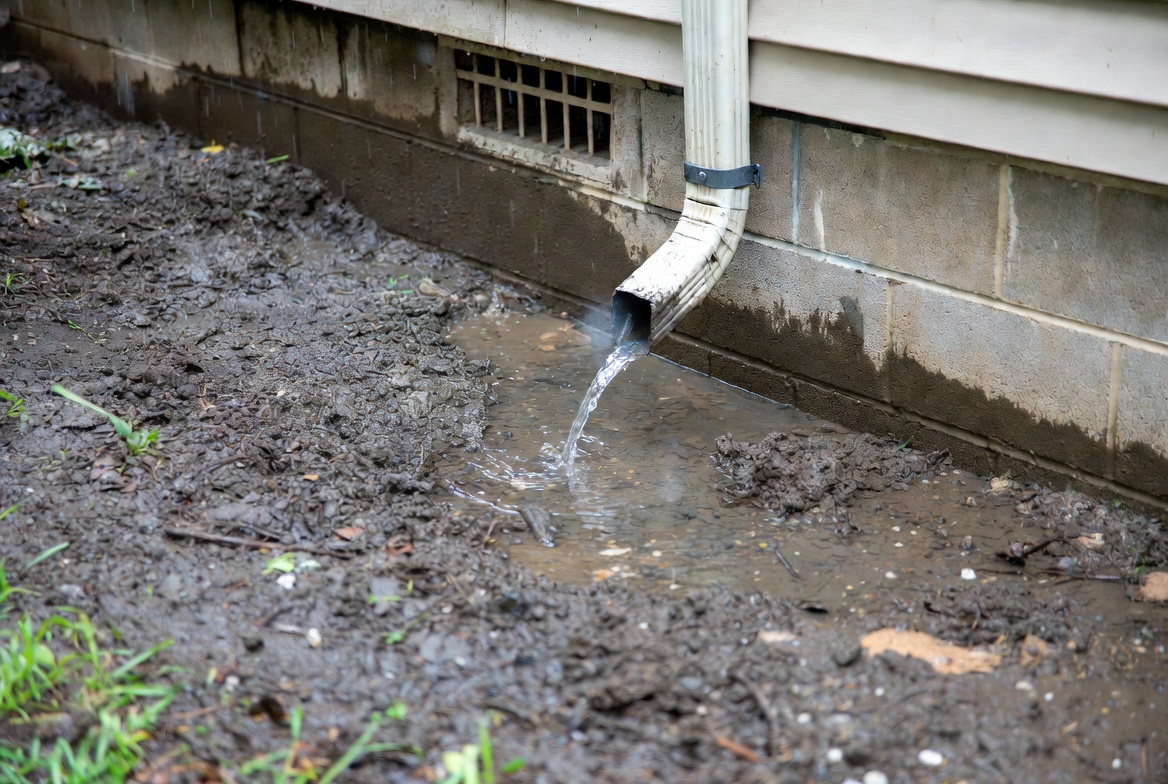
Image by ArchitectureCourses.org. Roof runoff dumping beside a crawl vent and foundation wall, one of the fastest ways to push water toward a crawl space after rain.
2. Is it in one area or everywhere?
One wet corner often points to a local entry problem. A single downspout. A low spot outside. A failed penetration. A broken line. Water across a broad area points more toward groundwater, widespread grading trouble, or a crawl space that never got proper drainage in the first place.
3. Is it liquid water, damp soil, or just high humidity?
These are different problems. Liquid water means bulk water is getting in. Damp soil without puddles may mean ground moisture and weak vapor control. High humidity without visible water can still be serious, but the solution path is different from a crawl space that floods after storms.
The Most Common Reasons Water Shows Up After Rain
Roof Runoff Is Dumping Too Close to the House
This is one of the most common and most fixable problems. Gutters overflow. Downspouts disconnect. Extensions are too short. Splash blocks shift. Buried leaders clog. The result is simple: a concentrated roof load lands beside the foundation every time it rains.
A lot of crawl-space water problems start here. Not because the crawl space is defective, but because the roof is feeding too much water to the same narrow strip of soil around the house.
If one section of crawl space is wet and it lines up with one overflowing gutter or one downspout exit, take that seriously. It is often the cheapest real fix on the whole project.
The Grade Slopes Toward the Foundation
If the soil around the house pitches inward, rainwater moves toward the wall instead of away from it. That sounds obvious, but it gets missed constantly. Mulch builds up. Beds get overfilled. Backfill settles. Hardscape traps runoff. The ground starts acting like a shallow funnel aimed at the crawl space.
This is why exterior correction usually comes before interior products. If the site is feeding water toward the foundation, the crawl space stays in defense mode forever.
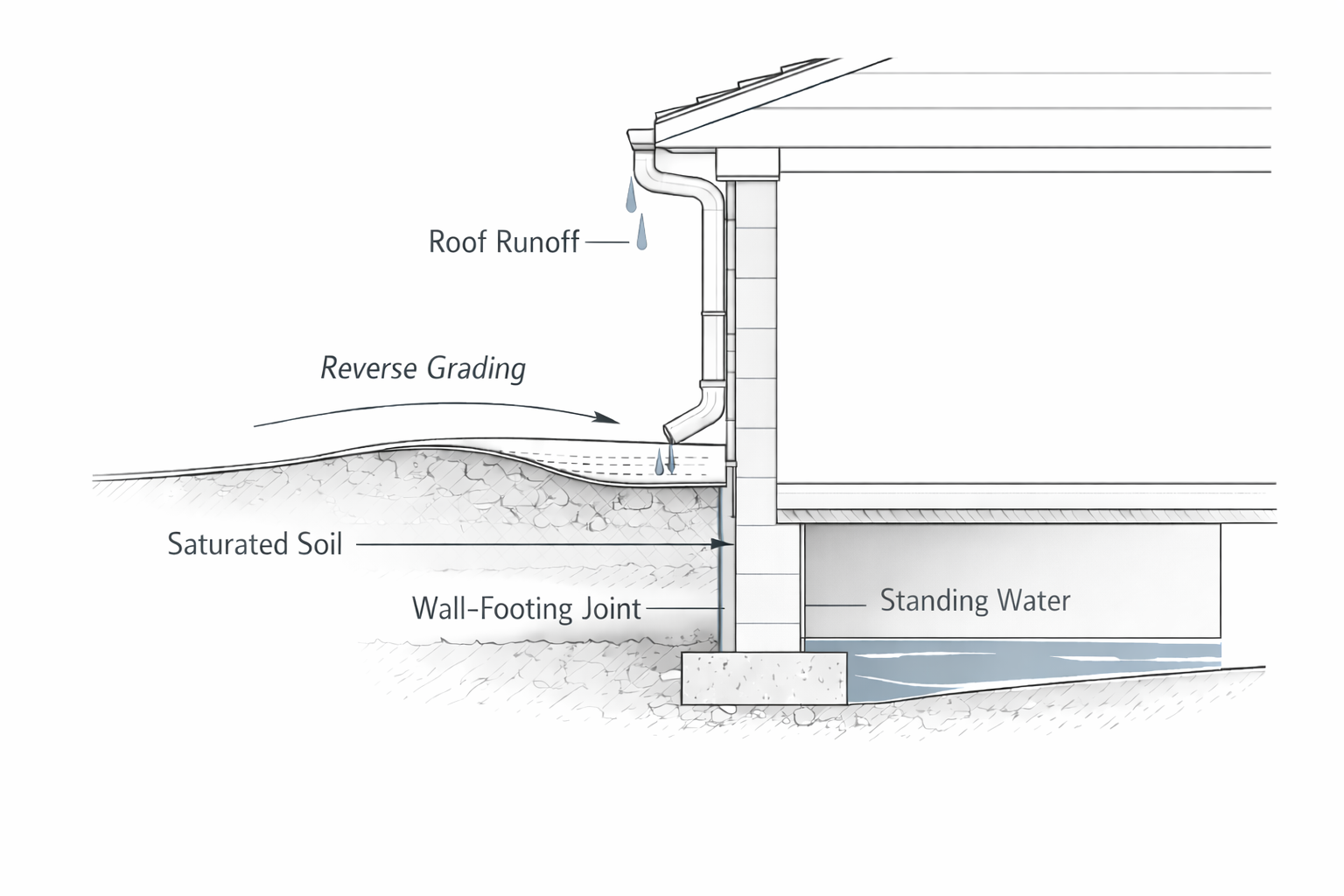
Illustration by ArchitectureCourses.org. Reverse grading and roof runoff near the foundation can drive water to the wall-footing joint and into the crawl space.
Groundwater Is Building Up Around or Under the Crawl Space
This is the harder one. Sometimes the water is not pouring in from the surface. It is rising from below or building up against the foundation during wet periods. That can happen on sloped sites, clay soils, low lots, homes cut into a hill, or crawl spaces where the floor sits below surrounding grade.
In those cases, a vapor barrier alone will not solve it. The problem is bulk water and pressure. That is where perimeter drainage, discharge routing, and sometimes a sump pump enter the picture.
The Drainage System Is Missing, Failing, or Too Small
Some houses simply never had real crawl-space drainage. Others had footing drains or interior drains that silted up, collapsed, or were never connected to a working outlet. Water builds up until it finds the easiest place to go.
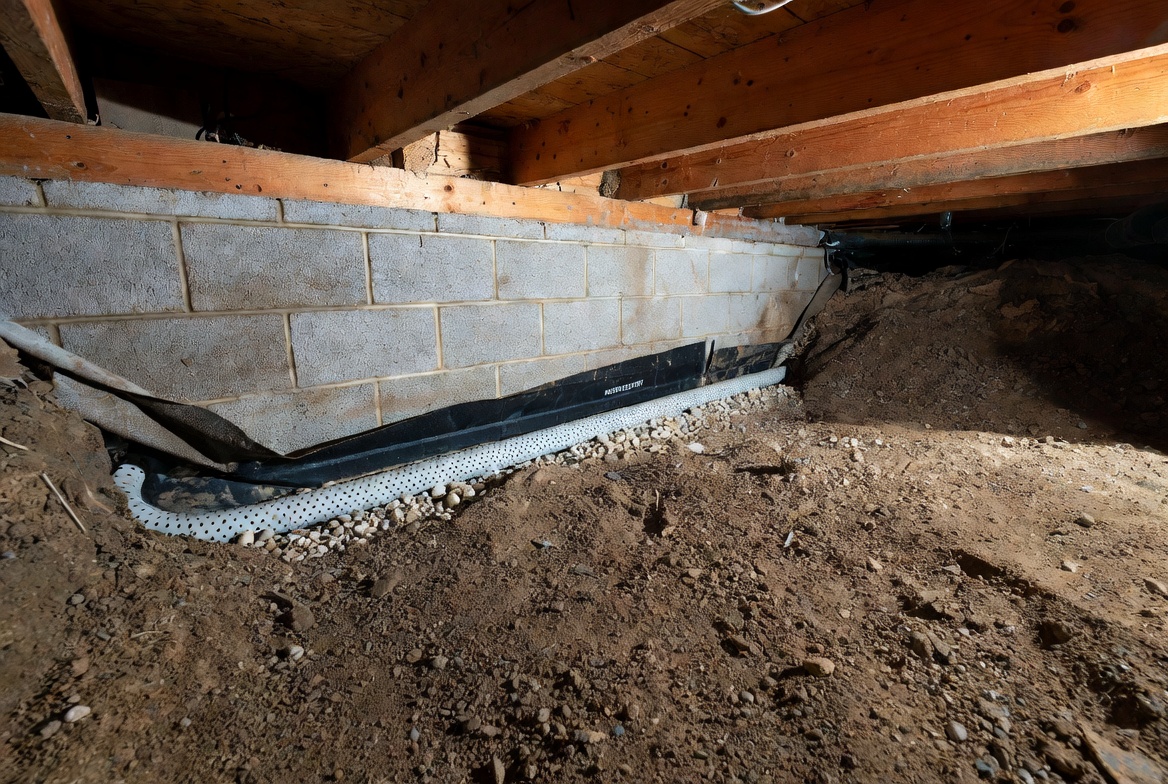
Image by ArchitectureCourses.org. Interior crawl-space drainage system with wall liner, gravel, and perforated pipe installed at the base of the foundation wall.
If you already have a drain system or sump and the crawl space still floods after storms, do not assume the concept failed. The system may be clogged, disconnected, badly sloped, too small, or discharging too close to the house.
That kind of repeated storm-water entry points to a drainage problem, not a vapor-control problem. The next step there is crawl space drainage system.
A Plumbing Leak Is Being Blamed on Rain
This happens more than people think. The crawl space gets checked only after storms, so the timing points everyone toward weather. But the real issue is a drain leak, supply leak, water-treatment line, condensate line, or HVAC moisture problem that was there already.
If one area stays wet long after the rest dries, or if the wettest spot lines up with plumbing or equipment, do not assume rain is the only cause. A storm can reveal a leak without being the main source.
The Crawl Space Has Ground Moisture but No Real Ground Cover
If the problem is damp soil, sweating ducts, and elevated humidity more than actual puddles, a missing or badly installed ground cover may be a big part of it. A proper liner can cut vapor coming off the earth. But that comes after bulk water is handled. It is not the first move if storm water is actively entering.
If the space is staying damp rather than actually flooding, crawl space vapor barriers is usually the next decision point.
What You See vs What It Usually Means
| What You See | Most Likely Cause | What To Check First | Best Fix Direction |
|---|---|---|---|
| Water near one wall or one corner after storms | Downspout, grade, local surface runoff, low penetration | Gutter overflow, short downspout, low exterior grade, splash marks | Fix runoff and grading before interior products |
| Water across a broad area | Groundwater or failed drainage | Lot drainage, hill runoff, existing drain or sump condition | Perimeter drainage, discharge, possible sump |
| Muddy soil but no standing water | Ground moisture plus poor drainage or no liner | Ground cover condition, exterior water load, humidity readings | Bulk water first, then sealed liner or encapsulation |
| One isolated wet patch that lingers | Plumbing leak or condensate issue | Pipes, traps, HVAC lines, drain routing | Repair leak first |
| Wet insulation and musty smell | Long-term moisture, repeated wetting, air movement into house | Humidity, liner condition, insulation condition, mold signs | Dry-out, removal of damaged materials, moisture correction |
| Water trapped on top of plastic | Bulk water entry after liner installation | Where water is entering, seams, wall terminations, grade outside | Stop entry source; do not blame the plastic first |
What To Check First Today
Look Outside Before You Spend Time Under the House
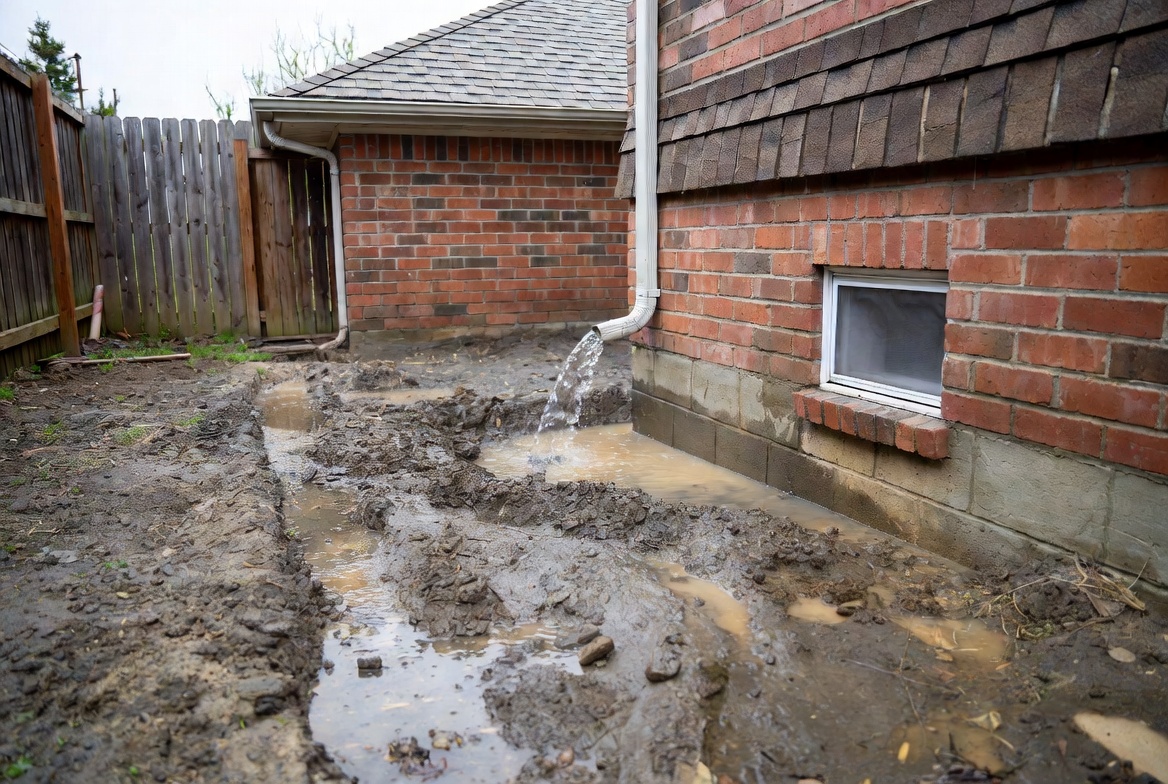
Image by ArchitectureCourses.org. Roof runoff dumping beside the foundation and pooling near the wall, a common reason crawl spaces get wet after rain.
A lot of people crawl under the floor first because that is where the symptom is. Start outside instead.
- Walk the house during or right after rain if you can.
- Check every gutter for overflow.
- Check every downspout connection and extension.
- Look for water dumping right beside the foundation.
- Look for mulch beds, edging, patios, or sidewalks that trap water against the wall.
- Look for low spots where the soil has settled.
- Check whether one side of the house collects most of the roof water.
This is often where the answer is sitting in plain sight.
Then Get Under the House and Map the Pattern
Do not just note that it is wet. Map it.
- Where is the deepest water?
- Is it near an access door, vent, penetration, or wall seam?
- Is it one corner or the whole perimeter?
- Are joists above that area darker or stained?
- Is insulation hanging or matted down?
- Is the liner torn, loose, or covered by water?
- Do you hear dripping from plumbing or condensate lines?
If the space has several problems at once, it helps to work through it like an inspection instead of chasing one symptom at a time. That is where crawl space inspection fits.
Check Plumbing and Condensate Before You Blame the Ground
Especially if the water pattern is narrow, localized, or still active days after the storm.
- Look around drain lines and traps.
- Check supply lines and shutoffs.
- Follow any HVAC condensate drain all the way to discharge.
- Look around water heaters, air handlers, and softener equipment if present.
Rain timing can make a plumbing leak easier to miss. Do not let it.
Fixes in the Right Order
1. Keep Roof Water Away From the Foundation
This is the first thing because it is cheap compared to almost everything else and it removes a large water source fast.
- Clean clogged gutters.
- Reconnect loose downspouts.
- Extend discharge well away from the house.
- Repair buried leaders that back up.
- Do not let roof runoff dump into a mulch bed hugging the wall.
If this step gets skipped, the rest of the fix often ends up fighting more water than it should.
2. Regrade Low Areas and Correct Surface Drainage
If the lot or planting beds slope toward the house, change that. This is not glamorous work, but it is often the job that decides whether the crawl space ever dries out for good.
Sometimes the fix is simple. Soil added and shaped correctly. A swale. A better outlet for runoff. A hardscape edge adjusted so water is not trapped against the wall.
Sometimes it is not simple. Tight lots, neighboring runoff, or a house cut into a slope can push you toward a more formal drainage solution. But surface drainage still comes first.
3. Solve Groundwater With Drainage, Not Hope
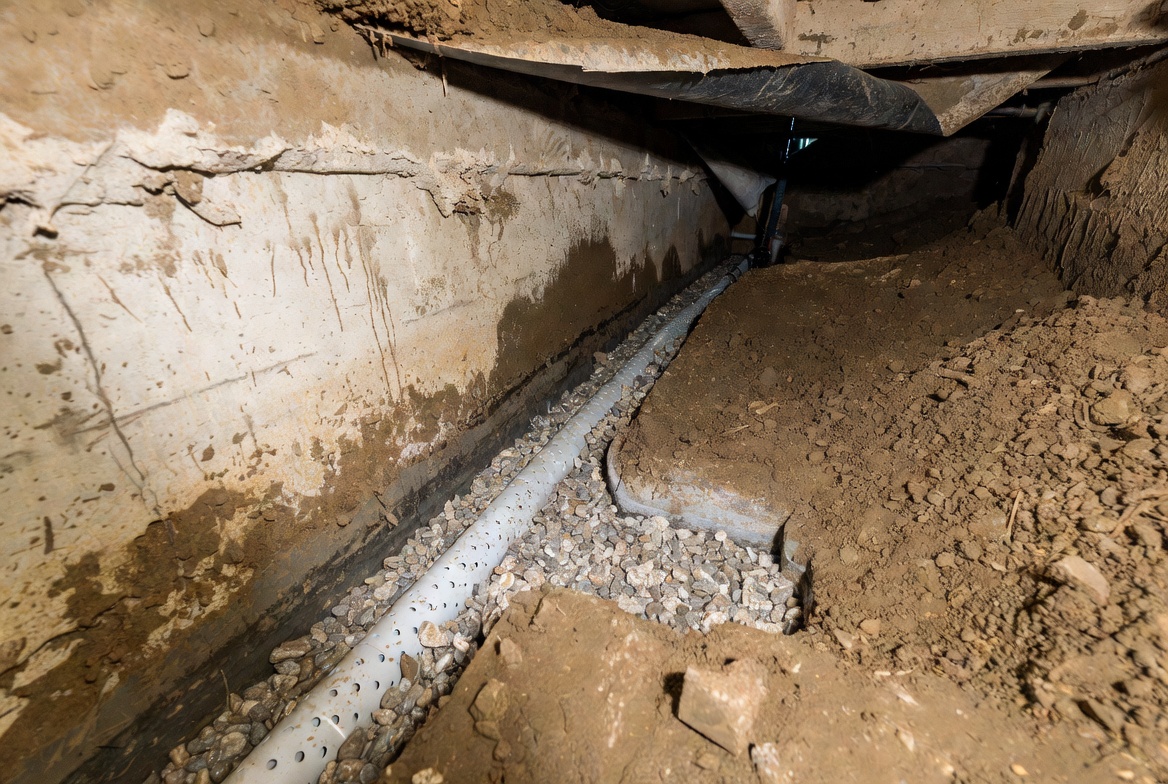
If the crawl space is collecting water from below grade or around the perimeter, you need a path to relieve that water. This is where people waste money trying to seal a problem that really needs drainage.
That may mean footing drains, an interior perimeter drain, a sump basin, or discharge improvements. The exact system depends on the house and site. But the principle is the same: stop water from building up against or under the crawl space.
If groundwater is part of the problem, the next useful move is crawl space drainage system and, where a basin and pump are part of the fix, cost to install a sump pump in a crawl space.
4. Fix Leaks Under the House
If plumbing or condensate is adding to the wetting, repair it before you start drying and sealing everything else. Otherwise you trap the same problem inside a cleaner-looking crawl space.
This includes small leaks. A slow drip over months is enough to keep one area chronically wet, damage insulation, and keep the smell problem alive.
5. Remove Water, Dry the Area, and Strip Out Ruined Materials
Once the source is controlled, get the water out. Small amounts may be vacuumed or pumped depending on conditions. Wet debris, cardboard, loose scraps, and anything holding water should leave the space.
Damaged fiberglass insulation often has to go. Moldy scraps and soggy organic debris are not helping anything. If there is obvious contamination, sewage involvement, or heavy mold, the cleanup bar rises fast.
If the crawl space has already moved into odor, staining, or visible growth, crawl space mold remediation is the next part of the job.
6. Then Decide Between a Vapor Barrier, Encapsulation, or Both
This part only works after bulk water is under control.
If the crawl space mainly has ground moisture and humidity, a properly installed liner may be enough. If the space is moving toward a closed, controlled assembly with sealed vents, wall insulation, and dehumidification, that is a bigger encapsulation decision.
Do not reverse the order. Encapsulating a crawl space that still takes on storm water is how people end up staring at trapped water, failed seams, and expensive frustration.
- crawl space vapor barriers
- crawl space vapor barrier installation
- crawl space encapsulation
- encapsulation vs vapor barrier only
7. Use a Dehumidifier for Drying and Control, Not as the First Structural Fix
A dehumidifier helps control humidity after water sources are corrected. It does not replace site drainage. It does not replace downspout fixes. It does not replace a sump if groundwater is entering. It does not stop liquid water from crossing the crawl-space floor.
People often jump here because it feels like progress. Sometimes it is. Often it is just expensive delay.
When the crawl space is ready for humidity control, the next decisions are crawl space dehumidifier installation and what size crawl space dehumidifier do you need.
What Not To Do
Do Not Start With Interior Moisture Products if Roof Water Is Dumping at the Wall
Fix the cheap outside failure first.
Do Not Assume Plastic on the Ground Solves Standing Water
A liner helps with vapor. It does not stop liquid water moving in from outside or below.
Do Not Ignore One Small Wet Spot That Keeps Coming Back
Recurring wetting is the issue, not whether the puddle looks dramatic today.
Do Not Leave Soaked Insulation in Place
It sags, holds moisture, loses performance, and becomes part of the odor and mold problem.
Do Not Use a Dehumidifier as a Substitute for Drainage
If the crawl space floods after storms, humidity control comes after the real fix, not before it.
When You Need Help Fast
Move quicker than normal if any of these are true:
- Water depth is more than a light film or shallow puddle.
- The problem returns after every major rain.
- You see mold growth or a strong musty odor.
- Insulation is soaked or falling down.
- Wood framing looks dark, soft, or deteriorated.
- The crawl space has electrical hazards, sewage, or contaminated water.
- Floors above feel bouncy, uneven, or newly sagged.
- There is already a sump or drain system that appears to be failing.
If structural symptoms are already part of the picture, that is when crawl space foundation repair becomes the right next stop.
If There Is Already Plastic on the Ground and You Still Have Water
This is where people get confused.
If water is above the plastic, liquid water is entering after the liner was installed. The liner is not the source. It is just showing you the problem more clearly.
If water is below the plastic, the ground may still be wetting from below or around the edges, especially if seams, overlaps, or wall terminations were never sealed well. That can still matter, but it is different from storm water running across the top of the liner.
Either way, the first question is still the same: where is the water coming from? Roof runoff. Grade. Groundwater. Drains. Leak. Then the fix follows.
If It Is Only Damp Soil, Not Standing Water
That is a different page shape and a different repair path.
Damp soil with high humidity, sweating ducts, and musty air often points more toward vapor control and crawl-space conditioning than emergency drainage. It still matters. It just means you may be closer to a liner, sealed vents, and humidity control than to pumps and drains.
The Order That Usually Fixes It
The most reliable sequence is boring, and that is why it works.
- Reduce roof runoff hitting the foundation.
- Correct grading and exterior drainage.
- Check for plumbing or condensate leaks.
- Add or repair drainage and sump components if groundwater is involved.
- Remove standing water and dry the crawl space.
- Strip out damaged insulation and contaminated debris.
- Then install or upgrade the moisture-control layer that fits the now-drier space.
Most bad outcomes come from reversing that order.
What To Do Next
If you now know the problem is repeated storm entry and groundwater, go to crawl space drainage system.
If you have stopped the water and need to decide between a ground liner and a full closed system, read crawl space encapsulation vs vapor barrier only.
If the crawl space is wet, smells bad, and you suspect growth on framing or insulation, move next to crawl space mold remediation.
FAQ
Is it normal to have water in a crawl space after heavy rain?
No. A crawl space may see humidity swings or occasional damp conditions, but recurring standing water after rain means the water-management system is not doing its job.
Can a dehumidifier fix water in a crawl space after rain?
Not by itself. A dehumidifier helps with humidity after the source is controlled. It does not stop runoff, groundwater, or active water entry.
Will a vapor barrier stop a crawl space from flooding?
No. A vapor barrier helps control moisture coming off the soil. It does not stop bulk storm water from entering the space.
What is the most common cause of water under a house after rain?
Short or failing downspouts, bad grading, and poor drainage are common first causes. Plumbing leaks also get mistaken for rain problems more than people expect.
Do I need a sump pump if my crawl space gets water after storms?
Maybe, but not automatically. If groundwater or perimeter water is the issue, a sump may be part of the answer. If roof runoff is dumping at the wall, fix that first.
How fast do I need to dry the crawl space?
Fast. The longer wet materials sit, the more likely you are to end up with odor, mold, and damaged insulation or framing.
Should I remove wet crawl-space insulation?
If it is soaked, sagging, moldy, or staying damp, yes, it often needs to come out. Wet insulation usually does not recover into something worth keeping.
When should I worry about structure?
If water keeps returning, floors feel softer or uneven, joists are dark or decayed, or support elements look compromised, stop treating it like a small moisture annoyance. That has moved into repair territory.